Another primary and another landslide for Donald Trump.
Tuesday’s Michigan primary gave him yet another decisive win against Nikki Haley. With 18% of the precincts reporting, Trump is at 65.6% and Haley is at 30% The results will change as the vote continues, but AP has called the race for Trump.
Michigan Republicans have 55 delegates to the national convention. Some will be awarded through Tuesday’s primary, while others will be at the party convention, which is Saturday.
In the Democrat primary, with 15% reporting, Biden won with 116,778 votes, or 79.5%. Some Democrats didn’t vote for Biden because Michigan is a state with many Muslims, most of whom do not support the U.S. policy for Israel. There was a Muslim movement to vote for “Uncommitted.” They account for more than 15% of Democrat primary voters in Michigan.
Striking is that Trump, even though he had competitors on the ticket, appears to have received more votes than Biden, who was only running against “Uncommitted,” Marianne Williamson (withdrawn), and Dean Phillips.
In the Republican primary with 18% reporting:
Trump: 128,700 votes
Haley: 59,012 votes
Uncommitted: 4,208 votes
Other Republican candidates received a smattering of votes, even though they had dropped out. For instance, Ron DeSantis received 2,103 votes.
In the Democrat primary, with 16% reporting:
Biden: 116,778 votes
Uncommitted: 22,177 votes
These numbers will be updated as results continue to come in.
Republican primary update: With 99% reporting, Trump has 68.2% and Haley has 26.5%.
Democrat update: Biden has 81.1% and Uncommitted has 13.3%. Marianne Williamson has 3%, Dean Phillips 2.7%.
With thousands of names to spare, Alaskans for Honest Elections has won the right to have its repeal of ranked-choice voting on the ballot this year.
The Division of Elections has certified 36,841 signatures, and those came from every House district but six, easily making the needed threshold for statewide support. The group needed to have 26,705 registered voters to sign the petition, which was handed into the Division of Elections in January.
With dark money from outside the state, ranked-choice voting was presented to Alaska as a way to clean up elections. Instead, it has only made them more muddy and less trusted, critics say.
Proponents of ranked-choice voting kept their organization alive to fight any attempts to repeal it. Alaskans for Better Elections will have massive amounts of dark money at their disposal to persuade voters to keep the system, in which there are no separate party primaries, and where general elections are done by ranking who voters prefer, followed by their second choice and third choice.
Whether the question goes on the August primary or the November general election is determined by when the Legislature adjourns.
In Alaska’s legislative budgeting cycle, nothing is final until the last gavel slams down, and the bill goes into law — or not.
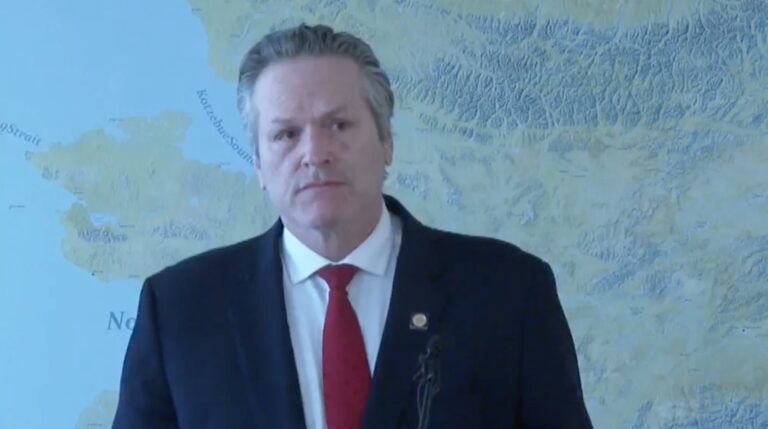
The controversial Senate Bill 140, passed by the House and concurred with by the Senate, was rejected by Gov. Mike Dunleavy on Tuesday, and that means the Alaska Legislature must either come up with a better bill, or the governor will veto SB 140. The Legislature has 14 days to send him a new, improved bill — one that has at least some of his priorities — or he said he will veto this one.
He wasn’t bluffing. A headcount shows that he has the votes to sustain a veto. The Legislature would need 40 votes, and is short at least three to override his promised veto.
There are other bills can serve as vehicles for some of the good measures that were in SB 140, Dunleavy said today.
Speaking of slamming, Dunleavy lit into the NEA teachers’ union for killing the teacher incentive bonuses he had wanted in the bill. He criticized the educational establishment for not supporting the great outcomes now being proven in charter schools, another aspect that was axed by the final bill version.
Dunleavy said the section of the bill that was to help improve reading was wholly inadequate, since reading scores in Alaska schools are at crisis levels. Alaska ranks 49th in education, and Dunleavy was hoping for major education reforms in the bill that went sideways before it got to his desk.
Dunleavy spent much time at the podium reading parts of an Anchorage Daily News editorial that supports his approach to education funding and reform.
After holding forth for nearly an hour in his Anchorage conference room, Dunleavy said that he appreciated the House and Senate for working on education so early, but that they send hm a three-legged horse that is “not going to run very far.”
While the governor did not actually put the veto pen to the bill on Tuesday, he made it clear he will do so, rather than let it go into law. If the education establishement wants an increase to the basic funding formula, he said, they are going to have to “help get these items across the finish line.”
He thanked the House for putting together the omnibus bill.
“I understand why the House voted to pass this bill out, because many believed it was the best thing they could get. I get that,” he said.
The final bill version voted on had been negotiated by Rep. Jesse Sumner of Wasilla in secret meetings with the Senate and Democrats, and sprung on the unsuspecting House majority.
Alaska Democratic Party took credit for the bill passing with a large increase to the Base Student Allocation. Posting on X/Twitter, the party wrote: “This major victory would not have been possible without the unwavering and unequivocal support of Democratic elected officials. Republicans in the Alaska State House fought us every step of the way until they saw it as a political win – but we never stopped fighting.” They didn’t mention Rep. Sumner’s work or give him credit.
However, it was the Republicans in the House that voted for the BSA increase of $680 per student, with the exception of two legislators, who balked at the flawed bill — Rep. David Eastman and Rep. Mike Prax.
Dunleavy said, “The bill is incomplete. Why not fix it? I think there were a number of legislators who thought this was the best they were going to get. I don’t think so.” He suggested his office and legislators work together and get a much better bill, and that there are two weeks to do so.
During questions from reporters, Dunleavy said, “There’s going to be a substantial BSA, there just is,” signaling that he is willing to add to the basic formula for spending, but he also is demanding the support for reading programs, charter school options, and teacher incentive pay.
Adam Trombley, who served on the Anchorage Assembly and also as a chief of staff in the Anchorage mayor’s office, has been named the incoming state director for Sen. Dan Sullivan. He will take over for Chad Padgett, who announced his departure last month.
Trombley served as an Anchorage assemblyman from 2011 to 2014 for East Anchorage. He moved to the Sand Lake neighborhood and later ran again for Assembly, but this time didn’t win. Later, he served as director of economic development, real estate director, and building official in the Bronson Administration, and then as chief of staff, before returning to the private sector in April, 2023.
Until just recently, he has worked as a senior network planner for Alaska Communications Systems. A 1998 graduate of East Anchorage High School, he graduated from Lewis and Clark State College in Lewiston, Idaho.
Starting March 11, Trombley will be Sullivan’s point person in Alaska. He will coordinate the senator’s in-state schedule, and travel with the senator across the state. He will keep the D.C. office apprised of significant occurrences in Alaska and will be the first person many Alaskans will reach out to. A state director has several key roles, according to the description at the U.S. Senate, including:
Representing the senator in all areas of the state, including meeting and maintaining professional relationships with federal, state, and local elected officials and agencies; staff from congressional delegation offices; community business leaders; and constituents.
Directing state office staff including supervision, assignments, and workflow; implementing office policies and procedures for state office operations; including recruiting, hiring, and training new employees; scheduling and chairing state office staff meetings.
Accompanying the senator on visits throughout the state; occasionally giving speeches, remarks, or awards at events in-state when the senator cannot be present.
Performing other special projects assigned by Sen. Sullivan.
Padgett, who has served as state director for three years, is moving to a job at Arctic Slope Regional Corporation, an Alaska Native corporation.
Sen. Dan Sullivan is now in his 10th year serving Alaska in Washington, D.C. Before running for office in 2014, he was the Commissioner of the Alaska Department of Natural Resources and also had served as Attorney General for Alaska.
Last month, the state director for Sen. Lisa Murkowski also announced he was leaving. Steve Wackowski is headed for a job at Santos, Ltd., an Australian-based oil company doing business in Alaska.
As we close out Black History Month, I was reflecting on how America’s black history is present in many aspects of our lives, even in areas we don’t typically associate with it. One such place is in the National Basketball Association.
On a recent episode of STAND with Kelly & Niki Tshibaka, Pete Babcock, the former general manager for the NBA’s Denver Nuggets, Atlanta Hawks, and San Diego Clippers, explained how the history of the NBA is extremely important to the league.
“I was always interested in…how the league went from being an all-white league to now a predominant African-American league,” Babcock said, “…and how the civil rights movement benefited from the National Basketball Association, and the game of basketball benefited from the civil rights movement. There’s so much overlap between the two.”
Although the civil rights movement is likely the furthest thing from one’s mind when watching NBA basketball games, the two are inextricably linked together. Each impacted the other in critical ways, and the lasting mutual effect the civil rights movement and the NBA have had can still be observed in the league today.
Babcock managed NBA teams during the NBA’s process of desegregation and retold the story of the NBA’s sometimes-painful journey on the show. In fact, Babcock pointed out that the desegregation of the NBA has had lasting positive effects on the players.
A critical aspect of the civil rights movement was breaking the false image of the “uneducated vagabond” that was so strongly perpetuated against the black community. With the emergence of leaders like Martin Luther King Jr., Malcolm X, and Booker T. Washington, this stereotype was shattered. It is here we can see one of the subtler parallels between the NBA and the civil rights movement.
Babcock explained that the NBA works to not only train the players physically, but also to improve them as people as well, stating, “the total human being is more important than just the plain skill of the player.”
Thus, the emphasis on character that was encouraged by leaders of the civil rights movement has lasted past the civil rights movement and is still seen in the attitude of NBA players, managers, and coaches today.
Perhaps just as important as his emphasis on the civil rights movement, Babcock also discussed how an accurate history is critical to the foundation of the NBA. He spoke at length about Black History 365 (BH365), a comprehensive history curriculum that he contributed to with Dr. Joel Freeman.
Founded and created by Drs. Joel Freeman and Walter Miltion Jr., BH365 was created with collaboration and input from a diverse and broad spectrum of voices, including Dr. Alveda King, Andrew Young, Smokey Robinson, NBA leaders, and many more. BH365 is a curriculum that teaches black history in full.
Unlike other curriculums that push critical race theory and encourage African Americans to embrace a victim mentality, BH365 is a truth-centric and inclusive account of black history.
Dr. Freeman discussed the importance of emphasizing the creativity and genius of Ancient Africa before diving into the darker side of black history. “We talk about the slave rebellions, because we wanted to show that hardly anyone was docile. There were a lot of passive aggressive ways of fighting against this [slavery].”
This Black History Month is a time to reflect on the lasting impact the civil rights movement has had on hearts, minds, and character. This impact has notably given us the strong players we can see in the NBA today. It’s also a time to underscore the importance of having a comprehensive view of history, for if we forget what we have learned, we are surely doomed to repeat it.
If you’d like to hear more about how the civil rights movement has given us the NBA we know today, or learn more about BH365, you won’t want to miss Pete Babcock and Dr. Joel Freeman’s interview on STAND. You can also view the episode on YouTube, Rumble, and your podcast streaming platform.
Kelly Tshibaka is the host of the podcast, TV, and radio show STAND, and the 2022 Alaska Republican candidate for U.S. Senate. She co-hosts the show with her husband, Niki Tshibaka.
Dennis Prager, conservative radio host, prolific author, and founder of Prager U, gave two public presentations in Fairbanks on Saturday, and he was blunt in his opinions on a wide range of topics, from the Israel-Hamas war to failure of American universities.
Prager’s appearances were sponsored by Alaska Family Council, the organization that hosted him in Anchorage two years ago. He had two motivations to return to our state: 1) See the northern lights, and 2) Help Alaska Family Council raise funds to continue supporting Faith-based principles in the public arena; the former being used as a lure to help with the latter.
The two events were sold out with over 200 people hearing Dennis speak during lunch, and a more intimate gathering of 52 showing up for dinner. (By the way, the dinner took place at the Fountainhead Antique Auto Museum, one of the premiere automobile displays in the country and a worthy destination if you’re looking for something really cool but rather unexpected for Alaska’s interior.)
Dennis Prager is known for his reasoned on-air discourse. Not all of us enjoy bombastic radio commentary, so Prager is a welcomed voice of calm. His explanation for asking tough questions of those who oppose him – and whom he encourages to call – is that he is seeking clarity. This is not just a tactic; it is his nature.
While sitting with a small group of Prager supporters at the Rat Pack Cigars shop on Friday night, Dennis led the conversation by asking questions. It was obvious that he was interested in learning why people live where it’s face-hurting cold and far removed from the rest of the population, so he asked straightforward questions in a search for knowledge and clarity.
That is how he handles matters on the radio, and it is how he likes others to treat him. Saturday’s Q&A sessions resulted in some pointed questions, including one about his Jewish faith, but he handled them well and without taking or offering offense.
It’s the type of straightforward yet unoffending talk most of us lack, and elected politicians tend to avoid.
Being an unabashedly observant Jew and defender of Israel, much of Prager’s talk focused on the Israel-Hamas war. Bottom line: the barbarity of the October 7th massacre requires a full scale, relentless response because to do anything less jeopardizes the very existence of the Jewish state. He pointed out the differences between the savagery of Hamas and the much-maligned response by the Israeli Defense Forces.
Hamas terrorists shouted “Allahu Akbar” (God Is Great) while raping Israeli women, and telephoned their parents to brag about the Jews they killed that day. The major difference, Prager argued, between Nazi Germany and Hamas is that Nazi Germany hid their crimes against Jews while Hamas openly celebrates them.
Prager also spent time discussing the deterioration of America’s institutions of higher education, calling them out for their near-universal support for all things leftist – not liberal, Prager likes to point out, but leftist. It’s the college educated, indoctrinated by professors enamored with Marxism but offended by all other things western, who buy into notions that white people are racist by nature and men can give birth. And that leads to one of his most telling statements . . .
If we hear a person say, “Men give birth,” we can be virtually certain that person also sides with Hamas. The two beliefs are equally absurd and have nothing whatsoever to do with each other, but are held by the same groups of people.
Prager is frustrated with the state of American society, and the world at large, but is able to smile and not let it get him down. And there’s a lesson there for many of us.
Dennis brought his wife and two stepsons with him but the Aurora Borealis didn’t cooperate, leaving them disappointed but with a desire to return in the future. That’s good news for Alaskans and Alaska Family Council.
Tim Barto is vice president of Alaska Family Council and a regular contributor to Must Read Alaska.
House Bill 368 was introduced on Feb. 20, and it looks like a Renewable Portfolio Standards bill with dates extended from earlier dates in previous RPS bills, requiring 35% “clean energy” by 2036 and 51% by 2051.
There are, however, some things to pay attention to in this bill.
There is requirement to begin reporting about the progress for “clean energy” beginning March 1, 2026. This Act takes effect July 1, 2024 and there are a number of requirements that are to be met soon.
The greatest failing of this bill is that there is no provision to control or limit the cost of energy that is added to the Railbelt. Cheap energy should be the goal. Rather than an RPS bill, it would be more profitable to all to have a bill that has the Railbelt utilities map out a plan that would be a guide for the future development. Without energy storage in the Railbelt, this clean energy bill is much less important than securing additional Cook Inlet natural gas.
This guide should investigate first the ability to add pumped hydro to the system as an energy storage mechanism, which would benefit the wind and solar energy sources to allow all excess energy generated to be stored. atteries would not be effective storage devices for Alaska, but are very effective for Kauai, Hawaii as the sun is there every day for about the same amount of time all year, and it will be warm enough for no one to be at risk to freeze if the power is interrupted.
Alaska is a different sort of place; a place in which people can suffer and die when the energy sources are not present when the days are dark and cold.
The next step would be to identify stable base energy sources such as hydroelectric dam, geothermal source or nuclear reactor which would be likely candidates to add to the system. Each of these energy sources must be estimated for size and for the timeline for when each can be brought on line and estimate the cost/kwh for each. These are all non-CO2 sources so should eliminate decarbonization discussions. In the course of this effort, the Railbelt utilities need to consider the amount of expansion to the energy sources that is required to accommodate whatever additional electrification will be needed.
Then the entire Railbelt needs to be evaluated for where the system needs to have microgrids formed to provide resilience to those portions of the Railbelt transmission and distribution which could be without power upon disruption of the transmission lines during earthquakes, fire, or wind and ice. Each of these microgrids would probably contain wind and/or solar sources supplemented by a battery energy storage system and then some base source of power such as a diesel generator, methanol fueled generator or maybe even a small geothermal generator. The identification of these microgrid locations would be sites made available for utilities or IPP to propose installation of necessary equipment some of which would be wind or solar (variable energy sources.)
At this stage, the Railbelt utilities will be able to work out what transmission line additions and changes are necessary to build out for the future system. To install the transmission lines to upgrade the system required by HB368 could well be a waste of time when a full understanding of where the energy sources will be installed is not yet known.
As we develop our long term energy plan, the first thing that is needed is to secure future Cook Inlet natural gas production and distribution. From comments I have read, those working on solutions to get more Cook Inlet natural gas is that the natural gas is subject to pricing as a commodity on the world market.
Some way to decouple Cook Inlet natural gas from the commodity market and ensure future price to the Railbelt utilities through contracts, using reduced royalties, streamlined permitting and favorable taxation to bring all parties together in mutual agreement, must be found. This will help secure our energy reliability and resilience, and allow proper engineering for whatever the future Railbelt system needs to be.
Encourage you legislators to find solutions to our Cook Inlet Gas supply problem and to resist entanglement with a renewable portfolio standard for our Railbelt Electrical utility.
Wind and solar would not provide “sustainable” energy without an energy storage. Cook Inlet natural gas will ensure continued energy for life safety and a growing economy. Let’s do what is sensible.
Robert Seitz is a licensed PE Electrical Engineer and lifelong Alaskan.
The past two weeks has been a twisted trail for the Last Great Race. If having PETA chasing away sponsors wasn’t enough, the internal politics has been a public relations challenge.
First, on Feb. 19, the race’s governing body met in an emergency meeting and disqualified up-and-coming racer Eddie Burke Jr from the 2024 race, which begins with the ceremonial start in Anchorage on March 3, and the actual start from Big Lake on March 4.
The race organization said that two pending assault charges stemming from 2022 against Burke made him not the kind of guy they wanted on the trail. He had violated the race’s personal conduct standard.
Then, two days later, after the Alaska Department of Law dismissed the charges and closed the case, the board reinstated him, with a terse statement.
The board then turned around and disqualified champion racer Brent Sass, due to unsavory allegations from a couple of women regarding sexual conduct that they said was nonconsensual. No charges are pending in those matters.
Now, just six days before the race start, Eddie Burke Jr. has withdrawn himself. He made his decision known on his Facebook page, explaining that after he had been disqualified, he had agreed to let other racers run some of his team, and he wants to honor the commitments he made.
Burke, a former amateur boxer and truck driver, finished seventh in the 2023 Iditarod, and was named Rookie of the Year.
“Due to recent events, I made the decision to lease out my race team to six individual mushers, competing in this years Iditarod. At the time, my main focus was letting dogs do what they love. Over the past 7 months, the dogs and I have put in over 2,000 miles on the trail and countless hours of preperation. Traveling to Nome is what this team deserves, even if that means traveling the trail without me,” Burke wrote on his Facebook page on Monday.
“After being reinstated, it has been a challenge to gather my team back together and prepare for the race. This has not only been difficult for me but also the mushers I have made agreements with. After tough consideration, I have made the decision to withdraw from this years race and honor the agreements I have made with my fellow mushers,” he wrote.
“This was not a easy decision to make but I am excited to watch my team travel the trail. There will always be another dog race and I never plan to be out of dogs. I look forward to cheering on my friends, running the few dogs left at the kennel, and most importantly, spending time with family. Thank you to all of my fans, sponsors and supporters. Your kind words and support has made it possible to work through these difficult times.”
Meanwhile, Sass has vehemently denied the accusations made against him.
Sass has won the Yukon Quest three times and won the 50th running of the Iditarod in 2022. He received the Vet’s Choice award in 2015 and 2019 for the way he took care of his team.
The two mushers leaving the race this year leaves 38 teams. This is up from the 33 teams that ran in 2023, which was the lowest number in the race’s history, reflecting the hardship many mushers suffered from the Covid pandemic policies. In 2019, before the pandemic, 52 mushers and over 1,000 dogs participated.
An unclassified summary of a 30-day review of circumstances surrounding the hospitalization last month of Secretary of Defense Lloyd Austin was released Monday.
The short version is: The department investigated itself and absolved itself of all blame for the president and Congress being kept in the dark as the secretary of Defense was in the intensive care unit.
Austin was diagnosed with prostate cancer in early December and was scheduled for surgery at Walter Reed National Military Medical Center for Dec. 22. He kept it secret from the president.
On Jan. 1, he was taken by ambulance back to Walter Reed after experiencing pain and was admitted to the intensive care unit. He transferred decision-making to Deputy Secretary Kathleen Hicks during his first surgery and then when he was admitted again, but he didn’t tell her why and did not inform the president or Congress.
The summary claimed Austin’s staff couldn’t share information about the secretary’s health due to medical privacy laws. Apparently, they felt they could not even tell the commander-in-chief. They said Austin’s medical condition fluctuated and “timely secured communication couldn’t be assured.”
The 3-page summary of the audit is accompanied by action items that the department will take to better prepare for a transfer of authority from the secretary to the deputy secretary or another official, should the secretary ever become incapacitated.
“The review found that the deputy secretary was at all times positioned to perform all the functions and duties of the secretary of defense during the period of transfer from January 2-5, 2024,” said Pentagon Press Secretary Air Force Maj. Gen. Pat Ryder during a briefing with reporters. “It also identified several processes and procedural improvements that could be made.”
The audit summary said, ““nothing examined during this review demonstrated any indication of ill intent or an attempt to obfuscate” the transfer of authority from the ailing secretary. The audit itself remains classified.
Austin has been called to the House Armed Services Committee on Thursday, Feb. 29, where Chairman Mike. Rogers of Alabama, has said that “Congress must understand what happened and who made decisions to prevent the disclosure of the whereabouts of a cabinet secretary.” The committee “will meet to receive testimony from Secretary of Defense Lloyd Austin on the circumstances surrounding the failure to communicate his absence to the President in a timely manner during his recent hospitalization.” The hearing can be watched on YouTube: