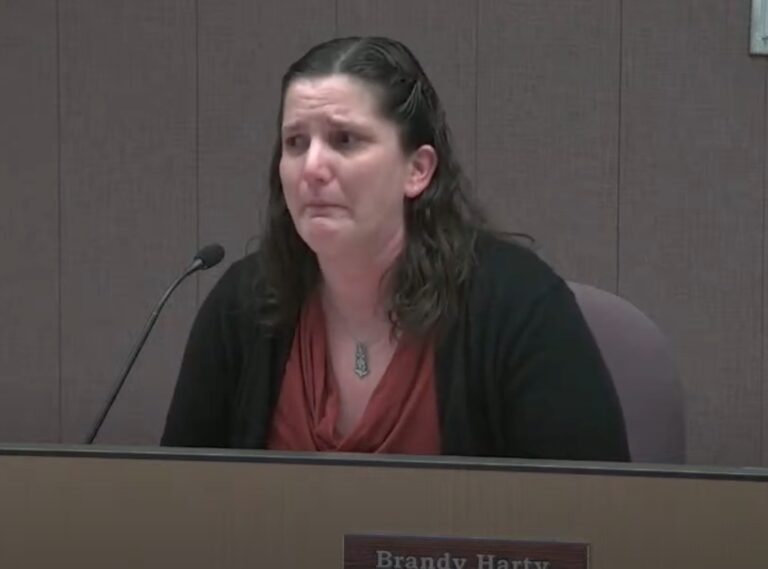
When Fairbanks School Board President Brandy Harty shared on the record the rumor she heard about Fairbanks lawmakers being bribed with $70,000 in campaign contributions, it stunned conservatives around the state. Where did she hear that rumor?
It may have been in the newsletter of Rep. Zack Fields, who represents downtown Anchorage and who is formerly a union organizer.
“In pressuring Republicans to flip-flop and oppose a bill they previously supported, Dunleavy threatened to campaign and spend $70,000 per race against any Republicans who voted to override the veto,” Fields wrote. The Alaska Beacon wrote that he got the idea from a Republican lawmaker.
Harty twisted it 180 degrees, and named Sen. Robert Myers, Rep. Frank Tomaszewski, and Rep. Mike Cronk, specifically saying into the microphone and on the record that the rumor was they had been promised $70,000 in campaign contributions in exchange for their vote against overriding a veto on an education spending bill, Senate Bill 140.
She then asked reporters in the room not to write about it. The Fairbanks News-Miner did her bidding and did not write about it.
She said, “I hope it was worth it.”
By inference, Harty was not only accusing the three lawmakers from the Interior, but all other Alaska lawmakers who sided with the governor on his veto override.
Conservatives in Fairbanks are weighing their options, including discussing whether they will file an ethics complaint against Harty for accusing lawmakers of a felony. But there is no actual consequence if such a complaint were filed; the only recourse Fairbanks has is to launch a recall of Harty.
People in Fairbanks are saying Harty is planning to run for the Legislature against Rep. Tomaszewski, since she has been bashing him loudly and repeatedly in public.
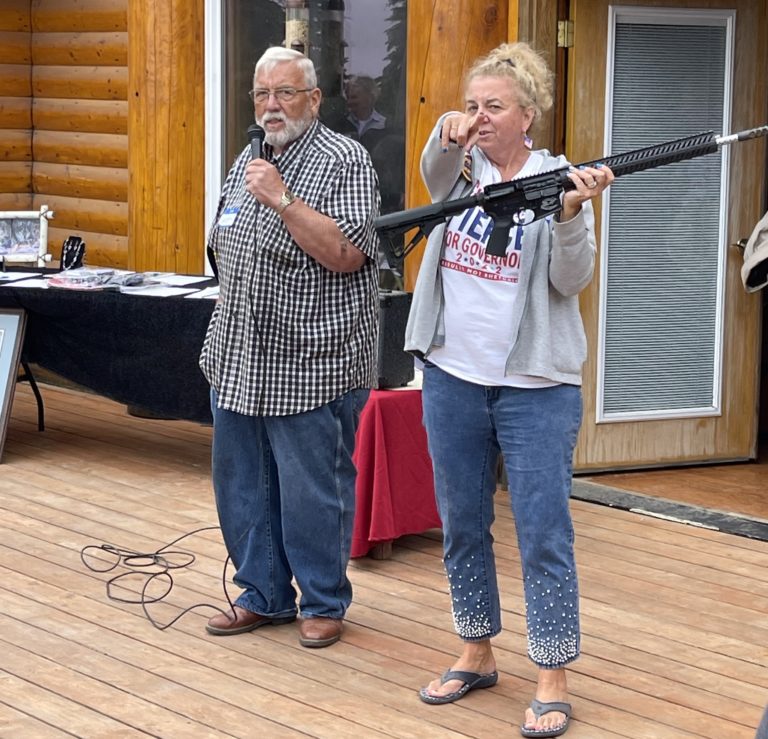
Alaska Attorney General Treg Taylor, alongside Attorneys General Raúl Labrador of Idaho and Todd Rokita of Indiana, spearheaded a coalition of 25 states challenging Illinois’ ban on AR-15 rifles and their standard 30-round magazines. In a brief filed with the United States Supreme Court, the coalition contends that the ban is unconstitutional and erodes the Second Amendment rights of citizens.
Alaska Gov. Mike Dunleavy underscored the importance of the challenge, expressing concern over the precedent set by the 7th Circuit Court of Appeals’ decision to uphold the ban.
“What the 7th Circuit has done with the Illinois’ ban on AR-15 rifles and magazines should frighten Americans,” Dunleavy said. “They have decided to uphold this ban based solely on the appearance of these rifles, and have abandoned all facts concerning their use, function, and Constitutional protection.”
Attorney General Taylor echoed Dunleavy’s statement, criticizing the 7th Circuit’s decision as “absurd at best” and reiterating that the Second Amendment does not let courts categorize firearms based on their appearance.
Taylor expressed confidence in the U.S. Supreme Court’s history of affirming Second Amendment rights and urged the highest court to correct the 7th Circuit’s erroneous interpretation.
The 7th U.S. Circuit Court of Appeals’ ruling in Barrett v. Raoul upheld Illinois’ ban on AR-15s, contending that the rifles’ militaristic appearance excludes them from Second Amendment protection. However, the coalition of states argues that such a distinction lacks textual or historical basis, emphasizing that the Second Amendment was originally intended to protect arms used in military combat.
The brief filed with the Supreme Court calls for the Court to grant certiorari and rectify the 7th Circuit’s decision. It asserts that the division created by the 7th Circuit between “militaristic” firearms and those used for self-defense is indefensible and contravenes the plain language of the Second Amendment.
Notably, the coalition challenging Illinois’ ban comprises a diverse array of states, including Alabama, Arkansas, Florida, Georgia, Iowa, Kansas, Kentucky, Louisiana, Mississippi, Missouri, Montana, Nebraska, New Hampshire, North Dakota, Ohio, Oklahoma, South Carolina, South Dakota, Texas, Utah, Virginia, West Virginia, Wyoming, as well as the Arizona and Wisconsin Legislatures.
The challenge addresses the fundamental interpretation of the Second Amendment and the extent of permissible firearm regulation by states.
This column is a response to Kirsa Hughes-Skandijs’ letter, “Black-and-white view of Gaza goes too far,” published in the Juneau Empire on March 19.
In her letter, Hughes-Skandijs has questioned why “…groundless accusations that perpetuate his [Dolitsky] black-and-white view should have made it to print,” referring to my column, “Israel-Gaza and historic, religious and ethnic challenges of global terrorism” published on March 4 in the Juneau Empire, which itself was a response to Dixie Belcher’s column published on February 26.
Editor’s note: That Dolitsky column is reprinted here at Must Read Alaska:
Why was my article published in Juneau Empire? For the same reason that “groundless and misleading” Hughes-Skandijs’s letter was published in Juneau Empire.
Remember, in America we still live in a democratic society, where citizens of our country exercise freedom of speech and expression, and also exercise check and balances—a system in which the different parts of an organization (e.g., government) have powers that control the other parts, so that no part can become too powerful.
When individuals, including myself, contribute their opinions to newspapers, journals or other forms of media, and their work is accepted for publication, they ultimately become journalists. In fact, truth, accuracy, and objectivity are cornerstones of journalism ethics.
In her letter, Hughes-Skandijs refers to the anti-Semitic and hateful school curriculum in Gaza as a “… scaremongering propaganda.”
She writes: “His [Dolitsky] unsourced claims about bloodthirsty kindergarteners are little more than the kind of scaremongering propaganda we have seen time and again in campaigns of state violence against vulnerable populations.” Frankly, I don’t even understand the meaning of this sentence; just an incoherent mumbling.
In fact, anti-Semitic teaching in Gaza, under censorship of Hamas, from kindergarten on is an indisputable fact. A generation of children in Gaza have been taught to hate from anti-Semitic textbooks (e.g., good read “The roots of Hamas’ terror attack can be found in Gaza’s schools” by Steve Israel,Forward, October 25, 2023).
How can anyone in good conscious negotiate a peaceful agreement or two-state coexistence with a nation committed to this type of hateful ideology?
Hughes-Skandijs made so many false assertions and misinterpretations related to my column that I don’t even know where to start in dismantling it. In her letter, she put words in my mouth, brought Ukraine and Vladimir Putin into her narrative, and made numerous unfounded accusations.
For example, Hughes-Skandijs writes: “After years of banging the drum for Ukrainian lives, Mr. Dolitsky now apparently feels that all wars are disproportionate and that’s just fine and dandy.”
Yes, indeed, all wars are disproportionate; I don’t just feel it, I know it as a historic and factual truth. I wonder, however, what Hughes-Skandijs was thinking when she made this statement and other false assertions in her letter. Do we speak the same language—English? Shall I explain my position, narrative and statements in three other languages—Ukrainian, Russian or Spanish? Keep in mind, misinterpreting or misconstruing your opponent’s language will not make your narrative more persuasive or credible, just an opposite.
Post-war Germany made a great effort to eradicate Nazi ideology in their country, especially in the school curriculum. Today, synagogues and Holocaust Museums are present in the major German cities—Dresden, Berlin, Frankfurt, and others. Germans of the post-war generation are ashamed of their past and they paid the price.
My mother, my relatives and all Soviet citizens that were under occupation in the former Soviet Union during World War II received a reparation from Germany in the amount of about $3,000 each. My father was a soldier and an officer of the Soviet Army during the war from 1939 to 1947. Military personnel did not receive a reparation from Germany; they were not considered under occupation, they fought Nazism in the frontline.
Gazans must apply the German’s model as an example and eradicate their hateful ideology toward Israel and other Jews worldwide. The solution for ending the Gaza-Hamas/Israel war in Gaza is somewhat simple—Hamas must surrender, get out of their tunnels and return the hostages (including eight Americans), those who perished and those who are still alive, to their families. Why do Hamas still fight, endangering their own countrymen in Gaza?
Alexander B. Dolitsky was born and raised in Kiev in the former Soviet Union. He received an M.A. in history from Kiev Pedagogical Institute, Ukraine, in 1976; an M.A. in anthropology and archaeology from Brown University in 1983; and was enrolled in the Ph.D. program in Anthropology at Bryn Mawr College from 1983 to 1985, where he was also a lecturer in the Russian Center. In the U.S.S.R., he was a social studies teacher for three years, and an archaeologist for five years for the Ukranian Academy of Sciences. In 1978, he settled in the United States. Dolitsky visited Alaska for the first time in 1981, while conducting field research for graduate school at Brown. He lived first in Sitka in 1985 and then settled in Juneau in 1986. From 1985 to 1987, he was a U.S. Forest Service archaeologist and social scientist. He was an Adjunct Assistant Professor of Russian Studies at the University of Alaska Southeast from 1985 to 1999; Social Studies Instructor at the Alyeska Central School, Alaska Department of Education from 1988 to 2006; and has been the Director of the Alaska-Siberia Research Center (see www.aksrc.homestead.com) from 1990 to present. He has conducted about 30 field studies in various areas of the former Soviet Union (including Siberia), Central Asia, South America, Eastern Europe and the United States (including Alaska). Dolitsky has been a lecturer on the World Discoverer, Spirit of Oceanus, andClipper Odyssey vessels in the Arctic and sub-Arctic regions. He was the Project Manager for the WWII Alaska-Siberia Lend Lease Memorial, which was erected in Fairbanks in 2006. He has published extensively in the fields of anthropology, history, archaeology, and ethnography. His more recent publications include Fairy Tales and Myths of the Bering Strait Chukchi, Ancient Tales of Kamchatka; Tales and Legends of the Yupik Eskimos of Siberia; Old Russia in Modern America: Russian Old Believers in Alaska; Allies in Wartime: The Alaska-Siberia Airway During WWII; Spirit of the Siberian Tiger: Folktales of the Russian Far East; Living Wisdom of the Far North: Tales and Legends from Chukotka and Alaska; Pipeline to Russia; The Alaska-Siberia Air Route in WWII; and Old Russia in Modern America: Living Traditions of the Russian Old Believers; Ancient Tales of Chukotka, and Ancient Tales of Kamchatka.
Another photo of a male in the women’s locker room at Planet Fitness in Fairbanks has emerged on X/Twitter, adding fuel to the public relations fire that broke out across the country after the gym cancelled the membership of a Fairbanks woman who photographed the man shaving in the women’s side of the facility.
In the latest photo, the man was dressing near other women. This photo was evidently taken by an anonymous member of the gym and shared with Libs of TikTok, a channel on X/Twitter that shows radical liberals as they actually are. Libs of TikTok has nearly 3 million followers.
Fairbanks conservative Patricia Silva’s story was featured on Gutfeld on Fox on Wednesday evening, anchoring a segment on “Vanishing Boundaries.”
Greg Gutfeld, who provides sardonic commentary on the news of the day, said that boundaries that have kept us safe and happy are beginning to disappear.
First, he said, society eradicated the boundaries “between male and female, between logic and irrationality, between reason and delusion. Boundaries give us meaning. Without them, we’re done … Planet Fitness sided with the offender. They call their gyms judgment free zones, and so canceled the woman’s membership. Planet Fitness, yeah, more like Planet [expletive deleted].”
That’s a lot of free publicity for Planet Fitness. Gutfeld averages 1.5–1.8 million viewers per night on his shows.
Planet Fitness’ stock valuation has remained wobbly this week, having lost a quick $400 million in valuation after the Silva video made the rounds on social media and in news outlets such as the Daily Mail and the New York Post. Mainstream media outlets in Alaska have remained silent.
Shares popped back in trading on Thursday morning as investors saw a “buy the dip” opportunity or as investment firms sought to shore up a crashing stock.
But the public relations damage continues online, as popular social media influencers have called for a boycott of Planet Fitness, which is standing by its policy of allowing men to use women’s locker rooms. It’s still to early to know if Planet Fitness will go the way of Bud Light, which hired a transexual male who portrays the persona of a teenage girl as the brand’s spokesperson.
That marketing move cost AB InBev, the parent company, and its shareholders. By August, its United States revenue had fallen 10%, as consumers stopped buying Bud Light, the company reported reported in a statement. Revenues fell $395 million North America during the quarter, compared to the previous year. Even today, AB InBev’s stock value, $59.73, is only what it was in 2012, having not recovered from the culture war it started with Dylan Mulvaney.
Wall Street Silver, an account on X/Twitter that has 1.2 million followers, posted the question, “Is it time to give Planet Fitness the Bud Light treatment? #BoycottPlanetFitness.” Many responding said they are canceling, but there’s no data yet to back that up; the company will need to report to shareholders at its next earnings call, which has not been announced. It’s latest filing with the Securities and Exchange Commission is at this link.
The Congressional Budget Office on Wednesday released a bleak outlook for the federal government with new projections that show debt levels will reach their highest levels ever in five years.
“Debt held by the public, boosted by the large deficits, reaches its highest level ever in 2029 (measured as a percentage of GDP) and then continues to grow, reaching 166% of GDP in 2054 and remaining on track to increase thereafter,” according to the CBO report. “That mounting debt would slow economic growth, push up interest payments to foreign holders of U.S. debt, and pose significant risks to the fiscal and economic outlook; it could also cause lawmakers to feel more constrained in their policy choices.”
The CBO further projected that the Social Security Old-Age and Survivors Insurance trust fund will be exhausted in 2033, the Medicare Hospital Insurance trust fund in 2035, and the Highway Trust Fund in 2028.
Maya MacGuineas, president of the Committee for a Responsible Federal Budget, said the new report should serve as a wake-up call for Congress.
“This is yet another reminder that politicians put political priorities ahead of the long-term health of the country,” she said. “There is no way to look at these eye-popping numbers without realizing we need to make a change. And yet we have lawmakers promising what they won’t do: I won’t raise taxes, I won’t fix Social Security, I won’t pay for all the things I do want to do. And so we continue on this dangerous path.”
MacGuineas said neither President Joe Biden nor former President Donald Trump have been talking about solutions on the campaign trail ahead of the 2024 presidential election.
“So far, the presidential campaign is not offering any hope – candidates need to be asked how they would fix Social Security, fix Medicare, and bring the debt back to manageable levels,” she said. “Voters should not be satisfied without specific answers.”
The CBO report found that “interest costs more than double in relation to GDP between 2024 and 2054, driven by rising interest rates and growing debt.”
“Those costs reach 6.3% of GDP in 2054 and are larger in every year than their average of 2.1% of GDP over the past 50 years,” according to the report. “Higher interest rates account for about two-thirds of the projected rise in net interest costs over the 2024–2054 period; primary deficits account for the rest.”
MacGuineas said the biggest concern is the rising cost of interest.
“The scariest part of our grim fiscal outlook is rising interest costs. Those costs have already doubled as a share of the economy since 2015, and this year CBO believes interest will cost more than defense spending or Medicare,” she said. “By 2053, interest costs will double again after becoming the single largest line item in the entire federal budget in 2051. This year, we will spend $870 billion on interest – more than all the federal dollars we spend on children – and that number will only grow from here.”
Michael A. Peterson, CEO of the Peter G. Peterson Foundation, called the long-term outlook “dangerous.”
“CBO’s new report shows that over the next three decades, America’s debt will grow by more than $100 trillion, as we pay out more than $75 trillion on interest alone. Our debt is projected to continue climbing, approaching twice our gross domestic product, which is uncharted territory for the world’s largest economy,” he said. “Looking ahead to 2025, the leaders we elect this fall will face a series of critical fiscal decisions, including the debt ceiling and expiration of some of the 2017 tax cuts. As we enter the heart of campaign season, CBO’s report is proof positive that our debt challenge is serious, and fiscal solutions should be a key part of the national conversation.”
Washington Gov. Jay Inslee has signed into law a bill requiring LGBTQ education in the state’s public schools.
Senate Bill 5462 requires Washington schools to incorporate Lesbian-Gay-Bisexual-Transgender-Queer history and perspectives into their curriculum. The bill was introduced in January of 2023 by Sen. Marko Liias, an Edmonds Democrat, under the banner of Diversity, Equity, and Inclusion.
Under the new law, the Washington State School Directors’ Association is mandated to review and update a model policy by June 1, 2025. By Sept. 1, 2025, the Washington Office of Superintendent of Public Instruction is required to produce and distribute a schedule for the revision of state learning standards, ensuring the integration of LGBTQ history into the educational framework.
“The model policy and procedure must require that school district boards of directors, within available materials, adopt inclusive curricula and select diverse, equitable, inclusive, age-appropriate instructional materials that include the histories, contributions, and perspectives of historically marginalized and underrepresented groups including, but not limited to, people from various racial, ethnic, and religious backgrounds, people with differing learning needs, people with disabilities, LGBTQ people as the term is defined in RCW 43.114.010, and people with various socioeconomic and immigration backgrounds,” the bill states.
Advocates of the bill argue that it will promote understanding, empathy, and acceptance among students, fostering a more inclusive school environment.
Critics say it is advanced grooming that is being infused into school curricula, in defiance of parents and families’ religious beliefs.
The new law is sure to have repercussions. Already, Washington parents are moving children to private schools. Stanford University economist Thomas Dee found that the number of Washington students enrolled in private school increased 26% between the 2019-20 and the 2022-23 school years.
U.S. Sen. Lisa Murkowski welcomed the announcement of more than $30.4 million for 42 climate resilience projects in tribal communities in Alaska.
The awards, made through funding provided by Congress through the Infrastructure Investment and Jobs Act, Inflation Reduction Act, and the annual appropriations process, will help tribal communities across the state adapt and bolster their resilience to climate change, said Murkowski, who is vice chairwoman of the Senate Committee on Indian Affairs.
“The selection of more than 40 climate resilience projects across tribal communities in Alaska is a significant step forward in addressing the growing threats and impacts of climate change,” Murkowski said. “By incorporating Indigenous knowledge and prioritizing community driven initiatives, we can ensure these resources effectively meet the unique needs of each Tribe.”
The entities listed below will receive awardsunder the Bureau of Indian Affairs’ Tribal Climate Resilience Annual Awards Program. Alaska received about one-quarter of the total of $120 million in awards announced Wednesday, she said. More information is available from the Department of Interior at this link.
As one of the lead negotiators and authors of the Infrastructure Investment and Jobs Act, Murkowski played a key role in authorizing and providing the funding awarded by DOI, she said in a statement.
Many of the awards appear to have nothing to do with climate resilience or infrastructure, such as the $201,000 for “Youth Climate Education and Stewardship in Hoonah,” the $192,000 for “Evaluating subsistence shellfish beaches for future enhancement and clam garden projects,” and $248,000 for non-described “Ahtna Territory.”
Alaska Award Recipients
Tribe/Tribal Organization
Purpose
Funding Amount
Ahtna Intertribal Resource Commission
Ahtna Territory
$248,013.00
Asa’carsarmiut Tribe
Asa’carsarmiut Adaptation Planning Project
$235,000.00
Bristol Bay Native Association
New Stuyahok Road and Drainage Improvements Planning Project
$106,501.00
Central Council of the Tlingit & Haida Indian Tribes
Tlingit & Haida Feasibility Study for Water Quality Testing in Southeast Alaska
$249,804.00
Central Council of the Tlingit & Haida Indian Tribes
Seacoast Indigenous Guardians Network Data Collection
$415,089.00
Chignik Bay Tribal Council
Indian Creek Bridge and Landfill Road Preliminary Engineering Report
$248,989.00
Chignik Bay Tribal Council
East Side Electric Distribution System Upgrades Preliminary Engineering Report
$249,638.00
Chilkoot Indian Association (Haines)
Planning for Resilience – Developing a Climate Adaptation Plan for the Chilkoot Indian Association
$234,515.00
Chugach Regional Resources Commission
Chugach Imaq – long-term evaluation of the effects of climate change on Indigenous marine mammals in the Chugach region
$208,086.00
Chugach Regional Resources Commission
Evaluating subsistence shellfish beaches for future enhancement and clam garden projects
Climate Resilient Drinking Water Infrastructure to Support New Affordable Housing Development for the Ketchikan Indian Community
$3,944,640.00
Knik Tribe
Strengthening Knik Tribe’s Co-Stewardship of Aquatic Wildlife Resources in Cook Inlet, Alaska: Gathering Knowledge to Ensure Long-Term Food Sovereignty by Learning from the Past, Taking Stock of the Present, and Planning for the Future
$2,870,666.00
Metlakatla Indian Community, Annette Island Reserve
Climate Change Adaptation Plan Update, Annette Islands Reserve
$155,922.00
Metlakatla Indian Community, Annette Island Reserve
Metlakatla Indian Community Tribal Climate Resilience Implementation 2023
$1,017,230.00
Native Village of Chenega (aka Chanega)
Empowering Tribal Resilience: Floating Wave Attenuation Breakwater Planning and Design for Climate Change Mitigation and Adaptation
$100,140.00
Native Village of Chitina
Planning for the Native Village of Chitina’s Climate Change needs
$244,684.00
Native Village of Diomede (aka Inalik)
Plan for the Native Village of Diomede
$232,036.00
Native Village of Ekwok
Ekwok Nushagak River Bank Stabilization Project
$634,569.00
Native Village of Eyak (Cordova)
Climate Resilient Ecosystems and Communities through Mariculture
The Anchorage Assembly passed legislation on Tuesday that creates more regulation for Anchorage homeowners, by way of requiring them to register and be monitored by the municipality if they want to have a short-term rental.
On Wednesday, Mayor Dave Bronson vetoed the ordinance, AO 2023-110.
In the veto explanation, Bronson said, “the Anchorage Assembly should not be meddling in an individual property owners’ ability to make a living for themselves and their families. Private property owners deserve to continue to be able to provide valuable housing offerings within the municipality on AirBnB, VRBO, and other outlets.”
The mayor’s full veto message can be read here. It is all but certain the Assembly will override his veto.
Many communities around the country are moving toward greater regulation of short-term rentals, further encroaching on private property rights. In the Alaska Legislature, Rep. Andrew Gray is trying to get his bill passed that would limit Alaskans to being able to own only one short-term rental. Libertarians, such as the Cato Institute, warn that Americans’ basic freedoms are being eroded by these new laws and regulations.
“A goal of this ordinance is to safeguard the renter, the property and neighborhood value,” said ordinance co-sponsor Assembly Member Randy Sulte. “Currently, neighbors of short-term rentals have little recourse for dealing with problem properties. This ordinance puts into place a system to enforce existing public safety requirements and require short-term rental owners respond to problems in a timely manner.”
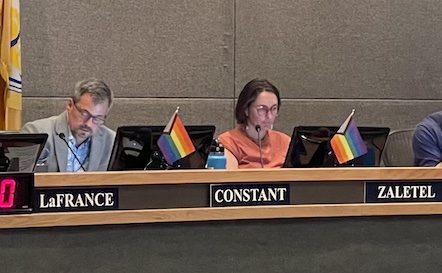
Ordinance co-sponsor and Assembly Vice Chairwoman Meg Zaletel added, “our community is in the midst of a housing crisis and we simply don’t have the data to understand how short-term rentals are effecting our housing market. This program will give us data that is currently held tightly by the rental platforms to make informed decisions in the future.”
The new licensing program applies to property owners who rent out units for less than 30-day increments; the license fee — $200 to $400 — is waived for deployed military, operators who rent for less than 15 rental days per year, owners who live on site or a neighboring property as their primary residence, and short-term rentals that also rent long term for more than 180 days per year.
The ordinance requires a minimum of $500,000 insurance, waived if the renting entity already has it covered through the rental platform (VRBO or Airbnb, for example).
The ordinance requires a manager to be on call 24 hours a day, seven days a week, or an alternate person who can respond to the renters’ call. The owner and guests must, the ordinance spells out, abide by all municipal codes, as they would in any case without this new ordinance.
The quality of the Fairbanks School Board was on full display on Tuesday night, as Brandy Harty, president of the Fairbanks North Star Borough Board of Education, spoke of her disappointment in three Interior lawmakers who voted against a mega-spending bill that would have given districts $680 more per student each year going forward, without any expectation of improvement in the quality of education and without so much as a fiscal note.
During her dramatic remarks, Harty sobbed through her condemnation of three Fairbanks legislators, and then accused Rep. Frank Tomaszewski, Rep. Mike Cronk, and Sen. Robb Myers of taking $70,000 campaign contributions in exchange for their no votes. In other words, she accused them of taking bribes for their votes.
She then beseeched the journalists in the audience to not quote her on that, because it was just a rumor that she had heard. Watch her spread a rumor accusing lawmakers of felony crimes in this video clip from the March 19 school board meeting:
Harty also said she would give Rep. Mike Prax of North Pole “a pass” since he never voted in favor of the legislation to begin with.
She was reacting to proceedings on Monday, when the Alaska Legislature failed to override a veto from the governor on Senate Bill 140. The bill started out as authorizing legislation for rural broadband improvement, but ended up being the vehicle for the National Education Association Alaska to get the extra locked-in funding formula it has been lobbying for over the past few legislative sessions.
There are other education funding bills in process in Juneau, but Harty had her heart set on SB 140 as being the only one that could possibly meet her expectations.
Harty, a former special education teacher, is the recipient of generous union campaign contributions. In her last race she received support from APEA/AFT (American Federation of Teachers, and Local 52 PAC, ASEA/AFSCME, which gave her $1,200 for her campaign for school board. She has been lobbying for a higher base student allocation for months.
Recently, Fairbanks North Star Borough School District was shown to have cooperated with the campaign staff for Rep. Mary Peltola, in helping her put together a campaign event at a North Pole school during school hours, which is a violation of law. The record shows that the district administrators assisted the campaign in breaking the law.