Former President Donald Trump laid out his stance on abortion and in vitro fertilization (IVF) Monday after recent major court cases reshaped the landscape on both those issues.
In a video posted online, Trump expressed support for IVF and said abortion laws should be handled by the states.
“Under my leadership, the Republican party will always support the creation of strong, thriving and healthy American families,” Trump said. “We want to make it easier for mothers and families to have babies, not harder. That includes supporting the availability of fertility treatments like IVF in every state in America.”
Trump’s support comes after the Alabama Supreme Court ruled in February that embryos should be treated as children, creating major questions about the future and legality of IVF.
IVF usually works by creating embryos outside the womb and then implanting them within the womb. Often, because of the failure rate of those implantations, those seeking IVF treatment will create many more embryos than they expect to have as children. Later, if a couple decides to stop trying to have children, the remaining embryos are either donated or destroyed, but destroying them could have been illegal under the new ruling.
In response, Alabama lawmakers passed a law in March providing criminal and civil immunity to IVF clinics that destroy or damage embryos.
“Today, I’m pleased that the Alabama legislature has acted very quickly and passed legislation that preserves the availability of IVF in Alabama,” Trump said. “The Republican party should always be on the side of the miracle of life and the side of mothers, fathers, their beautiful babies, and that’s what we are.”
Trump went on to say he has continued to receive questions about his stance on abortion since the overturning of Roe v. Wade, something he took credit for in the video. He said whatever states decide will be the final say.
“It must be remembered that the Democrats are the radicals on this one because they support abortion up to and even beyond the ninth month,” Trump said. “The concept of having an abortion in the later months and even execution after birth, and that’s exactly what it is, the baby is born, and the baby is executed after birth, is unacceptable and almost everyone agrees with that.”
The stance is a major strategic decision for Trump, as President Joe Biden and Democrats have repeatedly used the abortion issue to rally their base after the U.S. Supreme Court overturned the nationwide abortion legalization allowed Roe v. Wade and sent the issue back to the states.
“Like Ronald Reagan, I am strongly in favor of exceptions for rape, incest, and life of the mother,” he added.
Abortion has been a significant electoral issue for decades, but the overturning of Roe v. Wade significantly increased its importance. Under the Supreme Court’s ruling, states can decide their own abortion laws.
During his State of the Union Address, Biden made a point of this and claimed he would rally women to his side in November on this issue.
“Clearly those bragging about overturning Roe v. Wade have no clue about the power of women,” Biden said in his State of the Union remarks. “But they found out. When reproductive freedom was on the ballot, we won in 2022 and 2023, and we will win again in 2024. If you – if you, the American people, send me a Congress that supports the right to choose, I promise you I will restore Roe v. Wade as the law of the land again.”
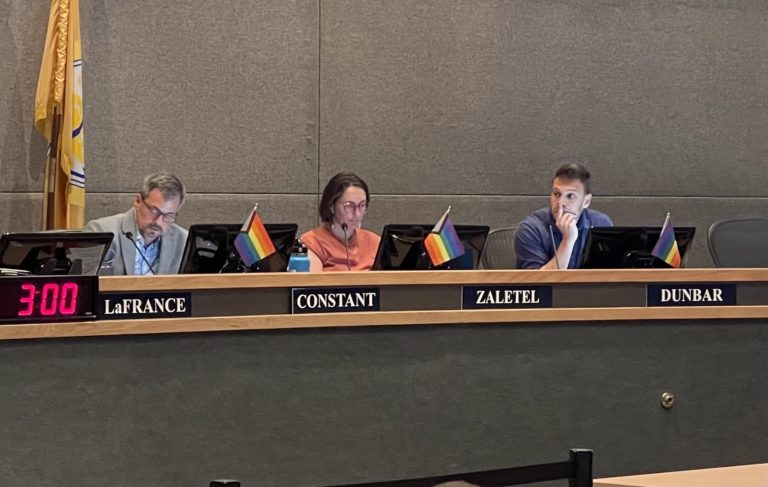
The April 9 meeting of the Anchorage Assembly will give the radical left majority another opportunity to stick it to the mayor during election season.
The question is whether the Assembly will override the mayor’s veto of a resolution that would allow the Assembly to subpoena an agreement signed by Mayor Dave Bronson concerning water rights at Eklutna Lake. The city gets the vast majority of its drinking water from the lake, which also supplies electricity to more than 25,000 homes in Anchorage and the Matanuska-Susitna Borough through the Eklutna Hydroelectric Project.
Last week, Bronson said in his veto explanation that he had already shared the agreement with the Assembly.
“Why are Assembly members spending taxpayer dollars for their attorneys to subpoena documents they already have access to? These threatening subpoenas are nothing more than scare tactics to bully municipal employees into potentially breaching municipal contracts,” he said.
At issue is a confidentiality contract Bronson and the Assembly are bound to due to a contract signed by former Mayor Ethan Berkowitz in 2017. Assembly members want to release the Berkowitz agreement with the public, and Bronson says he cannot release it without attracting a lawsuit.
The matter will come up for a veto override vote during the meeting, and with eight members having voted to subpoena the document and release it to the public, the Assembly appears to have the numbers needed to override the mayor’s veto.
The Assembly meets on the ground floor of the Loussac Library beginning at about 5 pm on Tuesday. You can watch the proceedings on YouTube at this link.
The principal of Clark Middle School in Anchorage, which critics have dubbed “Fight Club,” has been recognized by her peers for excellence.
The Anchorage School District said it is proud of Bennetta Orchitt, who was named Alaska Association of Secondary School Principals’ Region IV Principal of the Year.
“An educator for 15 years, Principal Orchitt’s staff share that she has a balance of common sense, proper procedures and protocol that has earned the love, trust, and support of her entire staff and student body.”
Well, maybe not all of the student body.
One student’s body was beaten badly by a gang of girls last month. She is still recovering from injuries and has been threatened by students that if she returns to Clark Middle School, she’ll “get jumped” again.
The girl’s story was told at Must Read Alaska last week: She was standing in the gymnasium during class when a group approached her and started punching, kicking her body, and pulling her hair. These were girls who had, according to accounts, threatened her in the past and called her race-related names and words like “albino.”
The attackers had been let out of school early and had come to the gym apparently for the purpose of targeting and beating up the girl. The beating continued until a teacher finally intervened. Two of the girls have since been charged with assault; others may be charged as well. The original story is here:
The mother of the girl told Must Read Alaska that she had reached out to the principal several times over weeks starting in January, when her daughter was first enrolled, to share her concerns about her daughter being bullied, but it took over a dozen contacts with the school administration before she could even meet with the principal. She does not feel the school had taken the threats seriously.
New video has emerged showing the attack from a different angle:
Other parents have since reached out to the mother saying they have videos from the incident that show other students were involved in kicking the girl. Parents with children at Clark have also reached out to the mother to relay their children’s similar safety issues.
Listen to the mother, Natasha Guthrie, talk about the conditions of violence and lack of accountability by faculty at Clark Middle School in this Instagram link.Or watch the video here:
Clark Middle School has a history of violence. Last year the campus was locked down after a major fight broke out that was not controllable by campus security and required several police officers to come in to bring order.
“It has been amazing the number of people who have reached out and who want to join in and speak out. The community support and outpour of has been absolutely amazing. Every time someone calls me I’m in tears because of the things that they say, and the help they offer,” Guthrie said.
It was a week in which Alaska Democrats in Juneau were in an unserious mood, but it was a week to remember in Juneau, as its main feature was foot-stomping.
Several Democrat House of Representative members helped facilitate and encourage truancy on Thursday, encouraging dozens of local high school students to skip school and march to the Alaska Capitol, where they would shout, chant, bang on doors, and even surrounded one female legislator, blocking her from being able to leave a committee room for 40 minutes.
Some of the legislators had even skipped their own committee meetings across town to Juneau-Douglas High School to march with the students to the Capitol, where they noisily advocated for an increase to the permanent formula for funding school districts.
The takeover of the Capitol was “what democracy looks like,” said House Minority Leader Cal Schrage, as students crowded into committee rooms and halls, making them impassible and setting up a safety hazard.
The House ended the week on an even stranger note on the House floor: Viagra for bush rats for the purpose of masturbation.
During debate over Senate Bill 45, establishing “direct care practice” health care services, several amendments were made on the House floor to dramatically alter health care in Alaska by forcing doctors to do things they might not want to do.
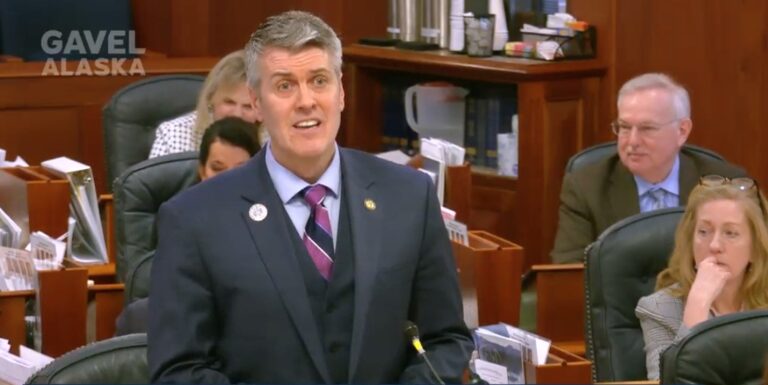
Rep. Andrew Gray tried to get his colleagues to vote for the establishment of a single-payer health care system in Alaska, which would socialize medicine.
He gave a passionate floor speech, in which he excoriated the medical care system, insurance companies, and doctors themselves, as he called for the socialized model. Then he went after Republicans, and had to be stopped short with a point of order. And then another point of order. And a third one. He was out of control.
“Republican policies got us into this mess and I would like Republican policies to get us out,” Rep. Gray said. He wants all doctors to accept any and all patients, and be paid by the state. Doctors could not reject any patients in what would be essentially universal Medicaid in Alaska. “We need to blow up the Alaska health care system,” Gray said, using incendiary language. “What do we have to lose?”
For doctors, it would be a loss of freedom, having state bureaucrats tell them that they must do all kinds of things they might not want to do, making them de facto employees at the will of the government.
Gray said his amendment would cost the State of Alaska about $7 billion a year, but there was no researched fiscal note attached to amendment #15, which consisted of just seven words. Ultimately, the amendment was ruled out of order.
Amendment 16 was offered by Rep. Jennie Armstrong, who was, as she is known to do, inserting sexual orientation, gender identity, gender expression (LGBTQ) language into the bill, forcing doctors to treat patients even if the doctors don’t feel qualified. The amendment could expose the doctors to legal peril if, for example, they chose not to prescribe hormones to teens for gender transitions.
That gave Gray another chance to grandstand. He talked about his own experience as a physician’s assistant and told a story about working in a clinic:
“We had older, single men who lived in remote Alaska and out in the middle of nowhere by themselves … She [a doctor] refused to prescribe Viagra to those patients because she believed that they might use it for masturbation.”
Gray said that he would then prescribe the medication if he felt it was medically suitable, supplanting his own judgment as a physician’s assistant over a doctor’s medical judgment.
SB 45 allows patients and doctors or health care providers to have direct-compensation relationships outside of insurance intermediaries. Typically, the direct care practice operates on patient membership fees and does not rely on insurance reimbursements. A direct health care agreement is a contract between a patient and doctor that involves a flat, monthly fee in exchange for routine visits and other services. These are sometimes called “concierge doctors” and the doctors often cater to those who are not in government-sponsored health care plans, but who have the money to pay for the membership fees.
As the government has made medical care more complicated, less accessible, and more expensive throughout the country, some doctors are choosing to provide these membership plans as a way to decrease their own stress level and increase their ability to care for people without an insurance company telling them what they can and cannot do. In America today, it’s often the insurance companies that actually make the decision about the level of care a person can receive; the same holds true for those on Medicaid, Obamacare, or Medicare — the government calls the tune on care.
Democrats in the House had tried amendments that would have upended the bill entirely, forcing doctors to see a mandatory percentage of patients who are on Medicaid and Medicare.
The bill is scheduled for the House floor once more on April 8 for a vote on final passage — without the Viagra clause.
School districts across the country are laying off teachers, citing high inflationary costs, budget deficits, and federal COVID-era funding running out after receiving windfalls in federal subsidies for three years.
The federal COVID-era subsidies were funded through ESSER (Elementary and Secondary School Emergency Relief) grants administered by state education agencies. Financed through the CARES Act and supplemental appropriations, the grant funding expires Sept. 30.
In California, within one month, roughly 1,600 California public school teachers and staff received layoff notices – a “massive increase” from previous years, California Teachers Association president David Goldberg told the Orange County Register.
Recent announcements include Pasadena Unified School District’s cutting 200 jobs and Anaheim Union High School District cutting 100, citing declining enrollment, the end of ESSER funding and budget shortfalls, for example, according to news reports.
The number of total education job losses won’t be known until after the state legislature passes a budget in June. The budget shortfall varies: Gov. Gavin Newsom’s projected shortfall is $38 billion, the state Legislative Analyst’s Office’s is $73 billion.
In Arkansas, which has been grappling with a teacher shortage for years, the Little Rock School District began its first round of layoffs in February, citing declining enrollment, high construction costs, and high interest rates on debt payments, the Arkansas Times reported. This is after nearly 10% of teachers in the Arkansas public school system left the education workforce before the 2023-2024 school year, according to a recent state report.
In New York, school districts statewide are facing budget shortfalls and massive layoffs due to the governor’s proposed budget, which reduces public school funding by $400 million, News 12 Long Island reported. The Riverhead Central School District already announced it is cutting 38 teaching jobs due to “fiscal” reasons, citing $19 million in COVID money it already spent with no more relief money coming. Buffalo Public Schools announced it was cutting $90 million from its 2024-2025 budget citing the COVID relief money ending. This translates to roughly 310 fulltime job cuts.
In Maryland, the Howard County Public School System announced 348 jobs would likely be cut in order to balance its fiscal 2025 budget. With a $103 million budget shortfall and increasing costs, including 13.6% increases in employee health insurance costs alone, its acting superintendent said, “a significant portion of our budget is staff, we cannot address the structural financial challenges without impacting staff,” the Baltimore Sun reported.
In Massachusetts, Dighton-Rehoboth Superintendent of Schools Bill Runey articulated a fiscal crisis many states are facing: “inflation is at record highs” but state funding for public schools doesn’t account for it. “We are cutting positions, and other districts are cutting even more,” he said, the Taunton Daily Gazette reported. “COVID relief artificially boosted the budget,” he said, and loss of ESSER money and high inflationary costs created a “fiscal crisis.”
In Texas, Arlington ISD announced it is cutting 275 jobs funded by ESSER, including positions related to classroom support, mental health, tutoring and after-school care.
Fort Worth ISD also announced it was cutting 133 ESSER funded jobs. This is after the district cut 200 jobs and had a $80 million deficit in the 2022-2023 school year, the Fort Worth Report reported. Well before COVID money was funneled into schools, Fort Worth ISD’s school board for more than a decade voted to pass unbalanced budgets with deficits, the Fort Worth Report notes.
Despite rising property taxes and a $1.2 billion bond project approved by voters in 2021, the district kept increasing its budget beyond its revenue as it continued to lose students. The district has lost enrollment every year since 2017. Enrollment dropped by roughly 10% between 2019 and 2021, the Wall Street Journal reported.
Education job losses are part of a predictable fiscal cliff, Education Resource Strategies, a nonprofit consultant that works with school districts, warned last year.
ESSER allocated $190 billion nationwide over three years, accounting for between 4% and 7% of total education funding for each state, through a round of funding allocated by Congress (ESSER I, ESSER II, and ESSER III). ESSER funds were used to augment budgets impacted by declining student enrollment, increasing employee salaries and benefits, and widespread inflation, the group and others say. Some finance experts warned against districts using ESSER money to fund salaries knowing the funds would not last.
As federal funds augmented budgets, inflationary costs continued to skyrocket from insurance to electricity, food, supplies and other expenses.
School districts in some states were already facing severe enrollment losses, which directly impact funding formulas. “ESSER may have temporarily mitigated what would have otherwise been significant revenue loss in some districts. This means that districts with enrollment decline may face an even steeper cliff than anticipated,” ERS said.
Based on several factors, ERS identified 15 states that would suffer the most this year from ESSER losses. It also published a report to help districts identify ESSER fiscal cliff risks.
It’s late in the game for the 33rd Alaska Legislature, and when it comes to social agenda items, the outcome is still to be determined. Here are four key bills in that category Alaska Family Council is keeping an eye on.
1. At first glance, SB 24 sounds rather innocuous, a piece of legislation that will help public school students with mental health issues; however, the mandatory lessons it dictates will be crafted by state-level bureaucrats and there is a wide swath down which the topic of mental health can travel if this bill becomes law.
Giving education bureaucrats the authority to develop mental health guidelines for children is a dangerous proposition, as we’ve all seen what leftist idealogues do when developing curriculum. Are topics such as racism, equity, sexuality, and gender going to creep their way into the topic of mental health? SB 24 opens that door, and attempts to shut that door via amendments from Senator Shelley Hughes unfortunately failed by large margins.
SB24 passed the Senate by a 15 to 4 vote, with the four dissenting votes coming from Republicans Bjorkman, Hughes, Kaufman, and Shower. It has three House Committees to clear including Health & Social Services, Judiciary, and Finance.
2.HB 17 was introduced by Representative Ashley Carrick of Fairbanks with the goal of extending insurance coverage for contraceptive prescriptions to 12 months.Carrick, who probably surprised many people – to include Jim Minnery – by appearing on his podcast, I’m Glad you Said That (Click hereto listen to that interview) said the legislation does not include abortifacients (pills that keep fertilized eggs from attaching to a woman’s uterine wall).
We are watching this legislation closely and are aware many Alaskans have valid concerns about the morality and safety of birth control medication, the expanding role of Government in this arena as well as whether this opens doors that need to remain shut.
As with SB 24, this bill’s language leaves loopholes that may be exploited to include abortifacients or other “morning after” drugs. HB 17 passed through the House by a vote of 26 to 9, with the following Republican Representatives voting against its passage: Carpenter, Eastman, Johnson, McCabe, Rauscher, Saddler, Tilton, Tomaszewski, and Vance. It’s been sent to the Senate and assigned to the Health & Social Services and the Labor & Commerce Committees.
3. In regards to bills that support basic biology and common sense, HB 183 is at the top of the list. This bill was introduced by Eagle River Representative Jamie Allard who is enthusiastic about saving girls’ sports for girls.
With help from Alaska Family Council, the Education Committee heard invited testimony from an outstanding group of experts, to include Riley Gaines, All-American swimmer and de facto leader of the movement to female sports from desecration by males declaring themselves female.
Alaska Family Council also played a critical role in ensuring that more than 70% of the written testimony was supportive of protecting girls sports.
HB 183 passed out of the Education Committee and is now in the hands of the House Judiciary Committee before hopefully going through the Rules Committee for a floor vote of the whole House.
4.HB 338 is another Jamie Allard-sponsored bill. The Eagle River representative is not afraid to put herself on record as standing up for what is right and moral, and she is willing to take the abuse and name-calling thrown in her direction.
This bill has to do with holding physicians civilly liable for the damage done to minors during sex change procedures on minors. It is brief, to the point, and much needed if Alaska is to save our children from the misguided ambitions of adults who should know better. The first hearing on HB338 will be in the Judiciary Committee on Wednesday, April 10th.
It will be interesting, especially in this election year, to see who is willing to go on record for common sense and decency, especially when it comes to HB 183 and HB 338.
Next week, we’ll get you up to speed on a few other bills related to protecting unborn life and parental rights. Stay tuned and ready to engage.
Tim Barto is vice president of operations at Alaska Family Council.
The Permanent Fund Division at the State of Alaska’s website has posted a notification saying Alaskans may receive an email that looks like it is from the division, but is not. If you clicked on a link in the email, it would be advisable to go into the myAlaska portal, log in, and change your user name and password.
“WARNING! Some PFD applicants have received fraudulent emails requesting they login to myAlaska or the PFD site and update their Alaska Residency verifiers. These emails WERE NOT sent by the State of Alaska. We recommend anyone who clicked on links in these emails to update their myAlaska password and security question/answer immediately. myAlaska does not send unsolicited emails or texts to users requesting they update their passwords or account details,” the state’s website says on one place.
“*MYALASKA WARNING! There are reports that some myAlaska users are receiving phishing text messages requesting users change or update their passwords. Do not respond to these messages. myAlaska DOES NOT send text messages or emails to users requesting that they change their passwords,” the notice says at the PFD website.
Plagiarism is the representation of another person’s language, thoughts, ideas, or expressions as one’s own original work. Indeed, it is a shameful and unprofessional intellectual practice; just like stealing someone else’s property. In my opinion, however, a fabrication is even worse practice — the act of inventing false information in order to deceive someone.
I have no tolerance for either — plagiarism and fabrication. In my upbringing I learned an enduring lesson of unintentional plagiarism when I was a second-grade student (8 years old) in the elementary school in Kiev, former Soviet Union (today Ukraine), in the late 1950s and early 1960s.
In the former Soviet Union, during my school years, the 10-year school term was split into elementary (years 1–4), middle (years 5–8), and senior (years 9–10) classes. All grades occupied the same large building and school complex. The academic year was from Sept. 1 through May 30, five days a week, with one short break in the winter and another in the spring. Kindergarten was a separate institution from the secondary school system.
The school curriculum was compulsory for all, carefully censored by government’s officials and standardized throughout the entire country. Textbooks and instructional material were contextually harmonized, for example, from schools in Vladivostok in the Russian Far East to Kiev in Ukraine or to Tashkent in Uzbekistan.
The school discipline was strict and teaching methods demanding, requiring intense drilling and repetitions to learn natural sciences and math subjects, and frequent memorization of the texts in social sciences, history and literature.
My elementary school teacher, Lyudmila Sergeevna Kozlova, was a strict disciplinarian; she demanded from her students absolute obedience, respect and compliance to her orders. One time, our homework assignment was to compose a short verse that would describe our patriotic feelings, commitment and love for the country — the Soviet Union. I was a reasonable chess player for my age, but creative writing was not my “cup of tea.”
So, I chose an easy way out—at home I copied one of Alexander Pushkin’s verses from his famous novel Eugene Onegin. This Pushkin’s novel in verse is considered a classic of Russian literature.
Alexander Pushkin (1799–1937) was a Russian poet, playwright and novelist. He is considered to be the greatest Russian poet, as well as founder of modern Russian literature. In Russia, even today, he is synonymous with William Shakespeare. In fact, my parents had a small library at home and Pushkin was a centerpiece of it.
So, on the following day, I selected a short verse associated with a romantic illustration in the book, a scene where Eugene Onegin confessed his love to Tatyana, another key character of the novel. The next day I submitted “my (i.e., Pushkin) verse” to my teacher. I speculated that in the absence of a better literary option, Onegin’s confession of his love to Tatyana could suffice my love for the mother-Russia:
I loved you. And, it might well be, this notion Is not extinguished in my soul just yet; But may it cease to bring on your commotion; I do not wish to make you feel upset.
I loved you mutely, hopelessly, and dearly, With bashful, jealous suffering one can’t know; I loved you tenderly and so sincerely,
May God grant that another love you so.
~ Translation by David Mark Bennett
At the end of the class, Lyudmila Sergeevna collected classmates’ verses for correction and verification of the students’ homework.
The day after she came to the class with visible enthusiasm and excitement. “We have a genius in our class,” she announced proudly to all classmates. “It is Alexander Dolitsky, our young and talented poet!”
She read “my (i.e., Pushkin’s) short poem” to the whole class, then with a friendly smile asked me to stand up and accompanied by my classmates’ cheerful ovation she re-seated me from the last row to the front of the classroom. My classmates stared at me in amazement, with a sense of admiration and curiosity. I, however, was trembling, terrified inside and wanted to run far away in space or hide under the thick blanket.
Later that day, Lyudmila Sergeevna shared “my verses” with a teacher of Russian literature and language Lilya Gregorievna Dobrova. This teacher, of course, immediately recognized the original author. “Yes, this is Alexander alright,” she declared. “But not Dolitsky, it is Alexander Pushkin!”
Lyudmila Sergeevna was embarrassed that she failed to recognize a legendary Russian poet. She came back to the classroom steaming with anger, ordered me to stand up, grabbed my left ear very hard and pulled me to the back row of the classroom. Then she loudly announced to all classmates, “Alexander Dolitsky is a thief; he stole verses of our famous poet Alexander Pushkin as his own, shame!” She finally released my ear that probably grew up several centimeters longer from her hard grab.
School teachers and my parents were notified of the incident; and for me there was no place to run away or hide from this unintentional plagiarism. My situation in the school was doomed; I was picked on and laughed at by fellow students and teachers.
My mother also was an elementary school teacher in a different school district in Kiev. She was not pleased with my wrongdoing, but realized that some damage control must be done in order to rectify the situation. Several weeks after the incident, my mother set aside a little bottle with red ink in it and commanded me to give the bottle to Lyudmila Sergeevna, as a gesture of goodwill and forgiveness. Evidently, the red ink was a deficit in Kiev; it was used by teachers for correcting students’ work.
The winters were cold in Kiev in the 1950s and 1960s. This winter day was exceptionally cold, about –30C. I walked to school holding a little bottle with red ink under my clothes on my belly so it would not freeze before my meeting Lyudmila Sergeevna. While in school, I sheepishly approached Lyudmila Sergeevna, pulled out the bottle from my shirt and whispered, “This is from my mother, I am sorry.” Lyudmila Sergeevna decisively rejected my offer with a stoic and uncompromising demeanor, resembling Joseph Stalin in a short “woman’s skirt.” “Tell your mother not to send me gifts anymore, go to your place,” she ordered.
So, the gift was not accepted and, therefore, a compromise and forgiveness could not be reached between us. Indeed, for one day I was a talented and promising young poet and the next day my fame turned tragically into “slipping on the banana peels.”
In the following academic year, my mother transferred me to another school in order to provide me a safe environment and fair treatment in the new setting. In reality, an innocent plagiarism of Alexander Pushkin’s verse resulted in severe punishment for my wrongdoing.
Plagiarism is not illegal in the United States in most situations. Instead, it is considered a violation of honor or professional ethics codes and can result in disciplinary action.
Fabrication, however, is making up data or results and manipulating research materials or changing results so that the information is not accurately represented, altered or reported. Obviously, fabrication of data and research are extremely serious forms of misconduct because it can result in an inaccurate information or scientific record that does not reflect a factual truth.
Presently, far-left media and pro-Palestinian “Hamas lovers” notoriously and intentionally fabricate information, misinterpreting history of Israel and the Middle East, and manipulating facts in relation to today’s Israel/Gaza/Hamas war. These progressive “Hamas lovers” continuously misconstruing the history of Judeo/Israel and, subsequently, falsely accuse Israel in genocide, apartheid and the occupation of Gaza.
Dixie Belcher’s article published in the Juneau Empire on February 26 and Kirsa Hughes-Skandijs letter published in the Juneau Empire on March 19 are remarkably erroneous, with no fact checked by the editor of the Juneau Empire. These two pieces are clear and indisputable examples of the fabrication and manipulation of information on the Israel/Gaza/Hamas war. Were these fabrications published in the Juneau Empire an editor’s oversight or were they done by an intentional design of the authors?
As Golda Meir, an Israeli fourth prime minister from 1969 to 1974, observed: “One cannot and must not try to erase the past merely because it does not fit the present.”
Alexander B. Dolitsky was born and raised in Kiev in the former Soviet Union. He received an M.A. in history from Kiev Pedagogical Institute, Ukraine, in 1976; an M.A. in anthropology and archaeology from Brown University in 1983; and was enroled in the Ph.D. program in Anthropology at Bryn Mawr College from 1983 to 1985, where he was also a lecturer in the Russian Center. In the U.S.S.R., he was a social studies teacher for three years, and an archaeologist for five years for the Ukranian Academy of Sciences. In 1978, he settled in the United States. Dolitsky visited Alaska for the first time in 1981, while conducting field research for graduate school at Brown. He lived first in Sitka in 1985 and then settled in Juneau in 1986. From 1985 to 1987, he was a U.S. Forest Service archaeologist and social scientist. He was an Adjunct Assistant Professor of Russian Studies at the University of Alaska Southeast from 1985 to 1999; Social Studies Instructor at the Alyeska Central School, Alaska Department of Education from 1988 to 2006; and has been the Director of the Alaska-Siberia Research Center (see www.aksrc.homestead.com) from 1990 to present. He has conducted about 30 field studies in various areas of the former Soviet Union (including Siberia), Central Asia, South America, Eastern Europe and the United States (including Alaska). Dolitsky has been a lecturer on the World Discoverer, Spirit of Oceanus, andClipper Odyssey vessels in the Arctic and sub-Arctic regions. He was the Project Manager for the WWII Alaska-Siberia Lend Lease Memorial, which was erected in Fairbanks in 2006. He has published extensively in the fields of anthropology, history, archaeology, and ethnography. His more recent publications include Fairy Tales and Myths of the Bering Strait Chukchi, Ancient Tales of Kamchatka; Tales and Legends of the Yupik Eskimos of Siberia; Old Russia in Modern America: Russian Old Believers in Alaska; Allies in Wartime: The Alaska-Siberia Airway During WWII; Spirit of the Siberian Tiger: Folktales of the Russian Far East; Living Wisdom of the Far North: Tales and Legends from Chukotka and Alaska; Pipeline to Russia; The Alaska-Siberia Air Route in WWII; and Old Russia in Modern America: Living Traditions of the Russian Old Believers; Ancient Tales of Chukotka, and Ancient Tales of Kamchatka.
Maine lawmakers are moving toward joining a Democratic-led multi-state compact that calls for scrapping the Electoral College system to elect presidents.
The state Legislature narrowly approved a proposal to ratify the National Popular Vote Interstate Compact this week, assigning the state’s Electoral College votes to the candidate who wins the national popular vote instead of the winner in its two congressional districts.
If Gov. Janet Mills approves the legislation, Maine would join 16 other states that have ratified the compact, representing 205 Electoral Votes. The pact needs at least 270 Electoral College votes to be activated.
Democrats who pushed the bill through the House and Senate argued that switching to a popular vote system would make Maine and other smaller states more relevant in presidential elections.
“The way states award electoral votes today is creating problems for our nation,” state Rep. Arthur Bell, D-Yarmouth, said in recent testimony supporting the bill. “The current system has elected the second-place candidate twice in our lifetimes and five times in the country’s history. Five out of 46 presidents is a pretty bad error rate. Elevating the 2nd place candidate erodes trust in our democratic system.”
Most Republican lawmakers voted against joining the compact, arguing that it would circumvent the U.S. Constitution and diminish the state’s influence in presidential elections.
In a statement, House Republicans blasted the measure’s approval, saying it shows that Democrats “do not care about everyday Mainers, their rights, their opinions, or their protections under the U.S. Constitution.”
In a statement, House Republicans blasted the measure’s approval, saying it shows that Democrats “do not care about everyday Mainers, their rights, their opinions, or their protections under the U.S. Constitution.”
The move to upend the Electoral College comes ahead of a contentious presidential election that could be decided in a handful of states — including Michigan, Arizona and Pennsylvania — where Trump currently leads Biden in the polls.
Maine divides its four Electoral College votes between its two congressional districts, often splitting the vote in presidential elections. In 2016, Republican presidential candidate Donald Trump peeled away the largely rural 2nd Congressional District from Democrat Hillary Clinton, winning one electoral vote, while Clinton won the statewide race and the 1st District, giving her the state’s other three electoral votes.
Trump carried the 2nd District handily in the 2020 elections, cinching one the state’s four electoral votes. The other three votes went to Democrat Joe Biden, who went on to win the presidency.
Mills, a Democrat, has 10 days to sign, veto, or allow the bill to become law without her signature.
Maine Democrats also pushed through ranked-choice voting before Alaska adopted the new voting scheme that Democrats favor.