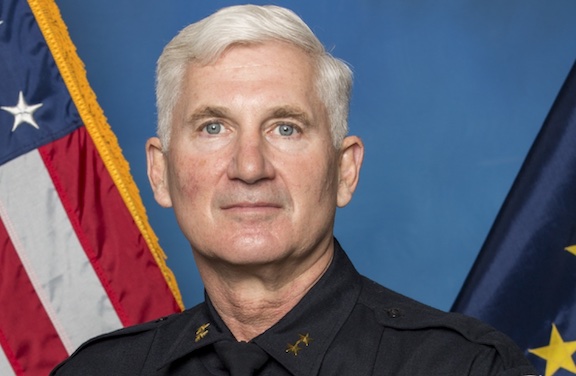
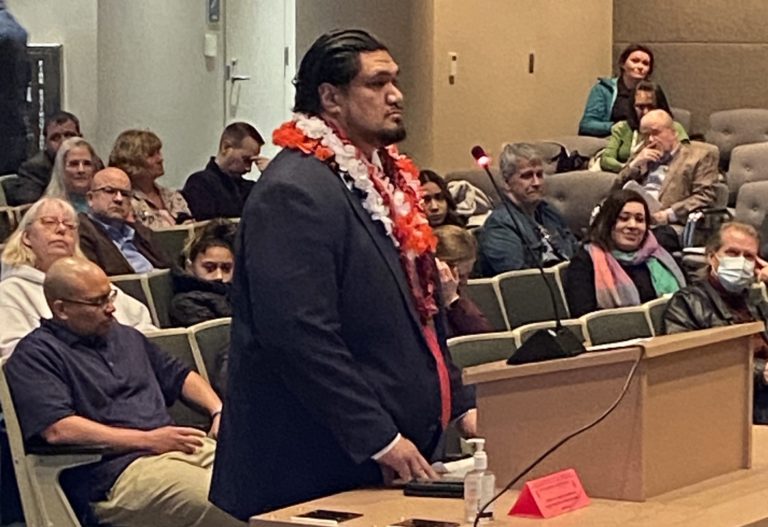
Mayor Dave Bronson announced that Anchorage Police Department Chief Michael Kerle will retire at the end of April after nearly three decades of dedicated service to the Anchorage community.
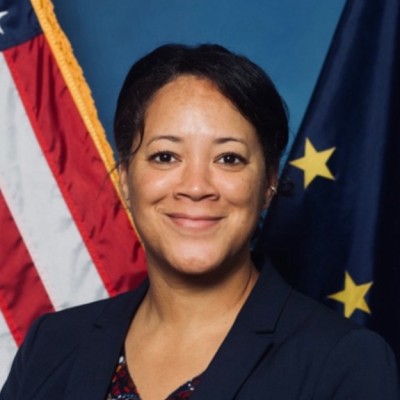
In his place, Mayor Bronson has appointed Police Captain Bianca Cross as the incoming Police Chief.
Bianca Cross, Anchorage Police Department chief of police designee.
Bronson expressed heartfelt gratitude for Chief Kerle’s commitment and exceptional leadership throughout his tenure. “Chief Kerle has been an outstanding leader and valuable asset to the Anchorage Police Department. His dedication to public safety and his tireless efforts have left an indelible mark on our community,” Bronson said.
Kerle was named chief in December, 2021 after the departure of Police Chief Kenneth McCoy. He had long planned to retire even before his promotion, which took effect in February of 2022, and his retirement is not a surprise at City Hall.
Cross has over 26 years of law enforcement experience and is captain at the Detective Division. She was the 2020 Alaska Association of Chiefs of Police Officer of the Year and was given a 2018 Anchorage Police Department Leadership Award.
In the coming weeks, Chief Kerle will work closely with Cross to ensure a smooth transition, culminating in the change of command on April 30. Cross will have to face confirmation from the Anchorage Assembly.
Under a new manpower plan that will cover the state Guards in all 50 states and 4 territories, Brig. Gen. Brian Kile has explained to Task & Purpose that he may be the commander ends up overseeing the Alaska Air National Guard failing to live up to its commitments.
An Alaska ANG analysis reviewed by Task & Purpose projects that the reductions — even if replacements are found — would cause the Alaska ANG to fall short as much as 50% across four key 24/7 alert missions that Guardsman currently fill: two alerts of specially trained radar operators that scan the air and space of Alaska’s borders for NORAD; and two flying missing — search and rescue and air-to-air refueling.
The hardest hit would be the Alaska ANG’s KC-135 tanker fleet, Kile said. “You’re talking about a 40 to 45 percent reduction in our ability to fly missions.” For the NORAD radar monitoring missions, he said, ”you look at how many people it takes to go on the floor and what we can provide is about, five days a week, 16 hours a day in coverage.” And the rescue teams, he said, might only have alert crews available during working days, Task & Purpose reports.
In 1972, NASA launched the Pioneer 10 spacecraft, and a year later, it launched Pioneer 11. These were the first manmade objects sent to explore the outer planets and continue traveling beyond our solar system.
The data they collected multiplied exponentially the scientific knowledge of our planetary neighborhood, and their remarkable journeys outside our planetary system boggled curious minds.
The continued existence of these interstellar travelers, however, is causing concern at the highest levels of government, and a new type of space race is emerging – a race to catch up with the two Pioneer spacecraft and destroy them.
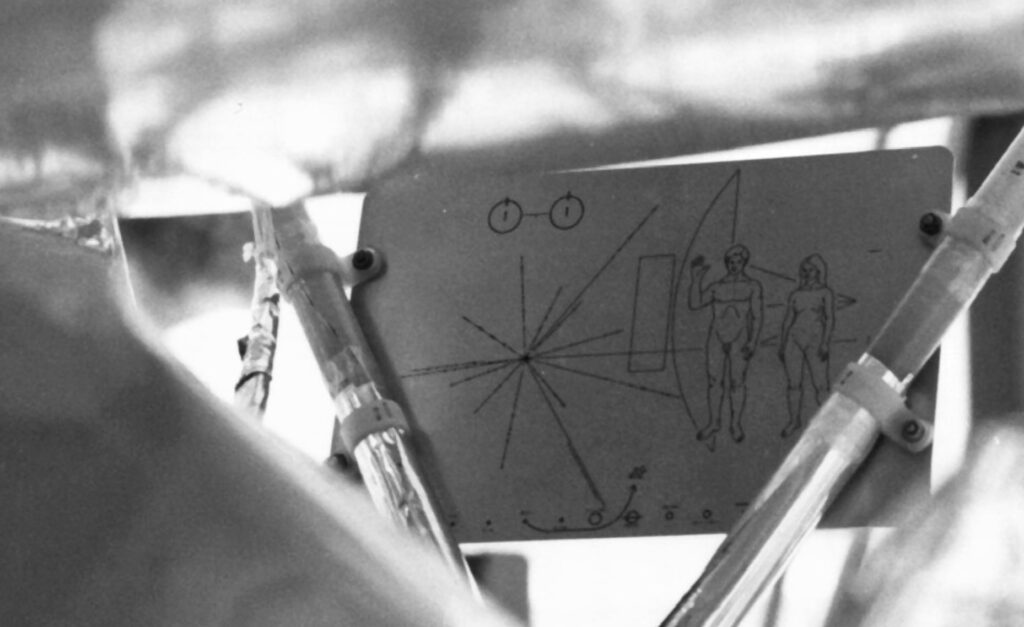
The issue at hand is that on board each spacecraft are gold-plated plaques, nine inches by six inches in size, installed on the infinitesimal chance that some alien beings come in contact with them. These plaques contain information about where the spacecraft originated from. That fact causes concern among scientists, such as the late theoretical physicist Stephen Hawking, who worry humans have put a veritable welcome mat out to advanced civilizations who may want to visit Earth armed with nefarious plans and deadly lasers.
But the real concern is that the plaques also contain drawings of a naked man and woman.
The plaque attached to Pioneer 10.
Tossing aside the alarming issue of exposing bug-eyed grays to soft porn, the Biden Administration, led by transgender Assistant Secretary of Health Rachel Levine, is concerned about the transphobic, binary-centric conclusions some wayward space reptilian might draw from seeing one man and one woman as representative of life on Earth.
An alien, and Assistant Secretary of Health Rachel Levine.
“They’ll think we’re Neanderthals if they find that thing,” said a very senior administration official who declined to be identified just in case she has to take over if the Big Guy forgets how to swallow and drowns in vanilla ice cream. “Which is not to say that Neanderthals were not enlightened in the ways of gender fluidity. Let me tell you something – those Neanderthals were just like regular people. They just had retarded brain function. Well, not retarded; we don’t like to say retarded because that’s a harmful word in some people’s realities, but they were kinda’ slow, you know, in a learning-challenged type of way. Neanderthals wouldn’t have taken the long, yellow school bus if they were around today. They’d ride in the short, yellow school bus. Which is still a nice bus, especially if it’s electric-powered . . . which all buses should be.”
NASA officials being tasked with this hunt-and-destroy mission are just a smidgen concerned about the logistics of it all, as the last communication with Pioneer 10 was in 2003, while Pioneer 11’s last blip was tracked in 1995; and they’ve been hurtling through space at about 27,000 miles per hour since then. One NASA accountant put the odds at coming within a light year of just one of the spacecrafts at one in 643 quadrillion. That’s not even factoring finding both of them and shooting them.
Asked what type of weapon system we would use if we were able to locate and catch up with one of the Pioneers, a Space Force General advised that shooting weapons in space is against international law. “I’m thinkin’ we’d have to latch on to it and fling it into the nearest star or black hole or something. That ought to do it.”
Upon request, a spokesperson for the Office of Management and Budget threw together some rough numbers, calculating the cost of such a venture would be in the neighborhood of three trillion dollars — per day, for six or seven thousand years. “Think of the embarrassment it would save us throughout the galaxy, though,” the accountant concluded.
Asked if Elon Musk’s SpaceX was willing to build a few extra of those really big rockets, another anonymous administration official said, “We don’t mention that name around here any longer. His whole free speech commitment is not really aligned with our truth.”
The consensus among everyone interviewed, though, was that this is a vital mission, to go where no LGBTQ+ person has gone before so that no LGBTQ+ alien would be triggered by seeing a picture of one man and one woman and thinking that was normal for life on Earth.
Tim Barto is the new Interstellar Space Reporter for Must Read Alaska.
The National Association of Intercollegiate Athletics said Monday that transgender women may not participate in women sports in their sanctioned events.
The policy posted on the NAIA’s website states that “Only NAIA student-athletes whose biological sex is female may participate in NAIA-sponsored female sports.” The policy also states that women beginning hormone therapy are not eligible to participate in women’s sports.
“This policy will be subject to review in light of any legal, scientific, or medical developments,” the policy stated.
The Associated Press reported the NAIA Council of Presidents approved the policy in a 20-0 vote during its annual meeting in Missouri.
The NAIA has 240 member colleges and has produced NBA Hall of Famers Scottie Pippen, who played at Central Arkansas, and Dennis Rodman, who played at Southeastern Oklahoma State.
“The NAIA becomes the first national college governing body to mandate athletes compete with their sex,” Riley Gaines wrote on X. Gaines has become an advocate for single-sex sports after she competed in college while at the University of Kentucky against transgender swimmer Lia Thomas, who was on the University of Pennsylvania team.
“Yes!! @NCAA – your move,” wrote former Fox News commentator Megyn Kelly on X.
The Human Rights Campaign criticized the decision.
“Today, the NAIA decided to bar an entire category of people from competition simply because of a right-wing outrage campaign that purposefully misrepresents and distorts the realities of transgender athletes while doing nothing to support women’s sports,” said Kelley Robinson, president of the Human Rights Campaign, in a press release. “The chilling message this sends not just to other sanctioning bodies but also to youth sports leagues across the country is dangerous and it must be stopped in its tracks.”
Have you ever wondered what Alaska gets for the total tax contribution its citizens give the federal government?
Alaska, a Russian-owned 665,384-square-mile piece of property, was $7.2 million sale to the United States in 1867. It remained a territory until 1959 when it was admitted to the Union as a state.
Its original admission was due to a combination of geopolitical, economic and strategic factors. This played out as a mixture of geographic military strategies and natural resource development potentials which offered its residents greater control over their affairs and resources. Alaska residents sought full representation and self-governance through statehood.
With statehood, the proliferation of military strategy development helped build and benefit several communities in Alaska, however, the long-sought dream of Alaskan natural resource development appears to have been bogged down by bureaucratic intransigency and lethargy.
In 2021, Alaskans filed income tax 349,810 returns based on an adjusted gross income of $29,233,555,000 with 641,450 individuals filing. This produced a total income tax liability of $4,216,090,000 or 14.4% of all reported income.
Today, Alaska has a population of some 710,000, yet we are the most federally dependent state in the nation with over 57% of Alaska’s revenue coming from the federal government.
Alaska gets a great return on the taxes its residents pay to the federal government. For every $1 that we as residents pay to federal taxes the state of Alaska receives $2.47 in federal funding or $10,389,233,000 (2021).
Alaska also receives a lot of federal jobs. Almost 5% of the state’s workforce is employed by the federal government compared to other states whose share is between 1% to 3%.
But what do we really get from that dependency?
The federal government through its funding controls the vertical and the horizontal of virtually every governmental function in Alaska. This includes and may not be limited to education, public welfare, hospitals, health, highways, police protection, corrections, natural resources, parks and recreation, governmental administration, utilities, liquor stores, and insurance trusts. With the majority of control, Alaska’s sovereignty as a state is actually a colonial dependency.
Simply put, if Alaska wants this money, Alaska must dance to whatever the piper is playing.
Think of this on a personal note, if you receive more than 57% of your income from the government, it typically means that you are heavily dependent on government assistance or support. This level of dependency on government income has various implications for an individual’s financial stability, self-sufficiency, and overall socioeconomic status.
Being highly dependent on government income affects an individual’s sense of financial independence and autonomy. It limits our ability to pursue opportunities for personal and professional growth outside of government assistance programs. Additionally, such a high level of dependency leads to concerns about long-term sustainability and reliance on taxpayer-funded resources. It also impacts one’s motivation to seek alternative sources of income or engage in productive activities outside of government support.
This high level of dependency on government income has broader societal implications. It strains government resources and budgets, leading to increased fiscal pressure on taxpayers in the form of additional varieties of taxes and potential cuts to essential services.
Moreover, a significant portion of the population relying heavily on government support hinders economic growth and innovation within a society. It contributes to social inequality and disparities, as individuals who are less dependent on government assistance have greater opportunities for economic advancement. Therefore, reducing dependency on government income is essential for fostering individual self-sufficiency and promoting economic prosperity.
It limits one’s ability to pursue personal goals and aspirations independently, as decisions and opportunities become more constrained by government assistance programs. This reliance creates a sense of dependency and diminishes feelings of self-worth and accomplishment. With that the creation of generational entitlements as currently happening in many lower 48 communities manifest to almost irreconcilability.
Financially, being highly dependent on government income leads to vulnerability during times of economic uncertainty or policy changes. Government support programs subject to budget cuts or policy reforms, which result in reduced benefits or eligibility criteria, affecting one’s financial stability.
Moreover, a high level of dependency on government income influences personal attitudes and behaviors towards work, education, and financial planning. It discourages individuals from seeking employment or pursuing higher education opportunities that lead to greater economic self-sufficiency in the long term.
Socially, relying heavily on government assistance impacts relationships and perceptions within communities. It leads to stigmatization or judgment from others, affecting social interactions and self-esteem. Additionally, individuals feel disconnected from broader societal norms and values associated with personal responsibility and contribution to society.
Overall, the personal implications of dependency on government income underscore the importance of fostering individual agency, financial independence, and resilience to navigate life’s challenges more effectively.
Have you ever wondered what Alaska gets for the total tax contribution its citizens give the federal government?
Michael Tavoliero is a senior contributor at Must Read Alaska.
Anchorage Municipal Attorney Anne Helzer penned a letter to the Assembly, in which she said she may have to rescind her “open door” policy with the Assembly after a meeting on April 4 in which a member of the Assembly behaved unprofessionally.
The letter said it was about “Expectation of Respectful Behavior Toward Municipal Employees by the Assembly and Outside Counsel.”
“This letter concerns behavior by an Assembly Member and outside legal counsel to the Assembly that occurred in the Municipal Attorney’s Office on Thursday, April 4, 2024. I am writing to let you know the effect of this inappropriate and unprofessional behavior in our office, how similar disrespectful and unsafe behavior affects our Assistant Municipal Attorneys and our staff employees, and how it has diminished trust in the Assembly and Municipal government,” the city attorney wrote.
“During that meeting, disrespectful and unprofessional behavior was displayed within the Municipal Attorney’s Office. This behavior included name calling, grimacing, yelling through the halls of the Municipal Attomey’s Office, and baseless personal attacks on an Assistant Municipal Attorney and on the department overall. This behavior was an apparent attempt to coerce an Assistant Municipal Attorney to comply with demands attempting to define the parameters of the visit. These tactics failed to intimidate the Assistant Municipal Attorney when she held firm to her ethical and professional duties in the face of this intimidation,” the letter said.
“On April 4, the Assembly provided our department with four hours notice that Assembly leadership, Assembly outside counsel, and Assembly counsel would arrive at 1:00 pm the same day to view confidential legal documents in our conference room. We accommodated this late-noticed demand for departmental time and resources and reprioritized other obligations. However, the conduct during that meeting lacked professional decorum, displayed significant disrespect, and created an environment that caused a Municipal employee to feel intimidated, belittled, and shaken in the workplace. Due to this behavior, I must reconsider my ‘open invitation’ to Assembly Leadership and their outside counsel to visit the Municipal Attorney’s office or meet with staff.”
“The conduct I witnessed yesterday was unprecedented, and I cannot allow it to happen again,” Helzer wrote. “Accordingly, I am considering that future visits from Assembly leadership and their outside counsel take place only afier the Department of Law has been provided with adequate notice. An assigned Assistant Municipal Attorney will be present and will remain for all visits to this office. If Assistant Municipal Attorneys are invited by Assembly members or their counsel for meetings occurring outside of the Municipal Attorney’s office, Assistant Municipal Attorneys may bring additional members of the Municipal Attomey’s Office with them if they elect to do so.”
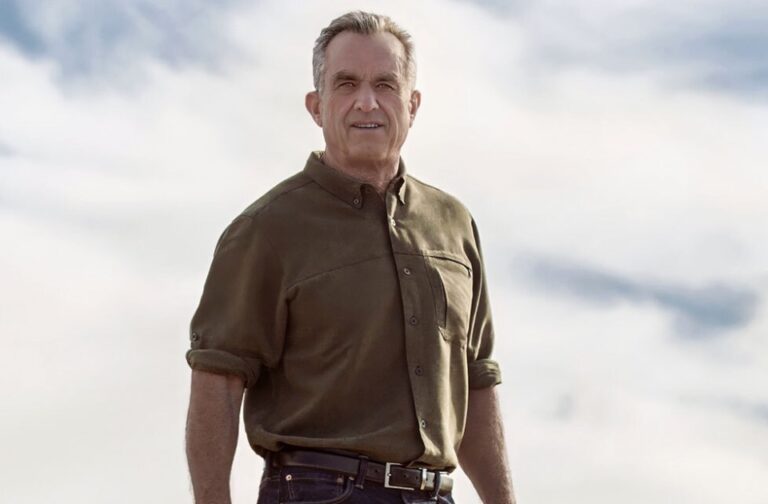
Presidential candidate Robert F. Kennedy, Jr. was a guest on KSRM’s The Talk of the Kenai on April 4. I will characterize the interview here, but for those who want to listen to the commercial-free 45 minute conversation, you may do the following:
At the top right of the Home Page, click “Podcasts”.
Scroll past the “Morning Update” and “Sound Off” programs to “The Talk of the Kenai” and choose Hour 1 on the proper date, above.
Mr. Kennedy’s speech impediment is easy to overlook once you know what to expect, but some listeners may still be unaware of it. It is not the result of a stroke but of damage to his vocal cords.
The Alaskan Independence Party was sought out by the RFK presidential team because we could easily put him on the ballot in Alaska. In the past, some chairmen have placed Constitution Party candidates under the AIP banner, but was discontinued by the late Chairman Lynette Clark because she felt that even with good parties and good candidates, Alaska would be better off avoiding the machinations of national issues and campaign staffs. Her wisdom in this regard may be right.
Negotiations with the RFK team gave us great hope. As you might expect, the staff stressed what we had in common: opposition to Covid tyranny, the weaponization of the federal Justice Department, the open southern border, undeclared wars of dubious purpose and even amending the Jones Act, that endless bugaboo that keeps our cost of living so high, and was a major driving force towards statehood. At one point the staff said that they would even try to get RFK at our Fairbanks convention, which gave us much to worry about finding a venue big enough to hold visitors.
This was scaled back to radio interviews on Alaskan topics. With that, I sent RFK a list of questions so that he could be prepared, as well as the AIP’s colorful and tragic history of its founder Joe Vogler and his mysterious disappearance and murder. I wanted him to be aware of how Sarah Palin was treated simply because she gave a cheerful welcoming address to our 2008 state convention.
The AIP was fully aware that an RFK presidency would be a mixed bag, and the interview proved that the bag contained some absolutely impossible policies for Alaska. Nevertheless, the man has courage and integrity as he has faced the vicious mainstream media’s full guns turned on him. His candidacy now represents an overt threat to the Democratic Party’s power. With an RFK presence, plausible deniability of a Biden victory being engineered by electronic and mail-in voting systems in all fifty states would be harder to maintain.
The ”Plus factor” of the interview:
He was, as expected, foursquare against the forced and coerced Covid vaccinations.
He was strong against the Biden disaster of open borders.
He agreed that the Jones Act should be modified.
He identified the weaponization of the Justice Dept as a threat to the Bill of Rights. Kennedy himself has been denied Secret Service protection, an outrage that ought to be a bi-partisan issue.
The “Minus Factor” of the interview:
When asked about the flawed statehood vote of 1958, he admitted he was only recently briefed, but said that if there was an unfulfilled federal treaty obligation, he would rectify that.
As an environmental lawyer, he sees Alaska’s development of its vast natural resources as something to be controlled by the federal congress. His appointment of Nicole Shanahan as VP firmly glues himself to the Green Lobby.
Despite calling himself an “absolutist” regarding constitutional philosophy, he would deny states rights as returned through the Dobbs decision regarding abortion. When asked about institutionalizing the Roe v. Wade decision through a federal statute, as called for by Biden in a recent major speech, he said that he would sign it. He also tried to mitigate that by calling for supporting wanted pregnancies through federal welfare, an obviously unconstitutional idea — as are most federal welfare programs, anyway.
The control of 65% of Alaska’s lands, along with most of the western states, precludes the stifling of not only Alaska but America’s economy. With states rights being denied for the contentious social issues, Kennedy’s idea of what “absolute constitutionalism” truly means, is not his strength.
Many conservatives see Kennedy’s VP pick as a way to snidely strengthen the Trump campaign, placing him firmly on the Left side of the spectrum. In all likelihood, Kennedy represents merely a fading vestige of fair-minded liberalism. It is impossible to have a perfect candidate for any office. A Ronald Reagan presidency gave Alaska only a temporary mitigation of unconstitutional federal control. A Trump presidency would likely do no better.
The AIP will not be placing RFK on the ballot. Our liberty and prosperity must come from within ourselves, not from a knight galloping in from the Lower 48. The Republican Party is too timid to admit that our 1958 statehood was flawed. Until that is changed, the AIP will continue to be that thin reedy voice of truth, crying out in the wilderness, and placing our Hope elsewhere in the motto: “In God We Trust.”
Bob Bird is chair of the Alaskan Independence Party and the host of a talk show on KSRM radio, Kenai.
The Vatican not only opposes radical “gender theory,” it condemns sex change procedures as harming the “unique dignity” of humans. The Catholic Church issued an updated “Dignitas Infinita” document on Monday, advising against “the age-old temptation to make oneself God.”
The extensive document, signed by Pope Francis, is at this link. It covers war, migration, sex trafficking, violence against women, sexual abuse, abortion, and other afflictions upon human dignity. It also addresses so-called “gender theory.”
“The Church wishes, first of all, ‘to reaffirm that every person, regardless of sexual orientation, ought to be respected in his or her dignity and treated with consideration, while ‘every sign of unjust discrimination’ is to be carefully avoided, particularly any form of aggression and violence. For this reason, it should be denounced as contrary to human dignity the fact that, in some places, not a few people are imprisoned, tortured, and even deprived of the good of life solely because of their sexual orientation,” the document says, acknowledging that humans who have alternate sexual identities must be treated with respect.
At the same time, the Church “highlights the definite critical issues present in gender theory. On this point, Pope Francis has reminded us that ‘the path to peace calls for respect for human rights, in accordance with the simple yet clear formulation contained in the Universal Declaration of Human Rights, whose seventy-fifth anniversary we recently celebrated. These principles are self-evident and commonly accepted. Regrettably, in recent decades, attempts have been made to introduce new rights that are neither fully consistent with those originally defined nor always acceptable. They have led to instances of ideological colonization, in which gender theory plays a central role; the latter is extremely dangerous since it cancels differences in its claim to make everyone equal,'” the document says.
It continues to expound on the dangerousness of gender theory before turning to the natural order and the deconstruction of that natural order through sex change procedures:
“The dignity of the body cannot be considered inferior to that of the person as such. The Catechism of the Catholic Church expressly invites us to recognize that ‘the human body shares in the dignity of ‘the image of God.’ Such a truth deserves to be remembered, especially when it comes to sex change, for humans are inseparably composed of both body and soul. In this, the body serves as the living context in which the interiority of the soul unfolds and manifests itself, as it does also through the network of human relationships. Constituting the person’s being, the soul and the body both participate in the dignity that characterizes every human. Moreover, the body participates in that dignity as it is endowed with personal meanings, particularly in its sexed condition. It is in the body that each person recognizes himself or herself as generated by others, and it is through their bodies that men and women can establish a loving relationship capable of generating other persons. Teaching about the need to respect the natural order of the human person, Pope Francis affirmed that ‘creation is prior to us and must be received as a gift. At the same time, we are called to protect our humanity, and this means, in the first place, accepting it and respecting it as it was created.’ It follows that any sex-change intervention, as a rule, risks threatening the unique dignity the person has received from the moment of conception. This is not to exclude the possibility that a person with genital abnormalities that are already evident at birth or that develop later may choose to receive the assistance of healthcare professionals to resolve these abnormalities. However, in this case, such a medical procedure would not constitute a sex change in the sense intended here.”
The rags-to-riches American story never ceases to inspire, and Alaska’s own Junior Aumavae’s story is no exception. On the most recent episode of STAND with Kelly and Niki Tshibaka, Aumavae told his story, from being a kid born in American Samoa to playing football in the grand stadiums in the NFL, and the trials and triumphs he encountered in between.
Aumavae grew up in a Samoan household, one child of thirteen. His family moved from American Samoa to Hawaii to Washington state, before finally settling in Anchorage. At that point, Aumavae described himself as a “problem child,” struggling in school, constantly getting into fights, and falling in with the wrong crowd. This resulted in him getting suspended from school.
“The road wasn’t always easy. During my time as a youth, there were a lot of troubles that I ran into…a lot of times I was spending my time with the wrong crowd…and ended up going down the wrong path.”
However, all this changed one day when, worried for his future, his mother sent him to the Valley to live with his sister. “That’s where I was able to find and get around the right people to change the trajectory of my future.” Aumavae recounted.
Surrounded by mentors, such as his sister, teachers, and high school football coach, Aumavae began to turn his life around. He emphasized the importance of focus during this time in his life, how learning to see and hear what others were saying was key in becoming a professional football player. Through hard work and focus, Aumavae was drafted into college football.
Life’s challenges, however, did not stop there. Aumavae suffered a multitude of potential career-ending injuries and resulting surgeries. At that point, everyone thought that his football career was finished. However, after being encouraged by his college coach and once again applying his incredible ability to focus, Aumavae fought his way back to football stardom.
Eventually, he was drafted to the NFL, playing for the Dallas Cowboys and New York Jets. He attributed his success to the significant amount of adversity he had to overcome to achieve it. “Many NFL players will tell you their story about adversity and how it made them stronger,” Aumavae told the Tshibakas. “You can have all the mentors in your life, but if the individual is not willing to pick up the tools and build their future, it’s all for nothing.”
Aumavae now has his own nonprofit, Elite Athletic Trend (EAT), where he helps youth to develop the skills necessary to prepare them for success. He also travels to business corporations and schools to tell his story and encourage people to focus on their strength and overcome adversity.
Aumavae’s story is one of perseverance and persistence. His example has influenced many for the better, including in his own family. Though he didn’t know it at the time, Aumavae’s determination, focus, and drive allowed him to take a stand against adversity and life’s challenges. His story will always be one we can look to for inspiration and reassurance of the good that comes from refusing to back down.
If you want to hear more about Junior Aumavae’s path from school suspensions to NFL stadiums, watch the newest episode of STAND. You can also view the episode on YouTube, Rumble, and your podcast streaming platform.
Kelly Tshibaka is the host of the podcast, TV, and radio show STAND, and the 2022 Alaska Republican candidate for U.S. Senate. She co-hosts the show with her husband, Niki Tshibaka.