To those encouraging the legislature to pass good homeschool laws in Juneau, I would say this: you are going into battle against a formidable enemy, and on ground of his own choosing. Tread carefully.
To put it in the immortal words of Jimmy Stewart: “Potter isn’t selling! Potter’s buying!”
If you don’t immediately recognize the scene above, click the link for a refresher (Note: it’s less than a minute).
I have received more questions about homeschooling laws in the last few weeks than I have in the last two years combined.
Despite the backdrop of the recent court ruling, I see homeschool families engaging with legislators as a very positive thing. Honestly, we need a lot more of it. Those who are quiet are often forgotten by legislators in Juneau. Today, the NEA is very loud in the halls of our state capitol building, and homeschooling families are very not loud. In politics, this is always a recipe for disaster.
The questions have been coming faster than my ability to answer them, so I wanted to take a minute to step back and offer some targeted observations as a homeschool dad serving in the legislature. I expect you will find my observations unique, if nothing else.
Background
My family started homeschooling when I was in 1st Grade. We kept at it through high school until I headed off to the Army and West Point. My wife’s experience was far more traditional; various public schools and colleges from kindergarten through her dissertation at Montana State. She is the scientist in the family. Our oldest will be going into 4th grade in the fall. Thus far, homeschooling has been the best choice for our family. It has been anything but easy, but it’s been worth it to us.
Many of the opportunities I enjoyed growing up would not have been possible if my parents hadn’t decided to invest in homeschooling my siblings and me. I entered politics to protect those same freedoms and opportunities for my kids and so many others. It makes me something of an oddity in the legislature. Fame, fortune and ego are motivations that those in Juneau understand; protecting homeschooling, not so much.
To be candid, homeschooling is rarely on anyone’s radar in the capitol building. When it is mentioned, it’s usually a Democrat legislator complaining about how it’s not fair that homeschool students aren’t required to take as many state tests as their peers in brick and mortar schools. On Wednesday night, legislators voted on a bill that will allow Alaska high school students to receive the Alaska Performance Scholarship using either their GPA or their college entrance test exam scores (ACT/SAT, etc.). Until I pointed it out, no one realized that the bill excluded some homeschoolers (i.e. those not affiliated with a school district) from receiving the same scholarship based on their ACT/SAT scores.
HSLDA
The Home School Legal Defense Association (HSLDA) is a national watchdog group that keeps an eye out for discrimination against homeschool students wherever it pops up. During my freshman year in the legislature, they notified us that Alaska had recently begun discriminating against homeschool graduates applying to work in state law enforcement. The Alaska Police Standards Council proposed new regulations requiring that henceforth independent homeschool graduates would need to go and get a GED before they could apply for jobs in law enforcement or corrections. Those regulations were approved by Gov. Bill Walker, and suddenly hurdles began going up.
Between HSLDA and my staff, we were able to help a number of graduates through the process in various creative ways, such as showing how one graduate’s curriculum was actually approved in the state of Tennessee, which was enough to satisfy the new regulations. In other cases, education officials had to be contacted to confirm a particular graduate’s bona fides. With the help of HSLDA, we crafted legislation to return to the way homeschool graduates had been treated for decades. The changes made sense and many legislators came on board to pass them into law.
Then the Alaska Police Standards Council weighed in and said that they didn’t mind making homeschool graduates jump through hoops, and they rather liked the regulations that they themselves had written (no surprise there). As long as there was no opposition, legislators were very glad to stand by homeschool students, but as soon as there was opposition, legislators withdrew their support. The results were disappointing, to say the least.
Big Brother: The NEA
If homeschool families are looking for more educational freedom, their main opponents are those looking for ever more state control over education. The National Education Association (NEA) is one such organization, and they are a monster in the legislature. In March, the NEA lined the halls of the capitol with teachers and came within one vote of overturning Governor Dunleavy’s veto of permanent increases to state education funding (Senate Bill 140). Nationally, the NEA is squarely in the Democrat political camp. Theoretically, the NEA should not be in a position to challenge a Republican governor’s veto in a Republican state with a majority of Republican legislators, but it did, and the NEA came extremely close to prevailing.
Historically, the NEA was not threatened overmuch by the small number of homeschool families in Alaska. With the growth of homeschooling since COVID, that is no longer the case. When the number of homeschool students approached 20,000, they launched a lawsuit against state correspondence programs. It’s about money, and it’s about control. Students are collateral damage.
The NEA counts many legislators among its allies. This was on full display last week during the legislative confirmation of Bob Griffin. For the last five years, Bob has been the single most active and vocal advocate for correspondence students on the State Board of Education. That earned him the ire of the NEA, especially after the veto showdown in March where Bob came out very publicly on the side of the governor and various education reforms. Following the governor’s victory in defending his veto, the NEA and its allies retaliated by calling in chits and torpedoing Bob’s reappointment to the board.
Moments before the vote on Bob’s confirmation, Democrat legislators publicly executed a campaign of character assassination against Bob. It was done to provide excuses for the NEA’s allies in the legislature to vote against an Air Force veteran and long-time advocate for Alaska students. When the chips were down, Twenty-one legislators stood with the governor and Bob, thirty-nine stood against him. After more emails came in supporting Bob, we renewed the effort to confirm his appointment. On the second vote, nineteen legislators still pursued his confirmation, but forty-one voted against pursuing it. Predictably, all nineteen legislators were Republicans. Among the forty-one legislators, there were 14 Republicans, as well as all Democrat/Independent legislators.
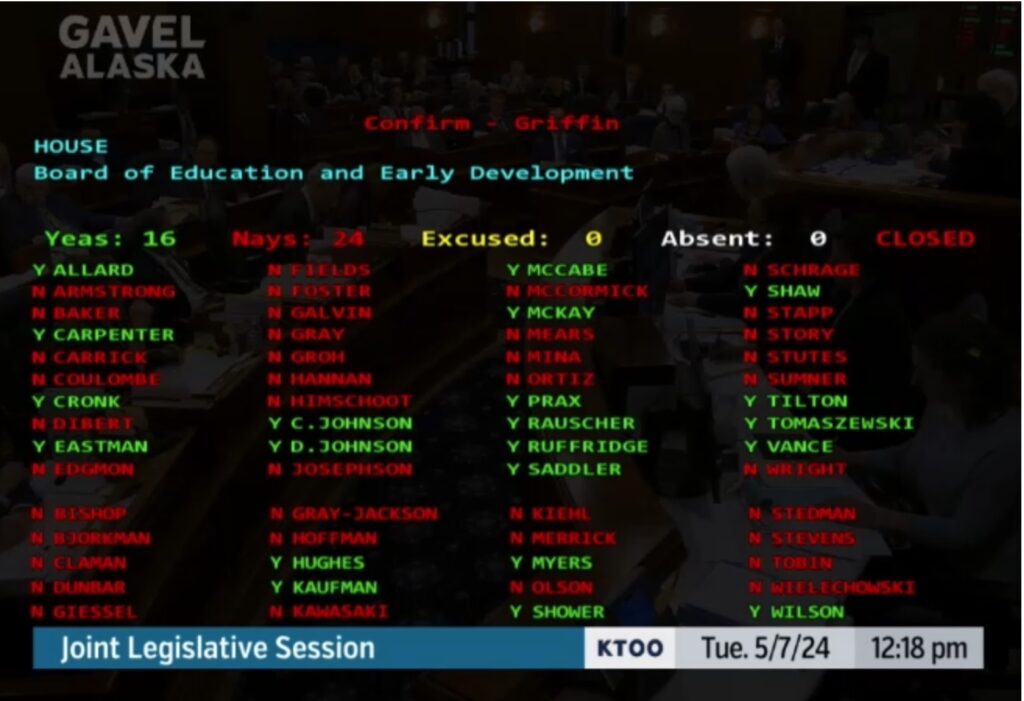
Seconds after Bob Griffin’s confirmation was torpedoed, the same NEA-backed legislator let loose a salvo against the confirmation of Bob’s ally on the Board of Education, Barb Tyndall.
Among other complaints, they declared that Tyndall was unfit to serve on the Board of Education because her 20-plus years of teaching experience had been at private Christian schools. It was a political misstep. From that point forward, her confirmation vote became as much about the state discriminating against Christians as it was about education policy. Unlike Bob, she was allowed to continue on the Board of Education, but twenty-six legislators (including one Republican) still voted to remove her from the board.
The Homeschool Community
I offer the above anecdotes to give you an idea of how lopsided things are in the state capitol building today. An appointee and close ally of the governor was just defeated in the legislature. Four hundred and seventy-one people contacted the Education Committees to keep Bob Griffin on the Board of Education, just using my website alone. Many others signed petitions, made calls, and sent emails. Even in an election year, that was not enough. The reasons why would take some time to unpack, but a fair summary is that homeschool families are not yet a force to be reckoned with in Juneau; the NEA already is.
If you hear me saying that politics is hard, and often unfair, you are right. It is hard, and it’s usually not fair. Bob is a stand-up guy who just got publicly excoriated for standing up for kids. Is it worth it?
If you think of education freedom as simply a “nice to have”, it probably isn’t. On the other hand, if you have come to see education freedom as crucial to your son or daughter’s future, then it is absolutely worth it.
The homeschool community dwarfs teachers organizations like the NEA in size. It isn’t even close. If current trends continue, that disparity will only become more pronounced over time. However, in Juneau, it is not as much about raw numbers as it is about political sincerity. Think of it like a boxing match between boxers of different weight classes. The homeschool community is two weight classes above the NEA in size, but the NEA has been boxing for years, and homeschool families have never been in the ring. In that kind of matchup, “Smart money” is on the boxer with the most training and experience.
The Midwives
The good news is that it doesn’t take years of training to become a force to be reckoned with in Juneau. We just watched one group make that transformation in less than 60 days. In January, the midwives board found themselves unexpectedly on the chopping block when the governor issued a surprise executive order to permanently dissolve their board. The word on the street was that there was nothing they could do about it. The governor wasn’t going to budge, and they had exactly 60 days to convince the legislature to veto the governor’s order, which was unheard of (until it happened).
At the time of the showdown, there were only 44 direct-entry midwives in Alaska. Even so, they reached out to the families they served, past and present, and became a near unstoppable force to keep their board alive. By the time of the vote, 59 legislators (out of 60 total) voted with the midwives to overrule the governor, myself included. The midwives were passionate about their issue and refused to go away quietly. The homeschool community could follow in their footsteps. Some, like the NEA, are banking on the fact that they won’t.
This Summer
At this moment, homeschool families are in a place very similar to where the midwives were in January, at the beginning of the 60 day countdown. It is 45 days until July 1st when Judge Adolph Zeman’s order is timed to go into effect. More immediately, the Alaska Supreme Court has scheduled oral arguments for June 25th, to give them time to render some kind of decision before the July 1st deadline.
The attorney general has advised against advocating for any permanent changes to the laws that deal with homeschooling, and to leave the current laws intact. Legally, it’s a sound argument. The Alaska Supreme Court could come in and overturn Judge Zeman’s decision, and that is exactly what the attorney general is hoping they will do. He is also asking the supreme court to stay the effect of Zeman’s ruling until they have issued their own ruling on the case.
Adolph Zeman
Don’t let anybody fool you, the supreme court is one of the most political organizations in Alaska. If they sense a revolt is brewing in the homeschool community, they will temper their judicial activism to avoid it. They want Judge Zeman retained at the ballot box in November. The chief justice himself personally supervised Judge Zeman’s retention hearing on May 8th. They pulled out all the stops, even asking Judge Zeman’s former law clerk (the judicial equivalent of a former intern) to come testify that Zeman should be retained at the ballot box.
Judge Zeman, very deliberately, did not consider recent U.S. Supreme Court decisions prohibiting discrimination against religious education. This is a major hole in his decision, and speaks volumes to the overtly political nature of the Zeman decision itself. For this reason alone, Judge Zeman merits an impeachment inquiry. Unelected Judges cannot be allowed to play legislator, and Judge Zeman has made himself the most important member of the legislature this year when it comes to state policy dealing with correspondence schools. If Zeman hadn’t intervened in such a dramatic decision, the legislature would still be debating the governor’s proposal to further expand funding for correspondence schools. Instead, the conversation has shifted to the future of correspondence schools themselves and the need for more government regulation.
The Legislature Today
Unfortunately, the legislature is in a truly terrible place right now when it comes to being able to pass good laws on correspondence schools. First, the last election did not play out well for education freedom. Legislators backed by the NEA far out-number those few of us who have connections with the homeschooling community. Second, after the election, NEA-backed legislators rose to positions of power in the legislature. At the same time, the four most conservative legislators, and those most naturally inclined to support education freedom, were effectively exiled for being too conservative, myself included.
In the senate, the three most conservative legislators were blocked from hiring staff, were blocked from serving on legislative committees, and are not part of the bipartisan leadership structure, which currently consists of nine Democrats and eight Republicans. In the house, my staffer was likewise fired, and I was blocked from serving on legislative committees and participating in the current bipartisan leadership structure, which consists of twenty Republicans and three Democrats.
As my state senator, Mike Dunleavy was a vocal proponent of education freedom. He, too, was exiled by the bipartisan majority in the legislature. His staffers were fired. He was stripped of his leadership positions, removed from his committees, and ousted from the majority caucus. For those unfamiliar with what a caucus is, think of it like joining a political party, but only for legislators, and only for two years.
The moral of the story is this: When you have a legislative caucus that is not pursuing a conservative agenda, you don’t need conservative legislators in leadership positions to help implement that agenda. In fact, the more conservative a legislator is, the less you want to put them in charge of anything, lest they put the breaks on your not-so-conservative policies. This is where we are at in 2024 in the Alaska Legislature.
HB400 and HB202
All this to say that the NEA and its allies have many cards to play in the legislature right now, and they have their allies in key leadership positions in both the house and the senate. From those leadership positions, if they want to block a piece of legislation, they can. If they want to add an amendment as a “poison pill“, they can. For the above reasons, it is very unlikely that we would see good legislation make it through the legislature right now, and very likely that any bills that do make it through will undermine the freedoms that homeschool families currently enjoy (like not being saddled with unnecessary state testing requirements).
Some legislators are doing a victory lap right now after passing HB202. This is far from a victory for education freedom.
The NEA gave HB202 a green light. Every NEA-backed legislator voted for it. That ought to tell you, at a minimum, that it doesn’t undermine the NEA’s enduring quest for more government control over education.
If you were following the recent battle over HB400, language that was similar to HB400 was stuffed into HB202 (a bill dealing with drug overdoses at school) late on Wednesday night. This is another reason why, instead of supporting specific bill numbers, it is always a good practice to focus on specific policies when you are talking with legislators. Identify specific policies that will be good for the state to adopt, and put your weight behind those policies. Otherwise, you might end up getting the bill number you asked for, but all of the policies that you didn’t.
By all accounts, it seems likely that the governor will sign HB202 into law in the next few weeks. Once signed, HB202 will put into statute (state law) some of the things that existed in Board of Education regulation back in 2014. Additionally, it will now also require correspondence schools to collect and submit information to the Board of Education, and the board to then submit that information to the legislature. State testing remains optional for parents, but any test results are to be sent to the board and on to the legislature.
With HB202, for the first time, we now have language instructing the board of education to follow the hybrid-Blaine Amendment in our state constitution, which instructs the state not to spend public funds to directly benefit a non-public school. The way this language is being interpreted by Judge Zeman is likely unconstitutional religious discrimination, which is one reason why the governor has appealed the decision. In any event, the portions of HB202 that relate to correspondence schools will automatically go away one year from now anyway. Definitely not a huge win here.
The Board of Education is now set to again take center stage in regulating correspondence schools as they did prior to 2014. Note, this is essentially what would have happened anyway even if HB202/HB400 hadn’t passed.
Let’s not beat around the bush. By asking Judge Zeman to declare Alaska’s correspondence school laws unconstitutional, the NEA deliberately created a crisis to sideline the governor’s 2024 education reforms. They succeeded. They used a flawed court decision—one that they asked for—to manipulate Alaskan families using fear. That is not ok.
On Wednesday, HSLDA and APHEA hosted a webinar on the history of the legislative battlefor independent homeschooling in Alaska. It’s an encouraging story. Homeschool families have fought and won legislative battles before. It’s just been awhile, and we’re really out of practice. Come join the fight!
Rep. David Eastman serves in the Alaska Legislature for Wasilla District 27 (formerly 10).