On Sunday morning, an irritable cow moose charged two men in Homer, kicking and stomping one to death, according to Alaska State Troopers. Medics, Troopers, and Alaska Wildlife Troopers responded to the scene and declared the man deceased; the moose has since left the area. No other information was available on Monday morning.
Update: The deceased has been identified as 70-year-old Dale Chorman of Homer, who was reportedly trying to get close to photograph two moose calves and aggravated the cow moose.
The Alaska Department of Fish and Game reminds Alaskans that it is not that hard to find yourself between a cow moose and her new offspring, a dangerous position in which to be.
If a moose is about to charge, you might observe the long hairs on its hump raising, its ears laid back (much like a dog or cat), and it may lick its lips (if you can see this, you are way too close, Fish and Game reminds).
“A moose that sees you and walks slowly towards you is not trying to be your friend; it may be looking for a hand-out or warning you to keep away. All of these are dangerous situations and you should back away. Look for the nearest tree, fence, building, car, or other obstruction to duck behind,” ADF&G says.
For President Biden and congressional Democrats, the fierce party division over the campus protests and the war in Gaza is full of warning signs during the 2024 election year. The unrest is unlikely to stop when universities break for the summer; protesters are pledging to disrupt the August Democratic National Convention planned to be held in Chicago.
Most House Democrats have been reticent on the antisemitic protests and encampments roiling college graduations this month, while a handful have vocally defended or even celebrated the student protests as displays of protected free speech.
Rep. Ilhan Omar, a Minnesota Democrat, said she was proud of her daughter, a Barnard College student who was suspended for participating in illegal protests and who was among 100 people arrested after demonstrations at Columbia University in April. Throughout the months of campus protests, members of the progressive “squad,” Reps. Rashida Tlaib of Michigan and Cori Bush of Missouri have applauded “courageous” anti-Israel student protestors while condemning efforts by university administrators and police to dismantle the encampments.
A RealClearPolitics analysis of Federal Election Commission data shows one possible reason most Democrats are trying to avoid the campus fray: House Democrats’ reelection campaigns have accepted $6.5 million from three major political families, which have helped bankroll several student groups participating in the protests. The family members cut most of those checks over the last two years, although some of the donations to longstanding House members came over the last decade.
The names are well-known among Democratic funding circles: Soros, Rockefeller, and Pritzker. Yet before the anti-Jewish protests swept college campuses over the last few months, their financial ties to the student groups were not widely known. Illinois Gov. J.B. Pritzker, a member of the same wealthy Pritzker family, is not among the donors.
Several investigative media reports over the last month have uncovered the extensive financial ties between these families and student groups involved in organizing anti-Israel protests and activism across the country predating the Oct. 7 Hamas terrorist attacks on Israel and in its aftermath and during Israel’s war against Hamas in Gaza.
The donors to student groups include George Soros, a billionaire philanthropist and Democratic campaign contributor who helms the Open Society Foundation and his family members; the Pritzkers, the owners of Hyatt Hotels Corporation; and members of the famed Rockefeller family, including relatives of the wealthy American Banker and philanthropist David Rockefeller. The donations have either gone directly to student groups involved in campus demonstrations or to umbrella foundations and organizations, which have, in turn, channeled the funds to the protestors.
The House Democratic Congressional Committee and the House Majority PAC, which was founded by former Speaker Nancy Pelosi and is directly affiliated with the House Democratic leadership, collected most of those funds, nearly $5.5 million by those two Democratic campaign entities alone, FEC records show.
Meanwhile, 30 House Democrats, including Democratic Leader Hakeem Jeffries and other members of the leadership, received a combined total of $856,858 from the Soros, Pritzker, and Rockefeller families, while a dozen Democratic candidates in competitive races received a total of $139,000. RCP did not examine Senate recipients.
The House members in competitive races who received funds from at least one of the three families include Reps. Mary Peltola of Alaska, Mike Levin of California, Yadira Caraveo of Colorado, Johana Hayes of Connecticut, Eric Sorensen of Illinois, Frank Mrvan of Indiana, Sharice Davids, Jared Golden, Hillary Scholten, Angie Craig of Minnesota, Don Davis, Chris Pappas of New Hampshire, Gabe Vasquez, of New Mexico, Susie Lee of Nevada, Steven Horsford of Nevada, Paty Ryan of New York, Marcy Kaptur of Ohio, Andrea Salinas of Oregon, Susan Wild of Pennsylvania, and Matt Cartwright of Pennsylvania.
Craig’s campaigns have received the most of any other House member from the three families: $96,490 since 2018. Lee’s campaign received the second most: $75,000 since 2017.
The Democratic candidates who accepted donations from at least one of the three families include Kirsten Engel in Arizona; Adam Gray, Rudy Salas, George Whitesides, and Will Rollins in California; Lanon Baccam in Iowa; Tony Vargas in Nebraska; Lauren Gillen, Mondaire Jones, and Josh Riley in New York; Ashley Ehasz in Pennsylvania; and Michelle Vallejo in Texas.
Neither the DCCC nor any of the House members and candidates responded to RealClearPolitics’ questions about whether they had any concerns about the financial ties between the Soros, Pritzker, and Rockefeller families to these student groups.
Several organizations have played key roles in pro-Palestinian student activism and protests and have received donations from Soros, Pritzker, and Rockefeller family members. The U.S. Campaign for Palestinian Rights, a pro-Palestinian advocacy group, has received at least $700,000 in Open Society Foundation grants since 2018 and $355,000 from the Rockefeller Brothers since 2019.
In 2023, the USCPR had three fellows – Nidaa Lafi, Craig Birckhead-Morton, and Malak Afaneh – all of whom have figured prominently in the nationwide protests, the New York Post reported in late April. The group provides up to $7,800 for its community-based fellows and between $2,880 and $3,660 for its campus-based fellows for spending at least eight hours a week organizing campaigns led by Palestinian organizations.
While all were involved in student protests over the last several months, the University of California at Berkeley’s Afanah, co-president of Law Students for Justice in Palestine, made the most headlines. Afanah commandeered a microphone during a graduation dinner at the law school dean’s home to speak out against Israel’s war in Gaza. She claimed a First Amendment right to disrupt the gathering and then accused the dean’s wife of assaulting her when she forcefully asked her to leave.
The Open Society Foundations defended its funding of these groups and their right to “peacefully protest” in an April 26 X.com post.
“We have a long history of fighting antisemitism, Islamophobia, and all forms of racism and hate, and have advocated for the rights of Palestinians and Israelis and for peaceful resolution to the conflict in Israel and the Occupied Palestinian Territories,” the Foundations said.
“Our funding is a matter of public record, disclosed on our website, fully compliant with U.S. laws, and is part of our commitment to continuing open debate that is ultimately the only hope for peace in the region,” the organization asserted.
Jewish Voice for Peace and IfNotNow are two additional organizations deeply involved in the student protests and backed by the Tides Foundations, which is Soros-funded. Jewish Voice for Peace, which openly describes itself as anti-Zionist, has also received $500,000 in funds from the Rockefeller Brothers Fund over the last five years. David Rockefeller Jr. sits on the Rockefeller Brothers’ board. The group has separately provided grants to both the Tides Foundation and the Tides Center, as Politico reported in early May.
The Pritzkers founded the Libra Foundation, which seeds smaller nonprofits, many of which have participated in pro-Palestinian marches, according to the same Politico report. One of them is the Climate Justice Alliance, which has labeled President Biden “Genocide Joe” for his handling of Israel’s war against Hamas in Gaza.
Others benefitting from Pritzker largesse include Black Organizing for Leadership and Dignity, which has helped promote anti-Israel protests, and the Immigrant Defense Project, which participated in a protest in D.C. earlier this year in which police arrested a number of participants. The Pritzkers also help financially support the Tides Foundation, which funds other small left-wing groups, including Adalah Justice Project, a prominent participant in the Columbia University protests and encampment, which police disbanded in early May.
House Republicans have launched multiple investigations into the funding of the campus protests and encampments. Earlier this week, the chairs of two GOP-led House committees, the Education and the Workforce and the House Oversight and Accountability panels, sent Treasury Secretary Janet Yellen a letterrequesting all suspicious activity reports, or SARs, connected to 20 organizations that have reportedly led, financed, and participated in the antisemitic protests on college campuses. SARs are documents that financial institutions and other professionals file with the Treasury’s Financial Crimes Enforcement Network to flag law enforcement to potential instances of money laundering or terrorist financing.
“It’s no coincidence that the day after the October 7 Hamas terrorist attack, antisemitic mobs began springing up on college campuses across the country,” Rep. Virginia Foxx, who chairs the Education and the Workforce Committee, said in a statement. “These protests have been coordinated and well-organized, indicating that outside groups or influences may be at play. American education is under attack. It’s critical that Congress investigates how these groups, who are tearing apart our institutions, are being funded before it’s too late.”
House Oversight Chairman James Comer pledged that his committee would follow the money trail and stressed that the antisemitism “thriving” on many college campuses “must not go unchecked.”
Topping the list that Foxx and Comer sent Yellen is Students for Justice in Palestine, or SJP, which has close ties to several anti-Israel organizations. After the Oct. 7 attacks, Students for Justice in Palestine’s national steering committee distributed a “tool kit” for activists that proclaimed, “glory to our resistance” and included a template for an advertisement showing protesters beneath a Palestinian flag. The image contained a paraglider, an apparent tribute to Hamas’ use of paragliders who slaughtered 360 youthful concert-goers, raped others, and took 44 people hostage during the Oct. 7 attack. That tool kit drew criticism from the Anti-Defamation League, which accused it of “celebrating terrorism.”
Students for Palestine has since been banned or suspended by Brandeis, Columbia, and George Washington University, among other colleges and universities. During his presidential campaign, Florida Gov. Ron DeSantis banned the group from state campuses, referring to their alleged ties to Hamas.
“We had a group of Students for Justice in Palestine,” DeSantis said. “They claimed solidarity with Hamas. We deactivated them. We were not going to use tax dollars to fund jihad.”
A 2016 report from the Cohen Center for Modern Jewish Studies at Brandeis stated that having a chapter on campus is “one of the strongest predictors of perceiving a hostile climate toward Israel and Jews.”
The Foundation for Defense of Democracies’ Jonathan Schanzer, a former Treasury official responsible for designating numerous terrorist financiers, said his organization has been watching the financial network behind Students for Justice in Palestine for several years. The group, he said, has an umbrella organization known as Americans Muslims for Palestine, or AMP, a nonprofit that was previously based in Chicago but more recently moved to Falls Church, Virginia. For the last several years, AMP has been embroiled in litigation, accusing it of being an “alter-ego” or shell organization for the Islamic Association for Palestine, or IAP, a disbanded organization linked to Hamas.
In 2023, Schanzer testified before the House Ways and Means Committee that IAP had received numerous checks and deposited them into Hamas’ bank account, information uncovered during the litigation. In some cases, the deposits included the memo line “for Palestinian martyrs only,” Schanzer noted.
Hatem Bazian, AMP’s founder, was a frequent speaker at IAP forums, and Osama Abuirshaid, who edited IAP’s newspaper, is now AMP’s executive director, Schanzer said. In addition, Abuirshaid has published articles in English and Arabic praising Hamas, noting in them that he has communicated with Hamas leader Mousa Abu Marzook.
AMP created Students for Justice in Palestine, which started with just a handful of schools and has now expanded to 200 U.S. campuses with chapters. The group is a loosely connected network of autonomous chapters with no named leader. The structure allows it to avoid registering as a nonprofit and filing tax documents. Bazian, who founded the first chapter 30 years ago at the University of California at Berkeley, has described the student organization as “a symbolic franchise without a franchise fee.”
Bazian, who is now the chairman of American Muslims for Palestine’s board and a lecturer at Berkeley, has downplayed its ties to the student organization. He says AMP has only provided printed materials and offered grants for students to attend conferences or host speakers but has no supervisory role or control over the Students for Justice in Palestine.
Schanzer, however, strongly disagrees. While he stresses that FDD has not produced any evidence of present criminal wrongdoing implicating AMP, he argues that AMP and its organizers deserve intense scrutiny from members of Congress. AMP, he said, has, over the last two decades, provided checks to students at Northwestern, DePaul, and Loyola universities, among others.
Last year, Bazian curiously criticized CNN’s Jake Tapper’s “racist” coverage of Rep. Tlaib, arguing in a post from his own X.com account that, “As Jews who believe in human rights and justice, we demand you do better.” Schanzer notes that Bazian is Muslim, not Jewish, and the tweet has led to suspicion that Bazian thought he was logged into Jewish Voice for Peace’s account but mistakenly tweeted from his personal account.
Nine Americans and Israeli survivors and victims of the Oct. 7 Hamas attacks are suing AMP and Students for Justice in Palestine, alleging that groups collaborated with Hamas to legitimize the Hamas attacks and provide public relations services for the terrorist organization. Meanwhile, the University of Florida chapter of Students for Justice in Palestine sued the state, challenging the Chancellor of the State University System’s order to state universities to deactivate the student group.
Susan Crabtree is RealClearPolitics’ national political correspondent.This article was originally published by RealClearPolitics and made available via RealClearWire.
Editor’s note from Alexander Dolitsky: My late friend and colleague Jeff W. Hahn initially published this insightful article in the “Allies in Wartime: The Alaska-Siberia Airway during WWII,” edited by Alexander Dolitsky, Alaska-Siberia Research Center, Juneau, Alaska.
The purpose of this article is to place the story of cooperation along the Alaska-Siberia Lend-Lease Airway during WWII into a larger context — the development of Russian-American relations over time.
Since 1917, relations between Russia and the United States have alternated between periods of competition and cooperation. My thesis is that whether relations have been cooperative or competitive has depended on the degree to which the leaders of the two sides have perceived that they have a common interest.
This was clearly the case during World War II, when the two countries allied in the face of Hitler’s aggression in Europe; the Lend-Lease cooperation was a particularly clear and dramatic example of that. At the time, the memorial to Lend-Lease operation was unveiled in Fairbanks, Alaska, on Aug. 27, 2006, the two countries again found themselves cooperating in the face of another common enemy—this time, the threat of global terrorism.
Initial American reaction to Soviet Russia was hostile. In 1917, after the October Revolution in Russia, the U.S. joined other European countries in efforts to weaken the Bolshevik regime. They originally supported a “Cordon Sanitaire”intended to isolate the Bolshevik government diplomatically.
Editor’s addition: French Prime Minister Georges Clemenceau is credited with the first use of the phrase “cordon sanitaire” as a metaphor for ideological containment. In March of 1919, he urged the newly independent border states that had broken away from Bolshevist Russia to form a defensive union and thus quarantine the spread of communism to Western Europe; this he called a cordon sanitaire. This is still probably the most famous use of the phrase, though it is sometimes used more generally to describe a set of buffer states that form a barrier against a larger, ideologically hostile state. According to historian André Fontaine, Clemenceau’s cordon sanitaire marked the real beginning of the Cold War; thus, it would have started in 1919 and not in the mid-1940s as most historians contend.
In fact, until 1933 the U.S. government refused to recognize the Communist government in Soviet Russia. In the 1930s, however, both countries increasingly found a common interest in their shared opposition to the emergence of fascism in Europe. From 1941 to 1945, they entered into an alliance against Nazi Germany and its Axis powers.
After 1945, relations between the Soviet Union and the United States continued to alternate between cooperation and competition. The period from the end of 1945 to about 1965 was a time of great hostility known as the beginning of the “Cold War”— cold only because actual military conflict did not occur. American policy, based on a perception of the Soviet Union as an expansionist power, was one of “containment.”
The Soviet Union was seen as an imperialistic power whose communist ideology justified its global ambitions. Soviet expansion could only be deterred by the threat of countervailing power. Containment theory received concrete expression in Europe in the NATO alliance and was later extended to alliances in Asia and the Middle East. By 1965, the Soviet Union was encircled by these hostile alliances.
At the end of the 1960s, the initial phase of the Cold War was replaced by a new period of cooperation known as “détente.” Again, cooperation grew out of a common interest—this time, a shared desire to control the growth of nuclear weapons. Although the recognition of this common interest can be seen in the 1967 Non-Proliferation Treaty, détentereached its zenith with the Strategic Arms Limitation Treaty (SALT) of 1972. The Anti-Ballistic Missile Treaty (ABM Treaty) in particular was evidence that both sides accepted the concept of Mutual Assured Destruction, which is based on the assumption that the security of both sides depends on the ability of each to destroy the other.
The other important result of détente, of course, was the political settlement in Europe known as the Helsinki Agreement, signed in 1975, which signaled an acceptance by all parties of a territorial status quo in Europe.
By the late 1970s, however, cooperation was replaced once again by competition. First, the Carter Administration (1976-1980) made human rights issues a priority in its foreign policy and accused the Soviet Union of violating them, pointing to the issue of Jewish emigration to the West in particular.
It was when Ronald Reagan became the U.S. president in 1980, however, that relations became so confrontational that one could speak of a new “Cold War.” Going beyond human rights issues, Reagan condemned the communist Soviet Union as an “Evil Empire” and abandoned the SALT process of limiting arms, arguing instead that nuclear arms must be reduced to the levels established in the original Strategic Arms Reduction Treaty, often known as START.
Further, Reagan insisted that the Soviet Union had forsaken détente by increasing its nuclear and conventional military forces. His response was to deploy a new generation of medium range missiles in Europe and to propose a comprehensive missile defense system known as the Satellite Defense Initiative or “Star Wars.” By 1985, all negotiations between the Soviet Union and the United States had ended.
Relations between the Soviet Union and the United States entered a new period of cooperation after Mikhail Gorbachev became general secretary of the Communist Party of the Soviet Union in 1985. Gorbachev adopted a new approach to Soviet foreign policy, which he called “New Thinking.” For Soviet-American relations, “New Thinking” applied to security meant that under Gorbachev’s leadership important agreements on reducing weapons could be achieved. The very first breakthrough on this issue came in 1987, when the two countries signed the Intermediate Nuclear Force Agreement eliminating all medium range missiles in Europe. This was followed by the Conventional Forces in Europe Agreement in 1990, a new Strategic Arms Reduction Treaty in 1991, and other agreements on weapons.
Along with these remarkable achievements in the area of military relations, other issues that had been sources of conflict between Soviet Russia and the United States also began to find resolution. By 1989, the U.S.S.R. had withdrawn from Afghanistan. The Berlin wall came down in the same year and free elections in the communist nations of East Europe brought non-communist governments to power, for the most part without violence.
Perhaps the most compelling evidence for the emergence of a new world order in which the Soviet Union would cooperate with the United States to preserve world peace was Soviet support at the United Nations for the use of force against Iraqi aggression in Kuwait. In short, by 1991, all the major issues of contention between the Soviet Union and the United States were ended. It seemed that a new era of cooperation was in place.
By the end of 1991, however, the U.S.S.R. had disintegrated into its 15 constituent republics, the largest of which was the Russian Federation. What would this mean for Russian-American relations? At first, the cooperative relationship that had developed under Perestroika [economic restructuring] and Glasnost [freedom of expression and political openness] continued to characterize relations between post-communist Russia and the United States. President Yeltsin and his foreign minister, Andrei Kozyrev, seemed committed to a pro-western orientation. For one thing, they continued to support United Nations sanctions against Iraq. In the area of nuclear arms reduction, they joined with the U.S. and the former Soviet republics of Ukraine, Belarus, and Kazakhstan to sign a protocol for START I in Lisbon, Portugal in 1992, which would enable START I to be implemented by returning all nuclear weapons in the former Soviet republics to Russia.
In January 1993, shortly before he left office, President George Walker Bush signed the START II agreement with President Yeltsin, calling for the reduction of nuclear weapons to half of their previous levels.
By the end of 1994, however, relations began once again to shift. In foreign policy, debate in Russia over whether continued cooperation with the West truly served Russian national interests was growing. Those arguing that American and Russian interests no longer coincided could point to a number of issues: American criticism of Russia’s actions in Chechnya in 1995; NATO expansion to the East including Poland, Hungary and the Czech Republic in 1997; the use of NATO military forces against Serbia, first in Bosnia in 1994, and then in Kosovo in 1999; and growing differences over Russian relations with Iraq and Iran.
As a result, although the U.S. Senate ratified START II in 1995, by 2000, the Russian Parliament had still refused to do so. Perhaps nothing made Russia more concerned about American intentions than the growing consensus in the U.S. government in support of the ballistic missile defense system, in violation of the 1972 ABM treaty. In short, by the time he left office on December 31, 1999, Yeltsin could accurately describe relations between East and West as a “Cold Peace.”
When Vladimir Putin became acting president of Russia on Jan. 1, 2000, little was known about him or his views on foreign policy. The first sense of what direction he might take came even before his inauguration as president in May 2000, when as “acting president” he managed to achieve what Yeltsin could not: Duma ratification of START II (although with the condition that the ABM Treaty remain in force). This, coupled with his inaugural speech emphasizing the importance of economic growth and the need to integrate Russia’s economy into the global economy, suggested a return to a more pro-western orientation.
From the American side, the year 2000 was dominated by the race for president. Relations with Russia were not an important issue in the campaign. After taking office in January of 2001, the initial attitude of the Bush Administration toward Russia was cool. Nevertheless, the administration’s general indifference toward Russia had begun to change, even before the events of September 11, 2001. During their first meeting in Slovenia in June 2001, Bush and Putin appeared to establish a warm personal relationship. As was reported by Frank Bruni, in “Leaders’ Words at First Meeting are Striking for Warm Tone,” New York Times, June 17, 2001, President Bush observed: “I looked the man in the eye. I found him to be very straight forward and trustworthy… I was able to get a sense of his soul.”
After Sept. 11, 2001, the dynamics of Russian-American relations completely changed to a better prospect. Once again, it is because of the perception of leaders on both sides that they have a common interest—this time in defeating the terrorism associated with radical Islamic fundamentalism.
Despite continuing differences on a number of issues, ranging from the sale of nuclear reactors to Iran and Russian criticism of the Bush administration’s decision to invade Iraq, the fact is that today [2007], as in the past, Russian-American relations continue to depend on mutual perceptions of common interests. For now, at least, those common interests compel both sides to cooperate just as they did with the Lend-Lease partnership during World War II.
Editor’s addition: From 2014 to present, Russian-U.S. relations again entered the phase of the “Cold Peace” or the “Cold Tension” over the situation in Ukraine, including the annexation of the Crimean Peninsula in 2014 and Russian invasion of Ukraine in February of 2022. The following articles in this series will provide a diverse and comprehensive overview of the World War II remarkable cooperation between two countries—one that will serve as a benchmark for future studies on this important subject.
***
Jeffrey Hahn was a professor of political science at Villanova University in Pennsylvania. This column was edited and adapted by Must Read Alaska senior contributor Alexander Dolitsky. Dolitsky was born and raised in Kiev in the former Soviet Union. He received an M.A. in history from Kiev Pedagogical Institute, Ukraine, in 1976; an M.A. in anthropology and archaeology from Brown University in 1983; and was enroled in the Ph.D. program in Anthropology at Bryn Mawr College from 1983 to 1985, where he was also a lecturer in the Russian Center. In the U.S.S.R., he was a social studies teacher for three years, and an archaeologist for five years for the Ukranian Academy of Sciences. In 1978, he settled in the United States. Dolitsky visited Alaska for the first time in 1981, while conducting field research for graduate school at Brown. He lived first in Sitka in 1985 and then settled in Juneau in 1986. From 1985 to 1987, he was a U.S. Forest Service archaeologist and social scientist. He was an Adjunct Assistant Professor of Russian Studies at the University of Alaska Southeast from 1985 to 1999; Social Studies Instructor at the Alyeska Central School, Alaska Department of Education from 1988 to 2006; and has been the Director of the Alaska-Siberia Research Center (see www.aksrc.homestead.com) from 1990 to present. He has conducted about 30 field studies in various areas of the former Soviet Union (including Siberia), Central Asia, South America, Eastern Europe and the United States (including Alaska). Dolitsky has been a lecturer on the World Discoverer, Spirit of Oceanus, andClipper Odyssey vessels in the Arctic and sub-Arctic regions. He was the Project Manager for the WWII Alaska-Siberia Lend Lease Memorial, which was erected in Fairbanks in 2006. He has published extensively in the fields of anthropology, history, archaeology, and ethnography. His more recent publications include Fairy Tales and Myths of the Bering Strait Chukchi, Ancient Tales of Kamchatka; Tales and Legends of the Yupik Eskimos of Siberia; Old Russia in Modern America: Russian Old Believers in Alaska; Allies in Wartime: The Alaska-Siberia Airway During WWII; Spirit of the Siberian Tiger: Folktales of the Russian Far East; Living Wisdom of the Far North: Tales and Legends from Chukotka and Alaska; Pipeline to Russia; The Alaska-Siberia Air Route in WWII; and Old Russia in Modern America: Living Traditions of https://mustreadalaska.com/alexander-dolitsky-setting-the-record-straight-on-israels-history-with-palestinians/the Russian Old Believers; Ancient Tales of Chukotka, and Ancient Tales of Kamchatka.
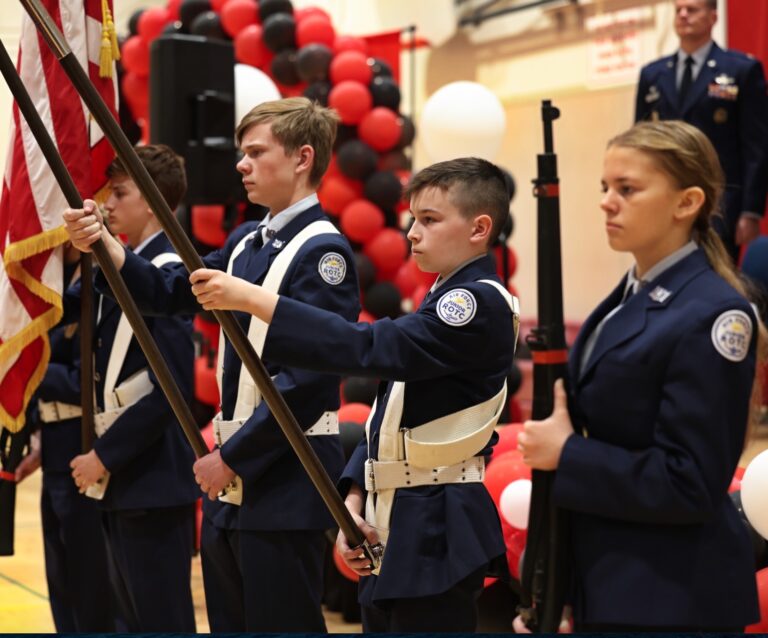
The final graduation ceremony has taken place and the tassels flipped. Seventy years after the first graduating class of 1954, when there were just three graduates, the Class of 2024 received their diplomas on May 15. They will be known as the last class of Eielson Ravens, as budget constraints and demographics have led to the closing of the school.
Preparations are being made to absorb the other Eielson students into North Pole middle and high schools, said School Superintendent Luke Meinart, after the board decided on March 19 that Eielson would be the one campus to close this year.
“I recognize the closing of Ben Eielson Jr/Sr High is incredibly hard news for impacted students, families, and staff. This wasn’t an easy choice for the school board and I know the deep sense of loss and uncertainty it may cause families and staff. While school closure is extremely challenging, the long-term goal is to provide better and more efficient services for students,” he wrote to the community.
“I want to acknowledge the incredible ways the Ben Eielson community showed up to advocate, and I’m committed to ensuring our Ben Eielson students have quality education opportunities. Work has already begun with North Pole Middle and North Pole High to ensure transitioning students will be welcomed and set up for success in their new schools,” he said.
Photos by FNSBSD’s Mariko Kinikin
Outside the school, a boulder was painted in red, white, and black: “THE FINAL CLASS.”
Located on Eielson Air Force Base, Junior and Senior Eielson High School was ranked 11th in the state for academics. The graduation rate was 92%, above the state average. This year, there were about 60 freshmen, 66 sophomores, and 46 juniors, according to U.S. News and World Report. Between the junior and high school, the student body totaled 411.
Watch the moving final ceremony for the final Eielson Ravens, as the 41 students who graduated walk into their futures:
Mary Peltola announced the endorsement of the Calista Native Corporation earlier this month, an endorsement that came just after she reversed her stance on the proposed Donlin Mine, which would be developed on Calista-owned land, if the federal government will grant water and other permits.
Peltola worked for the Donlin Mine project as a “community manager” for six years. But when she ran for Congress in 2022, she campaigned against the mine’s development.
The president and chief executive officer at Calista Native Corporation is Andrew Guy.
Guy is also on the board of a pop-up group called the Alaska Jobs Coalition. The website for the new group was created by the Ship Creek Group, a leftist political campaign group in Anchorage that has worked on the campaign of Peltola and many other Democrats in Alaska. Its members include Joelle Hall, president of the Alaska AFL-CIO, also a supporter of Peltola. The funding for the group is not revealed.
The entire “Donlin reveal” appeared to be one big coordinated event, although Peltola’s flipping on the mine has upset some of her Native supporters, who thought she was about “Fish, Family and Freedom.”
The timeline of the events:
April 10: The website domain AlaskaJobsCoalition.org is reserved for one year by Ship Creek Group, which does work for Peltola’s campaign.
April 23: News hits that Peltola comes out in favor of the Donlin Mine.
April 23: Calista, whose president and CEO is Andrew Guy, endorses Peltola.
May 14: Alaska Jobs Coalition, endorses Peltola in an op-ed in the Anchorage Daily News, and the next day it appears in the Fairbanks Daily News-Miner.
“The Alaska Jobs Coalition is not affiliated with any candidate or electoral campaign,” the op-ed states.
Then the group says, “Rep. Mary Peltola has consistently put Alaska jobs first in her votes supporting domestic energy production. Mary’s work with the White House was instrumental in getting approval for ConocoPhillips’ Willow oil project on the North Slope at a time when the administration has fought oil and gas projects elsewhere in Alaska.” But it doesn’t say explicitly that this is an endorsement, because that would run afoul of campaign laws, since the group is not officially doing campaign activities.
May 14: Alaska Jobs Coalition website formally launches. As of May 19, it is not registered with the Federal Elections Commission as a super PAC.
Alaska Jobs Coalition members, along with Calista’s Andrew Guy and AFL-CIO’s Joelle Hall, include Joey Merrick, business manager for Laborers’ Local 341; Gary Dixon, secretary and treasurer of Alaska Teamsters; Doug Tansy, business manager of IBEW Local 1574; Heidi Drygas, executive director of ASEA AFSCME Local 52; Barbara ‘Wáahlaal Gidaag Blake, vice president for Arctic Conservation of Ocean Conservancy and Juneau Assembly member; and trial lawyer Matt Singer, who specializes in Alaska Native corporation law.
The sequence of events has some of the markings of a coordinated, quid-pro-quo deal made in order to advance the interests of Calista and Rep. Peltola’s reelection, now just three months away. Ballots for military members living overseas will be in the mail in about 45 days, thus the campaign season is now in full swing.
Meanwhile, Peltola’s personal financial disclosure report, due May 15, is not on file with the Clerk of the Congress. She has asked for an extension and her financial ties will not be revealed until Aug. 13, just one week before the end of the Aug. 20 primary. In her 2022 filing, she did not disclose that she is a Calista Shareholder and receives annual dividends from the corporation.
Donlin, the proposed mine located on land owned by the Kuskokwim Corporation (surface estate) and Calista Corporation (subsurface estate), is jointly owned by Barrick Gold US Inc. and NovaGold Resources Alaska, Inc. Calista shareholders, including Peltola, stand to make significant passive earnings from the mine.
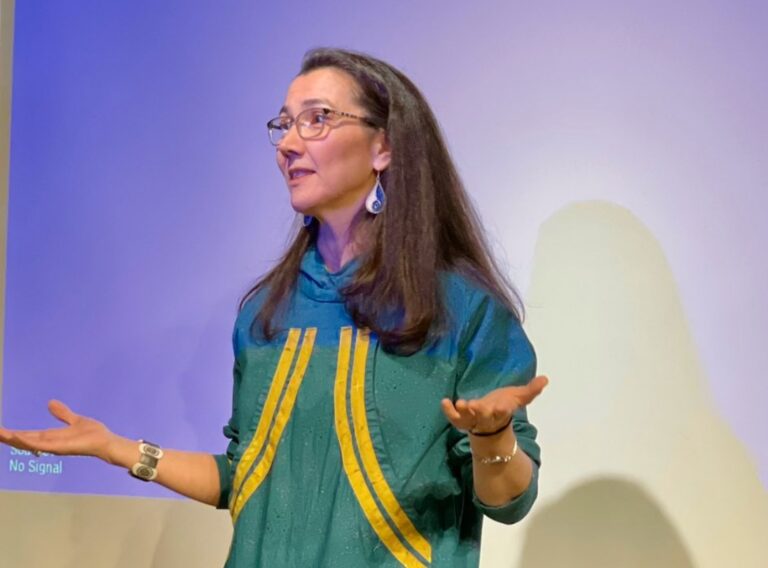
Rep. Mary Peltola was scheduled to speak at the Bethel Regional High School graduation, appearing in a pre-recorded message on Friday.
But the audiovisual feed was glitchy and kept switching to random internet content, such as a promotion for the comedy film “Argylle,” all making her message unintelligible to the Class of 2024, but providing lots of hoots and laughs.
The audio was inaudible and the videotaped message from Rep. Mary Peltola kept getting interrupted by random internet content showing up on the screen, but the show must go on, and thus the graduating class of 2024 at Bethel Regional High School had a memorable day, full of a few… pic.twitter.com/RRs75Ag8xx
Peltola was on her way to Juneau, where she partied with Democrats on Friday night, including National Democratic Party Chairman Jaime Harrison, who had flown in for the state convention. Peltola was the keynote speaker on Saturday at the gathering of top Democrats from around the state, with several Democrat legislators in attendance.
Meanwhile, Republican congressional candidate Nick Begich was at the Cruisin’ With Santa Car Show in North Pole, sponsored by the Lions Club, where a couple of thousand people came through on Saturday to look at classic cars and savor the goodies from food truck vendors in the Hotel North Pole parking lot.
Begich also attended Fairbanks Aviation Day at the Fairbanks International Airport and appeared on five radio shows in Alaska between Friday and Saturday. In Salcha, he had a fundraising event at Arctic Harvest Farm Distillery took a tour of the facility, which is the farthest-north farm-to-bottle distillery in North America, growing the grain used in the production of its spirits.
Congressional candidate Nick Begich tours the Arctic Harvest Farm Distillery in Salcha, Alaska.
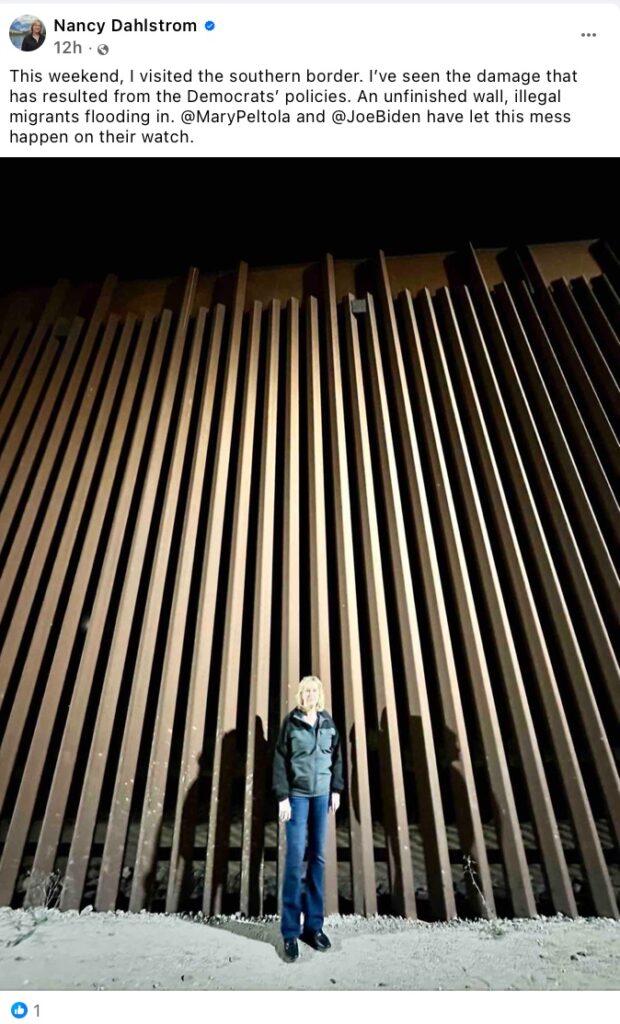
Congressional candidate Lt. Gov. Nancy Dahlstrom was at the southern border in Texas, where, as seen in the photo below, she viewed part of the unfinished border wall and appeared at a private campaign fundraiser.
Editor’s note: The report does not include whether Raisi has died.
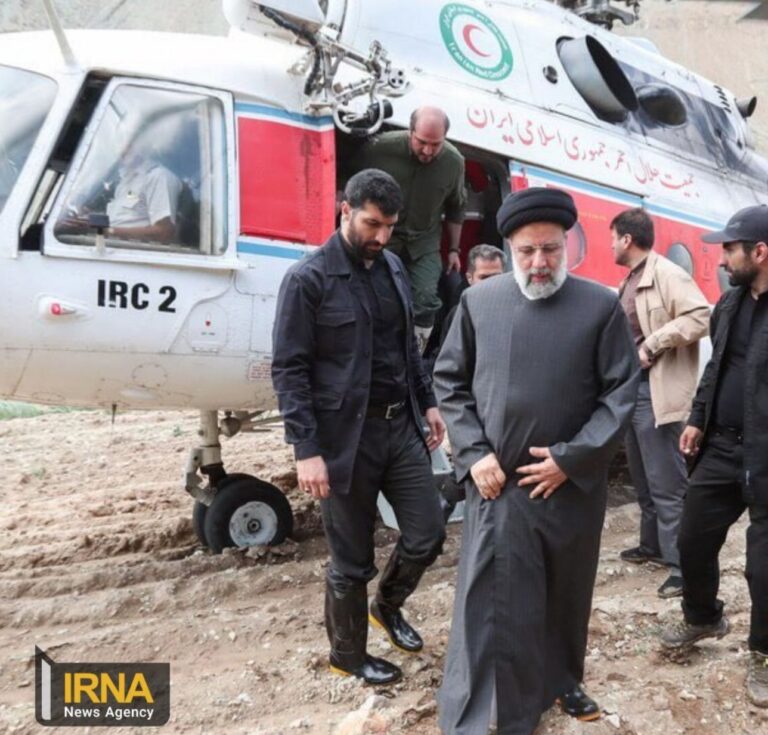
According to the Islamic Republic News Agency, a state-run media outlet, Iran’s President Ebrahim Raisi has been in a helicopter crash in a rugged, hard-to-reach northwest region of the country.
President Raisi was returning from a ceremony to celebrate a dam opening on the border with Azerbaijan when the helicopter crashed in the Varzaqan region on Sunday, the news agency said.
Foreign Minister Hossein Amirabdollahian, Governor of East Azarbaijan Province Malek Rahmati, and other leaders were also reported to have been on board the helicopter, the IRNA said.
Fog and difficult terrain has reportedly hampered the search and recovery efforts.
Iran has been funding Hamas terrorists in Gaza, prolonging the war that Israel is fighting against terrorism in its borders, which began when Hamas kidnapped and killed Israelis during a raid on Oct. 7, 2023. Terrorists are still holding over 130 Jewish men, women, and children in what has been seen as the worst event in Israel’s history and the most horrific attack on Jewish people since the Holocaust.
The U.S. Department of Treasury says that Iranian support, much of it through its Islamic Revolutionary Guard Corps, has enabled Hamas’s and associated terrorist activities. This includes the transfer of hundreds of millions of dollars in financial assistance and the furnishing of both weapons and operational training. Raisi is known by the international community as having committed crimes against humanity.
Raisi, who was an Islamic jurist, ran for president in 2017 but lost to moderate incumbent president Hassan Rouhani. Raisi ran for president again in 2021 and won. Wikipedia names him as one of four people on the “prosecution committee” responsible for the execution of thousands of political prisoners in Iran in 1988. Raisi has been sanctioned by the U.S. Office of Foreign Assets Control in accordance with Executive Order 13876 by Donald Trump.
Raisi, 63, is a protégé of Ali Khamenei, who is considered the most powerful political authority in the Islamic Republic.
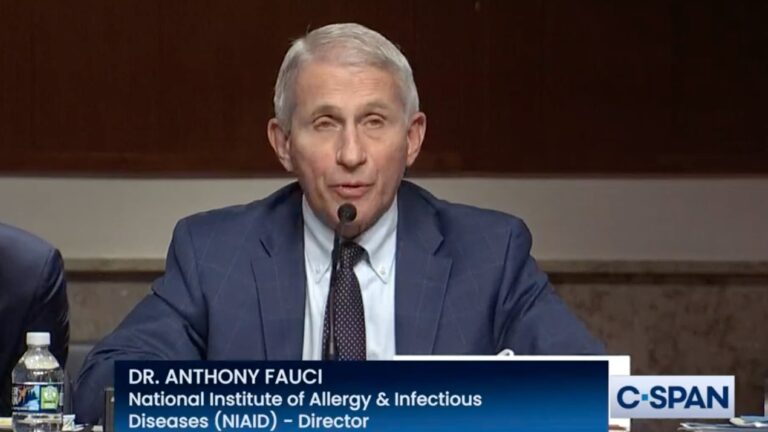
Almost three years to the day that Dr. Anthony Fauci vehemently responded to Sen. Rand Paul and said there was no gain-of-function research at the Wuhan Institute of Virology, the National Institutes of Health Principal Deputy Director Lawrence Tabak admitted such research occurred at Wuhan and that we paid for it.
Tabak went on to say this was “generic’ gain-of-function research, much like what is done in many labs across the country. That “generic’ kind is not regulated, as it does not cause a threat to mankind.
In hearing this response, Dr. Bryce Nickels, a professor of genetics at Rutgers University and co-founder of the pandemic oversight group “Biosafety Now,” told the Washington Post, “Tabak was engaging in the usual obfuscation and semantic manipulation that is so frustrating and pointless.”
Nickels said, “The NIH bigwig was resisting accountability for risky research that can create pathogens of pandemic potential.”
Kind of like the definition of “is” in the Clinton years. And clearly worded in such a way to avoid any wrongdoing by our government.
What is EcoHealth Alliance hiding from @NIH & the American people??
The Wuhan Institute of Virology's lab notebooks, to start.
EcoHealth violated the terms of its @NIH grant when it failed to produce “laboratory notebooks” with data about the WIV's gain-of-function research. pic.twitter.com/Lg9DkVbGVa
— Select Subcommittee on the Coronavirus Pandemic (@COVIDSelect) May 16, 2024
Common sense tells us it was not a coincidence that Covid-19 was first detected in Wuhan, China, right next to the Wuhan lab where gain of function research was ongoing. And the research they were conducting was on bat coronaviruses to make them more infectious to humans.
Our government knew of this research yet held to the fabrication that it was the wet lab and the U.S. had nothing to do with this research. Just recently, the Department of Health and Human Services cited EcoHealth, “for a series of reporting lapses on the research, and for not adequately monitoring the Wuhan institute’s compliance with the terms of a National Institutes of Health grant that partly funded the work.”
In the history concerning grants for this research to Wuhan, the NIH grant was canceled in the Spring of 2020 amid disputes over the origin of Covid-19. But the NIH eventually gave back some of that funding to EcoHealth in 2023.
Just this week, HHS finally suspended this research funding to EcoHealth with a proposed debarment for up to three years. But it can be extended depending on the circumstances. EcoHealth has three active NIH grants totaling $2.6 million from last year, according to the New York Times, to fund studies in southeast Asia and potentially more studies on bat coronaviruses, So no surprise that Peter Daszak denies this and states EcoHealth will dispute all charges.
As for Wuhan, it has been barred by HSS in July of 2023 from obtaining federal grants for 10 years.
It is interesting that this proposed debarment happened just two days before Tabak testified before Congress. It is also fascinating that the government stated they did nothing wrong—it is EcoHealth that failed to follow appropriate safeguards. Another no surprise here.
In an October 2021 letter to Congress, Tabak stated NIH funding had occurred for “limited experiments” at Wuhan that tested whether “spike proteins from naturally occurring bat coronaviruses circulating in China were capable of binding to the human ACE2 receptor in a mouse model.”
Tabak didn’t call this gain-of-function research but did state EcoHealth “failed to report” the research had modified SARS viruses to make them 10,000 times more infectious thus violating the terms of the grant.
And the NIH still gave EcoHealth funding back in 2023 — only now with the House Oversight Committee investigating, the NIH decided to suspend funding for the same reason it cited in 2021.
You can’t make this stuff up. And the government will parse with the best of them. The government is not accountable for anything by its standards.
The big question still remains. Did our government use our tax money to fund the gain-of-function research at the Wuhan Institute of Virology which resulted in millions of worldwide deaths?
Keep digging Congress. Keep digging.
Linda Boyle, RN, MSN, DM, was formerly the chief nurse for the 3rd Medical Group, JBER, and was the interim director of the Alaska VA. Most recently, she served as Director for Central Alabama VA Healthcare System. She is the director of the Alaska Covid Alliance.
Pride Month is just around the corner and the Federal Bureau of Investigation and Department of Homeland Security are warning revelers that their events and venues may come under attack by foreign terror organizations or their supporters. The U.S. State Department has issued a worldwide alert on the subject.
“FTO [foreign terrorist organizations] efforts to commit or inspire violence against holiday celebrations, including Pride celebrations or LGBTQIA+-related venues, are compounded by the current heightened threat environment in the United States and other western countries. FTOs and their supporters have previously promoted anti-LGBTQIA+ rhetoric and targeted LGBTQIA+ related events or venues for attacks,” the FBI reported.
The agency referred to a February 2023 message from the Islamic State, also known as ISIS, which featured an article on lesbian, gay, bisexual, transgender, queer and other varieties of gender identity. In the same issue , the publication called for followers to conduct attacks on unidentified soft targets, although the attacks and targets were not specific to LGBTQIA+ venues.
The FBI reminded readers that June 12 is the eighth anniversary of the terrorist shooting at the Pulse nightclub in Orlando, in which 49 people were killed and 53 were wounded.
“After the Pulse shooting, pro-ISIS messaging praised this attack as one of the high-profile attacks in Western countries, and FTO supporters celebrated it,” the FBI said. In 2023, three alleged ISIS sympathizers were arrested for attempting to attack a Pride parade in Vienna, Austria, using knives and a vehicle as part of the attack, the FBI said.
Possible indicators of potential threat activity, the FBI said, include:
Violent threats made online, in person, or via mail.
Unusual or prolonged testing or probing of security measures at events or venues.
Photography of security related equipment, personnel, or access points consistent with pre-operational surveillance without a reasonable alternative explanation.
Unusual surveillance or interest in buildings, gatherings, or events.
Attempts to gain access to restricted areas, bypass security, or impersonate law enforcement officials.
Observation of or questions about facility security measures, including barriers, restricted areas, cameras, and intrusion detection systems without a reasonable alternative explanation.
Eliciting information from facility personnel regarding the nature of upcoming events, crowd sizes, busiest times of day, etc. without a reasonable alternative explanation.
Attempts to enter a restricted area, bypass security, or impersonate law enforcement officials.