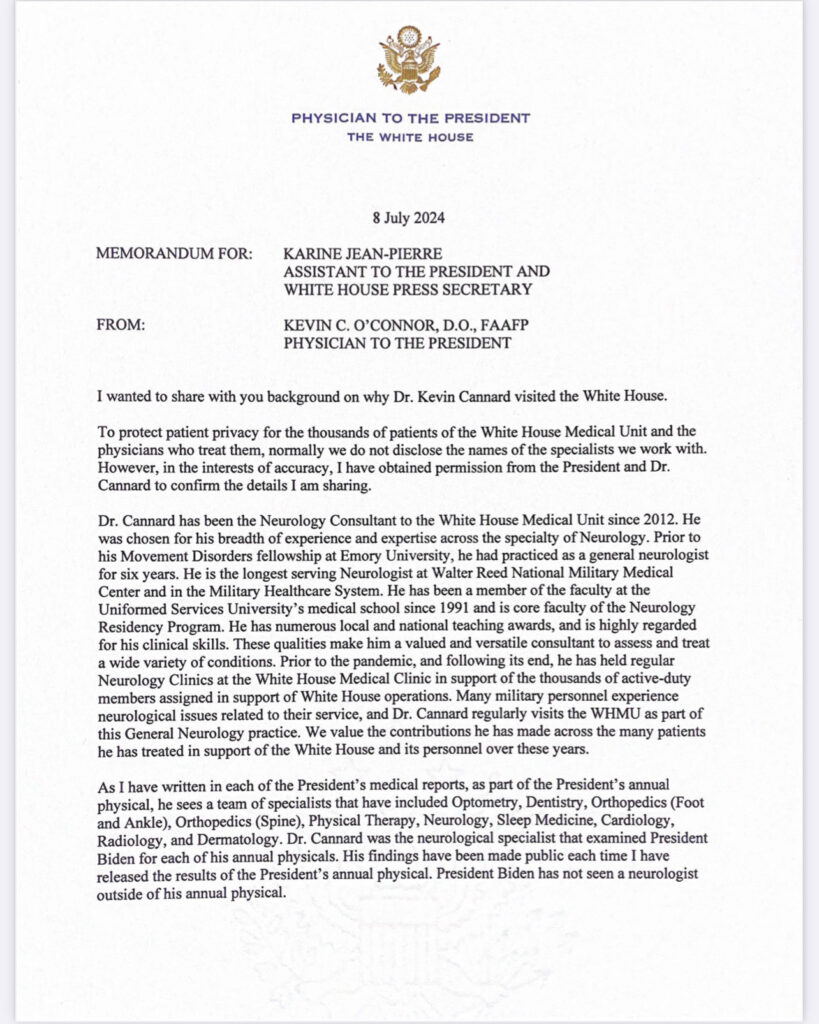
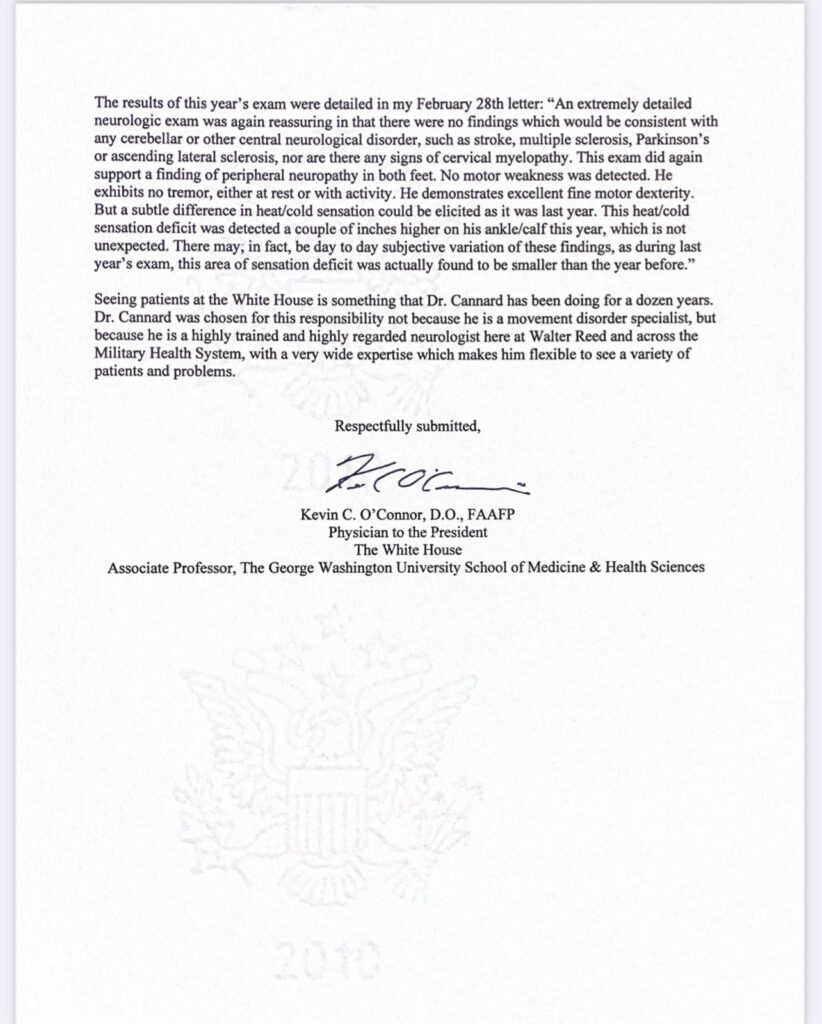
The pressure was mounting this week, after explosive revelations about the president’s possibly compromised health. Finally, the president’s physician released a letter on Monday night with his first public comments about why he brought a Parkinson’s disease specialist into the White House repeatedly.
On Monday, President Joe Biden’s press secretary had dodged questions over and over again about the neurological specialist and told reporters that asking about Biden’s health was disrespectful. Karine Jean-Pierre read the same sentence repeatedly to reporters rather than answer the questions about why a Parkinson’s specialist from Walter Reed Hospital was such a regular White House visitor over such a short duration.
In his letter, the president’s physician Dr. Kevin O’Connor explained why Dr. Kevin Cannard visited the White House eight times.
The letter from O’Connor spends most of the two pages going over Cannard’s credentials, but adds: “Dr. Cannard was the neurological specialist that examined President Biden for each of his annual physicals. His findings have been made public each time I have released the results of the President’s annual physical. President Biden has not seen a neurologist outside of his annual physical.” O’Connor implied Cannard was treating other patients in the White House.
Karine Jean-Pierre AGAIN refuses to confirm why a Parkinson’s specialist was at the White House.
Reporter: "You could clear this all up here just by saying what he was doing here and if it was connected to the president! Yes or no?!"
A Parkinson’s disease expert on NBC said that Biden has all the hallmarks of Parkinson’s and he could diagnose him from across the mall. Those symptoms include slow movement seen with Bradykinesia, a slowness of movement and speed (or progressive hesitations/halts) as movements are continued.
“It is one of the cardinal symptoms of Parkinson’s disease (PD). You must have bradykinesia plus at least either tremor or rigidity for a Parkinson’s diagnosis to be considered,” says the Parkinson’s Foundation.
Parkinson's expert says he could have diagnosed Biden "from across the mall."
If Joe Biden has a condition like this and it was hidden from American voters, it's one of the biggest and most scandalous cover-ups in American history. pic.twitter.com/rqFepbweEZ
President Biden on Tuesday firmly rebuked the calls from Democrats and major donors to step aside from the campaign, saying, “I am not going anywhere.”
House Democrats huddled in Washington Tuesday to discuss the president’s future, as a seventh Democrat has called for Biden dropping out, but Rep. Mary Peltola, who said on the record that her opinion “is irrelevant,” is laying low and saying she needs to go fishing in Alaska this week. Peltola is avoiding difficult conversations and decisions in Washington.
Alaska Attorney General Treg Taylor and 15 other attorneys general have filed an amicus brief with the U.S. Supreme Court regarding schools that help students make “social gender transitions” without their parents’ knowledge. Such as transition would include using a different bathroom, locker room, name, or gender pronoun at school and keeping that information secret from the parents.
Virginia Attorney General Jason Miyares is leading the amicus. “It is essential that schools work with parents, not against them, to support a child’s well-being,” Miyares said. “Parents have the right to be involved in major decisions affecting their children’s lives.”
As has occurred in the Anchorage School District, the Eau Claire, Wisconsin. school district enacted rules to help students change their identities at school and keep that information from their parents. The district is at the heart of this parent-driven lawsuit.
The district policies, as in Anchorage, allows male students to use the female bathrooms and locker rooms, according to how they feel their gender should be, or allowing boy-like females to use males’ private facilities.
The Eau Claire district told administrators to develop “Student Gender Support Plan(s),” which could include information on students’ medical and surgical transition intentions.
“Amici States have a compelling interest in protecting parents’ fundamental right to make decisions about “the care, custody, and control of their children,” the brief to the Supreme Court stated. “In fact, many Amici States have constitutional or legal protections for parents’ rights enshrined in state law. This case presents the opportunity for this Court to reiterate that government officials cannot interfere with this right—“perhaps the oldest of the fundamental liberty interests recognized by” this Court—just because the government officials believe that they know better.”
The Seventh Circuit dismissed the case, concluding that the parents who are challenging the school district’s gender transition policy had not asserted a concrete injury because they did not allege that the policy had been applied to their specific students.
The state attorney generals said, “This conclusion, however, is based on an erroneously cramped view of parental rights and this Court’s precedents. The parent-child relationship is directly harmed when a school district tells minor students that secrets from their parents—including an entire double life at school— are not only acceptable, but will be facilitated by the District. The district’s policy also hopelessly conflicts with constitutionally protected parental rights. Parents, not administrators, have the responsibility and right to raise their children.”
“The Seventh Circuit’s decision thus contributes to a rapidly-expanding — and increasingly confusing — area of law. Gender transition policies like the one at issue in this case have proliferated around the country. Unsurprisingly, so has litigation over these policies. Judicial decisions arising from these challenges are a jumbled mess, with many courts evicting parents from the courthouse on standing grounds, and few reaching the merits to protect parents’ rights. This Court’s intervention is needed to bring clarity, before more parents and children are injured,” the brief said.
The school district in Wisconsin has a written statement about its responsibility to keep parents informed of student welfare and progress in school. But not for gender issues, evidently. Those are different.
“Yet Respondents’ Gender Identity Support guidance blocks parents from learning more about certain aspects of their children’s conduct in school. Because, according to the guidance, ‘[s]ome transgender, non-binary, and/or gender-non- conforming students are not ‘open’ at home for reasons that may include safety concerns or lack of acceptance,’ Respondents allowed students to make changes to their gender identity, names, and pronouns without parental notice or consent,” the brief said.
In other words, the school can decide what aspect of a child’s “welfare and progress” could be discussed with the parent, stripping parents of their right to know.
A petition for a writ of certiorari was filed by the Wisconsin Institute for Law and Liberty, and America First Legal. They want the Supreme Court to decide if parents have legal standing to challenge what is “an explicit policy to usurp parental decision making” and to programmatically conceal student information from parents. Key to the lawsuit is the question of how a parent could even have standing to sue a school district for concealing such major life-changing information if the parent is not made aware of that information.
Alaska Attorney General Treg Taylor, Miyares, and the other attorneys general point out an opinion from Judge Paul Niemeyer of the Fourth Circuit Court of Appeals, which said such a school policy undermines parents’ constitutional rights and that parents didn’t have an option of choosing another policy for their children.
“This case presents an opportunity for the U.S. Supreme Court to provide much-needed clarity and reaffirm that government officials cannot override parents’ fundamental rights simply because they believe they know better,” Miyares said.
The amicus brief describes training that is given to teachers that put them in positions between parents and students. The training material is “targeting religious parents for special condemnation, claiming that the ‘weaponization of religious beliefs against marginalized people is the problem.'” and that “parents are not entitled to know their kids’ identities. That knowledge must be earned.”
In addition to Taylor and Miyares, the other attorneys general represent Georgia, Idaho, Louisiana, Missouri, Montana, Nebraska, North Dakota, Oklahoma, South Carolina, South Dakota, Texas, Utah, and West Virginia.
Some commenters question my motive for my columns, thinking that I am being financed by dark money or have a hidden political agenda. Some think I am not qualified to look at the data and come up with conclusions contrary to thousands of climate scientists they vaguely cite. Then there are some who show that they understand what I present and are supportive of my comments and recommendations. I thank them.
My motivation for writing articles about electrical systems, use of renewable energy in Alaska, and issues of climate concerns is to ensure people of Alaska are provided truth facts to guide them to a right and proper understanding and application of energy resources and to what urgency energy progress must be done. When I work on an electrical design I make sure I know what problem is to be solved or what objective is to be met and then make sure that this is kept in mind during the entire design, building and installation processes.
I have been investigating renewable and alternate energy resources since 1980 with consideration for their application for remote communities. Diesel fuel was expensive and at high risk of spill. Gathering wood is very time consuming. I have lived remotely in Alaska where the temperature got to -73oF. I am qualified by training, education and experience to discuss the range of topics I cover.
And, yes I will go against the reports of thousands of climatologist if what they advocate is wrong, is in error. In graduate school I studied physical oceanography, which included wind waves, ocean currents, tides and tidal currents. I also studied meteorology, in which I learned of measurements of air temperature, winds, radiation, rainfall and other features. In my studies of Arctic Engineering, I learned about permafrost, soil temperatures, snow, ice (including sea ice), and other aspects of the Arctic.
Then, with more than 50 years’ experience as an engineer in Alaska, I have successfully engineered systems and overseen their installation, to work with the environments we have in Alaska.
I support wind, solar or other renewable energy sources to be connected to the Railbelt Electrical system when done to solve a particular problem to benefit the system as long as done with a free market approach, with a goal to provide cheap electricity reliably and is not done through any legislated mandates.
There are practical reasons to have renewable energy resources incorporated into the Railbelt system. One application would be microgrids scattered through the system to provide power to isolated sections of the Railbelt system to provide local power when there are system wide outages. Battery energy storage systems have been proven over the last 20 years to provide stabilization for the electrical systems.
At least one commenter thinks that I might not have sufficient ability, capability or access to proper data to make an assessment of temperature data in Alaska. Others wonder if I had access to HAD-CRUT (Hadley Centre/Climatic Research Unit Temperature) raw data. Much of the analysis on the HAD-CRUT and other data have been analyzed by comparing average annual temperatures which provide a very steep increase(to show global warming) for the years with less cold temperatures, but do not disclose that the high temperatures are still within normal range and show no great warming trend. This was the point of my earlier article in which I questioned whether or not Alaska is warming 2 to 4 times faster than the rest of the planet.
My positions have been:
Inclusion of renewable energy sources to the Railbelt Electrical system requires long term energy storage such as pumped hydro to provide the greatest benefit;
Any addition or modification of the electrical system must be done according to best and proper engineering practice and must be incorporated to solve a particular problem or provide improvement to the system;
Legislation to impose RPS (Renewable Portfolio Standard) and other forms of mandated increase of renewable (wind and solar) are not needed, but demonstrated need and free market forces should be trusted;
Cook Inlet gas production needs to be stepped up immediately and expanded sufficiently to ensure the Railbelt utilities can provide electricity and heat year round to ensure safety and economy for the Railbelt for the foreseeable future. In the meantime our future fuel supply can be determined and secured;
Alaska is not warming 2 to 4 or even 2 to 3 times faster than the rest of the planet. Temperature data has been in a form that is misleading. The temperatures are not warming, we have just had less cold in recent winters.
I will continue to present additional information and comments on these and related topics and they will all be topics well within my capability and qualification to discuss. We will present truth and evaluate the energy requirements and the condition and needs of Alaska and its people fully and accurately. For those who doubt, keep reading. I hope to final convince you of the actual reality we live in.
Robert Seitz is a professional electrical engineer and lifelong Alaskan.
Boeing Company has agreed to plead guilty to a criminal fraud conspiracy charge relating to two fatal 737 MAX crashes in 2018 and 2019. The company has agreed to a $243.6 million fine.
In an unrelated case that was in civil court, Judge Arthur Engoron in February fined former President Donald Trump $464.8 million for what the judge says was overvaluing his New York properties in order to get more favorable loan terms. The fine was $354.8 million plus $100 million in interest.
The fines in the Boeing criminal case, concerning crashes in which 346 people died, and the Trump civil case, where there were no actual injuries, is in the same ballpark since Boeing has already paid a $243 million fine.
In addition to the main civil fine and interest, Judge Engoron also fined Donald Trump Jr. and Eric Trump $4 million and banned all three Trump men from being able to run New York companies in the future.
Trump has denied all wrongdoing and has appealed the ruling, as well as the extraordinary bond that the judge demanded be paid in cash.
In the Boeing case, the federal government will have the aircraft maker on a probation list for three years.
Families of the victims are opposing the Boeing plea deal, and will ask the judge to reject it because it makes concessions to Boeing “that other criminal defendants would never receive and fails to hold Boeing accountable for the deaths of 346 persons.”
White House Press Secretary Karine Jean-Pierre clashed with reporters during Monday’s press briefing while dodging questions about published reports that a renowned Parkinson’s disease expert visited the White House several times this year.
Citing White House visitor logs, the New York Postreported that the visits by neurologist Dr. Kevin Cannard of Walter Reed Medical Center included several with President Joe Biden’s personal doctor, Dr. Kevin O’Connor.
The revelation came less than two weeks after Biden’s poor debate showing against former President Donald Trump renewed concerns about his declining cognitive abilities and his ability to remain in office and serve another four-year term.
Biden is seeking reelection against presumptive GOP nominee Trump.
During the sometimes hostile back-and-forth, Jean-Pierre refused to acknowledge the visits or even confirm Cannard’s name.
Visibly frustrated with Jean-Pierre’s earlier non-answers, CBS reporter Ed O’Keefe shouted: “It’s a very basic, direct question. That’s what you should be able to answer by this point.”
“No, no, no, no, no,” Jean-Pierre responded. “Ed, please. A little respect here. Please.”
Jean-Pierre continuously cited security and privacy concerns for not answering the questions.
Biden, 81, has shown visible signs of decline throughout his presidency, which were punctuated by Special Counsel Robert Hur’s final report on his investigation into Biden’s mishandling of classified documents after he left the White House following his term as vice president under Barack Obama.
Hur declined to charge Biden, but his report highlighted Biden’s trouble remembering things, including the year his son died.
“In his interview with our office, Mr. Biden’s memory was worse,” according to the report, as The Center Square previously reported. “He did not remember when he was vice president, forgetting on the first day of the interview when his term ended (‘if it was 2013 – when did I stop being Vice President?’), and forgetting on the second day of the interview when his term began (‘in 2009, am I still Vice President?’)”
The Hur report continued:
“He did not remember, even within several years, when his son Beau died. And his memory appeared hazy when describing the Afghanistan debate that was once so important to him.”
Since the debate, when Biden repeatedly stuttered and faltered, and at times became incoherent and trailed off, many Democrats have stepped forward calling for him to step aside from seeking reelection.
Dan McCaleb is the executive editor of The Center Square.
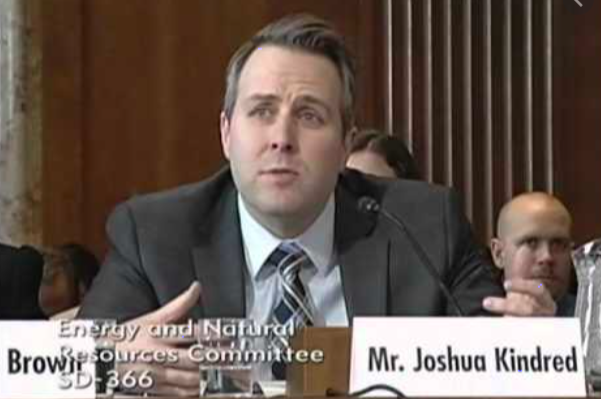
It all came down to sex and texts. Lots of texts. The Judicial Council of the Ninth Circuit has revealed the cause of U.S. District Judge Joshua Kindred’s sudden resignation in great and salacious detail. In the end, it was a forced resignation, the record shows. And it was so much more.
The complaint against Kindred was made two years ago. On May 23, the very detailed order and certification was made regarding the complaint of judicial misconduct against Kindred, who was appointed by former President Donald Trump to serve as one of three judges for the District of Alaska. The order and certification was made public on Monday, pursuant to 28 U.S.C. § 360(b) and in consultation with the Judicial Conference of the United States.
“The Order and Certification is the result of a thorough investigation conducted by a Special Committee appointed by Chief Circuit Judge Mary H. Murguia. In its Order and Certification, the Judicial Council concluded, among other things, that Judge Kindred engaged in misconduct by creating a hostile work environment for his law clerks and by having an inappropriately sexualized relationship with one of his law clerks both during her clerkship and after she became an Assistant United States Attorney. The former law clerk did not appear on any case before Judge Kindred while she was employed as an Assistant United States Attorney,” the court wrote.
In other words, Kindred had sexual relations with a law clerk who then became an Assistant U.S. Attorney. Such a person would appear before Kindred in court proceedings, creating a conflict of interest.
The order says:
“This judicial misconduct order arises from a complaint against Judge Joshua M. Kindred, District Judge of the United States District Court of Alaska. The Judicial Council adopts the findings of the Special Committee, which include a 105-page report along with 1,039 pages of exhibits. The Council concludes that:
“(1) Judge Kindred created a hostile work environment for his law clerks by engaging in unwanted, offensive, and abusive conduct, and treating the law clerks in a demonstrably egregious and hostile manner.
“(2) Judge Kindred engaged in misconduct by having an inappropriately sexualized relationship with one of his law clerks during her clerkship and shortly after her clerkship while she practiced as an Assistant United States Attorney in the District of Alaska.
“(3) Judge Kindred did not retaliate against individuals for reporting his behavior or participating in the misconduct process.
“(4) Throughout these proceedings, Judge Kindred lied to the Chief Judge, the Special Committee, and the Council. Although the evidence indicated that he had a sexual encounter with his former law clerk, Judge Kindred maintained that he “never had any sexual contact with [the law clerk].” Only when asked under oath during the Judicial Council meeting of April 5, 2024, did he admit that he had deliberately lied to the Special Committee.
“In view of these findings and pursuant to 28 U.S.C. § 354(b)(2)(A), the Council certifies to the Judicial Conference of the United States that United States District Judge Joshua M. Kindred has engaged in conduct that might constitute one or more grounds for impeachment under Article II of the Constitution. It further orders that Judge Kindred be publicly reprimanded for the conduct described in this order that violates the Rules of the Judicial Conduct and Disability Act and the Code of Conduct for the United States Judges and is prejudicial to the effective and expeditious administration of the business of the courts and the administration of justice. It further requests that Judge Kindred resign voluntarily from the position of United States District Court Judge for the District of Alaska.
“In November 2022, Chief Judge Mary H. Murguia received information about possible misconduct by the Honorable Joshua M. Kindred, District Judge of the United States District Court of Alaska. Responding to this information, Chief Judge Murguia directed a limited inquiry under Rule 5 of the Rules for Judicial- Conduct and Judicial-Disability (“JC&D”) Proceedings.
“Upon determining that there was probable cause to believe that misconduct had occurred, on December 27, 2022, Chief Judge Murguia identified a misconduct complaint against Judge Kindred pursuant to 28 U.S.C. § 351(b) and JC&D Rule 5(a).1 The complaint stated that probable cause existed that Judge Kindred: (1) created a hostile work environment for one or more judicial employees by subjecting them to regular discussions about his personal life, including conversations of a sexual nature, and ostracized a judicial employee who raised concerns about this behavior; (2) engaged in unwanted physical sexual conduct with a former judicial employee and engaged in unwanted verbal sexual conduct with that employee both during and after her clerkship; and (3) told individuals with knowledge of his potential misconduct to remain silent. Judge Kindred was provided with an opportunity to respond to the complaint pursuant to JC&D Rule 11(f).2”
In his response, Judge Kindred offered his “unequivocal denials to these allegations,” the order explained, stating that he was “in possession of communications that [he] believe[s] clearly establish that these allegations are entirely without merit.”
Based on Judge Kindred’s response and the information gathered during the limited inquiry, Chief Judge Murguia determined that there were reasonably disputed issues that needed to be investigated by a Special Committee.
“The Committee’s investigation included a review of documents obtained from various witnesses and Judge Kindred, including text messages exchanged between Judge Kindred and his law clerks. These communications included more than 700 pages of text messages,” the order said.
“The Committee also interviewed witnesses, including Judge Kindred, current and former court staff, as well as several attorneys and individuals with knowledge relevant to the Committee’s investigation. In all, 21 individuals were interviewed in person or by video. All interviews included at least two interviewers. Of the 21 individuals interviewed, 13 were current or former judiciary employees, including nearly all of Judge Kindred’s current (at the time) and former law clerks.
“The Committee’s investigation revealed that Judge Kindred created a hostile chambers environment for his law clerks. Judge Kindred appeared to have no filter as to the topics he would discuss with the clerks. He discussed his past dating life, his romantic preferences, his sex life, the law clerks’ boyfriends and dating lives, his divorce, his interest in and communications with potential romantic or sexual partners, and his disparaging opinions of his colleagues. He also made disparaging comments about public and political figures.’
Some examples of the comments Kindred made include: “I was a huge hit at dinner Partly due to how much shit I talked about Sarah palin”; “I told a republican [state] senator to eat a dick”; and “[a senator] is worried that I can kick [] his ass.”
Kindred also routinely used language that was inappropriate in a professional setting, such as encouraging rating people based on “fuckability,” stating that he was not “hoe-ignorant,” or telling stories about “giving blow jobs in a hot tub.”
In the few instances where clerks came to Judge Kindred to discuss his inappropriate behavior, they were belittled or ostracized, and, in one instance, a clerk left the clerkship, the order continued.
“Though many of these comments occurred in chambers, Judge Kindred also sent his law clerks numerous text messages over an extended period. These text messages document the nature of Judge Kindred’s inappropriate interactions with his law clerks as these comments lacked any connection to the clerks’ legitimate job duties and were often sexual in nature. For instance, Judge Kindred made inappropriate and often vulgar comments to his law clerks such as “I’m just gonna pay for [a law clerk’s boyfriend’s] next ass tattoo”; “You’re going to the big leagues. You might be better in the butt leagues”; “I’ve never been invited to an orgy by a stranger before”; “I got asked out by a waitress which actually made me feel way less insecure about being single again, which was nice”; and “So it looks like I might need a judicial tinder profile.””
Sen. Dan Sullivan posted a comment expressing his disappointment, saying he was extremely disappointed.
“I will continue to work with the Alaska Federal Judicial Council for appointment of federal judges who understand Alaska’s unique role in our federal system. This is crucially important for our state. Federal judges have lifetime tenure – their decisions will positively or negatively impact Alaskans for decades. I remain focused on working with relevant stakeholders to appoint Alaska federal judges who interpret the law as Congress intended, not as special interest groups and unelected federal bureaucrats want it to be,” Sullivan said.
“In the Order and Certification, the Judicial Council publicly reprimanded and admonished Judge Kindred for his conduct, which violated the Judicial Conduct and Disability Act and the Code of Conduct for United States Judges. The Judicial Council also requested that Judge Kindred voluntarily resign and certified the matter to the Judicial Conference of the United States to consider impeachment,” the court wrote.
Judge Kindred resigned, effective Monday, July 8. The Judicial Conference of the United States will continue to consider the matter, including the certification with respect to impeachment, Murguia wrote, along with this statement:
“The Judiciary is entrusted to self-govern and, in doing so, must hold its federal judges to the highest standards of integrity and impartiality. We take judicial misconduct complaints seriously. When allegations arise, the Judiciary conducts a fair and thorough investigation that focuses on promoting a civil and respectful workplace, free of discrimination and harassment, and maintaining the integrity of the Judiciary. The process seeks to preserve the effective and expeditious administration of the business of the courts. In all respects, this was a serious and sensitive matter. I thank the witnesses who provided information, understanding fully how difficult that may have been. In my role as Chief, I will continue to ensure that our judges are held to the highest standards.”
The North Slope Borough filed suit to challenge the final rule for the National Petroleum Reserve in Alaska that was made by the Biden Administration.
The borough said the Bureau of Land Management, by making the NPR-A off limits to oil and gas development, did not meaningfully consult with the tribes in the area or the borough.
“The rule would significantly and irrevocably harm the North Slope’s right to self-determination and ability to provide essential services for residents. This suit is filed alongside the complaints of the Voice of the Arctic Inupiat and the State of Alaska, demonstrating the unity of North Slope communities and Alaskans in opposing the BLM’s unjust and unilateral action to harm the livelihoods of the residents of the North Slope,” the borough explained in a press statement.
“When I was sworn in as Mayor of the North Slope Borough, I made a solemn promise to protect and provide essential services for the people of the North Slope Borough. The BLM claims to act on our behalf but what they are truly doing is undermining my ability to fulfill that fiduciary obligation,” said Mayor Josiah Patkotak. “We on the North Slope don’t have the luxury of keeping quiet and waiting for a new industry to swoop in and replace our largest economic driver. We have to speak up for our future as a people.”
The North Slope Borough houses the entirety of the NPR-A, and represents the ancestral homelands of the Inupiat people. The North Slope Borough is the largest employer in the region and provides the majority of essential services depended upon by residents, including public safety services, utilities, education, public health services and wildlife and subsistence management. These services are funded by taxes on infrastructure within the Borough – taxes which account for 95% of the Borough’s revenue.
Members of the North Slope Iñupiat Tribes, Village Corporations, Regional Corporations, and their elected leaders have been unanimous in their opposition to the rule.
In light of the Supreme Court’s recent decision in Loper, which removed what is known as the Chevron Deference, the North Slope Borough is taking proactive steps to incorporate this precedent into its regulatory framework.
“By aligning our policies with this landmark decision, we aim to ensure that our administrative actions and interpretations of ambiguous statutes are carried out with a heightened level of judicial scrutiny. This approach underscores our commitment to transparency, legal integrity, and the protection of our community’s rights and resources. Furthermore, the Borough remains steadfast in its adherence to NEPA and the Regulatory Flexibility Act, ensuring that environmental and economic impacts are thoroughly assessed and that small entities are considered in the rule-making process,” the borough said.
The lawsuit follows one filed by the State of Alaska, which makes a similar case, saying the feds had not consulted with affected parties, and that the agency had exceeded its congressional authorization.
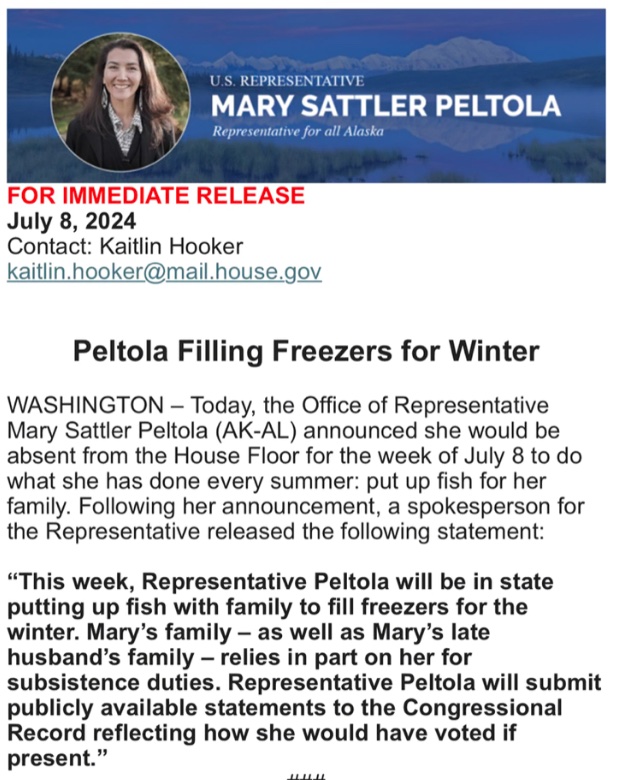
The U.S. House has been recessed for two weeks, but convened again on Monday. Yet Rep. Mary Peltola, Alaska’s only representative in Congress, won’t be at work for a third week because she is fishing in Alaska. She’s taking time off, while others are working. Next week, the House is back in recess, which means a whole month off for Peltola.
It’s a pattern that goes back decades for her, as Peltola has skipped work before to go berry picking in years past, much to the chagrin of her former employers.
Last year she skipped out on field hearings in Anchorage for the Transportation and Infrastructure Committee that she serves on, instead attending a glitzy campaign fundraiser in Colorado.
Peltola’s news release about her planned absence was not widely distributed on Monday, and was not posted to her official website press release page.
Peltola’s absence means she won’t have to face Capitol Hill reporters and their uncomfortable questions about her wholehearted endorsement of Joe Biden, her assessment that he is one of the “sharpest, smartest” people she has met in D.C., and her statement last week to the Fairbanks News Miner that her opinion of him is now “irrelevant.”
Her votes, too, will be irrelevant because she won’t vote at all, carrying on her tradition of having one of the lowest attendance and voting records in Congress. She will avoid having to be on the record on a key piece of legislation this week that requires voters to be citizens of the United States in order to cast their ballots. Democrats in the U.S. House of Representatives have been told to vote against a bill that implements greater safeguards against non-citizens being registered to vote in federal elections. The Safeguard American Voter Eligibility (SAVE) Act, introduced by U.S. Rep. Chip Roy, R-Texas in May, will come up for a vote this week.
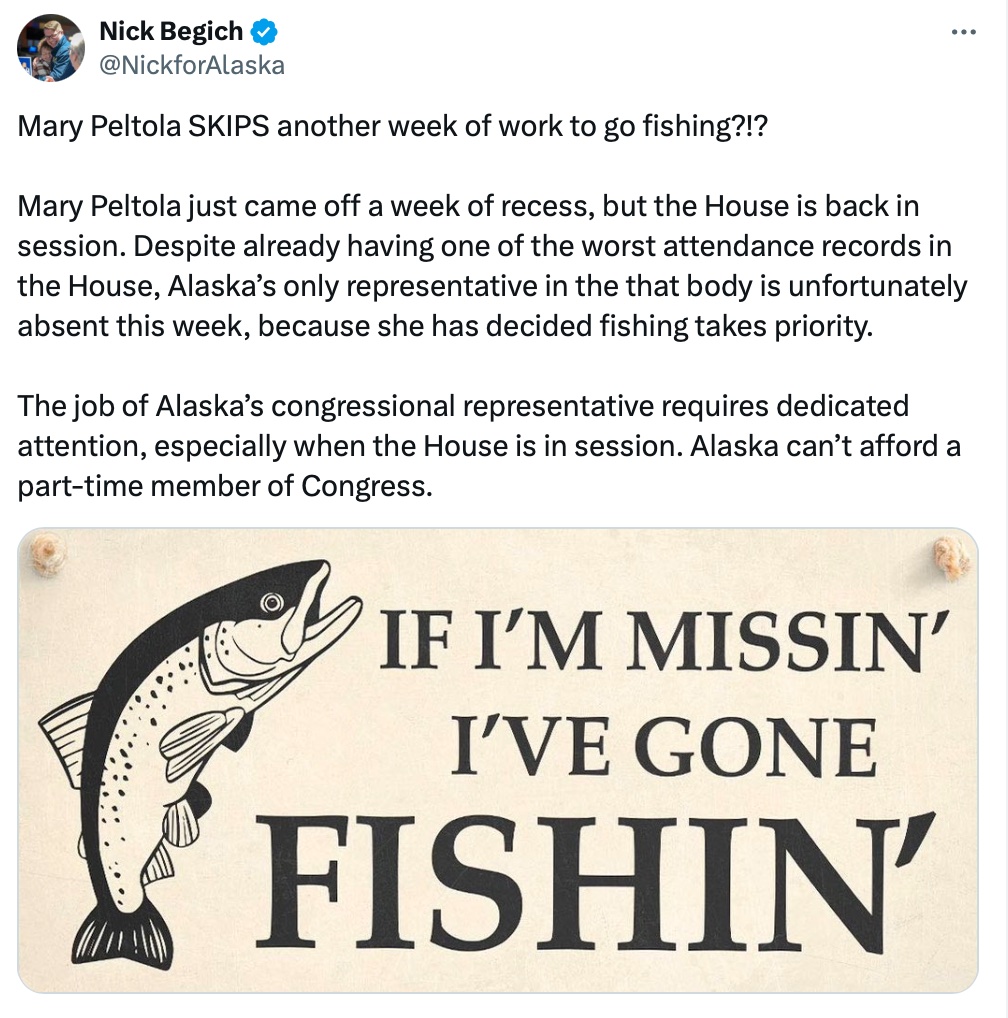
Congressional candidate Nick Begich made a note of Peltola’s disappearing act.
“Mary Peltola SKIPS another week of work to go fishing?!? Mary Peltola just came off a week of recess, but the House is back in session. Despite already having one of the worst attendance records in the House, Alaska’s only representative in the that body is unfortunately absent this week, because she has decided fishing takes priority. The job of Alaska’s congressional representative requires dedicated attention, especially when the House is in session. Alaska can’t afford a part-time member of Congress,” Begich wrote on X.
“Extreme Democrat Mary Peltola’s conveniently timed disappearing act stinks worse than fish in the office microwave. Reeling from her own toxic decisions to bear-hug Biden, Peltola plays hooky to avoid any tough questions,” said National Republican Congressional Committee spokesman Ben Petersen.
Congressional calendars are published months in advance and every member of Congress is made aware of the weeks when they can fish or campaign, and when they are expected to be back at work in D.C.
"I think that Joe Biden's mental acuity is very, very on. He's one of the smartest, sharpest people I've met in DC." – Mary Peltola pic.twitter.com/VYQX2JmmZx
One unhinged Alaska man brought a knife to a gunfight. Or rather, a harpoon. It didn’t end well for him.
Just after midnight on Monday, Alaska State Troopers were informed that a man wielding a sword was threatening to kill people on South Kasilof Beach on the Kenai Peninsula, where Alaskans are engaged in their annual personal-use dip-netting for salmon.
State Troopers and Wildlife Troopers responded to the area and located the man near several tents. When they drove up to the area, a man pointed a 7-foot harpoon at them and charged the Troopers’ marked patrol vehicle. The man initially retreated after Troopers ordered him to step back.
When the Troopers got out of their vehicle, the man charged at them again, still brandishing the harpoon, which was the kind of harpoon one might use in halibut fishing.
The harpoon man just wasn’t getting the point of the officers’ commands, apparently, and a Trooper discharged his firearm. The man took a bullet and fell.
Despite lifesaving attempts by Troopers and emergency medics, the man was declared dead at the scene. His body will be sent to the State Medical Examiner’s Office for autopsy. Next-of-kin notifications are in progress, and his identity will be released once notifications have been made.
No other campers were injured in the incident.
Alaska State Troopers are sharpshooters. Last month, they won the annual “The Shoot” competition with Canadian Mounties.
The Alaska Bureau of Investigation assumed case responsibility and is investigating the incident. Once their investigation is complete, it will be referred to the Office of Special Prosecutions for independent review. The Trooper who discharged his firearm has been placed on 72 hours of administrative leave in accordance with Department of Public Safety policy. The officer’s name will be released publicly in 72 hours.
Dip-netting opened at Kasilof in June and continues through early August.