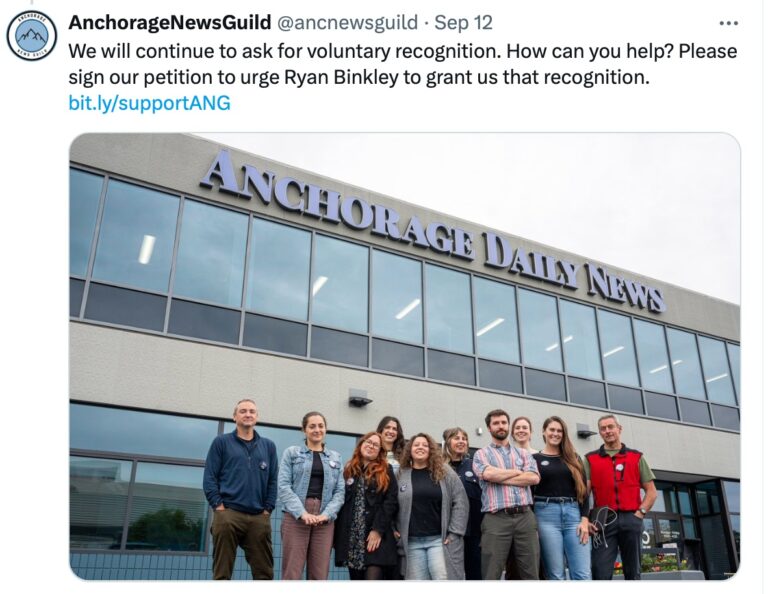
The owners of the Anchorage Daily News were invited by unionizing reporters to recognize the Anchorage News Guild as the legal labor negotiating entity representing the newsroom at the daily paper, which now only publishes in newsprint twice a week.
ADN owner Ryan Binkley said “no.”
That means the election at the new union will go forward for the 16 or so employees of the newsroom who signed union authorization cards for the newly forming Anchorage News Guild. Those who wish to support the journalists in organizing a union can sign the petition here.
“As the representation petition Anchorage News Guild filed with the National Labor Relations Board requests, we believe the employees should have an opportunity to decide whether they wish to be represented by the Anchorage News Guild in a free and fair secret ballot election conducted by the NLRB,” Binkley wrote in a letter to staff on Thursday, according to the letter that the union organizers publicized.
The reporters want higher pay and believe that unionizing will bring that to them.
“The decision by ADN management not to grant voluntary recognition of the Anchorage News Guild delays the beginning of contract negotiations that newsroom employees have said are critical to guarantee equitable, sustainable wages moving forward,” the guild said in a statement. “Their decision fails to honor the voices of the hard-working staff of the ADN newsroom.”
The guild members believe they will succeed and will organize under a national union, NewsGuild-CWA, which represents 25,000 media professionals at over 40 publications.
The local guild reports that the newspaper has hired a Seattle law firm that represents Starbucks and other companies that face unionizing.
“ADN management has also hired an attorney from Littler Mendelson, a notoriously anti-union law firm,” the union said, adding that the money would be “better spent investing in our newsroom and our community.”
The Biden-Harris Administration has done the unthinkable, seizing authority over nearly all of Alaska’s Arctic, but Rep. Mary Peltola has remained a no-show in Washington, not defending Alaska’s economy or sovereignty.
In a critical House Transportation Subcommittee on Water Resources and Environment hearing on Sept. 11, Peltola was notably absent, while testimony was given by a state official concerning the Biden-Harris Administration’s declaration of nearly all of Alaska’s Arctic to be wetlands protected under the Clean Water Act. Peltola is a member of the House Transportation Committee.
Biden’s action contradicts the U.S. Supreme Court’s 2023 rulings on wetlands, known as Sackett v. EPA. Peltola not only was absent, but provided no written testimony to the committee on the Biden-Harris actions that will wreak havoc on Alaska’s economy.
The Biden-Harris Administration claims that nearly all of Alaska’s Arctic Coastal Plain is a wetland protected under the Clean Water Act, in defiance of the U.S. Supreme Court’s 2023 wetlands ruling, an Alaska state official told a House subcommittee on Wednesday.
It’s an example of the Biden administration’s regulatory overreach, Alaska Department of Environmental Conservation Commissioner Emma Pokon told the House subcommittee hearing, and the overreach extends to permafrost on the North Slope.
“We have roughly 900,000 miles of navigable rivers and streams; 22,000 square miles of lakes; 27,000 miles of coastline; and, at about 130 million acres, more wetlands than every other state in the union combined. And all of that is before considering glaciers and groundwater. Anyone looking to build a home, a road, or a mine in the state will likely impact a water of some sort,” Commissioner Pokon said in her testimony.
Federal agencies continue to grope for complete authority over all waters, Pokon said. More than a year after Sackett was decided and the agencies published a revised rule, EPA and the Corps have not developed any standard that can be understood and implemented by the regulated community and state partners. The federal government appears intent on “leveraging uncertainty and the risk of civil and criminal liability to effectively maintain sweeping authority in their own hands,” Pokon said.
Peltola announced earlier this week that she is taking the entire week off to mark the one-year anniversary of her husband’s fatal plane crash. It is a cultural tradition, she said. She also took all of July off to cut and smoke salmon, also saying it was in honor of a cultural tradition. She has spent no meaningful time in Washington D.C. this summer but may be back at work in mid-September, barring any other cultural events that she must mark.
Her participation could have been crucial, given that Alaska’s waterways are essential not only for its environment but for fishing, energy, and infrastructure development.
Critics of the administration’s approach, including Republican subcommittee members, argued that the current regulatory environment hampers economic development. They cited delays in project approvals, especially for key industries like energy and construction, and referenced projects across the nation being stalled due to bureaucratic delays. One example discussed was Novo Nordisk’s $4 billion expansion project in North Carolina, which has been hampered by permitting delays under WOTUS rules.
The absence of Rep. Peltola was seen as a missed opportunity for Alaska to voice its concerns directly to the panel. Alaska, with its vast wetlands and waterways, faces unique environmental and economic challenges that require careful balancing of federal oversight and state-level autonomy.
Watch the hearing here:
Witness list and written testimony can be seen at these links: Ms. Emma Pokon, Commissioner, Alaska Department of Environmental Conservation | Witness Testimony Ms. Nicole Rowan, Director, Water Quality Control Division, Colorado Department of Public Health and Environment |Witness Testimony Ms. Courtney Briggs, Chairman, Waters Advocacy Coalition, on behalf of the American Farm Bureau Federation | Witness Testimony Mr. Vincent E. Messerly, P.E., President, Stream and Wetlands Foundation, on behalf of the National Association of Home Builders |Witness Testimony
The Alaska Supreme Court on Thursday heard the appeal of the Alaska Democratic Party, which was trying to kick a Democrat off of the ballot in the Alaska congressional race so Rep. Mary Peltola, the party’s favored Democrat, could have a better chance at winning reelection.
In the end, the Democrats were denied their attempt to game the ranked-choice voting system. All the justices but one voted to uphold the judgment of Superior Court Judge Ian Wheeles, who had said the Democrats were essentially trying to change the rules and were too little, too late to challenge the candidacy of Eric Hafner.
Currently, Hafner, Peltola, and Republican Nick Begich and Alaskan Independence Party John Wayne Howe are on the November ballot, which is now being printed for the Nov. 5 election.
The Democrats raise several points about Democrat Eric Hafner, and why he should be kicked off the ballot so voters would not be confused by having two Democrats to choose from.
Democrats complained that Hafner is serving time in federal prison and therefore would not be able to serve in Congress. Yet the Constitution makes no law against felons running for federal office. That’s possibly because such a law would encourage opposing parties to arrest candidates — as the Democrats have done with Donald Trump — in order to make them unqualified to serve.
Superior Court Judge Wheeles’ decision said the Democrats had made up all kinds of imaginary possibilities for the future that they have no way of knowing or proving, and that Eric Hafner is within his rights to file as a candidate. The Division of Elections made no error of judgment in allowing him to take the fourth slot on the ballot, since two previous candidates had dropped out after the primary.
Wheeles said that “one’s failure to plan does not constitute another’s emergency,” of the Democrats and their challenge of Eric Hafner’s name on the ballot. It’s their own fault they didn’t challenge Hafner’s qualifications in the legal time allowed, which is 10 days after the closure of the candidate filing period.
Only Supreme Court Justice Susan Carney dissented from the decision of the Supreme Court, saying she would have reversed Judge Wheeles’ decision which can be read here:
The printing and testing for accuracy of the November ballot is already underway at the Division of Elections. The ballots for overseas military voters must be put in the mail this month.
The Supreme Court has only announced its decision and is expected to explain its reasoning at a later time.
The Alaska Republican Party statement came out at about 9 p.m. on Thursday. Carmela Warfield, chairwoman of the Alaska Republican Party, called it a great day for Alaska and the rule of law.
“The courts agreed with the Alaska Republican Party and did not allow the Alaska Democratic Party to game the election to their benefit,” Warfield said.
“But what the current law allows is that we have an incarcerated, out-of-state Democrat on the General Election ballot in Alaska because of the confusing, ill-conceived ranked choice voting scheme that is currently the law in our state, whether we like it or not. And the Alaska Democratic Party sure seemed to like ranked choice voting util they decided they didn’t like it. Our traditional, straight-forward voting process would have addressed this second Democrat on the ballot and he would have been removed through his party’s primary,” Warfield said.
“We Alaskans have the opportunity in November to make sure this does not happen again in our great state, to turn away from outside influences and do what’s best for Alaska, by returning to a system of fair elections that all Alaskans — regardless of party affiliation — can be proud of,” she said.
On Thursday’s Michael Dukes Show, radio host of the same name spent a good part of the first hour discussing the bare bottom of Fairbanks North Star School Board member Bobby Burgess.
A while ago, Burgess’ wife, who is a major donor to Senate candidate and Assembly Presiding Officer Savannah Fletcher, published a photo on social media of her husband standing at the stove in a kitchen while wearing nothing but an apron to prevent a nasty burn on his privates.
Dukes played excerpts from KTFV’s report about the incident, including Burgess saying that people who have reposted the photo on social media have invaded his privacy.
That’s the thing about the internet. It’s a tough lesson that Hunter Biden had to learn as lascivious photos emerged of him during his drug-and-thug days, and it’s a lesson that Fairbanks School Board member Burgess is now learning.
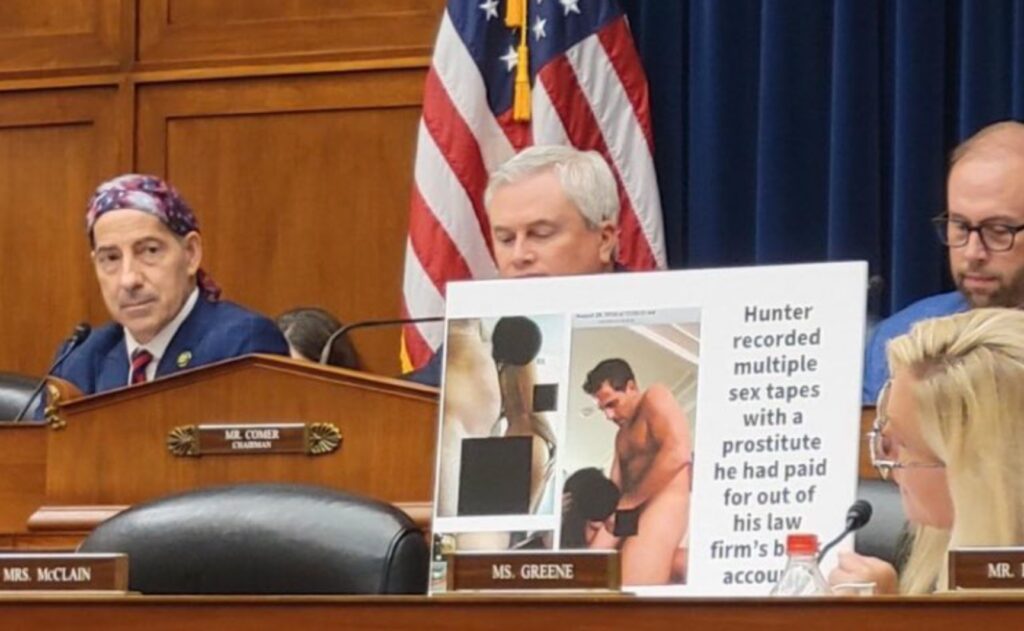
Rep. Marjorie Green Taylor in committee shows a photo of Hunter Biden that supposedly was found on his laptop, as Democrat Rep. Jamie Raskin, in a do-rag, looks on.
“You put it on the internet, it’s on the internet,” Dukes said. “You don’t put naked pics of your husband on social media.”
In Anchorage in 2020, Mayor Ethan Berkowitz resigned after a photo taken of his naked backside was posted in Facebook by a local news anchor. In that photo, his bottom was not as clearly visible as in the Burgess photo.
The photo published by news anchor Maria Athens that led to his resignation in 2020.
The talk of Fairbanks continues as the jokes about Burgess’ now-famous butt just continue to crack themselves.
But Dukes had a serious message, too. Burgess’ wife gave a non-apology for her role, and both she and her husband played the victim card, saying they were the subject of misinformation by a small group of people who disagree with their politics.
The photo of Bobby Burgess, posted on social media, has an emoji placed on it by citizen Keith Fons of North Pole to add some needed coverage.
Burgess’ wife Schupp was the one who recently led the charge to have Assemblywoman Barbara Haney removed from the Assembly because a letter she wrote to the editor did not include proper disclaimer that it was her own opinion, not that of the Assembly.
According to the Schupp complaint, the column written by Haney in the Fairbanks Daily News Miner failed to use the specific phrase “in my opinion as a private citizen,” in an opinion column.
Presiding Officer Fletcher, now running for Alaska Senate, allowed the complaint to move forward, even though others on the Assembly have written letters to the editor before that did not contain that exact phrase. Ultimately, Haney was not removed but was censured and fined $1 as a way to humiliate the conservative. That story is here:
Burgess himself recently posted on social media that there was a lack of decorum at public meetings. But while his wife has been protesting for Hamas terrorists at various events, he was removed from a private meeting that he crashed and disrupted. That story is here:
Ted Stevens Anchorage International Airport is known as a cargo flight hub, one of the busiest in the world. This week, a new start-up air cargo based in Mexico received approval to begin serving in the U.S. and will be seen by plane-spotters coming and going from Anchorage.
Awesome Cargo joins about 47 air carriers — 27 domestic and 18 international — that come through Anchorage, with about 44 cargo destinations served.
Anchorage ranks third in the world for cargo transit through its airport and in 2023 Ted Stevens Anchorage International Airport surpassed Shanghai Pudong Airport. About 3.461 million tons of cargo flies in and out of Anchorage annually.
Photo above shows an Awesome Cargo Airbus 330 landing on its first visit to Anchorage in July.
RollCall has place Alaska Rep. Mary Peltola on its list of “most vulnerable incumbents.”
Peltola, running for her second term, made her debut on the list of the top 10 most-vulnerable incumbent House members “after the state’s complicated primary process ended up with only one GOP opponent compared with the two she faced in 2022,” the political news and analysis publication says.
Last week, Cook Political Report announced that Republican Nick Begich has pulled even with Peltola, with just six weeks until the election ends.
The situation for Peltola got worse after the Alaska Democratic Party failed to get another Democrat kicked off the November ballot. Eric Hafner is the Democrats’ worst nightmare this election, as they had planned on having Republicans “split the vote” on the ranked-choice voting method used in the Alaska general election. Instead, they have two Democrats.
Notably, Roll Call characterizes Alaska’s voting system as “complicated.”
“The bill is coming due for extreme Democrat Mary Peltola selling out Alaskans to Biden, Harris and the radical Left’s agenda. While Peltola votes for open borders, against military pay raises and against veterans’ benefits, Nick Begich will secure the border and support our troops,” said National Republican Congressional Committee spokesperson Ben Petersen.
It’s that time of year again, when the Centers for Disease Control and Prevention is pushing that new Covid jab into your arm and into everyone’s arm who is six months or older.
The CDC no longer calls it a booster shot — it now marketed as an annual shot, much like your annual flu vaccine. But a rose by any other name is still a rose.
It doesn’t matter if children have an extremely low death rate from Covid or that no child under the age of 18 In Alaska has died from Covid. And it doesn’t matter that deaths from Covid are more common among people who have co-morbidities. It also doesn’t seem to matter there have been serious side-effects from the shot itself.
The Public Service Announcements are running nonstop, to include the need to protect grandma from this disease.
What should be pushed in Alaska is not the jab. What should be pushed in Alaska is people becoming intensely aware of their Vitamin D levels.
Last November in Must Read Alaska, I stated Vitamin D is critical to a robust immune system. Additionally, I pointed to a study done in Israel that demonstrated the Covid mortality rate for those with insufficient vitamin D levels was 25.6%, compared to 2.3% among those with sufficient vitamin D levels.
I know it’s no surprise to you we are losing sunlight daily. Winter is upon us, and you aren’t going to get much vitamin D from the sun.
Alaskans should be informed by their public health system that Vitamin D levels are critical for fighting infection and viruses. Instead, public health is once again pushing a Covid jab for all ages.
With the number of potential side effects from the mRNA vaccines, one should think twice about rolling up one’s sleeve and instead head to the nearest store to get some Vitamin D.
It is important to stay up to date with Covid, the government’s involvement, and what else is being planned for you in the future. I know you are tired of hearing about Covid.
Yet the masks mandates are starting back up again in parts of our country.
And doctors are still losing their board certifications because of their stance that covid jabs have too many side-effects. A German medical board recently fined a doctor $2,799 for warning people about dying from the Covid mRNA injections in 2021.
Yes, the beat goes on. I feel like this is Groundhog’s Day 4.0. The rhetoric is the same, the rules are the same, and they are once again gearing up to constrain your freedom.
What can you do about it? Be knowledgeable. Keep informed.
Join us for our next Covid Alliance Event on Oct. 26: “Alaskans 4 Personal Freedom.” Our speakers include:
Dr Meryl Nass, speaking on the World Health Organization and its threat to our national sovereignty. She will also delve into details on the newest “plandemic” in the making and discuss how the global elites plan to disrupt your food supply.
Lt. Col. Dr. Theresa Long, a whistleblower who testified before Congress, will address military vaccine issues and injury.
Dr. Stanley Goldfarb, cofounder of “DoNoHarm,” will speak on Diversity, Equity, and Inclusion in medical schools, and how this policy has affected what new doctors are learning or not learning in their educational process.
Dr. Pam Popper will address “Using the Courts to Restore Our Right,” in which she will discuss vaccine lawsuits that have been filed and what success we have had in this area.
Dr. Joel Wallskog, co-founder of React19, will recount his own vaccine injury, and unpack what avenues are open to others who were injured by this vaccine.
Dr. Ryan Cole, who had his medical license restricted in the state of Washington for prescribing Ivermectin to Covid patients via telemedicine, will speak about turbo cancers that have occurred since the start of the Covid pandemic.
Dr. James Lindsay will speak about culture wars and their effect on our children.
Dr. Peter Breggin will speak on “Thinning the Herd. The pandemic as a global Milgram experiment.”
Our own Dr. Ilona Farr will speak on “Finding Solutions To Treat Health Problems Caused by Covid-19.”
For just $55, you can stay ahead of the fake news and decide for yourself what’s best for you and your family. The price for the conference includes a hot plated lunch at the Egan Center, Anchorage.
Go to this link to purchase tickets and we’ll see you there.
Linda Boyle, RN, MSN, DM, was formerly the chief nurse for the 3rd Medical Group, JBER, and was the interim director of the Alaska VA. Most recently, she served as Director for Central Alabama VA Healthcare System. She is the director of the Alaska Covid Alliance.
U.S. Sen. Dan Sullivan, a member of the Senate Commerce Committee, joined Senator Ted Cruz and several of his colleaguesin sending a letter to the U.S. Department of Commerce demanding answers regarding the implementation of Commerce’s new financial management system, which has disrupted National Oceanic and Atmospheric Administration’s weather forecast operations and delayed financial relief for fishery disasters, particularly in Alaska’s small coastal communities. The federal failure has also threatened the availability of safety information for aviators and mariners, and left agency employees without reimbursement for official travel expenses.
NOAA was the first agency to implement Commerce’s new $341 million “Business Application Solution” program built by Accenture Federal Services. Designed to modernize financial and business management applications, the software’s implementation has resulted in significant system failures, delays, and cost overruns.
“The first rollout, at the National Oceanic and Atmospheric Administration (NOAA) in October 2023, has caused a backlog of thousands of unpaid invoices reportedly resulting in a loss of both alerts in tornado prone areas and vital weather information for pilots,” the senators wrote. “Even a short-term interruption in vital weather information and alert systems is an unacceptable tradeoff for transitioning to a new financial management system. In addition to these disruptions, there have been unnecessary delays in Fishery Disaster allocations. There are currently seven separate unfunded fishery disaster requests for salmon fisheries alone. This delay has been particularly catastrophic for small communities, like St. Paul Island, Alaska, where the collapse of crab fisheries has had enormous economic impacts. We are concerned what other adverse effects may result if the Department continues to roll out the new system without changes.”
“It is our understanding the Department has been aware of the need for improved transition management for some time,” the senators added. “One year after the Department awarded the contract for the new system—known as the Business Application Solution (BAS)—the DOC Office of the Inspector General (OIG) issued a Management Alert, stating that DOC needed to develop key inputs and align with known best practices. The Department failed to heed this warning as two subsequent OIG audit reports pointed, again, to a failure to implement basic management controls.”
The Inspector General’s report also found that changes in the BAS system to fix the issues experienced by NOAA will likely result in significant cost increases.
The senators want more information on how many sub-agencies have been negatively impacted by the failures and when the problems are expected to be resolved.
Joining Sens. Sullivan and Cruz in sending this letter were Sens. Susan Collins of Maine, Alaska Sen. Lisa Murkowski, and Katie Britt of Alabama.
As the Juneau Assembly addresses several looming economic issues, voters will decide three significant ballot propositions in their upcoming Oct. 1 municipal election, each with weighty financial implications.
Proposition #2, labelled “Ship-Free Saturdays”, targets Juneau’s cruise industry and the local businesses and jobs it supports. If passed, the proposition would slash city revenues by some estimates up to $4 million annually and result in visitor-related job losses.
Propositions #1 and #3 are separate bond issues dealing with public safety and water infrastructure that total $22.75 million. Together they would increase, by approximately 60%, the municipality’s outstanding general obligation (G.O.) bond debt, estimated at about $36 million at yearend 2023.
As standalone proposals, these ballot issues require critical scrutiny, but they don’t exist in a vacuum.
In the past year, Assembly members have tackled major unanticipated expenditures to plug budget gaps at the Juneau School District and Bartlett Regional Hospital resulting in millions of dollars added to the city budget. Putting even more strain on city finances, the Assembly has continued to hoard tens of millions of dollars for new city offices and a new cultural arts center project rejected by voters. To date, the total cost of the cultural arts facility and its annual subsidy remain unknown.
Then, last month a glacial outburst flooded 300 homes and hundreds of vehicles in the Mendenhall Valley. Recovery efforts are ongoing but mitigation of future floodswill be expensive and may take years to complete. Some of the city’s costs for recovery and mitigation may be reimbursed but future liability is unknown and will likely be substantial.
Juneau voters should consider all of the above when deciding how to vote on the three ballot propositions.
The “Ship-Free Saturday” petition proposes banning cruise ships with a capacity for 250 or more passengers on Saturdays and the Fourth of July, starting in 2025. It is particularly worrisome because it reduces the city’s annual revenues at a time when they are critically needed.
Passage of the proposition would send a message to the rest of the state that, apparently, Juneau is so flush with cash, we don’t need to worry about city finances. Clearly, that is not the case.
Citizen task force recommendations for a daily five-ship limit and an industry agreement to cap cruise passengers have been adopted by the city and are now being implemented. These cooperative solutions should be allowed to work before considering additional measures.
Furthermore, the legality of blocking ships from visiting Juneau is questionable and will probably be tested in court. Acting prematurely by passing this proposition undercuts the city-sponsored collaborative process and will likely result in years of costly litigation.
Voters should reject this attempt to circumvent years of productive, good-faith efforts engaged in by the city and the industry that have mitigated industry impacts.
The other two ballot propositions are a tougher call.
Ballot Proposition #1 authorizes $12,750,000 in G.O. bond debt to fund infrastructure repairs, equipment replacements, and technological improvements to Juneau’s deteriorating public safety communications system.
Ballot Proposition #3 will authorize $10,000,000 in G.O. bond debt to reconstruct the clarifier building at the Juneau Douglas Wastewater Treatment Plant.
Based on available information, it appears both are needed projects.
The question voters should ask themselves, is the timing right and is this the best way to pay for them?
Both projects would replace aging systems and facilities that have been ignored for years. We all want public safety to have the best communications possible and our wastewater to be handled dependably. But why weren’t these issues addressed in the regular budget process before they became critical?
Surprising taxpayers with large projects at the crisis stage is not the answer.
The City and Borough of Juneau has sufficient debt capacity for these projects, so that if passed, property taxes would not need to be increased. But, if voters say “YES”, this proposition will replace bonding capacity that could be used for flood mitigation or another unanticipated emergency. Saying “YES” would also make it more difficult for the Assembly to consider citizen property tax relief.
Until the full extent of the city’s financial obligations are known, Juneau voters should be wary of significantly increasing debt or reducing city revenues.
After retiring as the senior vice president in charge of business banking for Key Bank in Alaska, Win Gruening became a regular opinion page columnist for the Juneau Empire. He was born and raised in Juneau and graduated from the U.S. Air Force Academy in 1970. He is involved in various local and statewide organizations.