Tuesday, August 4, 2026
Home Blog Page 360

Desperate Democrats appeal to Supreme Court to kick a disfavored Democrat off of November ballot

19

The Alaska Democratic Party has appealed the decision by Superior Court Judge Ian Wheeles that allows Democrat felon Eric Hafner to remain on the ballot for the Alaska congressional race. Hafner’s name will show up for voters along with Rep. Mary Peltola, Nick Begich and John Wayne Howe for the ranked-choice voting in the congressional contest.

The Alaska Supreme Court will hear the case on an expedited basis, since the printing of the ballots for November is already under way and any delay in overturning of the lower court decision may impact the elections in ways that have never been seen in Alaska.

The appeal will be heard Thursday at 10:15 a.m. and will be live-streamed on ktoo.org/gavel.

Judge Wheeles’ decision says that the Democrats have made up all kinds of imaginary possibilities for the future that they have no way of knowing or proving, and that Eric Hafner is within his rights to file as a candidate, and the Division of Elections made no error of judgment in allowing him to take the fourth slot on the ballot, since two previous candidates had dropped out after the primary.

Wheeles said that “one’s failure to plan does not constitute another’s emergency,” of the Democrats and their challenge of Eric Hafner’s name on the ballot. It’s their own fault they didn’t challenge Hafner’s qualifications in the legal time allowed, which is 10 days after the closure of the candidate filing period.

“Plaintiffs’ complaint is not about the action or status of Hafner or the action or determination of the Defendants, but with the amendments of Ballot Measure 2 itself,” Wheeles wrote. “Plaintiffs complain that the statutes allow a candidate, such as Hafner, to unilaterally choose his party affiliation and declare it on the ballot. The court is applying that law to the facts and finds that Hafner is acting within his legal right to declare his registered voter affiliation and have it listed on the ballot. The court is likewise applying that law to the facts and finds that the Division is properly printing ballots as such. Plaintiffs allege no violation of law by Defendants or Hafner and no resulting harm. As a final point, Defendants argue that Plaintiffs’ case amounts to a veiled or improperly pled election contest. Plaintiffs dispute this characterization. The court made the analogy that one’s failure to plan does not constitute another’s emergency. The time sensitivity of this motion is inescapable. Equally inescapable is the reality that Plaintiffs could have pursued this relief at any time after Hafner filed his declaration of candidacy in late May.”

The Alaska Republican Party weighed in on the appeal:

“The Superior Court’s ruling in the case of Alaska Democratic Party v. State of Alaska, Division of Elections was a victory for all Alaskans. Superior Court Judge Ian Wheeles denied the motion for a temporary restraining order and preliminary injunction.
In short, the court got it right, and clearly agreed with the Alaska Republican Party – if the courts had found for the plaintiffs in this case, the irreparable harm would have been to Alaskans and our electoral process, not to the Alaska Democratic Party. Ultimately, the rights of the Alaskan voters prevailed,” said Carmela Warfield, Alaska Republican Party chairwoman.

“In their argument, the Alaska Democratic Party argued that the second Democrat on the ballot could impact the election by taking votes away from their preferred candidate. This is the direct result of the ranked choice voting scheme that is currently the law in Alaska. The Alaska Democratic Party seems just as frustrated as so many other Alaskans are with this ill-conceived law. They are so frustrated that they have appealed the court’s ruling to the Alaska Supreme Court, and the Alaska Republican Party will be right there with the people of Alaska,” Warfield said.

“All Alaskans — regardless of party affiliation – have the opportunity this November to prevent this type of nonsense from ever happening again by returning to a system of fair elections that all Alaskans can be proud of,” Warfield said.

Read the judge’s decision for yourself here:

Mikaela Emswiler: The ballot bandits from out of state are undermining Alaska’s elections

By MIKAELA EMSWILER

In a dramatic turn of events, the Alaska Democrat Party is now expressing disdain over the ranked-choice voting system with the same fervor that Republicans have shown for years. This change in attitude is fueled by the shocking inclusion of an out-of-state felon on the House ballot –a development that has ignited significant backlash within the Democrat party.

Eric Hafner, a Democrat currently serving a 20-year prison sentence in New York for threatening public officials in New Jersey, has never lived in Alaska and has no ties to the state. Yet, astonishingly, he has advanced to the “final four” candidates on the November ballot due to the dropout of two competitors ahead of him.

How did an incarcerated felon with no Alaskan residency even make it onto our ballot? This fact highlights one of the glaring flaws in our damaged election system.

Hafner’s unexpected place on the November ballot has ignited a strong response from the Democratic Party, who recently sued the Division of Elections in an unsuccessful attempt to remove Hafner. Hafner’s inclusion threatens to split the vote, echoing the 2022 Palin-Begich dynamic.

But Hafner’s place on the ballot isn’t the first instance we’ve seen of outsiders attempting to influence our elections. In 2022, Shoshana Gungurstein, an actress from California, launched a campaign in Alaska for U.S. Senate.

Gungurstein registered to vote in Alaska in April of 2022, then subsequently filed her candidacy. Gungurstein’s late registration disqualified her from running in any state-level races, but the US Constitution, being looser with its election laws, allowed her to run for US Senate. Her campaign was also primarily funded by out-of-state sources.

Between the rising occurrences of outsiders attempting to weasel their ways into our elections, suspicion about Dominion voting machines, and the influx of dark money from outside sources, have led both Democrats and Republicans to question the integrity of our election system. It’s clear that our democratic process is under threat.

Alaska’s Supreme Court has already addressed the unconstitutionality RCV, but the fight isn’t over. Support our efforts by visiting www.yeson2ak.com and voting YES ON 2 this November to ditch RCV as our electoral method.

Michaela Emswiler is with Yes on 2, a nonpartisan nonprofit organization dedicated to enhancing the quality of life for all Alaskans by providing education and advocacy concerning policy issues impacting Alaska and the nation, including education and research about how Alaskan elections operate.

L. Kathryn Holmstrom: Ranked-choice voting system has not worked well for Alaska

24

By L. KATHRYN HOLMSTROM

I would like to address the problems that the ranked choice voting election system has created in the great state of Alaska.

This system was initiated by Alaskans for Better Elections. The organization was given an immense amount of dark money from organizations from outside of our state to ensure that RCV would be implemented statewide. We became aware of how awful this system was when it impacted our 2022 election.

As a resident of Alaska for over 35 years, I would like to list a few of my concerns with the ranked choice voting system:

  1. There is a jungle primary, which has numerous problems. One of the problems is that there is no vetting. This opens the door to fraud and manipulation of the system. This recently came to light when a convicted felon incarcerated in New York placed his name on the ballot to run against Mary Peltola as the Democrat candidate.
  2. One person is not selected for the party during the primary vote. This results in the vote being split out if you have two people of equal likability and similar views on the issues. This can occur whether you are Republican, Democrat, or Independent.
  3. Because of the complexity of the system, there is a long delay in receiving the results. I remember knowing the results in 24 hours prior to ranked-choice voting, while now it is three weeks or more. This again opens up a door of opportunity for fraud.
  4. Many of the ballots were trashed in the 2022 election, because the people did not understand how to vote. If you have to send out instructions and pay for commercials to tell people how to vote, you do not have a user friendly system.
  5. Recently we have been bombarded by commercials for “No on 2”; their intent is for the Ranked Choice Voting System to remain in place. The commercials, again, are being initiated by Alaskans for Better Elections with outside dark money. They tried everything, to try to keep the repeal of ranked-choice voting off the ballot in 2024; even taking it to the Alaska Supreme Court, so that Alaskans would not have a voice as to whether they would like to keep RCV or return to the traditional closed election system that we have used for hundreds of years. They lost the battle in court, so now they are using $4.3 million in dark money they received in August to tell us that we don’t want dark money used in our state to influence our election. This is the definition of deception.

The bottom line is: Don’t fall for their attempt to deceive and confuse; vote YES on Ballot Measure 2.

L. Kathryn Holmstrom is a concerned resident of Alaska.

Chris Wright: Not all public safety employees want defined-benefit pensions

By CHRIS WRIGHT

You may have read recent commentaries that have made claims about what it means to support public safety. All too often, what gets lost in the discussion are the voices of actual public safety workers. Most of the time, those public safety workers are restricted from speaking out publicly about political issues, and they have a strong desire to remain neutral and above the fray of partisanship.

But there should be no mistake that there are issues that impact public safety workers such as police officers both positively and negatively. Unfortunately, the union bosses who claim to speak on behalf of the officers are so intertwined with partisan political allegiances and special interests that they often no longer make an attempt to reflect the views of their membership.

The discussion about defined benefits in Alaska is one of the best examples of how union bosses simply ignore the best interests of their membership. The bosses ignore their members who value the economic freedom and ownership that defined-contribution plans provide. The mobility provided by the defined-contribution plans allows for career growth opportunities. The union bosses simply don’t acknowledge how portable retirement plans that are owned by the employee allow them to take hundreds of thousands of dollars with them when they make life choices that benefit them personally. These types of plans benefited private sector workers beginning decades ago, and unfortunately, government workers were left behind.

The union bosses ignore the fact that the state of Alaska, taxpayers and all government workers deserve economic freedom that comes with a cost-specific retirement system that allows individuals to build wealth and provide income for retirement. This approach of allowing individuals to take personal responsibility instead of saddling taxpayers with unfunded liabilities benefits both the taxpayer and the individual with the retirement plan.

Why do the union bosses continually advocate for an outdated government-based system of retirement benefits? They constantly talk about retention and the cost of training and turnover. But police departments across the country all are facing severe manpower shortages and recruiting challenges. Most of those departments have outdated pension systems that Alaska has fortunately left behind. The union bosses want to prevent their members from leaving with hundreds of thousands of dollars and instead handcuff them to jobs that may no longer fit in their family life. And other departments have shown that those handcuffs don’t work anyway in retention efforts.

My interest and expertise on this topic comes from a unique perspective and life experience. I “retired” from a 20-year Wall Street career and became a police officer to serve the community I love. I served clients and help many transition from old-style pension plans to lucrative, wealth-building personal 401(k) accounts. Millions of working class Americans have benefited from being part of this wealth-building investor mindset instead of relying on the government to provide for when you retire.

Our current Alaska system takes a mandatory 13% of my gross salary that is contributed to my personal account. The required contributions are invested in prudent long-term investments, which prevent risky gambles of critical retirement benefits. This 13% is only the beginning of the opportunity for me and my coworkers to make other retirement contributions that are also matched.

My union has repeatedly attacked and vilified me for standing up for my coworkers. I have been elected as a union board member twice. I won a recall election that was initiated because I dared to challenge the union bosses on defined benefits. The union has done everything possible to silence me because I refuse to go along and support the union’s positions that hurt the membership. I implore you to talk to your friend or neighbor who happens to be a police officer. You should know that the union bosses consistently ignore their members and will not allow them to weigh in when the unions make political decisions.

Christopher Wright is a senior patrol officer with the Anchorage Police Department and speaks on behalf of himself. He is an elected executive board member of the Anchorage Police Department Employees Association. Wright has been a police officer for almost seven years after spending two decades in investment management.

Watch: Peltola’s fundraising pal Rep. Eric Swalwell’s meltdown in committee over Trump cat meme jokes

Rep. Eric Swalwell, who visited Juneau to raise money for Rep. Mary Peltola in 2022, is now losing his mind over the tidal wave of cat memes that show former President Donald Trump saving the cats and ducks of Ohio from becoming food for Haitian immigrants.

Swalwell has been an enemy of Alaska’s energy economy, and was a special guest of Peltola during her campaign. He was later investigated for his liaison with Fang-Fang, a Chinese spy, and for laundering campaign cash for Super Bowl seats.

Now, he’s incensed about rumors of Haitian immigrants stealing family cats from yards and ducks from city ponds and taking them home to eat have swept across social media, with video of people testifying about the problem of duck poaching and cat roasting to their local elected officials in Springfield, Ohio, where the Biden Administration sent thousands of Haitian refugees. He believes these rumors to be false.

While there has been no solid proof that the poaching of ducks and cats is a widespread problem, last year a community in Nebraska was in outraged after two illegal Honduran migrants allegedly killed a bald eagle with the intention of eating it.

“In interviews last month, following claims at a city commission meeting that Haitians were cooking wildlife taken from local parks, a city official said they had not been able to verify any of those reports and described them as “false” and “misleading” information amplified by social media,” Reuters wrote on the topic.

What is solid is that 20,000 Haitian immigrants have been sent to Springfield, Ohio, overwhelming the abilities of a town of just 59,000, thanks the Biden administration’s expanded of the Temporary Protected Status Program for Haitian immigrants.

Cats and ducks aside, on Wednesday, Ohio Gov. Mike DeWine said he’s send state troopers and millions of dollars in healthcare resources to the city, which has become the poster child for the failed immigration policies of the Biden-Harris Administration.

DeWine broadcast his plan in a news conference on Tuesday. A day earlier, Ohio Attorney General Dave Yost ordered his office to do everything in its power to stop the Biden-Harris Administration rom sending “an unlimited number of migrants to Ohio communities.”

“These dramatic surges impact every citizen of the community, every citizen,” he said, adding that other towns in Ohio are also suffering from an surge of Haitians. “Moms who have to wait hours in a waiting room with a sick child, everyone who drives on the streets, and it affects children who go to school in more crowded classrooms.” 

But it’s the cat and duck memes that made Swalwell crazy. In a House Judiciary Committee, he blasted Chairman Jim Jordan for passing along cat memes on X/Twitter, images hilariously showing Trump hugging ducks and cats as he saves them from becoming someone’s meal. The memes being passed around are being made with artificial intelligence and look cartoonish.

Some of them now are A.I.-made videos that are driving Democrats mad, such as this one:

If cats and ducks are apparently safe enough, according to Democrats, the roads, classrooms, and children of Springfield, Ohio are not. One child has been killed by a Haitian immigrant in Springfield.

Local police report also report traffic issues are exploding with the numbers of Haitians using the roads who don’t know how to observe traffic laws in the United States.

It’s a cultural thing. Haitians do consider cat meat a delicacy, and Haiti is considered by many to be among the most lawless places on earth. Traffic laws are merely suggestions in the deeply Third World Country.

JD Vance, running as Trump’s vice presidential nominee, had this to say about the cats and ducks debate:

“In the last several weeks, my office has received many inquiries from actual residents of Springfield who’ve said their neighbors’ pets or local wildlife were abducted by Haitian migrants. It’s possible, of course, that all of these rumors will turn out to be false. Do you know what’s confirmed? That a child was murdered by a Haitian migrant who had no right to be here. That local health services have been overwhelmed. That communicable diseases–like TB and HIV–have been on the rise. That local schools have struggled to keep up with newcomers who don’t know English. That rents have risen so fast that many Springfield families can’t afford to put a roof over their head. Here is Kamala Harris bragging about giving amnesty to thousands of Haitian migrants.”

Kamala the ‘Marxist’ smirks and sneers her way through first tough debate with Trump

135

Vice President Kamala Harris, in the biggest political event of the year, grimaced, squinted, sneered, twitched, pursed her lips, and made faces at Donald Trump during their first debate meet-up, hosted by ABC News on Tuesday evening.

Trump accused Vice President Kamala Harris of copying his plans because she had none of her own during the Tuesday night debate. He called her a Marxist and said she will destroy the United States if elected president.

“She has no policy. Everything that she believed three years ago and four years ago is out the window. She’s going to my philosophy now, in fact, I was gonna send her a MAGA hat,” Trump said, trolling her. “She’s gone to my philosophy, but if she ever got elected, she’d change it. It will be the end of our country. She’s a Marxist. Everybody knows she’s a Marxist. Her father’s a Marxist professor in economics, and he taught her well.”

Harris said she had the support of all the major economists of the world, including those from Goldman Sachs and professors from Wharton School of Business. She said the Biden-Harris Administration had “cleaned up” the mess that Trump had left.

Neither candidate scored points enough to persuade detractors to change their minds, however. Trump was polite to the nervous and twitchy Harris, who made exaggerated facial expressions at Trump, not unlike a teenager.

She was not able to bait him into some of his more legendary interruptive behaviors, however. Trump remained stoic and disciplined to his message, but repeatedly called out Harris on every lie that she told about him — and there were dozens.

Trump criticized the Biden-Harris border policies that have ravaged cities and towns across America.

“They’re criminals. Many of these people are criminals, and that’s bad for our economy too. Well, bad immigration is the worst thing that can happen to our economy. They have, and she has, destroyed our country with policy that’s insane. Almost policy that you say ‘they have to hate our country,” Trump said.

On social media, several commentators said that Harris was wearing earrings that doubled as high-end hearing devices, and that she may have been getting help.

Was Kamala Harris wearing an audio device during the debate? The word has spread that it appears so.

Topics of immigration, the economy, and abortion all came up, but there was no solid talk about energy policy for the United States or security in the Arctic.

The Lincoln Project, which is an anti-Republican organization, immediately published a statement that said, “Harris lit him up and melted his orange face paint like the Nazis in Indiana Jones.”

But an ABC poll done during the debate shows that 92% of viewers thought Trump won the debate, while just 4% thought Harris won. A CNN poll conducted after the debate showed Trump inching up from 53% to 55% and Harris inched down from 37% to 35% with poll participants.

Breaking: Anchorage judge rules that the Democrats’ second candidate stays on November ballot

18

Anchorage Superior Court Judge Ian Wheeles on Wednesday ruled against a request by the Alaska Democratic Party for a temporary restraining order and preliminary injunction against the Division of Elections, an effort by Democrats to stop the division from printing the general election ballot with the name of Eric Hafner on it as a Democrat.

In the congressional race, two Republicans pulled out after the primary was over, and Hafner moved up into the fourth slot for the general election ballot, where voters use the ranked-choice voting method.

The Democrats didn’t want Hafner to take votes away from Rep. Mary Peltola, who has evidently hundreds of Democrat detractors. Hafner was originally the sixth vote-getter out of a dozen on the ballot, but he moved up to fourth place, putting him on the general election ballot even though he had less than 1/2 percent of the primary vote.

The Democrats argued that some voters might be confused by Hafner being on the ballot and, since he is serving time in a federal prison, he can’t serve in Congress if he was elected.

Read the complete ruling here:

“Because of how the court has ruled on the above issues, the court deems it necessary to address Hafner as an indispensable party although the issue was not brought before the court by any of the parties. As a matter of due process, the court could not grant the relief sought by the plaintiffs without joining Hafner as an indispensable party. Under Civil Rule l9(a), an indispensable party must be joined in an “action if (1) in the person’s absence complete relief cannot be accorded among those already parties, or (2) the person claims an interest relating to the subject of the action and is so situated that the disposition of the action in the person’s absence may (i) as a practical matter impair or impede the person’s ability to protect that interest ….” Hafner has an actual interest in the outcome of this case and he would be deprived of his interest without due process if the court granted the relief sought by Plaintiffs,” Judge Wheeles wrote.

“Even if Hafner loses in the election, which all parties assume is likely, and the court assumes Hafner also accepts is likely, there is still an interest in being listed as a candidate on a ballot regardless of the results of the election. Without question, many people successfiilly elected into office start out running without the expectation of success, possibly only looking to build narne-recognition or call attention to a campaign issue. Whether that applies to Hafner is immaterial; the right to be placed on a ballot is a separate interest without regard to the ultimate success in the general election. That interest is certainly not adequately represented by an existing party. While the relief sought here is not asking Hafner to do anything, Hafner would still be deprived of his interest without due process of law if he were to be removed from the
ballot with no notice or summons of this proceeding,” the judge ruled.

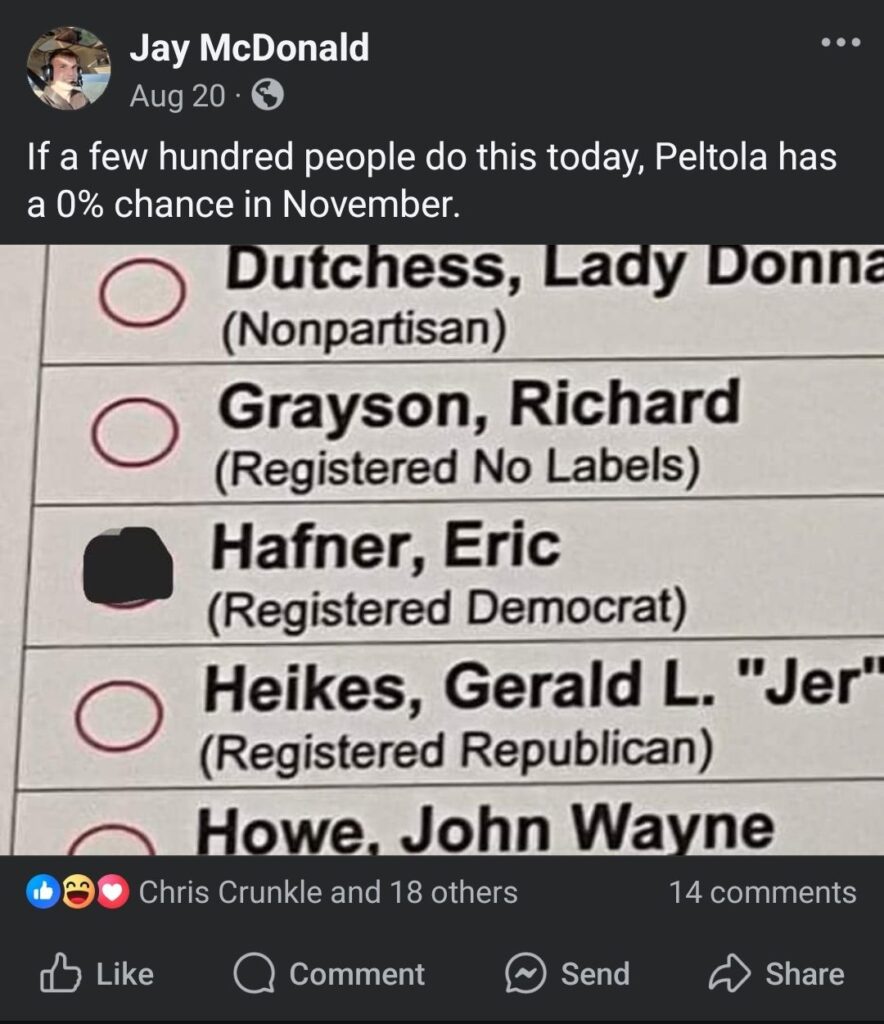
Anchorage voter Jay McDonald said he cast his ballot for Hafner for the express purpose of getting him onto the general election ballot. It’s the same reason, he said, that political gun-for-hire Jim Lottsfeldt’s group “Vote Alaska Before Party” was trying to get Republicans to vote for Gerald Heikes — to get him on the November ballot and confuse Republican voters.

McDonald said that he would not stand for having his voting rights disenfranchised by the Democrats. He had encouraged others to follow his lead and vote for Hafner, and he believes dozens of people did just that after he posted his ballot and reasoning on Facebook. He was prepared to sue if Hafner was kicked off the ballot.

Open primaries and ranked-choice voting was designed by liberals to ensure more Republicans would be on the November ballots than Democrats and split the campaign donations, volunteers, and momentum of conservatives. But it just didn’t work out that way on the second election to use the new system.

“Congresswoman Mary Peltola won the August 20 primary election with a clear majority of the votes cast. The next three highest vote-getters were all Republicans. But as an apparent result of last-minute machinations at the expense of Alaska voters, two of those three Republican candidates dropped out, and Defendants [Division of Elections] certified late Monday that they intended to place the fifth and sixth-place finishers on the general election ballot in their place,” the lawsuit says.

It goes on to say that the sixth-place finisher, Eric Hafner, the felon who has made violent threats against political figures, judges, and others, cannot and should not be on the ballot.

“Alaska law does not provide for the inclusion of the sixth-place primary finisher on the general election ballot under any circumstances. But if it did allow for such inclusion, Mr. Hafner would need to be replaced by the seventh-place finisher: Mr. Hafner is disqualified from representing Alaska in Congress for two reasons. First, because he is not and cannot possibly become an inhabitant of Alaska—as the U.S. Constitution requires—while he is serving a federal prison sentence in New York until 2036. And second, because he failed to list his full residence address on his declaration of candidacy, as Alaska law requires,” the lawsuit says.

The Division of Elections is on a tight timeline and made a compelling case to the court. In an affidavit, Director Carol Beecher said that the ballot printer began printing ballots on Sept. 6 and must provide test ballots to the division by Sept. 11, so the division can make sure the ballots can be read and counted by the machines.

“The State Review Board will begin logic and accuracy testing using the test ballots on September 11. All the physical components used in the election – meaning the ballots, USB sticks, memory cards, and voting machines-are designed and tested together. The State Review Board and then regional offices conduct logic and accuracy testing to make sure that the ballots will be counted accurately. Logic and accuracy testing will take one or two days,” Beecher wrote.

“Once logic and accuracy testing is complete, the Division will begin printing more than 3,500 ballots for uniformed, overseas, and state advance voters,” Beecher wrote.

State and federal law require the Division to mail absentee ballots to these voters by Sep. 21 — 45 days before the election. These ballots are processed through the United States Postal Service bulk mail facility in Anchorage. Bulk mail is not available on Saturdays, so the Division must mail these ballots on Friday, Sept. 20.

The ballots for uniformed, overseas, and state advance voters will be printed by the Division in-house, rather than by the printer. The Division cannot print these ballots until the State Review Board has completed logic and accuracy testing. Because of the size of the ballots, they will take longer to print, and the Division must take them to a different vendor to fold them. It also takes time to count and organize these ballots, she said.

Anchorage Daily News staff to unionize, workers say

21

The beleaguered Anchorage Daily News, facing declining circulation and reader apathy, now faces a problem from within — the staff is unionizing.

The news release from the Anchorage News Guild says organizers filed a petition for a union election with the National Labor Relations Board and have requested voluntary recognition from leadership at ADN.

“By forming the Anchorage News Guild, the newsroom staff at ADN aim to advocate for fair wages, increased transparency and a sustainable workplace environment,” the news release says. The newsroom at the newspaper has a staff of about 30, including those in management, such as editors.

The guild says about 80% of the newsroom staff at Alaska’s largest newspaper “are publicly in support of joining The NewsGuild-CWA, which represents more than 25,000 media professionals from publications including The Seattle Times, The New York Times, The Associated Press and many others. The Anchorage unit is joining the NewsGuild-CWA’s Pacific Northwest local.”

This move means the ADN will be the only newsroom in the state to be unionized, the group said.

“Collectively, members of ADN’s unionization effort say they love working for the paper and feel honored to produce the award-winning journalism Anchorage deserves. They say they are unionizing to ensure they can continue to tell the stories of their community for decades to come,” the guild says.

The guild asks the readers and community to show their support for the newsroom’s efforts by signing a petition at https://bit.ly/supportANG to urge leadership to grant voluntary recognition.

The ADN was owned by the McClatchy Company for many years before being sold to Alice Rogoff in 2014, through her online publication the now-defunct Alaska Dispatch News. She renamed the Anchorage Daily News the Alaska Dispatch News.

Rogoff ran the paper poorly and it went into a financial tailspin. She filed for bankruptcy protection in 2017, at which time Johne Binkley of Fairbanks organized The Binkley Company to buy the newspaper for $1 million — far less than the nearly $34 million Rogoff had paid to McClatchy three years earlier.

This year, the newspaper has reduced publication of its print edition to two per week to cut costs.