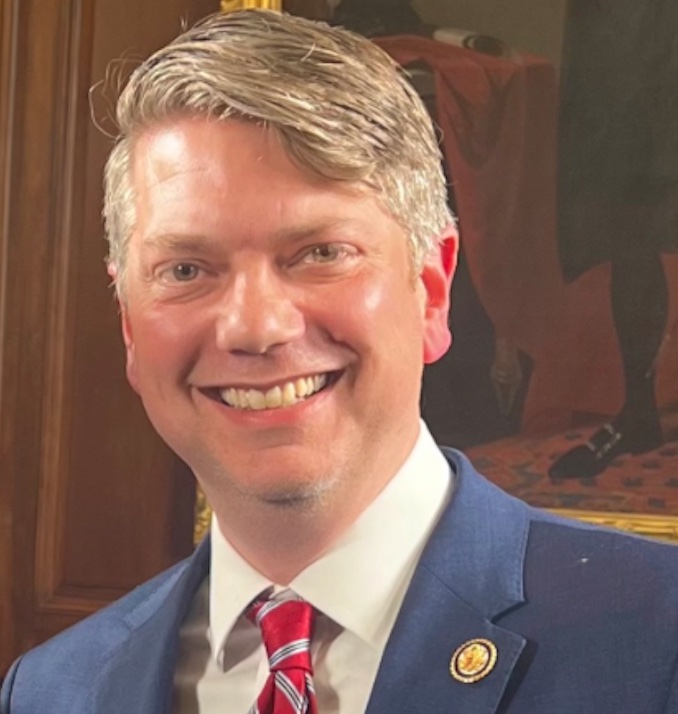
Congressman Nick Begich III has cosponsored legislation to address the growing risk of catastrophic forest fires, a result, in part, due to forest mismanagement.
“From the devastation caused by the Malibu fires to the growing risks faced by countless communities across the nation, it’s clear we are in the midst of a wildfire crisis,” Begich said. “Years of mismanagement and bureaucratic delays have left our forests vulnerable and our communities exposed. I am proud to support the Fix Our Forests Act as a decisive step toward addressing this urgent issue. This legislation provides the tools needed to manage our forests effectively, protect lives, and restore landscapes while creating much-needed jobs in rural areas.”
The Fix Our Forests Act streamlines permitting processes, streamlines forest restoration efforts, and fosters economic growth in rural communities.
“When it comes to safeguarding our families, firefighters, and forests, we cannot afford inaction. This legislation prioritizes safety, efficiency, and action to tackle the wildfire crisis head-on. It’s time to fix our forests and protect our communities,” he said.
The bill fact sheet highlights these features:
Simplify and expedite environmental reviews to reduce costs and planning times for critical forest management projects while maintaining rigorous environmental standards. Make communities more resilient to wildfire by coordinating existing grant programs and furthering new research. Promote federal, state, tribal, and local collaboration by creating a new Fireshed Center and codifying the Shared Stewardship initiative. Stop frivolous litigation and endless agency consultations that delay needed forest management activities. Give agencies new emergency tools to restore watersheds, protect communities in the wildland-urban interface and prevent forest conversion. Utilize state-of-the-art science to prioritize the treatment of forests at the highest risk of wildfire. Incentivize forest management projects of up to 10,000 acres to increase the pace and scale of addressing wildfire, drought, insects and disease. Revitalize rural economies by strengthening tools such as Good Neighbor Authority and Stewardship Contracting. Adopt new and innovative technologies to address forest health threats and suppress wildfires quickly and more efficiently. Harden utility rights-of-way against wildfire by encouraging more active management and the removal of dangerous hazard trees. Support wildland firefighters and their families through the creation of a new Casualty Assistance Program.
The House of Representatives passed the bill on Thursday on a vote of 279 to 141. It now goes to the Senate.
President Donald Trump signed an executive order Thursday declassifying Central Intelligence Agency files on the assassinations of President John F. Kennedy, Sen. Robert F. Kennedy. and Dr. Martin Luther King Jr.
They will be released to the public after more than 50 years.
“More than 50 years after the assassinations of President John F. Kennedy, Senator Robert F. Kennedy, and the Reverend Dr. Martin Luther King, Jr., the Federal Government has not released to the public all of its records related to those events. Their families and the American people deserve transparency and truth. It is in the national interest to finally release all records related to these assassinations without delay,”the order explained. “I have now determined that the continued redaction and withholding of information from records pertaining to the assassination of President John F. Kennedy is not consistent with the public interest and the release of these records is long overdue. And although no Act of Congress directs the release of information pertaining to the assassinations of Senator Robert F. Kennedy and the Reverend Dr. Martin Luther King, Jr., I have determined that the release of all records in the Federal Government’s possession pertaining to each of those assassinations is also in the public interest.”
It will take about 60 days for all of the documents to be released “in full.” Trump said the “families and the American people deserve transparency and truth. It is in the national interest to finally release all records related to these assassinations without delay.”
The Department of Justice and director of national intelligence (nominee Tulsi Gabbard) will develop a plan for the president to complete the release of these documents.
The President John F. Kennedy Assassination Records Collection Act of 1992 required all records related to the assassination of President Kennedy to be publicly disclosed in full by October 26, 2017, unless the President certifies that: (i) continued postponement is made necessary by an identifiable harm to the military defense, intelligence operations, law enforcement, or conduct of foreign relations; and (ii) the identifiable harm is of such gravity that it outweighs the public interest in disclosure. President John F. Kennedy Assassination Records Collection Act of 1992, section 5(g)(2)(D), Public Law 102-526, 106 Stat. 3443, 3448–49, codified at 44 U.S.C. 2107 note.
“I previously accepted proposed redactions from executive departments and agencies (agencies) in 2017 and 2018, but ordered the continued re-evaluation of those remaining redactions. See Temporary Certification for Certain Records Related to the Assassination of President John F. Kennedy, 82 Fed. Reg. 50,307–08 (Oct. 31, 2017); Certification for Certain Records Related to the Assassination of President John F. Kennedy, 83 Fed. Reg. 19, 157–58 (Apr. 26, 2018). In the Presidential Memorandum of April 26, 2018, I also ordered agencies to re-review each of those redactions over the next 3 years and disclose information that no longer warrants continued withholding under the standard set forth in section 5(g)(2)(D) of the President John F. Kennedy Assassination Records Collection Act of 1992,” the order explained.
President Biden allowed agencies to delay the release.
Alaska Sen. Lisa Murkowski will be a “no” vote on the nomination of Pete Hegseth for the Secretary of Defense. She said his drinking, infidelity, and the accusations against him were factors in her decision:
“Since Mr. Hegseth’s nomination last November, I have met with him and carefully reviewed his writings, various reports, and other pertinent materials. I closely followed his hearing before the Senate Armed Services Committee and gathered substantial feedback from organizations, veterans, and Alaskans. After thorough evaluation, I must conclude that I cannot in good conscience support his nomination for Secretary of Defense. I did not make this decision lightly; I take my constitutional responsibility to provide advice and consent with the utmost seriousness,” she said.
Murkowski voted to back 12 Biden nominees for his cabinet.
“I commend Pete Hegseth’s service to our nation, including leading troops in combat and advocating for our veterans. However, these accomplishments do not alleviate my significant concerns regarding his nomination. Managing the Department of Defense requires vast experience and expertise as the department is one of the most complex and powerful organizations in the world, and Mr. Hegseth’s prior roles in his career do not demonstrate to me that he is prepared for such immense responsibility. His leadership of two veteran organizations was marked with accusations of financial mismanagement and problems with the workplace culture he fostered,” she said.
Murkowski voted to confirm Defense Secretary Lloyd Austin, who oversaw the withdrawal and death of troops from Afghanistan and later disappeared for days, not telling anyone — even the White House — that he was in the hospital for a serious medical condition that required him to undergo surgery. He had not named a person to take over while he was unconscious.
“Although he has recently revised his statements on women in combat since being nominated, I remain concerned about the message that confirming Mr. Hegseth sends to women currently serving and those aspiring to join. Women have served our nation with distinction, overcoming immense obstacles to excel in combat and leadership roles, and they deserve to know that their leader honors and values their commitment to our nation,” Murkowski continued.
“While the allegations of sexual assault and excessive drinking do nothing to quiet my concerns, the past behaviors Mr. Hegseth has admitted to, including infidelity on multiple occasions, demonstrate a lack of judgment that is unbecoming of someone who would lead our armed forces. These behaviors starkly contrast the values and discipline expected of servicemembers. Men and women in uniform are held accountable for such actions, and they deserve leaders who uphold these same standards,” Murkowski said.
Murkowski voted to confirm Interior Secretary Deb Haaland, who led the reign of terror against Alaska’s economy during the past four years, halting every form of energy and resource development.
“Above all, I believe that character is the defining trait required of the Secretary of Defense, and must be prioritized without compromise. The leader of the Department of Defense must demonstrate and model the standards of behavior and character we expect of all servicemembers, and Mr. Hegseth’s nomination to the role poses significant concerns that I cannot overlook. Given the global security environment we’re operating in, it is critical that we confirm a Secretary of Defense, however, I regret that I am unable to support Mr. Hegseth.”
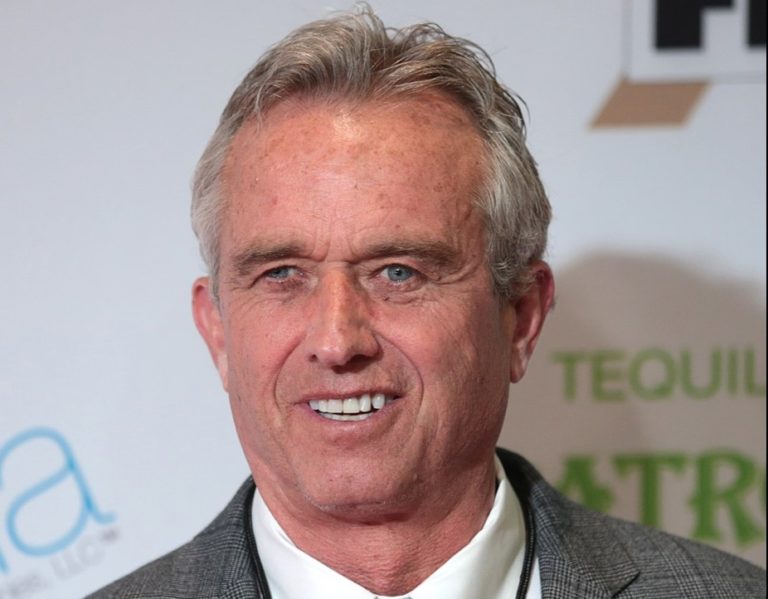
President Donald Trump has chosen Robert F. Kennedy, Jr. to run the U.S. Department of Health and Human Services.
RFK Jr. strongly believes we need to increase our focus on prevention of chronic diseases, we must decrease harmful additives to our food, improve vaccine safety, clean up our environment of toxic chemicals, and get better control of Big Pharma.
Here is what he believes:
Fight the Chronic Disease Epidemic
We are a highly developed country that values innovation in medicine and the curing of disease. Yet, according to the Healthy System Tracker, Disability Adjusted Life Years, the U.S. has the highest rate of disease burden among comparable countries, and the gap is growing. Life expectancy is dropping.
RFK Jr. plans to reorient federal health agencies to focus on chronic diseases and “rid them of Big Pharma’s influence.” In other words, we need to look at the underlying causes of diseases and replace prescription drugs with much healthier lifestyles, where possible.
That will require some individual behavior modification from all of us. It will be your choice — exercise, eat healthier, don’t smoke, less alcohol — or pop a pill.
Processed foods
It was amazing to me to see the number of chemicals and additives we have in our processed foods that are banned in many other countries.
In the 1990s, red dye #3 was banned from cosmetics because of the potential risk for cancer. But it took the federal government until January of 2025 to ban it from our food with the drop-dead date of 2027. RFK Jr. has been fighting for this for 35 years.
Ironically, this dye is found in some milk shakes they give the cancer patients who are undergoing chemotherapy. Thank God we are finally going to do what most of Europe did years ago.
Click on this linkto see the food additives either prohibited or restricted in Europe but still allowed in the U.S.
RFK Jr. has been an ardent supporter of more stringent testing with vaccine production so we can be assured that vaccines are safe and effective. He also wants the government to provide more vaccine information so people can make better decisions on their health and their children’s health.
His desire to get more stringent vaccine testing has led to Big Pharma saying, “he’s an anti-vaxxer.”
RFK Jr. has repeatedly said he is not an anti-vaxxer, but it seems he cannot get away from the negative press on this issue. The gaslighting will continue through his confirmation hearings.
Kennedy told NPR in early November that “we’re not going to take vaccines away from anybody.” He just wants them to be safe and effective.
Remember, the study to approve the jab against the Omicron strain of Covidwas only performed on eight mice. We know that sample size is much too small for valid results. I would have preferred a more robust evaluation before being told this jab was good to go.
Prescription drugs
RFK Jr. is opposed to the cozy relationship between Big Pharma and the FDA; retired FDA directors are known to simply move over to be on the boards of these big drug companies.
RFK Jr. also opposes the TV advertisements for the newest drugs, ads being delivered to the public daily. Have you noticed how many new ads for drugs are being shown recently? I know from experience it drives health providers nuts when a patient wants the newest and greatest drug when something less costly is just as effective.
The environment
RKF Jr. is labeled an environmental zealot. He wants to clean up toxic chemicals from our air, water, and soil. And he wants to ensure “that research into pharmaceutical drugs, pesticides, additives, and environmental chemicals is scientifically unbiased.”
I personally welcome his approach to making us a healthier nation. He has been meeting with senators to answer questions so that he can be confirmed as DHHS Secretary.
Sen. Dan Sullivan met with him and was pleased with the dialogue. He will support his confirmation.
Sen. Lisa Murkowski has not publicly stated if she will support RFK Jr.’s confirmation. She did say she met with him and she reiterated what he said were his views on vaccines. However, Murkowski then stated, “she would use Kennedy’s confirmation hearing to question him more before deciding how to vote.”
Take action
Do you believe it’s time to Make America Healthy Again?
Do you believe it’s time to break the cozy relationship between the federal government and Big Pharma?
Do you believe your children and grandchildren deserve healthier foods?
Then you can help support the confirmation of RFK Jr. to be our next secretary of the Department of Health & Human Services.
You can make a big difference. It’s time, Alaskans, for your voices to be heard. Phone calls seem to have a greater impact than emails.
Here are Sen. Lisa Murkowski’s contacts:
510 L Street Suite 600 Anchorage, AK 99501 Phone: (907) 271-3735 Fax: (877) 857-0322
522 Hart Senate Office Building Washington, DC 20510 Phone: (202)-224-6665 Fax: (202)-224-5301
Call, write, email her so she knows what you think. We need RFK Jr. at the helm. We need to get our country healthy again.
Linda Boyle, RN, MSN, DM, was formerly the chief nurse for the 3rd Medical Group, JBER, and was the interim director of the Alaska VA. Most recently, she served as director for Central Alabama VA Healthcare System. She is the director of the Alaska Covid Alliance/Alaskans 4 Personal Freedom.
Former Alaska Gov. Sarah Palin, in an interview with Al Arabiya News said she hopes President Donald Trump will appoint her to some position in his administration, preferably related to energy.
But she said she’s having trouble getting a meeting with Trump because of his gatekeepers.
“Again, President Trump knows where I am. You know, we have a good relationship. He knows that my administrative experience on a local level, at a state level, being chair of resources on a federal level to help with energy independence, he knows my area of expertise. We need to tap into everyone who has an ability and a willingness to serve this country. I’m certainly willing and I’m able. I hope he calls me,” she told Tom Burges-Watson, the interviewer for Al Arabiya.
“I know that there is that question out there as to why I’m not tapped into yet. President Trump has around him some gatekeepers that have made it very difficult to kind of, I guess, ingratiate oneself into the idea of the agenda that must be Former Alaska Governor Sarah Palin, in an interview with Al Arabiya News, said she hopes President Donald Trump will appoint her to a position in his administration, preferably related to energy.
According to Palin, she could not even secure credentials to attend the Republican nominating convention in Milwaukee, Wisconsin, in the summer of 2024, despite being a former vice-presidential nominee who spoke at the podium when she ran with Senator John McCain in 2008. Back then, she was invited to everything, but not now.
“I haven’t been invited to things. That’s OK because you kind of get used to that. I’m not gonna say rejection, but you kind of get used to that redirection. That is protection,” she said, reprising her role as victim.
In the interview, Palin also commented on Trump restoring the name of Mount McKinley after it had been changed to Denali by President Barack Obama in 2015.
“It didn’t need to have its name changed to start with. It’s always been Mount McKinley and McKinley Park. It’s absolutely beautiful. We locals up here and as governor, former governor, we’ve always called it Mount McKinley. So when it was changed to Denali for no reason. No, nobody was begging for a change in name in that peak. Just put it back the way it was, more common sense. There are so many other things that need to be focused on. So changing the name back to what it was from the beginning makes sense.”
Ironically, she called the mountain Denali many times in the past and her code name used by the Secret Service during her vice presidential run was “Denali.”
It wasn’t professional journalists who uncovered that the Bureau of Alcohol, Tobacco, Firearms, and Explosives (ATF) was defying President Donald Trump’s orders to end diversity-preference hiring. It was citizen journalists.
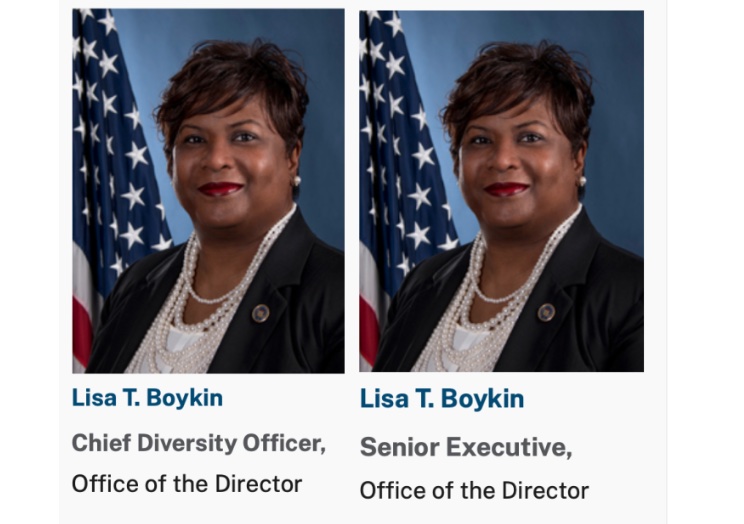
What these citizens discovered was that after Trump ordered agencies to eliminate all positions dedicated to “diversity, equity, and inclusion” (DEI), the ATF simply changed the job title of its chief diversity officer, Lisa Boykin.
Must Read Alaska investigated the claim and confirmed its validity. Indeed, Boykin is now listed as “Senior Executive, Office of the Director.” However, on Jan. 20— before Trump’s directive — her title was “Chief Diversity Officer.”
With this new title, it will likely be more difficult to terminate her position and refocus the agency on its essential mission.
Trump’s executive order states, in part:
Each agency, department, or commission head, in consultation with the Attorney General, the Director of OMB, and the Director of OPM, as appropriate, shall take the following actions within sixty days of this order: (i) Terminate, to the maximum extent allowed by law, all DEI, DEIA, and “environmental justice” offices and positions (including but not limited to “Chief Diversity Officer” positions); all “equity action plans,” “equity” actions, initiatives, or programs, “equity-related” grants or contracts; and all DEI or DEIA performance requirements for employees, contractors, or grantees.
Citizen journalists are posting instances of such bureaucratic defiance on X. While anything posted on X must be carefully verified, this case checks out.
One year ago, Senators Chuck Grassley and Joni Ernst revealed that the ATF was reclassifying positions within the agency. Specifically, the ATF was unlawfully classifying administrative positions as “law enforcement” roles and had been doing so for decades. This practice violated the law and wasted millions in taxpayer dollars, the senators claimed.
“ATF for years turned a blind eye to classification errors, even after whistleblowers brought it to management’s attention as early as 2018. This maladministration resulted in up to $20 million in overpayments to at least 91 employees who erroneously received enhanced law enforcement salaries and benefits while performing human resources, administrative, and other non-law enforcement duties,” the senators said.
While the ATF lost its authority to reclassify positions as law enforcement in 2020, it has since regained that authority. The reclassification of the DEI position is further evidence that the ATF may be reverting to its previous practices—something the senators explicitly warned against last year.
“Appropriate corrective action must be taken in regard to all employees who allowed taxpayer dollars to be wasted after notification of the aforementioned misconduct,” the senators wrote in 2024. “The American public must know the ATF will not revert to its previous impropriety after the restoration of its classification authority.”
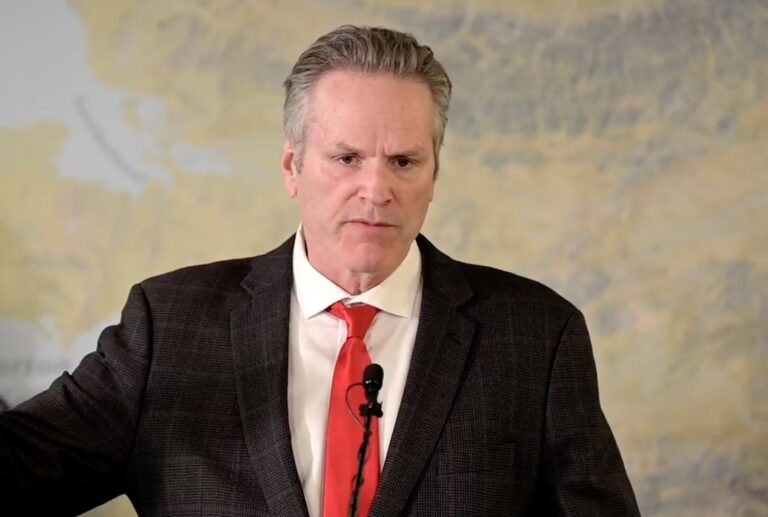
Gov. Mike Dunleavy announced legislation to enhance election integrity by ending the automatic voter registration that occurs every time a person files for a Permanent Fund dividend.
HB63 Election Efficiency and Integrity Bill does the following:
Repeals provisions of Ballot Measure No. 1 (2016) that allowed voter registration through PFD applications.
Closes early voting five days before Election Day.
Authorizes by-mail voting for communities with populations under 750.
Provides postage-paid return envelopes for absentee ballots.
Requires absentee ballots to be received by Election Day.
Allows the Division to begin counting absentee ballots sooner.
Increases flexibility in pay for election workers and standards for voting booths.
“This bill is a necessary step to ensure the integrity and transparency of our election process while addressing Alaskans’ concerns about reliability,” Dunleavy said. “By modernizing our election code, we can provide a more efficient and trustworthy system for voters and election officials alike.”
Currently, anyone who files for a PFD can end up with a voter ID card, even though they are not qualified.
It is doubtful the Democrats who control the Alaska House and Senate will let this bill move. Removing this provision may take a lawsuit.
Dunleavy also filedHB59, State-Tribal Education Compact Schools Pilot Program Bill
Building on the foundation of Senate Bill 34 in 2022, Dunleavy would establish a five-year pilot program to launch State-Tribal Education Compact schools in partnership with five federally recognized Tribes and Tribal organizations.
Key features of the bill:
Creates a framework for DEED and tribes to negotiate compacts for tribally operated public schools.
Mandates reporting on student data and enrollment to ensure accountability.
Provides funding for STEC schools comparable to regional education attendance areas.
Requires annual progress reports to the legislature, culminating in a comprehensive review at the end of the pilot program.
“Parents should be able to send their children to a school that they love and meets their educational needs. State Tribal Education Compact Schools are sure to be one of the public-school options that work the best for many Alaskan students, regardless of Tribal affiliation,” Dunleavy said.“This bill is a major milestone in bringing this transformative educational model to fruition.”
Dunleavy also announced HB62 Sexual Assault Kit Tracking System Bill
This legislation ensures the comprehensive implementation of a statewide Sexual Assault Examination Kit Tracking System, reinforcing transparency and accountability in addressing sexual assault cases.
Key provisions include:
Mandates healthcare providers notify law enforcement of completed kits within seven days.
Requires law enforcement to update survivors on kit status within 14 days of testing.
Establishes clear accountability at every stage of the kit collection, transmission, and testing process.
“Survivors of sexual assault deserve a system that prioritizes their well-being and delivers justice,” Dunleavy said. “This bill reflects our commitment to creating a trauma-informed, survivor-centered process.”
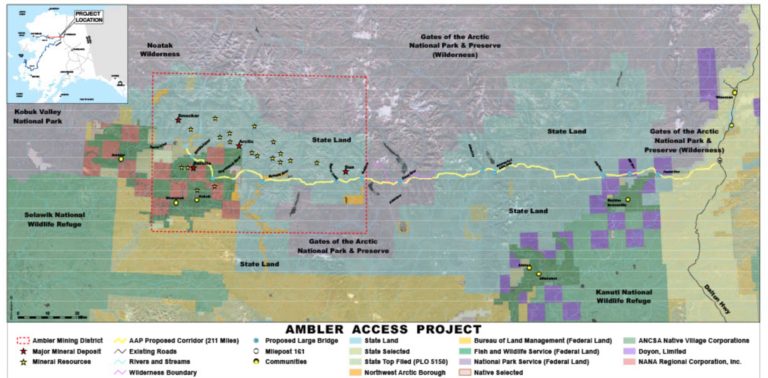
President Donald Trump, in his executive order relating to Alaska resources, has reversed the Biden Administration’s decision to revoke federal permits for the road to the Ambler Mining District, a state-owned parcel that has right-of-way across federal land for an industrial-use road.
In August, the Biden Bureau of Land Management locked up 28 million acres of lands and waters and prevented the Ambler Road from being able to be built, even though access to that area was guaranteed by Congress.
Ambler Road would link the Ambler Mining District to Alaska’s highway system, but the 211-mile road needs to cross the Gates of the Arctic National Wildlife Park and Preserve so that mining could produce gold, silver, zinc, copper, and rare earth mineral for America’s national security. There is no other way to access the state land set aside for mining.
This reversal of the Biden decision was among the requests of Alaska Gov. Mike Dunleavy in his transition report to the Trump Administration.
“The Ambler Mining District has extensive deposits of critical minerals and could be a secure, reliable U.S. supply-chain resource, essential for our Nation’s tech-focused economy, green energy products, and military effectiveness,” Dunleavy said in his report to the Trump team.
The order says, “place a temporary moratorium on all activities and privileges granted to any party pursuant to the record of decision signed on June 27, 2024, entitled “Ambler Road Supplemental Environmental Impact Statement Record of Decision,” which is referred to in “Notice of Availability of the Ambler Road Final Supplemental Environmental Impact Statement, Alaska,” 89 Fed. Reg. 32458 (April 26, 2024), in order to review such record of decision in light of alleged legal deficiencies and for consideration of relevant public interests and, as appropriate, conduct a new, comprehensive analysis of such deficiencies, interests, and environmental impacts; and reinstate the record of decision signed on July 23, 2020, by the Bureau of Land Management and United States Army Corps of Engineers entitled “Ambler Road Environmental Impact Statement Joint Record of Decision,” which is referred to in “Notice of Availability of the Record of Decision for the Ambler Mining District Industrial Access Road Environmental Impact Statement,” 85 Fed. Reg. 45440 (July 28, 2020).”
Less than four months ago, Juneau voters approved a $10 million bond for wastewater facility upgrades and a $12.75 million public safety communications bond.
At last week’s City and Borough of Juneau (CBJ) Assembly meeting, members discussed boosting Juneau’s property tax millage rate as well as proposals to place another $30 million in bonds on this year’s ballot.
The two new bond proposals are $20 million to upgrade water and wastewater utilities and $10 million for Juneau School District capital improvement projects.
Last fall, did anyone foresee the need to ask for another $20 million on top of the $10 million voters just approved for wastewater? Had voters been made aware of that prior to the election, they may have had questions about CBJ management and finances of utility operations.
This is occurring amid a backdrop of spectacular water and sewer rate increases. In December, residents were warned of proposed increases of more than 60% in water rates and 80% in sewer rates over the next five years. According to the city, a current total monthly water and sewer bill of $147 would rise to $258 by 2029, a combined 76% increase.
The new bonds would moderate some of the increase but only enough to barely offset the additional 5% CBJ sales tax most residents will pay.
City bonding capacity is not unlimited. It will be tested even further when CBJ is responsible for tens of millions of dollars in matching funds for flood mitigation projects and when the Second Channel Crossing project is approved.
The sudden emergencies that have continued to crop up in budget discussions over the last several years are troubling. The police communications bond (while necessary) was an emergency, and now school building repair and utility upgrades are critical. These may be legitimate projects, but why are they ignored for so long that they become emergencies?
Today, when faced with a real crisis (the threat of widespread glacial flooding), the Assembly’s knee-jerk reaction is to jack up taxes and debt to preserve their status-quo spending.
Taxpayers deserve to know why the Assembly is perfectly willing to balloon our debt for so-called critical projects while they have no problem sequestering millions for discretionary Assembly grants and squirreling away $16 million of taxpayer funds for a new city office building. Rejected twice by voters, the bulk of the fund created by the Assembly for that project remains unused and should be available for other uses.
Instead of a new office building, city leaders decided to rent expensive office space to house employees. But they are considering spending $8-11 million in repairs and improvements to vacated school buildings – space that could be used for offices. Does that make sense?
Assembly members apparently have also agreed to double cruise ship docking fees by adding another $7 per berth tax on top of the existing $7 fee.
Higher cruise dock fees, while increasing revenues, seem less transparent when learning the Assembly intends to use them for dock-related operating expenses, traditionally funded by Marine Passenger Fees (MPF). Freeing up MPF funds in this way allows a wider range of uses in projects and services that presumably address cruise tourism impacts. As readers will recall, the “wider range of uses” apparently includes the millions of dollars the Assembly has shoveled into the voter-rejected arts and culture center, all without the approval of voters who will be taxed to operate and maintain it.
Juneau taxpayers should rightfully question why community priorities like public safety, utilities, and schools are put on the ballot while the Assembly allocates large cash appropriations for discretionary grants and projects that voters have rejected.
Little, if any, consideration is being given to reducing the budget in any significant way to address Juneau’s affordability.
Assembly priorities should promote affordability. Taxes diverted for discretionary projects could be used for paying down debt or rebating back to taxpayers, thereby lowering property taxes and the overall cost of housing.
City leaders seem to believe that no matter what the financial demands are, they can be met from an endless pot of money.
Ultimately, one way or another, that means it will be coming from the often ignored and increasingly stretched Juneau taxpayers.
After retiring as the senior vice president in charge of business banking for Key Bank in Alaska, Win Gruening became a regular opinion page columnist for the Juneau Empire. He was born and raised in Juneau and graduated from the U.S. Air Force Academy in 1970. He is involved in various local and statewide organizations.