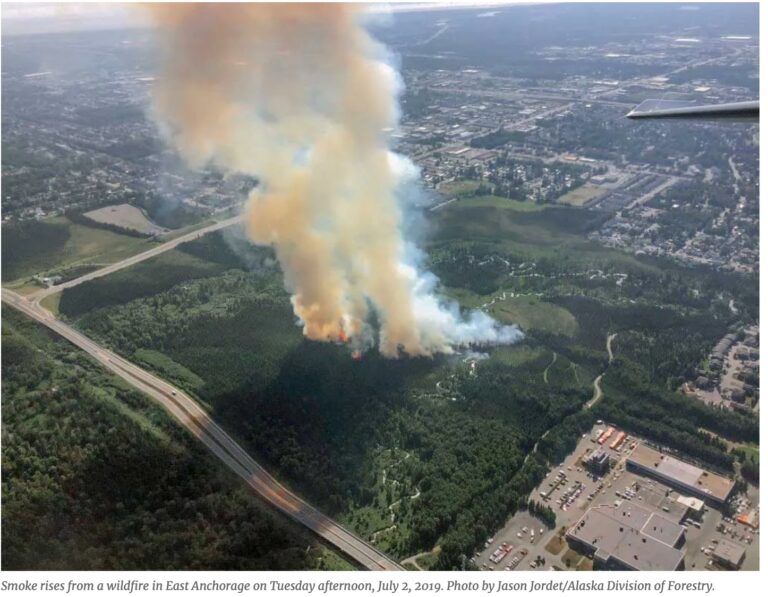
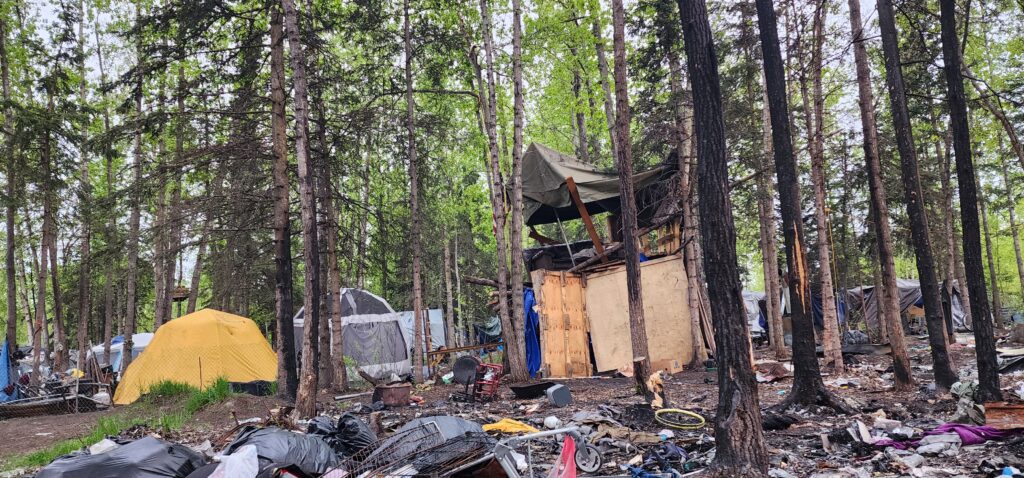
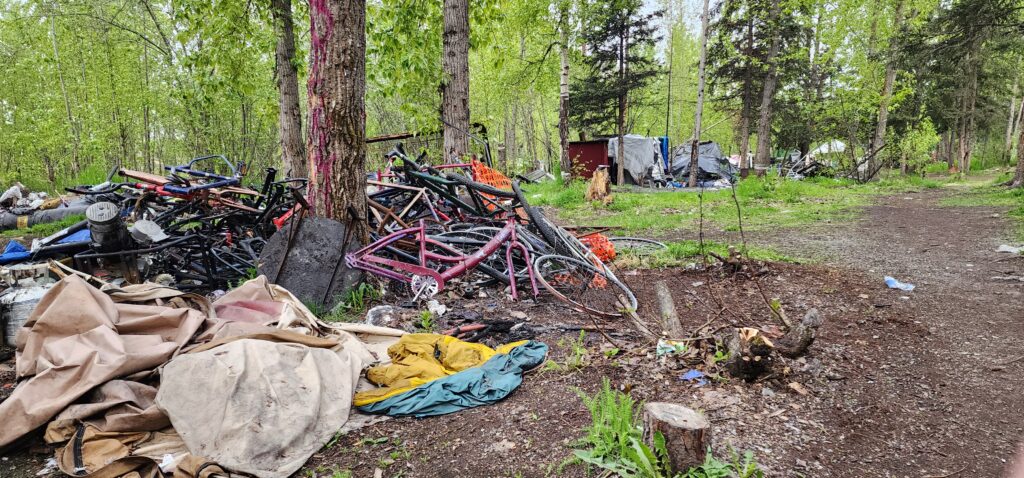
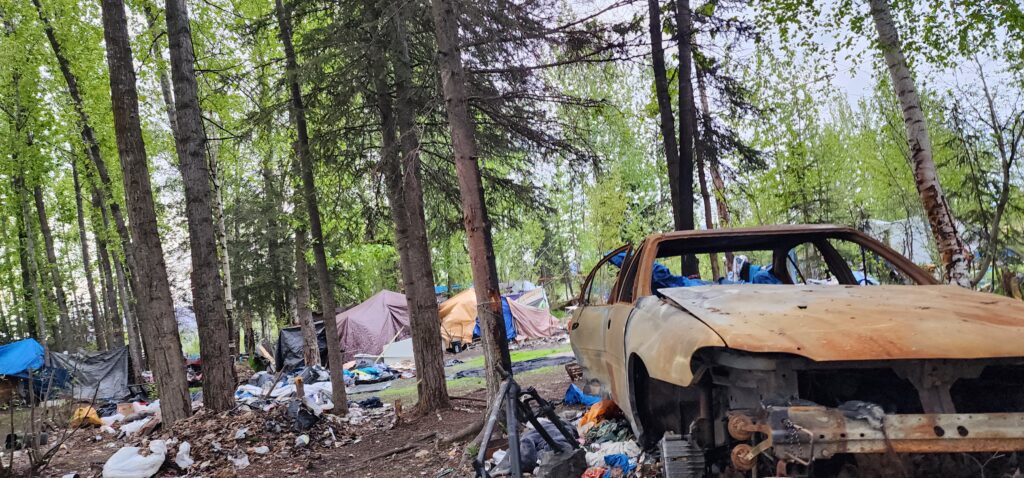
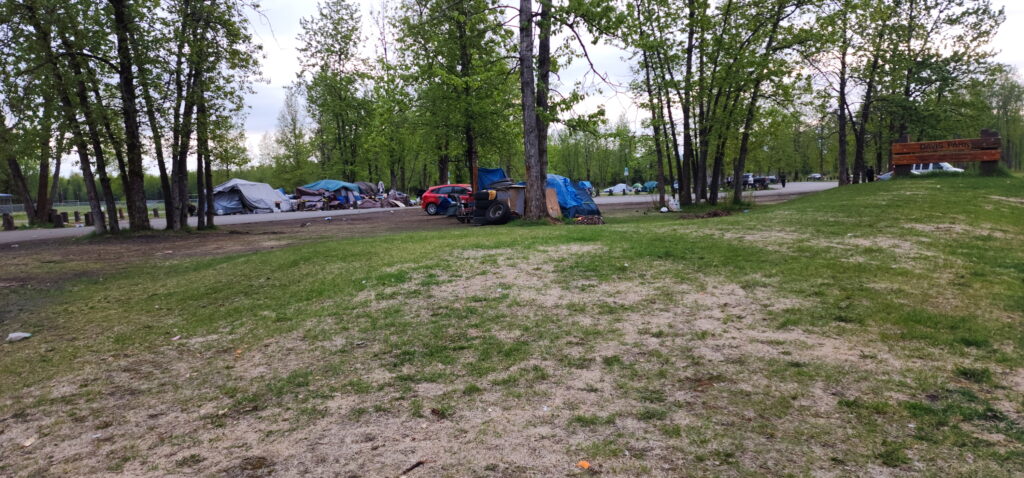
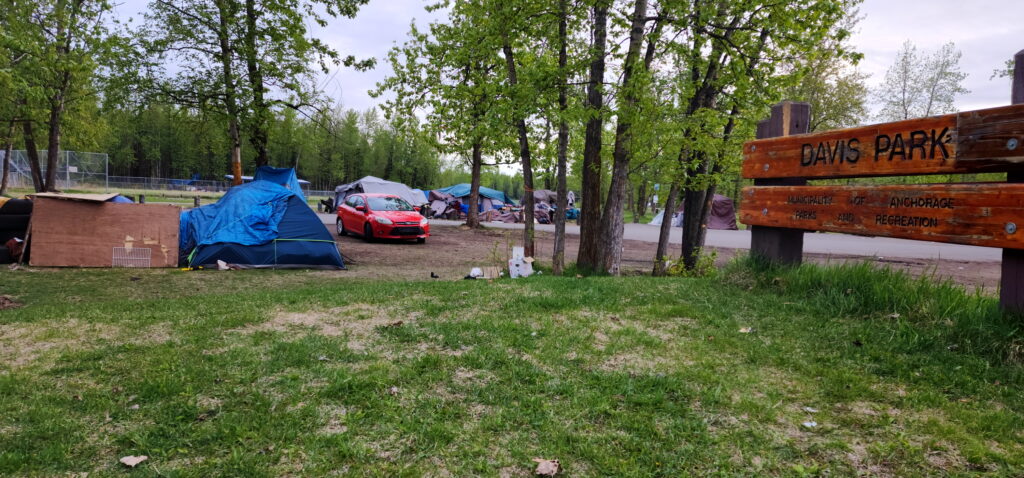
The Anchorage Assembly passed Ordinance AO 2025-61 this week, introducing criminal penalties for unauthorized fires to address wildfire risks, particularly those linked to vagrant encampments, which are a growing threat in Anchorage.
The ordinance makes it a misdemeanor to start fires on public or private land without permission during fire season, on public roads or sidewalks, or in violation of a burn ban.
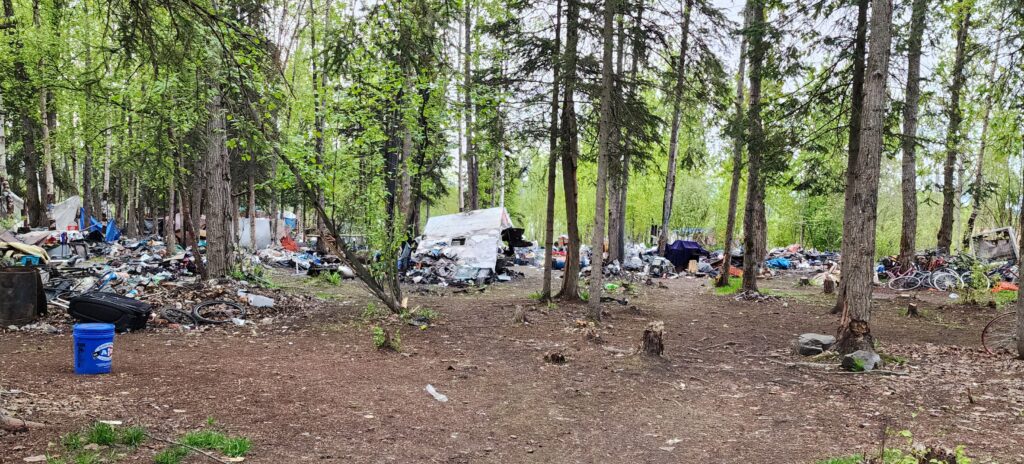
Numerous vagrant fires are being set on sidewalks and in greenbelts.
The new ordinance may deter negligent fire-starting, but it is unclear if vagrants will be aware or will abide by the ordinance. After all, the vagrant camps are lawless places, filled with garbage and stolen items.
Over 80% of Anchorage is considered urban wildland. Anchorage Fire Chief Doug Schrage called the ordinance critical and said firefighters are responding daily to outdoor fires that risk escalating.
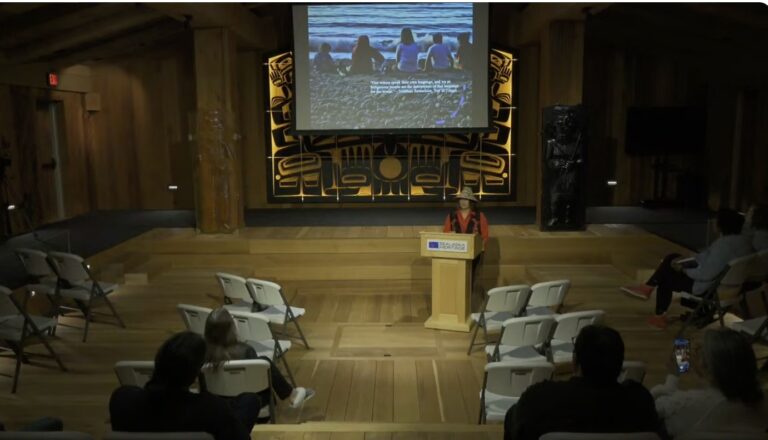
Barbara Blake, vice president of the Ocean Conservancy, former Juneau Assembly member, and former aide to former Gov. Bill Walker, delivered an address Friday, during which she proposed that an oral tradition of Natives should be considered the “Indigenous Law of the Sea,” and that salmon are relatives to Alaska Natives.
Her talk, titled “Weaving the Currents: Writing an Indigenous Law of the Sea,” challenged attendees to reconsider global approaches to ocean and environmental stewardship and instead acknowledge the primacy of indigenous people, and how they should ” dictate” how the sea, rivers, and land are managed. She was not specific when it came to explaining how China and Russia would go along with it, or how the other 8 billion people living on Planet Earth would agree to indigenous primacy.
Speaking to a sparsely attended room at the Sealaska Heritage Institute’s Spring Lecture Series, Blake emphasized that what she calls “an Indigenous Law of the Sea” is not a new framework, but a long-standing system of governance rooted in Native traditions and values, all through oral tradition. Indigenous law is the real law, she said, even if it is not written down.
“The laws that we carry and the laws that underpin how we treat the ocean, how we treat the waters, how we treat our beyond human relatives are the laws how we operate in the world,” Blake said. “They’re not written down like the laws you see in the Constitution of the United States or the Constitution of the State of Alaska. They’re handed down from generation to generation.”
She described this body of law as one of remembrance and reconciliation, not innovation. “Thinking about this work is not creating new law, but it’s a remembrance and it’s a reconciliation of the law that we always carried,” Blake said. “Just re-instituting the law that governed this place for a millennia.”
Blake urged the audience to imagine a world where these Indigenous laws and values were not only remembered, but actually were dictates. “What would it look like today if we pulled those laws forward into maybe a written form, maybe a verbal form, and the rest of the world said yes, we will abide by those laws as well?” she asked.
It was toward the end of her lecture when she repeatedly called salmon the relatives of indigenous people. Here’s the clip of her talking about them as relatives (not visible on mobile phones, sorry):
Blake also quoted Jonathan Samuelson, a Yup’ik and Tlingit presenter who participated in the recent Indigenous Law of the Sea gathering.
“Our waters speak their own language,” Samuelson was quoted as saying, “and we as indigenous people are the interpreters of that language for the world.”
Blake, too, said only indigenous people could interpret the water.
Blake explained how Indigenous communities, by spending time on the waters and land, are attuned to changes brought by climate change, unlike non-Natives. “The ocean is speaking to us. Our rivers are speaking to us. Our land is speaking to us. And what are those things telling us? What are our salmon relatives telling us about how the world is being treated?” she asked.
Throughout her lecture, Blake said indigenous peoples have a duty to what she called “our beyond human relatives.”
Presumably salmon, but no one in the audience questioned why they are eating their relatives.
“We know we have a responsibility to our oceans … our waters and our lands and our beyond human relatives,” she said. “That has been our responsibility that has been passed down for generations.”
“For thousands of years we’ve carried all this knowledge—15,000 years carbon-dated proof of existence in this place. We know our stories go back before that,” Blake said. “Our stories of creation are from these lands and from these waters.”
She also said that indigenous babies are born with the knowledge of this law.
She made the argument that it’s time to write down the “laws” and then get the world to agree to them.
Blake acknowledged that indigenous people have different “laws,” depending on where they live and that each of these sets of “laws” are legitimate.
A new draft plan from the Environmental Protection Agency that would eliminate federal limits on greenhouse gas emissions from coal- and gas-fired power plants could shift the landscape of climate policy and the US carbon credit market, including Alaska’s.
According to reporting by The New York Times, a copy of the draft proposal was sent to the White House on May 2 and may be released for public comment in June.
The document marks a reversal in regulatory approach from prior Biden-era EPA actions, including a 2024 rule that imposed new emissions restrictions on coal-fired plants.
The draft reportedly says carbon dioxide emissions from US power plants do not contribute significantly to dangerous pollution or climate change, citing the declining share of global emissions represented by the US power sector. Eliminating these emissions would not produce a measurable improvement in public health or welfare.
Alaska Gov. Mike Dunleavy has been developing a regulatory framework for carbon management, focusing on carbon capture, utilization, and storage and carbon offset projects.
In 2023, Gov. Mike Dunleavy proposed carbon management and monetization legislation to enable the Department of Natural Resources to regulate carbon offset and sequestration projects on state lands. These legislation allows private companies to lease state lands for carbon offsets (keeping lands undeveloped) or store CO2 underground for permanent sequestration or enhanced oil recovery, particularly in the Cook Inlet basin, estimated to have a 50-gigaton CO2 storage capacity. The target for this monetization is Asia, with countries like Japan looking to buy carbon storage to meet international climate goals set by globalists.
Alaska also submitted a climate action plan (renamed Sustainable Energy Action Plan) to the EPA in 2024 under the Climate Pollution Reduction Grants program, focusing on renewable energy expansion and energy efficiency (e.g., heat pumps, home weatherization, and hydroelectric projects like Bradley Lake). The plan avoids direct regulation of oil and gas emissions but emphasizes reducing emissions from energy use.
The Trump Administration policy shift, if enacted, could have far-reaching consequences for the burgeoning carbon credit market, which relies heavily on emissions limits to drive demand for offsets. Such credits are typically purchased by companies seeking to comply with emissions regulations or to voluntarily meet environmental, social, and governance (ESG) targets.
By removing the regulatory cap on emissions from major polluters, the EPA could reduce the pressure on utilities and industrial firms to purchase offsets, dampening demand in both compliance and voluntary markets.
The move may also shift the center of gravity for carbon market activity from the federal level to states like California and Washington, which maintain their own cap-and-trade systems. These programs could gain new prominence as firms seek alternative venues for regulatory certainty and emissions accountability.
The new EPA direction is almost certain to bring lawsuits and fierce opposition from environmental groups and Democrat lawmakers, many of whom championed the 2024 EPA rules.
At that time, the EPA projected that its regulations would prevent up to 1,200 premature deaths annually and reduce thousands of cases of asthma and hospitalizations related to air pollution. Now, the EPA says there is no data to support that claim.
Power plant operators, many of which have already made major investments in emissions reductions and carbon trading strategies, may find themselves caught between diverging state and federal priorities.
Alaska’s carbon sequestration framework relies on market-driven demand for carbon storage. A federal rollback of emissions limits could weaken demand for carbon storage services, as power plants (especially coal- and gas-fired) would face no federal mandate to reduce CO2 emissions.
This could reduce revenue potential for Alaska’s carbon storage projects, undermining the economic viability of the DNR’s leasing program.
Before the new EPA rule can take place, it must go through public comment period and could be revised. The topic is sure to come up during Gov. Mike Dunleavy’s Sustainable Energy Conference in Anchorage in June, when the head of the EPA Lee Zeldin, Secretary of Energy Chris Wright and Interior Secretary Doug Burgum are scheduled to attend.
Voters in Oakland, California, have elected a new mayor following the recall of Mayor Sheng Thao, who faced criticism for rising crime and an ongoing FBI corruption probe. Thao’s 2022 victory was due to the complexities of ranked-choice voting—which was also used this month to choose Mayor-elect Barbara Lee.
Ranked-choice voting, or RCV, comes from the left’s grab bag of bad ideas about “our democracy.” Ironically, it only makes voting harder and even disenfranchises voters.
With RCV, voters rank candidates in order of preference instead of voting for one candidate. This makes ballots longer, with many more bubbles to fill in and more complicated instructions. RCV benefits voters who have plenty of spare time and access to information.
First-place rankings are counted first, and then the least popular candidate eliminated. On those ballots, if voters ranked someone second, rankings are adjusted upwards for the next round of counting. Ballots without other ranked candidates are discarded, resulting in a decrease in turnout with each round of counting.
Of course, all this is done by computers since doing it any other way would be too slow. The counting, adjusting and recounting happens over and over until a candidate has a majority of the supposed first-place votes.
RCV advocates claim it leads to better politics and more centrist winners. But in 2022, former city councilor Loren Taylor likely would have won if not for ranked-choice voting. He was the more moderate, reform-focused candidate. Instead, the radical Thao was elected, only to be later removed.
This year, Taylor appeared ahead on election night once again, but Barbara Lee was eventually declared the winner after nine rounds of adjusting votes, discarding ballots and re-tabulation. Part of Lee’s eventual win was also due to California accepting ballots long after Election Day.
Mayor-elect Barbara Lee seems set to continue Thao’s failed policies, including gun buybacks, “violence interrupter” programs and the same “ceasefire” strategy as her predecessor. Basically, she’s going to ask criminals nicely to stop shooting and robbing quite so many people in Oakland.
Months before the election, Barbara Lee returned thousands of dollars donated to her campaign by a family linked to former Mayor Thao’s corruption scandal. Barbara Lee was also one of the few prominent figures that publicly opposed the recall of Sheng Thao.
Oakland has become a case study in the failures of RCV. Does it lead to moderate winners? Absolutely not. Does it make politics kinder and gentler? Lee’s allies spent the final days of the campaign trying to tie Taylor, a long-time Democrat, to Donald Trump and the MAGA movement, while Taylor’s allies were pointing out Lee’s ties to Oakland’s corruption scandals.
RCV has even led to a failed election for the Oakland school board. Voter mistakes on their RCV ballots were compounded by a computer programing error by county officials. These RCV failures went undetected for long enough that the wrong winner actually took office.
All this highlights why some in Oakland are working to repeal RCV. Earlier this year, they announced plans to gather signatures for a petition that could lead to a vote on repeal. Oakland’s decline is clear, and it isn’t far-fetched to say that ranked-choice voting is playing a big role.
For the second time in under three years, RCV elected a far-left mayor with ties to a corrupt political family. It’s time for Oaklanders to take back their city once and for all and repeal ranked-choice voting before it’s too late.
Harry Roth is the Director of Outreach at Save Our States and Project Manager of the Stop RCV Coalition.
Alaska State Troopers have confirmed the recovery and identification of a body found near the mouth of the Susitna River on May 22. The deceased has been identified as 32-year-old Skye Rench of Wasilla, one of two men who went missing in early March after an ATV broke through the ice on the river.
A private pilot alerted authorities after spotting what appeared to be a body on the riverbank. A Department of Public Safety helicopter was dispatched to the area, where, with assistance from a member of the Alaska Dive, Rescue, and Recovery Team, the body of an adult male was recovered and flown to the Wasilla Airport. The remains were then transferred to the State Medical Examiner’s Office for autopsy and identification.
On May 23, the Medical Examiner’s Office confirmed the identity of the deceased as Skye Rench. His next of kin have been notified.
Rench and 42-year-old Sean Kendall of Anchorage had been missing since March 6, 2025, when a side-by-side ATV carrying five adults broke through the ice on the Susitna River around 8:45 a.m. Three of the passengers managed to escape the freezing water and walked to a nearby work camp, later declining medical attention after being picked up by a chartered helicopter. Rench was on contract for a drilling company with a remote project near Point Mackenzie, when the ATV went through the ice.
Despite an intensive aerial search using DPS aircraft and support from the Civil Air Patrol, ice conditions made ground-based search efforts impossible. After two days with no further developments, Alaska Wildlife Troopers transitioned to a reactive search status on March 8. At that time, both missing individuals were publicly identified, and their families were notified.
Some of the Memorial Day weekend events around the 49th State (add yours in the comment section below and we’ll add them as needed):
Anchorage:
Headstone cleanup: Saturday, Nuvision Alaska invites the public to help restore and clean veteran headstones at Anchorage Memorial Park Cemetery, 535 E. Ninth Ave. from 11 am to 2 pm. This is the fourth annual year for the cleanup. Bring gloves, 5-gallon buckets and water spray bottles, natural or nylon bristle scrub brushes, and small hand tools. A reception to follow at the American Legion Post 1. More information about how to participate further down the page.
Anchorage Remembers Memorial Day Ceremony: Delaney Park Strip on Ninth Ave. and I Street, 9:30 to 10:30 am. This is the official municipal ceremony in Anchorage. For more information, contact Anchorage’s Military and Veterans Affairs Chair David Foli: 907-444-4646.
Memorial Day BBQ at American Legion Post 1 – Hosted by Nuvision Alaska at American Legion Jack Henry Post 1. A community barbecue to honor the Monday holiday. Takes place Monday from 12:30 to 3 pm. Military ID needed and preregistration requested at this link.
Memorial Day Military Appreciation Concert – Held at Central Lutheran Church, featuring performances to honor military service members. Takes place Sunday, 6:30 pm at 1420 Cordova St, Anchorage.
Memorial Day Event at JBER- Joint Base Elmendorf Fort Richardson – Joint Base Elmendorf-Richardson will hold its annual Memorial Day ceremony on May 26, 2025, at the Fort Richardson National Cemetery. The ceremony is free and open to the public. Pre-ceremonial music begins at 11:30 am, and the ceremony itself starts at noon. To make access easier, the right-hand traffic lane of the Fort Richardson Gate will be dedicated for direct access to the cemetery between 10 am and 12:15 pm. Those arriving outside of these hours will need to obtain a visitor pass at the Richardson Visitor Control Center. This year’s keynote speaker is Verdie Bowen, director of the Alaska Office of Veterans Affairs and a 23-year veteran of the US Air Force.
Juneau
Memorial Day service Monday, 11-11:30 am Alaska Memorial Park. Organized by American Legion Auke Bay Post #25.
Auke Bay Post #25 Memorial Day Open House, 11:30 am.
Mat-Su
Veterans Wall of Honor Memorial Day ceremony: 1 p.m. Monday, 801 Wasilla-Fishhook Road in Wasilla. Line up for the walk at 10:30 am at the Mat-Su Wall of Honor and proceed to Aurora Cemetery starting at 10:45 am. At 11 am, the memorial ceremony will be led by VFW 9365. The walk starts at 10:45 am, and at 11 am. A memorial service will be held at the Wall of Honor at 1 pm. Potluck at 1:30 pm at VFW Post 9365 at 301 E. Lake View Ave. in Wasilla.
Kodiak
Kodiak Crab Festival – A major annual event started Thursday and ends Monday, featuring fun events, a solemn blessing of the fleet, and a memorial service for lost fishermen and mariners.
More about the headstone cleanup in Anchorage:
Now in its fourth year, the “Honoring Our Heroes Headstone Clean-Up” event returns to Anchorage Memorial Park Cemetery on Saturday, May 24, from 11 am to 2 pm. The event is a collaboration between Nuvision Credit Union and American Legion Jack Henry Post 1.
Community members, including veterans, active-duty military personnel, and local residents, are invited to help clean and care for the grave markers of veterans buried at the cemetery. Volunteers will be provided with tools, though bringing personal supplies is also encouraged. Refreshments will be available, courtesy of veteran-owned businesses.
Over the first three years, volunteers cleaned more than 1,800 headstones. This year, organizers hope to extend the effort to additional cemetery tracts with the help of over 150 volunteers.
The event also features a coordinated tribute:
The American Legion Auxiliary will place 1,400 crosses on veterans’ grave markers.
The Veterans of Foreign Wars (VFW) will adorn all veteran headstones with American flags.
Volunteers, alongside Nuvision representatives, will place pennies on each headstone, following the military tradition of leaving a coin to signify respect and remembrance.
The clean-up will be followed by a Thank You Reception for all volunteers at American Legion Post 1 from 2 – 3:30 pm., 840 W. Fireweed Lane
Those interested in volunteering can register in advance through Nuvision’s event page.
Alaska Attorney General Treg Taylor has joined a coalition of 23 states in a legal challenge to Vermont’s recently enacted Climate Superfund Act, an unconstitutional overreach that could cripple Alaska and American energy production.
The controversial Vermont law, modeled after similar legislation in New York, seeks to hold a select group of coal, oil, and natural gas producers financially responsible for a share of global greenhouse gas emissions dating back to 1995. The fines could total billions of dollars, with no cap included in the statute.
“Alaska is home to the most abundant natural resources and some of the most stunning environmental treasures in the nation,” said Taylor. “Protecting those resources is important and done every day here through rigorous environmental standards. However, Vermont’s newest legal efforts expand their authority and agenda, push their state powers far beyond any reasonable interpretation of the Constitution, and improperly attempt to impose on Alaska’s and other states’ sovereign authority.”
The lawsuit argues that Vermont’s law imposes retroactive liability on companies that were operating in compliance with both state and federal regulations during the time period in question. It also warns that the financial burden of the law would force many traditional energy producers out of business, resulting in widespread job losses and increased dependence on foreign energy sources from nations with weaker environmental protections.
Critics of the law say it unfairly targets domestic producers while ignoring Vermont’s own historical reliance on fossil fuels to power its economy. They also argue that such state-level initiatives conflict with federal energy policy and are preempted by existing federal statutes.
Joining Alaska and West Virginia in the lawsuit are the states of Alabama, Arkansas, Florida, Georgia, Idaho, Indiana, Iowa, Kansas, Kentucky, Louisiana, Missouri, Montana, Nebraska, North Dakota, Ohio, Oklahoma, South Carolina, South Dakota, Tennessee, Texas, Utah, and Wyoming.
The US Department of Justice filed a separate legal action challenging Vermont’s Superfund Act, in alignment with Executive Orders issued during President Donald Trump’s administration aimed at defending domestic energy interests.
The coalition is asking the court to block Vermont’s law and declare it unenforceable under federal law.
Under Mayor Suzanne LaFrance, the vagrancy problem in Anchorage is worsening. While Democrats blamed the former mayor because he was a Republican, their chosen leader has all-but failed to address the problem of criminal vagrancy and chronic homelessness among the population of inebriates, drug addicts, and parolees.
Suzanne LaFrance, incoming mayor of Anchorage, takes part in a parade that featured anti-semitic slogans on June 29, 2024.
Since LaFrance was sworn in on July 1, 2024, the vagrant encampments have exploded around the city.
A conservative estimate shows that Anchorage has spent at least $14.66 million for specific homelessness-related programs and services in 2024, in addition to other unspecified costs, such as camp abatement, administrative costs, or other grants, which would drive that figure far higher.
We took a tour of some of them this week to show you just what Anchorage residents are having to deal with this summer, as they avoid trails, green spaces, and local parks. Here is the photographic evidence of Anchorage, a city in crisis in 2025:
The solution to vagrants taking over Town Center Square park is evidently to remove the trees, a project of Mayor LaFrance that is now underway. The solution was also used in others places, such as the intersection of 36th Ave. and New Seward Highway.
Near Davis Park.Near Davis Park.Near Davis Park.Near Davis Park.Town Center Square in the heart of Anchorage.
Downtown Anchorage.
Downtown Anchorage at a restaurant next to City Hall.Downtown near the Performing Arts Center.Davis Park, where camps were abated but have since returned.Davis Park, where abatement has failed.
See our previous coverage of the city in decline, with more photos, at these links:
In the political world, you can almost always explain past and future actions by simply following the money. Who does this spending benefit? Who is getting political support? Who is being excoriated? Who is yelling loudest?
Here in Alaska, education is one flash point, with the money going to the various education unions rather than “The Children.” Failure to belly up to the trough with sufficient support is painted as lack of support for The Children rather than very real concern for the complete lack of accountability and abysmal performance of public education in this state over the last several decades.
Similarly, the push for a return to defined benefit pensions for law enforcement is another, newer one, that will quickly be extended to all state union employees. Failure to support is excoriated as lack of support for law enforcement, a laughable charge given the robust gun culture of Alaska.
We can’t afford either, but no matter, as the “All Your PFD Belong To Us Caucus” (formerly the Bipartisan Caucus), have them paid for, first with shrinking the Permanent Fund dividend to a vestigial $1,000 and when that’s gone, they go after the corpus of the Permanent Fund itself to pay for their new obligations.
Who benefits from all this? Democrats, who are purchasing the votes of their supporters with other people’s money. In fact, with the theft of the PFD, they are purchasing political support with the money of individual union members and their families.
This is such a great scam that Republicans have gotten into the game. The two vectors are rural broadband and climate change / green energy spending. Lisa Murkowski is the most obvious practitioner of this.
Rural broadband is a uniquely Alaskan form of grift, with tens of millions of dollars appropriated to make rural broadband available to the Bush. The politicians who support this grift give the free money (taxpayer’s money) to broadband providers who lay fiber and hook up individuals and communities to the internet. Those providers then turn right around and write checks to political campaigns of politicians who support the ongoing grift.
This grift completely ignores the rise of Starlink, satellite-based broadbandthat can be hooked up for a few hundred dollars with monthly service in the $120 range. But nobody gets elected pushing Starlink. Note that if individuals are getting their full statutory PFD, they can afford roughly three Starlink subscriptions per year. That won’t elect any democrats or rainy day RINOs, but no matter.
Our final example comes from climate change / green energy spending most recently authorized in the Biden Inflation Reduction Act passed in 2022. A lot of the money authorized has yet to be spent or committed. The Trump DOGE team recommended eliminating most of the unallocated spending, something which distresses Alaska’s Senior US Sen. Lisa Murkowski greatly.
When you have a huge pile of money lying around, there is always the possibility of graft and corruption, though in this case that corruption is just as possible as night following day.
The Biden administration managed to shovel $100 billion dollars in green energy grants, loans and commitments out of the front door of the Department of Energy’s Loan Programs Office (LPO) in the 76 days between Nov 5 and Trump’s inauguration Jan 21. That program managed to write just over $40 billion in the 15 years of its existence before Election Day 2024. No corruption there, I’m sure (/sarc).
Of course, our senior US senator is completely silent about that corruption, though she is quite vocal about reversing the cuts.
“One lesson I remember from the PayPal days: Do you know who complained the loudest? Fraudsters. There would be immediate over the top indignation from the fraudsters. We’re going to see outrageous stuff from fraudsters as we continue cracking down, they’re the loudest.”
It is always nice when the Other Side tells you who they are, what they are, and what they want. It is even better to listen to them and have an appropriate, timely response.
Alex Gimarc lives in Anchorage since retiring from the military in 1997. His interests include science and technology, environment, energy, economics, military affairs, fishing and disabilities policies. His weekly column “Interesting Items” is a summary of news stories with substantive Alaska-themed topics. He was a small business owner and Information Technology professional.