Defense Secretary Pete Hegseth began Memorial Day weekend on Saturday by joining volunteers at the Korean War Veterans Memorial, helping clean statues and headstones in a hands-on tribute to the fallen. Alongside his children, Hegseth participated in the effort as a way to honor veterans and spark conversations about the war’s enduring legacy.
More than a symbolic gesture, Hegseth described the cleanup as an opportunity to educate younger generations about the Korean War, a conflict often referred to as “the Forgotten War” despite its lasting global consequences.
Hegseth’s nomination was opposed by Sen. Lisa Murkowski, who said he does not possess the “judgment and character” to be Secretary of Defense.
Murkowski spent Saturday at the Haines Beerfest, an annual drinking event sponsored by the Southeast Alaska State Fair. It’s an event she has attended in the past.
Hegseth said his participation in the restoration of the memorial was also for his children’s character.
“It gave me a moment to remind the kids about the Korean War, what was it, why did it matter, what the strategic environment was, who were we fighting, how many people we lost, and why are we still there,” Hegseth said during the event. “All of those conversations that otherwise may not come up around a dinner table.”
Hegseth emphasized the importance of passing down the meaning of Memorial Day through personal engagement and reflection. “We have to very intentionally infuse it into the minds and hearts and souls of young kids so that they understand why it’s special — and want to pass it [along] as well,” he said.
Veterans Affairs Secretary Douglas A. Collins was also present at the event, lending support to the volunteer effort and joining in the tribute.
The Korean War Veterans Memorial, located on the National Mall, honors the service and sacrifice of the nearly 1.8 million Americans who served in the three-year conflict. The war resulted in the deaths of more than 36,574 US service members (18 of them women).
The Alaska Department of Transportation and Public Facilities is advancing plans for a new ferry terminal at Cascade Point, as Gov. Mike Dunleavy works to bring access to Juneau’s capital city.
Located at Mile 42 of Glacier Highway, approximately 30 miles north of the current Auke Bay ferry terminal, the Cascade Point site would reduce travel times, improve schedule reliability, and lower operating costs for the Alaska Marine Highway System, according to DOT.
The terminal development stems from a 2023 Memorandum of Understanding between the State and Goldbelt, Inc., a Juneau Alaska Native corporation. Goldbelt owns the surrounding lands, and the agreement established a public-private partnership designed to promote economic opportunity.
DOT is now entering a design-build procurement process for Phase 1 of the terminal, using state funds previously appropriated for the Juneau Access project. These funds are restricted for use in the Lynn Canal corridor, making the Cascade Point project a suitable match without requiring new federal spending or triggering significant delays.
The Legislature’s final budget cut money from the Juneau Access project, but that can be vetoed by Gov. Mike Dunleavy. There was originally over $40 million in a fund for the project — a fund that has been sitting there for more than a decade. The Senate Finance Committee in May took $37 million previously allocated for the project. The press release from the Department of Transportation indicates that the Dunleavy Administration is not going to allow that reappropriation of funds.
Juneau’s Sen. Jesse Kiehl, who sits on the Finance Committee, barely put up a fight for his district.
But Dunleavy appears to be forging ahead on Juneau Access. According to DOT, the proposed Cascade Point terminal will:
Reduce round-trip transit times to Haines and Skagway by over two hours;
Lower vessel fuel use and operating costs;
Increase the ability of the AMHS to run more frequent trips during peak travel seasons;
Improve schedule reliability by reducing exposure to challenging marine weather conditions.
These improvements align with findings from the 2020 AMHS Reshaping Work Group Report, which recommended Cascade Point as a viable way to modernize service.
The 2045 AMHS Long-Range Plan also noted Cascade Point as a potential future asset, pending feasibility analysis. That technical work has now confirmed the site meets engineering standards for ferry operations.
Cascade Point is not intended to replace the Auke Bay terminal but rather to supplement it, offering greater operational flexibility and resilience. Officials say the dual-terminal model will allow the ferry system to adapt more effectively to seasonal surges and unforeseen service interruptions.
The concept for a terminal at Cascade Point has been under discussion for nearly two decades and gained new momentum in recent years. Since 2022, DOT and Goldbelt have worked together on environmental reviews, engineering designs, and land use planning.
As the project progresses, DOT says it remains committed to public interest and engagement in the planning process.
“Cascade Point reflects smart planning, strong collaboration, and the Governor’s direction to deliver meaningful transportation improvements for Southeast Alaska,” Commissioner Ryan Anderson said.
More information on the design-build contract and project timeline is expected to be released in the coming weeks.
Must Read Alaska walked through several acres of wasteland across from Davis Park, this week. The area is what our readers have dubbed “SLAZ” — the Suzanne LaFrance Autonomous Zone. It is filled with makeshift structures, some of them two-story, and the ground is covered with human waste, stolen bikes, household goods, and other items, and garbage.
Anchorage residents see these encampments all over the city, but this one is especially impressive in size and lawlessness.
SLAZ is a reference to Seattle’s Capitol Hill Autonomous Zone (CHAZ), a lawless zone that was created in 2020 as a protest of the death of drug addict and wife beater George Floyd of Minneapolis.
Take the tour with us by clicking on our YouTube video, and then click on stories below to see more multi-media coverage of the vagrant-ruled wastelands of Anchorage.
Palmer Mayor Steve Carrington has survived a recall attempt, with voters rejecting the effort by a margin of 222 to 176. The election results were announced Friday afternoon by the Palmer City Clerk, with roughly 8% of the city’s registered voters participating in the special election.
The recall effort stemmed from allegations that Carrington engaged in official misconduct by hiring an outside attorney without obtaining prior approval from the Palmer City Council. The incident occurred last year during a period of legal uncertainty related to accusations involving former Palmer City Manager Stephen Jellie, whose short duration as city manager left the city in upheaval.
Carrington defended the decision as necessary under the circumstances, and voters ultimately sided with him in the special election.
The election results are scheduled to be certified during the upcoming regular Palmer City Council meeting on May 27. Carrington, who will remain in office through the city’s regular election in October, filed a letter of intent to run for reelection as mayor shortly after the results were released.
In a pivotal legislative win for taxpayers and President Donald Trump’s “America First” agenda, the House of Representatives last week passed a sweeping budget package of conservative reforms — representing one of the most consequential policy shifts in a generation.
Dubbed the Big Beautiful Bill, the legislation includes broad measures on taxation, border security, energy production, and government reform — all passed without a single Democratic vote.
Alaska Congressman Nick Begich, a first-term Republican, hailed the bill as “a game-changer for working families and small businesses in Alaska and across America.”
The Anchorage Daily News report on his vote criticized the bill as an attack on the poor, a characterization that Begich condemned as a “predictable, partisan hit job.”
“Last year, voters gave Republicans a clear mandate: cut reckless spending, secure the border, and grow our economy — and we delivered,” Begich said in a statement on X, in response to the newspaper’s coverage.
Both Anchorage Daily News reporter Iris Samuels and Begich’s own uncle, Tom Begich — a Democrat and former state senator — attacked the congressman for his vote. Tom Begich blasted his nephew in a column that ran in the same newspaper.
Key Provisions of the Bill Include:
$1.5 trillion in deficit reduction, the largest spending cut in nearly three decades, achieved without affecting core benefits for traditional Medicaid recipients or food assistance for low-income Americans.
Work requirements for Medicaid among able-bodied adults starting in 2026, with exemptions for the elderly, Native populations, parents of young children, and regions with high unemployment. These requirements, which begin by Dec. 31, 2026, apply to able-bodied adults without dependents or disabilities, aged 19 to 64. To maintain coverage, recipients must work, volunteer, or engage in education at least 80 hours per month — less than 19 hours per week.
Permanent extension of Trump-era tax cuts, including the elimination of taxes on tips, overtime pay, and car loan interest — provisions Republicans argue will ease burdens on middle- and working-class Americans.
$144 billion in defense spending, aimed at bolstering U.S. military readiness amid rising global threats.
Over $140 billion for border security, which Republicans call the “strongest in U.S. history.”
Major energy reforms to expand domestic production and reduce regulatory barriers, with the goal of increasing American energy independence and lowering consumer costs.
The Medicaid provisions are designed to protect the most vulnerable while restoring accountability and eliminating fraud. Importantly, the bill maintains eligibility for those actively seeking work or employed but still living in poverty. By reducing fraud, Republicans argue the program becomes more sustainable.
“Medicaid integrity is restored without harming those who need it,” said Begich. “This is compassionate reform –not cuts.”
All House Democrats voted against the bill. Republicans countered that the bill targets only expansion populations, not traditional Medicaid enrollees such as the elderly, disabled, or children. They also noted that most able-bodied recipients are already working.
The Anchorage Daily News claimed the legislation would harm vulnerable Alaskans and entrench income inequality. Begich called this “ideological spin” and said the outlet ignored the bill’s targeted exemptions for Alaska Native populations and high-unemployment regions.
“Alaskans aren’t fooled by leftist media narratives,” Begich wrote on social media. “This bill protects our people, boosts our economy, and respects our unique status.”
Medicaid fraud is difficult to quantify due to its multilayered nature, much of which involves providers, insurers, and other companies. The Centers for Medicare & Medicaid Services (CMS) reported a 2024 improper payment rate for Medicaid of 5.09%, equating to roughly $31.1 billion of the $611 billion in total Medicaid spending.
According to the National Conference of State Legislatures, health expenditures make up roughly 32% of the average state’s budget.
A 2024 HHS Office of Inspector General report estimates that beneficiary fraud accounts for about 2% of convictions and 0.1% of financial recoveries in Medicaid fraud cases — a likely undercount of actual abuse.
Provider fraud accounts for the remaining 98% of convictions and is also addressed in the bill.
CMS’s Payment Error Rate Measurement data estimates improper payments in Medicaid, including both administrative errors and potential fraud. The 2024 figure of 5.09% is widely considered to underrepresent the problem.
According to the Department of Governmental Efficiency (DOGE), Section 110206 of the bill cuts $625 billion in fraud and abuse over a decade — money currently lost to ineligible recipients and bureaucratic waste.
DOGE stated the bill’s framework ensures taxpayer dollars prioritize vulnerable groups like seniors and disabled Americans by redirecting funds from administrative overhead to actual care. Work requirements (Section 110004) target able-bodied adults “gaming the system,” not single mothers or those genuinely in need.
With 42% of Medicaid improper payments stemming from eligibility errors (per 2023 HHS audits), the bill’s provisions aim to protect the program’s long-term integrity.
While the budget bill passed the House, its fate in the Senate remains uncertain.
Still, the House passage of the Big Beautiful Bill marks a defining moment. With extensive provisions for Alaska’s economic future — spanning oil, gas, mining, and timber — the bill could have an impact comparable to the legislation that authorized the Trans-Alaska Pipeline System.
“I’ve always said: American prosperity starts in Alaska — and the Big Beautiful Bill puts America First and Alaska back on the map,” Congressman Begich said.
Roughly 20% of Alaska’s 60 lawmakers come from public education careers, many as former teachers, professors, lobbyists, or school board members.
When including those tied to education advocacy, tutoring businesses, and NEA-aligned nonprofits, and former work as legislative aides, that influence may reach as high as 35%.
The majority of Alaska lawmakers do not come from the private sector; they’ve never signed the front of a paycheck, only the back. More than half — mostly all the Democrats — are from government careers, which explains why they do not focus on the economy, but only on spending and taxes. They don’t advance bills to support energy or resource development. They only focus on growing government programs and funding schools to the maximum extent possible.
Among the most prominent from the education industry are Reps. Andi Story and Sara Hannan of Juneau, both longtime public education insiders. Hannan is a former teacher and Story is a former school board member, co-founder of Great Alaska Schools and past president of the Alaska Association of School Board.
Rep. Maxine Dibert came to the Legislature straight from the classroom in Fairbanks. Rep. Rebecca Himschoot of Sitka retired from teaching after 24 years in the classroom, then ran for office. Rep. Ted Eischied of Anchorage was a teacher for 25 years. Rep. Ashley Carrick of Fairbanks was a teacher. Rep. Alyse Galvin of Anchorage is a cofounder of Great Alaska Schools. Rep. Andy Josephson taught in the Kuspuk School District in Lower Kalskag for four years.
Sen. Jesse Bjorkman of Nikiski was a teacher and NEA union official. Sen. Gary Stevens of Kodiak is a former professor. Sen. Elvi Gray-Jackson was a teacher’s aide in the Anchorage, then an administrator and served on the school board. Then you can add in Republican Sen. Mike Cronk, a former teacher.
There are others who have NEA ties through part-time, substitute, and adjunct work.
The NEA-bloc routinely aligns with NEA-Alaska’s priorities, chief among them being an increased per-student funding without accompanying reforms to make schools more accountable.
NEA-Alaska, through its PACE political fund and lobbying muscle, has helped shape legislative outcomes by backing campaigns and mobilizing grassroots efforts, particularly in urban strongholds like Juneau, Anchorage, and Fairbanks. The override of HB 57 is the clearest sign yet that the NEA’s political investments have paid off.
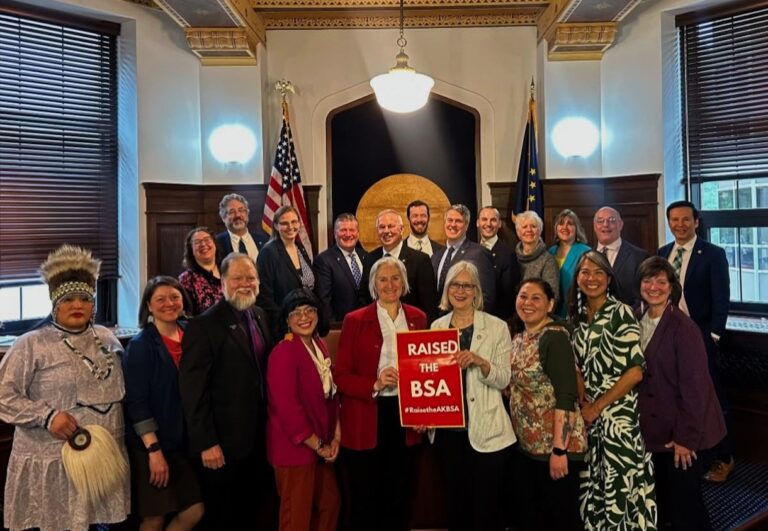
These legislators show little concern for building the private sector economy and growing a stable job market in Alaska, even as Alaska faces a projected $400–500 million deficit for FY26.
Despite this, the Legislature, in overriding the governor’s veto of House Bill 57, chose to approve a $184+ million annual increase in education spending without identifying a durable funding source. Oil revenues, which once buoyed the state budget, now account for only about 30% of general fund income. The Permanent Fund Earnings Reserve Fund picks up most of the slack, and further draws risk destabilizing the annual dividend Alaskans rely on. Right now, the funding source is a raid on the economic development engine of the state and the higher education fund for scholarships. Later it will be taxes.
Supporters of HB 57 claim the increase is long overdue, pointing out that the Base Student Allocation has been flat since 2017, although the truth is that the Legislature and governor have awarded one-year increases every year for over a decade.
But throwing more money into the system does little good if it isn’t paired with structural reforms, Gov. Mike Dunleavy has argued. Administrative bloat remains a major problem in Alaska’s school districts: Between 2002 and 2020, administrative salaries rose 18%, while teacher pay increased just 1%.
Today, Alaska has approximately five non-teaching staff for every four teachers, an imbalance that diverts resources away from classrooms.
The education lobby’s opposition to any meaningful reforms, such as school choice, voucher programs, or stricter accountability measures proposed by Gov. Dunleavy, undermines the credibility of their funding demands.
HB 57 contains token policy gestures, such as minor adjustments to charter school processes and cell phone policies, but avoids any significant challenge to the NEA’s grip on public education. Voucher proposals and charter school expansions, backed by fiscal conservatives and some parent groups, continue to be stonewalled by the same bloc that pushed HB 57 through.
The override of HB 57 signals that organized special interests, especially those with deep roots in the education industry has, can dictate budget policy regardless of the state’s fiscal outlook. It weakens the executive branch’s ability to impose discipline in budgeting and puts added pressure on the Permanent Fund at a time when global oil markets remain volatile.
Gov. Dunleavy’s veto was a responsible attempt to force broader reforms and long-term sustainability. The Legislature’s override, driven by the NEA’s PACE political apparatus and the legislative bloc of former educators, was a rejection of that restraint.
In the short term, schools may get a funding boost. But in the long run, this decision deepens Alaska’s structural budget imbalance and further insulates an education system that has yet to deliver results commensurate with its cost.
Alaska stands at a crossroads. Decades of bureaucratic expansion, fiscal mismanagement, and policy drift have left the state with underperforming institutions, rising costs, and a growing disconnect between the people and their government. While Alaska is blessed with immense natural wealth and a resilient population, it suffers from structural inefficiencies that hinder its progress and undermine public trust.
In response, a new conservative leadership—anchored in constitutional values, community self-determination, and fiscal responsibility—proposes a comprehensive realignment of four critical systems: Education, Health and Welfare, Energy, and the Permanent Fund Dividend.
Each of these reforms is justified not by ideology, but by necessity.
1. Education: Restoring Local Control and Breaking Bureaucratic Dependency
For decades, Alaska’s education system has been dominated by a centralized bureaucracy that is unresponsive to local needs and fiscally unsustainable. The Department of Education and Early Development (DEED), along with layers of school boards and administrative mandates, has created a system where spending has increased while student performance remains stagnant, particularly in rural and Indigenous communities.
Justification for Reform:
Alaska ranks among the highest in per-pupil spending but among the lowest in academic performance and graduation outcomes.
Local communities lack meaningful control over curriculum, personnel, or funding priorities.
Statewide mandates stifle innovation, burden educators, and alienate parents.
Solution: Dismantle the Department of Education and Early Development, abolish all local school boards, and empower parents and communities through direct education savings accounts, community learning co-ops, and curriculum freedom. Restore education as a right rooted in community, not a privilege dispensed by bureaucracy.
2. Health and Welfare: Ending Federal Dependency and Streamlining State Systems
Alaska’s health and welfare system has become a fiscal albatross. Medicaid expansion in 2015 shifted immense financial risk to the state without improving access or outcomes. Meanwhile, state agencies such as the Department of Health and the Office of Children’s Services have grown bloated, slow, and opaque, often harming the very populations they are meant to serve.
Justification for Reform:
Medicaid now consumes the largest share of Alaska’s operating budget and continues to grow without measurable improvements in care.
The assumption of federal trust responsibilities (e.g., under Public Law 280) has left the state vulnerable to liability and inefficiency.
Critical services are buried beneath regulatory overreach, workforce licensing delays, and fraud-prone contracting.
Solution: Reverse Medicaid expansion, return federal responsibilities to the federal government, and dismantle or restructure failing bureaucracies. Prioritize community-based service delivery, fraud reduction, and private-sector health partnerships that deliver results over rhetoric.
3. Energy: Unleashing Resource Development and Achieving Hydroelectric Dominance
Despite possessing vast energy resources, Alaskans face some of the highest energy costs in the nation. The Alaska Energy Authority and the Alaska Industrial Development and Export Authority have failed to deliver on their mandates, instead favoring insider deals and politically engineered projects over real development.
Justification for Reform:
Southcentral Alaska faces a natural gas shortfall due to regulatory inaction and infrastructure neglect.
Federal-style permitting and anti-development rules have paralyzed progress in oil, gas, and mineral extraction.
Energy monopolies and state-funded intermediaries distort markets and limit rural access to affordable power.
Solution: Dismantle AEA and AIDEA, repeal all laws that impede energy development, and fast-track hydroelectric infrastructure. Encourage open-market energy access and return control of Alaska’s energy future to its people—not its middlemen.
4. The PFD: Restoring the People’s Share and Rebuilding Trust
The Permanent Fund dividend was created to ensure that all Alaskans benefit from their state’s natural resource wealth. Since 2016, legislative appropriations have diverted billions away from dividend payments, breaking public trust and disproportionately harming low-income Alaskans.
Justification for Reform:
The statutory PFD formula has been violated multiple times through legislative appropriation.
More than $13 billion in PFD earnings have been diverted to government spending without voter consent.
The erosion of the PFD undermines economic justice and fuels public distrust in state institutions.
Solution: Restore the statutory PFD formula, repay withheld dividends to all eligible Alaskans, and enshrine PFD protections in the state constitution. The PFD is not a government program. It is the people’s rightful share, and it must be safeguarded accordingly.
Conclusion: A Conservative Restoration of Alaska’s Future
These four pillars of reform, education, health and welfare, energy, and the PFD, are not isolated initiatives. Together, they represent a blueprint for restoring sovereignty, self-governance, and sustainability in Alaska’s public institutions. By dismantling failing systems and rebuilding from the ground up with a focus on efficiency, equity, and accountability, Alaska can secure a stronger, freer future for all its residents.
Donna Arduin, a prominent state budget management and tax reform expert who was an early figure in the Dunleavy Administration, has uncovered possible fraud at the Kennedy Center for the Performing Arts.
The Kennedy Center is under scrutiny after she found internal documents that revealed a pattern of deficit spending and accounting practices that could prompt legal action. The revelations, first reported byThe Daily Wire, point to alleged fiscal mismanagement during the tenure of recently departed president Debra Rutter — mismanagement that current leadership now describes as “criminal.”
Kennedy Center President Richard Grenell informed the board of directors this week that the organization uncovered $26 million in “phantom revenue” embedded in its fiscal year 2025 budget. “It’s criminal,” Grenell said, to The Daily Wire, adding that the findings would be referred to the U.S. Attorney’s Office for investigation.
The allegations center on claims that Rutter and her leadership team fabricated revenue to balance the budget, misleading the board and jeopardizing the institution’s financial integrity. Rutter has denied the accusations, telling The Washington Post that the board approved every annual budget her team submitted.
However, Kennedy Center Chief Financial Officer Arduin, who joined the institution earlier this year, disputed Rutter’s defense in a letter obtained by The Daily Wire. Arduin, a high-profile budget expert with national experience, pointed out that audit processes and budgeting are on entirely different timelines and that audits do not validate budgets retroactively.
“Budgets and audits are on vastly different timetables and audits do not review the budgeting process,” Arduin wrote to Grenell. “Audits are released up to a half year after the conclusion of the fiscal year, whereas budgets are approved well in advance of the fiscal year.”
Arduin has a long record of strong fiscal leadership, having served as budget director in several states, including Florida under Gov. Jeb Bush, was well as New York under Gov. George Pataki, and California under Gov. Arnold Schwarzenegger. In Alaska, Arduin briefly served as Gov. Mike Dunleavy’s budget director in 2019, where her cost-cutting proposals triggered leftists and the mainstream media. Because the Legislature did not follow her recommendations for drastic budget reductions, Alaska now faces the fiscal crisis that she predicted it would encounter. Legislators take more and more of Alaskans’ Permanent Fund dividends and try to push taxes onto Alaskans.
At the Kennedy Center, Arduin concluded that the organization’s fiscal year 2025 budget was deliberately veiled with $26 million in non-existent revenue. “The Board believed that they were in good faith passing a balanced budget,” she wrote.
In March, Arduin informed her fellow senior executives the Kennedy Center had “no cash to pay our bills.”
Beyond the fictitious revenue she unearthed, Arduin also detailed a concerning reclassification of donor-restricted funds. According to her letter, the Kennedy Center’s leadership under Rutter renamed a $54 million debt reserve, originally designated for retiring a bank loan, as a “sustainability fund.” The name change allegedly created the illusion of newly raised funding and allowed the reserve to be used to cover operational deficits.
The US Army this week announced changes to its retention policies, taking effect June 1. The adjustments come amid strong enlistment and a high demand for reenlistment.
The updates include reinstating the 90-day reenlistment window for eligible soldiers, reflecting a huge turnaround in enlistment now that Joe Biden is no longer commander in chief.
Under the new policy, soldiers not currently deployed or preparing to deploy and have an expiration of term of service before October 1, will have until May 31 to request retention extensions. These extensions allow soldiers to delay a reenlistment decision without fully committing to continued service.
After that deadline, extensions will be available only under specific conditions detailed in Army regulations. Special circumstances will continue to be evaluated on a case-by-case basis.
Beginning July 1, soldiers will only be able to reenlist from the time their reenlistment window opens until 90 days before their expiration term of service (ETS). Those within 90 days of separation will no longer be eligible to reenlist under the new policy, tightening the timeline for career decision-making.
Army leaders said the changes are meant to give commanders and career counselors better insight into retention trends while encouraging Soldiers to make timely, informed decisions about their futures in the service.
“As the Army adapts to evolving needs and conditions, we have to make sure our retention policies keep pace,” said Master Sgt. Kindra Ford, Senior Army Retention Operations NCO. “We’re working hard to keep career counselors, Soldiers, and leaders up to date to help them make informed decisions about their careers.”
The policy updates follow the Army’s suddenly strong performance in retaining personnel. In April, the Army exceeded its fiscal year 2025 reenlistment goal by retaining 15,600 Soldiers, surpassing its target by 800. This comes as the Army also reported reaching over 90% of its recruiting goals in May, a positive sign for force sustainability.
“With reenlistment and recruiting exceeding expectations, the Army is in a good position to maintain its end strength and force requirements for the foreseeable future,” said Ford.