Glenfarne Group, LLC, the majority owner and lead developer of the Alaska LNG project, has selected global engineering firm Worley to carry out additional engineering and deliver the final cost estimate for the proposed pipeline.
The selection marks a pivotal step forward for the long-anticipated $39 billion Alaska LNG project, a joint venture with the Alaska Gasline Development Corporation, the state’s independent energy infrastructure agency.
Worley, which has operated in Alaska’s North Slope region for over 60 years and has a longstanding presence in the state’s energy sector, will expand its role to become a key advisor to Glenfarne on all components of the project. In addition to refining the pipeline’s engineering scope and updating its cost estimate, Worley will also take on responsibilities related to the development of the Cook Inlet Gateway LNG import terminal.
The final cost estimate is a required step before Glenfarne makes a final investment decision (FID), which is expected later this year, the company confirmed in the announcement.
“The declining gas production from Cook Inlet risks Alaska’s energy security, as well as U.S. national security and military readiness,” said Brendan Duval, CEO and Founder of Glenfarne. “Prioritizing the development and final investment decision of the pipeline is essential to solving the natural gas shortages which are already impacting the state.”
Duval emphasized Glenfarne’s commitment to accelerating the project timeline and engaging potential strategic partners. He also highlighted Worley’s experience both globally and in Alaska: “We are particularly proud to be expanding our relationship with Worley to Alaska LNG from our existing partnership on the Texas LNG project,” he said. “Worley is one of the world’s largest and most experienced engineering and project delivery firms with a long history of success in Alaska.”
The Alaska LNG project, envisioned to transport North Slope natural gas through an 800-mile pipeline to a liquefaction terminal in Nikiski, has experienced numerous delays and shifts in strategy over the past decade. The project stalled under former Gov. Bill Walker, who sought communist Chinese state investment and control. It has since regained momentum under Gov. Mike Dunleavy, with a focus on American-led development and energy security.
Worley’s client history in Alaska includes work with NANA Regional Corporation, one of the state’s 13 regional Native corporations, signaling deep industry ties that may prove beneficial in navigating the regulatory and logistical hurdles ahead.
The updated engineering and cost work will build upon previously completed studies and designs, bringing the multibillion-dollar megaproject one step closer to groundbreaking.
A new online tool is shedding light on a subject that has long fueled political tension in Alaska: the reduction of the Permanent Fund Dividend (PFD). The website, PFD Doomsday Clock, allows Alaskans to quickly calculate how much money they and their families have lost since the state government stopped paying out full statutory dividends in 2016.
Developed by concerned Alaskan Phil Izon, the tool uses publicly available data to estimate the gap between what residents would have received under the traditional PFD formula and what they actually received each year. Users simply input the number of eligible family members, and the site instantly displays a cumulative total of lost income.
For a family of four, the losses since 2016 can amount to more than $20,000, money that, under the original formula, would have been distributed directly from the earnings of the Alaska Permanent Fund. Instead, The Bill Walker Administration and legislatures have capped or restructured the payments, using portions of the fund’s earnings to cover perceived state budget shortfalls.
The site presents the information starkly, with a running counter and breakdowns by year. It’s a powerful visual reminder of how deeply the dividend issue cuts across Alaska’s political and economic landscape.
Since Gov. Walker’s Administration first reduced the PFD payout by half in 2016, critics have argued that the state has violated the intent and statute that governs the dividend program, which was created to ensure that all Alaskans benefit from the state’s resource wealth. Proponents of the reduced dividend argue it’s a necessary measure to maintain essential services amid fiscal challenges.
The release of the calculator arrives at a time when the current Legislature has reduced the dividend to just $1,000 in 2025. public pressure is once again mounting for lawmakers to return to the statutory formula. As debates continue.
With elections approaching in 2026 and budget debates ongoing, the PFD remains a potent symbol of what Alaska once was, and what it has become. Alaskans have a clear window into just how much it has cost them and their children.
What began as a routine REDDI report quickly unraveled into a high-octane crime spree Saturday night, leaving wreckage and injury in its wake along the scenic but infamous stretch of the Seward Highway on Memorial Day weekend.
At approximately 7:58 pm. on May 24, Alaska State Troopers received a report of a motorcycle exhibiting dangerous driving behavior near Mile 13, not far from the near the Grayling Lake trailhead. Before troopers could intercept the motorcycle, the situation escalated dramatically.
A good Samaritan, seeing the motorcycle toppled and its driver apparently injured, stopped to render aid. But instead of receiving help, the motorcyclist, later identified as 47-year-old Rondy Dupuy of Seward, sprang into action, commandeering the bystander’s Jeep and speeding north on the highway.
As Alaska State Troopers scrambled to respond, information flooded in. The motorcycle itself, they soon discovered, had been reported stolen just hours earlier. And Dupuy’s reckless flight didn’t end with the Jeep theft.
Before authorities could bring the chaos under control, the stolen Jeep slammed into a sedan, injuring both occupants and prompting the closure of the Seward Highway for nearly two hours. Emergency responders and law enforcement descended on the crash site, securing the area and tending to the injured.
Dupuy, who had an outstanding warrant for Misconduct Involving a Controlled Substance in the Second Degree, was taken into custody following medical treatment. In addition to his existing warrant, he now faces a litany of new charges: Two counts each of Assault in the Third Degree, Vehicle Theft in the First Degree, and Theft in the Second Degree, along with charges of Driving While License Revoked (DWLR), Driving Under the Influence (DUI), and Criminal Trespass in the Second Degree.
Dupuy was remanded to Wildwood Pre-Trial Facility following medical clearance.
Alaska State Troopers expressed their gratitude to the US Fish and Wildlife Service, whose swift assistance proved invaluable at both the crash site and during the ongoing investigation.
Over the past decade, Alaska has become a sobering case study in the systematic digression from freedom to entitlement, where government agencies, originally built to serve and protect, have transformed into sprawling bureaucracies of dependency, eroding both the independence and health of its people.
In a bitter irony, the very programs created with the intention of improving lives, Medicaid expansion, SNAP, subsidized housing, behavioral health grants, have instead produced managed decline, where poverty is institutionalized and personal agency is replaced by procedural compliance.
The irony lies not just in the results, but in the intentions. These programs were meant to expand access, reduce suffering, and create equity. Instead, they’ve created chronic dependency, where people are sustained in poor health rather than healed, where public nutrition programs coexist with soaring obesity and diabetes, and where addiction services multiply even as communities fall deeper into despair.
Alaska’s Medicaid program, expanded in 2015 with promises of increased care, now consumes billions while delivering long wait times, limited provider access, and little measurable improvement in public health.
Wellness is no longer the goal. Maintenance within a broken system is!
This decay has not been limited to health. SNAP benefits and housing subsidies, instead of providing stability, have fueled multi-generational reliance on the state, displacing family responsibility and weakening community resilience. In this environment, hope is rationed, and initiative is penalized. The government has become not a partner in progress, but the central authority managing a web of entitlements. This web quietly discourages self-reliance.
Meanwhile, to fund this expansive machinery, Alaska’s government has increasingly diverted money from the Permanent Fund dividend (PFD). Once a symbol of shared wealth and economic independence, the PFD is about to become a memory. In doing so, the state strips individuals of direct control over their portion of Alaska’s resource wealth and instead reallocates it through opaque bureaucratic pipelines, where the individual is always a passive recipient, never an empowered actor.
The cruelest irony of all is this: in attempting to protect the vulnerable, we have made more people vulnerable. In trying to reduce inequality, we have deepened the divide between state-managed existence and authentic opportunity. And in promising compassion, we have delivered control.
In this same vein, Alaska has witnessed the quiet emergence of a new class divide, not between rich and poor in the traditional sense, but between those who work for the government and those who live off it. This is the unintended but entirely predictable result of a system where government spending, not production, innovation, or private enterprise, has become the dominant economic engine in much of the state.
Classic Marxism.
On one side are the bureaucratic beneficiaries: agency employees, administrators, program managers, and consultants whose salaries, pensions, and job security are shielded from market forces and funded by taxes, royalties, and increasingly, by diverted Permanent Fund revenues. These individuals operate in a parallel economy where performance is often decoupled from results, and institutional growth, not public service, is rewarded. Their livelihoods depend on maintaining the size and scope of government itself.
On the other side are the dependent class: not by nature, but by circumstance, trapped in webs of Medicaid, SNAP, housing subsidies, and a host of welfare systems that offer temporary relief but long-term stagnation. These Alaskans are not empowered to build, compete, or rise; they are managed, surveyed, and processed. Any attempt to break free from these programs is met with bureaucratic resistance, benefit cliffs, or administrative delays that punish ambition and reward compliance.
Caught between these two classes is the shrinking private sector, where entrepreneurs, tradesmen, small business owners, and working families shoulder the costs of both systems while receiving few of the privileges. They do not draw checks from the state, nor are they supported by it, but they are constantly told they must pay more for the sake of “adequacy” and “equity” in a structure that seems neither adequate nor equitable.
This is not a healthy society. It is a soft caste system built not on merit, but on proximity to government power. It is a reversal of Alaska’s founding values, where rugged self-reliance and equal footing under the law were once the norm. And it is unsustainable.
Our state motto has become “North to entitlement.”
To restore balance, Alaska must rebuild a culture of earned independence, where dignity comes from contribution, not entitlement; where public servants serve rather than rule; and where assistance is a stepping stone, not a way of life. The state’s future depends not just on reducing bureaucracy, but on reviving the principle that government exists to enable freedom, not divide citizens into the managed and the privileged.
Change begins with awareness of the system’s drift, consciousness of its consequences, and conscience to act against it. We must awaken to how far we’ve strayed from Alaska’s original intent, freedom, opportunity, and accountability, and recognize that no policy, no program, and no bureaucracy can replace the responsibility and dignity of a free people. Only when citizens reclaim their role, not as passive recipients, but as active stewards, can we restore a system rooted in liberty, local control, and self-determination.
The solution is not to withdraw compassion, but to reclaim freedom. That begins by dismantling this entitlement apparatus, restoring local control, re-empowering families, and returning public resources to the people.
Alaska cannot recover its promise by continuing down a path paved with good intentions and buried under bureaucratic outcomes. It must rediscover the original values that built it: responsibility, liberty, and trust in the individual, not the institution.
Democratic donors are planning to spend $20 million to figure out how the Democrats can talk to dudes.
Democrats are viewing men as an exotic species they need to study in order to learn how to speak to them. The party is trying to decode American men and worm their way inside their brains with messaging.
In a long analysis in The New York Times titled “Democrats Are Still Searching For Path Out of the Wilderness,” the newspaper talks about the $20 million initiative with a straight face.
Faced with cratering support among key voter groups (including black Americans), the Democratic Party is investing millions to try to understand and reconnect with one demographic it has steadily lost: The American male.
The effort, code-named SAM, short for Speaking with American Men: A Strategic Plan, reflects growing alarm inside the party about its image, particularly among younger, working-class male voters. Once a reliable part of the Democrat coalition, this group shifted decisively to the right in 2024, helping deliver Donald Trump a second term — this time with a national popular vote win.
SAM’s mission, according to internal documents obtained by The New York Times, is to study the “syntax, language, and content” that resonates with men online, including in male-dominated digital spaces such as gaming platforms and social media forums, and to reshape Democratic messaging to meet the dudes where they are.
The plan marks a significant departure from traditional outreach strategies. It urges the party to abandon what it calls a “moralizing tone” in favor of language that feels authentic and compelling to male voters who have become increasingly alienated from progressive cultural and political narratives, as well as the female-dominated Democratic Party.
One of SAM’s proposed tactics includes placing advertisements inside video games, since that is where young men spend a lot of time and it’s not a place that conventional political media reaches. The goal is not only to get their attention but to counter the influence of so-called “right-wing messaging” that the Democrats believe is happening.
The Democratic Party’s erosion among men is part of a broader trend as in 2024 men of all demographics swung hard to the right. This shift has rattled party strategists, who now see male disengagement as a serious structural liability heading into 2026 and beyond, according to the Times report.
The SAM project reflects a deeper reckoning within the party.
“We lost credibility by being seen as alien on cultural issues,” said Democratic pollster Zac McCrary, warning that even a strong showing in the next election could mask long-term damage.
For Democratic strategist Anat Shenker-Osorio, who has led hundreds of voter focus groups, the solution is simple: Stop navel-gazing and start acting. Voters, she says, “are hungry for people to actually stand up for them — or get caught trying.”
In focus groups conducted by Shenker-Osorio, swing voters often compare political parties to animals.
Republicans are typically described as “apex predators,” such as lions, tigers, or sharks. They are seen as powerful and aggressive. Democrats, by contrast, are likened to slow or passive creatures such as tortoises, sloths, or slugs.
One Georgia voter offered a more pointed comparison, calling Democrats “a deer in headlights,” frozen and helpless even when danger is clearly approaching.
These metaphors reflect how many voters, especially men, perceive Democrats as lacking strength or resolve, according to Shenker-Osorio.
With SAM, the party appears to be testing whether it can speak directly to a group it has spent decades alienating.
President Trump’s Executive Order 14212 of Feb. 13 established the President’s Make America Healthy Again Commission.
Within the first 100 days, the commission was required to submit to the President the Make Our Children Healthy Again Assessment. Then within 180 days, the Commission had to submit to the President its strategy based on the findings to improve the chronic childhood disease crisis.
The charge was threefold:
Evaluate the scope of the crisis and identify contributing factors that may add to the overall state of childhood health.
Advise and assist the President to inform the American people on the crisis, using “transparent and clear facts”
Provide the President with “Government-wide recommendations on policy and strategy” to address the contributing factors and to “end the childhood chronic disease crisis”.
Robert F. Kennedy, Jr. (RFK), Secretary of the Department of Health and Human Services (HSS), released the first report on the childhood health crisis on May 22, 2025.
The MAHA report identified four core drivers of the childhood chronic disease crisis:
Poor Diet: Almost 70% of our children’s calories come from ultra-processed foods—linking this dietary shift to rising rates of obesity and type 2 diabetes.
Cumulative Load of Chemicals: “Beyond glyphosate, the report broadly warns that pesticides, microplastics, and dioxins are commonly found in the blood and urine of American children, pregnant women” to include breastmilk —some at high levels. Add to this the “cumulative burdens” of multiple exposures.
Lack of Physical Activity and Chronic Stress: There has been a significant decline in physical activity in our children along with increased screen time (nearly nine hours daily for teens). Additionally, there is a rise in chronic stress, sleep deprivation and mental health issues including depression and anxiety.
Overmedicalization: Concerns were raised about the “growth of the childhood vaccine schedule” and more medications being prescribed to our children, “including antidepressants, ADHD stimulants, and antibiotics, questioning their long-term impact and calling for more safety data and non-pharmacological interventions”. There has been a 250% increase in attention-deficit/hyperactivity disorder (ADHD) prescriptions between 2006 and 2016. Between 1987 and 2014 there has been a 1,400% increase in antidepressant prescriptions.
MAHA Report Findings on Childhood Health Crisis include:
Autism: 1 in 31 Children
ADHD: 10% of Children
Childhood Cancer: Up 40%
Teenage Depression: Doubled
Suicide Deaths Among Young People: up 62%
High School Students Considered Suicide: 3 million
Children with Allergies: 1 in 4
This assessment is just the first step in a process laid out by President Trump’s Executive Order, that established the MAHA Commission in February, shortly after Kennedy’s swearing-in. The report will now be used over the next 80 to 100 days by the MAHA Commission to fashion concrete policy recommendations to be implemented during the remainder of President Trump’s term.
Sadly, our children are likely to have shorter life spans due to these chronic diseases, despite the U.S. spending more on healthcare than other wealthy nations.
“Today’s children are the sickest generation in American history in terms of chronic disease, and these preventable trends continue to worsen each year, posing a threat to our nation’s health, economy, and military readiness,” the report states. More than 40% of our children have at least one chronic health condition.
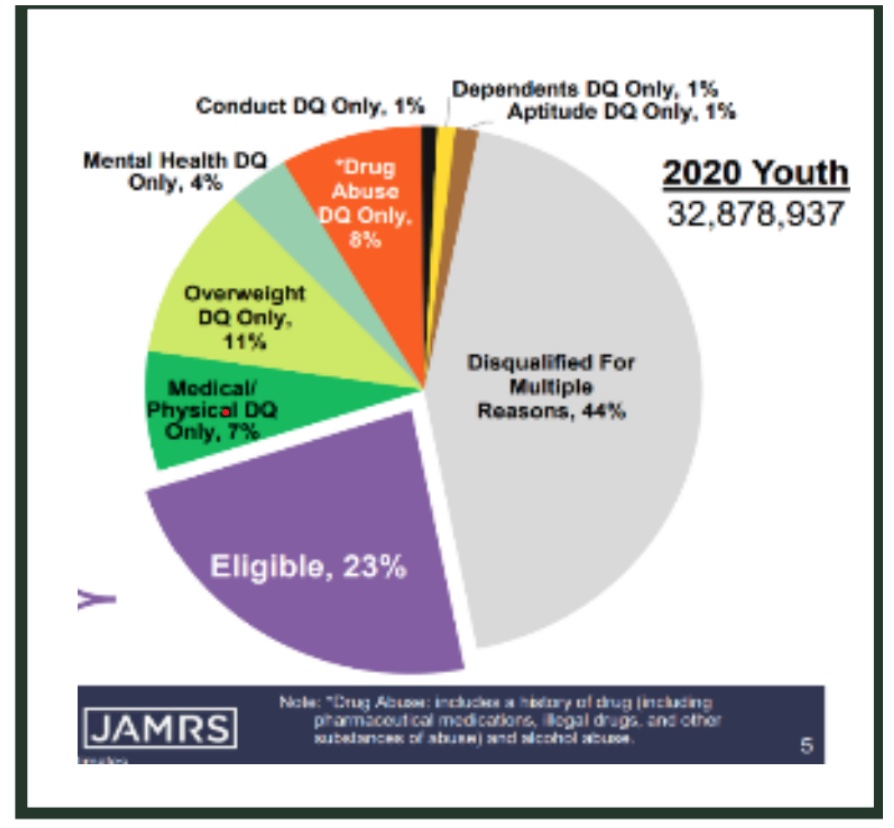
There are far reaching consequences to this chronic disease crisis. Shockingly, over 75% of American youth (aged 17- 24) aren’t eligible for military service because of obesity, poor physical fitness, and/or mental health challenges.
This has led to concerns Congresspersons from agricultural states and farming groups about what economic impact this will have on agriculture, especially the use of chemicals on crops. The farmers are especially concerned about glyphosate and atrazine that are used routinely on crops. These herbicides are linked to cancer, reproductive disorders and other conditions.
Kennedy maintains policy changes won’t “hurt” the farmers, but time will tell. The stakes are high on both sides of the issue. But the stakes are even higher for our children.
Big Pharma is also concerned as to what this could do to their profit margins. They have been pushing medications to fix everything when a simpler solution without chemical medication may be possible.
RFK Jr.’s team has 80 days to come up with the policy recommendations based on this report. That’ll be due out some time in August.
Sadly, we have relied too much on the easy fix-taking a pill to fix everything. And our farmers have relied too much on herbicides to maximize profits for too long.
We spend more money on healthcare than any other Western country, and our children are the sickest. It’s time we make a change—for the future success of our nation.
We must find a balance. Our children are too important to sacrifice to corporate profits.
Linda Boyle, RN, MSN, DM, was formerly the chief nurse for the 3rd Medical Group, JBER, and was the interim director of the Alaska VA. Most recently, she served as Director for Central Alabama VA Healthcare System. She is the director of the Alaska Covid Alliance/Alaskans 4 Personal Freedom.
Your editor at Must Read Alaska will be keeping a light work schedule on Memorial Day … Might work six hours instead of 12.
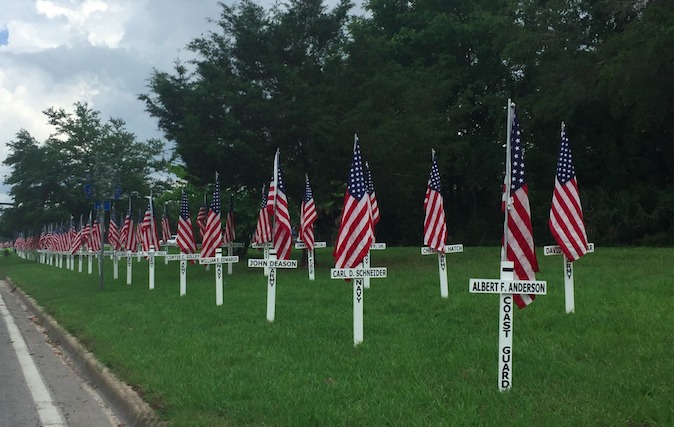
Memorial Day, for many of us, is a reminder of the profound cost of freedom, and it’s how we honor the men and women of the United States Armed Forces who gave their lives in service to the nation.
We can sure make it a “happy Memorial Day,” and yet, it is also a solemn day of reflection, gratitude, and a time to recognize the courage, sacrifice, and unwavering commitment of those who laid down their lives to protect the values and liberties that define America.
Beyond the barbecues and parades, Memorial Day calls us to pause and pay tribute to the fallen, and especially to teach the next generation about the price of peace and the enduring legacy of those who served with honor.
We’ll be back in full swing on Tuesday, ready for the fray.
Memorial Day, this year observed on May 26, is the start of summer for most Americans and is a day many will celebrate with barbecues for family and friends. We Alaskans might savor a little warm weather, for a change, hang out our flower baskets, and brush the cobwebs from our fishing poles this three-day weekend.
As we welcome the coming of summer, let’s not forget those who have sacrificed their lives for us, so we can have those barbecues in a free country. For our Gold Star families, this is a somber day of remembrance, a time when the pain of a loved one lost is acutely felt.
Freedom is not free: This is a phrase engraved into the Korean War Veterans Memorial in Washington, D.C., and its something Col. Walter Hitchcock of the New Mexico Military Institute in Roswell, N.M. is most often credited with coining. It’s how we remind ourselves that somebody somewhere “paid this freedom forward” by making the ultimate sacrifice of life itself.
Memorial Day gives Americans the opportunity to pay respect to those in this generation and the ones who came before us who died while serving our nation. Please join me this Memorial Day in remembering – on behalf of past, present, and future generations – the deep and enduring debt we owe to our fallen and to their families, friends, and colleagues.
On this Memorial Day in 2025, I’m remembering the words of President Ronald Reagan, from his Inaugural Address in 1981:
“With all the creative energy at our command, let us begin an era of national renewal. Let us renew our determination, our courage, and our strength. And let us renew our faith and our hope.American patriotism runs quiet, and deep, our value of freedom sustains our national heritage.
“We have every right to dream heroic dreams. Those who say that we’re in a time when there are not heroes, they just don’t know where to look. You can see heroes every day going in and out of factory gates. Others, a handful in number, produce enough food to feed all of us and then the world beyond. You meet heroes across a counter, and they’re on both sides of that counter. There are entrepreneurs with faith in themselves and faith in an idea who create new jobs, new wealth and opportunity. They’re individuals and families whose taxes support the government and whose voluntary gifts support church, charity, culture, art, and education. Their patriotism is quiet, but deep. Their values sustain our national life,” Reagan said.
Even more so, for our greatest heroes, let’s look at the grassy expanses of all our national cemeteries with their row upon row of simple white markers bearing Crosses, Stars of David, or Islamic Crescents. They add up to only a tiny fraction of the price that has been paid for our freedom, Reagan noted, and I would add that many of our local cemeteries are the final resting place for these military super heroes, many of whom ran into the firefight or braved stormy skies and savage seas to ensure our safety as a nation.
These are men and women of unquestioned valor who dedicated themselves to the protection of our homeland and the preservation of its ideals. Through each successive generation, this country has endured because of those who sacrificed so much, so we may have the freedoms we enjoy today.
More than 1.2 million Americans have made the ultimate sacrifice for our freedom since 1775. Following the terrorist attacks on Sept. 11, 2002, the United States of America has lost 7,085 U.S. military personnel, including 1,242 Special Operations personnel.
In the words of Reagan, “Perhaps you and I have lived with this miracle too long to be properly appreciative. Freedom is a fragile thing and is never more than one generation away from extinction.”
It’s never too late to be “properly appreciative.” It will take that appreciation, and more, for us to live up to the standards set by the Greatest Generation.
Rep. Jamie Allard serves the community of Eagle River, House District 23, in the Alaska State Legislature, is a U.S. Army veteran, and is the wife of a veteran.This column first ran in 2024 and was updated and republished for 2025.
A worship rally organized by Christians from On Fire Ministries turned violent Saturday afternoon at Cal Anderson Park, located in Seattle’s Capitol Hill neighborhood, a formerly family-oriented neighborhood that has been taken over by the LGBTQ+ community.
The Mayday USA event was part of a five-city national tour and in Seattle drew violent opposition from transgender activist groups and resulted in 23 arrests after the trans-activists attacked the worship attendees and police.
Antifa and trans activists get ARRESTED after clashing with police at peaceful Christian gathering in Seattle.
— AmericanPapaBear (@AmericaPapaBear) May 25, 2025
Promoted as a worship gathering to uphold “Biblical truth and values,” the rally also offered resources on abortion and same-sex relationships, drawing criticism from trans-activists who viewed it as an affront to the community. Mayor Bruce Harrell criticized the event and said it was counter to the values of Seattle.
“Seattle is proud of our reputation as a welcoming, inclusive city for LGBTQ+ communities, and we stand with our trans neighbors when they face bigotry and injustice. Today’s far-right rally was held here for this very reason – to provoke a reaction by promoting beliefs that are inherently opposed to our city’s values, in the heart of Seattle’s most prominent LGBTQ+ neighborhood. When the humanity of trans people and those who have been historically marginalized is questioned, we triumph by demonstrating our values through our words and peaceful protest – we lose our voice when this is disrupted by violence, chaos, and confusion. Anarchists infiltrated the counter-protestors group and inspired violence, prompting SPD to make arrests and ask organizers to shut down the event early, which they did,” Harrell said.
Masked violent Antifa members have been arrested at a violent direct action on May 24 to shut down a Christian event at Cal Anderson Park in Seattle. Antifa believe in using violence to stop Christians religious practices. pic.twitter.com/fWFdrw64eM
Groups including the Seattle Democratic Socialists of America and other leftist organizations were part of the mayhem against what they said was an “anti-trans, anti-queer” event.
The location of the worship service was same place where the deadly CHAZ (Capitol Hill Autonomous Zone) occupation took over in 2020 in protest of the death of wife-beater and drug addict George Floyd.
One of those arrested was Mikaele Andrew Baker, who, according to independent journalist Andy Ngo, is a member of the Youth Liberation Front. Baker was a certified state delegate for Bernie Sanders’ 2020 presidential campaign and has been arrested repeatedly at Antifa riots for years but faced no consequences, Ngo said.
The violence began shortly after 1:30 p.m., when members of the tran-tifa group began tearing down fences, throwing bottles, and attacking rally participants and police officers. According to the Seattle Police Department, at least one officer was injured badly enough to need medical attention. Authorities arrested 22 adults and a minor on charges ranging from assault to property destruction and obstruction.
Seattle Police are making arrests after Antifa, Trantifa and far-left extremists gathered for a violent direct action to shut down a Christian worship event at Cal Anderson Park. The park is at the center of the former deadly CHAZ occupation. pic.twitter.com/6006VBqBZn
Washington State Patrol troopers were called in for backup as the violence continued to escalate. Throughout the riot, Seattle Police Department posted updates on X, such as:
“Officers are making multiple arrests at a protest inside Cal Anderson Park. Orders are being given to protesters to back away from officers and to stop throwing items at officers.”
“Additional arrests have been made inside the crowd. No injuries have been reported at this time.”
“Individuals in the crowd have begun throwing water bottles at officers. Additional arrests will occur as we can safely remove those individuals from the crowd.”
“Protesters have now knocked over fencing. Additional officers will be responding to the area to assist in maintaining a safe environment.”
“The Seattle Police Department has requested mutual aid from the Washington State Patrol. You will see Troopers wearing different uniforms from officers inside the park.”
Mayor Harrell has called for a review of the city’s permitting process for rallies in sensitive areas, and highlighted the potential for confrontation at the Cal Anderson Park if Christians want to ever use it again.
On Sunday, the Seattle Police Officers Guild published a statement rebuking the city’s lack of will to deal with violent Antifa members:
Public Safety in the City of Seattle continues to be politicized and violent ANTIFA criminals once again dominate Seattle’s public safety conversation with their insane use of political violence. This is Seattle’s public safety political reality.
Over seven hundred police officers have fled this city in the past decade. This is due to the public safety political decisions by our elected leaders, activist pressure, and for their lack of action against ANTIFA criminals who continue to dictate public safety political terms. The remaining police officers in this city are tired. Our community is tired. This is Seattle’s public safety political reality.
Time and time again, Seattle’s public safety servants have been the tool or entity to blame for Seattle’s woes. Despite this reality, SPOG members know that we lead the nation in police accountability and that our accountability system is under full civilian management. Yet we incessantly hear political activists calling for more. This is Seattle’s public safety political reality.
In the past fifteen years, Seattle’s tax base has spent well over 200-million-dollars to pay federal monitors and their staff in what appears to be the never-ending Department of Justice (DOJ) Consent Decree experience. Will it ever end? How many policies need to be changed? This is Seattle’s public safety political reality.
Given today marks the 5th anniversary of George Floyd’s death, we stood with Seattle during the 2020 George Floyd demonstrations. As the demonstrations turned riotous, we were then ordered to protect public buildings and infrastructure at all costs. As a result of these riots and political pressure, our elected leaders decided to surrender a police precinct. We were also prohibited from entering major sections of our city to answer 911 calls. People died as a result. Untold amounts of property destruction occurred. Scores of police officers were injured. The city paid out millions of dollars. Sadly, this was one of the major reasons that has led to our current police staffing crisis. This is Seattle’s public safety political reality.
SPOG welcomes a mayoral review of yesterday’s Seattle Parks Department’s decision to allow a demonstration permit for families who wanted to exercise their 1st amendment rights at Cal Anderson Park. What we are struggling to understand is, why was this park chosen and authorized, especially when this park is commonly known as the heart of ANTIFA land. We have no doubt that this city decision, as naïve or deliberate as it was, put police officers in an untenable predicament. Whether it’s our job or not, we were once again ordered to put ourselves into a political quagmire. SPOG understands we will once again get blamed, and more calls will be heard for more accountability. This is Seattle’s public safety political reality.
To be clear, WE DO NOT have the proper staffing to handle any more of these demonstrations that turn into mass arrests. Even more importantly, we as a police union understand that this city lacks the political will to allow police to use the necessary tools to hold back criminal mobs to protect life and property. This once again, puts lives in danger. Haven’t we learned from 2020? Will our prosecutors and judges hold these criminals accountable? Will the activists call for more police accountability? This is Seattle’s public safety political reality.
Presently, 28% of the city’s remaining 847 deployable police officers (284) are eligible to retire. If yesterday is a precursor of future events, we may see what was previously described as Seattle’s “Summer of Love” once again turn into Seattle’s Summer of Violence and the decimation of a once renowned police force. This is Seattle’s public safety political reality. Moving forward, the Seattle Police Department is hiring.