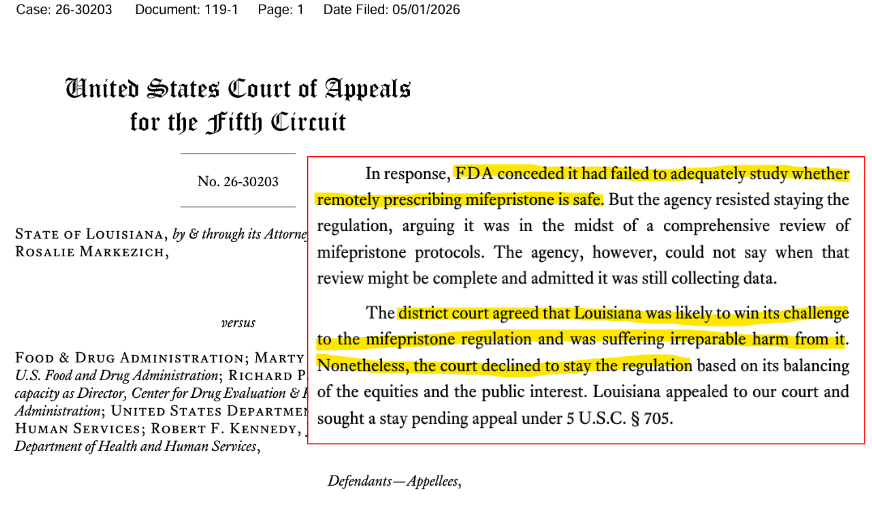
In 2023, the U.S. Food and Drug Administration allowed the abortion drug mifepristone to be prescribed online and dispensed through the mail. Today, May 1, 2026, the U.S. Court of Appeals for the Fifth Circuit reinstated the in-person prescription requirement at least until the FDA finishes research regarding the drug’s safety. The decision aligns with the FDA’s own concession that “it had failed to adequately study whether remotely prescribing mifepristone is safe.” (Louisiana v. FDA, No. 26-30203, 5th Cir. May 1, 2026)
In 2025, the State of Louisiana challenged the FDA in court, claiming that “the FDA’s justifications for remotely dispensing mifepristone were based on flawed or nonexistent data.” Louisiana also claimed the FDA has caused significant harm: “[Louisiana] also documented how the new regulation had resulted in numerous illegal abortions in Louisiana and in Louisiana paying thousands in Medicaid bills for women harmed by mifepristone. Louisiana sought a stay of the regulation while the litigation proceeded.”
Louisiana took the case to the Appeals Court after the District Court refused to stay the regulation allowing remote prescription and mail reception of the abortion drug. According to the Court documents, the District Court “agreed that Louisiana was likely to win its challenge to the mifepristone regulation and was suffering irreparable harm from it. Nonetheless, the court declined to stay the regulation based on its balancing of the equities and the public interest.”
The District Court, despite acknowledging the “deficiencies” in the 2023 REMS which removed the in-person requirement, the Court believed it was “ill-equipped to evaluate the validity of an in-person dispensing requirement, particularly where FDA has thus far failed to even collect the data necessary [to do so].” In other words, the District Court decided a potentially unsafe drug could continue to cause recognized and irreversible harm because of a lack of data. The Appeals Court rejected this unusual reasoning by requiring the FDA to finish their research before the in-person requirement may be lifted.
The Court states clearly in Louisiana v. FDA: “To the contrary, as the district court explained, the agency “essentially acknowledged APA procedural deficits with respect to mifepristone” by “stating that [its] intention to review the mifepristone regulatory framework was precipitated by ‘the lack of adequate consideration underlying the prior REMS approvals.’” Based on the same defects, our court has previously concluded that FDA’s actions here were likely unlawful. See Alliance II, 78 F.4th at 249–51; Alliance I, 2023 WL 2913725, at *16–18. That reasoning squarely applies to the 2023 REMS…”
The Court continues: “FDA “relied on various literature relating to remote prescription of mifepristone—despite FDA’s admission that the literature did not affirmatively support its position.” Alliance II, 78 F.4th at 250.”
Therefore, the Court granted Louisiana its motion. As a result, remote prescription and mailing of the abortion drug is now prohibited nationwide, at least until the FDA finishes its research on medication abortion.
Readers can learn more about documented safety risks associated with mifepristone here: Overlooked Dangers of Mifepristone, the FDA’s Reduced REMS, and Self-Managed Abortion Policies: Unwanted Abortions, Unnecessary Abortions, Unsafe Abortions – Lozier Institute
Louisiana v. FDA, No. 26-30203, 5th Cir. May 1, 2026: