Speaker Louise Stutes sent a letter to Gov. Mike Dunleavy on Friday saying that it’s not safe to be in Juneau because of Covid-19, and therefore she wants the Special Session, due to start Monday, to be cancelled.
In reality, Juneau is the home of some of the most Covid-vaccinated people in America, and may be the safest place in the state for lawmakers. But Stutes doesn’t want to risk it.
According to the most recent data available from the New York Times, 89 percent of Juneauites over the age of 65 are vaccinated for Covid-19, while 77 percent over the age of 18 are vaccinated for it, and 76 percent of those over the age of 12 are vaccinated.
Stutes said in her letter, “Alaska is currently experiencing its highest infection rate-the most per capita in the nation-of the COVID-I9 pandemic. You have wisely safeguarded the health of departmental employees by directing them to work from home until further notice, yet you ask that 60 legislators plus staff return to Juneau to conduct in person proceedings. Including partisan and support staff, the health of hundreds of people will be put at risk to address items that we have yet to gain consensus on. Cost is another factor that should be considered. it would be incredibly costly to the state to engage the legislature for yet a fourth special session,” she said.
Stutes said in her letter that the supplemental dividend is not important enough to call a special session:
“Throughout the year. we have worked in good faith towards a fiscal plan and that will continue regardless. A special session is not necessary for the legislature to continue its work. Committees can continue hearings. have ample time to involve the public. and craft good public policy that has been well vetted. The legislature has passed a balanced budget, avoided burdening Alaskans with taxes, and provided an $1,100 PFD. Legislators are dedicated to achieving a complete solution and we will continue to work diligently towards that end,” she wrote.
Juneau rates itself in the “red” zone for Covid. CovidActNow, a group whose board members include Rep. Jonathan Kreiss-Tompkins, rates Juneau’s risk as “very low” and at the same time says the risk is “severe.” Kreiss-Tompkins told the Legislature in 2020 that Covid would be a die-off event for Alaska, with tens of thousands of deaths.
Juneau’s vaccination rate is higher than the top cities like Seattle, San Francisco, and Portland. Juneau’s Bartlett Memorial Hospital has open beds in all departments, according to the most recent State data:
The Alaska Marine Highway System continues to struggle with declining ridership, reliability, and reduced funding. There is no shortage of opinions about what should be done.
For years, coastal communities became accustomed to regular ferry service to any port that wanted it – whether the traffic supported it or not. Unions continued to extract more benefits and higher wages – whether warranted or not. When Southeast population began slipping and ridership declined, state subsidies continued to balloon, and fares had to increase.
It was a vicious cycle and it had to end. It finally did when Gov. Dunleavy was elected. His proposed cuts to the ferry system were not popular and arguably not implemented very well, but they were necessary. Today, while the system is currently operating with less than half the fleet it once had, communities are still getting service, albeit with less frequency.
In 2019, a study commissioned by Gov. Dunleavy concerning future operations of AMHS suggested folding AMHS into a public corporation. But without systemic changes, re-creating AMHS as a public corporation is akin to re-arranging the deck chairs on the Titanic.
Ferry advocates’ insistence that Alaska’s “roads don’t make a profit” and reduced ferry service is like “shutting down the Parks Highway” is a faulty comparison. 99.5% of Alaska’s vehicular traffic occurs on roads and over 80% of the highway operations/maintenance budget is offset by users through gas taxes and other fees.
Those choosing to live in coastal communities must face the facts: ferries historically have moved less than 1% of vehicular traffic with only 30% of the operational costs paid by users and 70% subsidized by state general funds.
Throwing more operating money at the problem will only help perpetuate the current inefficiencies and expense drivers that threaten to sink the system today.
AMHS’s biggest cost drivers are labor and fuel. If the system is ever going to operate at acceptable service and subsidy levels, then these costs must be addressed.
Ironically, these issues were tackled over 40 years ago when AMHS was still in its infancy. In 1977, as part of recommendations for the Southeast Alaska Transportation Plan, the Southeast Conference unanimously endorsed a plan that eliminated double crews on most vessels by operating mostly shuttle ferries. A mainline vessel would run north to Ketchikan then on to Juneau and return south. Shuttle ferries would then run from Juneau and Ketchikan to outlying communities. This “hub and spoke” system, combined with extending roads where possible, promised to improve flexibility, reduce labor costs, and fuel costs by operating smaller more efficient day ferries.
Unfortunately, the plan was never implemented except in a limited way with the Alaska Class Ferries, the Tazlina and the Hubbard. Yet, plans are now underway to add crew quarters to these vessels, totally reversing their efficiency advantage.
Meanwhile, environmental activists and ferry unions have deliberately stalled meaningful road projects that would have made AMHS more efficient and sustainable.
This is why AMHS is in the predicament it is today.
There’s no reason the State cannot update, finalize, and implement a shuttle ferry plan similar to the SATP in Southeast Alaska and parts of Southcentral Alaska. This still makes sense even as some routes, such as cross-Gulf or to and from Bellingham, and ports in SW Alaska may require larger mainline vessels.
There is also no reason our state should not build roads where they make sense.
The Environmental Impact Study for the proposed Juneau Access project connecting Juneau and Haines incorporating these concepts estimated a fare of $21 each way for vehicle and driver. Other examples include completing construction of road projects from Kake to Petersburg and Sitka to Warm Springs that would lower user and system costs and improve AMHS efficiency and reliability.
Those are the kind of public transportation improvements that can be realized with a day-shuttle ferry operation coupled with a road extension.
Another proposed plan involves building a new ferry terminal north of Juneau at Cascade Point, shortening the Northern Lynn Canal ferry route 30 miles and reducing one-way sailing times by approximately 2.1 hours.
Contrary to claims by road opponents, these initiatives have not suffered from a lack of transparency or public input. The most recent two-decade effort to implement day ferries and a road extension in Northern Lynn Canal is evidence of that.
If we want a reliable, efficient ferry system, it’s time to try something different. What we are doing now isn’t working and hasn’t worked for a long time.
After retiring as the senior vice president in charge of business banking for Key Bank in Alaska, Win Gruening began writing op-eds for local and statewide media. He was born and raised in Juneau and graduated from the U.S. Air Force Academy in 1970. He is involved in various local and statewide organizations and currently serves on the board of the Alaska Policy Forum.
Anchorage Assemblywoman Meg Zaletel is refusing to attend Assembly meetings in person until everyone in the Assembly chambers is forced to wear a mask, and until people are spaced out to her liking.
She made the comment Thursday night at the opening of the third night of public testimony on her Ordinance 2021-91, the universal masking law that would apply to all in Anchorage who are over the age of 2. The law is likely to pass the Leftist Anchorage Assembly, but Zaletel has not shown up in person during testimony to face the people opposing her ordinance, instead calling into the meeting from her home.
The hearing went late into the night on Thursday, with a room that was just as packed as it was on Tuesday, the first night of public testimony. The hearing continues on Monday in the Assembly chambers, the first floor of the Loussac Library.
Later in the meeting, Zaletel said wanted the hearing to continue Friday and Saturday, and even said she would pay for police overtime costs of the Saturday meeting out of her own Assembly fund, and that she would even show up in person to push through the testimony, but eventually it became clear that Saturday was untenable — Assemblyman John Weddleton said he had a marathon that he wants to attend in Girdwood.
Zaletel’s ordinance has been unpopular with testifiers, who are especially unhappy with the enforcement mechanism that relies on neighbors, customers, and others turning each other in for not wearing masks appropriately in Anchorage. Some have compared that to what the Nazis did in Germany to the Jews in hiding, or what the communists did to the Russians under Stalin.
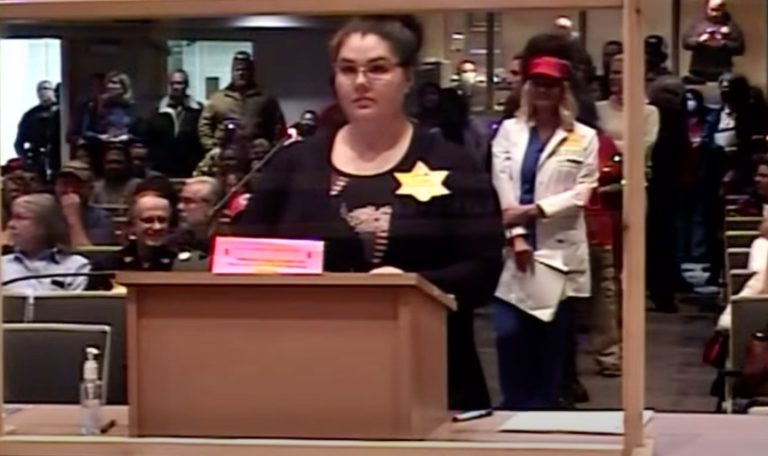
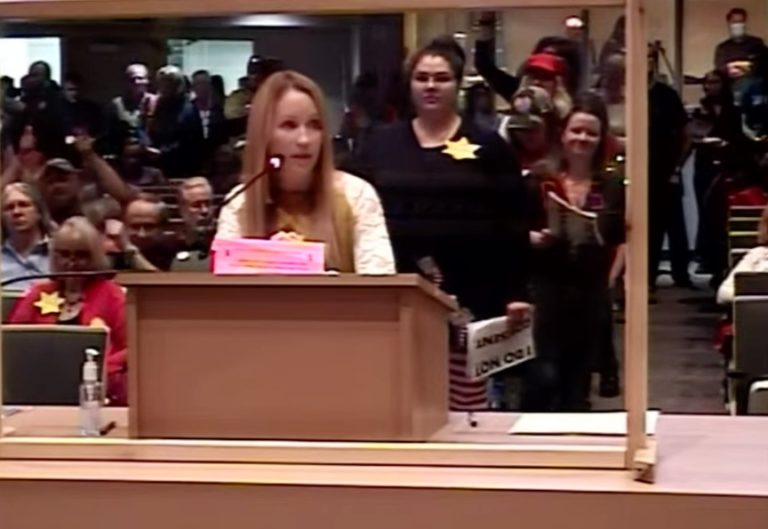
Many people on Wednesday night wore yellow Star of David cutouts on their clothing when they attended the Anchorage Assembly meeting. They were making a point that Assembly’s intention to have people tell on others who are not wearing masks is the slippery slope to Nazi Germany.
The Left struck back. Assemblyman Chris Constant even sent a message of “help” to the Holocaust Museum. Twitter was filled with commentary.
In the end, the mayor of Anchorage issued a statement about the use of the Star of David and the raucous behavior during the last two nights of Anchorage Assembly meetings, where the public has been clearly against the mask mandate being pushed through by the leftist majority.
The statement in total:
“I understand that we should not trivialize or compare what happened during the Holocaust to a mask mandate and I want to apologize for any perception that my statements support or compare what happened to the Jewish people in Nazi Germany, that was one of the most evil and darkest times in our world’s history. I should have chosen my words more carefully, and if I offended anyone, I am truly sorry. Anchorage has always been a city that takes care of its neighbors, no matter what differences exist among us. We love a good debate and talking about issues that matter to us and our families. I respect everyone’s right to petition their government, to speak up in favor or opposition to major policies with wide-ranging impacts. But we must do so with decorum and respect. It is never appropriate to resort to name-calling, intimidation, or hatred, under any circumstances. Everyone in this city loves Anchorage, as do I. Every member of the Assembly loves Anchorage. Being called to serve in public office means you want to make your community a better place. That is certainly why I chose to run for mayor, to make sure our city moves forward and becomes the city we all know it can be. But we cannot achieve that if we shout each other down, insult our neighbors, and use profanity and offensive language to describe one another. It is counterproductive and creates a toxic environment where nothing can get done. So, for those who gather in opposition to this ordinance, I ask you, please keep it civil. Keep your comments forceful but respectful, and based on policy, not personality. For those of you who gather in support of the ordinance, I ask the same thing. We must keep our composure and listen to one another if we are to move this city forward. The last two nights have been passionate and even heated at times. That being said, let us debate the issue tonight on its merits, and let’s refrain from mean-spirited and offensive language while doing so. Members of the Assembly, you have my full support in asking for calm tonight, and my pledge to work with you to ensure all voices are heard in a way that respects everyone as equals. My faith compels me to follow the Golden Rule, and I would ask the same from everyone here tonight.”
The Star of David was being worn by those who believe that the mandates are going down the wrong path, the path the Nazis when they isolated the Jews, gay people, and disabled, and eventually took them to the concentration camps, where as many as 11 million were killed or died.
Read more about the Holocaust in this story from the Atlantic Monthly.
The Assembly meets again on Thursday beginning at 6 pm. More testimony is expected.
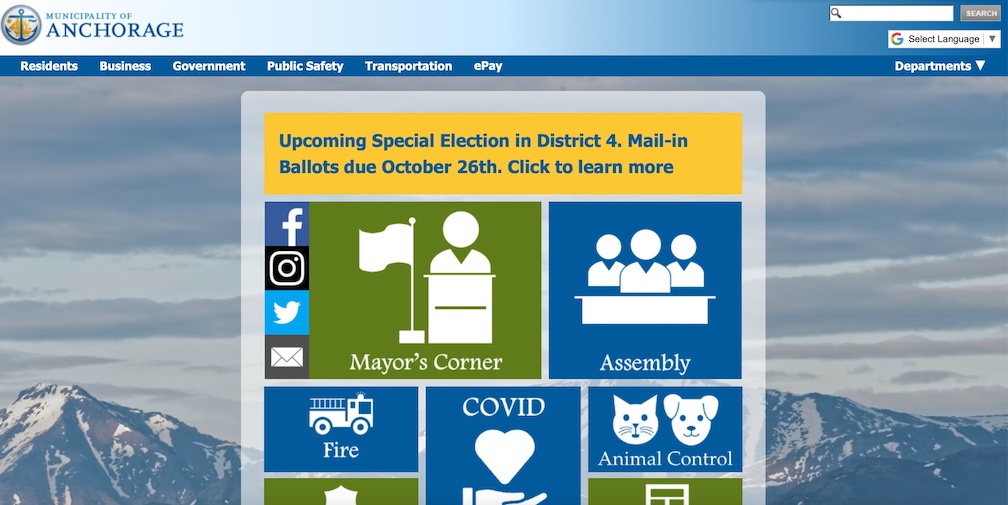
The Municipal Clerk of Anchorage has sent a scorching letter to Municipal Manager Amy Demboski, taking umbrage and threatening legal action because the Bronson Administration posted a yellow box on the front page of its website reminding people that there is a special election coming soon, and directing them to the Clerk’s page for more information.
Clerk Barbara Jones insisted only she can give out information about elections, and she believes this is an election law violation of “grave concern” with the box on the front page of the Muni website.
Jones earlier this month was caught spying on draft documents of the Administration and passing information on to her allies on the Assembly, a violation of her duties. No consequence has been reported regarding spying on the Executive Branch by the Assembly branch, for whom Jones works; Jones had been slipping draft plans to Assemblyman Chris Constant.
The special election concerns the recall of controversial Assemblywoman Meg Zaletel, who represents Midtown Anchorage. She is at the heart of a hated universal masking mandate that she and leftist allies on the Assembly are pushing through as an ordinance this week. The Clerk reports to Zaletel, who she may be seeking to protect.
Ballots for the mail-only election will be sent out on Oct. 5 or 6, with the deadline for getting them back to the Clerk’s Office on Oct. 26.
The yellow box that offended Municipal Clerk Barbara Jones.
But the public, if they wanted to vote in this district and needed to change their official voter registration with the state, had only until Sunday, September 26 to get those changes made.
The Clerk had posted no timely information on how to do that. Normally, a bright yellow “Elections” box is visible on the front page of the Municipality’s homepage prior to and just after an election.
In fact, Jones first placed an election notice on line on Sept. 26, buried on the Elections page, too late for anyone to change their voter registration if they had moved into the district recently.
See the Clerk’s Sept. 26 notice about the special electionat this link.
Jones’ letter says she believes that the Administration posting the information box and link without her permission constitutes an interference in elections.
Through a public records request, Must Read Alaska obtained memos that circulated in the Administration on the topic, and the letter that Clerk Jones sent to Demboski, in which she complained about the box.
It all started on Sept. 22, when Demboski wrote to the city’s IT manager, asking him why there was no notification about an upcoming election.
“I was just noticing on the Muni homepage that there is no reference to the upcoming special election. I find this odd because I recall always seeing a prominent notice right on the home page whenever there is an election. Can you please work with your team to put a banner on the homepage to ensure the public can easily find election information? Thank you in advance for your help; it is greatly appreciated,” Demboski wrote.
Erika McConnell, deputy clerk, then wrote a note, saying that “I’m following up my recent phone call with an email, cc’ed to Director Dahl, to reiterate our expectation that all changes to the municipal website specifically relating to Assembly branch matters, including elections, must be approved by the Municipal Clerk’s Office.”
The clerk had not approved notifying the public about the election and was asserting its control over the information.
By Sept. 24, McConnell was demanding the box about the special election be removed and replaced with a box that simply said “Elections.”
“Would you please replace the yellow box at the top of the muni home page with the standard yellow box that says ‘Elections’ that is part of the group of department/issue boxes? Please let me know by when you can get that change made,” McConnell wrote to the webmaster.
Then came phone messages from Barbara Jones, some other notes back and forth with the IT department, Demboski, and the webmaster, and finally a long and formal letter to Demboski:
I understand the Muni webmaster Heather Holland was directed to add the information in the snippet below to the Municipal Home page regarding the Special Election. This was done without knowledge or notice to anyone on the Municipal Clerk’s Election Team, and is very concerning.
The Municipal Clerk’s Office has all authority regarding running and supervising municipal elections as detailed in the Charter and Title 28. The Charter states that “[t]he assembly by ordinance shall establish procedures for regular and special municipal elections….” Section 11.02(a). The Assembly’s ordinances codified in Title 28 specifies that “[t]he municipal clerk shall prepare for, conduct, and supervise all municipal elections….” AMC 28.10.020. There is no role in Title 28 for the Mayor nor the Administration in the running and supervising of municipal elections.
The Municipal Clerk’s Office and OIT have an “OIT Elections Playbook” to discuss election operations for which the Clerk’s Office uses OIT’s assistance. Nothing in the Playbook authorizes OIT to update the website without the Clerk’s Office authorization. This is important, because of the rules in state statute and Ethics Code regarding use of municipal resources to influence an election.
At the least Marc, you and I discussed that if OIT has concerns about elections, OIT should communicate that concern to the Clerk’s Office. The failure to communicate this change is troubling, not the least of which is that it appears that the Administration is conducting outreach and education about the Special Election.
As detailedabove, only the Municipal Clerk’s Office has the authority to conduct outreach and education about elections. No other Municipal entity – neither the Assembly nor the Mayor – has the authority to conduct outreach and education about elections because it is not in the Mayor’s nor the Administration’s usual course of duties to conduct outreach and education about elections. Because this banner was not authorized by the Municipal Clerk’s Office, it appears to be conduct in violation of state law and an APOC violation,” Jones wrote.
“These issues are serious and of grave concern. I encourage you to seek guidance from the Department of Law immediately, if you are skeptical of the points in this message. The integrity all municipal elections and compliance with Charter, Municipal Code, and state law Is a duty charged to the Municipal Clerk. This message is in an attempt to prevent irreversible taint on the upcoming election and correct what were probably well-intentioned actions but that appear to violate election laws as described above,” Jones wrote.
Demboski was having none of it. She responded that the city manager is responsible to the mayor for the overall administrative functions of the municipality and that she has no intention of requesting permission from Jones for what is a simple matter of notifying the public of a special election.
“The Administration has taken no position, done no advertising for or against, with respect to the upcoming Municipal Special Election. I simply instructed IT to create a link on the municipal homepage to direct the public to the Clerk’s webpage disseminating your publicly available election information, which is usual and customary for a link/banner/or button on the homepage directing the public to Clerk’s webpage where they can find more information on elections. This practice is routine and clearly an administrative function of government; the Administration is historically responsible for the design and maintenance of the municipal website. Simply directing people to your information is not interfering with, “running,” or “supervising” an election, nor is it utilizing municipal resources to attempt to influence an election in any way. To accept that premise, would be to accept that directing the public to the Municipal Clerk’s election information is itself biased, which would imply the Clerk’s information is biased and will sway the election. The argument is ludicrous on its face. Furthermore, Eberhart, was about an Assembly Member who used staff to do opposition research on his opponent; this, situation has no bearing here whatsoever,” Demboski wrote.
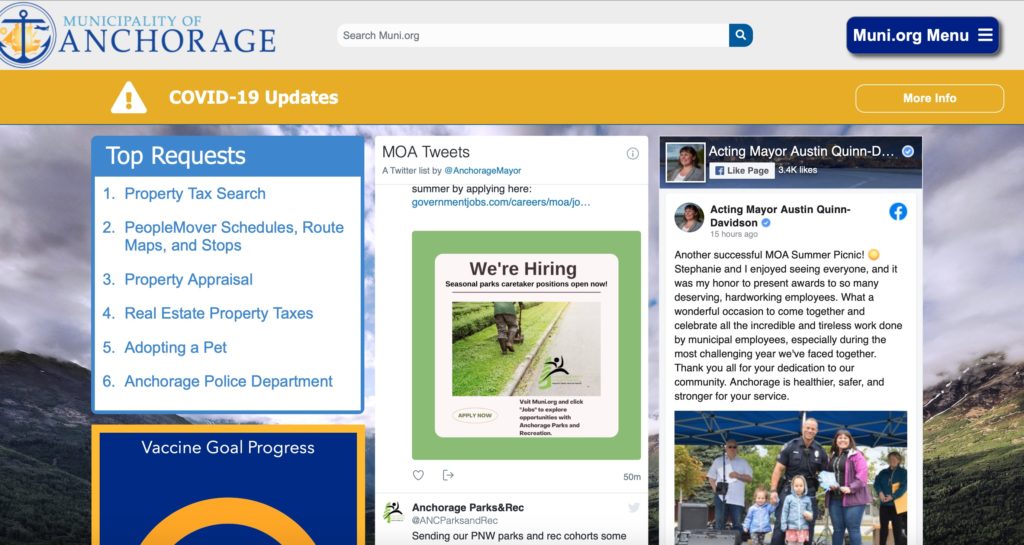
Demboski went on to describe politely how the previous administration of Acting Mayor Austin Quinn-Davidson had all but destroyed the municipal website as she handed it over to the Bronson Administration and that it has been under reconstruction ever since.
The website left for Mayor Bronson featured Acting Mayor Austin Quinn-Davidson, a Twitter feed, and the city’s vaccination status.
“This Administration has been here just shy of 3 months, and in that time we have had to completely remake the Municipal website because the last administration left us with a mess. The current website now looks similar, but it is slightly varied in look and function, but the historical feel and function has been largely recreated (this includes directing folks to the Clerk’s page relating to elections). We are simply doing our best to help the public find information on the website, which the public and the Assembly have told us many times they wanted,” Demboski wrote.
She then went on to push back against the allegation of “irreversible taint on the upcoming election,” and the allegation that the box somehow breaks election laws.
“I find those comments salacious, unfounded, lacking of logic or common sense, and without basis in Anchorage Municipal Code or Charter. In fact, I have great concern that the reaction from you and the Deputy Clerk (in a series of emails and phone calls to IT) lead me to question why the Clerk’s office is attempting to create obstacles for the public to gain information about this election (from your own webpage, by the way)? Multiple administrations before this one, have had prompts on the muni homepage directing folks to election information; did you also raise this level of concern over those prompts on the homepage in previous elections? Which ones? If not, why not? Why this election? The reaction of the Clerk’s office leadership creates an appearance of bias, which leads me to question your objectivity, or ability, to conduct and oversee this election in a neutral manner. This is a great concern that could significantly erode the public’s trust in the fundamental fairness of elections, as well as the presumed neutral process conducting and overseeing the elections,” Demboski wrote.
“I never thought it would cause controversy because people are directed to your webpage for election information. In my humble opinion, it is a totally nonsensical and an indefensible position. I hope after some reflection and consideration of the facts, you realize that this is an overreaction; the facts are: we have taken nopositions relating to this Special Election, we simply created a link to publicly available information on your webpage, which is impossible to ‘taint or sway’ an election, again, unless your information is biased toward one side or the other. Unfortunately, I fear the this reaction has done a great deal of harm to the Clerk’s office leadership’s appearance of neutrality,” Demboski wrote, concluding her letter by saying she would continue to do her job and will not ask the Clerk permission to conduct administrative functions of government, including the management of the Municipality’s website.
In September, Jones had issued a press release announcing it is voter registration month, without notifying people that there was a special election the following month that they might want to register for.
Jones has had a testy relationship with the Bronson Administration since the April election, when the Bronson campaign outworked Assemblyman Forrest Dunbar. The Bronson campaign worked hard to help people whose ballots had been rejected because of a technical flaw get their ballots fixed and filed with Jones in time to be counted. Jones publicly objected to many of the Bronson team’s campaign volunteers who were observers at the vote-counting building at Ship Creek, and the fact that they watched the building 24-7 during the vote counting process, staffing a recreational vehicle with observers to keep track of who was coming and going to the building.
Jones made no secret of her irritation with the Bronson campaign, while the Dunbar campaign sent her flowers through Assemblyman Chris Constant, one of the key lieutenants of the Dunbar campaign.
The success of the campaign has led the Assembly to introduce an ordinance prohibiting people from helping others vote.
In a letter addressed to the Anchorage Assembly, the CEO of Providence Medical Center says the organization supports the ordinance from Assemblywoman Meg Zaletel, which would mandate community masking for all in Anchorage over the age of 2.
The ordinance, AO 2021-91, has caused a furious community response since it was introduced in a secretive special meeting of the Anchorage Assembly on Sept. 20. This week, the Assembly is working through public comments, and will again hear public comment at the “continued” meeting that begins at 6 pm Thursday at the Loussac Library.
“Providence is also one of the top 10 commercial property taxpayers in the Municipality of Anchorage,” Preston Simmons wrote. “We are deeply committed to improving the physical and economic health of our state.
“Alaskans can continue to expect high-quality care, but you should know that the state’s health care safety net is strained. We are being tested like never before. Even before the pandemic, patients were coming to the hospital with more serious illnesses, requiring higher acuity care. These cases require skilled medical teams, including skilled nurses. Alaska’s hospitals are consistently operating near or at capacity and available staffed beds are at a premium,” he wrote.
“I believe the question was asked during the Assembly meeting and echoed by some in the room, if Alaska’s hospitals and Providence are lying about the toll and impacts of COVID- 19. The clear and unequivocable [sic] answer is no,” the letter said.
“Health care staffing shortages have only been exasperated [sic] by COVID-19 and are not tied to vaccine requirements. The lack of available travel nurses and the increased stress and demands placed on caregivers has resulted in real shortages across the nation. The mental and physical toll on health care workers will have lasting impacts. To be blunt, they are tired. They are burned out,” the letter said.
Simmons went on to describe Providence Alaska’s vaccine policy for its burned out workforce, saying, “If we reflect to a little more than a year ago, Alaska’s health care workers celebrated the arrival of the first COVID-19 vaccines by taking selfies and lining up to receive the first doses.”
As of Sept. 29, 84% of Providence Alaska caregivers are either vaccinated or have an approved medical or religious exemption, Providence said.
“The good news is that public health measures that are based on science save lives. Masking is effective. Social distancing is effective. Washing our hands is effective. Vaccines are effective. Alaskans need to wear masks indoors and as CEO of Providence Alaska, I reiterate our support for any measures that result in the increased use of masks, including AO No. 2021-91. Mitigation measures — including indoor masking requirements — provide a layer of protection for our communities, families, and workforce.
In case you missed Tuesday night’s Anchorage Assembly meeting, don’t worry, you didn’t miss much. It was business as usual, except with an added 200 people or so waiting in anticipation to give their testimony on two items that were added during a special Assembly meeting on Sept. 20. These items were AO 2021-91, which would bully Anchorage businesses into trying to enforce and require their patrons to wear a face covering in their businesses; and AO 2021-92 which is a retaliatory response regarding Mayor Dave Bronson’s appointments.
The public continued to file in and out of the Assembly chambers while they were conducting the beginning of meeting formalities, but an unforeseen technical glitch caused quite a stir.
The sound was temporarily lost in the Wilda Marsden Theater, which is the overflow room, and the video was completely out. This caused the large overflow crowd to come from the Wilda Marsden and demand entry into the Assembly chambers. With the chambers already well over capacity, security guards had to hold the line at the doors.
There was screaming and chanting while people waited to get into the Assembly chambers so they could watch what was happening. This caused numerous interruptions to the meeting facilitated by Assembly Chair Suzanne LaFrance. LaFrance even went as far as putting the public in “timeout” and pausing the meeting for five minutes on three separate occasions.
There were the comments from the crowd of onlookers during initial audience participation, which was, for the second meeting in a row, dominated by an administrative staff manager from Providence Alaska Medical Center and a doctor from Providence, edging out the time slot for other member of the public to give their testimony.
This was just a repeat of the last Assembly meeting where they continued to circle around the questions rather than answer them, or they would refer the Assembly to others who would know the answer.
The meeting was managed as business as usual. The members took up all the items of regular business on the agenda as planned. It wasn’t until almost 10:30 pm that Assemblywoman Jamie Allard made a motion to reorder the day. However, she was quickly shut down by Acting Chairman Chris Constant, who took over for Chair LaFrance for the item they had in front of them, due to a conflict that was, in fact, a minor technicality. They finished the item and a motion was made to reorder the day, but it still put the most anticipated item (AO2021-91, the universal masking ordinance) third in line. A motion was also made to extend the meeting from 11 pm to midnight.
A zoning change then took up almost the entirety of the remainder of the evening with the public hearing of the masking ordinance starting at 11:45 pm. This hearing was continued Wednesday starting at 6 pm in the assembly chambers. That meeting also went until midnight, and is continued to Thursday at 6 pm. They will hear everyone in the chambers and on the phone. So please show up early so you can speak.
The actions taken by the Assembly on Tuesday just proved that this ordinance, which originally was littered with the word “emergency,” is actually just another attempt at restricting the rights of over 300,000 Anchorage residents. They called a Special Assembly meeting eight days prior to get it on the agenda for Tuesday, and then rather than taking it up right a way because it is was so important it just couldn’t wait, they continued on like “business as usual.” This illustrates why the power to act in an emergency rests with the executive branch, not the legislative branch.
The reactions from the crowd Tuesday and Wednesday, while disruptive, were well justified. The way the Anchorage Assembly conducts business is abhorrent. They continue on with business as usual because “that is the way we have always done it.” The Anchorage Assembly’s poor time management, disregard for the public and blatant disrespect for people’s time has led to the situation we saw develop in the chambers.
Many of the members and the body as a whole have lost the respect of the people of Anchorage over the past 19 months. That was further proven Monday and Tuesday by the display of the crowd.
The only reasonable action that can be taken by the assembly now is to postpone AO 2021-91 indefinitely. They have proven that this AO is really not all emergency. Their willingness to filibuster the night away reinforced this point.
Louis Imbriani is an Anchorage resident and civic activist.
Testimony at the Anchorage Assembly on Wednesday night was passionate, raucous, and at times members of the public were escorted to the door for disrupting the meeting with applause or shouting. One man was hauled off by police in handcuffs for being too energetic in his expression of displeasure with the attempts the Assembly was making on liberty.
The Anchorage Assembly’s leftist majority may have thought they had worn out the public with a 7-hour filibuster on Tuesday night, but nearly as many people returned Wednesday for the opportunity to tell the Assembly “No” on Ordinance 2021-91, which would put everyone two and older in masks whenever they are in public.
By the time midnight rolled around Wednesday, some people had been waiting in line for 13 hours over two days for their three minutes at the microphone.
As occurred on Tuesday night, the insults were hurled freely at the Assembly, and Chairwoman Suzanne LaFrance had to call for five-minute breaks, a punishment for the public outburst.
Testimony will continue on Thursday at 6 pm, and there were many more in line for an Assembly meeting that has brought focus on the handiwork of Assemblywoman Meg Zaletel, who is the prime sponsor of the masking ordinance. Zaletel, for the second day in a row, did not show up to face the public’s wrath, but attended the meeting from the privacy of her home, as did fellow leftist Pete Petersen, who cosponsored the ordinance.
Many people in the audience wore paper yellow Stars of David, emblematic of the way the Jews were singled out by the Nazis leading up to their genocide. Still others held or wore signs that said “Recall Meg Zaletel,” and “I will not comply.”
LaFrance, for the second night in a row, had lost control of the meeting, and admonished the crowd repeatedly to stop clapping. At one point, she asked those who had clapped to raise their hands, and when one out of eight people raised their hands, she told security officers that they would be the ones removed if there was another outburst.
In a series of messages on Twitter, Rep. Zack Fields of Anchorage has come up with a new strategy sure to please his base: He says that Must Read Alaska is cashing in on death. Why?
Fields was remarking on a t-shirt at the MRAK online store that says “Unvaccinated Lives Matter,” a nod to those who have not gotten the Covid-19 vaccine for their own private reasons, whether health, religious, or skepticism.
Fields, who was caught drinking beer and leg-wrestling, unmasked, in the Alaska Capitol campus earlier this year with Rep. Kelly Merrick and Rep. Sara Rasmussen, is also asking Gov. Mike Dunleavy to declare another statewide emergency over Covid, and has requested a statewide mask mandate from the governor.
Must Read Alaska has been telling the stories of Alaskans who are losing their jobs because they do not want to take the Covid-19 vaccine.
Like Anchorage Democrat Assemblyman Forrest Dunbar,who wants Must Read Alaska shut down, Fields has expressed the interest in eliminating conservative news from Must Read Alaska, writing, “Until @GovDunleavyreaches the people sending us this (who are in his base) who are being fed misinformation by this website and people like Suzanne Downing, the case count will grow and unnecessary deaths will continue to increase.”
Must Read Alaska exists on the donations of readers who support an alternative to the mainstream media narrative.