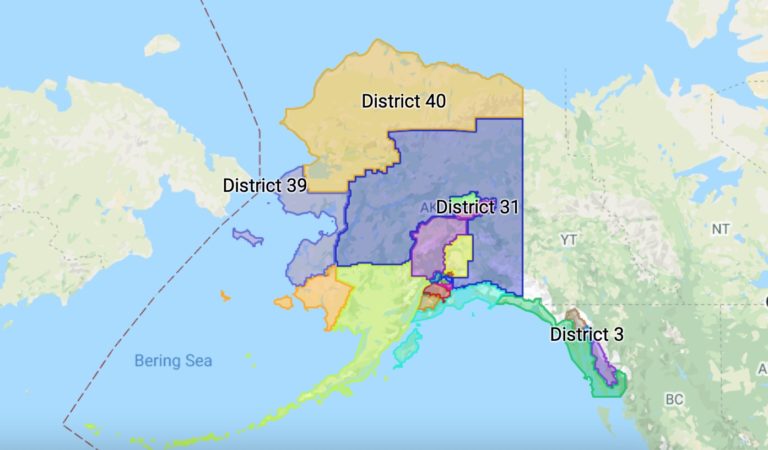
This week the Alaska Redistricting Board will try to wrap up its work of redrawing political boundaries across the state to even up the population of each of the 40 House seats. The board started its work in earnest after receiving final population numbers from the Census Bureau in mid-August. It has a Nov. 10 deadline. If necessary, the board will meet over the weekend, but the goal is to finish by Friday.
The public is invited to testify on Tuesday and Friday during the hours specified below. To date, most of the testimony has come from Democrat partisans.
Review all the maps under consideration at this link.
The meeting schedule for this week:
Tuesday, Nov. 2, 9 am: Full board meeting, at the Anchorage Legislative Information Offices
Agenda is attached
Location: Anchorage LIO, Denali Room (1500 W. Benson Blvd)
Testimony will be taken between 9:00-10:30am, in-person and via teleconference (please call in by 10am). Teleconference: from Anchorage 563-9085; from Juneau 586-9085; from anywhere else: 844-586-9085
Friday, Nov. 5, 9 am: Full board meeting at the Anchorage LIO
The plan is to have another opportunity for public testimony, starting at 9 am, then finish out any agenda items held over from November 2, including adoption of the final redistricting plan.
Location: Anchorage LIO, Denali Room (1500 W. Benson Blvd)
Testimony will be taken starting at 9 am, in-person and via teleconference Teleconference: from Anchorage 563-9085; from Juneau 586-9085; from anywhere else: 844-586-9085
The lone conservative on the Anchorage School Board, former State Sen. Dave Donley, has done site visits to two schools and found that, in defiance of School District policy, the Pledge of Allegiance is no longer being recited at the start of the school day.
Donley hopes to bring up this matter to light during the work session that precedes the Monday meeting of the Anchorage School Board. The work session may be attended by the public, and is held at the ASD Education Center, Boardroom, 5530 E. Northern Lights Blvd.
The work session starts at 4 pm, with the regular board meeting beginning at 6 pm. The regular board meeting will begin with an executive session, to which the public is not invited.
The school board is limiting the number of people who may attend the meetings due to Covid-19 mitigation protocols, but the meeting may be watched online at https://www.youtube.com/user/AnchorageSD
During the regular meeting that begins after the executive session, a capital bond that will be presented to voters next year will be reviewed. In the six-year plan the board will consider is construction for new schools to replace two aging elementary schools.
The board is looking at a two-year bond propositions for April 2022, April 2024, and April 2026. Two-year bonds enable better planning, the superintendent noted, which leads to increased efficiencies and reduced costs to the district given that contractors will have greater certainty of fund availability.
East High School Academic Area Safety Improvements project is scheduled in year one, the design of which was previously funded in the April 2018 ballot proposition.
Years two through six include replacement of two elementary schools, including tearing down and replacing Inlet View Elementary, and renovations for two secondary schools. Allocations are also included for deferred maintenance and security projects to address current backlog and growing facility sustainment.
The total cost of projects over the six-year period included in the proposed plan is about $278.3 million. Superintendent Deena Bishop Administration anticipates retiring nearly $236 million over this period for a projected net debt increase of $42.5 million.
In September, American Airlines changed its fine-print contract with its customers. Now, if the airline cancels a flight, it will only be responsible for refunding the travelers’ tickets and fees — it’s not responsible for hotels, expensive last-minute replacement tickets, food, transportation, or missed connections.
In other words, American Airlines is now operating like a discount airline, with no guarantees: If you spent $100 on a ticket and the flight is cancelled, you’ll just get your $100 back.
That’s compounded this week by the more than 1,750 flights the airline canceled over the weekend and at least 336 canceled so far on Monday, or 12 percent of American’s flights today, according to FlightAware.com.
The airline is blaming wind gusts at Dallas-Fort Worth, its hub, according to CEO David Seymour’s memo to employees on Saturday. But the majority of the cancellations are due to staff shortages, especially flight attendants, according to the Wall Street Journal.
Southwest Airlines canceled 80 flights on Saturday and 20 on Sunday. Three weeks ago, Southwest canceled more than 3,000 flights over four days, blaming storms in Florida, and air traffic control staff shortages. Later it became evident that the airline was also short-staffed.
American Airlines and Alaska Airlines are part of the oneworld® airline partners group.
Read about how American Airlines’ new terms of service agreement may leave you stranded at Fortune magazine.
Assembly Member Jamie Allard’s Must Read Alaska column on Oct. 29 nails the challenge we face in today’s Marxist control of our cities in America, detailed through her personal experiences in working to represent her community.
Anchorage is not an atypical Marxist stronghold.
We can see these experiential examples in almost every state in America. Seattle, Minneapolis, New York, Portland, San Francisco, and Los Angeles in particular stand out. These formerly wonderful cities are now controlled by a Marxist regime solely focused on destroying Americanism, actively attempting to murder liberty in ways we have never seen in our respective lifetimes.
One may ask, why destroy something that is innately good and best for its citizens?
Why implement a totalitarian regime with mind-numbingly rigid controls on citizens?
And why are these same citizens seeming go along with the new regimes like lambs to slaughter?
These are questions must be addressed if we are to survive the onslaught.
Here in Anchorage we see the conservative attempts to change the fabric of municipal government to a breathable balance between individual rights and the need for the rule of law. However, the current assembly powered by the unions, the education industry, the health care industry, and the welfare industry not only continue to drive stakes through the heart of individual rights but ignores the law in favor of political expediency and situational ethics.
Oh, and the almost $1.5 billion dollar budget controlled by the municipal assembly and the school board continues to enrich the pockets of the unions, the education industry, the health care industry, and the welfare industry while Anchorage’s general and student population is on the decline.
This situation necessitates the extraction of more and more money from a shrinking population.
This is the tragedy of the early 21st Century, which like the plague of the early 20th Century Progressive Movement captured the control of our banks, our education system, our food, and more, now focuses on indoctrination of our population through propaganda and entitlement.
We are moving closer to despotism and further away from liberty.
What is liberty?
Frederic Bastiat in “The Law” asks, “Actually, what is the political struggle that we witness? It is the instinctive struggle of all people toward liberty. And what is this liberty, whose very name makes the heartbeat faster and shakes the world? Is it not the union of all liberties—liberty of conscience, of education, of association, of the press, of travel, of labor, of trade? In short, is not liberty the freedom of every person to make full use of his faculties, so long as he does not harm other persons while doing so? Is not liberty the destruction of all despotism—including, of course, legal despotism? Finally, is not liberty the restricting of the law only to its rational sphere of organizing the right of the individual to lawful self-defense; of punishing injustice?”
“Legal despotism” is the perversion of the rule of law.
With every meeting, the innocent and alleged “enemies” of the municipal assembly are convicted on trumped-up accusations or false evidence in their kangaroo public hearings by limiting speech, attempts at humiliation, and betrayal of their oaths as they pervert public policy.
They cut off the microphone, they mock the speakers, and they force citizens to wait for hours just to speak, and then end the meetings before those citizens have had their turn at the speaker’s box. They pretend to be the victims of an angry and deranged public when they are the real bullies and tormentors.
Then there are the corrupt beneficiaries who all participate in the institutionalized theft of our public trust and taxes with impunity.
We the public are outraged and incredulous.
The innate desire for liberty, even here in Anchorage, is ignored and frustrated by its policy makers, who use our tax dollars to frustrate and demean the American spirit.
These statists pretend superiority over their constituents as they attempt to arrange our lifestyles through their organizations and regulations. Any successful conservative actions to limit these actions are worked around, overcome, and met with greater arrogance and greater limitations on our liberty. Even when conservatives succeed, they end up in failure because of these arrogant and all-knowing autocrats.
In Alaska, the question is simple: How can we as conservatives change the policy makers who believe their sole task is to have power and control over every aspect of our lives and future?
The answer in 2021 is not through municipal elections, attending assembly meetings, sponsoring recalls, or other forms of legal civil disobedience. We have seen these all fail to our disappointment, despair, and great expense.
The answer, in my opinion, is simply take our ball and go to another field to play.
Eaglexit is all that we as conservatives have left.
Think about it.
Is there any other way?
The Municipality of Anchorage must be decentralized. The detachment of Assembly District 2, including Eagle River, Chugiak, and its other communities, will weaken the power and control of the Marxist assembly in the remainder of Anchorage.
In this process, Assembly District 2 will have their chance at real liberty.
What will follow?
Perhaps Assembly District 6 and other assembly districts will realize their potentials and detach.
It really is not a question of whether we can afford it. The real question is can we afford not to decentralize Anchorage?
Those who are against Eaglexit argue that costs will rise. Yet, from 2019 to 2021, our mill rate in the Eagle River Tax District 10 increased by 10%.
Do they not see this?
Or are they just the epitome of the frog in the water, slowly heating to a boil and ignoring the impending disaster?
Perhaps it is time for a civics course.
Come join us.
Oh, and by the way, Assembly District 2, you may want to jump out of seats and give Assembly Member Jamie Allard the standing ovation she deserves!
Michael Tavoliero is a realtor in Eagle River, is active in the Alaska Republican Party and chairs Eaglexit.
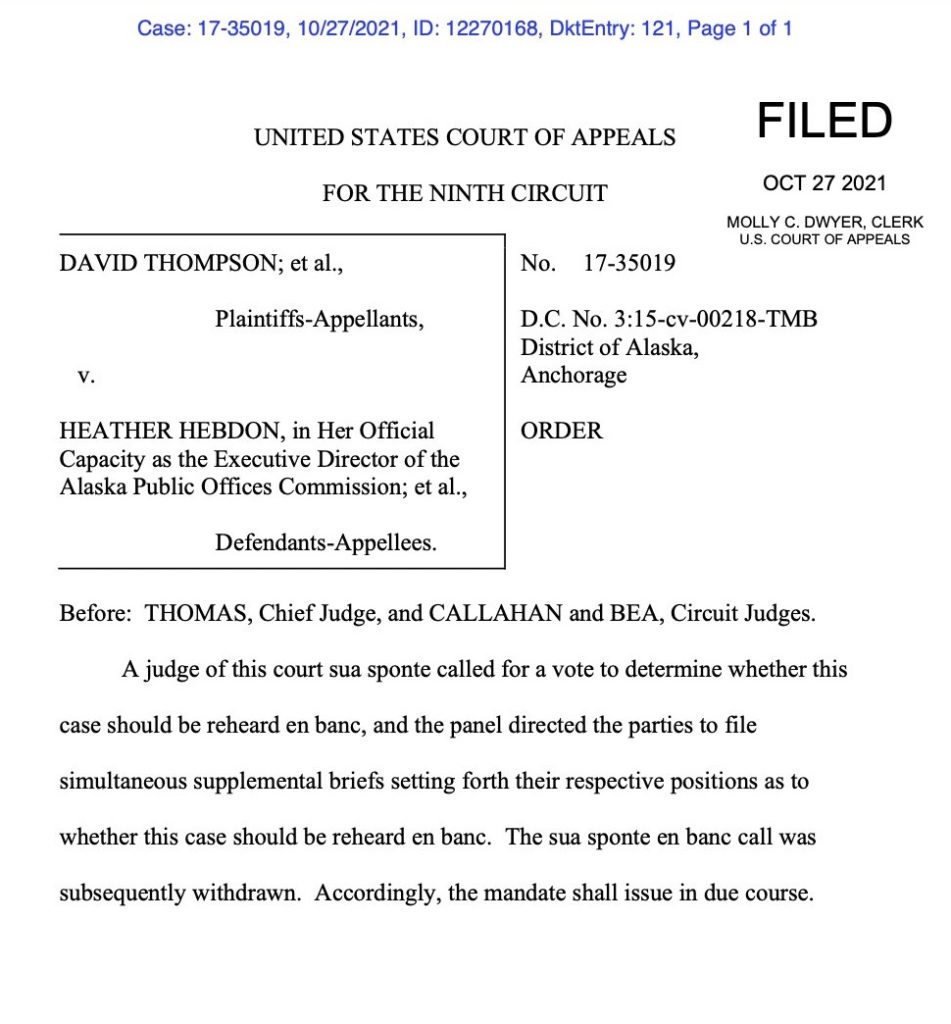
The Ninth Circuit Court of Appeals will not rehear the case on Alaska’s $500 campaign finance limits.
The apparent meaning is there are no limits on on donations to campaigns in Alaska, until new campaign contribution laws are passed.
A judge on the Ninth Circuit asked that the ruling be heard by a larger panel from the Ninth Circuit Court of Appeals.
But the State of Alaska never requested that the court do so, and with the state uninterested in an appeal, the judge, whose name has not been revealed, withdrew the request for the en banc hearing.
In July, the Ninth Circuit Court ruled that Alaska’s draconian $500 campaign contribution ceiling “significantly restrict the amount of funds available to challengers to run competitively against incumbents.”
The lawsuit Thompson vs. Hebdon has been dragging on for seven years. During that time, one of the plaintiffs, Aaron Downing, died. The other plaintiffs are Jim Crawford and David Thompson.
The men had challenged the State of Alaska’s statute that puts a $500 annual limit on an individual contribution to a political candidate, (2) the $500 limit on an individual contribution to a non-political party group, (3) annual limits on what a political party—including its subdivisions—may contribute to a candidate, and (4) the annual aggregate limit on contributions a candidate may accept from nonresidents of Alaska.
The decision went to the Supreme Court, which partially remanded it back to the Ninth Circuit. There, two judges made the decision in favor of the plaintiffs, saying the $500 limit is unconstitutional.
The Dunleavy Administration could have asked for the full Ninth Circuit to hear the case en band, but did not, even though Democrats begged him to quite publicly. The $500 limit works best for Democrats because their candidates enjoy more funding from unions.
Instead, another judge on the panel asked for the rehearing, likely at the request of Democrat Party interests; those interests control much of the judicial system.
Congressman Don Young has two job openings — one in his DC and one in his Anchorage office:
Special Assistant – Anchorage
The special assistant monitors and updates our state director and me on state and local issues. This position acts as my liaison to federal, state, and local agencies, and answers casework correspondence and communications with constituents.
Duties include, but are not limited to, handling constituent casework assignments, assessing issues on the ground that may require legislative action, acting as Young’s proxy at meetings when he is voting in D.C., and compiling and delivering constituent opinions on items before Congress.
The ideal candidate works well under pressure, is willing to work with a flexible schedule that may include nights and weekends, and can grow and maintain relationships with community members and stakeholders in Alaska.
Strong oral and written communication skills, knowledge of Alaska and its culture, a grasp of the legislative process, understanding of local and state issues, and a level temperament are required. Given the range of casework and his office’s commitment to privacy, applicants must be able to maintain confidentiality and exercise discretion.
Travel of up to 10% may be required, and applicants must hold a valid driver’s license.
Legislative Correspondent – Washington, D.C.
Responsibilities include answering phones, overseeing constituent communications, managing all incoming and outgoing mail, processing flag and tour requests, supervising the interns’ day-to-day tasks, drafting legislative and non-legislative letters, and other duties as assigned. Candidates must be able to set and meet deadlines, work well in a team environment, and occasionally work outside of standard business hours, including nights and weekends. Alaska ties are preferred but not required.
To apply, send a resume and cover letter to [email protected]with “Anchorage Special Assistant” in the subject line.
Two young Republicans who are challenging Republicans incumbents in Congress posted Halloween commentary that featured President Joe Biden.
“Happy Halloween! Today is full of scares, but there’s nothing more frightening than Liberal Lisa Murkowski being Sleepy Joe Biden’s Chief Enabling Officer. It’s time to defeat her and spook the DC Insiders!,” was the comment posted with Kelly Tshibaka’s Halloween greeting on Twitter. She is challenging Sen. Murkowski to represent Alaska.
Running for the House of Representatives, Nick Begich posted a design featuring Sen. Chuck Schumer, President Joe Biden, and Speaker Nancy Pelosi as pumpkin heads, calling them monsters who need to be kicked out of the “swamp.” His Halloween greeting was posted on Facebook.
The number of students enrolled in Anchorage School District has not fully recovered from what it was before the Covid pandemic and subsequent school closures and the district’s pandemic policies.
For the 2018-2019 school year, there were 46,734 students enrolled, according to the Alaska Department of Education.
Last year’s official number was 41,902.
Now, according to the October count, there are 42,826, an increase of just 924 students from last year, but a decrease of 3,908 from before the pandemic.
That is a 2% recovery in enrollment in the public schools year over year, an important measure because State Base Student Allocation funding is calculated on enrollment. It’s more than an 8 percent decrease from the year before the pandemic hit and schools across the country began enacting various measures, including closing schools, moving to distance learning, masking, and ending school bus service.
The student count period for this year ended Oct. 22.
For FY2020, the district received an historically high amount from the Legislature, over $331 million. In FY2021, that dropped to nearly $322 million.
State foundation formula payments for the first nine months of the fiscal year are calculated based on the priorfiscal year’s official enrollment number. The remaining three months — April, May, and June — are re-calculated and trued up based on the finalized foundation counts for that school year, so that as the year ends, districts will have been paid what they are due based on the reconciled “average daily membership” count.
However, there is a “hold harmless” provision that says if the drop from the prior year is more than 5%, the funding formula will be based on the prior year’s count. The hold harmless provision has a three-year formula explained here.
Anchorage school enrollment peaked at 50,024 students in the 2003-2004 school year. Since then, ASD has added more than a million square feet of new schools. In simple terms, in 18 years Anchorage has lost nearly 8,000 kids — but added space for 6,000 more.
This year’s official number is much lower than it was projected to be by the district. See story below from September:
Nearly every seat was full and the parking lot overflowed, with cars stretching far down the street at ChangePoint Church in Anchorage, where some of the leading experts on early treatment for Covid-19 led a full day of presentations for medical professionals and separately for lay people.
800 cars were parked in the parking lot itself for the event, and up to 1,200 people attended some or all of the day’s presentation.
The morning session was highly technical for those in the medical profession. In the afternoon, it was more about people and policy, and there was much cheering and approval from the audience, who rose to their feet to applaud several times.
Lockdowns “cause more lives lost than it saves by far,” said Dr. Robert Malone, the founder of the Global Covid Alliance of doctors telling the truth about Covid, its origins, successful early treatment, and the misguided medical establishment. He is the inventor of the vaccine technology used in the Covid-19 vaccines currently being used. “These lockdowns are totally inappropriate.” He and the group of doctors have been trying to take their messages to every state.
It’s not fun, he said, being libeled by the media or the medical industry, after spending 30 years in research with several vaccine patents to his name.
“They are hunting physicians that speak out. They hunt them through a standard practice. And by ‘they,’ I’m referring to the press,” he said during the afternoon session.
He said in Italy he was labeled as a terrorist, and as part of the “dirty dozen” by Italian media, for being part of an international summit on Covid.
In Portugal, he ran into a pediatrician who advocated against vaccinating children for Covid. The doctor was vilified in the press and ended up with a threat against his medical license.
Malone, who just came back from Hawaii, said Hawai has had its economy destroyed by lockdown policies that have no merit.
He met a doctor on the island of Maui who has said publicly that pregnant women should not be given the Covid vaccine. The result of speaking out was a U.S. senator declaring, also publicly, that the doctor should lose his license.
Malone talked about other people in Hawaii who worked on early treatment and had their licenses threatened: “I’ve seen the same thing play out again and again and again.”
“The press is hunting physicians all over the world,” Malone said, acknowledging that a reporter from Reuters was in the room.
“I’ve been accused that the reason I’m doing this is because there’s some flaw in my character and I’m seeking attention. Trust me, this is not fun. It’s not fun to be constantly subjected to attacks, derision, character assassination, professional assignation by the press,” he said at the beginning of his afternoon presentation. “I’ve been called the most vilified scientist in the world. I’m not doing this for fun. I’m not doing this for some sense of personal aggrandizement. I would have been quite happy staying on my farm with my wife and working on the four different clinical trials that I am about to start.”
He said he went public with his opinions about the Covid vaccine because “I was personally offended by what was being done, by the violation of the ethics, of the standards and regulatory norms that I’ve been trained on for over 30 years as a vaccine and drug development specialist.”
All of the speakers at the summit had harsh words for the media for creating a culture of fear around the virus. Malone called out the “fact-checking” industry, and said the fact-checkers are paid by organizations such as the Robert Wood Johnson Foundation to attack people. That foundation has major financial ties to Johnson & Johnson, he said.
Dr. Richard Urso, a Houston opthamologist, repeated the message that vaccinating children with the Covid-19 vaccine was not only unnecessary but could be harmful. His message was repeated by the other guest speakers. He called for the medical community to draw on their courage to do the right thing, and treat patients early for Covid, rather than wait until they are on a ventilator. There are treatments that are working, and natural immunity is the strongest defense at this point.
The overarching message from the presentations was the importance of medical freedom, and the need for doctors to be able to care for patients without the fear they are currently experiencing.
All of the speakers warned against using the new Covid vaccines on pregnant women. Too little is known about what happens when the vaccine hits a pregnant woman’s system or the unborn child she carries.
The visiting doctor-scientists had words of praise for local family physician Ilona Farr, who was the first speaker of the day. She received a standing ovation from the large auditorium. Farr described how she has worked to keep people out of the hospital by using treatment protocols being developed by doctors all over the world. There are only a few doctors and nurse practitioners in the state who are actually treating people for Covid with the specific protocols that she says are working in almost every patient she has treated, except one patient who got the medicines too late.
It’s very difficult in Alaska to get the Ivermectin and Hydroxychloroquine prescriptions filled, and Farr and the other doctors advised people have them in their medicine cabinets in advance of contracting the virus, because the virus is so debilitating that once sick, people are unable to advocate for themselves.
Other points the physician-scientists made:
When people say Ivermectin is a horse drug, remind them aspirin is also used as a horse drug.
No Covid shots for children. Natural immunity will be better for them.
Let physicians treat patients.
The National Institute of Health has no protocols for early treatment, even nearly two years after the pandemic started.
We are having an epidemic of fear.
For the vast majority of people, the virus is survivable.
Using remdesivir, the one medication approved for treatment of Covid, can be inappropriate and also dangerous if administered too late in the course of the illness, and can cause organ failure.
Treating Covid early with Ivermectin and Hydroxychloroquine, Vitamin D, Zinc, Quercetin, Melatonin, and other nutrients has been successful when used in appropriate doses.
Using Ivermectin or other medications when patients are already in shock or on ventilators is not helpful
People are dying unnecessarily because of the lack of early treatment.
Covid vaccines don’t stop transmission or infection. They are not creating safety.
Covid-19 is a manufactured virus made in China. Dr. Li-Meng Yan said it is part of a bioweapons program and the Communist Chinese hope to tear apart America with the virus.