Monday, May 4, 2026
Home Blog Page 1030

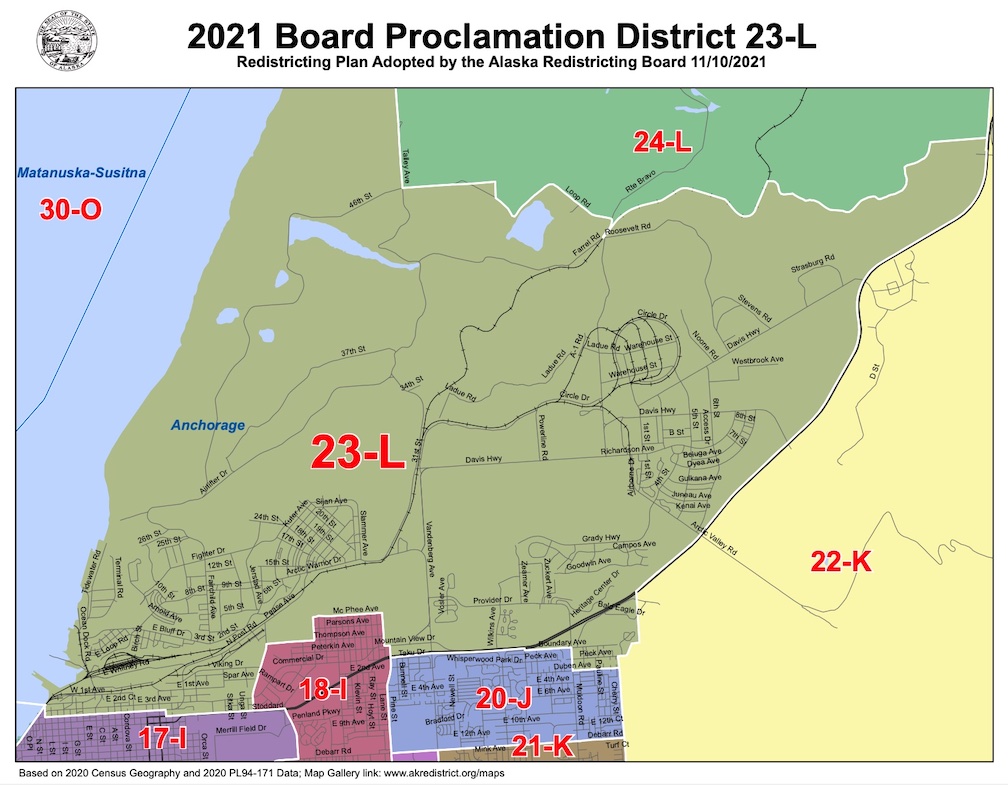
Redistricting board adopts six proposals for public to weigh in on, but takes a pass on map offered by Alaska Democratic Party

11

The Alaska Redistricting Board has adopted six proposals that will be part of public review and testimony beginning next week.

There are two maps created by the board, and four maps brought forward by third parties, which include:

  • Coalition of Doyon, Ltd., Tanana Chiefs Conference, Fairbanks Native Association, Sealaska, and Ahtna, with a map that strengthens Native representation.
  • Alaskans for Fair and Equitable Redistricting (AFFER), a group of Republicans.
  • Alaskans for Fair Redistricting (AFFR), a group of Democrats.
  • The Senate Minority Caucus, Democrats in the Senate.

Today the board heard testimony from various individuals regarding the maps that will create new political boundaries across Alaska:

  • Former Sen. Cathy Giessel of Anchorage, a Republican, wants the board to reject the map provided by the Republican group AFFER, at least as the lines pertain to what is now District 31.
  • William Stat (sp) of Fairbanks said to be careful drawing lines outside of boroughs.
  • Gail Lindemore (sp) said it was not acceptable to move Nikiski on the Kenai to the South Anchorage district.
  • Yarrow Silver, a nonpartisan voter, was upset about proposed maps, but like the Democrat maps the best,
  • Senators Tom Begich, Jessie Kiehl, and Scott Kawasaki, testifying online, make some changes to their Senate Minority Democrats’ map that incorporates Houston city limits into one district.
  • Sen. Tom Begich said he is receiving a lot of questions about decisions made regarding ANCSA regions, and says court precedent states that borough boundaries are more important.

The maps submitted by Alaskans for Fair and Equitable Redistricting took criticism from Board member Nicole Borromeo, who said the Southeast Alaska district lines violate court precedent. The group said it had presented a new map but the board didn’t have it for the meeting.

“We were pleased to hear from Alaskans from every region of the state and replace our initial maps with new and improved versions three and four, which better reflect the socio-economic integration characteristics of each region,” said Board Member Nicole Borromeo, speaking about the two maps offered by the board. “We look forward to hearing feedback from Alaskans on our new draft maps, as well as the four adopted third-party draft maps, as we present them in public meetings in communities across the state.”

The only third party plan that was viewed as unacceptable for the next phase of public review was the one provided by the Alaska Democratic Party. The Republican Party provided no map.

The third parties who provided maps had been making corrections to them since Friday’s public testimony, but that caused a bit of confusion in Monday’s meeting.

Although the maps are not yet available for public review, they will be shortly at this link.

The deadline to adopt a final state legislative map is Nov. 10, 2021.

Round two: Second high-level employee abruptly resigns from Bartlett Regional Hospital in Juneau

14

Just days after the CEO of the largest hospital in Southeast Alaska resigned over an inappropriate relationship with someone who worked for her, the other shoe has dropped.

Bradley Grigg, who was the chief behavioral health officer of Bartlett Regional Hospital, quit Monday, as first reported by KTOO radio in Juneau.

Grigg, in a letter to the chairman of the board of the hospital, said that he had talked with his family and “have made the decision that I can no longer serve Bartlett in this capacity any longer.” He asked for privacy concerning his “personal issues” that led to the decision and apologized for not being able to give adequate notice.

“Bartlett has afforded me many amazing opportunities for growth, and I will forever be grateful for my time spent at BRH. I’ve come to the conclusion the CBHO position is no longer a position I should fill, as it’s no longer a good fit for me,” he said.

Juneau’s Bartlett Regional Hospital Chief Executive Officer Rose Lawhorne abruptly resigned her position last week. The Bartlett Regional Hospital Board of Directors held a special meeting on Saturday and moved to terminate her employment, effective immediately.

City Manager Rorie Watt told KTOO that the reason she was forced out is that she had a relationship with someone who was a direct report. The relationship predated her appointment as CEO in March of 2021, and Watt said that if she had made it known at the time of her hiring, an alternate reporting structure could have been arranged. It’s unclear why Watt felt it necessary to report the reason for what is clearly a forced resignation.

Read the original story here:

Rules are for the little people: Assemblyman Constant pokes fun of masks, jokes with buddies about masking his ‘log’ before contact

50

Although in the Assembly meetings, Anchorage Assemblyman Chris Constant wears his mask like a religious icon, when he’s partying with the bros, he hugs, close talks, takes selfies and then goes on social media to joke about how his brand new friends are part of his new social “bubble.”

Constant was following the lead of Hollywood, where the Emmy Award Ceremony was a mask-free event with lots of close contact.

A series of exchanges on social media shows the extent of Assemblyman Constant’s distain for masks, which comes out when he’s not performing official duties. And, as a side benefit, reader can see he finds public testimony painful — so painful that he gets a headache. A migraine headache. He really can’t stand all the “racist” comments he has to listen to in his role on the Assembly.

Here’s Assemblyman Constant partying with a bunch of new friends, and there’s no mask or social distancing at all:

Among the group cozied up to was Sabrena Combs, a Palmer city councilwoman who is now under investigation for violations of the open meetings laws in an unrelated matter.

When people on Facebook critiqued Constant for not maintaining a six-foot distance, he joked, “I held my breath.”

Later, his friend joked, “I hear that the CDC says you can contact logs as long as you’re both wearing masks,” a sexual innuendo pun referring in part to contact logs that some people keep to be able to reach out to people in case someone gets Covid.

Combs noted the naughty intent of the comment, and there was some emoji-pounding going on about that.

Check out the exchange, which was soon taken down from Facebook, but exists here for history’s sake:

Like the mayor of San Francisco, London Breed, who was caught partying and dancing without a mask over the weekend, and then excusing it away when the media asked her, Constant is in the process of making a law that everyone in Anchorage must wear a mask.

The details of the mask ordinance was revealed just one hour before a meeting the Assembly was trying to advance the ordinance that would force everyone in Anchorage to wear a mask.

Earlier this month, Constant was photographed at a wedding reception in Palmer, where neither he nor anyone else was masked, and all maintained close contact at the venue, which was both indoors and under a canopy.

Read : Constant parties in the Valley without a mask

In May, Constant moved to lift the mayor’s mask mandates, and then was caught on a hot microphone saying he wanted to rob Assemblywoman Jamie Allard of being able to make the motion.

ENI mandating vaccines for Slope work

63

ENI, which operates on Alaska’s North Slope, is instituting a mandatory Covid-19 vaccine policy.

“Effective December 1, 2021 all employees and contractors who work in the Gulf of Mexico or the North Slope of Alaska must be fully vaccinated and will be required to show evidence of receiving an FDA approved, or FDA authorized for emergency use, Covid-19 vaccination,” wrote CEO Luca Pellicciotta to employees last week.

“To assist any employee who has a qualifying medical condition that contraindicates the vaccination, or who objects to being vaccinated on the basis of sincerely held religious beliefs and practices, the Company will engage in an interactive process to determine if a reasonable accommodation can be provided, so long as it does not create an undue hardship for the Company and/or does not pose a direct threat to the health or safety of others in the workplace,” he wrote.

Employees approved for an accommodation for medical or religious reasons will be screened in accordance with the Company’s existing Covid-19 protocols, or as may be determined “to be reasonable under changing and evolving circumstances,” he said. All personnel must wear a mask anytime in a common area, indoors or outdoors, if unable to properly social distance, regardless of vaccination status.

After Dec. 1, 2021, choosing to remain unvaccinated, absent an approved reasonable accommodation, will result in your voluntary absence from work, which if continued for two consecutive hitches, will be considered a voluntary resignation of employment.

ENI operates the Oooguruk oil field, and the Nikaitchuq oilfields.

Mask martial law ahead? Assembly tries to cut down the mayor’s power and introduce their own mask law for all over age of 2

117

In a move that took the Anchorage public by surprise, the Assembly today agreed to advance an ordinance that would require everyone over the age of 2 in Anchorage to wear masks while indoors in public spaces, and in some outdoor spaces as well.

It’s a direct hit at Mayor Dave Bronson, who said he will not declare any sort of mask mandate in Anchorage.

The draft ordinance by Assemblywoman Meg Zaletel was placed on next week’s agenda, without discussion or comment or discussion from any of the Assembly members, except Jamie Allard, who said it was a vast overstepping of the Assembly’s authority.

Allard said, “It’s clear that this Assembly has a savior complex, and is hell-bent on violating the public’s constitutional rights. This body will not stop until they get what they want. There is no doubt the Assembly is absolutely exceeding its authority.”

Members of the public attended the meeting, and a few of them said the fact that the Assembly did not post documents until one hour before the meeting shows the liberal majority is trying to keep public participation at bay. They also criticized the Assembly for having the meeting in a small room in City Hall, which limits participation.

It was bum-rushing a mask mandate ordinance through; if not for today’s meeting, the ordinance could not be introduced until the next Assembly meeting on Sept. 28, and not voted on for two weeks after that. Instead, today’s meeting helped the liberal Assembly jump through the first hoop. On Sept. 28, there will be brief public testimony and a vote.

A dozen or more members of the public spoke in opposition to the ordinance. One attorney, Mario Bird, said it would be grounds for recall for the Assembly members who vote for it, because it is clearly a violation of the separation of powers. He begged the Assembly to stop their actions.

The public who showed up was angry at the Assembly for the lack of transparency and the overreach, but the members on the Assembly who showed up in the room who are favoring the ordinance, sat stoically behind their masks. Only Assembly members Crystal Kennedy and Allard remained unmasked on the panel, Kennedy said she was shocked at the effort to ordain a mask mandate from the majority.

Mayor Dave Bronson is opposed to the mask mandate. It’s likely he would veto the mask ordinance, but the Assembly has the votes to override him. The mayor also has the ability to take the ordinance to court, and it’s almost certain that he will.

It looks like the Assembly is throwing gasoline on the fire of the relationship between the Assembly and the Mayor’s Office.

Breaking: Power-grabbing Assembly looks to total-control mask mandate for Anchorage

85

At a meeting whose agenda was kept vague, the Anchorage Assembly will consider a measure from Assemblywoman Meg Zaletel, which essentially declares an emergency in Anchorage.

The move would remove the emergency authority that resides with the executive branch of the city: Mayor Dave Bronson, and give it to the Assembly, which would enact a mask mandate for all.

The mask mandate applies to everyone over the age of 2, with some exceptions for medical and mental illness conditions.

Some details just released in the draft ordinance follows.

The full Assembly meeting is in a small conference room in City Hall from 1-2 pm on Monday, Sept. 20.


  1. The Assembly hereby finds that a health crisis exists with the COVID-
  2. 16  19 pandemic based on the circumstances described in this ordinance, and that the
  3. 17  unforeseen rapid increase in COVID-19 infections and hospitalizations have
  4. 18  resulted in insufficiency of services by the health care system and local hospitals
  5. 19  substantial enough to endanger the public health, safety or welfare.
  1. A substantial or high alert level occurs when either of the following two
  2. 22  criteria are met: there are more than 50 new cases of COVID-19 per 100,000
  3. 23  persons in the MOA over the past 7 days; or the percentage of positive COVID-19
  4. 24  tests in the past 7 days exceeds 8%. So long as the Municipality of Anchorage is in
  5. 25  the substantial or high alert level for community transmission of COVID-19 and at
  6. 26  any time the Municipality of Anchorage again reaches one of these levels, the
  7. 27  requirements of this ordinance shall be in effect.
  1. 29  Section 3. All individuals must wear masks or face coverings over their noses and
  2. 30  mouths when they are (a) indoors in public settings or communal spaces outside
  3. 31  the home; or (b) outdoors at large crowded public events. Unvaccinated individuals
  4. 32  are additionally encouraged to wear masks at all outdoor public gatherings,
  5. 33  regardless of size.

A face shield is generally not permitted in lieu of a mask or face covering, as face shields are less effective in stopping the spread of COVID-19. However, face shields may be permitted in lieu of a mask or face covering for the following individuals, who must wear a face shield whenever a mask or face covering would be required unless it is impossible to do so:

Any individual who cannot tolerate a mask due to a physical or mental disability;
Individuals who are communicating with someone who is deaf or hard of hearing;

Individuals performing an activity that cannot be conducted or safely conducted while wearing a mask (for example, a driver experiencing foggy glasses, a dental patient receiving care, an equipment operator where there is a risk of dangerous entanglement).

AO regarding Covid-19 mitigation measures Page 5 of 7

Employers must make sure employees who are present in the workplace have access to and wear masks or face coverings…

The complete draft ordinance is in this file:

Harvest moon signals start of autumn

6

For the Europeans and pioneers in America, it is the beginning of the harvest season; for the Tlingits in Alaska, it was called the Young Animals Moon or Child Moon; and if you’re in the Southern Hemisphere, it’s the beginning of spring.

The Harvest Moon is the last full moon of summer in the Northern Hemisphere, and arrives Sept. 20-22, the fall equinox being on Sept. 22.

Residents of Southcentral Alaska were able to get a good preview of it on the night of Sept. 19, but clouds may obscure the moon Monday night, and the forecast calls for just a peek-a-boo view of it Tuesday.

In some parts of the state, the weather won’t cooperate to make the harvest moon visible. A low pressure moving into the Gulf of Alaska is hitting cold air from the north with strong winds in Seward and Whittier, and sustained winds up to 45 mph and gusts to 55 mph. Snow flurries may be found at some elevations in Southcentral and in Fairbanks. Juneau will be washed out of the spectacle with rain, but Nome residents will have a good chance of seeing the last moon of summer.

The moon will appear full for about three days, Sunday evening through Wednesday morning, according to NASA.

Read more about the harvest moon at NASA.

Craig Campbell: Why can’t we all get along?

By CRAIG E. CAMPBELL

Over the past year I had the pleasure of writing opinion pieces for Must Read Alaska, expressing a strong conservative viewpoint on government.  Since joining the Bronson Administration, I have refrained from engaging in opinion writing, to avoid complicating any relationship between Mayor Bronson and the Anchorage Assembly.  

Today I am making an exception, to provide some historical perspective on a brewing dispute between the Assembly and Administration over the separation of powers.

During the Sept. 14 Assembly meeting there was disagreement concerning the Assembly and the Administration seating configuration. 

The Assembly, seeking to provide more spacing between Assembly members, wanted to use the five seats in the Assembly chambers historically assigned to the Administration. 

The Administration objected and advised the Assembly that the Administration would retain use of the five traditional seats. The Administration suggested the Assembly could use the five seats located below and in front of the Administrations seats if they wanted to provide greater separation between Assembly members.  The debate got a wee bit heated; I will admit. 

After the debate concluded, both the Assembly and Administration remained in their traditionally designated seats.  However, just prior to adjournment that evening, Vice Chair Chris Constant laid on the table an unnumbered ordinance to amend the municipal code regarding management authority over meeting premises and other municipal property used by the Assembly, Boards, or Commissions and set it for public hearing at the Sept. 28 Assembly meeting.  

His proposal is the most aggressive affront to the traditional separation of powers between the executive and legislative branches that has ever been proposed by either body since the 1975 unification of the Anchorage Borough and the City of Anchorage.  

What the Assembly proposes is to transfer management authority for operations of any space within the municipality used by the Assembly, or any board or commission, over to the Assembly.  Let me quote: “Notwithstanding any other section of this code, the (Assembly) presiding officer shall have management authority over the premises.” 

Management authority is defined as “control over the physical and logistical arrangements of the premises for a meeting, including furnishings, equipment, technology, security, seating assignments, accessibility accommodations, signage, decor, and other personal property and operational matters at the premises.”  

Premises is defined as “the Assembly Chambers or other room in which the meeting is held, and adjacent areas and rooms reasonable and necessary for the logistical purposes, staff support, security, executive session, recess, public and press access, and other ancillary needs related to the meeting.” 

In the preamble to the code change, the sponsor states “it has been a long standing practice and custom in the Municipality of Anchorage that the Assembly Chair has the authority to direct the setting of the Assembly Chambers at the Z.J. Loussac Library for regular and special Assembly meetings.”  The author concludes by stating that the ordinance change is intended to “clarify this long history, custom, and practice.”  

Not to create friction between the executive and legislative bodies, but rather to provide an insider’s perspective on the stark differences between how the executive and legislative branches view their roles in public service, I would suggest the author has not accurately portrayed the historical relationship between the bodies. Let me explain.

I had the pleasure of serving on the Anchorage Assembly for nearly 10 years, which included the second term of Mayor Tony Knowles, both terms of Mayor Tom Fink, and the first term of Mayor Rick Mystrom.  I recall many heated debates and strong-willed disagreements; however, in all those times both sides respected the separation of powers and protocols for public discourse during Assembly meetings.   

Historically, the Assembly always had control over the seating arrangement of the 11 Assembly members across the main dais in the front of the chambers. It was always understood that the Assembly chair controlled the agenda, the schedule, and the public process during any regular or special meeting. This was also honored for board and commission meetings. However, it has always been accepted protocol that the Administration retained control over the seating arrangement of the five seats at the far end of the dais.  

The primary reason for Administration control over this seating arrangement concerned the safety of the mayor and senior staff.  The wall on upper level of the dais, in front of both the Assembly and Administration seats, was reinforced with a Kevlar barrier in 2015 to protect Assembly members, the mayor, and senior staff from potential injury should there ever be a violent incident during an Assembly meeting.  

Additionally, the Administration’s seats are located close to an external exit, by which the mayor and staff could expeditiously vacate the building without having to be exposed to a hazardous situation.   

The effort of the Assembly chair on Sept. 14 to use the Administration seats for Assembly members and relegate the Administration to the unprotected, lower level seats would expose the mayor and senior staff to potential safety and security risks.  This was categorically unacceptable, as explained by the municipal manager at the meeting that evening.

To my recollection, there has never been an effort by any Assembly Chair to involuntarily relocate the Administration.  For Assembly member Constant to suggest the municipal code must be changed because the Administration exerted their historical practice of sitting on the upper level of the Assembly dais, behind a protected barrier, is a stretch.  

To be more specific, there was no challenge to Assembly authority by the Administration in maintaining the long-standing practice of sitting in their traditional seats, as there were other options for providing increased separation for Assembly members that evening. 

In closing, one can only speculate that the motive for this ordinance change is not actually about Assembly chamber seating.  

In July, Chair LaFrance and Vice Chair Constant introduced AO 2021-66, which was intended to create a position within the Assembly staff that would have unfettered access to the executive branch, breaching the separation of powers and undermining the traditional roles of local government.  

AO 2021-66 would have established unrestricted access to all activities of municipal government and its departments, all municipal personnel, buildings, rooms, meetings, files, records, policies, plans, and  records pertaining to any financial expenditures by municipal fund injecting the Assembly directly into the executive branch deliberative process and legal oversight of municipal operations.  

It certainly appears this new proposal is another attempt to blur the separation between the executive and legislative branches and gain more control of executive functions by the Assembly.  

I am pleased the Assembly recognized the extreme overreach presented in AO 2021-66 and amended out most of the tasks that would have created a separation of powers crisis.  

Likewise, I encourage the Assembly to step back from this newly introduced ordinance that would usurp executive responsibilities as outlined in both the Anchorage Charter and Code, spurred by a tiff over seating.  There is no reason to break the long-standing Assembly chambers seating arrangements practice, unless of course one were really only interested in creating a divisive environment. This unnumbered ordinance should be tabled.

Craig Campbell is policy director for Anchorage Mayor Dave Bronson.

Interior Department moving Bureau of Land Management back to Swamp from Colorado

26

The Bureau of Land Management, for a brief moment in history was to be located in Colorado, where the agency could be closer to the land it manages.

All that changed last week when Interior Sec. Deb Haaland, whose nomination was backed by all three of Alaska’s congressional members, announced the agency would be once again located in Washington, D.C., so that senior officials could be closer to Congress.

The Trump Administration move to relocate it to Grand Junction, Colo. was because one in every 10 acres in America is managed by the BLM, which has control of 30 percent of the nation’s minerals, as well. Being located in the nation’s capital was seen by the Trump Administration as being out of touch with the agency’s mission.

In Alaska, the agency manages more surface and subsurface acres than in any other state, including 70 million surface acres and 220 million subsurface acres (federal mineral estate) in a state with a landmass equivalent to about one-fifth of the entire contiguous United States.

Haaland informed BLM employees Friday, although many of them already knew. In a department press release, she said the Grand Junction office will be expanded as a western headquarters, but that senior staff will be moved to Washington, D.C.

“The Bureau of Land Management is critical to the nation’s efforts to address the climate crisis, expand public access to our public lands, and preserve our nation’s shared outdoor heritage. It is imperative that the bureau have the appropriate structure and resources to serve the American public,” Haaland said. “There’s no doubt that the BLM should have a leadership presence in Washington, D.C. – like all the other land management agencies – to ensure that it has access to the policy-, budget-, and decision-making levers to best carry out its mission. In addition, the BLM’s robust presence in Colorado and across the West will continue to grow.”

“The past several years have been incredibly disruptive to the organization, to our public servants, and to their families. As we move forward, my priority is to revitalize and rebuild the BLM so that it can meet the pressing challenges of our time, and to look out for our employees’ well-being,” she said. “I look forward to continuing to work with Congress, Tribes, elected officials and the many stakeholders who care about the stewardship of our shared public lands and healthy communities.”