The Alaska Supreme Court has upheld the election package known as Ballot Measure 2, which involves nonpartisan primaries and ranked-choice general election ballots, and a combined Governor-Lieutenant Governor ticket for the primary. Voters narrowly approved the massive voting changes pushed by dark money from Outside the state in 2020.
The court said it would later explain in full its decision to uphold a September ruling from the lower court.
The ruling casts aside the Alaska Constitution, which specifies how the governor and lieutenant governor shall be elected.
The Alaska Constitution says, “The governor shall be chosen by the qualified voters of the State at a general election. The candidate receiving the greatest number of votes shall be governor.”
The Constitution specifies the “greatest number of votes,” not a ranked-choice scenario for choosing the state’s executive officer.
Supreme Court in rapid time validated the dark money campaign by Scott Kendall, which may provide the Alaska Legislature with more motivation to act on election integrity bill offered by Gov. Mike Dunleavy and read across on Tuesday as House Bill 286.
The ballot measure was opposed by both Republican and Democratic parties in Alaska, which maintain they have a right to keep control over how they operate their party primaries.
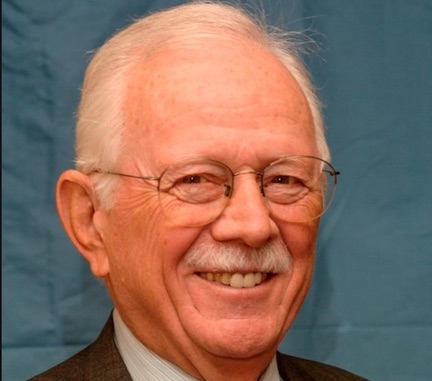
The former Rules Committee chair for the Alaska House of Representatives has thrown his name in for House District 10, which is the old House District 24 in Anchorage. Craig Johnson filed for office on Wednesday.
Johnson, a Republican, represented District 24 for 10 years, from 2007 to 2017. He tried for Senate in 2016 but could not prevail over Natasha von Imhof, who became senator. Upon his retirement from the House, Chuck Kopp ran and won that seat. Kopp was replaced by Rep. Tom McKay, but now district lines have been redrawn and there is no incumbent for the District 10 seat.
Running for the Democrats in that seat is Sue Levi, a perpetual Democrat candidate.
Johnson’s professional experience includes working as a legislative aide from 1997-1999 and 2004-2006. He was the general manager of the Alaska Journal of Commerce and Alaska Military Weekly, and was vice president/general manager of KYMG radio.
He said he originally ran for office to help Alaska be a better state for the next generation and that those are his same goals today. Since leaving office, he has focused on his health, including getting knee surgery and exercising. Johnson is a conservative and would return to office as a veteran of the Legislature.
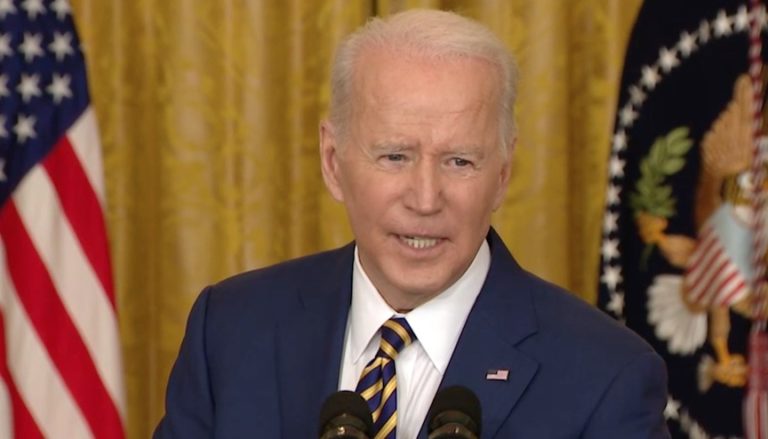
“Why do you suppose such large segments of the American electorate have come to harbor such profound concerns about your cognitive fitness?” NewsMax reporter James Rosen asked President Joe Biden during a press conference today.
“I have no idea,” Biden answered.
In a rambling and incoherent press conference, only the second during the year of his presidency, Biden was asked again about his competency, “From the messy rollout of 5-G this week to the Afghanistan withdrawal, to testing on Covid, what have you done to restore Americans’ faith in the competence of government? And are you satisfied by the view of the competence of your government?”
Biden answered: Look, let’s speak to Afghanistan. I know you would like to focus on that, which is legitimate. We were spending $1 trillion a week … I mean $1 billion a week in Afghanistan for 20 years. Raise your hand if you think anyone was going to be able to unify Afghanistan under one single government? It’s been a graveyard of empires for a solid reason — it is not susceptible to unity, number one. So the question was, do I continue to spend that much money per week in the state of Afghanistan knowing the the idea that being able to succeed other than sending more body bags home is highly, highly unusual.”
“My dad used to have an expression. He’d say, son, if everything is equally important, nothing is important to you. There is no way to get out of Afghanistan after 20 years easily. Not possible. No matter when you did it. I make no apologies for what I did. I have a great concern for the women and men who were blown up on the line at the airport by a terrorist attack against them. But the military will acknowledge and I think you will know lot about foreign policy, the that had I not pulled those troops out — we would be asked to put somewhere between 20,000 to 50,000 more troops back in because the only reason more Americans weren’t being killed and others is because the last president signed an agreement to get out by May 1. And so everything was copacetic. Had we not — copacetic. We would be putting a lot more forces in. Now do I feel badly what’s happening to — as a consequence of the incompetence of the Taliban? Yes, I do.”
But, he said, he also feels badly about what is happening in the Eastern Congo, and a whole range of things around the world, “that we can’t solve every problem, and so I don’t view that as a competence issue.”
He also said the 5-G rollout was not a competence issue. “I don’t view that as somehow a mark of incompetence.”
He doesn’t see his Covid policy as incompetent, either.
“Look, think what we did on Covid, when we were pushing on Astrazeneca to provide more vaccines. Well, guess what, they didn’t have the machinery to be able to do it, so I physically went to Michigan, stood there in a factory with the head of Astrazeneca and said, ‘We’ll provide the machinery for you. This is what we’ll do. We’ll help you do it so you can produce this vaccine more rapidly.’ I think that’s pretty hands-on stuff.
“I think you have to look at things the way we used to look at it on balance. What is the trajectory of the country? Is it moving in the right direction now? I don’t know how we can say it’s not. I understand the overwhelming frustration, fear, and concern with regard to inflation and Covid. I get it. But the idea, if I gold you when we started — I tell you what I’ll do in the first year, create six million jobs, I’m going to get unemployment down to 3.9%, I’m going to generate and name it all, you’d look at me like I’m nuts. Maybe I’m wrong.”
Reporter Peter Doocy asked Biden why he is trying so hard to pull the country so far to the left.
“I’m not,” Biden responded.
Biden also said Russia President Vladimir Putin will probably invade Ukraine, and doesn’t think the United States or Europe can do anything about it.
“Do I think he’ll test the West, test the United States and NATO, as significantly as he can? Yes, I think he will,” Biden said. “But I think he will pay a serious, and dear price for it that he doesn’t think now will cost him what it’s going to cost him. And I think he will regret having done it.”
When the reporter asked to clarify if an invasion is likely, Biden answered, “My guess is he will move in. He has to do something. I probably shouldn’t go any further. But I think it will hurt him badly.” He suggested Putin might be able to get away with “a minor incursion.”
This weekend, my heart swelled with gratitude for the life Rev. Martin Luther King, Jr. helped make possible for me and my family.
His work paved the way for my father, the youngest child of an impoverished widow in the D.R. Congo, to attend an Ivy League college, pursue a successful career in international banking, and create economic advancement opportunities for thousands in developing countries through his work in microfinance.
Dr. King established love as the animating principle that sustained his nonviolent struggle for racial justice. It was the panacea that made possible his dream’s fulfillment. “Love is the greatest force in the universe,” he said, “[t]he heartbeat of the moral cosmos.”
Love, he believed, would empower our loyalties to “transcend our race.”
There is a beautiful simplicity to Dr. King’s life message, one that stands in stark contrast to the divisive emails Assembly Member Chris Constant sent non-profit leaders, the media, and Municipal employees this past weekend. Mr. Constant felt the commemoration of Dr. King’s legacy of love and racial unity was an appropriate time to racialize a legal dispute between the Municipality’s legislative and executive branches.
Apparently, Mr. Constant remains livid over Mayor Bronson’s termination of Mr. Clifford Armstrong III, the Chief Equity Officer appointed by the previous administration, and his subsequent appointment of Mr. Uluao “Junior” Aumavae to fill the position.
So, when Mr. Constant was extended a friendly invitation to join Mr. Aumavae and Mayor Bronson for a celebration of MLK Day, he responded by informing everyone on the email chain, including Mr. Aumavae, that he did not recognize Mr. Aumavae as the Municipality’s Chief Equity Officer and invited everyone to raise their “voice[s] for [j]ustice.” I am happy to oblige because I believe his emails made a mockery of Dr. King’s legacy and were demeaning of Mr. Aumavae.
Mr. Constant engaged in the tired tactic of race-baiting when he wrongfully described Mr. Aumavae’s appointment as a “cynical act to divide a community.” Mr. Aumavae’s appointment was intended to unite our community, not divide it. As a member of the black community, I recommended Mayor Bronson appoint Mr. Aumavae to his post, not only because of his sterling qualifications but also to honor the values of diversity, inclusivity, and equal opportunity Mayor Bronson and our city hold dear.
It boggles the mind that Mr. Constant refuses to celebrate Mr. Aumavae’s appointment to the highest government office in Alaska a member of the Samoan community has ever held. Does he honestly believe his exploitative conduct promotes equity?
Mr. Constant also accused Mayor Bronson of failing to advance equity in this administration. Curiously, Mr. Berkowitz’s administration did not submit a federally required Affirmative Action Plan to the Assembly in 2015, 2016, 2017, 2018, or 2019; nor were any African Americans hired to serve in the office of Mayor Berkowitz.
Yet, I suspect neither Mr. Constant nor his predecessors accused Mr. Berkowitz of failing to pursue equity. Simply put, Mr. Constant’s rhetoric does not match his record.
At best, his criticism reflects a lack of self-awareness; at worst, it is naked hypocrisy. Mayor Bronson has appointed numerous women, three African Americans (including perhaps the Municipality’s first black Chief Human Resources Officer), an Alaska Native, and a Samoan to senior executive positions in his administration. Show me Mr. Constant’s commitment to equity by what he has said and I will show you Mayor Bronson’s commitment by what he has done.
I am disappointed and disheartened by Mr. Constant’s insensitive and opportunistic emails that risked provoking racial discord on a day intended to celebrate racial progress and promote racial unity. As we approach Black History Month, I request that Mr. Constant allow Anchorage’s black community to enjoy the celebration in peace. Why not let the court judge the merits of our respective arguments, while we focus our attention on other important matters of Municipal government?
Notwithstanding our differences, I invite Mr. Constant’s collaboration in this administration’s future pursuits of racial justice and equal opportunity. Like Dr. King, I have an “audacious faith” in our city’s ability to build a better tomorrow if we heed his counsel to run when we cannot fly, walk when we cannot run, or crawl when we cannot walk. Our shared objective is to keep pressing forward, even if progress is sometimes slow, until all of us fully inhabit what Dr. King described as “the city of freedom.” We shall overcome with or without Mr. Constant. Personally, I hope it is with him.
Niki Tshibaka is the Human Resources director for the Municipality of Anchorage.
“Walking Alaska’s Toughest Beat” is the motto of the Alaska Correctional Officers’ Association, the union that represents the uniformed security staff of the Alaska Department of Corrections.
The Department of Corrections was in my portfolio for most of my time with State Labor Relations. I got it almost immediately after I began with the State of Alaska in 1987, and I quickly learned that I got it because I was the “new guy,” and nobody else wanted it. I covered DOC until I became director in 2003.
I advised their supervisors and managers, I represented the State in adjudicating grievances, and I negotiated most of their labor agreements.
In the early days, the correctional officers were a part of the General Government Unit, the 8,000-odd member bargaining unit that represents all State employees who aren’t something else. The relationship between the correctional officers and the State was contentious on good days.
The correctional officers were prohibited from striking and had access to interest arbitration to resolve their contract formation disputes. In the 1980s, the Alaska Public Employees Association represented them, and in the early 1990s the Alaska State Employees Association represented them.
Both used them as their “storm troopers” by taking correctional officers negotiations to impasse and arbitration and then using the arbitration award as a template for an agreement for the rest of the bargaining unit.
We got them under a voluntary agreement just before we went to arbitration with the rest of the general government unit in 1990 or so, when they were represented by ASEA. We began encouraging correctional officers leadership personalities to form a separate unit for the correctional officers. We maybe thought about helping them do that, but it would have been illegal, so, of course, we didn’t.
They were successful in forming their own bargaining unit composed solely of correctional officers and in the beginning represented by the Public Safety Employees’ Association, the union that also represented State Troopers. PSEA represented them well, but the relationship wasn’t happy and the correctional officers went off on their own as an independent association in the early 2000s. They were and remain the only State employee union that is local, independent, and not a part of the AFL-CIO. We got along with them pretty well but we did them no favors. I rearranged the career plans of quite a number of their members by sustaining dismissals in arbitration.
The last dismissal arbitration I ever did on behalf of the State was a correctional officer in Nome for excessive force. I won. Full disclosure; since I retired, I’ve represented the union in several arbitrations. When they’re right, they’re right, and with State management as it has been in recent years, they’re often right. I only half-jokingly said that I had made the State’s labor relations policy: “We can work this out if you don’t involve Art in it.”
I also had the State Troopers in my portfolio for much of my career. The Troopers might argue about who has the toughest beat, but I’d say it is a toss-up. Troopers are much more likely to have to confront someone with a weapon in his hand, but they have one too, and the correctional officers don’t.
But to the tough part, Troopers get to do good things and deal with good people, although sometimes in bad circumstances. About the only thing a correctional officer has to look forward to in his/her 12-hour shift is quitting time. We’ve made heroes of healthcare workers and first responders in the Covid Scamdemic, but these workers know the people they’re dealing with are sick; the correctional officers take whomever the police drop off at the sally port.
It is a hard thing to work the balance, even if you know the world of criminal justice pretty well. The cop and correctional officer position is always that a civilian can’t substitute his/her judgment for the law enforcement officer who is facing a threat. I don’t buy that view without qualification. The civilians have a voice too, but that voice has its limits; if you haven’t had to make the split second decision to use force, you really aren’t qualified to judge somebody else’s decision to use force.
At minimum, any civilian involved in a use of force decision should have a comprehensive knowledge of the correctional and law enforcement environment. I did quite a few force cases. I won some and I lost some; won more than I lost but not by a wide margin, and the reality was that the arbitrator who was making the decision had little knowledge of the environment. Unfortunately, people with a J.D. from Harvard don’t usually know much about jails.
Which brings me to what I really want to talk about. On Nov. 22, 2017, three inmates at Anchorage Correctional Center were to be transferred from one area of the jail to another by a prisoner transport officer in a Corrections van. The transfer was caused by the misbehavior of the inmates in assaulting another inmate, so these guys were on the radar as aggressive inmates.
When the van arrived on the other side of the facility, something happened and the inmates became aggressive as the transport officer attempted to disembark the inmates to the sally port. A group of correctional officers converged and one of them discharged pepper spray at one of the inmates, which made incidental contact with the other two inmates. The correctional officers closed the van door to restrain the inmates. Surveillance video reveals that the inmates remained in the closed van between seven and seventeen minutes.
The incident deescalated and the inmates were brought into the facility. At least one showered to remove the pepper spray. Two others may not have had the opportunity to shower and change clothes. One of the inmates filed an inmate grievance. Correction’s Human Resources investigated it, the “internal affairs” unit investigated it, and neither found merit in the inmate’s complaint. Just for the record, inmates complain a lot.
Enter the Ombudsman’s Office.
Confession: I never had much use for the Ombudsman’s Office. It was always political types doing political things for the politicians they worked for. I had enough trouble hiring people with investigatory and analytical skills in real jobs; these were jobs for somebody who knew somebody. The events at issue took place during the Gov. Bill Walker Administration, but by the time the Ombudsman got involved, the Walker Administration was gone. The Ombudsman is a Walker appointee with a five-year term.
Somehow in the last few months the Ombudsman’s interest in this case was rekindled. Three or four years after the event transpired, the Ombudsman’s office asked Corrections to respond to allegations of wrongdoing regarding events that took place before the current Corrections managers were even in office.
I’ve read the public version of the report in some detail, and I do know how to read these things, and the DOC didn’t cover itself in glory, but after the passage time involved, it would be difficult to respond. There is a legal doctrine of “latches” which says that the passage of time is a defense because time makes you unable to adequately defend yourself.
We get a magnum opus from the Ombudsman about how Corrections should manage itself. Nobody in the Ombudsman’s Office has a clue how the DOC should manage itself. I’m willing to bet that nobody who participated in this investigation had ever been behind a door they didn’t have the key to before they did this inquiry.
Of course, Pravda — excuse me, the Anchorage Daily News — made the Ombudsman’s report front page news.
This is a rerun of an old communist-Democrat play. They and the ADN scammed up the National Guard scandal to bludgeon Gov. Sean Parnell. Somewhere in there they ginned up a scandal about Corrections systematically abusing Native inmates and the Gov. Bill Walker regime put a self-serving social worker in charge to try to make political points. Well that guys made enough political points to get an appointment in Colorado, where they thoroughly hate him.
If I’d gotten this case, and in my time I probably would have, I would have investigated it with Department of Administration employees and I might have put some paper in a couple of officers’ files. I only know what I can glean from an investigatory report made by people who didn’t know what they were looking at. Maybe the use of force was justified, maybe it was just an act of intimidation.
I don’t know, and neither does the Ombudsman, but I assume the Walker people will try to use it the same way they used the National Guard scandal, because that was the whole purpose of it.
Art Chance is a retired Director of Labor Relations for the State of Alaska, formerly of Juneau and now living in Anchorage. He is the author of the book, “Red on Blue, Establishing a Republican Governance,” available at Amazon.
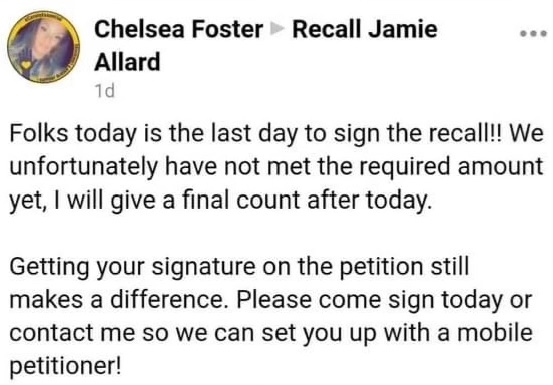
The group trying to recall Anchorage Assemblywoman Jamie Allard didn’t file their petitions with the Anchorage Assembly Clerk’s Office because they could not get enough signatures from voters in Chugiak-Eagle River.
The Clerk’s Office gave the Recall Allard group an extra day to gather signatures because of the Martin Luther King holiday on Monday, but it was not enough. The effort was led by Chelsea Foster, who is not in Allard’s district. She told her group on Facebook that cold weather this winter was a factor in not being able to get out of the starting gate.
There’s no telling how many legitimate signatures the group received because the petition is private information until submitted officially to the government, but the signature gatherers ran into a lot of resistance in the conservative stronghold of Eagle River, and the petition itself was ginned up by a couple of people from outside the Assembly district, which didn’t help the recallers make their case.
Allard has served on the Assembly since 2020, and is now a candidate for the Alaska House of Representatives, District 22.
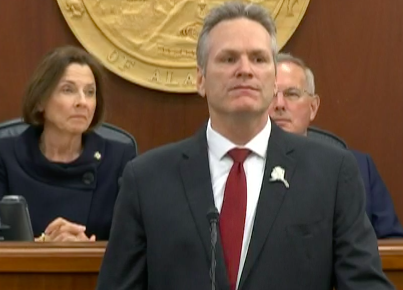
Gov. Mike Dunleavy’s State of the State Address is scheduled for 7 pm on Jan. 25, according to sources in the Administration. The annual address is given annually as an update to the Legislature and the people of Alaska about the general condition of the state and how the governor intends to address problems and opportunities in the coming year.
In 2021, the address was given remotely for the first time in Alaska’s history, due to pandemic and resulting shutdown conditions in the Capitol.
This year, it appears the address will be in person the House Chambers in Juneau, where it is traditionally. Both the House and Senate usually crowd into the one chamber, and the gallery of seats for the public is taken by members of the Dunleavy Administration, his family, and select guests who he wants to introduce. The address is often about 40-50 minutes long and is broadcast on the Legislature’s channel, AKleg.gov. There is always a chance that the Legislative Council will change its mind and shut down the in-person speech, if a number of legislators become contagious with Covid-19.
This year’s remarks may be focused on opportunity, as Alaska comes out of an extended recession followed by a global pandemic that has taken the lives of 955 Alaskans.
The State will be having to manage millions of federal dollars coming for infrastructure projects, which means there will be an abundance of jobs, but a lack of workers and spiking inflation caused by the federal money printing operation. Dunleavy will probably talk about public safety and the increased State investment in Village Public Safety officers, as well as the general state of crime in Alaska, which has been trending down since Gov. Walker left office and Dunleavy reversed his soft-on-crime legislation, SB 91.
And he’ll most likely speak to his goal to fix the mess that is the Permanent Fund dividend, which has become Alaska’s biggest nightmare ever since Gov. Walker cut the dividend in half. He will probably challenge the Legislature to not use “election year” as an excuse for not getting anything done.
(Pictured above, Dunleavy giving the State of the State Address in 2020, with then-Senate President Cathy Giessel, and then-House Speaker Bryce Edgmon in the background.)
The Juneau Empire announced that 30 percent of subscribers to the physical newspaper will start receiving their newspapers by the U.S. Postal Service. The change is a result of the inability of the newspaper to find carriers for certain neighborhoods. The partnership will ensure more on-time delivery for those on Douglas Island, downtown near Basin Road, and in some neighborhoods “out the road.”
The newspaper was an afternoon paper until after 2000, when it switched to becoming a morning paper. Its delivery has been troubled by too few people wanting to pick up routes in the morning. As a consequence, the Postal Service partnership will mean those subscribers will get their news later in the day, said David Rigas, publisher.
Most newspaper carriers in America are no longer kids on bikes, but adults working routes with their cars. Typically the routes are a second or third job for them. Carriers are not employed by the newspapers but act as independent contractors and may get 10-15 cents for every newspaper delivered.
According to David Rigas, publisher of the Empire, about 30% of subscribers will see a delivery change beginning Jan. 18. He said that the partnership with the United States Postal Service will ensure regular paper delivery to areas where reliable delivery by carriers has been lacking for the newspaper that was founded in 1912.
The paper reported that the move to partial mail delivery comes after a months-long effort to find neighborhood carriers for the Empire, which was purchased from Morris Communications by GateHouse Media in 2017. GateHouse sold its Alaska papers to Sound Publications the next year. The printed edition comes out Tuesday through Friday and Sunday.
2021 had a lot significant events. Most of them bad. The big headline for 2021 was the Covid virus. There are so many negative aspects to this issue it is difficult to know where to start.
Let’s start with President Donald Trump’s Operation Warp Speed, one of the few bright spots, even if was in the year prior. President Trump got a vaccine through the development and approval process in less than a year when it historically takes three to five years. That was quite an accomplishment. He then handed the vaccine and a plan to distribute it over to Joe Biden, who promptly screwed it up.
That is how we started 2021. Good ole Biden had said earlier that having 200,000 people die on a president’s watch should result in that president resigning.
Well, today, over 400,000 people have died on Biden’s watch, and that is with 60 percent of the population vaccinated, considerable experience in treating the virus, and a well-established distribution system for testing and vaccines. According to Joe’s own statement as a candidate, he is the one who should resign. The problem is if he did, we get Kamala Harris, which would be a dubious improvement.
Biden recently said “There is no federal solution” to the Covid disaster. Therefore, the states are on their own as to how to deal with Covid. The pProblem is, the federal government is in control of the vaccines, test kits, and virus treatments. This allows Biden to use the crisis for political gain.
Republican governors, such as Gov. Ron DeSantis of Florida, get less vaccines etc. so they look bad. Politicizing a life and death situation has to be the lowest thing a president could do.
Masks and other virus protocols are to prevent the spread of the virus unless, of course, you are out protesting and burning down cities or sneaking across the southern border. Apparently, the virus doesn’t attack left-wing protesters or illegal aliens. I should point out, Republicans are also not allowed to attack them.
Next, we have the Christopher Steele Russian “dossier.” This was nothing more than a bunch of lies and distorted fantasies concocted by a Trump hater on the take for FBI and Hillary Clinton campaign money. Nobody could or would check his sources. They just forwarded it to various people who could get it integrated into the government agencies. This spawned the Mueller sham investigation with the drive-by media reporting on every non-proven element of the politically driven exercise in political assassination.
Today, no one wants to acknowledge any association with what appears to be a flimsy hoax. This all played into a concentrated effort to discredit and drive from office a duly elected president.
Now that Igor Danchenko (Steele’s source) and others have been indicted, some of the truth may float to the surface of the Washington D.C. swamp.
Then we have the trusty “woke”, let’s fire-the-cops campaign. The “legalize marijuana” group must have been significantly involved in formulating this plan, while partaking of their product. The results were huge cuts in police budgets in mostly blue cities.
To nobody’s surprise, the crime rate went through the roof. On top of that, BLM and Antifa were occupying and burning down various neighborhoods, federal courthouses, and police stations. The government response was “Move along. Nothing to see here.”
Apparently, there were no laws broken while perpetrating this destruction. Also, those who got killed or injured, it was considered just an accident. The Jan. 6 “riot” was different because they were mostly Republicans, so the Feds arrested and jailed 750 people so far.
All the woke people who sing the praises of BLM and Antifa but keep a 45 pistol in the house seem to be a bit conflicted. It is OK to burn down a neighborhood, but not mine. If you come here, I will shoot you because there are no cops to protect me.
Those people who supported BLM and Antifa and then voted for Biden are sitting in their burned-out neighborhoods watching inflation go through the roof, the virus spreading like crazy, “free” test kits unavailable, vandals running around stealing what they want, supply chain shortages, our foreign policy in the tank (Afghanistan, Ukraine) and public confidence in our government at an all-time low. It could be they may be revisiting their choices. Let’s hope so.
There are several other events I could include, such as blatant media bias. An African American drove a car into a Christmas parade and killed six people, including a kid, was in the headlines for a couple of days. A white guy, probably a Republican, drove a car into a bunch of protesters and killed one person , and those were headlines for two months.
Joe Bidens gaffs are too numerous to cover here.
A million people a year crossing our southern border (very few of them college graduates or skilled labor) putting a huge burden on our welfare system.
This just gets too depressing to go on so, I will close with wishing you a happy new year, hopefully.