
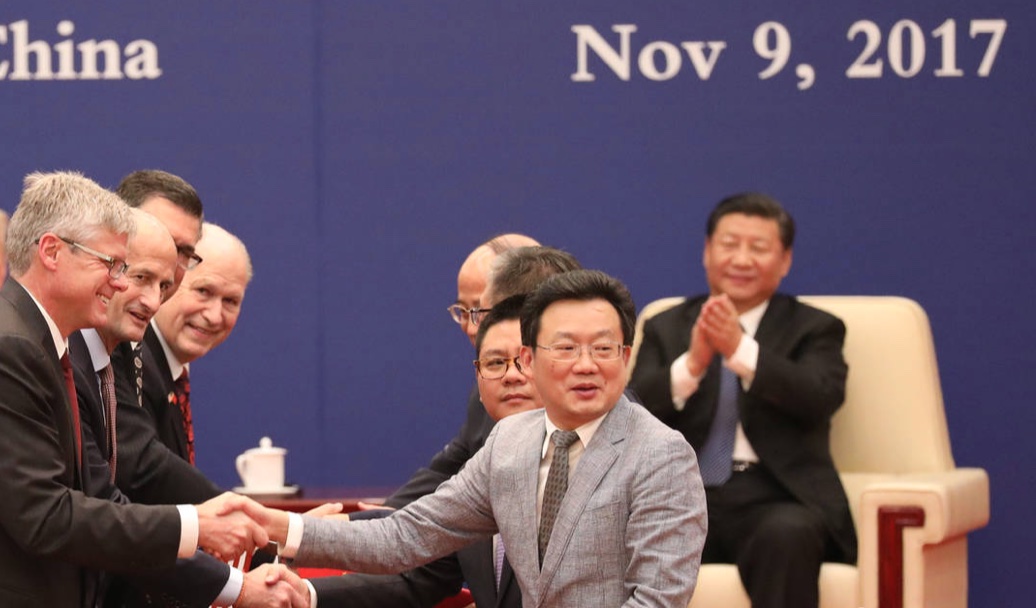
Part VI in the Must Read Alaska series on former Gov. Bill Walker’s alliance with China during his years as governor
Former Gov. Bill Walker once promised Alaska he’d build a gasline to Nikiski. To fulfill that campaign promise, he signed agreements has would have had China pay for 75% of the cost of building the project, and Walker signed contracts giving China the advantages to build the components for the project. He signed agreements to give away contracts for 75% of the natural gas to China.
Downing: The loyalty pledge that Bill Walker made to Communist China in 2017
Alaskans showed Walker the door in 2018. He withdrew from his race for reelection on Oct. 19, 2018, but remained on the ballot, and limped to the finish with only 5,757 total votes, or 2% of the vote.
Gov. Mike Dunleavy let all those agreements with the communist Chinese expire.
Four years later, while Walker tries once again to get control of state strategic assets, the world power dynamic has changed dramatically. We’ve entered another Cold War with Russia and China allying against the United States.
At the U.S. Naval Academy this week, a security analyst on a discussion panel told the Academy audience that the Chinese are not only preparing for war with the United States, but are focusing on Alaska, where the published Chinese war plans show an intent to attack U.S. military bases as a way of interrupting a major military advantage the United States has that is closest to China.
At the same time, China and Russia are in an arms race with the United State to develop hypersonic, maneuverable glide missiles. These missiles can defeat traditional anti-missile systems in the U.S. because after they go up, they return to the atmosphere, where they are maneuverable at five to 10 times the speed of sound. The United States’ sophisticated missile deterrent systems don’t have time to figure out where a missile’s actual target is.
China has already tested a nuclear-capable hypersonic glide vehicle, carried on a rocket, that circled the globe and landed within 24 miles of its target in 2018.
From Science Magazine, comes a vivid description of how these hypersonic, maneuverable missiles would work against Alaska or other targets:
“High in the sky over northwestern China, a wedge-shaped unmanned vehicle separated from a rocket. Coasting along at up to Mach 6, or six times the speed of sound, the Xingkong-2 “waverider” hypersonic cruise missile (HCM) bobbed and weaved through the stratosphere, surfing on its own shock waves. At least that’s how the weapon’s developer, the China Academy of Aerospace Aerodynamics, described the August 2018 test. (China did not release any video footage.) The HCM’s speed and maneuverability, crowed the Communist Party’s Global Times, would enable the new weapon to ‘break through any current generation anti-missile defense system,'” writes Richard Stone for Science.
“For decades, the U.S. military—and its adversaries—have coveted missiles that travel at hypersonic speed, generally defined as Mach 5 or greater. Intercontinental ballistic missiles (ICBMs) meet that definition when they re-enter the atmosphere from space. But because they arc along a predictable ballistic path, like a bullet, they lack the element of surprise. In contrast, hypersonic weapons such as China’s waverider maneuver aerodynamically, enabling them to dodge defenses and keep an adversary guessing about the target,” Stone explains.
The advent of maneuverable hypersonic missiles and the fact that the U.S. appears to be behind the curve may be a “Sputnik” moment for the country. Sputnik, the earth-orbiting satellite launched in 1957 by the Soviet Union during the Cold War, vividly demonstrated that the Soviets had outpaced the United States in space technology.
China is now considered the greatest security challenge for the United States, even more so than Russia, according to a Pentagon’s public version of the classified Nuclear Posture Review.
While the document, released on Thursday after a seven-month delay, says that conflict with China “is neither inevitable nor desirable,” it describes an effort to prevent China’s “dominance of key regions,” a reference to military dominance in the South China Sea and aggression against an independent Taiwan. The Pentagon warned that China is working to undermine American alliances in the Indo-Pacific and is using its growing military to coerce and threaten neighbors.
The Department of Defense’s National Defense Strategy directs the department to act urgently and says that China is “the pacing challenge for the Department.”
“The PRC remains our most consequential strategic competitor for the coming decades. I have reached this conclusion based on the PRC’s increasingly coercive actions to reshape the Indo- Pacific region and the international system to fit its authoritarian preferences, alongside a keen awareness of the PRC’s clearly stated intentions and the rapid modernization and expansion of its military. As President Biden’s National Security Strategy notes, the PRC is ‘the only country with both the intent to reshape the international order, and, increasingly, the economic, diplomatic, military, and technological power to do so,'” the report said.
The report also says Russia’s war in Ukraine and the Kremlin’s growing alliance with China are serious threats to the U.S. and her allies, with nuclear weapons, cyber operations, and long-range missiles.
Downing: Bill Walker’s alliance with Xi, who is now readying for war with the West
China and Russia as partners “now pose more dangerous challenges to safety and security at home, even as terrorist threats persist.”
Alaska dodged a bullet, by not allowing China to make it a “debt trap” province, as Bill Walker intended to do. Alaska is not selling natural gas to what has become the United States’ most worrisome enemy.
But, while former Gov. Walker was stopped in his tracks by Gov. Mike Dunleavy, it’s still not clear Alaska will dodge a missile in the coming decade of tension between major adversaries on the global stage. Alaska’s understanding of its military vulnerabilities will be a major focus for the next governor.


