Wednesday, May 6, 2026
Home Blog Page 998

Congressman Don Young votes with 12 other Republicans for the infrastructure bill

Congressman Don Young voted in favor of the Democrats’ massive $1 trillion infrastructure bill, which passed the House in late-night voting on Friday.

In a statement, Young said:

“Last night, I voted in support of the Infrastructure Investment and Jobs Act, commonly referred to as the bipartisan infrastructure bill. Our country is an economic powerhouse in no small part due to our historical support for infrastructure and other surface transportation projects. Perhaps more than anyone else, Alaskans know just how vital reliable infrastructure is to stay connected with one another and secure upward economic mobility. But I will be honest: when I take a look at some of our roads, bridges, and ports, I do not like what I see. I truly believe that this bipartisan infrastructure legislation may be our last best chance to make the federal investments necessary to modernize and strengthen America’s infrastructure needs for the next century and beyond.”

The bill makes big advances to President Joe Biden’s anti-oil, climate change agenda. It adds $350 billion to the federal deficit.

Young said the bill was not perfect but few pieces of legislation are.

“However, I firmly believe that we cannot sacrifice the good for the perfect. Very frankly, inaction on infrastructure risks our nation’s fundamental economic independence and strength,” he said.

“I am very pleased by the historic investments this legislation makes in Alaska. The bipartisan infrastructure bill authorizes $3.5 billion in federal Highway funding for Alaska over five years. This means we can rebuild, maintain, and construct new roads and highways to better serve Alaskans and keep them safe. The benefits for our state do not stop at highway funding alone,” Young said. The bill also has money for the Alaska Marine Highway System.

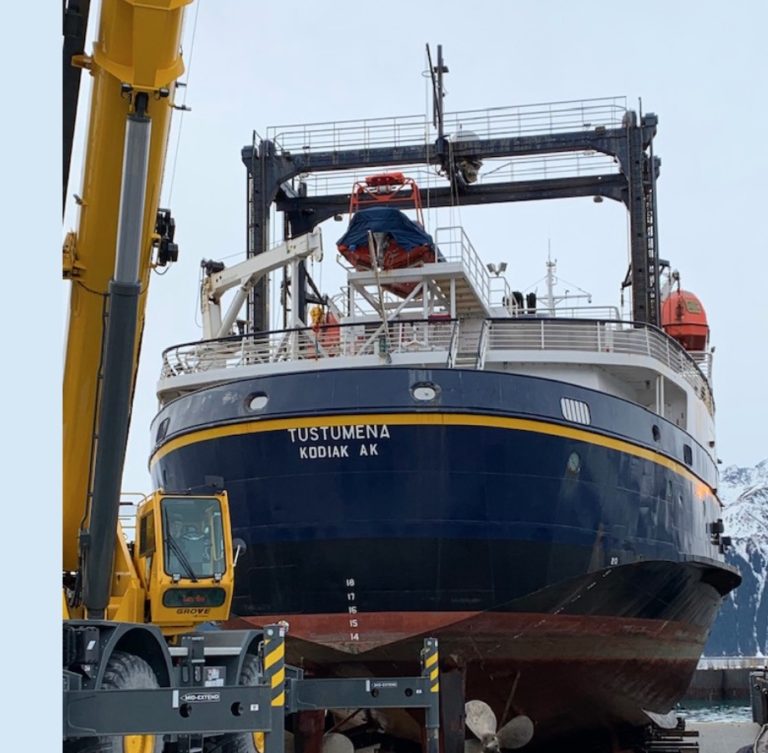
“This bipartisan infrastructure bill builds on this progress by providing $1 billion for essential ferry service to rural Alaskan communities. Additionally, it provides $73 million for the construction of new ferries for Alaska, while providing funding for an electric ferry pilot program to help our fleet run cleaner. Finally, for the very first time, the AMHS, will be eligible to receive future federal Highway aid funds for operation and repair. To say that this bill is a game-changer for Southeast is an understatement — this is a once-in-a-generation investment opportunity for Southeast Alaska’s families and economy,” Young said.

There is also money for ports and harbors, with Alaska in line to receive $250 million for remote and subsistence harbor construction for communities off of the road system. There’s also money for broadband access, and $75 million for the Denali Commission.

“I have made it repeatedly clear that I do not like the way this bill made it to the House Floor. It should have moved through regular order, allowing Transportation Chairman DeFazio and Ranking Member Graves to improve the bill. But there are no do-overs now, and too much of America’s infrastructure is already in the 11th hour of its usefulness. This is a solid piece of legislation that will help set the stage for the next century of American competitiveness. Alaskans have known for many years how close transportation is to my heart. In my life, I’ve driven tanks, captained boats, mushed dogs, and flown planes, among other forms of transportation. I have always stood up for our state’s unique needs, and it is my great hope that this bipartisan infrastructure legislation helps America continue to lead the world and better compete with our adversaries,” Young said.

The other Republicans who voted in favor of the bill were Rep. John Katko of New York, Rep. Don Bacon of Nebraska, Rep. Jeff Van Drew of New Jersey, Rep. Fred Upton of Michigan, Rep. Adam Kinzinger of Illinois, Rep. Anthony Gonzalez of Ohio, Rep. Brian Fitzpatrick of Pennsylvania, Rep. Tom Reed of New York, Rep. Andrew Garbarino of New York, Rep. Nicole Malliotakis of New York and Rep. David McKinley of West Virginia.

Redistricting: New political boundary map renumbers many districts

The Alaska Redistricting Board was able to agree by consensus on most of the political boundaries from Barrow to Hyder.

But when it came to Anchorage, the fireworks began. Board member Bethany Marcum and Board member Nicole Borromeo each had a version of where the political boundaries would be, and in the end Borromeo, working on behalf of Democrats, won the day.

By a vote of 3-2, the Borromeo Anchorage map was approved. Only Marcum and Board Chair John Binkley voted for the other map that would have slightly favored Republicans, while Board member Budd Simpson, a Republican, said the Borromeo Anchorage map was more compact and appropriate.

Many of the districts have new numbers, which will require politicos to relearn the districts. For instance, District 15, represented by Rep. David Nelson, is in an area of Anchorage that will known as District 21. The old District 21 is in West Anchorage.

Also, some incumbents would have to run against each other in the new districting plan:

Wasilla Republicans Rep. David Eastman and Rep. Christopher Kurka now live in the same district boundaries and would have to run against each other next year. That leaves Eastman’s old district without an incumbent lawmaker.

Chugiak-Eagle River, Republicans Rep. Ken McCarty and Rep. Kelly Merrick are in the same district. South Eagle River / Arctic Valley, where Merrick serves, does not have an incumbent lawmaker going into the next election.

Democrat Rep. Harriet Drummond of District 18, who represents midtown and Spenard, and Democrat Rep. Zack Fields of District 19, who now represents downtown Anchorage, will have to run against each other to maintain a seat in the House. District 18 will not have an incumbent.

District 17 Rep. Andy Josephson and District 23 Chris Tuck, have been wedged into a district. Both are Democrats.

Republican Rep. Sara Rasmussen and Democratic Rep. Matt Claman, have been pushed into a district that could give them both trouble in the next election.

Some of the geographic features of the new map include:

District 1 encompasses Ketchikan, Coffman Cove and Wrangell, but not Petersburg.

District 2 has Petersburg, Kake, Hoonah, Elfin Cove, Sitka, Tenakee, Angoon, Port Alexander, stretching from Hollis and Craig at the southern end, all the way north to Yakutat.

District 3 puts Skagway, Klukwan, and Haines into the northern Juneau-dominated district, as well as Gustavus. The district has almost all of the Mendenhall Valley and is now represented by Rep. Andi Story.

District 4 is the downtown Juneau, Douglas, and North Douglas District, kept relatively stable, but add the airport area. The district is represented by Rep. Sarah Hannan.

District 5 keeps Cordova with Kodiak, and also has Seward. It is now represented by Republican Rep. Louise Stutes.

District 6 has Seldovia, Halibut Cove, Homer, Anchor Point, Ninilchik, and Kalifornsky. That district is now represented in part by Rep. Sarah Vance, a Republican.

District 7 is Kenai-Soldotna.

District 8 is the Nikiski-Cooper Landing-Hope area of the Kenai Peninsula.

District 9 is now Girdwood-Whittier, also portions of south Anchorage as far north as South High School.

District 10 is west of Potter Marsh in the southern end of Anchorage, all the way to Dimond Blvd and as far east as the New Seward Highway.

District 11 encompasses Campbell Lake and Sand Lake in Anchorage, with a northern boundary of Strawberry Road and eastern boundary of Northwood St.

District 12 has the Anchorage Ted Stevens International Airport surrounding neighborhoods, north to the Turnagain neighborhoods.

District 13 is much of what District 18 used to look like, encompassing Spenard, Rogers Park, and the Tudor area as far east as Lake Otis Parkway.

District 14 has Taku Campbell in the center of it. It stretches from International Blvd. and Tudor Road on the north, to Dimond Blvd. in the south, and east to New Seward Highway.

District 15 is the shape of South Dakota, a rectangle from Huffman Road in the south to Abbott Road in the north and west to New Seward Highway. It used to be called District 26.

District 16 is an East Anchorage district that starts at Service High School on Abbott Road in the southern end and goes north to Tudor Road. It’s mostly old District 25.

District 17 has the U-Med district, parts of Campbell Park, and parts of Russian Jack in East Anchorage.

District 18 is now the Muldoon, Scenic Foothills portion of East Anchorage. It features Cheney Lake and Nunaka Valley Park North.

District 19 has McPhee Ave. as its primary northern boundary and much of Mountain View, and goes east to Pine Street, while having a zig-zagging southern border that includes Reka Drive, 20th Avenue, and Northern Lights Blvd. It was mostly old District 19.

District 20 is still a downtown district, with West Anchorage High School, and east to Airport Heights Drive. It encompasses Alaska Regional Hospital and Merrill Field.

District 21 has Government Hill, JBER, and following the Glenn Highway, goes north as far as the Anchorage Landfill.

District 22 Chugiak and Eagle River, it includes the northern Glenn Highway in the Anchorage Municipality, and includes the north Anchorage Municipality boundary.

District 23 is a Northeast Anchorage District, from DeBarr Road on the south end to Glenn Highway on the north. It is Muldoon proper.

District 24 is much of southern Eagle River, with a lot of jagged boundaries.

District 25 has Fishhook, Sutton, Chickaloon, and Valdez. It is the Eastern Mat-Su plus Valdez.

District 26 is a jagged-edged Wasilla district that has Teeland Middle School, Colony High School, and Finger Lake in it.

District 27 is another jagged-edged district that has Wasilla in it, including East Fairview Loop Road, and the mouth of the Matanuska River. This is parts of old District 12 with addition of KGB Road.

District 28 has Palmer, Lazy Mountain, Butte, Knik, and north to the Matanuska River.

District 29 in Wasilla features the Curtis Menard Sports Center area, Meadow Lakes, Wasilla High School.

District 30 has Big Lake, Houston, Talkeetna, Denali Borugh, and as far north as Healy, Clear, and Anderson.

District 31 Fairbanks has Eielson, Farmers Loop, Pleasant Valley, Salcha, and Fox.

District 32 Fairbanks features the Fairbanks International Airport and the University of Alaska Fairbanks.

District 33 Fairbanks is the urban Fairbanks area, as far north as Creamer’s Field.

District 34 is Fort Wainright and East Fairbanks, with part of Badger.

District 35 is the North Pole area, including part of Badger.

District 36-40 are the rural districts from the Canadian Border to the Arctic Ocean, Bering Sea, and Gulf of Alaska.

Many tasks remain to be done prior to adoption of a Final Proclamation of Redistricting, due no later than November 10, 2021. 

There may be lawsuits over the map; Valdez is likely to sue over its inclusion in District 25. They have already submitted a 300-page testimony document that is in opposition to be included in the Mat-Su.

The Board is scheduled to meet at 9 am at the Board offices, 3901 Old Seward Hwy., Ste 141 on Monday, Nov. 8. It will be working on pairing Senate districts to the House districts it voted on on Friday.

Mayor’s second library director resigns

Judy Eledge saw the writing on the wall with the Anchorage Assembly and evidently didn’t want to put herself and her family through the liberal Assembly meat grinder. She knew she would not be confirmed by the oppositional majority that has been blocking Mayor Dave Bronson on his cabinet choices. And so she resigned on Friday.

Eledge, who was appointed after the Assembly denied Bronson his first pick for the job, former school principal Sami Graham. The Assembly didn’t like Graham because she lacks master’s degree in library science. Eledge also doesn’t have that particular degree. Both have been lifelong educators, however, with decades of teaching or administering schools in Alaska.

The Alaska Library Association had opposed both nominees because of the degree that the protectionist group feels is essential to managing a library.

Eledge has been asked to remain as deputy library director, a position that does not require confirmation. The mayor’s office will conduct a search for a new library director.

Graham, meanwhile, is serving as Bronson’s chief of staff.

The Assembly majority of nine has given the mayor’s office a clear indication that it will buck his appointments and has already denied confirmation to two top-level nominees in the city — Jim Winegarner for Real Estate, and Graham for Libraries. Dave Morgan for Health resigned before the Assembly brought his name forward for a vote, when he realized he didn’t have the votes to be confirmed.

Dunleavy: ‘President is not king’ in overreach vax-mandate statement

“The Biden Administration’s OSHA rule was a longtime coming and we have been preparing for months now in anticipation,” said Gov. Mike Dunleavy on Friday, in reference to a lawsuit his administration joined, along with 10 other states, against President Joe Biden.

President Biden’s attempt to force mandates upon the nation is unconstitutional – it is an attack against the individual’s freedom and a threat against libertyMy administration previously issued an Administrative Order which represents my commitment to Alaskans against President Biden’s vaccine mandates. Alaskans can rest assured I will take every action possible to defend them and their rights. I am not anti-vaccine; I am anti-mandate, and I will stand up against federal overreach,” he said.

The lawsuit claims OSHA has no legal grounds for expanding its authority. The U.S. Supreme Court has determined that executive agencies have no power to institute such broad and overarching rules. OSHA’s responsibility is to protect Americans against workplace hazards, not enforce rules that significantly impact religious liberty and personal freedoms, according to Gov. Dunleavy and the Department of Law.

“OSHA’s emergency temporary standard violates the separation of powers and infringes upon the right of all Americans to decide for themselves whether a COVID-19 vaccine is right for them,” Attorney General Taylor said. “This mandate is unconstitutional, and we have made strong arguments as to why the courts should block implementation of OSHA’s rule.”

OSHA should have taken into account the potential religious objections of employees to the vaccine mandate and it should have considered other alternatives for those with natural immunity to COVID-19, the lawsuit states. The suit calls it an “overreach by a massive federal bureaucracy,” which previous courts have invalidated.

“OSHA cannot use the fact that hundreds of millions of Americans are employed in the national economy to regulate all facets of their lives with only attenuated workplace connections. But the Biden Administration has effectively admitted that this is precisely the role the Vaccine Mandate is intended to perform,” the court filing states.

The OSHA rule creates a “Hobson’s Choice” for employees, Dunleavy said, subject to either losing their jobs or forfeiting their personal freedom and bodily integrity.

“The president is not a king and he does not get to make up the law and control the individual,” Dunleavy said. “This is why he lost the eviction moratorium and why he will lose again. Health measures are a traditional state and local power under the 10th Amendment.”

Liberal Anchorage Assembly finds it tough to accept mayor’s board appointees

A special meeting of the Anchorage Assembly on Thursday revealed a legislative body having a lot of trouble with the fact that it does not control the Mayor’s Office any longer, and that the new mayor is making appointments to volunteer portions of the government — boards and commissions. The closed online meeting was spent dissecting Mayor Dave Bronson’s many appointments to boards and commissions.

Dozens of boards and commissions slots were left vacant during the “nothing to report” Mayor Berkowitz era, when former Mayor Ethan Berkowitz left the vacancies unfilled. As it turns out, dozens of people had been serving in official capacity on boards without the authority to do so. Some boards, such as the Military and Veterans Affairs Commission, were completely vacant.

For example, Pat Abney has been on the election board since 2018, and the leftist Assembly majority is visibly upset that Abney’s name is not being renominated by Bronson, after her term expired in October. Instead, the mayor is appointing a male to the all-woman commission.

Abney is a partisan Democrat, and a former candidate for the Alaska State House of Representatives in 2002 and 2006. She was a member of the Assembly from 1991-2001. Instead of Abney.

That change upset the Assembly majority, which had prepared several detailed questions for the Bronson Administration about the process used to determine who would be a good fit for a board or commission. The Assembly has gone so far as to request to see the resumes of all the nominees and the majority members are indicating they don’t think the mayor has appointed qualified people.

View all the boards and commissions expired and vacant seats here.

View current appointments to fill vacancies here:

Municipal Manager Amy Demboski provided answers to the Assembly, as they grilled her over the qualifications of the nominees.

What outreach and advertising was done to recruit the new appointees? Was the outreach done in a way that ensures broad community representation on the Boards and Commissions (several have specific requirements to meet geographic and demographic diversity)? 

Demboski replied that all residents had the opportunity to apply via OnBoard, a software that the municipality uses. Outreach was conducted through the muni website, social media, transition team, and community councils. Staff reviewed appointments with board diversity in mind.

There are 29 people whose terms expired in October 2021 who were not reappointed. How many of those submitted applications or indicated to their board/commission that they intended to serve out a new term? Can the Assembly have access to these applications? Were all existing members adequately informed that they would need to reapply for their positions (the past practice was to reappoint without a new application)? 

Demboski replied that it has not been the practice of the executive branch to advance resumes of people not nominated. Instead, Bronson notified members who were not reappointed. “We are continuing the process to send out letters to thank those members not reappointed for their service,” she said.

Several Boards and Commission have very specific requirements outlined in municipal code for who fills each seat, and sometimes technical requirements for appointees. Do the new appointments maintain these requirements? Can the Administration note on the AMs which seat each appointee is filling similar to how it is shown in the Anchorage Memorial Park Cemetery Advisory Commission section on OnBoard: https://onboard.muni.org/board/2868.

Demboski replied that this was done in some cases, but not all. While this has not always been done in the past, now that the OnBoard system is set up, she said it would be a good practice for the Municipality to maintain. Applications were first received via OnBoard, then filtered by the board/commission in which the applicant expressed an interest.

Next, applicants were evaluated against code requirements to serve on a particular board/commission; then, boards/commissions were evaluated for vacancies and expiring (or expired) seats.

Finally, the Mayor selected the appointees from the eligible applicants who had made it through the review process. Thank you for the recommendation to mimic the Anchorage Memorial Park Cemetery Advisory Commission section on OnBoard; we are happy to consider this recommendation as we move forward.

There were 23 people who expired prior to 2021, but according to OnBoard, that person was still serving (perhaps unaware that they had expired).

Some of these were reappointed, but some were listed on the Administration’s appointment documents as Vacant and new appointees were put forward. Of those, how many were still actively participating in 2021? How many reapplied for their seats? How did the Administration determine which Members to reappoint and which ones to replace?

Demboski replied that when the Bronson Administration took over, they found the information about who was actively participating in their board or commission was not recorded in a manner to easily track. Some people serving a previous administration were not in compliance with code (because terms had long been expired, or in one instance the reappointment was not put forward to the Assembly, but the person continued to serve in an official capacity).

“The appointments for boards and commissions are solely at the discretion of the Mayor; this process is exclusively a function of the executive branch,” Demboski said.

The staggering is off for the Election Commission. Would the Administration be willing to readjust the new appointment for Seat 4 for one year to expire in 2022, to bring the Commission back into alignment with the code to have staggered terms? 

Demboski replied that the the administration is reviewing all board and commission terms for legal alignment with the member’s terms.

Mayor Charlie Pierce: Alaskans are losing faith in election process. It’s time to act.

By KENAI BOROUGH MAYOR CHARLIE PIERCE

Open Letter to Elected State Senators, State House and Lt. Governor:

People are losing trust in the election processes and elected officials. Doing nothing in Juneau is getting old, and people are fed up. Have we forgotten that we who are elected serve at the pleasure of the people who elected us? Why is it that we run for office, promise the world, get elected, then don’t talk to the people who got us elected again until we run for office again? 

This cycle seeds distrust in the people we serve, and at the end of the day, these people are our bosses. We report to them, work for them, are accountable to them, and should make ourselves available to them. Raising money, getting elected, blaming the system on no results, saying you need more time to accomplish things, raising more money to get elected again for the things your first promised years ago — this way of life has got to go! 

I am not perfect by any means, but I answered to no special interest groups and did precisely what I said I was going to do, which balanced the budget and did not raise taxes. I have been doing this every year, day in and day out, with a great team at the Kenai Peninsula Borough. I also keep a literal open-meeting policy. Anyone from the public is welcome to come into my office and meet with me. If I am in my office at the time, I will make time for you right then and there. If I am busy, then we will schedule a meeting for later. You don’t have to be a president of a company or a lobbyist to get an appointment with me. I’m a small-town guy raised by a mom who showed me the value of people is not in their titles or how much money they make, but in who they are as a person. 

What I hear from people all over the borough is: Does my vote count, why aren’t there stricter voter ID laws, how much voter fraud happens each year, why are there not forensic audits on each election cycle? These are questions from good, hard-working Alaskans, and I guess that it rings true all over the state. The average person that I meet does not trust the system. Again, what are we doing to win back this trust? 

Making political statements about trying to fix it or trying to look into it is not enough anymore. We need action and results at the state level. Anyone who tells you election fraud does not happen is lying. A former elected official allegedly committed election fraud to get reelected. This potential election fraud just happened a couple of years ago, and what if there was more, but she was the only one that got caught.

This is why a forensic audit would at least help restore trust because you don’t have to look back but a couple of years, and you will find this huge election fraud case happening right here in Alaska.

There are more all around the USA: https://www.heritage.org/voterfraud/#choose-a-state.

In one case in Alaska, a person pleaded guilty to a felony count of forging signatures on an initiative petition to re-establish the coastal zone management plan. One of the initiative’s sponsors noticed inconsistencies with the signatures that the person had collected and reported the problem to the authorities. The forger was sentenced to serve two years in jail followed by three years’ probation. This case was caught, but I suspect many cases of fraud in Alaska elections are not.

Bottom line is that election fraud occurs, and we need to do a better job as a state to prevent it. 

So, what can you do as elected officials? You may not like what I have to say: It’s called accountability. I encourage you to be grateful to the people who helped you get elected, know that you are accountable to the people that elected you, and make sure you show them that you know that.

Second, give the lieutenant governor the tools he needs to ensure election fraud does not happen again in our back yards. We are losing the trust of the people, and doing nothing in Juneau is getting old fast. 

Charlie Pierce was elected mayor of the Kenai Peninsula Borough in 2017, and was reelected in 2020.

Alaska joins 10 states in suing over controversial Biden vaccine mandate for private sector companies

Alaska and 10 other Republican-run states filed a lawsuit on Friday against the Biden Administration’s mandate for Covid-19 vaccinations at companies with more than 100 employees.

The lawsuit, filed in the Eight Circuit Court of Appeals, was brought Arizona, Arkansas, Missouri, Montana, Nebraska, New Hampshire, North Dakota, South Dakota and Wyoming together, plus the office of the Iowa Attorney General, Tom Miller, a Democrat. Several nonprofits joined the lawsuit, along with five private employers.

The filing says “This mandate is unconstitutional, unlawful, and unwise.”

Earlier in the week, some of the same governors signed a letter warning President Biden from taking the final step of enacting the deadline he promised to set during his executive order in September. But the die was cast, and OSHA filed its ruling on Thursday, giving large employers until Jan. 4 to have their workforce fully vaccinated. The rule applies to over 80 million American workers.

On Thursday, attorneys general from Kentucky, Ohio, and Tennessee sued to stop the vaccine mandate for federal contractors. That mandate deadline is Dec. 8, but some sanctions are already going into effect.

Among the private companies who joined the lawsuit are: The Rabine Group of Companies, Lawrence Transportation Company, Guy Chemical Company, Terri Mitchell, Employee of Guy Chemical Company, Independent Bakers Association

Art Chance: A brave new Alaska of Permanent Fund and trust fund babies

By ART CHANCE

Unless President Joe Biden adds crashing the stock markets to his astounding list of failures, sometime in the next months the Alaska Permanent Fund will surpass the $100 billion mark, a holy grail for Alaska’s trust fund babies and wannabe trust fund babies.   

The popular notion has been that with a Permanent Fund corpus greater than $100 billion, the State could maintain current services off the fund’s revenue alone, so long as it could limit or eliminate the Permanent Fund dividend and devote most or all of the earnings to governmental operations.  

This warms the cockles of lefty hearts as it harks to the sainted Gov. Jay Hammond’s notion that we should use oil development to turn oil wells into money wells.  The lefties think they can abandon natural resource development and productive enterprise generally and just live off the Permanent Fund.

What they really want is the Juneau economy all over Alaska. Most of our readers are not from Southeast and have never been closer to Juneau than 30,000 feet or so as they flew by. It isn’t really the land of beer pong and leg wrestling, but it has a social and economic system that the lefties and self-styled elites find attractive. Juneau has almost no true private sector economy. It has a few big boxes and some retail and service businesses to serve immediate needs.   Those businesses understand that their market is government employees who are mostly left of center; so they’re not going to advocate any conservative positions or give any money to conservative candidates.  

Here’s where somebody from Juneau chimes in about the mines in Juneau. Those high-paid miners they like to tout mostly hot bunk in apartments, do their shift, and go home to momma in the Lower 48 on their off-week(s); they’re not a part of the Juneau economy or res publica.  Yes, there are administrative and other support employees in mining, but they’re really indistinguishable from the people who trudge into State and Federal office buildings every morning.

And finally, the two mines are in Juneau over the vehement opposition of the Juneau leftist elite, and mine owners and management are simply not a part of Juneau politics. 

The dream of the trust fund babies is to turn the whole State into Juneau.  Post-scamdemic, we’re close here in Anchorage to achieving that, and it is probably just as close in Fairbanks, Juneau, and Kenai.  

Other than a minimally necessary service sector and transportation sector, urban Alaska has only such trade as is necessary for the people who live off the government to provide for themselves. If you are among Alaska’s ruling elite, government, healthcare, education, and social services providers, you can pretty much get anything you need to make yourself happy in Anchorage, other than fashionable entertainment, anyway. The rockers and country musicians are being defiant and having some events, but the fashionable types aren’t ready to leave the house yet.

The computer on my Mercedes Benz is demanding a scheduled service; the dealer can’t offer me an appointment for two months.  To make it worse, my trusted independent backup can’t give me an appointment for five weeks.  In 2019, I would have had to wait at most five days, and they’d have given me a ride home and come and picked me up when it was done. Either a whole bunch of mechanics/technicians have packed up and left Alaska or they’re sitting home drawing welfare and unemployment benefits having discovered that in Slo Jo’s world, working isn’t worth it.   Well, in the Trust Fund Babies’ world, working really isn’t worth it either.

I worked in two Democrat administrations — Gov. Steve Cowper and Gov. Tony Knowles. Cowper was dealing with an economic crisis and had to act responsibly; the Democrats/leftists hated him for it. Things were a little more stable economically by Knowles’ time, thanks to the efforts of Cowper, Gov. Wally Hickel, and people like me, so his administration could act like the typical Democrat Trust Fund Baby.   If you were a State employee with ministerial or regulatory authority during the Knowles Administration, the very worst thing you could do for your personal well-being was to actually do your job.

As I look back on 1994-96, what I should have done is just stay home; they wouldn’t have had either the skill or the guts to fire me, and I’d have three more years of PERS earnings.  Instead, I told them where to put it and went to work for the Legislature as a contractor; that cost me about $300K in PERS earnings. I’ve never bothered to figure out what that costs me every month, but my wife probably has.

What today’s Trust Fund Babies want is for the whole population of Alaska to essentially work for the State or for local governments that live off the State. You can be a public employee in either State or local government or in education, you can be a healthcare employee, you can be on welfare, or you can be a part of a small service and retail sector that lives off the foregoing group; welcome to Juneau.

With oil at nearly $90 a barrel. there is probably enough money around to have some bread and circuses to keep the plebes happy next year.   The problem is the same one we struggled with back in the Seventies; oil is a finite resource.  We understood back then, that one day it would run out, and we wouldn’t have all that beautiful money anymore, so we started stashing some of it away.   

Now that we’ve turned oil wells into money wells, we have to confront the same issue with that money; it is all good when the the stock market is at record highs every day. What happens when it isn’t? All that money is really just speculative, fiat money; what happens when its value collapses?  Do you want to be a trust fund baby with the State managing your life, or do you have more faith in yourself?

Art Chance is a retired Director of Labor Relations for the State of Alaska, formerly of Juneau and now living in Anchorage. He is the author of the book, “Red on Blue, Establishing a Republican Governance,” available at Amazon. 

Ben Carpenter: Biden mandate defies logic and our moral obligations

By REP. BEN CARPENTER

The president of the United States, through the Occupational Safety and Health Administration (OSHA) arm of the federal government, has declared that employers must consider employees who get sick from Covid-19 as an occupational exposure and are therefore required to enforce vaccination or testing on their employees.

This is a nonsensical determination and I am glad that Governor Dunleavy has indicated he will challenge this Emergency Temporary Standard (ETS) in court. This action is also a departure from the authority Americans have entrusted their federal government with and our societal norms. It is testing our resolve in where we place our trust.

It is impossible for employers to prevent the spread of the Covid-19 illness with any of the currently available vaccines authorized by the Food and Drug Administration for Emergency Use Authorization or other authorization.

All the available vaccines were created to lessen the symptoms of the Covid-19 disease. None is effective at preventing the spread of the virus. Breakthrough cases prove that vaccination is not a reliable means to prevent infection and is likely an indicator that future variants of the SARS-CoV-2 coronavirus will be unaffected by the current vaccines.

The more we vaccinate, the greater the risk that vaccinated people are creating a more deadly coronavirus than would have occurred naturally. 

It is impracticable to prove that viral infection occurred at a place of work, under most circumstances, nor are most employers qualified to make such a determination. Employees leave their place of employment and are at risk of exposure from everyday activities unrelated to employment.

The ETS acknowledges this reality but places the burden on the employer to decide when and where an employee contracted a naturally occurring virus. This is a major departure from our societal norms and places a destructive and unnecessary wedge in the relationship between an employer and an employee. 

The world is dealing with the consequences of the SARS-CoV-2 coronavirus and the Covid-19 disease it causes. Our federal government has labeled the SARS-CoV-2 virus as a naturally occurring variant of the coronavirus family. That the virus exists at all is an act of God since it wasn’t created by man. 

However, the SARS-CoV-2 coronavirus has mutated numerous times. Alaska’s Chief Medical Officer and Chief Epidemiologist expect it will continue to do so. Matter of fact, Dr. Anne Zink’s stated opinion is that the sooner we get everyone vaccinated, the less risk there is of natural virus mutation.

This qualified medical assessment exists with the full knowledge that fully vaccinated patients are experiencing breakthrough infections. These patients are biological incubators like unvaccinated Covid-19 patients, except that any mutations that occur may have been influenced by manmade vaccines. 

Man didn’t have to intervene to cause SARS-CoV-2 mutations, but our continued intervention may cause more deadly mutations. When the SARS-CoV-2 coronavirus mutates with immunity to available vaccines, is it still considered a naturally occurring virus? Or does the impact of man-made vaccines on the virus change who’s responsible for the new variant? This is more a legal question than a medical one. The patient may be indifferent; they’re sick either way. But if the patient’s vaccine doesn’t work and they die, who’s responsible? Is it still an act of God? Is the employer responsible? Is the government? Does the doctor who prescribed and administered the vaccination have any culpability?

We should all care about the efficacy of forcing questionable vaccinations on our species. Voters especially.

If a person subscribes to the theory that the SARS-Cov-2 is a manufactured virus, then liability for the consequences should lie with the creator, and we should be having a completely different conversation.

Regardless of how the SARS-CoV-2 coronavirus came into existence and because it is both impracticable to prove that viral infection occurred at a place of employment and impossible for employers to prevent the spread of the virus by means of available vaccinations, OSHA and the Biden administration should have considered Covid-19 disease in the workplace as force majeure. Neither the federal government, nor employers, have liability for the outcome of the SARS-CoV-2 coronavirus infection in Americans. 

This conclusion isn’t a free pass to do nothing; compassion still demands a response. Early treatment with safe, effective, and proven medications are the best response to the Covid-19 illness. This is only debatable in the United State of America. Other countries lacking our economic resources and political liabilities have addressed the act of God with the means they have available. This is where employers should be focusing. This is also where our federal government is failing to focus. Why?

Forcing Americans to inject something into their body against their will is not demonstrating compassion. Compelling Americans to do so or face becoming unemployable is also not compassionate. Forcing employers to choose between compelling their employees to inject something into their body against their will or firing those employees is downright sinister. 

If a person subscribes to the theory that the federal government and employers have the right to force experimental vaccination on American employees, then it would reason that those employers accept the liability for the consequences of their actions. Since Americans are dying from the experimental vaccines, those employers should be held responsible for those deaths and likewise, OSHA should also consider those deaths to be occupationally related. Neither the President’s Executive Orders, nor the OSHA ETS, acknowledges that death is a potential outcome from the ETS. It provides no guidance for what to do when it happens. It’s as if they don’t want employers to know of this potential outcome.

Employers should seriously consider their moral obligations before choosing to comply with the ETS or deciding that it’s in their company’s best interest to force vaccination. Employers may have been given a right to vaccinate by the federal government, but that doesn’t mean it’s the right thing to do. History will record how we individually and collectively responded to the fear facing all of us. God will know if our response was to choose the easy wrong instead of the hard right. 

If the president of the United States, or his administrators, believe they can protect Americans from an act of God with mandatory vaccinations, or absolve employers or governments from liability of their actions, they have usurped the role of God Himself. If Americans conform, comply, or are otherwise complicit in furthering this nonsense, our national motto should be changed to “In Government We Trust”.

If our safety, security, and fortunes have become so important to us as to willingly invite a strong federal government to decide how we should act in the face of death, we don’t deserve the title of a God-fearing nation and we are no longer free men.

Rep. Ben Carpenter represents District 29, Nikiski and other communities on the Kenai Peninsula.