Thursday, June 18, 2026
Home Blog Page 962

Kevin McCabe: What do we really know about the Oath Keepers?

By KEVIN MCCABE

I am very concerned about the alleged issues surrounding Rep. David Eastman and his membership in the Oath Keepers.

I am, however, far more concerned with the consequences of any contemplated action, to the Legislature, the government of Alaska as a whole, and the conservative Mat-Su delegation. What I mean when I say that is simply this: Representative Eastman’s voters sent him to the Legislature three different times.

Who am I and or who do other legislators (or any of us who are not his constituents), think we are to usurp their votes and to remove their representation?

Look, I don’t always 100% agree with all of my 39 colleagues. Some of them I disagree with a lot of the time. And I disagree with Rep Eastman a lot.

Sometimes it is process, and sometimes it is politics. But is it my job to try to remove a legislator if I disagree with them? No. That job belongs to his or her constituents. And there are two ways to do that – through the ballot box, or by recall petition.

Most Americans know about the concept of “due process;” and the American ideal of “innocent until proven guilty” which has legal basis found in the 5th, 6th, and 14th Amendments, as well as English common law and many other documents found in our legal (including both Alaska and US Supreme Courts) procedures and precedents.

So with no “due process” and the idea that an American is innocent until proven guilty by that due process, can I as a legislator, set myself up to be judge and jury and “punish” a fellow legislator sent to do the states work by his voters? Should I vote to “cancel” those constituents votes? Do you really want me to? Because that is what some of you are asking legislators to do. 

Many of those calling for Eastman’s ouster do not even know, or have never seen, the Oath Keepers manifesto, rules, platform or ideals. In short, Alaskans are believing the hysterical left bloggers, the left leaning mainstream media, and the Twitter warriors instead of reading the Oath Keepers constitution themselves. I read about them over a decade ago when Oath Keepers approached me about membership.

From what I remember many folks are taking the Oath Keepers platform and ideals completely out of context; especially in light of our history. Remember, our Declaration of Independence says this:

“We hold these truths to be self-evident, that all men are created equal, that they are endowed by their Creator with certain unalienable Rights, that among these are Life, Liberty and the pursuit of Happiness.–That to secure these rights, Governments are instituted among Men, deriving their just powers from the consent of the governed, —That whenever any Form of Government becomes destructive of these ends, it is the Right of the People to alter or to abolish it, and to institute new Government, laying its foundation on such principles and organizing its powers in such form, as to them shall seem most likely to effect their Safety and Happiness.”

Is the Oath Keepers’ platform much different? Do we know? If you support removing Eastman, do you know? Have you seen the Oath Keepers platform or do you just believe  what the media/bloggers are writing? If so, ask yourself what their agenda is?

Finally, where does it end? Should we remove half the legislature because they are NRA members?

Should we find the social media posts of those legislators who supported BLM, Occupy Wall-Street, Occupy Seattle, or Antifa, and vote to remove them as well?

Should we remove legislators who are supported by various financial support groups and PACs, who also have an agenda that appears to run contra to our constitution?

Where does it end?

This whole thing is not an attempt to uphold our constitution. It is a thinly veiled personal and political hatchet job. No, this is about some who do not like a Representative’s positions, and his district’s politics, trying to get rid of him.

It is about some far far left Democrats and Socialists who see this as a way to remove a Republican from the House, shift the voting paradigm of the conservative Mat-Su, and create upheaval and strife for the conservative minority; all while cancelling the political stance of the district voters and the Mat-Su in general. 

Frankly I am dismayed to see so many smart people, educated in civics and American history, buying into this. The consequences to our state, of removing a representative in such a manner, are too great – and I cannot support this method.

Keep in mind that it could be any representative next;  but for now, the focus seems to be on shifting the voting block of the conservative Mat-Su delegation.

There is a recall procedure and a ballot box. If a representative’s constituents want him or her removed, then these are the two methods to use.

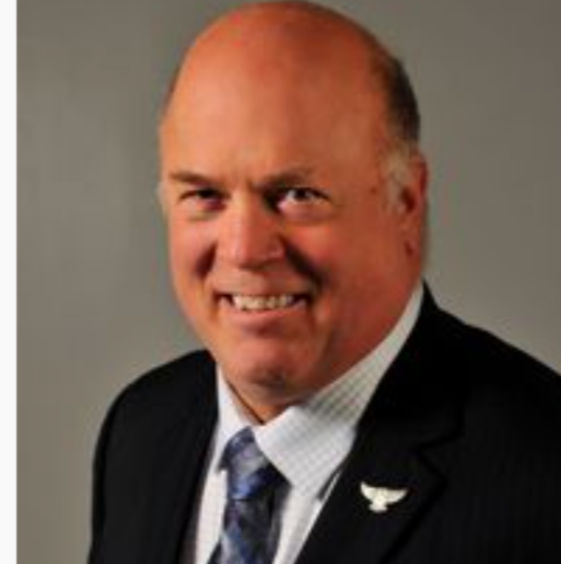
Rep. Kevin McCabe has represented District 8 as a member of the Alaska House of Representatives since 2021.

Feb. 1 is drop date for Anchorage candidates for April 5 local election

Candidates who have filed for Anchorage municipal offices but who want to withdraw have until 5 pm on Feb. 1 to ensure their names are removed from the April ballot.

Candidates dropping must file a notarized statement of withdrawal with the Anchorage Municipal Clerk either at the Municipal Clerk’s Office, 632 West 6th Avenue on the second floor, or at the Muni’s Election Center, 619 East Ship Creek Ave. The Clerk’s office downtown is often closed, according to members of the public who have reported it to Must Read Alaska on several occasions.

Notary service is available at the Election Center or the Municipal Clerk’s Office, according to the Municipal Clerk’s web page.

If the candidate withdrawal statement is filed after 5 p.m. on Feb. 1, the Municipal Clerk has the sole discretion to remove the candidate’s name from subsequent notices and the ballot.

The mail-in ballot will be mailed to qualified voters in Anchorage about 21 days before the April 5 election.

Friday was the candidate deadline for filing for the Anchorage election.

Rally supporting Canadian truckers set for next Sunday from Anchorage to Eagle River

Assemblywoman Jamie Allard and a group of Alaskans are organizing a truck Freedom Convoy for noon on Sunday, Feb. 6. It will line up on C Street near Cabela’s and in the Cabela’s parking lot in Anchorage, and end at the Eagle River Lion’s Club.

The convoy starts at 3 pm, but participants are advised to arrive at least an hour early, to dress warmly, and to check Allard’s Facebook page during the week for updates. Allard said more details will be released this week, and she is looking for a few committed volunteers to handle logistics at both the front and end of the convoy. She can be reached at [email protected].

The Feb. 6 convoy is a combination of two separate convoy efforts that were under way at the same time, one started Shaun Roberts, a military veteran in Anchorage, the other by Allard, also a veteran and sitting Anchorage assemblywoman representing Chugiak-Eagle River.

Allard said that it’s apparent the Canadian truckers spent a lot of their own money to get to Ottawa, some of them traveling thousands of miles, and that the cost of fuel is high. The event she and others are planning includes a fund-raising component to help truckers in Canada with their expenses, but is also a way for Alaskans to show their support for working men and women who have been laboring throughout the Covid pandemic, and who are now being forced to take vaccines as a condition of employment.

“Alaska depends on free trade, this is effecting our supply chain. The truckers need to be able to access our state. They’re just trying to do their jobs,” Allard said. “They just want to be able to provide for their families and their countrymen.”

Both the Trudeau government and the Biden Administration have enacted strict border controls, prohibiting foreign drivers from crossing the borders without proof of a current Covid vaccine.

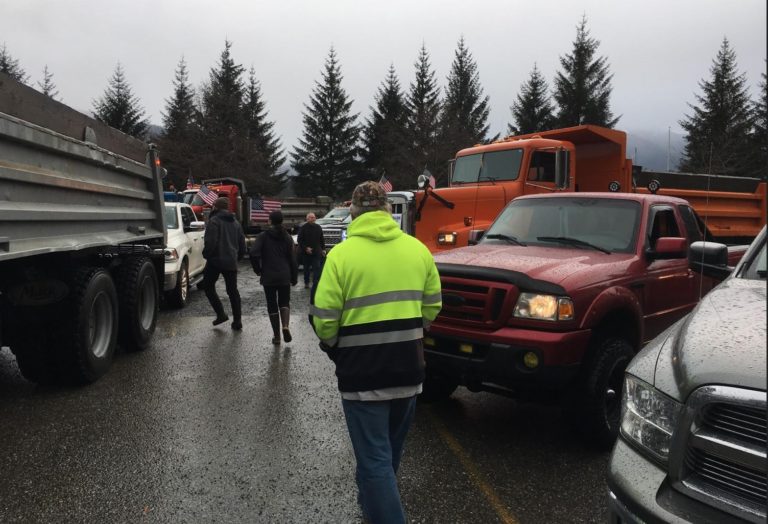
Juneau truckers and freedom supporters staged a convoy on Saturday, stretching over 2.5 miles as it crisscrossed the capital city.

Some liberals in Juneau were annoyed and shared their displeasure with the Freedom Rally on Twitter:

Saturday fundraiser for Kathy Henslee for Anchorage Assembly brings out dozens

Over 60 people came out to the Carousel Lounge in Spenard on Saturday afternoon to support Kathy Henslee, who is running against incumbent Assemblywoman Meg Zaletel for a seat to represent Assembly District 4.

Spotted at the fundraiser was Carousel Lounge owner Paul Berger, Mayor Dave Bronson, Rep. Laddie Shaw, Louis Imbriani, Jerrod Dunbar, Judy Eledge, Gretchen Stoddard, and a host of Anchorage residents who are not regulars at political fundraisers.

Most of Henslee’s fundraisers have attracted crowds of between 60-100 people. The municipal election, a mail-in-only process, ends April 5. Ballot packages will be mailed to qualified Anchorage voters no later than 21 days before Election Day. 

Henslee is running because, “As I have watched the public servants in my beloved city ignore the citizen’s needs and make everyday life more and more difficult with restrictive regulations, out of control spending, and harmful social ideas, I felt the need to act,” she said.

The next event for Henslee is Feb 16, with hosts Dawn and Kris Warren at St. Coyote, 135 West Dimond, 5:30-7 pm.

Failure to pay the dividend according to statute has created political chaos

By JOE GELDHOF AND JUANITA CASSELLIUS

For a long time, significant issues about our Permanent Fund have been bungled and avoided.

How long? Too long — since 2016, when then-Gov. Bill Walker decided to ignore the longstanding formula to pay the Permanent Fund dividend embedded in Alaska law.

The failure to pay the dividend according to statute has created political chaos. Every legislative session since Walker vetoed the dividend payment has seen political fighting over the size of the dividend. Without a fix to the dividend fight, Alaska cannot adopt a sensible fiscal plan.

The time to act on the dividend formula is now. Pointing to higher oil prices or using the upcoming election as an excuse to continue avoiding decisions is unacceptable. The financial well-being of Alaska is deteriorating because of the inaction by our elected officials. Action is needed now, not down the trail.

The best way to solve the annual dividend brawl is to put a workable dividend formula before the voters as part of a constitutional amendment. In order to fix Alaska’s fiscal uncertainty, the first step is to address the dividend and then work on government needs and revenue measures. Alaska’s citizens and their dividend must be addressed first, not government spending, taxes or any other issue related to solving the fiscal situation of our state.

The Permanent Fund is the greatest thing we have done for Alaskans since statehood. The fund takes a portion of our current non-renewable revenue from oil and holds those funds in trust for the future.

Instead of allowing the current generation to spend all the funds on themselves, we wisely saved for the future.

Providing a fair dividend to every Alaskan prevents a raid on the fund in multiple ways. Without a dividend, individual Alaskans are without a stake in their savings account and the fund will quickly become less than permanent. As former Gov. Jay Hammond once warned: “As go the dividends, so goes the Permanent Fund.” Without dividend protection, we risk losing the fund in the future.

The annual failure of our elected officials to adopt a fair and sustainable dividend formula is corroding Alaska’s political discussion. Instead of acting decisively on the dividend, too many politicians have avoided difficult choices. Since 2013, the Legislature has gutted Alaskans’ savings accounts, spending more than $20 billion to fund government.

Now, with oil prices elevated and federal funding flowing into the state’s treasury, far too many politicians are seemingly content to avoid dealing with the citizen’s dividend or putting our fiscal house in order.

We need to act now. But we need to act responsibly.

Current proposals to use the Percentage of Market Value, or POMV, formula to fund government and a dividend have potential to erode the value of the Permanent Fund.

The current dividend proposal based on a 5% POMV payout is set too high. With inflation running at more than 5%, the 5% POMV — with 50% to government and 50% to dividends — presents an unacceptable risk to the fund’s growth.

Other threats to the Alaska Permanent Fund loom. There is increasing evidence select individuals and special interests are salivating at the prospect of investing the Permanent Fund in pet projects that are not competitive based on normal prudent investment criteria. We are dangerously close to politicizing the investment criteria for the Permanent Fund. If we allow this to happen, the best idea we Alaskans adopted in our statehood history — the Permanent Fund — will be destroyed.

Alaska’s elected officials have repeatedly demonstrated an inability to spend money responsibly. Saving money has also been a problem. Many of these elected officials overpromise and underperform when it comes to dealing with Alaska’s finances. The Legislature has spent too much and saved too little of our mineral wealth.

That’s why we call on Alaskans to demand that dividend legislation is passed in this 2022 session. The citizens need a constitutional formula and one that works for all Alaskans, not just government.

The formula needs to protect the fund from inflation. And the formula needs to grow the Permanent Fund, not just government.

The formula should provide every Alaskan with a guaranteed dividend derived from their Permanent Fund.

We must avoid converting the Permanent Fund into a development slush fund to back dubious projects advocated by special interests.

The only way our elected officials will protect the Permanent Fund and your dividend is if voters demand protection of Alaskans’ commonly-owned resource wealth.

Joe Geldhof is a lawyer in Juneau and a board member of the Permanent Fund Defenders. Juanita Cassellius is a nurse in Eagle River and coordinator for Permanent Fund Defenders (www.pfdak.com).

As Trudeau flees capital, truckers and freedom supporters converge on Ottawa

Tens of thousands of Canadians turned the nation’s capital into a parking lot on Saturday, in what is arguably Canada’s biggest mass protest in the nation’s 154-history. Even with the police closing most bridges into Ottawa, the city center is jammed with trucks and people.

Civil disobedience is not a regular feature of Canada. But last week, truckers took to the roads from British Columbia to New Brunswick, and pointed their wheels toward Ottawa, where they rallied at the capital against the government’s vaccine mandates.

On Friday, the prime minister told reporters that the convoy was a “small fringe minority” who “do no represent the views of Canadians.” The House of Commons security team warned Parliament members to head “somewhere safe” and to hide if they saw any protests near their homes, according to Canadian press.

Prime Minister Justin Trudeau and his family hustled out of town to an undisclosed location for their safety. With a crowd that large and spontaneous, there was likely to be a troublemaker or two. A few protesters danced on the nation’s war memorial, and a flag with a swastika on it was spotted, although it’s impossible to know if these were incidences created by the intelligence community in Canada or the United States. The images of the Canadian flag with the swastika appears to be a protest flag that equates Canada’s government with the Nazis, but the meaning is being interpreted by the mainstream media as white supremacy.

A Sikh leader in Canada who is the leader of the New Democratic Party said the event was led by white supremacists.

The convoy was estimated to be 70 kilometers long and had 50,000 participants, with hundreds of thousands who turned out along the roads to cheer the truckers on as they rolled through the country. It is being spoken of as the longest truck convoy in world history.

There were no reports of violence or injuries at the Ottawa rally on Saturday. As night fell in eastern Canada, many of the protest participants curled into their bunks in their trucks and were preparing to spend the night. The weather is bitter cold in Ottawa tonight with wind chill temperatures tonight expected as low as -35.

Hotels.com shows that all hotel properties in the city were either booked or not taking reservations for Jan. 29-31.

(Photo from Twitter)

In November, ballots won’t be fully tabulated until 10 days before governor is sworn in

ELECTION WON’T BE CERTIFIED UNTIL SIX DAYS BEFORE SWEARING IN

The new election system approved by voters in 2020, known as Ballot Measure 2, has created a system that may lead to further distrust in the election, if counting and reporting of the numbers is not handled carefully, the state’s own director of the Division of Elections implied during a Senate hearing on Tuesday.

Election Director Gail Fenumiai, a veteran manager of many elections in Alaska, told the Senate State Affairs Committee last week that the division will release results of the ranked choice voting general election in just two stages — once on Election Night, Nov. 8, when all the ballots received at that point will have their first choice candidates counted — and then no more results will be released until the deadline has passed for mail-in and absentee ballots, which is Nov. 23.

That is a full two weeks after the election, and unlike with normal elections, where results are updated daily, with Ranked Choice Voting, the public won’t be able to see a trend, and many of the initial results may flip.

Fenumiai said that if her office released updated results every day between Nov. 8 and Nov. 23, the results could vary so widely that it could lead to mistrust in the counting process.

The counting process for ranked choice voting is done by a computer system with an algorithm, or computer rules that are internal to the counting software. Those voters whose first choice candidate was not successful in reaching the majority of votes will have that vote crossed off and their second choice vote will move up to be their first choice vote.

Watch Elections Director Gail Fenumiai explain the risk involved with releasing tallies daily at this link.

Sen. Mia Costello said that the problem is structural with the way Ranked Choice Voting is designed.

“You really can’t go beyond the first round [in counting] until you have every single ballot because you have to know if somebody is the outright winner. So it seems in this age of technology and modernization and progressive way to vote with ranked choice voting what we find is that we are just adding more time before the voters actually know the results of the election,” said Costello at the end of Fenumiai’s presentation. “I understand that now. If we are going to allow ballots to appear 15 days after the election, then we can’t progress past round one until all of those are counted, because you could already have a winner that is just out there in the mail. There are people serving in this Legislature who have won elections by a coin toss.”

Watch Sen. Costello’s comments at this YouTube link.

After an hour and a half of discussion in Senate State Affairs, it was clear that lawmakers have a hard time understanding Ranked Choice Voting and explaining it. Many suspect the public will have difficulty as well.

Sen. Scott Kawasaki, however, underscored the need for the Division to educate the public on how to vote with the new system, so they can “vote for us.”

The Fairbanks Democrat emphasized that Ranked Choice Voting is now the law of the land and its merits should not be debated any further, but rather lawmakers should focus on getting the people comfortable with it.

Watch Sen. Scott Kawasaki talk about how the focus should be on getting the public comfortable with Ranked Choice Voting here.

Sen. Mike Shower, who chairs the committee, said that the people who will be most likely disenfranchised by the new system are Democratic voters, those who are elderly, those who do not have English as their first language, and those who have disabilities. That’s because their ballots are most likely to be “exhausted” for any number of reasons, but primarily because they may not understand how Ranked Choice Voting works and how to correctly mark a ranked choice ballot. Some voters will not necessarily have time under the new system to fix a ballot they’ve made an error on, such as if they mistakenly voted for two people as their first choice.

Other interesting aspects of the new voting system:

  • Write-ins are not allowed in the primary.
  • If there are only four people in a race in the primary, all will advance to the general election ballot, where Ranked Choice Voting takes place.
  • The order of where candidates are seen on the ballot will be random.
  • Write-in candidates must file with the Division of Elections to be qualified.
  • There appears to be a clear advantage to going to the polls in person, rather than voting by mail, so officials can give voters a new ballot to mark if they make a mistake. But the ballot they will be handed is likely to have the names of the candidates in a different order.
  • Hand counts won’t happen with Ranked Choice Voting because it is too complicated.
  • On Election Night, only first vote candidates will be counted and announced.
  • Ranked Choice Voting requires centralized tabulation.
  • Votes can continue to arrive at the Division of Elections up to 15 days after the election.
  • The final tabulation on Nov. 23 should go quickly since it is all done by computer algorithm. That is one day before Thanksgiving Day, Nov. 24.
  • The election will not be certified until Nov. 29.
  • Dec. 2 is the deadline for requesting a recount for the governor and lieutenant governor’s race. Dec. 4 is the deadline for requesting a recount for all other races.
  • The governor, by order of the Alaska Constitution, will be sworn in on Dec. 5, just six days after the election is certified, and three days after a recount challenge can be filed.
  • The new governor won’t know he or she is governor until the last minute and won’t have time to start transitioning into office, preparing a budget for the Dec. 15 deadline, and assembling a cabinet.

Shower said that national studies prove that poor people are disenfranchised by the system that is used by the State of Maine and the City of San Francisco.

Shower said that a Princeton professor showed that the average disenfranchise rate is 11 percent of the vote, which means of 400,000 voting Alaskans, more than 40,000 are likely to have their ballots tossed. But as much as 20 percent of the ballots could be marked invalid.

According to the Princeton report by Nolan McCarty, Ph.D., Professor of Politics and Public Affairs at Princeton University:

  1. RCV resulted in a substantially lower “full participation” rate in Maine in 2018 as compared to plurality and runoff systems, where “full participation” means casting a ballot that could not be exhausted and thus is guaranteed to count toward the final outcome. This is particularly true in jurisdictions like Maine with more elderly and less- educated voters.
  2. These results, as well as the high number of ballots cast that lack any clear rational explanation, demonstrate that the low “full participation” rate in Maine cannot be explained by deliberate voter choice alone. Indeed, the results demonstrate that voter confusion causes many voters not to fully participate. The inherent complexities of the system are preventing voters from fully participating and thus effectively disenfranchising large numbers of voters.
  3. The purported benefits of RCV have not manifested in jurisdictions where RCV has been utilized over long periods of time.

“As I outline in my report, an RCV system comes with a significant number of vices, many of which manifested themselves in the 2018 Maine elections. Chief among them is that the system provides many significant impediments to full participation of the voters who choose to cast ballots,” McCarty wrote.

“Central to this issue is the phenomenon of exhausted ballots. In an RCV election, ballots may become unusable in later rounds of tabulation when the voter has failed to rank any of the candidates that remain in contention. When such a ballot is cast aside after the first round of voting for this reason, it is said to be exhausted, and it is no longer counted for purposes of determining the ‘majority’ winner. The academic literature and the analyses in my report demonstrate that ballot exhaustion is pervasive in RCV elections, sometimes leading to the discarding of over 20% of the ballots during the final round of tabulation. It also appears to be persistent, as rates of exhaustion do not decline over time. Jurisdictions that have used RCV for decades suffer from ballot exhaustion at similar rates as new adopters of the voting system,” McCarty wrote.

The Princeton study is found here:

Hundreds of Juneau truckers hold their own freedom convoy in solidarity with Canada truckers protesting vaccine mandates

Thirty big trucks and scores of pickup trucks joined a convoy in Juneau to support the massive freedom truck convoy and rally that converged on Ottawa, Canada on Saturday. Only this one stayed in the capital of Alaska.

The truckers and supporters gathered in parking lots near Fred Meyer and took the Old Glacier Highway as far as the hospital intersection, where they got onto Egan Drive, headed downtown to pass by City Hall, the downtown library, and up to the Capitol, where they planned to make themselves heard, according to one of the organizers. Then they planned to head to Douglas and eventually out the road to do the Back Loop Road.

Hundreds of people are involved in the rally in what is normally thought of as a hotbed of leftism, Alaska’s capital city.

One observer downtown quipped that the residents in the Democrat-dominated downtown were beside themselves with angst over the honking trucks.

“They can console themselves with a third or fourth booster shot,” the man said to MRAK. Another person, who is in the convoy, said that many of the people participating have been vaccinated, while others have not.

The current estimate is that the convoy is 2.5 miles long, stretching from Twin Lakes to downtown, and 200 or more individuals are involved.

Check Must Read Alaska’s Facebook page for videos.

Supply chain issues delay return of ferry Tustemena to service

3

The Alaska ferry M/V Tustumena will return to service on July 15. Due to extensive refurbishments that have been slowed by supply chain issues and vendor delays, the “Rusty Tusty” iw staying in the Seward JAG shipyard an additional 15 days.

The M/V Kennicott will cover the majority of sailings on which passengers have reservations. Alaska Marine Highway System reservation staff is reaching out to all ticketed passengers to reschedule their voyages.

Work being done on the Tustemena includes upgrades and replacements to passenger and vehicle elevators, steelwork, superstructure coating, bridge deck upgrades, and interior engineering systems upgrades. The $9.4 million refurbishment was awarded to the Seward shipyard on Dec. 28, 2021.

The Alaska Department of Transportation and Public Facilities expected the Tusty to enter the shipyard earlier, but shifted the schedule back after an initial unsuccessful construction bid opening. The shift means the ferry will add 20 days of service in late November and early December.

The Tustumena was built in 1964 and is one of two certified ocean-class ferries in the AMHS system. It is the only vessel capable of serving all 13 ports of call between Homer and Unalaska. The 58-year-old ship has become more expensive to maintain and operate and will be replaced with a new vessel in about six years.

Alaska owns and operates 10 ferries that serve communities from Ketchikan to the Aleutian chain.