Wednesday, October 21, 2026
Home Blog Page 918

Trump coming to Alaska, possibly July 9, for campaign rally for Palin, Tshibaka

Former President Donald Trump is scheduled to be in Anchorage on July 9 for a rally for Sarah Palin for Congress and Kelly Tshibaka for U.S. Senate. The date has shifted a couple of times and is still not 100% firm, Must Read Alaska has learned, but the preferred venue is the Alaska Airlines Center at the University of Alaska Anchorage campus.

Trump has endorsed both Tshibaka and Palin for their respective races, and has also endorsed Gov. Mike Dunleavy. It’s uncertain if Dunleavy will be part of the rally, which will include the sale of tickets and tables.

Trump endorsed Tshibaka one year ago, after she announced her run against Sen. Lisa Murkowski. He jumped in with an endorsement for Palin within days of her April 1 announcement of her run for Congress after the death of Congressman Don Young.

Dan Fagan: Dunleavy appoints Alice Rogoff’s daughter to Alaska Permanent Fund Board of Trustees

By DAN FAGAN

There’s no single individual alive today who has hurt the financial bottom line of Alaskans more than former Anchorage Daily News publisher and owner Alice Rogoff.

The ignoring of the statutory formula Permanent Fund dividend calculation that is on the books has cost Alaska families’ tens of thousands of dollars over the past several years. The vision to raid the Permanent Fund Earnings account shrinking Alaskans yearly dividends was birthed in the heart of Alice Rogoff. 

Back in 2014, with her vast wealth, Rogoff vaulted herself into a kingmaker. She was instrumental in creating the so-called “Unity Ticket” in the governor’s race. Rogoff, behind the scenes, worked with Big Labor bosses and other swamp creatures to create the Bill Walker-Byron Mallott ticket to run against Republican incumbent Gov. Sean Parnell. 

Walker squeaked out a victory only after Rogoff used her newspaper to manufacture dozens of fake news stories and columns falsely claiming Parnell looked the other way as women were sexually harassed in the Alaska National Guard. 

It was the clearest case of journalism malpractice and propaganda ever seen in Alaska. The day after the election, the steady flow of fake news National Guard stories screeched to an abrupt halt. 

Why would Rogoff, the ex-wife of David Rubenstein, one of the wealthiest men on the planet worth more than $4 billion, desire to manipulate a governor’s race in Alaska?

Based on Rogoff’s own words and actions the answer seems clear: She had her eye on the massive amount of wealth contained in the Alaska Permanent Fund. 

Rogoff knew that Gov. Walker would transform the Permanent Fund from a way to share the state’s resource wealth with the people through a yearly dividend check to instead a mechanism allowing the Juneau and Washington D.C. swamp to raid the fund’s considerable wealth. 

In April of 2015, Rogoff wrote a column in her paper calling for using the fund as leverage to borrow more money. She described it as a way to “help fund state government.” Translation: Use the fund to make special interests fatter and happier.  

“Besides oil, Alaska has another vital resource – huge cash reserves and assets,” Rogoff wrote on April 11, 2015. “This, in turn, provides us credit and the ability to borrow money against it.”

She went onto write any money earned from her scheme could be used to fund government. Rogoff also argues “state spending could continue at a healthy level.”  

Rogoff has since lost her kingmaker status with the collapse of the Walker Administration. She no longer had any juice or clout to reach her tenacles into the Alaska Permanent Fund and steer it further away from benefitting Alaskans and toward the Swamp. 

That is until this week when Gov. Michael J. Dunleavy appointed Rogoff’s daughter, Gabrielle Rubenstein, to sit on the Board of Trustees for the Alaska Permanent Fund.  

The obvious question is: Of all the capable Alaskans available for this crucial position, why choose the daughter of the woman most responsible for shrinking Alaskan’s dividend check? Is it not fair to assume Rogoff’s vision and obsession with the fund might influence her daughter’s decision making?  

And what about Rubenstein’s swampy multi-billionaire father? Is it also safe to assume he may now have an inside track on steering the direction of the $80 billion fund with his daughter now on the Board of Trustees? David Rubenstein is already managing up to $1.7 billion of the $80 billion fund. 

It’s possible Gabrielle Rubenstein has a very different vision for the Alaska Permanent Fund than her mother. Rogoff, like her former minion Bill Walker, favors steering the fund’s earnings toward special interests, leaving Alaskans with only scraps. 

Does Dunleavy’s appointment of Rubenstein reflect a shift in his view of the purpose of the fund? He campaigned as a staunch fighter of the statutory dividend formula but quickly abandoned that approach after getting elected. Dunleavy then transitioned to the POMV plan touted by his opponent, Mark Begich. 

Has the governor’s appointment of Alice Rogoff’s daughter to the Alaska Permanent Fund Board of Trustees mean he now endorses the idea the fund is best used when it benefits special interests instead of working Alaskans?

Did he make this choice to endear himself to Walker voters? 

Whether it’s the governor’s refusal to use his line-item veto pen, or his coziness with Anne Zink, or putting Alice Rogoff’s daughter in a position impacting the permanent fund, Dunleavy has consistently governed as though conservatives have no other choice but to vote for him.  

Dan Fagan hosts a morning talk show on Newsradio 650 KENI from 5:30 to 9 a.m. weekday mornings. 

Quannah Chasinghorse-Potts makes National Geographic cover

Quannah Chasinghorse-Potts of Fairbanks is featured on the cover of the July Issue of National Geographic which will focus on Native sovereignty.

“Quannah has been using her new platform to advocate and raise awareness for Indigenous rights, including the protection of our lands and ways of life. We are so proud to see Alaska Native representation at this level,” Tanana Chiefs wrote.

The Alaskan model and environmental activist burst onto the modeling scene with a runway appearance at Fashion Week in Paris and on the cover of Vogue Mexico. She was also featured on the cover of Elle magazine, which printed a feature on the first Indigenous woman to walk for certain luxury brands.

Alaska Senate Democrats furious over rejected ballots

Alaska Senate Democrats have sent a letter to the Division of Elections and the lieutenant governor demanding answers for the very high rejection rates of mail-in ballots in the special primary election for the United States Congress. 

According to Division of Elections data, one area of Alaska had more than 17% of all ballots received so far rejected. Reasons for being rejected include not having a signature or voting more than once.

The Division of Elections showed a 9% rejection rate in the Mountain View neighborhood of Anchorage, and 15.2% and 17.4% rejection rates respectively in the rural areas of Bering Straits/Yukon Delta and Bethel/Lower Kuskokwim.

“This incredible rate of ballots being thrown out in Alaska’s first mail-in election is absolutely unacceptable,” said Sen. Bill Wielechowski.

Democrat candidates received less than 15% of the overall vote in the special primary, something about which the Alaska Democratic Party has to be concerned.

“These numbers, if verified, mean Alaska Natives and other minorities and residents from less affluent areas have been denied their right to vote. Vote by mail works, but only if implemented so that all citizens have a chance for their vote to be counted,” said Senate Minority Leader Tom Begich (D-Anchorage).

In the 2020 primary, 1,240 ballots were rejected out of 62,455 mail-in votes cast. That was a rejection rate of 2%. But it appears that the Democrats are queuing up for a lawsuit over the election, which was held as mail-in only.

But the rejection rate in Bush Alaska is similar to what it has been in the past, according to election experts.

“Every Alaskan, who is registered to vote, deserves to participate in our elections and their votes must be counted. While the Division of Elections has done a good job running our elections in the past, Alaskans need to know why so many ballots were discarded in our first, statewide by-mail election in this June election. We need answers now so Alaskans can maintain their confidence in future elections,” said Sen. Scott Kawasaki (D-Fairbanks).

Turnout ( ballots logged in, before processing) from around the state:

  • Northwest Arctic: 13%
  • Nome: 14.5% 
  • Bethel 16.5%
  • North Slope 18.3%
  • Anchorage 22%
  • Yukon-Koyokuk: 22.7%
  • Fairbanks 24%
  • Mat-Su 24.3%
  • Kenai: 28%
  • Petersburg: 29%
  • Wrangell 29.7%
  • Juneau 29.3%
  • Haines 28.9%
  • Denali borough 30.2%
  • Copper River Census Area 32.3%

Ballots counted: 133,022, as Palin-Begich gap tightens, and Sweeney loses ground to Peltola for Congress

Update: The Division of Elections posted another update on Wednesday afternoon, with 133,022 ballots total counted. The updated counts for the top four in the special primary for the congressional race are:

  • Palin: 37,558, 28.30%
  • Begich: 25,625, 19.31%
  • Gross: 16,921, 12.75%
  • Peltola: 11,560, 8.71%

Earlier story:

The Wednesday release of ballots counted by the Division of Elections in the race for Alaska’s congressional seat shows another approximately 18,400 ballots counted, for a total of 127,409.

Sarah Palin’s lead has been eroded slightly in the latest count. With 36,152 total votes, she is holding onto the lead at 28.44%, which is down about 1.4% from the election night total.

Nick Begich is holding steady with 24,696, or 19.43%, gaining slightly since election night.

Between the two front-runners, they have captured 48% of the total vote among the 48 candidates on the ballot.

Al Gross, a Democrat who is running without a party, now has 16,223 votes, also maintaining at 12.76% of the vote since election night. He maintains his third place position for the Aug. 16 special general election ballot.

Mary Peltola of Bethel increased her share to 10,904 votes, now at 8.58% of the total vote, an increase of more than a percentage over election night.

Tara Sweeney has slipped a bit in her percentages, with 6,915 total votes, or 5.25% of the total vote. Santa Claus kept 4.45%, and the other contenders not making up substantial ground.

There may be another 10,000-20,000 ballots to be counted, as ballots trickle in through the mail. The counting has been done in the chronological order the ballots were received, and thus, the later ballots are shifting slightly away from Palin and distributing through the other 47 names on the ballot.

Alaska held a mail-in special primary election because of the untimely death of Congressman Don Young and the need to get an Alaskan in place to fill the rest of his term until January, when the winner of the regular general election will be sworn in.

Federal Reserve jacks up interest rate, most in 3 decades

The largest interest rate increase since 1994 has been announced by the Federal Reserve. The three-quarter point rate hike is meant to combat inflation, which is at a 40-year-high. Raising the federal funds rate makes borrowing money more expensive, which impacts rates on credit cards, new and used car loans, mortgages, and business loans.

“The committee seeks to achieve maximum employment and inflation at the rate of 2% over the longer run,” the Federal Reserve said in its online statement. “In addition, the committee will continue reducing its holdings of Treasury securities and agency debt and agency mortgage-backed securities, as described in the Plans for Reducing the Size of the Federal Reserve’s Balance Sheet that were issued in May. The committee is strongly committed to returning inflation to its 2% objective.”

The decision came at the end of the Feds’ two-day meeting, in which officials said further rate increases may be appropriate.

Fed Chairman Jerome Powell somewhat conceded in a press conference that while the Federal Reserve is not trying to create a recession, it’s becoming more likely that there will not be a “soft landing,” where inflation comes down enough and a recession is avoided.

“The events of the last few months have raised the degree of difficulty” of avoiding recession, he said. “There’s a much bigger chance now that it’ll depend on factors that we don’t control. Fluctuations and spikes in commodity prices could wind up taking that option out of our hands.”

Powell was asked by reporters why this rate hike was more aggressive than what he had hinted it would be. Powell said the latest reports show inflation to be heating up.

“We thought strong action was warranted at this meeting and we delivered that,” he said.

Road warrior: Sen. Peter Micciche spotted in Nikiski measuring ruts in road

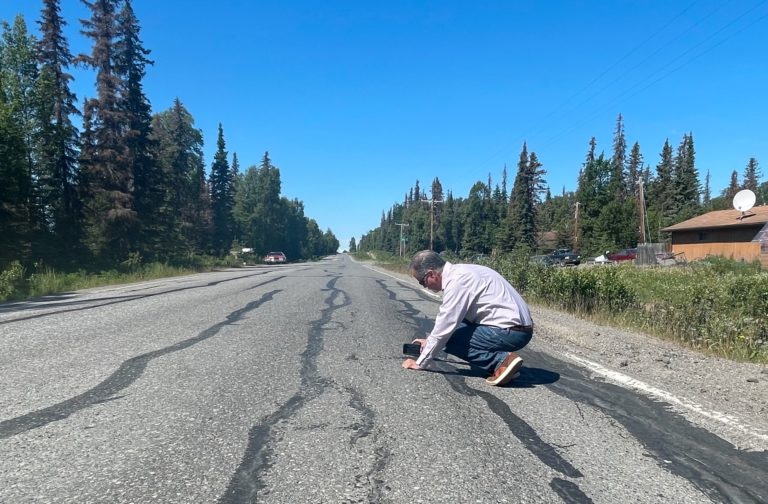
Sen. Peter Micciche was on South Miller Loop on his hands and knees measuring the ruts in the road on Wednesday morning after appearing on the Must Read Alaska Show. He’s going to make a case to the Department of Transportation to do some repairs on the road before winter. Nikiski, on the Kenai Peninsula, has a lot of bad roads, but those living in the South Miller Loop road area say it’s a “death trap.”

Micciche had received a complaint from someone in Nikiski, and so went out to see the problem with his own eyes — and took a measuring tape.

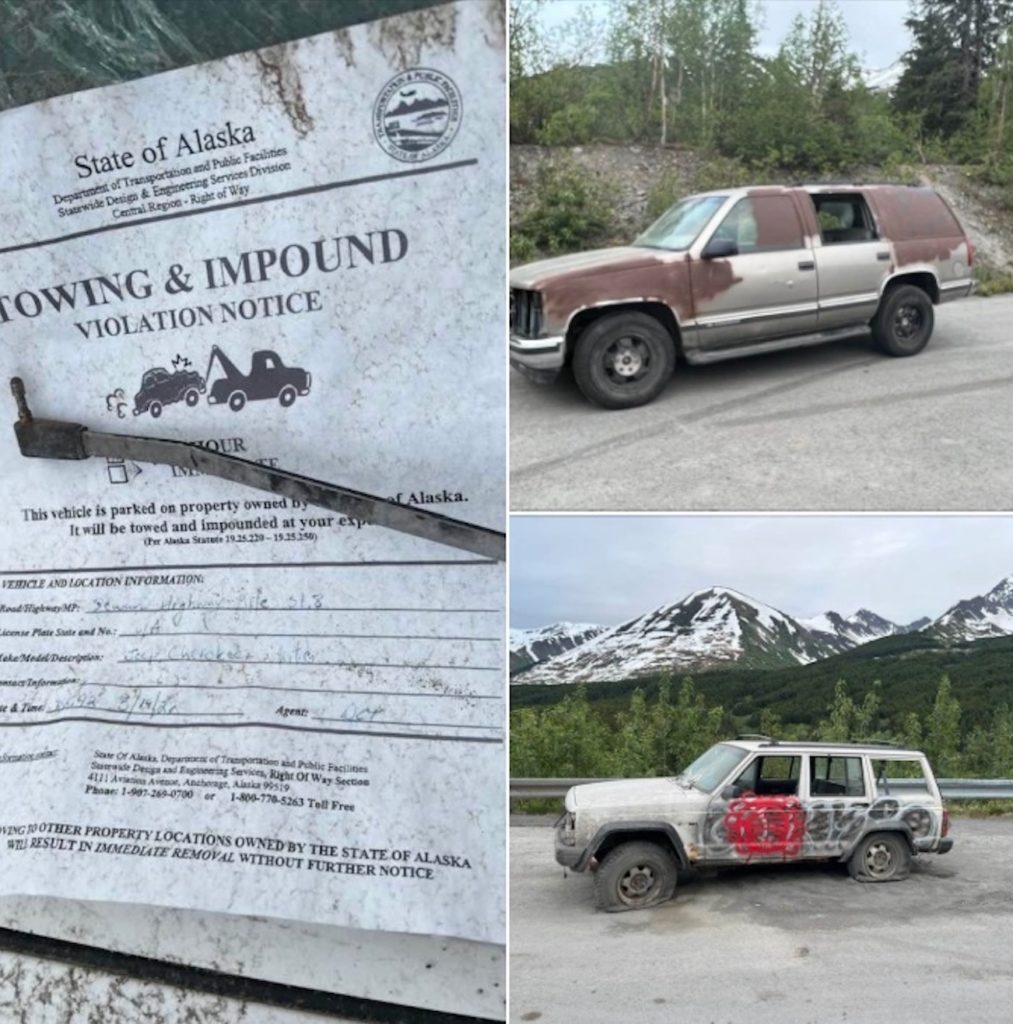
Last week, Micciche posted on Facebook that if DOT didn’t remove derelict cars from the side of the the Seward Highway he was going to go out there and haul them away himself. The cars were removed within 24 hours, and Micciche posted his profuse thanks to DOT on Facebook.

He’s not in campaign mode — Micciche is not running for reelection to the Alaska Senate.

Alaska Attorney General signs letter to Biden: Stop mandating unlawful transgender policies for schools

More than half of the state attorneys general in the country, including Alaska Attorney General Treg Taylor, have asked the Biden Administration to reverse new federal rules that require school districts to allow boys to compete on girls athletic competitions, use their locker rooms and gender-specific bathrooms or lose federal food dollars.

Last month the Department of Agriculture said it will include gender identity and sexual orientation on its list of protections under Title IX, the federal law that prohibits discrimination in schools based on gender.

Twenty-six out of the 27 Republican attorneys general signed the letter saying that “vastly expanding the concept of ‘discrimination on the basis of sex’ to include gender identity and sexual orientation, the Guidance does much more than offer direction. It imposes new—and unlawful—regulatory measures on state agencies and operators receiving federal financial assistance from the USDA. And the inevitable result is regulatory chaos that would threaten the effective provision of essential nutritional services to some of our most vulnerable citizens.”

The attorneys said in that the change in the interpretation is a wholesale change in the law, which is outside the legal authority of the department.

“We have long had a productive relationship with the federal government, managing various food and nutrition programs guided by the principles of cooperative federalism. We would like to continue this cooperative relationship. But the Guidance flouts the rule of law, relies on patently incorrect legal analysis that is currently under scrutiny in the federal courts, and was issued without giving the States the requisite opportunity to be heard. While we are always open to working with your Administration to resolve these matters, under the present circumstances we are constrained to ask that you direct Secretary Vilsack and the Department of Agriculture to rescind this Guidance,” the attorneys general wrote.

The entire letter is at this link.

Dunleavy appoints new member to Permanent Fund board, and it’s a name you’ll recognize

Gov. Mike Dunleavy has appointed Gabrielle “Ellie” Rubenstein to the Alaska Permanent Fund Corporation Board of Trustees. 

Rubenstein replaces Bill Moran, a Ketchikan banker who is retiring from the board after 16 years. Rubenstein will serve a four-year term beginning July 1.

Rubenstein is the daughter of famed billionaire and philanthropist David Rubenstein, founder of the Carlyle Group, which has had management of a small portion of the Permanent Fund, of up to $1.75 billion. David Rubenstein is among the world’s wealthiest and most influential individuals, a frequently featured guest at the World Economic Forum that takes places in Davos, Switzerland each January.

Ellie is also the daughter of the notorious former owner of the Anchorage Daily News (Alaska Dispatch), Alice Rogoff, who left the state after driving the state’s largest newspaper into bankruptcy. During her time at the ADN, Rogoff meddled in state government and politics, and steered Gov. Bill Walker through her election coverage. She famously hosted President Barack Obama at her home on Campbell Lake in Anchorage, and crashed her floatplane in Halibut Cove.

Ellie Rubenstein first moved to Alaska in 2001, and after completing her undergraduate degree, she moved to Anchorage. She has been a resident of the state for the last decade. She is a co-founder and CEO of Manna Tree Partners, a growth equity food investment fund that focuses on investing in family-owned food companies.

“Manna Tree closed its first fund just last year with $141.5 million,” Pitchbook wrote in 2021, “but the firm has already scored an exit with the IPO of pasture-raised egg maker Vital Farms, which went public at $657 million pre-money valuation last July. It has also backed indoor farming startup Gotham Greens, grass-fed beef producer Verde Farms and Evolve BioSystems, the maker of a probiotic supplement for infants.”

Ellie Rubenstein is said to be an avid angler, hunter, and pilot. She is the founder of a nonprofit that promotes outdoor wilderness, youth education, and military health and recovery programs.

She has dedicated time to the American Red Cross since first volunteering with the Red Cross of Alaska in 2014. Rubenstein earned her bachelor’s degree in sociology from Harvard University, her master’s degree in agriculture economics from Purdue University, and her MBA from Indiana University’s Kelly School of Business.

The Alaska Permanent Fund is an $80 billion sovereign wealth account that was established to secure oil royalties for the future, when Alaska would not be receiving as much from oil taxes and yet would still need revenues to run state operations. It is a constitutionally established perpetual fund that has been managed by the Alaska Permanent Fund Corporation since 1976. Alaskans receive a dividend from the fund’s earnings.