A floor sealant known as Hillyard Seal 341 was served to students enrolled in a latchkey youth program in Juneau. From the school district report:
On June 14, breakfast was served at Glacier Valley Elementary School to students enrolled in the RALLY program. All breakfast components were served by NANA Management Services staff and placed on food service trays, which students brought to a cafeteria table to consume.
Breakfast was served starting at 8:45 a.m, the district reported. Shortly thereafter, students complained of the milk tasting bad and burning their mouth/throat. Juneau School District RALLY and NANA staff immediately followed up by smelling/tasting the milk and looking at the container/label.
It was found that the “milk” served was actually a floor sealant resembling liquid milk. Staff immediately directed students to stop consuming the substance and removed it.
Twelve students ingested the floor sealant. The RALLY site manager immediately contacted poison control. All steps provided by poison control were carefully followed and parents/guardians of the students who ingested the chemicals were informed of the incident.
The school district food service supervisor and RALLY supervisor arrived at the school by 9 am. Upon arrival they found that the RALLY site manager was taking all the steps provided by poison control, checking in with students and staff, and reaching out the parents/guardians about the incident. One student received medical treatment at Bartlett Regional Hospital and two other students were picked up from RALLY and the parents may have sought medical advice.
The district food service and RALLY supervisors followed up with the NANA staff to ensure the served product was disposed of and the remaining product removed from the premises and placed in chemical/hazardous storage.
The investigation is continuing assisted by the district, City and Borough of Juneau, NANA and Juneau Police Department.
The World Health Organization’s director general said that WHO will rename monkeypox soon, because of stigma and racism.
Tedros Adhanom Ghebreyesus, WHO director general, announced Tuesday that the organization is working with partners and experts from around the world to change the name of monkeypox virus.
“Stigmatizing groups of people because of a disease is never acceptable. It can be a barrier to ending an outbreak as it may prevent people from seeking care, and lead to undetected spread,” WHO said on its website.
The disease has started to show up in countries where it is not endemic, outside the African continent. In America, there have now been 72 cases of the disease, which is spreading mainly among the promiscuous gay male community. The global case count has risen to 1,600; on May 20 there were but 80 cases identified globally. Today, the main outbreak is in the United Kingdom, with 470, Spain with 313, and Portugal with 231 cases. Germany has 229, Canada reports 142 cases, and France has 125 actives cases that are known.
“In the context of the current global outbreak, continued reference to, and nomenclature of this virus being African is not only inaccurate but is also discriminatory and stigmatizing. The most obvious manifestation of this is the use of photos of African patients to depict the pox lesions in mainstream media in the global north. Recently, Foreign Press Association, Africa issued a statement urging the global media to stop using images of African people to highlight the outbreak in Europe,” wrote a group of scientists in the journal Virological.
“Some cases have been identified through sexual health clinics in communities of gay, bisexual and other men who have sex with men. It is important to note that the risk of monkeypox is not limited to men who have sex with men. Anyone who has close contact with someone who is infectious is at risk. However, given that the virus is being identified in these communities, learning about monkeypox will help ensure that as few people as possible are affected and that the outbreak can be stopped,” the Centers for Disease Control said last month.
Symptoms of monkeypox include:
Rash with blisters on face, hands, feet, eyes, mouth and/or genitals
Fever
Swollen lymph nodes
Headaches
Muscle aches
Low energy
WHO says you can catch monkeypox if you have close physical contact with someone who is symptomatic. This includes touching and being face-to-face.
“Monkeypox can spread during close skin-to-skin contact during sex, including kissing, touching, oral and penetrative sex with someone who has symptoms. Avoid having close contact with anyone who has symptoms,” WHO says.
This is the first time that so many monkeypox cases and clusters have been reported concurrently in non-endemic and endemic countries in widely disparate geographical areas, according to WHO. Most cases are being identified through sexual health services in primary or secondary health-care facilities and have involved mainly, but not exclusively, men who have sex with men.
Meanwhile, the U.S. government has ordered 500,000 more monkeypox vaccine doses for delivery this year, according to the manufacturer, Bavarian Nordic of Denmark. The European Union has ordered 110,000 doses of the vaccine from the company.
Into the 1960s and ‘70s if a couple of your neighbors or relatives didn’t like you or wanted something you had, they could have the county sheriff haul you before the county judge to determine whether or not you were fit to participate in human society any longer. If your “friends and relatives” convinced the judge, you could be judicially committed to the state mental “asylum.”
That’s a more delicate way of saying you could be sentenced to life imprisonment without possibility of parole and you had no right of habeas corpus. They could also subject you to any sort of medication or therapy that they chose whether or not you consented. Therapy like snake pits and ice baths had about ended by the mid-20th Century, and surgical lobotomy had all but ceased. But electro-convulsive therapy (ECT) or “shock treatment” was still a fashionable tool. In essence ECT was just a non-surgical form of lobotomy because after a few treatments you’d have an IQ in the mid- to low- double digits and would no long pose a problem for anyone.
There had been a movement in the Country to do something about the medieval conditions in mental institutions and probably the greatest impetus to dramatically reforming the involuntary commitment process was the 1975 movie “One Flew Over the Cuckoo’s Nest,” which dramatically demonstrated the barbaric conditions and abuse in mental institutions.
The Democrats like to politicize the issue by claiming that their bete noir President Ronald Reagan cut all the funding for mental health, but actually there was little federal funding for mental health; it was a state and local issue and the citizenry had rejected the current system and would no longer support it. Unfortunately, we threw the baby out with the bathwater and today’s homeless camps are the legacy.
Now we are poised to bring the barbaric system back in the guise of “Red Flag” laws. Red Flag laws work about the same way as domestic violence laws; the naked assertion of someone you are associated with is enough to deprive you of your Second Amendment right to keep and bear arms. Just as is the case with domestic violence laws, your ex-wife to be or the teenaged kid you wouldn’t let take the car keys at midnight on Saturday night calls the cops and says you made them afraid and you have guns. If it is a domestic violence, they lead you out of your house in cuffs without even your toothbrush.
It won’t take them long to go that far with Red Flag, but for now, armed officers just come to your house and confiscate all of your firearms, no process, no hearing; they just take them. You can get a hearing to try to get them back.
Here is where we return to the medieval history of behavior not approved of by society. If you’re dumb enough you show up pro se to try to get your firearms back, but having an attorney that anybody but the wealthiest and best connected can afford isn’t much better than pro se.
You show up to tell the judge that you go to work every day, support your family, have no criminal records, and thus have a right to have your firearms back. The Soros-funded district attorney steps in and asserts that you made people frightened and not only should not have your guns back but pose a threat to yourself and others. The judge isn’t going to assume the role of psychiatrist, so s/he decides to refer you to the government’s mental health establishment to evaluate you and make a determination if you are psychologically fit to possess weapons or even move freely in society.
Now, there may be some government psychiatrists, psychologists, social workers and the like who aren’t left-wing loons, but I haven’t run into one in a long, long time. As a general matter if you go straight from college to government, you spend the rest of your life as a left-wing loon. A working class (and I don’t just mean blue collar, but any hourly wage employee not a member of the degreed elite) who might be registered as a Republican or who shows some indicia of voting that way, and who owns guns is by-definition insane to these people. You are a threat to yourself and others, so welcome to your new address at the looney bin.
You get out when and if your betters decide you should get out.
Art Chance is a retired Director of Labor Relations for the State of Alaska, formerly of Juneau and now living in Anchorage. He is the author of the book, “Red on Blue, Establishing a Republican Governance,” available at Amazon.
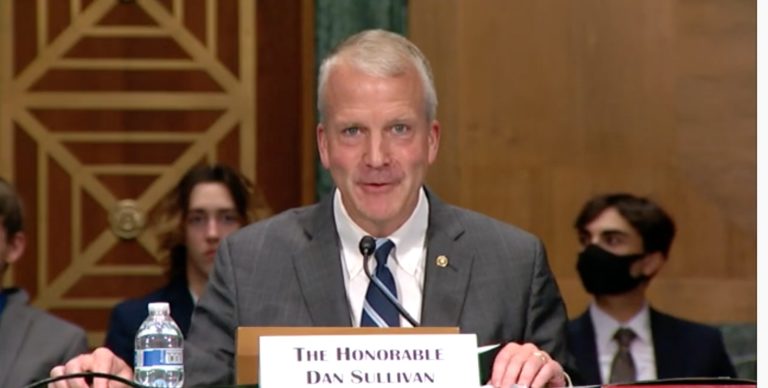
U.S. Sen. Dan Sullivan testified before the Senate Banking Committee today on the challenges posed by large asset managers that wield the enormous voting power of millions of passive index fund investors to control “virtually every large U.S. corporation.”
Sullivan spoke on the legislation he introduced last month—the Investor Democracy is Expected (INDEX) Act—that addresses problems stemming from the consolidated voting power within Wall Street’s largest investment advisers.
“The impetus for this legislation was due to my ongoing frustrations with many of America’s largest banks and insurance companies that undertook policies to start blackballing oil and gas investment development in Alaska,” Senator Sullivan saidto the Senate Banking Committee. “At the same time, these financial institutions, banks, and insurance companies were eagerly and continue to eagerly do business with Communist China. . .These financial institutions do this in part because of pressure from their largest shareholders, the big three investment advisors, and their index funds.”
Sullivan’s legislation is in response to the hypocrisy of America’s largest banks black-balling oil and gas development in Alaska and across the country while propping up the Chinese Communist Party, even as American families face record-high energy costs. This initial frustration uncovered a much larger concern about the sheer power that is consolidated among the three largest investment advisers: BlackRock, Vanguard, and State Street.
The INDEX Act would require investment advisors of passively-managed funds to vote in accordance with the instructions of fund investors—not at the discretion of the adviser. Deconsolidating this voting power will neutralize the dominance of these investment advisers and foster a healthier, more competitive, and more democratic corporate governance system.
“At its core, the INDEX Act is politically and policy-neutral focused instead on the very real and unprecedented power amassed by the big three investment advisors that should be a concern for us all,” Sullivan said. “It would return voting power back to the beneficial owners of the shares, not the index fund managers. In many ways, it’s a logical next step that was undertaken by Dodd Frank when broker-dealers used to be allowed to vote shares they held in street name. It would neutralize the massive power that the largest investment advisors have amassed and it would empower the real beneficial owner of these shares. It would foster a healthier and more competitive and democratic corporate governance system, which is what we should want and certainly what the American people expect.”
Original cosponsors of Senator Sullivan’s legislation include: Senators Pat Toomey (R-Pa.), Mike Crapo (R-Idaho), Chuck Grassley (R-Iowa), John Cornyn (R-Texas), Kevin Cramer (R-N.D.), Bill Hagerty (R-Tenn.), Marco Rubio (R-Fla.), Thom Tillis (R-N.C.), Steve Daines (R-Mont.), Cynthia Lummis (R-Wyo.), John Kennedy (R-La.), and Rick Scott (R-Fla.).
White House Press Secretary Karine Jean-Pierre dismissed concerns regarding President Joe Biden’s possible reelection bid.
In an interview with CNN’s Don Lemon late Monday, Jean-Pierre responded to a question concerning Biden’s potential inability to run again in 2024.
“Does the President have the stamina, physically and mentally, do you think to continue on even after 2024?” Lemon asked.
“Don, you’re asking me this question? Oh my gosh, he’s the president of the United States,” Jean-Pierre replied. “That is not a question that we should be even asking.”
The comments come after a New York Timesarticle reporting Democrats’ hesitancy to endorse Biden, who is 79, for a 2024 run.
“That article that we’re talking about is hearsay,” Jean-Pierre said. “That’s not what we care about; we care about how are we going to deliver for the American people, how are we going to make their lives better.”
U.S. Rep. Alexandria Ocasio-Cortez, D-N.Y., declined to endorse Biden’s potential running in 2024 during a different CNN interview.
“We’ll cross that bridge when we come to it,” Ocasio-Cortez said. “We’ll take a look at it.”
Biden’s approval ratings also show Democrats’ wavering support of the President. His approval rating sits at 41%, according to Reuters.
Specifically, voters claim that inflation is the most pressing issue, according to a poll by Quinnipiac University, with 64% disapproving of his handling of the economy.
When asked by a reporter on Monday about the issue of inflation, Jean-Pierre responded, “we know families are concerned about inflation and the stock market. That is something that the president is – is really aware of. And so, look, we face global challenges. We’ve talked about this. This is – we’re not the only country dealing with what we’re seeing at the moment as it relates to inflation.”
Defending her previous statements on the matter, Jean-Pierre has come out saying that Biden does indeed plan to run in 2024 on her Twitter account.
“To be clear, as the president has said repeatedly, he plans to run in 2024,” she said.
Gov. Mike Dunleavy has accepted Department of Natural Resources Commissioner Corri Feige’s resignation.
Commissioner Feige has served Alaskans from the beginning of the administration, and is leaving to devote more time to her family, the governor said. Her last day with the administration is June 30.
“Commissioner Feige is a shining example of what public service can be. Her list of accomplishments during her three years at the helm of DNR was impactful to say the least,” Dunleavy said. “She guided Alaska’s resource development industries through a pandemic without placing their employees at risk, asserted Alaska’s rightful ownership over submerged lands and positioned the state to be more self-reliant and food secure. Her legacy will be with Alaska for many years to come.”
Dunleavy will appoint an interim commissioner by June 30.
Earlier this month, Education Commissioner Michael Johnson announced he was leaving at the end of June. He is taking a job out of state.
The Donald Trump era has brought countless examples in which Democrats, bureaucrats, and the establishment news media wove a sensational tale that turned out to be false.
There’s the Russia collusion caper that wasn’t, the 51 security experts who wrongly claimed Hunter Biden’s laptop was misinformation, the Ukraine quid-pro-quo call that had neither a quid nor a quo, and the Moscow bounties on U.S. troops’ heads that never happened.
Now the Jan. 6 panel — led in part by the Russian collusion advocate Rep. Adam Schiff, D-Calif. — has been called on the carpet for falsely suggesting a GOP lawmaker ran a reconnaissance mission inside the Capitol for Jan. 6 protesters the day before the riot.
Ironically, the man who blew that whistle is the new Capitol Police Chief J. Thomas Manger, who got his job on House Speaker Nancy Pelosi’s watch but handed Republicans vindication on an allegation they long claimed was a smear.
Manger wrote in a letter Monday to Congress, which Just the News obtained, that an exhaustive review of security footage found no evidence that Republican Rep. Barry Loudermilk of Georgia did anything other than give constituents a tour of some congressional office buildings.
In fact, the chief said, the congressman didn’t even enter the U.S. Capitol with the group.
“There is no evidence that Representative Loudermilk entered the U.S. Capitol with this group on January 5, 2021,” Manger wrote in a letter to Rep. Rodney Davis, R-Ill., the ranking Republican on the House Administration Committee. “We train our officers on being alert for people conducting surveillance or reconnaissance, and we do not consider any of the activities we observed as suspicious.”
“All I can think of is this is a Soviet-style propaganda trial, like a show trial,” Rep. Claudia Tenney, R-N.Y., who spent time working in Communist Yugoslavia earlier in her career, told Just the News. “They put this tape together using propaganda, selected words and clauses cut and pasted to smear the people they want to smear and to get the outcome.”
“They put this tape together using propaganda, selected words and clauses cut and pasted to smear the people they want to smear and to get the outcome.”
– Rep. Claudia Tenney, R-N.Y.
Rep, Rodney Davis, the Illinois Republican who pressed Capitol Police to review the evidence and clear Loudermilk, said Democrats who besmirched his colleague’s name need to face accountability before the House Ethics Committee.
“The Democrats need to be ashamed of themselves,” Davis told the “Just the News, Not Noise” television show Monday night.
Former Georgia Rep. Doug Collins, who played a role unraveling the Russia collusion narrative, said Democrats have reached the political limits of the proverbial boy-cry-wolf tale, and it is time for their enablers in the mainstream media to push back. Some of the biggest names in media reported the Loudermilk allegations when they surfaced last month.
“I’m wondering how many of these political writers — The New York Times Washington Post, all these folks — are actually lining up to give the retractions,” Collins told Just the News. “…Let’s just be honest. They buy any narrative they can to impugn conservative congressmen, to malign Donald Trump, to make this event that they’re trying to pin basically on the conservative movement. And they’re willing to destroy lives, you know, really to do it without actually investigating, without reporting.”
The Loudermilk tale gives a case study on how an unsubstantiated claim spreads from one congressperson to the next, requiring weeks before officials knock it down with facts and evidence.
Or have you been swayed by the fear-mongering of the so-called “Defend our Constitution” group?
Have you been exposed to their arguments that a constitutional convention will be “dangerous and expensive?”
Let’s address their point of view, shall we?
They are telling us that a constitutional convention would draw in “an unprecedented amount of outside special interest groups and dark money to change Alaska’s laws to promote their own agendas, and make Alaska a guinea pig for national political agendas”. It is plainly displayed on their “Defend Our Constitution” website, www.defendakconstitution.com.
They also tell us it’s expensive, in fact, an unnecessary expense, of possibly $17 million.
I can’t help but wonder if Alaska voters will fall for this and other fear mongering exaggerations as we did with Ballot Measure 2 and the Bill Walker gubernatorial election. The consequences of the former have yet to be fully realized and the latter gave us Senate Bill 91, a total Alaska criminal law revision, through former state Senator John Coghill, who had to pass it before he read it, and Senate Bill 26 a percent of market value, or POMV, draw from the Earnings Reserve Account, which butchered the Alaska Permanent Fund Dividend Program.
But my argument is that our own Legislature cost us almost a quarter of a billion dollars in four years, and they have been relatively useless. A constitutional convention will be an opportunity for the citizens of Alaska to participate in an historic process to fix the things that are really wrong with our constitution, right the ship, and send a message to all political elite that we won’t stand for the status quo when it benefits so few.
On Tuesday, Nov. 8, 2022, Alaskan voters will have the incredible opportunity to decide whether to approve a constitutional convention. Alaska’s political elite currently enjoy the benefits of government the way it is. The fear-mongering is just a smoke screen to hide this fact, create an artificial crisis and use their special interests and dark money to perpetuate it. Don’t buy it.
Here’s an example of how things can go wrong with our current constitution in place:
A day before the U.S. House of Representative special election voting ended, the Alaska Human Rights Commission (AHRC) got an Alaskan Superior Court judge to rule that the State of Alaska cannot certify this mail-in election because the Division of Elections did not provide an adequate way for blind people to vote privately in all areas of the state.
Fortunately, the Alaska Supreme Court overruled this opinion on the day voting ended, but still, I can’t help but wonder why a state agency couldn’t have gotten things settled prior to the cost of litigation and, more importantly, was the intention of this litigation aimed at adversely impacting the special election? Just another smoke screen hiding their real intentions?
For me, it marked another instance of state bureaucracy weaponization using a government agency to restrict its constituency. This was an action designed to upset our constitutional process as well as potentially deprive the Alaska voters of equal protection under the law.
Personally, I see the constitutional convention as an exciting opportunity for the constituency to come together as a state to decide what changes to the constitution are needed. I also think the attempt by a state agency, AHRC, to subvert the special election is another reason why a constitutional convention is timely and necessary.
When considering an Alaska constitutional convention, here are some things to think about:
One important distinction is its delegate membership composition. A constituent assembly, another name for a constitutional convention, signifies that the delegate composition is chosen from our Alaskan constituency and not necessarily from our legislature.
Our state constitution is the foundation of Alaska’s public policy. But what is public policy?
Because “public policy” is such a general term, both the Alaska Supreme Court and the United States Supreme Court have avoided giving it any specific definition.
From my perspective, public policy is either top-down or bottom-up government.
In other words, does Alaska’s constitution promote public policy as government restricting its people? Or the people restricting their government?
When you think of a constituent assembly, do you agree that its main goal must be a thorough discussion on the strong constitutional protection of the principles of limited government and that these principles include the preservation of individual rights and the maintenance of strong legal constraints on our state government’s size and scope?
Given the past decades of state government operations, do you have faith in the people operating our government institutions?
Do you think Alaskans have lost faith in the constitutional mechanisms which maintain our government’s operations?
Does our state constitution conflict with our U.S. Constitution?
Does Alaska’s public policy encourage or restrict growth?
Did you know our state constitution was fashioned by a majority of FDR New Deal Democrats who wanted to construct a model utopian state during a time when the expansion of government control and power was the goal of the federal government?
How’d they do?
I can’t for the life of me understand why a constituent assembly is so dangerous, unnecessary, and expensive outside of disturbing the political elite’s self-interest and selfishness to maintain power and control over the wealth of our state, one of the greatest undeveloped natural resource development communities in the world.
If we as a state had from statehood educated our children in civics, our state constitution, and our US Constitution, would we be having these fears and doubts now? Unfortunately, having already deprived our children of a sound civics education, we find Alaska’s political elite now condescend and patronize Alaskans with yet another crisis.
It seems to me that a repetitive 10-year event with our citizenry educated in this manner would be something to look forward to.
Their sole intent is to continue to control the money and the power in this state through fear and artificially created crises.
“Crisis is the rallying cry of the tyrant.” James Madison
A constitutional convention is necessary.
Michael Tavoliero is a realtor in Eagle River, is active in the Alaska Republican Party and chaired Eaglexit.
Our coverage of bits and pieces from the campaigns continues. If you love this coverage, consider keeping Must Read Alaska going with a donation. Thank you!
135,712 votes are in (only 108,981 are counted) in the special primary for the congressional seat that is vacant. That means 80% of received ballots are counted, but more are still coming in and to be counted and announced Wednesday.
Festivals and appearances: Nick Begich, a leading candidate for Congress, was a the Kenai River Festival on Sunday, and then at a fundraiser for Tuckerman Babcock for Senate in Soldotna, talking to hundreds of Alaskans on the Kenai all day Sunday after a rocking Saturday in Palmer at Colony Days Parade. He was also on the Dan Fagan, Duane Bannock Show, and Mike Porcaro Show on Monday.
Sarah Palin, the top vote-getter for Congress in the primary, showed up at the School of Government on Monday night; the conservative social group in Palmer is organized and hosted by Mat-Su Mayor Edna DeVries, and Palin’s first appearance there was not to give a speech, but just to do a Q and A.Video on Must Read Alaska here.
When asked about why she endorsed Bill Walker and Democrat Byron Mallott for governor and lieutenant governor in 2014, (Minute 22:30) Palin said a lot of people wanted him to be governor and voted for him, and she didn’t know he was going to turn out the way he turned out. Walker is pro-abortion.
Palin also defended signing the economically destructive ACES oil tax legislation that killed oil production in Alaska for years after she left office.
At Minute 30, she claimed President Obama’s righthand man said he voted in Alaska and yet he doesn’t live here.
At Minute 32, she answered the accusation that she was a big spender.
Rejection slips: Rejected ballots from the special primary election are coming in significantly higher from areas where people had also, just two years prior, voted in favor of Ballot Measure 2, which brought Alaska the nightmare elections scenario now playing out:
House District 38 (Bethel) 17.99% ballots rejected
House District 39 (Nome) 15.38% ballots rejected
House District 40 (Kotzebue + Utqiagvik) 12.33% ballots rejected
House District 37 (Bristol Bay + Aleutians) 12.19% ballots rejected
House District 19 (Anchorage – Mountain View) 9.33% ballots rejected
The district with the least percentage of rejected ballots?
Fairbanks-Goldstream House District 4, the university area of Fairbanks, with less than 1% rejected ballots. The state average in this election for rejected ballots is a new record at 3.56%.
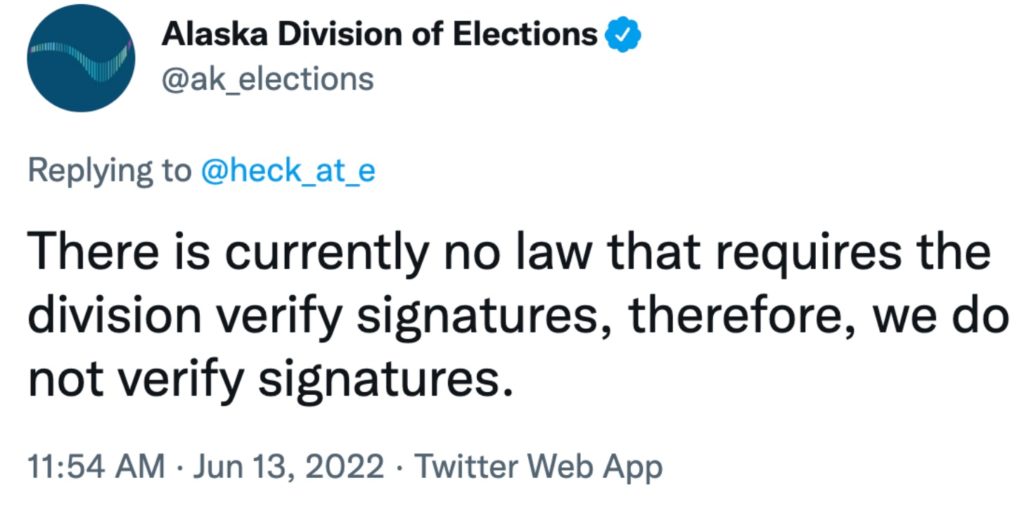
Signatures verified? It’s not that the signatures on the rejected ballots being tossed — the Division of Elections does not even verify signatures. Seriously. You can write in Mickey Mouse. So it’s something else:
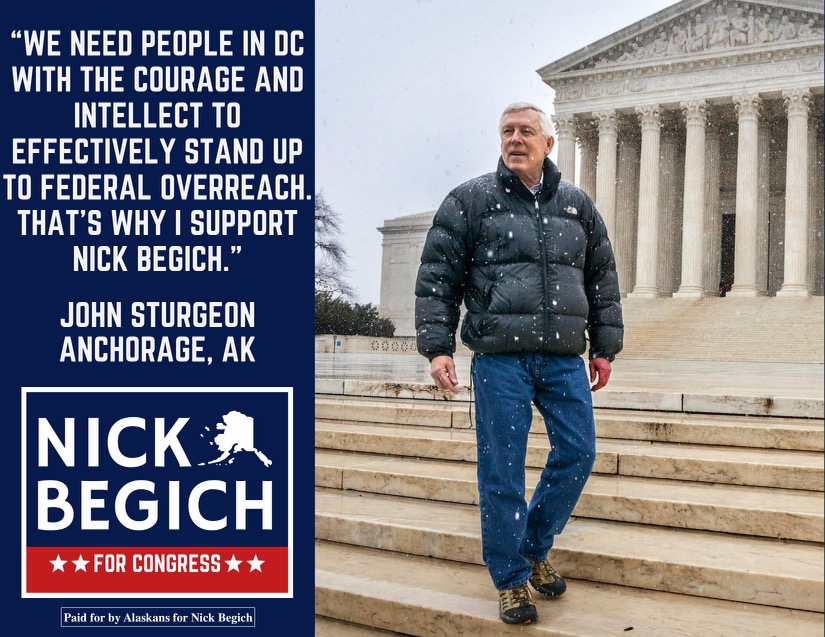
Endorsements: John Sturgeon, outdoorsman and hunter who took his case to the U.S. Supreme Court and won — twice — endorsed Nick Begich for Congress. Patti and Art Mathias endorsed Sarah Palin for Congress.
Alaska voters chose Republicans: More than 60% of the vote for the Special Primary Election went to Republican candidates, with Democrat candidates getting less than 15% support, according to the nearly 109,000 votes that have been tabulated. The chart:
Kelly Tshibaka in Fairbanks: U.S. Senate candidate Kelly Tshibaka, a Republican, was in the Golden Heart City for the military appreciation ball, where Lisa was one of the speakers, along with General “Mad Dog” Mattis.