Sunday, May 10, 2026
Home Blog Page 897

Column: Vote yes on homeless navigation center

By MAYOR DAVE BRONSON, ASSEMBLYMAN FELIX RIVERA, FORMER ASSEMBLYMAN JOHN WEDDLETON

This week, the Anchorage Assembly will consider plans to construct a homelessness navigation and prevention center on the Anchorage Police Department campus near Tudor and Elmore roads. After many months of collaborative work and constant refinement through public input, we believe that our bipartisan proposal is sound, humane, and represents the most significant opportunity we’ve had in decades to turn the tide on homelessness.

We urge a yes vote on our resolution funding construction of the navigation center.

The navigation center will serve as a point of entry to treatment programs, specialized shelters, and permanent supportive housing all across Anchorage. In the same way that emergency rooms triage and transfer patients to specialized care, the navigation center will be a welcoming facility, staffed by competent navigators whose job is to connect clients to income, benefits, healthcare, and housing.

A key element of any navigation center is a “housing first,” low-barrier approach that prioritizes housing and deprioritizes admission requirements. This means accepting family configurations that traditionally struggle to gain access to shelters – single adults, couples, elders with a caretaker – and working to quickly place them into permanent housing. Only when this most basic human need is met are clients able to meaningfully engage with wrap-around services and address the root cause of their homelessness.

Earlier this week, we had another opportunity to share our plan with the public, and by Thursday’s Assembly meeting the administration will have provided nearly 300 pages of documentation to policymakers and the public. While some cost escalation due to inflation is to be expected in today’s economy, the building is currently priced at $9 million. Preliminary estimates for operating costs are $5 million per year. To put this amount into perspective, current municipality-run shelter operations cost more than $6 million each month. Even with inflation, the navigation center will unequivocally be a cost saver.

The steel-membrane structure, complete with skylights and windows, will be a tremendous leap forward over the ill-suited Sullivan Arena. While the 200-bed sheltering capacity of the navigation center will be temporary, the facility will be permanent – providing homelessness prevention services and meeting other community needs for many years to come. For those worried about winter conditions, rest assured that Sprung structures are already in use on the North Slope, Siberia, and even the Andes Mountains.

None of this would’ve been possible without your feedback. The facility will be designed for 200 clients, and emergency capacity will only be activated in the event of a true crisis. We’ve brought in the Anchorage Fire Department to develop fire mitigation plans, and we will continue to work with our safety partners to ensure pedestrian safety.

While we recognize that the location will always be a point of discussion, it’s worth remembering that the current site was selected after a review of over 70 locations around town. In truth, every one of us lives near a homeless shelter. The shelters are on our trails, in our parks, and behind our businesses. It’s up to us to fix this, and we believe the selected location is the best site by a long shot.

As we move forward, it’s important to maintain perspective. The navigation center is just one part of a comprehensive transition plan from mass sheltering to sustainable operations. On Monday, we celebrated the opening of the Sockeye Inn which will soon provide 61 private rooms for the medically vulnerable. Last Thursday, the Anchorage Coalition to End Homelessness processed over 100 applications for permanent housing from clients at the Sullivan Arena, and we’re very close to securing an additional 120 rooms at the GuestHouse Inn for workforce and supportive housing.

Private entities are also hard at work bringing additional services online. Partnering with the municipality, the Salvation Army is on the verge of reopening its 68-bed substance misuse treatment facility on 48th Avenue. On Third Avenue, the Rasmuson Foundation, Weidner Apartment Homes, Bean’s Café, and Catholic Social Services are working together to open a navigation center as early as next year. These private service providers will continue to bear the lion’s share of homelessness efforts in Anchorage, and we’re tremendously grateful for their efforts.

There’s no denying that the challenge that lies ahead is enormous, but all of us believe that we’ve never been better positioned to make a real difference. Our coalition represents every political stripe and point of view – whether you’re after safer trails, a more vibrant economy, or you share our belief that we have a moral obligation to protect the vulnerable and marginalized, we welcome you to our cause.

We call on the full Assembly to join us with a yes vote on navigation center funding.

Dave Bronson is the mayor of Anchorage. Felix Rivera represents Midtown on the Anchorage Assembly and is the chair of the Assembly’s Committee on Housing and Homelessness. John Weddleton represented South Anchorage on the Anchorage Assembly.

Win Gruening: Constitutional convention would open up a can of worms

By WIN GRUENING

In 1972 and four times since, Alaska voters were presented with the question “Shall there be a Constitutional Convention?” Each time, voters have declined the invitation.  In 2002 and 2012, voters turned it down by a 2-1 margin or greater.

On Nov. 8, 2022, voters will once again be asked to answer the question.

The purpose of a constitutional convention seems quite straight-forward but its impact could be far-reaching and potentially lead to unintended consequences.  

Fortunately, there is a better alternative.

Alaska is one of 14 states requiring a mandatory vote on this question periodically. The Alaska Constitution calls for the question to be automatically placed on the ballot every ten years, but it’s only recently that the prospect of a convention has been taken seriously. 

There are a number of reasons for this but the primary cause is voter frustration with persistent partisan gridlock in our legislature.  

For many, a constitutional convention is seen as a way to settle questions surrounding the Permanent Fund.  How the Permanent Fund should be used, including the dividend formulation and which government services it could support, is often promoted as a reason to hold a convention.  But there’s no guarantee that agreement could be reached on that subject or that discussion would be limited to that one issue. Indeed, judicial appointments, statewide taxes, and abortion are also cited as likely topics.  

While arguments have been made that discussion could be limited to certain subjects, the Constitution is explicit:  “Constitutional conventions shall have plenary power to amend or revise the constitution, subject only to ratification by the people. No call for a constitutional convention shall limit these powers of the convention.”

Even more radical changes could be adopted. One proposal would change Alaska’s municipal governments to 5-member county boards with an elected sheriff and an appointed state senator.  Other politically divisive issues such as school choice and subsistence rights could be raised.  

The convention process involves three separate public votes. The first is whether to call a convention, the second is to elect convention delegates, and then a final vote is taken on whether to approve any constitutional amendments.  This entire process could take as long as four years.

During this time, Alaskans and businesses would be in limbo as taxes, environmental regulations, education, and more could be subject to change and create years of economic, legal, and regulatory uncertainty.

It’s questionable that a constitutional convention would accomplish what promoters claim – especially in Alaska where the guidelines and timelines for selecting delegates and proposing and approving amendments are unique.  

Alaska’s Constitution states: “…delegates to the convention shall be chosen at the next regular statewide election, unless the legislature provides for the election of the delegates at a special election. The lieutenant governor shall issue the call for the convention. Unless other provisions have been made by law, the call shall conform as nearly as possible to the act calling the Alaska Constitutional Convention of 1955, including, but not limited to, number of members, districts, election and certification of delegates.”

Proponents frame the arguments for a convention as a way to bypass the Legislature and let the “people” finally have their say.  Yet, the delegates to such a convention, in most cases, will be the currently elected representatives from voters’ districts. Legislators would be expected to run as delegates from their districts to the convention.  They have campaign staffs, name recognition, and popular support.  

It doesn’t seem likely that a convention populated mostly by sitting legislators would be much different than what happens in every legislative session.

Alaskans could spend millions of dollars on an unnecessary, lengthy, and acrimonious process that could have been avoided.

Alternatively, as with 17 other states, Alaska allows constitutional amendments to be referred to a state-wide ballot with a two-thirds vote in the state legislature.  If our constitution needs to be amended, this is a proven approach, having been used successfully 28 times since Statehood.  Unlike a convention, proposed changes are considered individually.  An amendment would be researched, debated and vetted in a deliberative way without the political theater of a convention. 

Requiring a super-majority of legislators to approve a constitutional amendment for the ballot is a high bar for a reason. Once a proposed constitutional amendment is referred to the ballot, only a simple majority vote is required to pass it. The legislative super-majority rule prevents our constitution from being changed without broad public support.

Our founding document has served us well since 1959.  Since then, it has been hailed as a model constitution for its brevity, flexibility and protection of individual rights. Extensive alterations are unnecessary and a constitutional convention is not the mechanism best suited to make incremental adjustments.

After retiring as the senior vice president in charge of business banking for Key Bank in Alaska, Win Gruening became a regular opinion page columnist for the Juneau Empire. He was born and raised in Juneau and graduated from the U.S. Air Force Academy in 1970. He is involved in various local and statewide organizations.

Cost of government: Revak rolls Senate committee leadership to get lavish state pension plan reinstated

It’s not enough that Alaska has the highest unfunded pension liability in the United States, per capita. A Republican running for Congress now wants to add more debt to Alaskans.

Alaska State Sen. Josh Revak led the charge on Wednesday get a bill out of the Senate Labor and Commerce Committee. HB 55 would give a costly defined benefits package to first responders. It’s the first step to getting defined pensions back for all State employees.

At a time when the Legislature cannot see its way to pay Alaska Permanent Fund dividends still owed to Alaskans, it may force this bill to the governor’s desk during his re-election year.

On behalf of Democrats in the House and Senate, Revak unexpectedly filed a “Rule 48” memo to force the bill into the final committee of referral, the Finance Committee. This is a last-resort measure, but for Revak, it’s a first resort.

Labor and Commerce Committee Chair Mia Costello has scheduled a hearing for Saturday on the bill but is unclear if the signatories in the Rule 48 memo are available for the committee hearing.

Most in the Capitol believe Revak’s action is a play is to get the public safety union endorsement for his anemic congressional campaign. Revak filed for Congress after Congressman Don Young died.

The Alaska Policy Forum and Americans For Prosperity both oppose HB 55, saying there are ways to create defined benefit plans that are fiscally neutral, but this is not the way.

Across the country, state pension plans are bankrupting governments. There have been repeated efforts in Congress to allow governments to declare bankruptcy in order to reneg on the pension benefits that are promised to state workers.

In Alaska, the now-defunct pension plan has $5.4 billion to $31 billion in unfunded liabilities as of 2020, depending on how the sources determine assumptions. On a per-capita basis, it’s the highest unfunded liability pension in the nation, according to ALEC, the American Legislative Exchange Council. Pew Research shows Alaska is 67 percent unfunded in its existing pension debt.

Those favoring HB 55 say that a pension for first responders will help with worker retention.

Those opposing the bill say it will bring with it huge financial risk for the state, that it has not gone through rigorous stress testing, and that it will add to unfunded liabilities that the state may not be able to pay to future first responders, especially as no new oil is coming online in Alaska, and Alaska is increasingly relying on the Permanent Fund to pay for government.

Other critics of the bill point out that 86 percent of police stations around the country face retention issues and yet most of them are in a traditional pension systems, like the one Revak is pushing to restart in Alaska.

When Alaska had a pension plan for public employees, the state’s debt skyrocketed, from $1 billion to $4.5 billion in a two-year period between 2007 and 2009. Alaska has moved to a 401K program to be more fiscally responsible, but the state is still saddled with paying off the old pension plan obligations.

Sponsors of HB 55 are Democrat caucus members Reps. Andy Josephson, Chris Tuck, Adam Wool, Matt Claman, Zack Fields, Liz Snyder, Bryce Edgmon, Ivy Spohnholz, Andi Story, Harriet Drummond, Daniel Ortiz, Cal Schrage, and Republicans Sara Rasmussen and Kelly Merrick.

In the Senate, the sponsors of the bill are all Democrats: Tom Begich, Elvi Gray-Jackson, and Bill Wielechowski.

For political reasons involving union endorsements, Sen. Revak has joined the Democrats to lead the effort and move the bill to a vote.

five-year cost analysis report by consultant actuary Buck Global on behalf of the Legislature raised serious concerns: “Adverse plan experience (due to poor asset returns and/or unexpected growth in liabilities) or changes to more conservative assumptions will increase the plan’s unfunded liabilities, which results in higher Additional State Contributions.”

It also said that the impact of HB 55 on projected Additional State Contributions “depends on how large the unfunded liabilities become. If the Actuarially Determined Contribution rate for HB 55 members’ pension and healthcare benefits exceeds 9%, then HB 55 will lead to larger increases in Additional State Contributions compared to what would have happened without HB 55…By shifting active P/F members (and all future P/F hires) from DCR to DB, the State will be taking on greater risk of higher contributions in future years.”

The Buck Global report warns that analysis that HB 55 would commit Alaska to unpredictable long-term costs in the future.

FCC, DOJ, FTC were asked to block Musk purchase of Twitter; feds announce they will more closely monitor disinformation with a new governance board

The government is watching the evolution of Twitter into a free speech platform and making some plans of its own to curtail disinformation. Within 48 hours of the purchase of Twitter by Elon Musk, the Department of Homeland Security announced it is creating what the Biden Administration calls a “Disinformation Governance Board,” designed to fight disinformation and misinformation ahead of the 2022 midterm elections. Others are calling it a “ministry of truth.”

Earlier in the week, the Open Markets Institute said the FCC, Justice Department and Federal Trade Commission should block Musk’s purchase of social media giant Twitter.

FCC Commissioner Brendan Carr responded to the institute’s request: “The FCC has zero authority to block Musk’s purchase of Twitter. And it is particularly frivolous to ask the agency to do so in the name of protecting free speech and open debate.”

The focus at the outset of the new Disinformation Governance Board project will be on what the government calls “irregular migration” (also known to regular Americans as illegal immigration) and Russia.

Heading up the governance board is Nina Jankowicz, who was a disinformation fellow at the Wilson Center. She previously advised the Ukrainian Foreign Ministry as part of the Fulbright Public Policy Fellowship and oversaw Russia and Belarus programs at the National Democratic Institute. 

Jankowicz has a social media history of sharing misinformation and disinformation about former British spy Christopher Steele’s discredited dossier that led to the Durham report.

Jankowicz has also on social media distorted information about Hunter Biden’s missing laptop and his dealings in Ukraine.

In addition to the new “ministry of truth” board, the federal government is taking other steps relating to the internet. The State Department and White House’s National Security Council is launching on Friday a “Declaration for the Future of the Internet.” The virtual launch will be broadcast from the White House with more than 50 partners from around the world.  

“The Declaration is a political commitment among partners to advance an affirmative vision for the Internet and digital technologies,” the State Department says. The launch will be livestreamed to the public on www.whitehouse.gov/live. Following the launch, the Declaration of the Future of the Internet will be posted at www.state.gov.

The document has goals of opposing discrimination based on gender identity, quashing state-sponsored cybercrime and disinformation, and condemning Internet outages that are meant to block access to information. Also, there are references to human rights, rule of law, child exploitation, and creating a safe internet that is free from “discrimination based on race, ethnicity, political beliefs, gender identity, and sexual orientation. Online safety should include forbidding gender-based attacks and child sexual exploitation,” according to a leaked draft of the document.

The declaration has gained traction in recent months as Russia and China threaten to disconnect from the internet. Signatories include the U.S., European Union, United Kingdom, Japan, Canada, and South Korea. Ukraine may also participate in the announcement.

The declaration is also supportive of the principles of net neutrality and opposes “misusing or abusing the Internet or algorithmic tools or techniques for unlawful surveillance, oppression, and repression that do not align with international human rights principles, including developing social scorecards or other mechanisms of domestic social control or pre-crime detention and arrest.” 

Fritz Pettyjohn: Sarah Palin, Trump, and Alaska lands

By FRITZ PETTYJOHN

Alaska is fortunate in having Sarah Palin running for Congress. Because she has had a long and close association with Donald Trump, she has his enthusiastic support. She’s in an ideal position to get him to reconsider his opposition to the transfer of federal lands to the state.

Sixty-one percent of Alaska is owned by the federal government. Other states of the mountain west, such as Nevada, Utah, Idaho, Montana, Wyoming have similarly large portions of their lands under federal ownership. There is no justification for this absentee land ownership. It’s an antiquated residue of the situation which prevailed at the time they were admitted to the union. Nevada, for instance, was admitted in 1864 when it had less than 40,000 people. At the time, it made sense to keep 90% of the state under federal control. It doesn’t make sense anymore.

Because of decades of federal mismanagement, the west suffers from repeated catastrophic wildfires. Forest lands under state ownership are, by and large, properly managed, and wildfires are contained. Forests under state management are revenue producers. In contrast the federal government spends vastly more than it receives in revenue. The Property and Environment Research Center, (PERC) of Bozeman, Montana, has studied this issue in depth, and has volumes of research supporting the transfer of federal lands.

PERC’s data shows that under state ownership, resource development of all kinds can provide revenue, jobs, and vitally needed commodities such as oil and minerals, including rare earth minerals. The federal government is not a wise resource manager. It is subject to political pressure from the rabid environmentalists who oppose responsible resource development. Because it is their land, Alaskans can be trusted to manage it properly. 

When he was running for President in 2016, Trump gave an interview with Field and Stream magazine, and he addressed this issue. When asked about the transfer of federal lands to the states, he said, “I don’t like the idea because I want to keep the lands great, and you don’t know what the state is going to do.” 

This is the position of Safari Club International, a group of wealthy trophy hunters. They fear that under state ownership, residents would be given a preference in the taking of fish and game. As non-residents, their access could be restricted, so they lobby against any transfer to the states. Trump’s son, Donald Trump Jr. is an active member of the Safari Club and was the keynote speaker at its 2020 convention. He has convinced his father to take the Safari Club’s side against the states. 

Former President Trump seems to be making plans to run again in 2024. If he does, he needs to reconsider his position on this issue. Sarah Palin is perfectly positioned to make the case to him on behalf of the state of Alaska. If she is able to succeed, she would be doing him a favor. 

Trump’s position against the transfer was politically costly in 2016. His principal opponent, Ted Cruz, came out strongly in favor of returning these lands to the people who live on and around them. As a direct result, he was able to win the primaries and caucuses of northern Nevada, Alaska, Idaho, Wyoming and Utah. In 2024 Trump would be opposed by others seeking the Republican nomination. Following the Ted Cruz playbook, they will certainly also support the transfer of federal lands. Trump should do likewise. It’s in his own political self-interest.

Trump has promised to visit Alaska to support Palin’s candidacy. If he does, it will be a perfect opportunity for Alaskans to try to persuade him that they can be trusted with their land.

Fritz Pettyjohn worked for the Ted Cruz for President Committee in 2016, and promoted his candidacy in Alaska.

States Newsroom in Alaska will soon be largest political news organization in state

The States Newsroom, a progressive news organization funded by liberal philanthropic interests, will soon have the largest staff of political reporters in Alaska.

Yereth Rosen has announced she has been hired as the news organization’s fourth employee, working out of Anchorage. She has been working as a writer for Reuters, and for Arctic Today, an online publication owned by Alice Rogoff, former owner of the Alaska Dispatch News, which is now the Anchorage Daily News. She was also a reporter for the Alaska Dispatch News.

Rosen joins Andrew Kitchenman, who is leaving KTOO-FM’s newsroom; James Brooks, who is leaving the Anchorage Daily News; and Lisa Phu, who is leaving the Juneau Police Department, where she was a public information specialist.

Rosen will cover political news from Anchorage, while Kitchenman, Brooks, and Phu are based in the capital city.

The States Newsroom characterizers itself as an unbiased news source but is ideologically driven and backed by some of the biggest names in dark money in politics, including the Arabella Advisors, the Hopewell Fund, and others who have given to the news project, which intends to shape the narrative toward the Democratic Party. States Newsroom is tax-exempt and was listed by the Nieman Foundation for Journalism as a collection of “hyper partisan sites … masquerading as local news.”

Gay politics: Anchorage man rages at Assembly because two gay-theme books are not in public library

39

“Maurice,” is a gay-themed romance novel, considered mediocre by literary standards, by author E. M. Forster. It was published posthumously. “2020” is a collection of poetry by poet Louise Gluck that won the Nobel Prize.

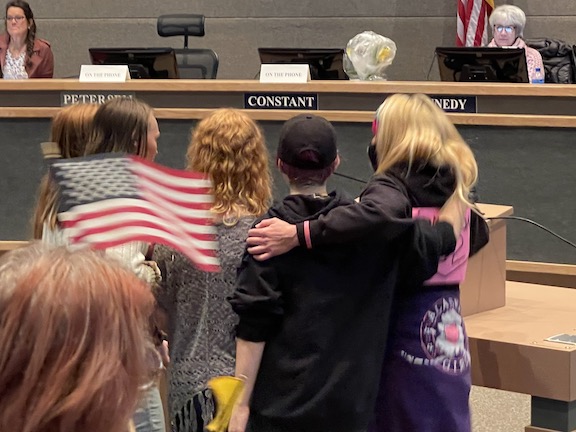
An Anchorage man, River Ramuglia used his three minutes at the podium on Tuesday night to rage at the Anchorage Assembly because these two books are not in the Loussac Library collection.

The Gluck poetry collection is available in the library’s collection of e-books. The Forster novel is available at the UAA library, but is not in the Anchorage Public Library stacks. It is widely available online as a free download, however, all over the internet.

The two books, according to Ramuglia, saved his life as a gay man. He threw his copies down and called them his “carcass.”

Assemblyman Chris Constant was aghast, and agreed with Ramuglia that the Forster gay romance novel should be in the library.

The man also demanded that the Bronson Administration allow him to interview the nominee for library director. Watch his testimony:

Matthew Beck, the Blue Alaskan author, comes out of closet and is new comms director for Alaska Democrats

Jeanne Devon, Communications Director of the Alaska Democratic Party, announced her departure from the position she has held since 2018.

She came to the role as the author of The Mudflats blog, and Press Secretary for the Alaska Senate Democrats.

“ADP is thrilled to announce that Matthew Beck, who has been writing The Blue Alaskan blog since 2020 will be stepping up to take on the role of Communications Director. He has already onboarded and will be ready to take the reins when Devon departs on May 13,” the Alaska Democratic Party wrote.

The party provided no other background information on Beck, other than to say:

“There couldn’t possibly be a better person to fill this critical position in the ADP staff,” said Lindsay Kavanaugh. “Matthew has proven for the last two years that he has the chops, the talent, and the values that will serve him well in this role. Sometimes in Alaska we think that we have to settle, or to compromise our values. He knows and understands that we are proud to be Democrats and that our values mean something. Alaska is becoming more blue, more diverse, and his outstanding work at The Blue Alaskan exemplifies this.”

“I have absolutely loved my time at ADP,” said Jeanne Devon. “Working to inform Alaskans, elect Democrats, and promote our values has been both a privilege and an honor. But Matt taking the position is a huge win for Democrats across the state. He is passionate, dedicated, and like me started off as an anonymous blogger who worked on a volunteer basis for years – not because of money, but because of genuine commitment and caring about the people of Alaska. That’s what we need more of. I’m excited to see him make this role his own, and light a fire under Democrats as we head into the critical and unprecedented election season of 2022. And to everyone in the true-blue political circle I have been proud to call home since 2008, I thank you for your support from the bottom of my heart.”

The Blue Alaskan has been operating anonymously for two years, providing Democrat operatives talking points and deep state information. It is aligned with the Anchorage Press, which often reprints its stories.

Trevor Project, which advised Anchorage Assembly on banning conversion therapy, is grooming children online

The organization that helped the Anchorage Assembly adopt an ordinance banning counselors from helping children overcome gender confusion also has a website feature that counsels kids online and helps them hide their online chat history from their parents.

The Trevor Project provided legal counsel and other services to the liberal majority of the Anchorage Assembly during the contentious 2020 debate over whether local government should curb First Amendment rights of counselors. Must Read Alaska has made public records requests for documents relating to the legal advise it was being given by the Trevor Project, but the Assembly has claimed attorney-client privilege, even though there was no legal contract with the D.C. organization.

The documents requested by Must Read Alaska and others in the community have been redacted so that the email conversations between gay Assembly members Chris Constant and Austin Quinn-Davidson, and the Trevor Project attorney and organization advisors cannot be read. The public continues to be kept in the dark about the intentions of this group of gay activists; none of the gay activists on the Anchorage Assembly have children.

The Trevor Project, as it grooms children online, gives kids with an exit feature on its live-chat function that erases the chat history, so parents cannot monitor who is interacting with their children.

Children who stumble upon the Trevor Project are interacting with strangers who are taking an interesting the youngster’s sexuality.

Trevor Project uses Twitter to entice children into its universe.

One mother posed as a 15-year-old and reached out to the Trevor Project chat line. Her account was first published in the website The Post Millennial:

A mother who is dealing with her own child’s gender dysphoria posed as a 15-year-old gender dysphoric biological female to access services online with the Trevor Project on Sunday. She found that every step of the way, she was guided further and further into affirmation of being trans, with no stop gaps along the way where a kid could be told that maybe they weren’t trans, and should take a moment to think about it.

The mother, referred to here as Gloria though that’s not her real name, presented herself as confused about many things, but sure of being “not cishet,” and interested in knowing more about detransitioning.What emerged in the online chat with a representative from the Trevor Project was advocacy for transitioning, no information about detransitioning, and apparent certainty in the face of an uncertain teen who didn’t know where to go for help.

The Trevor Project guided Gloria to resources on hormones, including how to get them without parental awareness, chest binding, and an introduction into a community of teen transitioners.

“My child spent a lot of time on The Trevor Project website when she first asserted a ‘transboy’ gender identity around age 12,” Gloria told The Post Millennial. “She also spent a lot of time on Tumblr, Discord and other sites at the time. I had no idea they were actively grooming my child into trans ideology and a new belief system.”

To access a live chat representative from Trevor Project, Gloria had to fill out an opening questionnaire asking if she’d attempted suicide before, and how she identified in gender identity and sexual orientation categories. The options for sexual orientation were “Asexual Bisexual, Gay, Lesbian, Pansexual, or Queer.” For gender identity, the selectable options were “Agender, Boy/Man, Genderfluid, Gender nonconforming, Genderqueer, Girl/Woman, Non-binary, Questioning, Third Gender, Transgender, or Two Spirit,” with options for “Questioning, Straight, Not Sure, Not listed above, and Prefer not to say” listed at the bottom.

“I’m confused about my gender,” Gloria began.

“Hi, thanks for reaching out to TrevorChat,” came the reply. “My name is Quinn, what’s going on?”

“I am just not sure what to do about gender. I hear a lot [of] stories about people detransitioning. Maybe I made a mistake,” Gloria wrote.“Ok, interesting,” Quinn responds. Can you tell me more about what you’re hearing?”

“I have seen some videos on YouTube of people who had [top] surgery,” Gloria wrote, “And [no] longer identify as trans. Will that happen to me?” She asked.

“I gotcha,” Quinn replied. “It’s difficult for sure. How do you feel about your own self?”

“I don’t feel like a girl,” Gloria replied. “And I don’t like girly things. And I’m gay. I like other boys.”

“What would you like me to call you today while we chat?” Quinn the counselor asked.

“My name is Trent,” Gloria replied.

“Thanks Trent. How old are you?”

“15.”

He asked where she was located—information which Gloria provided. “I have been identifying as a boy for three years,” Gloria wrote. “I feel like my parents want me to detransition. In the past I did but then my friends said it was just internalized homophobia. I mean transphobia. Maybe. Both”

“I understand,” Quinn replied. “Yeah. [S]ometimes it can be transphobia. How do you feel about it?”

“I don’t know what to think,” Gloria replied under the pseudonym Trent. “I once got a doll for a birthday when I was little and I really wanted a truck. I want people to see me as who I am.”

“What made you first question this – parents or friends?” Quinn asked.

“I read about it and I know right away I was more than an ally,” Gloria wrote.

“I gotcha. What did your parents say to you about detransitioning?”

“Also I am NOT cishet,” she wrote. “They haven’t said much. But I can tell it’s what they want. At first they were very supportive and bought me binders and everything but then they started reading all these terf books and said they don’t believe in gender identity anymore.”

“Not cishet,” Quinn wrote, “understood. How has their belief that they don’t believe in gender identity anymore made you feel?”

The rest of the interview with the fictional Trent and the counselor at Trevor Project can be found at this link.