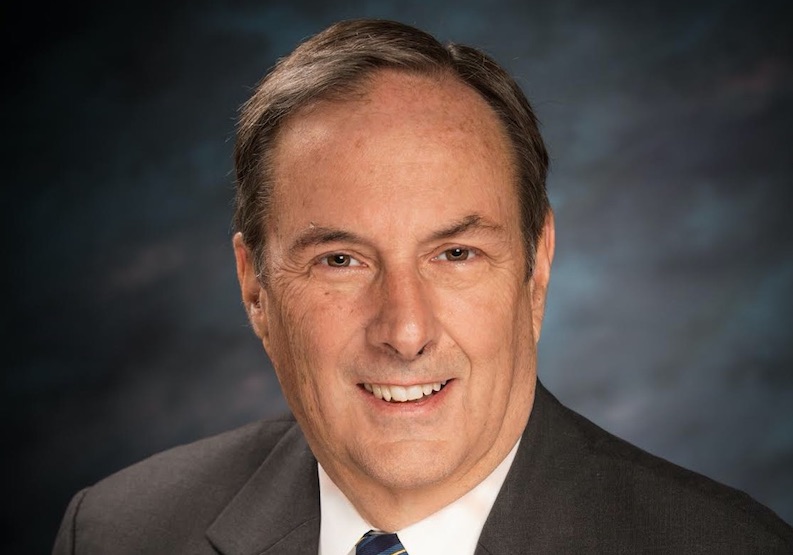
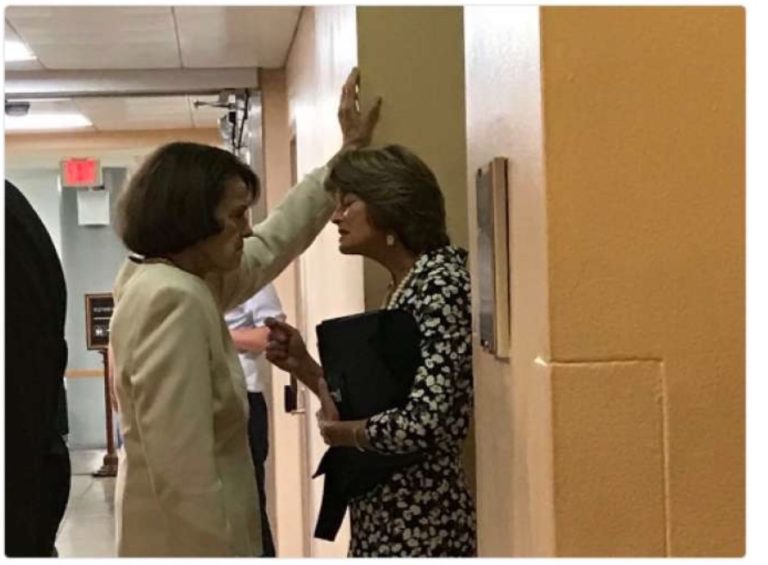
The Anchorage Police officers who shot back after a dangerous felon pulled a gun and shot one of them were Kevin Morris and Carter Mayes, the Anchorage Police Department said today. Police policy is to release the names of officers who discharge their firearms 72 hours after the incident. The two officers, per department policy, complete four days administrative leave after the incident.
Morris has one year of service in the APD, and Mayes has three years of service. Police did not release the name of the officer who was hospitalized after taking a bullet to his abdomen.
Mayes is a board member of the Alaska Peace Officers Association.
Iese Gali Jr. was charged last week with attempted murder in the first degree of a police officer, assault in the first degree of a police officer, assault in the third degree of a police officer, and misconduct involving weapons in the third degree. The charges follow an incident that took place at the Centennial Park Campground, when officers attempted to contact Gali, who was wanted on a separate charge of evading law enforcement.
District Court Judge David Nesbett set bail at $1,000,000 cash, and Gali Jr. remains in custody. If convicted, he faces a maximum possible sentence of 99 years for the charge of attempted murder in the first degree, 20 years for the charge of assault in the first degree, and 5 years for the charges of assault in the third degree and misconduct involving weapons in the third degree.
The Alaska Office of Special Prosecutions will review the police officers’ use of force and that report will be given to department’s internal affairs to check for policy violations. The public will be made public by Office of Special Prosecutions upon completion.
Apologists for feckless Gov. Mike Dunleavy often blame the Alaska legislature for the governor’s inability to stand up to Alaska’s big government types.
They argue it’s unfair to compare Dunleavy to effective governors like Florida Gov. Ron DeSantis. They say the Florida governor, unlike Dunleavy, has a cooperative private sector-oriented legislature.
That’s true. Rep. Kelly Merrick of Eagle River essentially ran a con game two years ago on voters running as a conservative for her House seat. She then joined with the Democrats.
Republican Rep. Louise Stutes and Rep. Sara Rasmussen abandoning the GOP caucus along with Merrick’s defection all but guaranteed big government interests would face no opposition from the Legislature this past session.
Gov. Dunleavy fans, the few that there are, said he had no other choice but to recently sign the largest budget in state history coming in at $8.63 billion. That’s a 38% increase over last year’s budget according to the Alaska Policy Forum.
This year’s budget is a stark contrast to the one originally proposed by Dunleavy. The governor promised to use his veto pen to cut $130 million from the oversized university budget but after being threatened with a recall, he gave the money back.
Dunleavy has at the very least been open and honest about his drastic shift from budget hawk to lackey willing to go along to get along with special interests.
“It was made clear by a number of groups of Alaskans that they didn’t necessarily care for large reductions. It’s also been made clear to me by Alaskans that they’re not necessarily sad about taxes,” Dunleavy told the left-leaning Anchorage Daily News last summer.
Dunleavy recently won praise for signing the state’s unprecedented and massive budget and his obvious political transformation from Senate Minority Leader and Democrat Tom Begich.
“It was this governor who attempted to dismantle the university system, cut public education funding, and put the state’s fiscal burden on local taxpayers in his first budget,” Begich told Alaska Public Media. “We are encouraged now by a budget that rejects that vision.”
Alaska already spends four times as much on state government per capita as Florida. With this year’s monstrosity of a budget, the disparity will only increase.
It is true DeSantis has help from his legislature in standing up to his state’s insatiable big government advocates.
But Dunleavy has something DeSantis does not. It takes three quarters of the Alaska Legislature to override the governor’s line-item veto. Only one other state, Arizona, has such a powerful veto pen. Florida legislators can override a governor’s line-item veto with only a two-thirds vote.
So, Alaska, a red state, where Donald Trump beat Joe Biden by 10 percentage points in 2020, only needs to elect one out of every four legislators with the courage to stand up to special interests. One in four willing to stand up to union bosses, non-profit cabal types, lobbyists, and corporations depending on government bloat and largess.
That’s an awfully low bar and yet the special interests continue to have a never-ending stranglehold on Alaska’s state government because Dunleavy, and his predecessors for that matter, refuse to pick up that mighty line-item veto sword to any significant degree.
In fairness to Dunleavy, he didn’t create this problem. He inherited this mess after former half-term governor and reality TV star Sarah Palin signed the massive tax bill ACES.
The job killing tax scheme transferred so much cash out of the private sector and into government, it is directly responsible for the Jabba the Hutt sized state budget we have today.
Once ACES passed, the impact was immediate. Drilling activity dropped from 10 rigs active in Alaska in 2006, to eight rigs in 2007, and six rigs in 2010.
This happened at a time when the price of oil was mostly far north of $100 a barrel. There was talk of having to shut down the pipeline if the decline in oil drilling became much more dramatic. This also happened at a time when other oil plays in North America were thriving.
We’ll never know how much new investment Sarah Palin’s ACES cost the state of Alaska. We do know this: Palin’s ACES opened the door to the obesity state government suffers from even today.
Palin is also responsible for the election of Bill Walker as governor in 2014. Walker ran as a conservative, even though he has long been a major adversary of Alaska’s largest taxpayer, the oil and gas industry.
Walker barely beat out incumbent Republican Gov. Sean Parnell by two percentage points after Palin, a darling of low-information and celebrity-fawning conservatives, endorsed him.
“Walker and Palin are a part of a splinter group of people who claim to be conservative but have the same contempt for oil as Democrats,” wrote Juneau Republican activist Murray Walsh in May.
Walker’s contribution to maintaining Alaska’s government bloat came with his ignoring of the statutory formula for the Permanent Fund. This allowed politicians the opportunity to raid the fund’s earnings reserve account to make special interests happy. Even if it meant leaving the citizenry with scraps.
The Walker move has cost an Alaska family of four more than $50,000 in lost dividend money.
The problem with Alaska’s government weight problem is it smothers out new private sector investment.
Companies are less likely to invest new capital in the state when Alaska politicians can’t say no to special interests.
Since only the private sector — not the government — creates wealth, corporate executives know one day Alaska politicians will look to them to pick up the tab.
Palin, Walker, and Dunleavy make a great team in assuring government remains fat, happy, and in full control.
Dan Fagan hosts a morning drive radio show weekdays from 5:30 to 9 a.m. on Newsradio 650, KENI.
Disclaimer: Political analysis offered by the host of the Dan Fagan Radio Show is not the result of a rebuffing for unrequited love.
At a speech at a Turning Point USA conference in Tampa, Florida today, former President Donald Trump said that all members of the U.S. military who were kicked out due to refusing a Covid-19 vaccine would be reinstated under his leadership and would receive back pay, as well as an official apology.
In the U.S. Army alone, 1,300 soldiers have separated from the military for refusing to get the COVID-19 vaccine, under orders from the Biden Administration.
Along with that promise to the military, Trump teased that he may indeed be in the running for 2024; the crowd at the conference erupted in cheering. He said the Left wants to try to force him to say he is not running.
“If I announced that I was not going to run for office, the persecution of Donald Trump would immediately stop … But that’s what they want me to do, and you know what? There’s no chance I’d do that,” Trump said.
Turning Point USA is a college-focused nonprofit organization founded by a college drop-out, Charlie Kirk. The organization believes in limited government, and whose mission is to educate, train, and organize students to promote freedom. The attendees at the organization’s conferences trend younger than activists in the Republican Party. The event in Tampa was the organization’s “Student Action Summit.”
“The country is in decline. The United States is now a failing nation,” Trump said today, and he said that President Joe Biden’s withdrawal from Afghanistan was the “most humiliating day in the history of our country,” and that the media “hardly played it up” because they were “trying to protect Biden.”
Trump has been crossing the country, giving speech after speech to conservative, liberty-minded Americans, as he apparently continues to test the water for a possible 2024 presidential run. He was in Anchorage earlier this month to stump for Senate candidate Kelly Tshibaka, congressional candidate Sarah Palin, and Gov. Mike Dunleavy.
Craig Campbell is the new national committeeman for the Alaska Republican Party. He replaces Mike Tauriainen of Kenai, who has served in the role since taking over for Peter Goldberg in 2020.
The State Central Committee of Alaska Republicans approved a resolution on Saturday thanking Tauriainen for his service over the past two years.
Campbell has served in several roles in the Alaska Republican Party, including as finance chair and vice chair. He is the former lieutenant governor for Alaska under Gov. Sean Parnell, and was adjutant general for the Alaska National Guard and commissioner of the Department of Military and Veterans Affairs under Sarah Palin. He is currently the interim director of the Ted Stevens Anchorage International Airport. He was a top aide to Mayor Dave Bronson during the transition to the new mayor’s administration and was CEO of the Alaska Aerospace Corporation for several years. A gifted writer, he has been an on-again, off-again columnist at Must Read Alaska.
As national committeeman, Campbell is one of 50 men who are a voting members of the Republican National Committee, where the platform and other major party decisions are made. The national committeewoman for Alaska is Fairbanks resident Cynthia Henry, who has served in the role since 2015.
The Alaska Republican Party is a political force representing constitutional rights and liberty for all. Its roots go back to the Civil War; the first president who was a member of the Republican Party was Abraham Lincoln.
During the Civl War, against the advice of his cabinet, President Abraham Lincoln signed the Emancipation Proclamation that freed the slaves. The Republicans of the day worked to pass the 13th Amendment, outlawing slavery; the 14th Amendment, guaranteeing equal protection under the laws; and the 15th Amendment, securing voting rights for African-Americans. Republicans are proud of this civil rights heritage, which extended to the passage of the Civil Rights Act of 1964, with 87 percent of Republicans voting in favor of the bill, which built on the Civil Rights Bill of 1866 that passed with near unanimous Republican support.
The Republican Party also played a leading role in securing women the right to vote. In 1896, the Republican Party was the first major political party to support women’s suffrage.
When the 19th Amendment finally was added to the Constitution, 26 of 36 state legislatures that had voted to ratify it were under Republican control.
The first woman elected to Congress was a Republican, Jeanette Rankin from Montana in 1917. The party is now chaired by a woman, Ronna McDaniels, the second woman in history to chair the Republican Party. In Alaska, the party is also chaired by a woman, Ann Brown.
Editor’s note: What follows is the purely fictional story of Earth 41, located far away in a parallel universe.
By RODNEY DIAL
On Earth 41, the population has exceeded 7 billion and will soon reach 8 billion. Resources are being depleted and the environment is failing. The elites and global leaders have determined that the only way to save the earth is to dramatically reduce the population. Efforts to accomplish this task require years of planning and coordination. As part of this reset, the partial justification and “noble goals” include the end of wars, famine and poverty; a world without borders with peace and security for all.
Global leaders, realizing that a transition of this magnitude will throw the entire world into chaos, develop a plan to achieve these goals and control the process using a method called the Hegelian Dialectic; Problem-Reaction-Solution.
The government creates a problem and attributes blame to others.
The people react by asking the government for protection and to solve the problem.
The government then offers the solution that was planned by them long before the problem occurred.
Rights and liberties are exchanged for the illusion of safety and security.
Leaders of Earth 41, commit to the following: step one; a disease will be created of low lethality, for a “vaccine” that already exists[1]. The “vaccine” being designed to confer limited protection to the recipient of the lab created disease; concealing the intended purpose. “Vaccine” protection will function similar to sugar given to a child: an initial burst, followed by a dramatic crash. Vaccinated individuals will become more susceptible to immune system failure over time without regular boosters that the body will be trained to become dependent upon.
On our earth, a fictional story, that could almost be seen as “predictive programming” occurred between 1993-99, in the television series Deep Space Nine (DS9). In the series, a mortal enemy of the good, “The Dominion,” threatens the galaxy. The Dominion, led by a group of leaders called the “Founders,” genetically modify the DNA of their working class called the Jem’Hadar, to be physically reliant upon a substance called Ketracel-white. As long as they have this substance, they live. Without it they eventually die.
As a result the Jem’Hadar became dependent on “The Founders” for life and religiously follow any order given.
On Earth 41, the government soon reaches saturation of those who can be coerced into taking the immune damaging shot. Simultaneously, after nearly a year has passed, the effects of damaged immune systems become increasing difficult to hide from the citizens.
Like our earth, Earth 41 has a number of viral diseases that lay dormant in the nerve cells of the host, held at bay when the immune system is healthy. As Earth 41 distributed the “vaccine,” a resurgence of viruses such as shingles (from chicken pox) and herpes, appears as a side effect of the damage being caused to immune systems. The state-run media immediately dismisses this as a rare side effect and of no importance.
The public becoming numb to the initial outbreak and increasingly aware of the inconsistency of governmental messaging is quickly moved into phase two. In this step, another pandemic will appear and be portrayed as random and unconnected to the original pandemic. This new monster will be called… monkeypox.
Monkeypox, nearly indistinguishable from smallpox, has now (from the public’s standpoint) jumped from being a “rare” disease confined to rural Africa to a worldwide concern. The elites know, and are counting upon, no one asking why the outbreak is limited in mostly unvaccinated Africa, but is suddenly running rampant in mostly vaccinated Europe.
The Elites know, that the “pox” virus exists in most adults in dormant form[2], and count on the weakened immune systems of the vaccinated to allow this virus to present. Virtually everyone who contracts monkeypox is “vaccinated” but the State-run media once again buries the information and labels it as fake news. Monkeypox produces painful sores on its victims and fear grows worldwide.
Because monkeypox is harder to transmit than the first virus, a plan is developed to increase the number of carriers to maximize the impact. Years prior, as part of this plan, over 100 million doses of smallpox vaccine (effective at preventing monkeypox) were stockpiled. This vaccine, called ACAM2000, was horded by the government in large quantities for seemingly no reason; considering that smallpox was declared eradicated in the 1980s.
It was seen as quite a success that no one questioned why the government needed enough smallpox vaccine for nearly one third of the country. Unfortunately, ACAM2000 comes with known side effects and is not recommended for people who have “weak immune systems.” ACAM2000 uses a mild strain in the same family as monkeypox and smallpox to confer immunity, however the mild strain can replicate in those with a weak immune system leading the host to transmit the virus to others[3].
Earth 41 quickly declares monkeypox a pandemic and uses a group of its citizens known to be highly compliant in taking the first vaccine, as early adopters for the monkey pox vaccine. This group with already damaged immune systems is now used as carriers to spread the next pandemic.
As monkeypox grows, Earth 41 leaders declare an emergency. They say the virus has mutated and may possibly be airborne. New efforts are made to “boost” those who took the immune damaging vaccine, as well as push flu and monkeypox vaccines. Seemingly overnight, multiple pandemics are occurring at the same time. Additionally, by changing the official definition of what “vaccinated” means; those not up to date with their vaccines are counted as unvaccinated, making it appear that a pandemic of the unvaccinated is taking place.
A segment of the population is vilified and blamed (Hegelian Dialectic), division grows, lockdowns, and restrictions are reimposed.
Over time, Earth 41 citizens become dependent upon regular boosters to live, their immune systems fail without support every six months or so. To hide their actions the Elite impose draconian penalties for the few remaining holdouts that have refused the injections, as no control group can be allowed to exist. Simultaneously, the world economy is destroyed, hyperinflation occurs and a one-world digital currency is introduced.
A leader rises up who appears to have the answers to fix everything. Through 10 appointees, Earth 41 rulers now control the people…at least most of them. To get the last few, regulations are imposed preventing the buying or selling of those not up to date on their vaccinations.
A few holdouts remain and due to reports of forged vaccine documents and a need for a faster method of verification, a universal ID that cannot be forged is necessary (they say). Proof of compliance must be bodily and unique to the individual and will come with privileges (formerly known as rights) such as buying and selling. Through fear the public complies and laws are passed to implement the process. The two approved locations for identification are the right hand (ease of scanning), and forehead for those without a right hand.
The Earth 41 government now controls the population by controlling money and health care. Physical health becomes dependent upon the latest vaccine, money is digital, buying and selling allowed only to compliant citizens (social credit), and movements are tracked and privacy is eliminated[4].
The End.
Moral of the Story: Be glad we don’t live on Earth 41 and that this could never happen here.
Rodney Dial lives in Ketchikan, where he also serves as borough mayor.He writes this allegory in his capacity as a citizen and guest columnist.
I know many who desperately want to support Sen. Lisa Murkowski. Over 20 years, Murkowski has made personal connections to many people I know. They have worked with her, fought beside her, and many have spoken to her or know her personally.
The folks who elected Murkowski over the last 20 years are often good, conservative, salt-of-the-earth people. This piece is written to present an honest opinion that the Murkowski you knew 20, 15, or even 5 years ago is not the person who has become the most left-wing Republican in the Senate in our nation’s history.
As I present the ways Murkowski has moved away from you, please conscientiously reconsider putting Murkowski as your first, second, or third choice on the ranked choice ballot.
1. Trust – Trust is the glue of life. It’s the most essential ingredient in effective communication. It’s the foundational principle that holds all relationships. – Stephen Covey
Murkowski was the sole Republican supporting the left-wing election tampering bill, blaming Republicans for wanting one person, one vote and open, free, and fair elections
2. Wisdom – A person must be big enough to admit mistakes, smart enough to profit from them, and strong enough to correct them. – John C. Maxwell
Murkowski was the sole Republican to fail to vote for Justice Justice Brett Kavanaugh to the Supreme Court.
3. Consistency – It’s not what we do once in a while that shapes our lives. It’s what we do consistently. – Tony Robbins
Murkowski fell in love with her “independent” status: She voted for Biden Supreme Court nominee Ketanji Brown Jackson, and she opposed the Pebble Mine process.
4. Values – It is our choice of good or evil that determines our character, not our opinion about good or evil. – Aristotle
5. Representing Alaska – “I mean, I’m not here to be the representative of the Republican Party. I’m here to be the representative for Alaskan people. And I take that charge very, very seriously. So, when there is a conflict, when the party is taking an approach or saying things that I think are just absolutely wrong, I think it’s my responsibility, as an Alaskan senator speaking out for Alaskans, to just speak the truth.” – Lisa Murkowski on CNN
Environmentalists love Murkowski’s support for Biden’s appointments like Interior Sec. Deb. Haaland. And whatever you think of Trump personally, there is no question his presidency was fantastic for Alaska. Murkowski, however, did not vote for Trump. Also, her campaign is funded almost entirely by Lower 48 special interests.
6. Priorities – If you knew Murkowski in the past, that doesn’t mean she represents you today.
7. Where do you fit in with Murkowski’s new group of friends?
What happened 12 years ago remains very relevant today. After losing to Joe Miller in the 2010 primary, Murkowski stood on stage with the NEA and public unions to announce her plan to get back to the Senate. Doing so, she made a fundamental move away from you, to her new group of friends. Over the last several years, these are friends she has gotten to know even better, follow more closely, and rarely or never break trust with.
Is that what she still does for you, never breaks your trust, fellow conservative?
Glen Biegel is a talk show host and cyber security professional in Anchorage.
An effort by gubernatorial candidate Christopher Kurka failed today at the Alaska Republican Party’s State Central Committee’s quarterly meeting. The vote was overwhelming against it.
Kurka, a Republican who is running to the right of Republican Gov. Mike Dunleavy, requested the endorsement through his supporters. He has been a harsh critic of Dunleavy since announcing his candidacy in November. He is running a lean campaign, having raised $112,000 but having spent most of it. Overall, he raised $112,692, spent $114,885 and has campaign debt of $8,400. His campaign cash-on-hand in his official 30-day report was $2,653.
As a candidate for governor, he is not able to be a candidate to return to the Alaska House of Representatives, where he has served since January, 2021, representing Wasilla.
Meanwhile, Joe Wright, a candidate for Senate Seat L, received the party’s overwhelming endorsement. Other Republican candidates for that seat are Rep. Ken McCarty and Rep. Kelly Merrick.
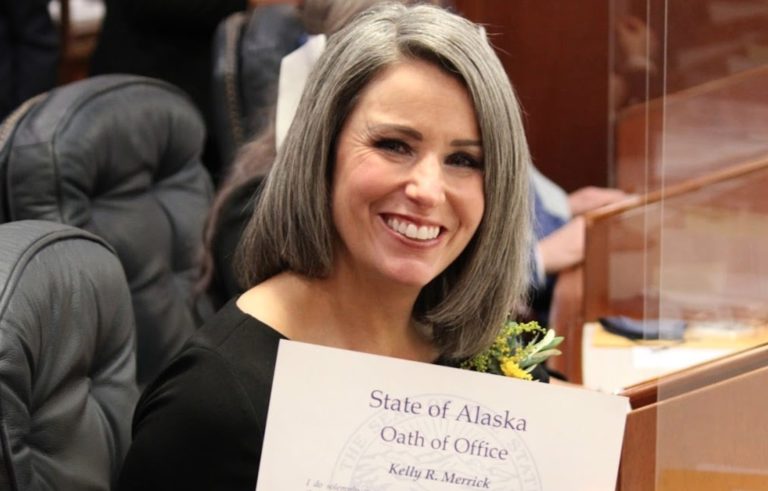
After debate, Rep. Merrick (shown in photo above) was censured by the Alaska Republican Party for caucusing with the Democrat-controlled majority in the House. She is now running for Senate but the party sent her a big message today — her behavior has cost her the support of the party officers, who voted heavily in favor of the censure, the second one the officers have passed regarding her in the past year.
There were numerous other endorsements today, including one for Elijah Verhagen for State Senate representing Fairbanks. The SCC did not, however, endorse the sitting incumbent Sen. Click Bishop, a Republican. The party endorsed Republican Sen. Mia Costello of Anchorage, who is facing off against Rep. Matt Claman, a Democrat. Tuckerman Babcock, running for Senate for Kenai, was endorsed by the party; but Jesse Bjorkman, his Republican opponent, was not.
Heath Smith of Homer was endorsed for Senate but incumbent Republican Sen. Gary Stevens was not.
The Biden Administration may declare monkeypox a public health emergency, as the number of cases in the U.S. nearly doubled in a week. Fifty Democrat lawmakers from the U.S. House sent President Joe Biden a letter asking for the emergency declaration, along with additional funds to be spent to protect the vulnerable from the disease, get more vaccines manufactured and
The administration is looking at “what are the ways the response could be enhanced, if any, by declaring a public health emergency,” said White House Covid response coordinator Ashish Jha on Friday, who said the topic is an active conversation at the Department of Health and Human Services.
On May 22, Jha had a different viewpoint on it, saying he doubted monkeypox would have any widespread impact in the United States.
“I feel like this is a virus we understand,” he said on ABC’s “This Week.” But that same week, President Biden said monkeypox is something “everybody should be concerned about.”
The number of U.S. cases in May were less than 200. On Friday, there were 2,891 confirmed cases in the country, double from the previous week, and the disease was present in all but six states. In the United States, 99% of the cases are related to male-to-male sexual contact, WHO reports. The CDC puts the number at 97%. The first two cases of the disease in children have ben confirmed — one is a toddler in California, and the other was an infant who is not a U.S. resident. Both are presumed to have caught the disease from someone in their household.
The World Health Organization has issued its highest-level emergency alert over the monkeypox outbreak, which has grown to more than 16,000 cases in 75 countries. Only five deaths have been reported from the outbreak, said WHO director general Dr Tedros Adhanom Ghebreyesus.
The global health alert came at the end of a WHO emergency committee meeting on the virus. Only two other such global health emergencies are current from WHO: the Covid-19 pandemic and polio.
The WHO emergency comes with a set of directives and advice for countries, which can be read at this link. In the advice, it asks those who are having large gatherings where casual sex is part of the expectation to hold off.
Other points made in the WHO declaration refer to the initial stages of the HIV/AIDS pandemic:
The multi-country outbreak of monkeypox meets all the three criteria defining a public health emergency (PHEIC) contained in Article 1 of the Regulations (1. an extraordinary event […] 2. constitut[ing] a public health risk to other States through the international spread of disease 3. which may potentially require a coordinated international response);
The moral duty to deploy all means and tools available to respond to the event, as highlighted by leaders of the LGBTI+ communities from several countries, bearing in mind that the community currently most affected outside Africa is the same initially reported to be affected in the early stages of HIV/AIDS pandemic;
The observed rising trends in the number of cases reported globally, in an increasing number of countries, and, yet, likely to reflect an underestimation of the actual magnitude of the outbreak(s);
The cases of monkeypox reported in children and pregnant women, which are reminiscent of the initial phases of the HIV pandemic;
Future waves of monkeypox cases are expected as the monkeypox virus is introduced in additional susceptible populations;
The modes of transmission sustaining the current outbreak are not fully understood;
The changes in the clinical presentation of cases of monkeypox currently observed with respect to the clinical picture known to date;
The need to generate further evidence related to the effectiveness of the use of both, pharmaceutical and non-pharmaceutical measures in controlling the outbreak;
The significant morbidity associated with the monkeypox outbreak(s);
The potential future implications on public health and health services if the disease were to establish itself in the human population across the world, particularly for an orthopoxvirus causing human disease, as global immunity has greatly declined after smallpox was eradicated.
“Let them eat cake” seems to be the message from Canadian Prime Minister Justin Trudeau. The princely prime minister wrapped up meetings Friday with provincial ministers, and signaled he will move ahead to reduce the allowable use of fertilizer by Canadian farmers as his next step in fighting climate change.
The Trudeau government wants a 30% reduction in emissions, but farming experts say that reducing nitrous oxide emissions can’t be done without reducing fertilizer use, which will hurt their ability to stay in the farming business. Farmers also say this will result in less food being produced by Canada and will lead to food shortages at a time when there are already global food shortages.
In 2021, the agriculture and agri-food system employed 2.1 million people, provided 1 in 9 jobs in Canada, generated $134.9 billion (around 6.8%) of Canada’s gross domestic product, according to the Canadian government.
“The world is looking for Canada to increase production and be a solution to global food shortages. The Federal government needs to display that they understand this,” said Alberta Agriculture Minister Nate Horner. “They owe it to our producers.”
Horner said that this year’s crops are the most expensive that have ever been planted, “following a very difficult year on the prairies.”
“We’re really concerned with this arbitrary goal,” said Saskatchewan Minister of Agriculture David Marit. “The Trudeau government has apparently moved on from their attack on the oil and gas industry and set their sights on Saskatchewan farmers.”
Fertilizer emissions reduction was not on the agenda of the annual meeting of Federal-Provincial-Territorial ministers of agriculture. Provinces pushed the federal government to discuss this topic, and were disappointed to learn that Trudeau had already set the 30% target.
“The commitment to future consultations are only to determine how to meet the target that Prime Minister Trudeau and Minister [Marie-Claude] Bibeau have already unilaterally imposed on this industry, not to consult on what is achievable or attainable,” the governments of Alberta and Saskatchewan said in a combined statement. Bibeau is the nation’s agriculture minister.
“Western Canadian farmers already produce the most sustainable agri-food products in the world, and they’re continually being asked to do more with less. We cannot feed the growing world population with a reduction in fertilizer,” the provincial leaders said. “Western Canadian producers base fertilizer inputs on realistic targets based on moisture availability. Producers are conservative in the use of fertilizer inputs and don’t add more than what is needed. They alone simply cannot shoulder the impact of this shortsighted policy.”
Canada is a net exporter of food staples such as grain. It has 0.5% of the global population, but produces about 1.5% of the food in the world, while consuming about 0.6% of world food production.
Sri Lanka has been the test kitchen for the organic-only policy. In 2021, President Rajapaksa banned synthetic fertilizer and pesticide imports, which forced the millions of farmers in that country to go organic, practically overnight. The result has been disastrous, with major food shortages, social unrest, and ultimately a protest that took over the capital and forced the resignation of the government.
Sri Lankan scientists and agriculture experts had warned of dire consequences for many crops, such as cocoa, coffee, soybeans, and other staples.
in Sri Lanka, rice production dropped 20 percent in the six months after the organic-only policy was implemented. Instead of feeding itself, the country spent $450 million on rice imports. The production of tea, which is the country’s biggest export, fell by 18 percent. The population of Sri Lanka is now facingimminent starvation.