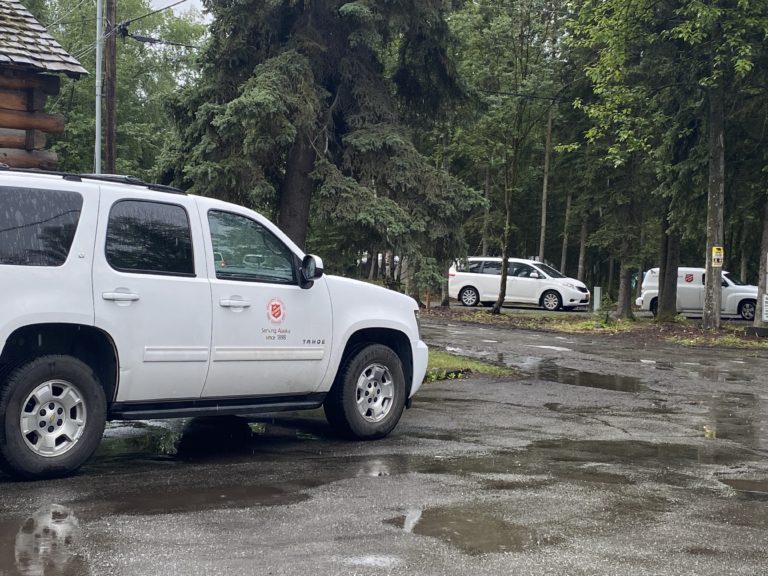
The Salvation Army continues to manage the homeless camp at Centennial Campground in Anchorage. The latest situation report from the Salvation Army advises that 34 people, including four families, have been relocated from the campground to other housing.
The Salvation Army has done initial assessments with 69 of the people at the camp to determine their individual situations and needs. The camp census is 143 people at this time, an elastic number as people come and go. One person’s life has been saved from an overdose of an opioid drug by the use of Narcan by staff on site; another person died of an overdose.
Meanwhile, the Party for Socialism and Liberation, a revolutionary socialist/communist organization in Anchorage, plans a protest at today’s regular Anchorage Assembly meeting, in which they repeat the verbiage from the leftists on the Assembly, saying the campground is a “humanitarian crisis,” the same words used by Assemblyman Chris Constant and his allies.
The campground was set up in July to reduce the risk of wildfires from the illegal encampments around the wooded areas of Anchorage. A few dozen of the people who had been sleeping at the Sullivan Arena came over to the Centennial Campground, as the Sullivan was closed on July 1.
The Salvation Army assumed case management and social service coordination at the campground, and is helping find suitable solutions for each individual camper.
The Salvation Army also reports:
Two people have been assisted in getting back to their families in other communities — one elderly homeless person is leaving for family in Texas, and another person is leaving for St. Paul Island, where he has family.
Ten of the homeless people in the campground have been signed up for a workforce development program with Beans Cafe.
Security continues to be a priority at the camp with checks by a private security firm day and night, and routine checks by police. Staff continues to do hourly checks of the campground to ensure it is as safe as possible.
The Salvation Army and Parks and Recreation are meeting daily to coordinate their efforts. Some 18 agencies are now involved. A conex trailer has been brought to the campground to help expedite the distribution of tents, sleeping bags, blankets, boots, coats, and other items. Bear-proof containers are now on site.
Six people were onboard a floatplane that crashed on takeoff from Lake Hood about 9:18 am on Tuesday. Winds were brisk out of the Southwest on Tuesday, and windsocks around the lake were flapping when the plane apparently hit one of the fingers of the lake, where a jetty of land creates a division between channels of water.
According to National Transportation Safety Board, a pilot and six passengers on the de Havilland Canada DHC-2 Beaver were rescued and taken to a hospital. The plane, operated by Regal Air, was heading to Kati National Park, a popular bear-watching spot and the passengers on board were from out of state.
Criminals are being taken off the streets of Anchorage by the dozens. From July 19 through July 21, a timeframe that includes the incidence of the felon who shot an Anchorage police officer, nine agencies joined together for an Anchorage-wide crime suppression sweep with a focus on violent offenders.
Those efforts resulted in the seizure of multiple drugs, four firearms (one that had been reported as stolen), and $3,800 cash. 23 felony warrants and 35 misdemeanor warrants were served, 11 new felony charges were filed, and 29 new misdemeanor charges were filed.
The Anchorage Police Department, Federal Bureau of Investigation, U.S. Marshals, Bureau of Alcohol, Tobacco, Firearms, and Explosives, Alaska State Troopers, Wasilla Police Department, Palmer Police Department, Drug Enforcement Administration, and the U.S. Postal Inspectors participated. Regardless of which agency handled the paperwork and drew the case number, representatives from several different agencies were involved in each case.
“The cooperation of law enforcement agencies at all levels (federal, state, and local) is paramount to strengthening crime prevention efforts and increasing public safety. This collaboration locally was highlighted in last week’s operation,” said Anchorage Police Chief Michael Kerle. “Working together we strived to reduce the crime rate and minimize the impact of criminal activity on families, our youth, and every member of this great community.”
The following are some highlights from the arrests made:
APD Case 22-23385:
A traffic stop was conducted on a vehicle at E 11th Avenue and Hyder Street that had illegally tinted windows and no license plates. The driver, 23-year-old Issac J. Maeva, was charged with Misconduct Involving a Weapon II – Drug Crime, Misconduct Involving a Controlled Substance III, and Violate Conditions of Release. He was remanded at the jail on an outstanding warrant. The passenger, 24-year-old Sophia I. A. Belton, was remanded at Hiland Correctional for Misconduct Involving a Controlled Substance IV.
AST Case AK22073721:
A traffic stop was conducted at Debarr Road and Muldoon Road on a vehicle with illegally tinted windows. The driver, 32-year-old Jeramie D. Ghrames, was arrested for Driving with a Cancelled License (DWLC). A bag from inside the vehicle was seized as evidence and subsequently searched once a search warrant was obtained. Inside the bag was a stolen handgun. Ghrames was additionally charged with Misconduct Involving a Weapon III – Felon in Possession and Theft II. Ghrames was also on the Scofflaw List (multiple unpaid traffic citations) for over $3,500; the vehicle was impounded.
APD Case 22-23506:
A traffic stop was conducted at W 36th Avenue and Oregon Drive on a vehicle with illegally tinted windows. The driver, 36-year-old Fale J. Moevao, advised officers there was a BB gun between the driver’s seat and middle console. Officers located the weapon and determined it was a loaded handgun. The rest of the vehicle was searched once a search warrant was obtained. Moevao was remanded at the Anchorage Jail on the charges of Driving with a Revoked License (DWLR) and Misconduct Involving a Weapon III – Felon in Possession.
APD Case 22-23646:
Officers contacted 31-year-old Albert P. Berry at W 9th Avenue and D Street; he had a misdemeanor warrant. Berry physically resisted during the handcuffing process, and he provided a name that was not his own. Pre-trial Officers arrived at the scene and advised Berry had cut off his ankle monitor. Ultimately Berry was remanded at the Anchorage Jail on the charges of Criminal Mischief III, two counts of Violate Conditions of Release, Resisting, Escape III, and False Information.
Not included in the sweep report, but arrested while he was on the lam inside the Centennial Campground, Iese Gali Jr. was charged last week with attempted murder in the first degree of a police officer, assault in the first degree of a police officer, assault in the third degree of a police officer, and misconduct involving weapons in the third degree. The charges follow an incident that took place at the Centennial Park Campground on July 20, when officers attempted to contact Gali, who was wanted on a separate charge of evading law enforcement. A massive police presence descended on the campground after Gali pulled a gun and shot one of the officers in the abdomen.
In 2018, former Alaska Gov. Sarah Palin told a reporter from the Daily Mail that that she and her then-husband Todd were “finally in that spot where we can seize the opportunity to get outside and do more.” They had already owned one luxury home in Scottsdale, Arizona, had sold it, and were building an even bigger mansion in the same area.
“We were anchored here [Wasilla] for the kids. Now our youngest daughter is going to be out of school — she’s going to go to nursing school — she’ll be taken care of,” Palin said in an interview published that year. “And we’re ready to do a lot more.”
“We’re not going to be holed up in Wasilla, Alaska, the rest of our life,” Palin told the reporter. There was no indication they intended to sell their house on Lake Lucille, but it was clear to readers they were going to spend more time out of state; they were building the kind of home in Arizona that most would not consider an occasional getaway.
Palin’s new mansion on Scottsdale mountain property was being built after the Palins sold their other Scottsdale home for $2.275 million in 2016, according to The Los Angeles Times.
According to MansionGlobal.com, the Palins had purchased the new lot for $937,000 in 2015. With the mansion still under construction in 2018, the 30-year marriage was failing. Todd filed for divorce, and she put the unfinished project on the market. The two-story, 7,660-square-foot house sold for $6.2 million.
Sarah and Todd had been an item in Wasilla since high school. In the 2018 interview, they told the reporter they thought it was time for a change.
“I want to do something that will influence our culture,” Sarah is quoted as saying. “To really remind people how important a work ethic is and to try to erase a lot of this idea that people have that government owes them anything. Or that anybody owes them anything.”
Palin told the Daily Mail in 2018 she wanted to be more national in focus, in “some positions here to get that message out there, how important it is to be independent, get out there and work for yourself.”
“He’s more driven than I am to bust out and get some things done,” Palin said of Todd, adding, “If you see sea planes flying around Arizona or New Mexico you’ll know who it is.”
Palin, now 58, retreated to her Wasilla house for a couple of years, but appears to be spending more time out of state once again with her new beau, retired NHL hockey player Ron Duguay, who has a house in New York City and another in Ponte Vedra Beach, Florida. Duguay, 65, and his ex-wife, supermodel Kim Alexis, divorced in 2016.
Although she is campaigning for Congress in Alaska in 2022, Palin is rarely seen in public in her home state, or anywhere else for that matter, since the heady days this past winter when she was a regular item with Duguay in New York City, while her lawsuit against the New York Times was being heard in a Manhattan courtroom. She was being featured in newspapers in New York almost daily.
After Don Young died, she made her move to rejoin political life. She has done a few parades — the Colony Days Parade, the Bear Paw Parade, and the Golden Days Parade, but otherwise she has kept a fairly low profile.
Palin has filed for Permanent Fund dividends and she has voted in most elections in Alaska for the past decades, except for a couple of municipal elections. She has maintained her street credibility as an Alaskan.
Last week Duguay told a Canadian reporter that he and Palin were negotiating marriage. Palin appeared flustered at the comment and said it sounded like he was negotiating a hockey contract. TheNational Enquirer in May wrote, however, that it is Palin who has an extensive list of prenuptial demands of Duguay.
Sen. Mike Shower has gotten one of the most prized endorsements from conservatives: Mayor Dave Bronson of Anchorage. Shower also received the endorsement of the Alaska Republican Party’s State Central Committee at its meeting on Saturday.
Shower represents Senate Seat E, but the new district is renamed Senate Seat O, and the new district lines stretch up the Parks Highway to Anderson and Clear. He is challenged by retired wildlife trooper Republican Douglas Massie.
Shower spoke at the meet-and-greet barbecue for Rep. Kevin McCabe on Sunday and is the featured speaker a the conservative “School of Government” in Palmer on Monday night starting at 7 pm, at the Real Life Church, 10697 E. Palmer-Wasilla Highway.
Only Donald Trump could get away with selling a t-shirt with his picture all over it from neck to hem.
During his visit to Anchorage for the campaign rally for Kelly Tshibaka and Sarah Palin on July 9, former President Trump spotted a couple of fans in the front row of the Alaska Airlines Center at the University of Alaska wearing shirts that had his face printed all over them. He was in love with the hilarious shirts — and invited the two Alaskans up to the stage so that the 5,000-6,000 fans in the audience could see them.
Now, just two weeks later, he’s made his own version of the Trump face t-shirts and he’s selling them to raise money for his political action committee, “Save America.”
He called the Alaska shirts “EPIC.”
“Did you see what happened at my rally in Alaska?,” Trump wrote in his email pitch to his email list. “I called some FRONT ROW PATRIOTS onto my rally stage because of the incredible TRUMP RALLY SHIRTS they were wearing. After I saw this amazing shirt, I knew I had to have them ready to go for Patriots like YOU. I called my team and they were quick.“
Trump said his shirt is “a MASTERPIECE and a true symbol of my SAVE AMERICA movement. I only want my most devoted Patriots to have one, which is why I set one aside for YOU.”
In September of 2021, conservatives who opposed the Covid mandates in Anchorage, imposed by the Anchorage Assembly, showed up at the Anchorage Assembly meeting to protest.
Some of them wore handmade yellow stars to remind the Assembly that some of their Covid policies were reminiscent of Nazi Germany’s early stages of oppression of the Jews, actions that eventually led to the rounding up and mass killing of Jewish people.
The media had a field day. Fed by leftists and opportunists, story after story appeared in international and local media about the yellow stars, and the entire protest backfired on conservatives, many of whom do not fully understand that the Left controls the narrative and the media, and conservatives using Holocaust imagery for anything but the Holocaust is going to end badly.
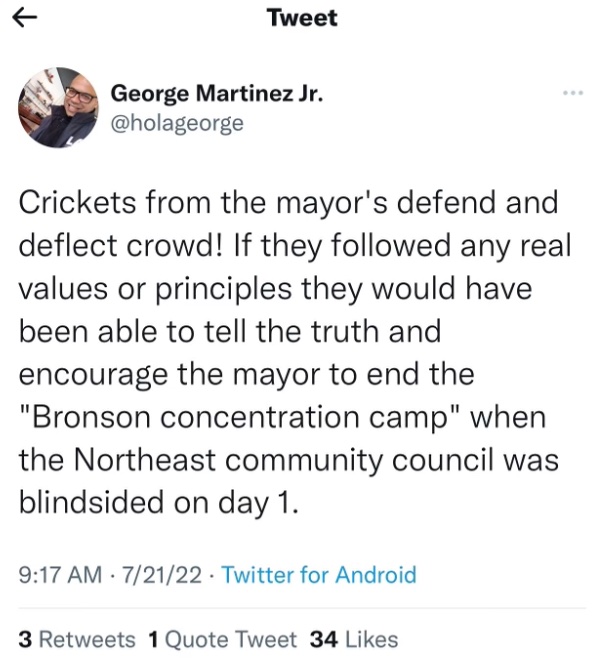
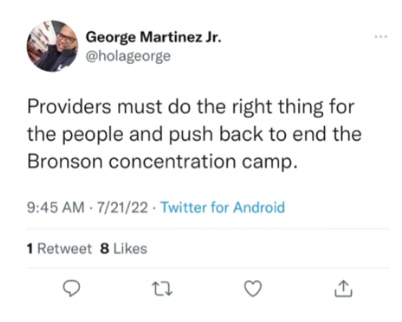
Last week, a leftist ally of the Assembly majority, George Martinez, used Holocaust analogy to describe a homeless campground in Anchorage. He called it the Bronson concentration camp. Not once but twice on social media, Martinez referred to the campground that way, trying to start a movement to associate Bronson with Nazis.
Martinez, formerly associated with the Occupy Movement in New York City, moved to Anchorage several years ago and was an operative in the former administration of Mayor Ethan Berkowitz, whose career cratered in disgrace in 2020.
Martinez works for the leftist organization, Anchorage Humanities Forum, which is hosting an event next month that specifically excludes white people.
Martinez is also an invited adviser to the Anchorage Assembly majority on issues regarding the Youth Advisory Council. He is considering a run for higher office, but for now, he is the main communication guy for the nonprofit landing spot that pays his rent, with pass-through grants from the government.
The Left was dead silent on Martinez’ use of Holocaust terminology to describe a campground that has running water, toilets, wi-fi, cleared out camping sites, and where social services are being delivered all day by Salvation Army, Catholic Social Services, Bean’s Cafe, AWAIC, Gospel Rescue Mission, and others in the community. Security officers drive through the camp continuously to keep people safe.
The situation for homeless campers at Centennial Campground is not ideal, but for the vast majority of them, it’s better than living around the woods in Anchorage in illegal campsites. Plenty of people camp in Alaska. When I was a young woman, I camped on the Homer Spit, while working at the Seward Fisheries dock. People camp all over the state, in rain and shine, and some campers make a lifestyle of living the rent-free life for many months of the year.
The campground won’t be suitable for winter. But already the Salvation Army is moving dozens of people into shelters. Those who want to go to shelters are getting on the list and getting settled, while those who are not ready to come in are waiting for fall. More than 35 people have been moved to shelters, leaving about 180 in the campground, at last count.
A trip through the campground led to this description by a reader:
“The established guardrails are ‘Auschwitz’ by the Left and ‘Boy Scout camp’ by the right. Bottom line – it was pretty damn close to the Boy Scout camps I remember as a kid,” the Anchorage resident wrote.
“Every time some lunatic uses ‘Auschwitz,’ ‘concentration camp,’ ‘Hitler,” or Nazi,’ all I can picture are the disgusting pictures of the thousands of emaciated women, children and men piled up 10 deep as far as the eye can see. ‘Concentration Camp’ is NOT what I saw! I said hello to many folks and they returned a hello too. Many had plates of food and were lounging around chatting with other folks.
“I saw ZERO trenches dug with skeletal bodies laying in them….therefore the idiots suggesting ‘concentration camp’ need to watch ‘Band of Brothers’ and get some effing perspective!!” the writer said.
In the Centennial Campground, there are dangers. One of them is the remnants of gangs that come and go. There are remnants of Native Brotherhood gang, a skinhead gang, and Polynesian gangs. Some of those gang remnants are people who have cycled in and out of prison and some of the gangs they are associated with are known prison gangs.
These gang members are some of the same people who used to use the Sullivan Arena, where there were plenty of sketchy people staying for months on end. Bad things also happened at the Sullivan Arena, but the Leftist on the Assembly and their media handmaidens didn’t report that, because the Sullivan Arena was a leftover from the Ethan Berkowitz Administration. They viewed it as good. Sullivan Arena was closed as a shelter on July 1, and now the process begins to get those folks situated and keep the illegal encampments from further endangering the public.
But back to the Left on the Assembly and its partnership with the mainstream media: Where is the outrage over George Martinez calling a campground a “Concentration Camp” and using Mayor Bronson’s name to try to associate it with Nazism? Assemblyman Chris Constant? Assemblyman Forrest Dunbar? Assembly Kameron Perez-Verdia (who is Martinez’ boss at the Alaska Humanities Forum)? Assemblywoman Austin Quinn-Davidson? What do you have to say, leaders of Anchorage?
The Left is silent, because it will never call out its own. And the media is the handmaid to the Left, and remains compliant and mum. But some of us still remember what the Leftist media said about the symbolic yellow stars less than a year ago, which were worn to fight oppression by the Left, and to remind people of just how bad things can become if you allow incremental oppressions to compile.
Attack ads by the Bill Walker for Governor campaign are dredging up his supporters’ old complaint that Gov. Mike Dunleavy asked for a loyalty pledge from employees who wished to remain working for the Dunleavy Administration upon the departure of Walker, who was unceremoniously dethroned in 2018 by Alaska voters.
The letter sent by former Gov. Bill Walker to employees of Gov. Sean Parnell when Walker took over in 2014 told them to submit their letters of resignation.
The letter sent by the incoming-Walker Administration to Parnell employees is nearly identical to the one sent by the incoming-Dunleavy Administration to those who had been hired under the Walker regime, and we have acquired copies of both letters so the public can make their own judgment about the so-called “loyalty pledge” that Walker says Dunleavy demanded of state workers.
The Walker letter from 2014:
Message from Bruce Botelho, Walker-Mallott Transition Coordinator:
On December 1, 2014, Governor-elect Bill Walker and Lieutenant Governor-elect Byron Mallott will be sworn into office. Prior to and immediately after this date, they will be making personnel decisions concerning the staffing of Executive and Lieutenant Governor’s Offices.
A preliminary and customary step in the transition between administrations is the request for resignation letters. In keeping with that custom, I ask that you submit your resignation from state employment in writing to the address noted below by November 28, 2014. Please make your resignation effective upon acceptance by the Walker-Mallott administration. Of course, no action on your letter will be taken before the transition.
Acceptance of your resignation will not be automatic and consideration will be given to your statement of interest (if any) in continuing in your current or another state position. Please also include your e-mail and phone contact so that you can be reached to discuss your status directly.
We understand that transitions are a time of uncertainty and great personal stress. We will endeavor to reach individual determinations on an expedited basis. Finally, we wish to express our appreciation for your service to the people of Alaska. We trust that you found it rewarding and that it will prove to be a solid foundation for your future endeavors.
Note: If you believe you have received this message in error please so indicate in a reply to the above electronic mail address.
The Dunleavy letter to employees was almost identical, although was a bit more inviting in the way it asked people to apply for positions in the Dunleavy Administration. The letter was sent from Transition Chair Tuckerman Babcock:
Over the next several weeks, the outgoing and incoming administration are working together to make the transition from Governor Walker to Governor-Elect Dunleavy as seamless as possible. Both administrations greatly appreciate the dedication and service of all employees who serve the State of Alaska. We understand that transitions can be difficult both personally and professionally. Therefore, we are working to provide you with information to make the transition process as smooth as possible.
As you aware, Governor-Elect Dunleavy will be sworn into office on Monday, December 3, 2018. In the coming weeks, the incoming administration will be making numerous personnel decisions. Governor-Elect Dunleavy is committed to bringing his own brand of energy and direction to state government. It is not Governor-Elect Dunleavy’s intent to minimize the hard work and effort put forth by current employees, but rather to ensure that any Alaskan who wishes to serve is given proper and fair consideration.
As is customary during the transition from one administration to the next, we hereby request that you submit your resignation in writing on or before November 30, 2018 to [email protected]. If you wish to remain in your current position, please make your resignation effective upon acceptance by the Dunleavey administration.
Acceptance of your resignation will not be automatic, and consideration will be given to your statement of interest in continuing in your current or another appointment-based state position. Please also include your e- mail address and phone contact so that you can be reached to discuss your status directly.
Governor-Elect Dunleavy is encouraging you and all Alaskans to submit their names for consideration for service to our great state. Should you desire to continue your service to the State of Alaska in another appointment-based position, you are invited to submit your information and the position(s) you desire for consideration before December 3, 2018. Please submit your application through the portal located at GOVERNORMIKEDUNLEAVY .COM.
We appreciate your assistance and cooperation during this period of transition. Again, we wish to express our sincere gratitude for your dedication and service to the State of Alaska and wish you the best in your future endeavors.
Note: If you believe you have received this message in error please so indicate in a reply to the above electronic mail address.
Walker is running for governor again, on a ticket that is no longer endorsed by the Alaska Democratic Party, which has decided to back Les Gara for governor. Walker left the Republican Party in 2014 and ran with the support of the Alaska Democratic Party that year with Democrat Byron Mallott as his running mate. This year his running mate is labor attorney Heidi Drygas, who was his commissioner of Labor during his four turbulent years in office.
Sen. Lora Reinbold of Eagle River announced her endorsement of the Charlie Pierce-Edie Grunwald ticket for governor/tt. governor at a Pierce for Governor campaign event at Kriner’s Diner in Anchorage on Sunday.
Also endorsing Pierce was Andy Kriner, owner of Kriner’s Diner. Kriner battled former Anchorage Mayor Ethan Berkowitz over the illegal shutdowns of businesses in Anchorage during the onset years of the Covid pandemic.
Reinbold said Pierce’s conservative credentials of fiscal responsibility, his position on the Permanent Fund dividend, support for education, resource development, election reform, rights of the individual and personal medical care choice are some of the reasons for her endorsement.
“While the current administration abandoned its obligation to the citizens of Alaska in exchange for special interest and lobbyist favors, Mayor Pierce kept the Kenai Peninsula Borough ‘open for business’ during the Covid pandemic, fought against all forms of mandates, promoted personal choice for medical care and even introduced and passed the very first 2nd amendment sanctuary Borough Ordinance protecting your right to bear arms. Charlie Pierce represents leadership for Alaska. The Pierce-Grunwald ticket is the only one that puts “Alaskans First” and is committed to a better Alaska for all of us,” Reinbold said in a statement.
The first stop for all candidates for governor and lieutenant governor is the Aug. 16 primary election, when all will be on an open ballot in a jungle primary, unlike in years past. Due to Ballot Measure 2, no longer do lieutenant governors run independently and are then paired with the winning nominee from a party. Now, they run as teams of governor/lieutenant governor.
Reinbold is not running for reelection to the Senate, where she has been a staunch conservative.