New Hampshire voters on Tuesday voted no to a constitutional convention, with a decision of 66% against, 34% in favor. Like Alaska, New Hampshire votes on the matter every 10 years.
In Missouri, voters take up the matter every 20 years. This year, as in the past, they voted it down; the result was 67.7% against, 32.30 in favor.
Alaska voters had the highest percentage of the three states when it came to saying no to a constitutional convention. Voters went 69.84% against the idea. Alaska voters will get a chance to decide the question all over again in 2032.
A constitutional convention brings together elected delegates who meet and consider changes to the state’s constitution. Any proposed changes approved by the delegates must also be approved by voters in a statewide election.
The last time voters in a state approved a constitutional convention question was in 1996 in Hawaii, when the question passed 50.5% to 49.5%. But the Hawaii Supreme Court ruled against the vote, saying that the question had not actually passed the voters since too many voters left their ballots blank on that question.
Prior to that, Alaskans passed the constitutional convention question in 1970, but the Supreme Court, responding to a lawsuit from opponents, threw out the vote, saying the wording of the ballot question was misleading. The question was reworded and put on the 1972 general election ballot, where voters rejected it. Since statehood, 1970 was the only time a constitutional question has passed in Alaska.
The Alaska Permanent Fund is one of the institutional investors that had exposure to the bankrupt cryptocurrency exchange FTX, which filed for bankruptcy on Friday, along with 134 of its associated companies. There will be losses.
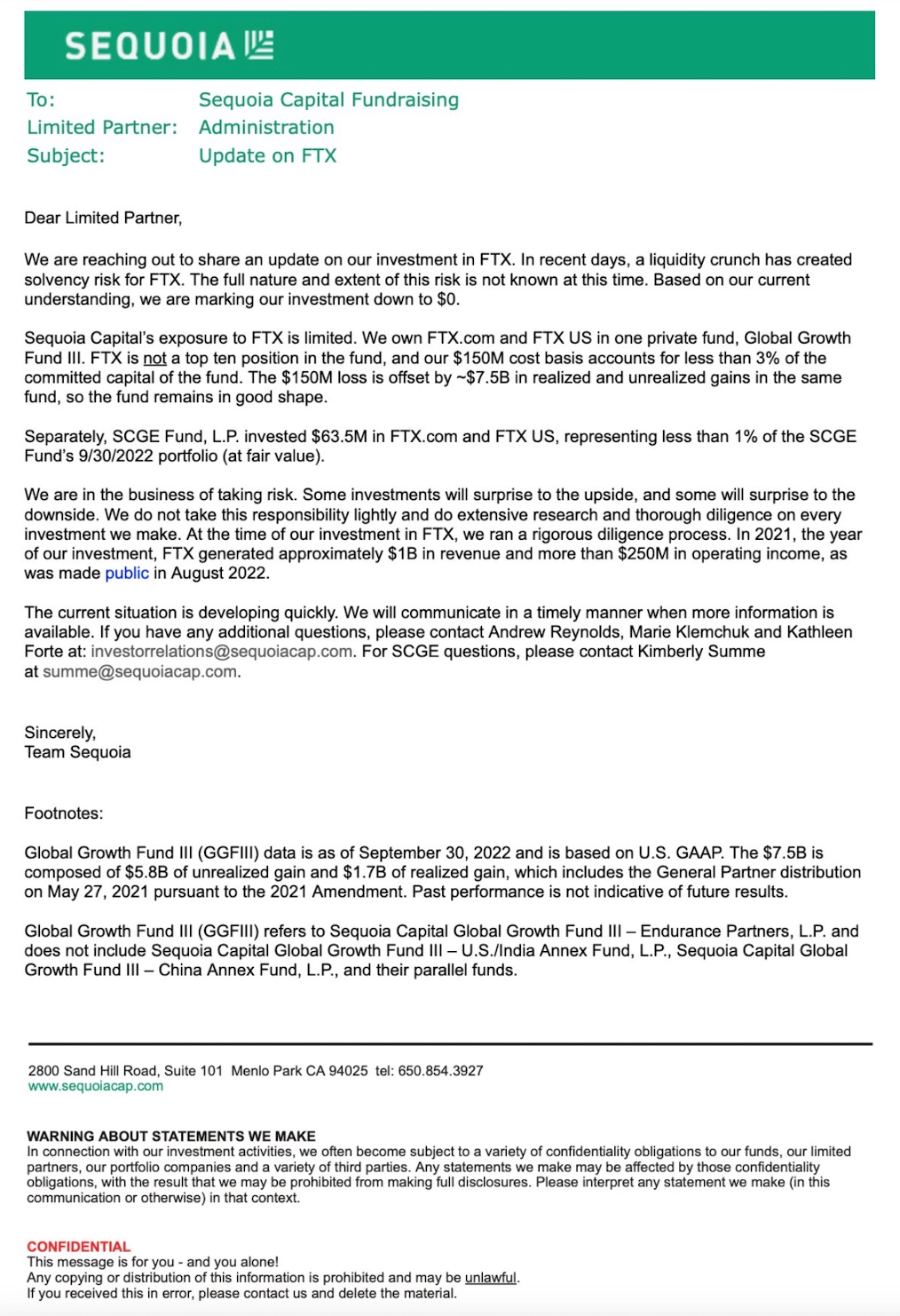
The Alaska Permanent Fund’s investments were through Sequoia Capital, headquartered in Menlo Park, Calif., and other venture capital firms. Sequoia sent a letter to its limited partners on Wednesday marking down the value of its investments in FTX to $0.
The Alaska Permanent Fund had committed as much as $200 million to Sequoia’s Global Growth Fund III, according to Pensions and Investments, an online blog. It was that fund that made the investment of up to $214 million of pooled money from various investors into FTX; thus, the Alaska Permanent Fund’s exposure was not the full amount.
Other institutional investors that had money tied up in FTX include the Ontario, Canada Teachers’ Pension Plan, and the Washington State Investment Board. The Ontario Teachers’ Pension Plan had $95 million invested in FTX Trading and FTX US, but reports that the loss will have a limited impact on the plan.
Sequoia Capital removed its glowing profile of FTX founder Sam Bankman-Fried from its website last week and replaced it with a markdown notice.
“Aliquidity crunch has created solvency risk for FTX and its future is uncertain. Many have been affected by this unexpected turn of events. For Sequoia, our fiduciary responsibility is to our LPs. To that end, we shared this letter with them today regarding our investment in FTX. For FTX, we believe its fiduciary responsibility is first to its customers, and second to its shareholders. As such, FTX is exploring all opportunities to ensure its customers are able to recover their funds as quickly as possible.“
FTX users could be out as much as $8 billion in losses, after it appears that FTX CEO Sam Bankman-Fried used money from customer accounts to transfer to other accounts and fund risky investments. Those companies include FTX-owned Alameda Research, which owes FTX some $10 billion.
The loss on FTX is offset by the fund’s roughly $7.5 billion realized and unrealized gains, Sequoia said in its letter.
“We are in the business of taking risk. Some investments will surprise to the upside, and some will surprise to the downside. We do not take this responsibility lightly and do extensive research and thorough due diligence on every investment we make,” the letter explained, signed “Team Sequoia.”
“At the time of our investment in FTX, we ran a rigorous due diligence process,” the company said, although that is now in question, since it appears the CEO of FTX was running a Ponzi scheme to fund his political favorites in the Democrat Party.
In 2018, the then-$81 billion Alaska Permanent Fund Corp. committed $200 million to Sequoia’s Global Growth Fund III, and the $161 billion Washington State Investment Board retirement system approved an allocation of up to $350 million, according to Pensions and Investments.
FTX founder and CEO Sam Bankman-Fried resigned Friday as CEO, and about 130 companies affiliated with FTX also began voluntary bankruptcy proceedings, according to FTX’s website.
Those companies that are also embroiled in the bankruptcy include:
105. LedgerPrime Bitcoin Yield Enhancement Master Fund LP
106. LedgerPrime Digital Asset Opportunities Fund, LLC
107. LedgerPrime Digital Asset Opportunities Master Fund LP
108. Ledger Prime LLC
109. LedgerPrime Ventures, LP
110. Liquid Financial USA Inc.
111. LiquidEX LLC
112. Liquid Securities Singapore Pte Ltd
113. LT Baskets Ltd.
114. Maclaurin Investments Ltd.
115. Mangrove Cay Ltd
116. North Dimension Inc
117. North Dimension Ltd
118. North Wireless Dimension Inc
119. Paper Bird Inc
120. Pioneer Street Inc.
121. Quoine India Pte Ltd
122. Quoine Pte Ltd
123. Quoine Vietnam Co. Ltd
124. SNG INVESTMENTS YATIRIM VE DANIŞMANLIK ANONİM ŞİRKETİ
125. Strategy Ark Collective Ltd.
126. Technology Services Bahamas Limited
127. Tigetwit Ltd
129. Verdant Canyon Capital LLC
130. West Innovative Barista Ltd.
131. West Realm Shires Financial Services Inc.
132. West Realm Shires Services Inc.
133. Western Concord Enterprises Ltd.
134. Zubr Exchange Ltd
In July, Sam Bankman-Fried said he and FTX had a “few billion” on hand to shore up struggling crypto firms to prevent the collapse of the digital currency industry, and at the time he said the worst of the sector’s liquidity problem had likely passed.
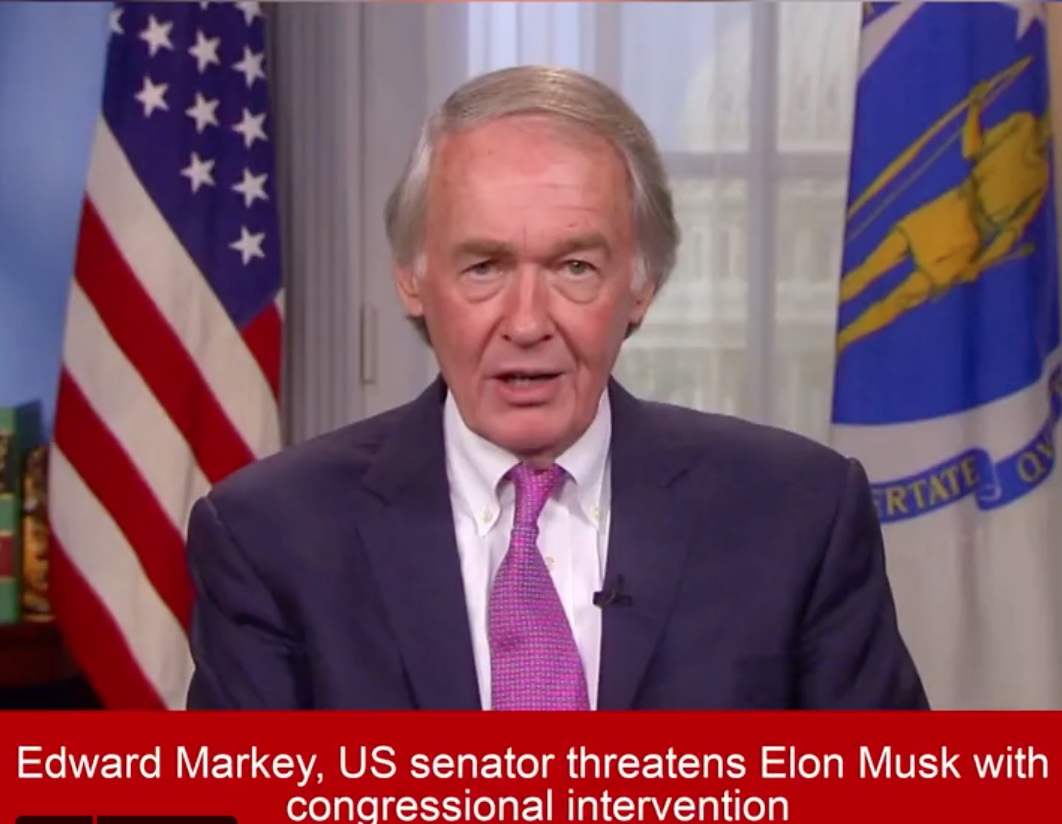
Sen. Ed Markey of Massachusetts is hopping mad at Twitter owner and CEO Elon Musk, and has threatened to take congressional action against Twitter and other Musk-owned companies, after someone set up a “verified account” on Twitter that impersonated the aging Democrat senator. Markey wrote Musk a letter demanding to know how the fake account got through the verification system known as “blue check.”
“A @washingtonpost reporter was able to create a verified account impersonating me—I’m asking for answers from @elonmusk who is putting profits over people and his debt over stopping disinformation,” Markey wrote on Twitter Sunday afternoon. “Twitter must explain how this happened and how to prevent it from happening again.”
“I’m asking for answers from [Elon Musk] who is putting profits over people and his debt over stopping disinformation,” Markey had tweeted on Friday.
As it turns out, Markey had given permission to the Washington Post reporter to set up the fake account. But we digress.
Musk’s response on Twitter was snarky: “Perhaps it is because your real account sounds like a parody?”
The tweet-fight continued, with Markey writing Sunday afternoon his retaliatory message: “One of your companies is under an FTC consent decree. Auto safety watchdog NHTSA is investigating another for killing people. And you’re spending your time picking fights online. Fix your companies. Or Congress will.”
It almost sounds like a government official’s threat against Musk’s right of free speech. Some may see it as an abuse of power.
Democrats are unhappy with Musk, who has turned more conservative in the past few years. Congress has subpoenaed Facebook CEO Mark Zuckerberg to answer questions about its practices, and now may turn its attention to Musk. Now, with the Senate in Democrat control, Markey could use his powers to hold governmental hearings to embarrass Musk, reveal corporate practices and company policies, and interfere in the free market. Markey sits on the Commerce, Science, and Transportation committee, where is assigned to the Subcommittee on Consumer Protection, Product Safety, and Data Security and the Subcommittee on Communications, Media, and Broadband.
Markey has served as U.S. senator from Massachusetts since 2013. He was the congressional representative for Massachusetts’s 7th congressional district from 1976 to 2013.
Unregulated crypto currency traders funding political campaigns. What could go wrong?
News broke this week that the FTX currency exchange, similar to a Ponzi scheme, crumbled and took down the investments of millions of people.
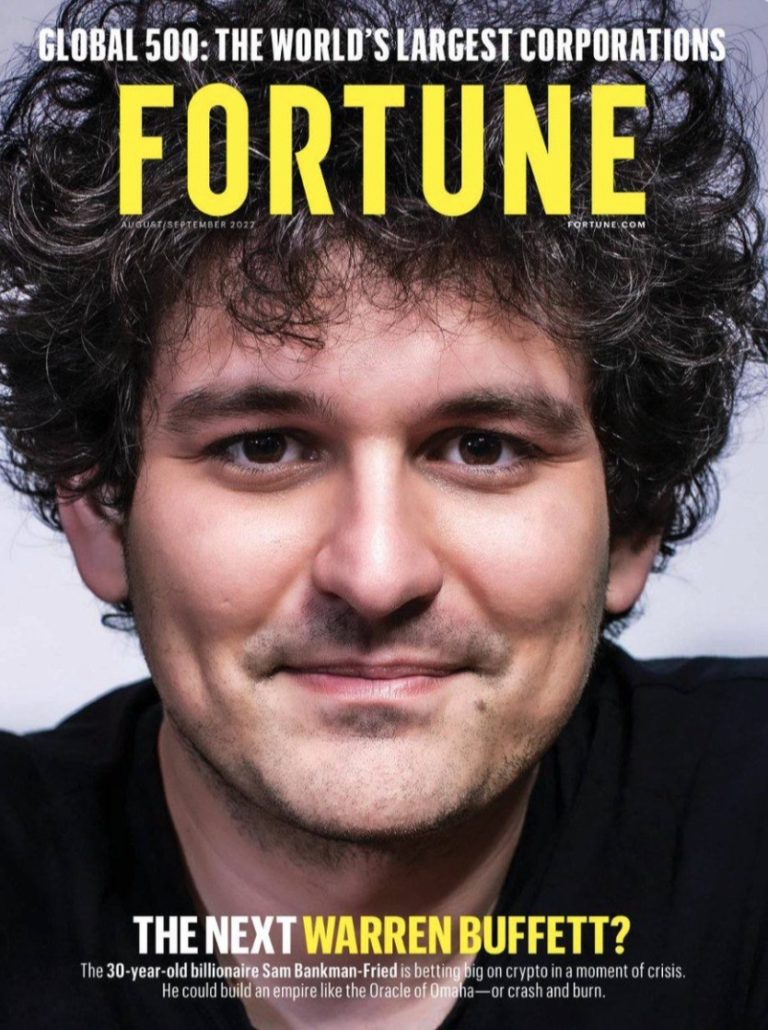
The 30-year-old founder of FTX, Sam Bankman-Fried, who operates outside the United States, resigned Friday as the company declared bankruptcy. A caretaker CEO who helped Enron recover from bankruptcy has come in to try to usher the company through the bankruptcy process. (This is not investment advice, but if you are invested in FTX, you won’t see your investment back any time soon.)
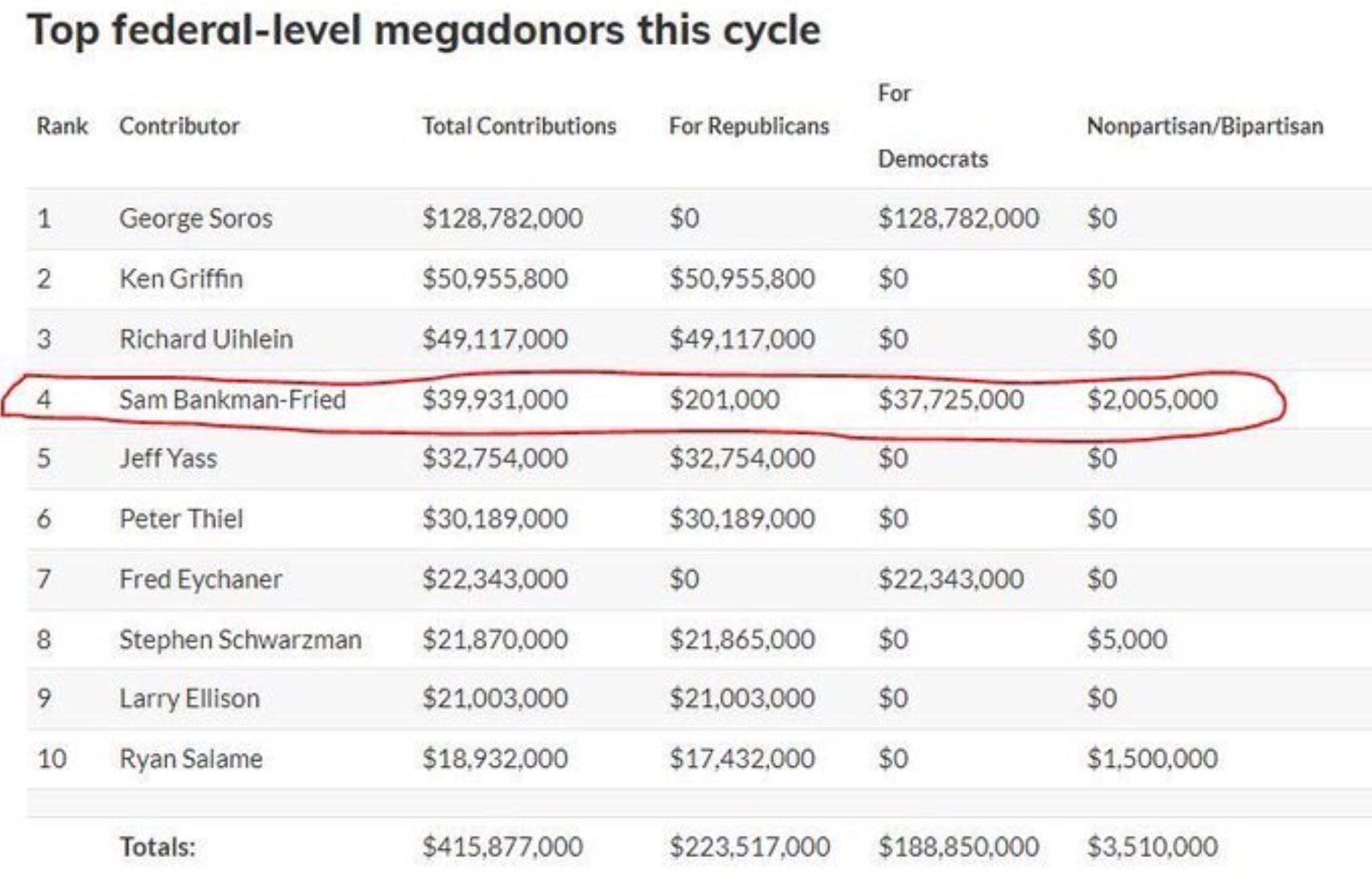
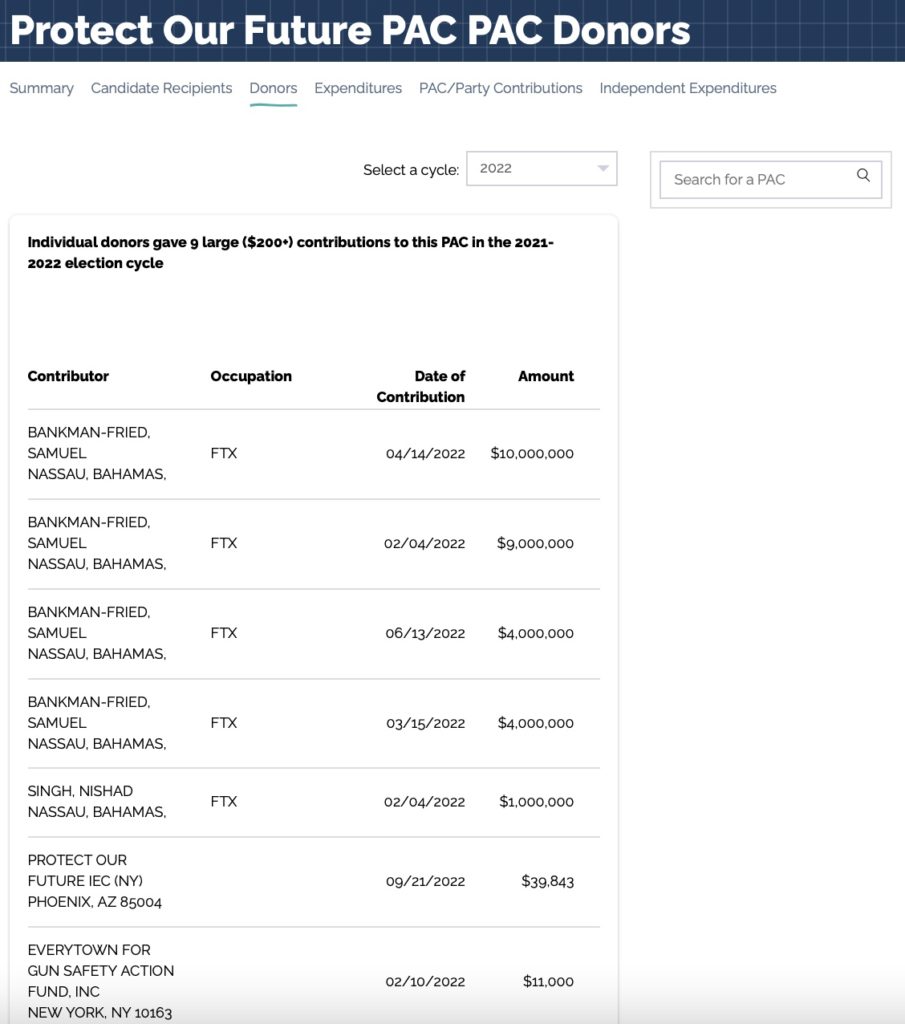
Bankman-Fried, who conned billions of dollars out of people and transferred tens of millions of dollars to Democrat campaigns, was the Democratic Party’s second-largest donor this year, after well-known Democrat funder George Soros.
His operation was, in essence, a money-laundering scheme for Democrat campaigns. At the same time, Bankman-Fired was buying influence in Congress, as a key player in stopping the “red wave” that was to be the 2022 elections.
To help flip Alaska blue, Bankman-Fried donated $6 million to the Democrat House Majority PAC, which in turn donated $5,000, the maximum amount allowed, to the campaign of Alaska’s Democrat Congresswoman Mary Peltola.
FTX is a decentralized cryptocurrency exchange founded by the MIT graduate in 2018. It was primarily focused on derivatives, options, volatility instruments, and leveraged tokens.
Bankman-Fried “stormed on to the US political scene with multimillion-dollar donations that led lawmakers, particularly Democrats, to believe he was ushering in the next generation of donors. But in a matter of days, his business empire collapsed into bankruptcy and the prospect of millions more in donations evaporated,” writes the Financial Timeson Sunday.
In 2020, Bankman-Fried was the second-largest donor to get Joe Biden elected president, also after No. 1 George Soros. Bankman-Fried was only 28 years old at the time and had only been in the crypto business for about 1-2 years.
2022 top donations to candidates.
The majority of Bankman-Fried’s donations to Democrats — about $28 million — was through the Protect Our Future Pac, which used the funds to support 25 Democrats in congressional races. Of those, 18 have won their races, including Virginia’s Abigail Spanberger and Florida’s Maxwell Frost, a 25-year-old.
From OpenSecrets.org
But for Bankman-Fried, it was more about furthering his crypto businesses. He intended to influence public policy and gave to some right-leaning political action committees. But only about $155,000 went to Republicans, such as Alabama Sen.-elect Katie Britt, who was an ally, and Arkansas Sen. John Boozman. Bankman-Fried also donated to the campaign of Sen. Debbie Stabenow, the Senate Agricultural committee overseeing crypto, which Boozman also serves on.
Some politicos said they suspected Bankman-Fried’s primary goal in politics had been to further his crypto interests through the political process. Elon Musk, the world’s richest man, said he had not heard of Bankman-Fried until people started mentioning him as a potential investor in Twitter. “But then I got a ton of people telling me [that] he’s got, you know, huge amounts of money that he wants to invest in the Twitter deal. And I talked to him for about half an hour. And I know my bullshit meter was redlining. It was like, this dude is bullshit – that was my impression.”
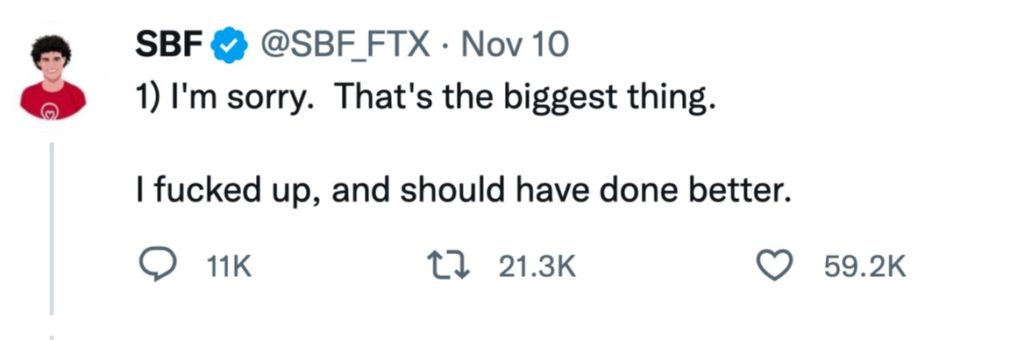
Sam Bankman-Fried on Twitter last week, where he had many things to say, this among them.
One of Bankman-Fried’s other interests was to elect lawmakers to the House of Representatives who would focus on pandemics. He was one of the founders and was the main funder of a group called Guarding Against Pandemics, a political influencer run by his brother, Gabe Bankman-Fried, who was an adviser to Democratic political action committees and was a staffer to Democrats in the U.S. Capitol. The purpose of the group was to ostensibly work on preventing the next Covid pandemic, but it may be another political scam or money-laundering operation.
At the peak of his crypto scheme, the Bankman-Fried was said to be worth $26 billion. At the beginning of last week, his worth was pegged at $16 billion. At the end of the week, it was pegged at zero.
Bankman-Fried’s other crypto company, Alameda Research and Weste Realm Shires Services (known as FTX.US), are are embroiled in the same meltdown, which has also entangled other crypto companies as the fallout continues.
Bankman-Fried is now in the Bahamas, where he is likely a flight risk to a jurisdiction that has no extradition treaty with the United States. The United States has extradition treaties with about 107 countries.
The most charitable view of the election process in most of the U.S. is that it is embarrassing. A more realistic if heretical view is that it is criminal. I lean toward the latter: It’s a criminal enterprise seasoned with a dollop of stupidity and laziness.
I’m not some hopeless romantic that thinks it will all be OK if we just go back to paper ballots on Election Day; Tammany Hall and the Richard Daley Machine did election fraud really well without Dominion Machines and mailed-in ballots.
Alaska is no saintly example of elections. The first political story I recall when I first arrived here in 1974 was about bags of ballots turning up in the trunk of an Alaska State Trooper car days after the election was supposed to be over.
There was more than a whiff or corruption and vote fraud in much of rural Alaska and several political personalities tied to rural/Western Alaska got a new federal address in the 1980’s. The Wally Hickel-Jay Hammond primary in 1978 was so tainted that the Alaska Supreme Court went so far as to say there was fraud, though they wouldn’t say the word, preferring the vague word malconduct. The court set a rule that it wouldn’t upset the outcome of an election unless whatever malconduct was done had substantially affected the outcome of the election, and the judges reserved to themselves the power to make that determination.
Interestingly, the Alaska Supreme Court has found something that might be malconduct in several elections, it has never found enough malconduct to throw out an election.
Get-out-the-vote campaigns and voter fraud are only one step removed from each other; you use the same techniques and data for the one as the other. The only difference is a GOTV program gets out real people who are honestly entitled to vote. A fraud program only cares about getting a ballot with a registered name on it into a ballot box. Voter fraud the old-fashioned way took a lot of organization and a lot of labor. Fast forward to the world of universal registration, unsolicited mail ballots, long early voting periods, and any-reason absentee ballots, and it is child’s play to commit fraud, especially in rural Alaska.
The dumbest thing, among many dumb things, that Alaska has ever done politically is passing the automatic Permanent Fund dividend application automatic voter registration. Everyone who knows anything about State government knows that the Permanent Fund Division has almost no application security; if you can fill it out and mail it, you get a Permanent Fund dividend and you’re almost certainly then made into a registered voter. Thus, we have over 604,000 registered voters in a state with 732,000 declared residents.
Permanent Fund dividend application fraud largely relies on fraudsters getting ratted out by jealous friends and neighbors who envy their new big screen.
With the universal registration and unsolicited mail ballots, all a fraud operation needs is a name and address and those are easy to get. Drop boxes just make it easier; there is risk to the mule to bring a few hundred fraudulent ballots into a polling location; some honest election worker might notice. If you have the name of a putatively registered voter all it takes is a little phone work to determine if they’re still at the registered address and only a little more to determine if they’re in the district or the state.
The fraudster is relatively safe if the person named merely no longer lives at the registered address; it is unlikely there will be any investigation of such fraudulently cast votes. If the named person is no longer in the district, fill out the ballot and put it in the mail or a drop box; do a few hundred of those and you’re doing your part to “save democracy,” as the Democrats like to say.
Art Chance is a retired Director of Labor Relations for the State of Alaska, formerly of Juneau and now living in Anchorage. He is the author of the book, “Red on Blue, Establishing a Republican Governance,” available at Amazon.
Sarah Palin appeared in Toronto, Canada on Saturday with her boyfriend Ron Duguay, signing autographs and having her picture taken for cash at a card show. She sold autographs for $40, and photos with her for $50.
Duguay was there as a former hockey star with the New York Rangers. The Toronto Sport Card Expo ran Nov. 10-13. Duguay and Palin were on the Expo floor on Nov. 12.
Toronto’s Sport Card & Memorabilia Expo is Canada’s largest and longest-running sports collectables show, its website says, and gives collectors the chance to get autographs from hockey and other sports legends. Collectors can shop over 200 dealers & corporate booths and find rare cards and sports memorabilia from over 100,000 square feet of expo space.
Prices have come down since this summer, when Palin was charging $2,900 for a photo with her during the campaign.
Some visitors didn’t pay the $50 but got the picture of Palin the old-fashioned way:
Palin ran for Congress this year to replace Congressman Don Young, who died March 18. She is currently in second place, with 26% of the vote, and is not expected to win over Democrat Mary Peltola, who is currently serving the remainder of Young’s final year in office. The delay in the results is largely a product of the 2020 Ballot Measure 2, which ushered in open primaries and ranked choice voting in general elections.
Last week, Palin told her vast social media audience that she was feeling victorious and had hired her loyal friend Jerry Ward as her interim chief of staff. She said she was heading to Washington, D.C. to meet with the House Freedom Caucus and start working for Alaskans in anticipation of the announcement of her win.
Over the past two years, Palin has made substantial income selling “Cameo” custom videos that capitalize on her hard-earned fame.
Bill Walker has been generous to the Ship Creek Group and campaign-associated Alaska economy, spending over $3.8 million in failed gubernatorial election campaigns since 2010. He’s Alaska’s Beto O’Rourke, the Texas Democrat who has failed for statewide office three times in six years, but spent $175 million doing so.
Although the election for governor has not been finalized, Walker, the former one-term governor, now stands with a 20% result in 2022, which is remarkable, considering that in 2018 he pulled out of the race in the last three weeks leading up to the midterm election, and received 2% of the vote.
In 2010, Walker’s first failed run for governor, he spent $570,394.
In the 2018 election cycle when he was running for reelection, he spent $1.039,917.
In 2022, he has spent more than $2,261,730, or about $53 per vote for the 42,943 vote counted so far. Final reports will include more spending and at least a few more votes, but as of now, he has perhaps set a record.
Walker spent a whopping $3,872,041 on elections where he either dropped out or was defeated in a landslide. This may give his donors pause before they give over their hard-earned money to Walker — if there is a next run for governor.
On the other hand, Gov. Mike Dunleavy has never lost a race, and in fact has won nine elections in a row. He spent $1,289,259 on this year’s campaign, as of the most recent filing with Alaska Public Offices Commission.
As of Thursday, Dunleavy’s vote total was over 52%, with 111,897 voters picking him first. More results are expected for all the Nov. 8 races on Tuesday, according to the Division of Elections, and the final sorting of first, second, and third-place votes on the ranked choice ballots will be calculated on Nov. 23.
Whatever the results are, it appears Walker will not be able to retake the governorship of Alaska, in spite of his record spending.
An election-related lawsuit challenging the Alaska residency of Jennifer “Jennie” Armstrong, who came from Louisiana in June of 2019, and who is apparently the winner of District 16’s House seat in the the Alaska Legislature, was assigned a new judge last week. The state objected to the first judge for unknown reasons and Judge Herman Walker will take over.
Armstrong now has legal representation: Election activist and author of the Ballot Measure 2-ranked choice voting lawyer Scott Kendall has joined the fray, representing the Democrat, who ran to become the first openly pansexual candidate to be in the Alaska Legislature. Armstrong is not named in the lawsuit, whose plaintiffs are directing their complaints over Amstrong’s illegality to the state Division of Elections.
According to Armstrong’s own social media account, she visited Alaska in May of 2019 to visit her then-boyfriend. Then she returned in June of that year and applied for a non-resident fishing license on June 23, declaring her residency to be in Louisiana. It appears from her activities that she came up to go fishing with her boyfriend. As a non-resident in June of 2019, she was not eligible to run for House in the 2022 election, having missed the deadline by a couple of weeks.
The following June, Armstrong applied for and received a 2020 resident sport fishing license.” On said application, Armstrong indicated that she was a resident for one year and zero months, meaning that she asserted her residency in Alaska did not begin until June 2019, which contradicts the story she told the Alaska Department of Fish and Game the prior year.
Armstrong did not demonstrate the intent to remain in Alaska until at least June 7, 2019, but possibly as late as August 26, 2019, when she registered to vote, the lawsuit explains.
The clock is ticking on the lawsuit. Nov. 29 is the Division of Elections’ target date to certify the general election, per statute 15.15.450.
District 16 residents Chris Duke, Randy Eledge, Steve Strait, and Kathryn Werdhal are the plaintiffs in the lawsuit, which has no court hearing date set. Armstrong and Kendall have filed a motion to dismiss the case.
Donations to the HD16 Armstrong Candidacy Challenge can be made to the Holmes Weddle and Barcott Trust Account and will be used to pay legal fees and costs incurred by the firm in connection with the recount and potential litigation related to the referenced litigation.
Donations can be mailed to: ATTN: Stacey C. Stone Holmes Weddle & Barcott, PC 701 W 8th Ave, Ste 700 Anchorage, AK 99501 (907) 274-0666 Any donation checks should reference HD16 Armstrong Candidacy Challenge. Credit card donations can be given online at https://secure.lawpay.com/pages/hwb/trust or over the phone by calling 907-274-0666. Corporate donations are allowed, and no funds will be paid to or under the control of any candidate. If the amount donated exceeds the legal fees and costs incurred, the surplus donations will be returned to the donors on a pro rata basis.
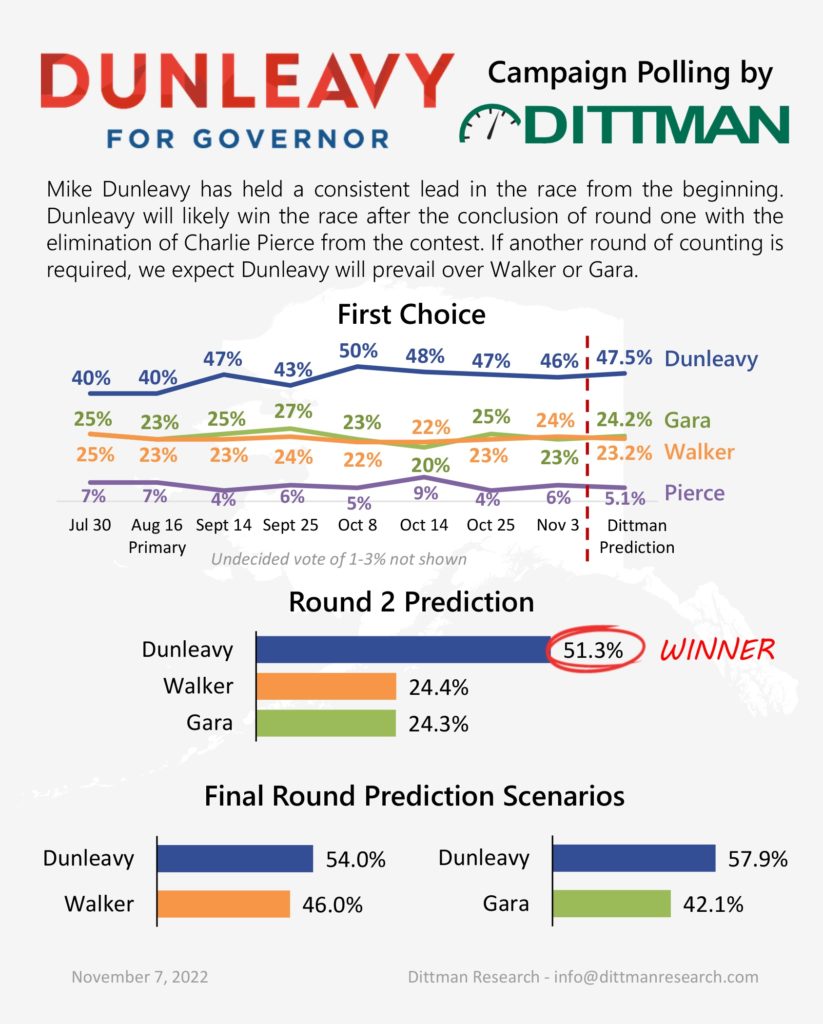
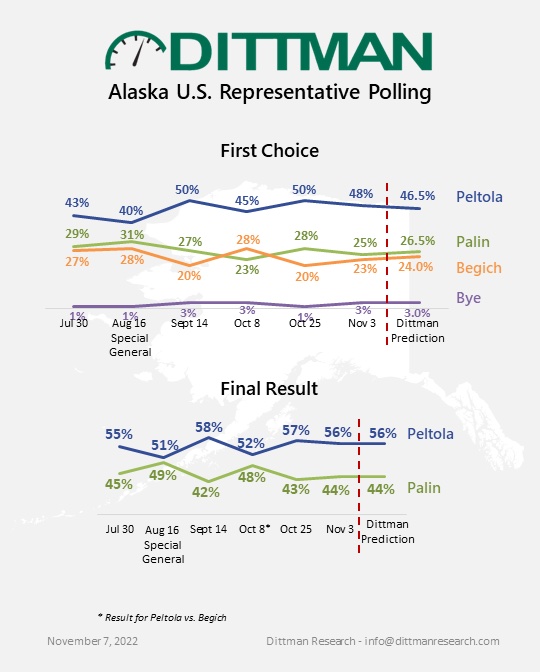
Alaska-based Dittman Research was a clear winner on Tuesday, with a sweep of all the elections polled. The Alaska survey firm, started by Dave Dittman and now owned by Matt Larkin, predicted several races correctly. Before Tuesday’s election, Dittman made these predictions:
Mary Peltola would win on election night with 45.5% of first-choice votes. The current standing is Peltola with 47.26%.
Sarah Palin would come in second with 26.5% first-choice votes. She currently has 26.57%.
Nick Begich would come in third with 24.0% first-choice votes. He is standing at 24.19%.
Chris Bye would come in fourth with 3% first-choice votes. Bye is at 1.73%.
In the governor’s race, Dittman predicted:
Mike Dunleavy would win with 47.5% of first-choice votes. His actual result is currently 52.06%.
Les Gara would get 24.2%. His actual result is 23.07%.
Bill Walker would get 23.2%. Walker is at 20.10%.
Charlie Pierce would get 5.2%. Pierce is at 4.55%.
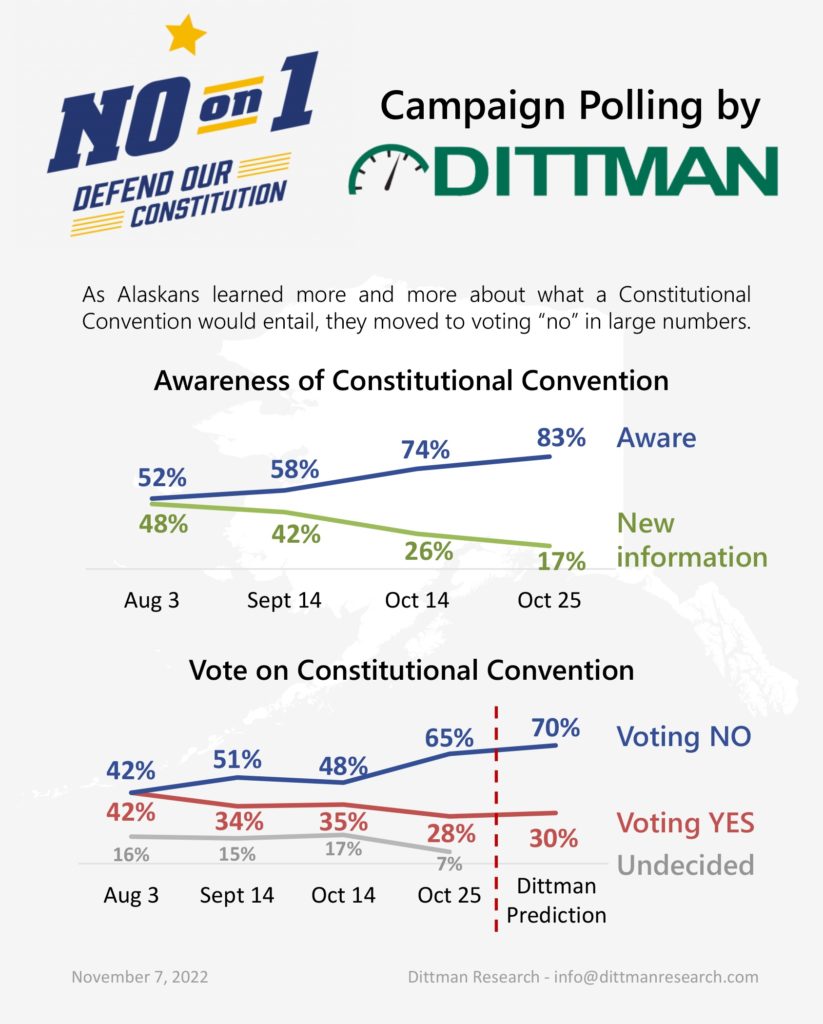
On Ballot Measure 1, the Constitutional Convention, Dittman predicted voters would reject it by 70%. In actuality, voters rejected the measure 69.84%.
Dittman’s predictions also delved into the second-round count. If Dunleavy drops to the 47.5% predicted by Dittman for the first round, Dittman predicts he’ll end up at over 51% in the second round. Dittman predicts Peltola will will for Congress with 56% of the votes in the final round of counting for that race. Those results won’t be known until Nov. 23, due to Alaska’s slow election process that was made worse with the ballot measure passed in 2020 that brought ranked choice voting into play in the general election.
The information that Dittman provided the day before the election:
Dittman Research is Alaska’s most trusted pollster, and has been accurately predicting the races for governor and U.S. Senate for over 50 years, since its founding in 1969, It has commercial clients and has political clients.
“We’re very pleased once again to have accurately predicted the outcome of another election cycle, and we’re grateful for the thousands of Alaskans who willingly share their views with us on the issues of the day so that we can provide the public with relevant and accurate public opinion information,” said Matt Larkin, CEO.