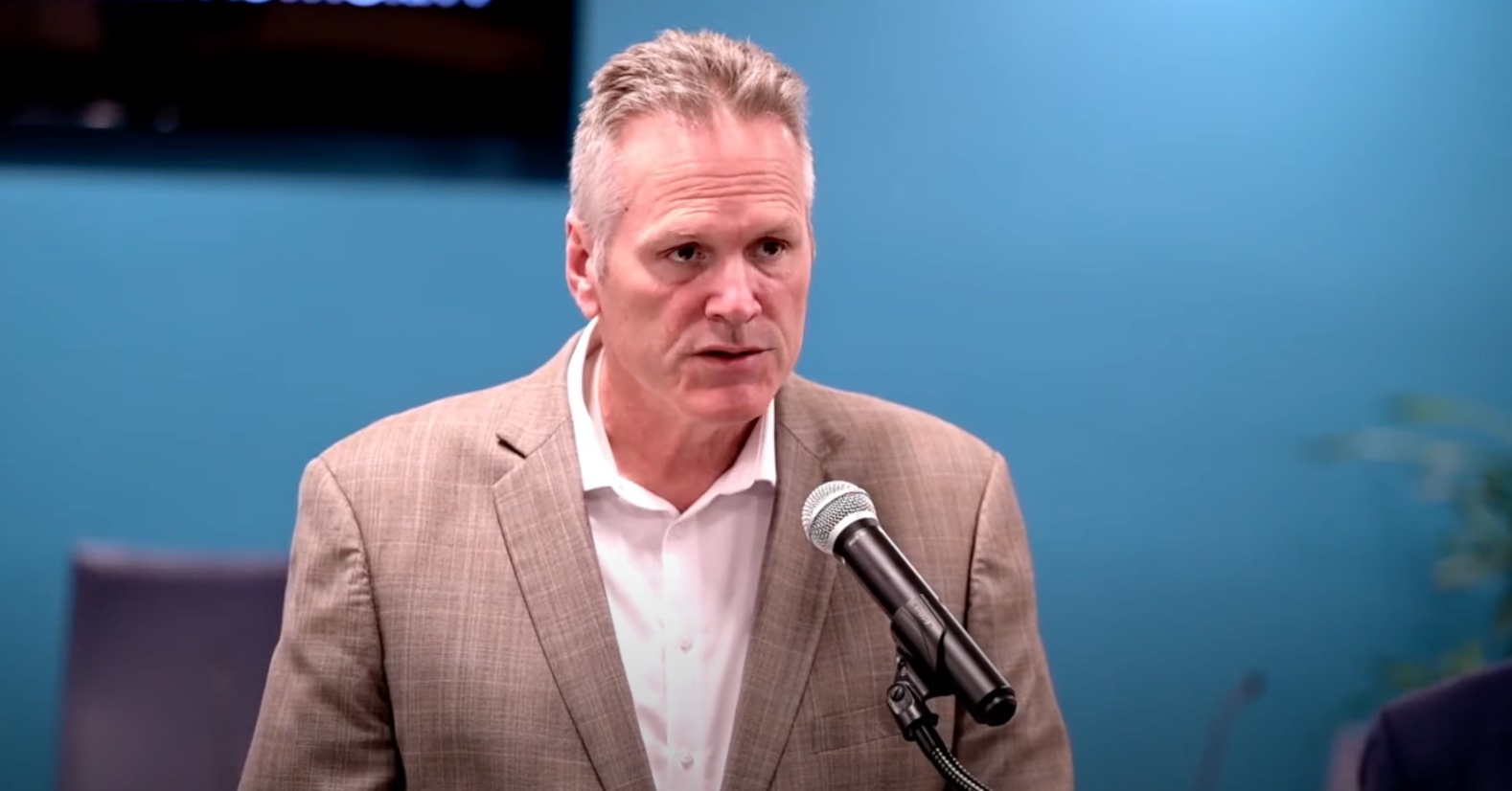
Gov. Mike Dunleavy introduced SB83 to provide people who work in a licensed occupation and who are licensed in another state the ability to get a temporary, limited license so they can begin working in Alaska sooner.
The bill will allow individuals with “clean licenses” in other states to work up to 180 days while completing final requirements for Alaska licensure.
The bill covers more than three dozen licensed occupations, ranging from barbers and hairdressers to pharmacists and nurses.
“For people who want to live, work and play in the most beautiful state in the country, nowhere competes with Alaska,” Dunleavy said. “Making sure that qualified professionals who come to Alaska can get to work right away is important for both attracting skilled workers and meeting workforce needs.”
The bill establishes limited reciprocity for qualified practitioners who hold substantially equivalent licenses in other states or in Canada.
The measure will benefit both employers and workers by reducing wait times, lost revenue and frustration.
About one in four employed Americans work in a licensed occupation.
The mayor and the Assembly may disagree on whether Anchorage needs a navigation center to help homeless, vagrants, and transients get their feet on the ground, but the bills for the work that has been done on the center do need to be paid, and Acting Municipal Manager Ken Kohlhase intends to pay them.
Kohlhase today notified the Anchorage Assembly that money sitting in an account for the homeless navigation center, which was started late last year, will be used to pay the invoice of one of the contractors.
“As we all anticipated, Roger Hickel Contracting, Inc. has made a claim against the Municipality asserting an entitlement to payment for work it performed in construction of the Navigation Center prior to the time the project was terminated. The cost basis of that claim was carefully reviewed by The Boutet Company on behalf of the Administration, and largely found to consist of valid charges,” wrote Kohlhase to the Assembly, which is the appropriating body.
Kohlhase said it’s in the best interest to settle the claim, and that he intends to pay $2.455,351.93 to Roger Hickel Contracting on March 24.
Kohlhase referred to a resolution for $4.9 million that the Assembly passed last May that was “to be used for construction of an adult shelter and/or navigation center.”
The Assembly has been preparing to claw back that money because many of the liberal members don’t want Mayor Dave Bronson to finish the navigation center, even though funds were appropriated by the Assembly for that purpose. The struggle over what direction to take on homeless issues has consumed the Assembly and mayor’s relationship since the outset.
“This existing appropriation is more than sufficient to satisfy the claim at hand. Since the claim is for construction work falling squarely within the appropriation’s designation that it be used to pay for ‘”‘construction of an adult shelter and/or navigation center'”‘, it is the Administration’s intent to fund the settlement with this appropriation,” Kohlhase wrote.
Kohlhase also wrote that he acknowledged the appropriation was conditional on the Bronson Administration using the old Golden Lion Hotel for a substance misuse treatment center.” Since then, doubts have arisen about whether it could be used as such legally.
“The Mayor satisfied that condition on June 1, 2022, when he issued a statement acknowledging that direction was given to ‘the facilitation group guiding the mass care exit to recommend the best option to providing substance misuse treatment centers’ and promising to consider the former Golden Lion Hotel for this purpose.”
Several liberal members of the Assembly are determined to force the mayor to use the Golden Lion Hotel for a drug treatment facility, but the neighborhood opposes it. Bronson came into office with the idea that a navigation center near Elmore and Tudor Roads was a best practice that had worked in other communities. He convinced the Assembly to fund it, but they later reneged on the agreement and have fought the mayor ever since.
Meanwhile, Assemblywoman Meg Zaletel, who is paid well over $100,000 per year to run the Anchorage Coalition to End Homelessness, opens her own navigation center in downtown Anchorage this month, in partnership with Catholic Social Services, after having fought the mayor over his navigation center concept. the ACEH-CSS center is on Third Avenue downtown.
The debt ceiling is the legal limit on what debt the federal government can accrue, and right now that includes $24.5 trillion of debt held by (owed by) the public and the roughly $7 trillion the government owes itself due to inter-agency account borrowing (Social Security and Medicare funds).
Today, the debt is beyond its authorized limit and the government is taking extraordinary actions to avoid being in a default position, with the U.S. Treasury unable to borrow money to make payments.
The U.S. House and Senate, when they return next week, will face this grim fact of their own making and will have to deal with it before summer. Conservatives want to see spending cuts, while liberals, including the president, want to raise the borrowing limit. It will not have been the first time Congress has faced this test.
FiveThirtyEight.com senior analyst Geoffrey Skelley believes Sen. Lisa Murkowski is one of the most likely of Republicans to vote for an increase to the debt ceiling. She has a record of voting to raise the limit. In fact, Murkowski has voted to raise the debt ceiling nearly seven out of 10 times.
“When it comes to which GOP senators are most likely to be involved in passing a debt limit increase, we unsurprisingly start with the chamber’s two prominent moderates: Sens. Susan Collins of Maine and Lisa Murkowski of Alaska. Collins has voted for three-fourths of debt ceiling bills since 2001, while Murkowski has voted for nearly 7 in 10. But in looking for other potential votes, some other names may surprise. Sens. Kevin Cramer of North Dakota and Mike Rounds of South Dakota have supported two of every three debt ceiling bills that have come before them. And indicative of his common involvement in dealmaking on the debt ceiling, McConnell has supported 65 percent of the bills that have come before the Senate since 2001,” Skelley writes in FiveThirtyEight.com.
Murkowski votes in favor of President Biden positions 65%of the time, according to FiveThirtyEight.com, while Alaska Sen. Dan Sullivan votes with Biden just 45% of the time. In 2021, Sullivan voted against increasing the debt ceiling, while Murkowski voted for it.
In the House, Alaska Rep. Mary Peltola, in Congress for just five months, is in the 100% Biden category, already on record saying how she will vote: “Not raising the debt ceiling is reckless and irresponsible. We have to do it.”
Thirty years ago, the national debt was less than $5 trillion. Much has happened in those years, including inflation, the war on terror, Obamacare, the Covid pandemic, the influx of 10 million illegal immigrants per year, and an overall national population rising from 260 million people in 1993 to 332 million people in 2023. Add to that presidents and members of Congress unable to cut spending, and it appears the nation is heading for a debt that will be 126% of the national gross domestic product by this time next year. It ended 2022 at 122% of GDP.
A bunch of my friends and I got together in the beginning of 2019 and formed Eaglexit. Eaglexit is an organization founded to educate the citizens of Anchorage’s Assembly District 2 (Eagle River and Chugiak) on the realities of detaching from Anchorage and incorporating as its own municipal government. This idea has been around since the early 1970s.
Education on the topic of Alaska’s local government and the fundamentals to form a local government, especially in these times, is critical to understanding how local government will work for its constituents rather than the current reality of constituents working for their local government.
What was fascinating were the responses we encountered in our journey to provide local government education to one of the most “conservative” communities in Alaska.
When considering our approaches to informing our neighbors, we discovered that often conservatives were more rigid and resistant to change and preferred clear answers. What was a bigger surprise was conservatives weren’t as interested as I thought they would be to find out for themselves the answers to their own questions.
On the other hand, the liberals we engaged were more flexible and tolerant of our mission. They were curious, but also weren’t motivated to discover answers to their own questions.
Both groups were hesitant about change and reluctant to discover what it would bring.
I’m not saying that either one is smarter than the other. Everybody is different. It is just how wiring has evolved over their lives.
The result is conservatives lean to more structured and persistent cognitive styles, while liberals are likely to draw from that “aha” moment. In many ways they end up with the same conclusions, but their journeys take them down different paths.
Regardless of political persuasion, most of the good people of Assembly District 2 are working. They are providing for those they love. They are taking care of their families. Most working couples in Assembly District 2 don’t have time for extra activities. They work with their heads down with one purpose…to enjoy the company of those they love. They work and live because time for them is a precious resource, which cannot be recycled.
With the responsibilities of raising a family and working, there is scarce opportunity to engage in community involvement, which poses a challenge as the limited time available often results in ignorance and apathy.
Ignorance and apathy manifest as pseudo-somnambulation. For most of us, we “wake up” only when something affects us personally and by then it is often too late.
The majority who spoke supportively and wanted us to get the job done supported us through donations and kept us moving in the right direction. Thank you.
We are now about to submit working documents to the Alaska Local Boundary Commission. But even now after almost four years, I find newcomers who will ask the standard question, “Will my taxes go up?”, and some who declare, “I don’t get involved in politics.”, and only a few who say “I’m not interested.
For those that ask, “Will my taxes go up?”, my answer is no. Under our analysis, property taxes will go down. As you will see in the following paragraphs, property taxes through the municipality of Anchorage have gone up tremendously in the past few years.
More to the point and to answer that question, in 2019, the value assigned by the Municipality of Anchorage in Assembly District 2 to taxable real property assessments less exemptions was $3.706 billion. Add in the business property inventory tax assessment of $80 million, the total was $3.786 billion. All combined, the total property taxes for Assembly District 2 came to $58.687 million.
In 2022, the value assigned by the Municipality of Anchorage in Assembly District 2 to taxable real property assessments, minus exemptions, was $4.178 billion. Add in the business property inventory tax assessment of $91.991 million, this added up to $4.27 billion. Total property taxes for Assembly District 2: $67.959 million.
The increase in total property assessment from 2019 to 2022 for Assembly District 2 was 12.78%
The increase in total property taxes from 2019 to 2022 for Assembly District 2 was 15.75%.
I urge you now: It’s time for all of us to wake up and get involved.
With the utmost respect regarding those that state, “I don’t get involved in politics,” examine our historical record of the last decade. Politics have raised our taxes, duplicated services, inefficiently spent our tax dollars and left a questionable future for our children.
There are those who are not interested in politics, either because they find it boring or because they do not see how it directly affects their lives. Some feel that their political engagement will not make a difference, and therefore choose not to engage in political discussions or activities.
But the overwhelming reason for not getting involved is fear.
Some don’t like conflicts and potential arguments with others, especially friends and family, which political activity will invariably create. Many of us fear being judged or criticized for our political views and avoid politics completely. With that, we become resistant to change.
It’s important to note that while people might say they don’t “do” politics, it is difficult to completely disengage from politics because it affects many aspects of our lives, such as healthcare, education, employment, and more.
For those who insist they are not interested, I’ll leave you with Plato’s warning of almost 20 centuries ago:
“The price good men pay for indifference to public affairs is to be ruled by evil men.”
Michael Tavoliero is a realtor in Eagle River, is active in the Alaska Republican Party and chaired Eaglexit.
Alaska Gov. Mike Dunleavy issued Administrative Order 344 on Thursday, establishing the Alaska Energy Security Task Force.
The purpose of the task force is to develop a comprehensive statewide energy plan that will evaluate the energy generation, distribution, and transmission for the State of Alaska and its communities. The development of the plan will include collaborating with both the public and private stakeholders, his office said. The statewide energy plan, including proposed timelines and milestones, will be presented to the governor upon completion.
“Despite Alaska’s position as a leading producer of energy, the cost of energy in Alaska, especially in our rural communities, is extremely high,” Dunleavy said. “As everyone has been reminded by the war in Ukraine, access to and cost of energy are influenced by global events. I’m establishing this task force to create a plan that will reduce Alaska’s vulnerability to fluctuating energy markets by securing dependable and affordable energy for Alaskan residents.”
On Sept. 30, 2022, Governor Dunleavy established the Office of Energy Innovation to provide a central point of focus for Alaska’s efforts to reduce the cost of energy for residents. The Task Force will provide recommendations on overall energy policy for the State of Alaska, as well as strategies and tactics to achieve its goal of reducing the cost of energy for Alaskans.
The task force’s initial report to the governor is to be completed by May 19. Once the report is received, further clarification and deliverables may be identified that would require additional work by the task force, his office said.
The Alaska Energy Security Task Force will have 13 voting members and five ex officio members appointed by the governor.
The voting members are as follows:
The Commissioner of the Department of Environmental Conservation, or the Commissioner’s designee.
The Commissioner of the Department of Natural Resources, or the Commissioner’s designee.
The Executive Director of the Alaska Energy Authority, or the Executive Director’s designee.
One member from the University of Alaska with a background in energy.
One member from a utility that represents rural Alaska or a community receiving power cost equalization.
One member who represents a city, borough, or municipality.
One member with a Railbelt utility background.
One member from the oil and gas industry.
One member from the mining industry.
One member with a background in economic development.
One member from the business community.
One member from any segment of the Alaskan energy industry.
One member of the general public.
The five ex officio members of the task force are as follows:
One member from the Regulatory Commission of Alaska.
One representative from the Denali Commission.
One representative from the U.S. Department of Energy, Arctic Energy Office.
The first Alaska straw poll for the presidential election of 2024 was conducted this week by Must Read Alaska in the MRAK newsletter that reaches over 35,000 Alaskans three times a week.
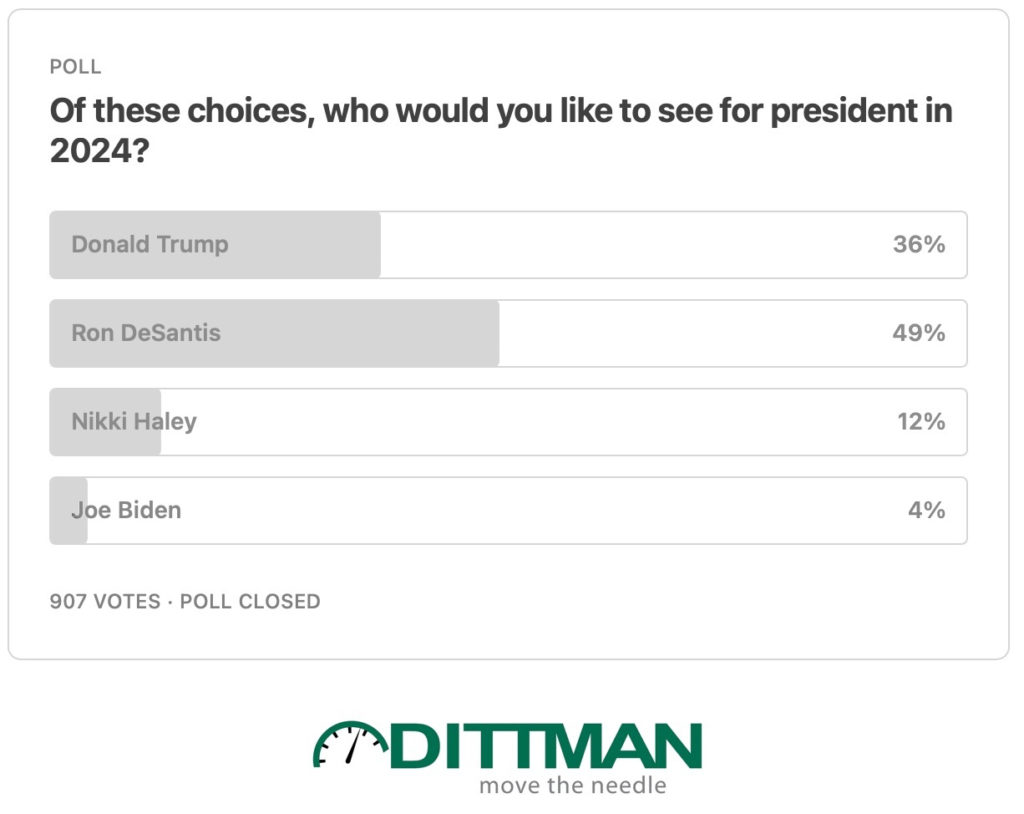
Of the 907 readers who participated in the Monday straw poll, 49% chose Ron DeSantis, the governor of Florida. Coming in second was former President Donald Trump at 36%, followed by former South Carolina Gov. Nikki Haley at 12%, and President Joe Biden at 4%.
The Must Read Alaskanewsletter subscribers trend conservative, and the poll is not scientific. A straw poll is an unofficial vote taken to test the relative strength of candidates or issues but is very different from a traditional poll.
Although this poll was conducted Feb. 20-22, nearly a year before the first Republican primaries in New Hampshire and Republican caucus in Iowa, it is the first indication among conservatives in Alaska that DeSantis has a strong following in the 49th state, and that Trump’s star has, perhaps, faded. Trump won Alaska with nearly 53% of the general election vote in 2020, with Biden capturing nearly 43% of the general election vote.
This poll was conducted before Republican entrepreneur and author Vivek Ramaswamy announced his candidacy on Tuesday.
How does the Must Read Alaska straw pollcompare to more scientifically conducted polls around the nation?
According to a Reuters/Ipsos public opinion poll, Trump leads among registered Republicans in America, when the question was asked in the Feb. 6-13 poll. 43% of responding Republicans picked Trump, 31% picked DeSantis, and 4% picked Haley. Biden was not included in the poll of Republicans, which surveyed 1,465 registered Republicans, part of a larger sample of more than 4,000 adults nationwide. The poll’s credibility interval, a measure of precision, was about 3% for registered Republicans, according to Reuters.
In addition to the four names polled by Must Read Alaska, and Ramaswamy, who just announced his candidacy, Maryland Gov. Larry Hogan is considering a run, as are former Secretary of State Mike Pompeo, former Vice President Mike Pence, and New Hampshire Gov. Chris Sununu.
Must Read Alaska thanks Dittman Research for partnering on Question of the Week and thanks those who took part in the straw poll. Check the Monday Must Read Alaska newsletter for the next big Question of the Week for Alaskans. Note that no one can see how you vote in a Must Read Alaska Question of the Week.
Two wolves and a sheep decide what’s for dinner: That’s what the U.S. Department of Labor has done with American workers’ retirement accounts over the past few months.
Now that President Joe Biden’s ESG (Environmental, Social, Governance) rule has been officially published in the Federal Registry, Congress can review it and unwind it. The Congressional Review Act is the one weapon Congress has to keep the Biden Administration from wolfing down Americans’ 401(k)s.
The House and Senate must do so at their earliest convenience this week.
The CRA can be used anytime by Congress, but is usually tried after a change in administration, when an outgoing president promulgates 11th-hour rules, and when there is a shift in majority in the House and Senate that can undo those rules through the congressional review and disapproval process.
The ESG rule was issued by the Department of Labor. It encourages retirement fund managers to insert political bias into their investment decisions, in favor of environmental, social, and corporate governance ideals — a shifting goal — rather than profitability. The regulation is 180 degrees opposite of the intent of Congress when it created the rule that mandated that fund managers make decisions that protect the financial interests of clients.
The Employee Retirement Income Security Act of 1974 set parameters for most voluntarily established retirement and health plans in the private sector, with Congress aiming to protect individuals in these plans. ERISA allowed workers to trust their retirement fund managers, and trust is no small deal.
The Biden ESG rule allows these fund managers to instead take the retirement savings of millions of hard-working Americans and, rather than invest them for earnings, invest them with one or both eyes on political correctness, or for some shifting environmental or social engineering goal. The ESG rule puts a thumb on the scale for “woke” investments that have historically not done that well in the free market, but instead push a far-left political agenda, including things like Critical Race Theory, climate change, and the definitions of gender.
This new “Great Reset” rule allows retirement funds to essentially become independent expenditure groups that make businesses into the handmaidens of the left. Plan participants may unknowingly be enrolled in ESG funds that don’t align with their political views or investment strategies.
Sen. Mike Braun (R-Ind.), and all Senate Republicans have drafted a bipartisan joint resolution of disapproval under the Congressional Review Act to overturn President Joe Biden’s ESG rule. Sen. Joe Manchin, (D-WV) is apparently with them, and they need but a simple majority to pass a disapproval resolution. It is within reach in the Democrat-controlled Senate to get that majority.
In the House, a similar resolution is being advanced, led by Rep. Andy Barr (R-Ky.) Also in the House, a working group was formed this month to do a deeper dive into the hazards of ESG investing rules. The Republican Working Group, led by Oversight and Investigations Subcommittee Chairman Bill Huizenga (R-Mich.) will look at the threat to capital markets posed by ESG proponents.
Americans’ 401(k)s are already threatened by a related Biden proposal announced during his State of the Union address that will increase taxes on corporations because their shareholders are, in his view, making too much money. That proposed tax makes profit a bad thing and less profit means less earnings for retirement accounts, which are the shareholders Biden thinks are getting too rich.
The last thing Americans need is for their financial advisors to now take an ideological stand and decide that workers of America should be invested in high-risk, low-yield green companies. That’s never been the role of the fiduciary. The job is to protect the investor.
Sen. Dan Sullivan, (R-AK) describes it as raiding retirement accounts. It’s worse than that. This new rule shakes Americans’ faith in their financial institutions, and it takes away their rights as investors, rights that were, until November, protected under ERISA.
As the Senate reconvenes and the House returns from two weeks of meet-and-greets in home districts, readers will be seeing a lot more about the effort to eject — and the effort to protect — the ESG woke investing rule.
Democrats are wolves deciding that retirement funds are the lamb they are having for dinner. Only the Congressional Review Act that can keep those wolves at bay, for now.
Anchorage has an ordinance that requires the municipality to provide cold-weather shelter when the average temperature in the city drops below 45 degrees. That usually means September. As summer came to an end in 2022, Mayor Dave Bronson ordered the Centennial Campground closed to homeless and transient campers, and re-opened the Sullivan Arena, which currently houses around 360 people on cots set in rows across the main surface of what used to be a space filled with ice for hockey.
Alexis Johnson, Anchorage’s homeless coordinator, gave Must Read Alaska’s John Quick a tour of the facility, which you can view at the link below and where you can also hear Rob Seay, a community liaison, tell inspirational stories about people getting back on their feet. One aspect that video reporter John Quick noticed about the shelter is that it is tidy, clean, orderly, and quiet. This is a shelter that most of the members of the Anchorage Assembly have never seen — but you can:
Thank you to Mayor Dave Bronson for allowing Must Read Alaska to produce this video.
On Wednesday, every Alaska House representative got to have his or her say: Did Rep. David Eastman violate the rules of decorum set forth by the body, while he spoke about child abuse in the Judiciary Committee?
Thirty-five said yes, one said no.
Eastman was allowed to stand and explain himself, but he didn’t. Instead, he referred to procedure.
He should not have to explain himself for badly communicating in a committee meeting on Feb. 20 — that is his right, protected under the First Amendment. It’s also the right of all the other legislators to say he stepped over a line.
Eastman pointed out that “we are a deliberative body, we do have a deliberative process, that is not been followed in this case.” And yet, as a deliberative body, the House as a committee of the whole has the right to also deliberate on comments made that are deliberative.
Years ago, when Eastman made comments about Native women coming to Anchorage to get abortions, he was not on the floor or in committee, but speaking to the press, which willingly spread the words far and wide. The House censured him for those remarks in 2017.
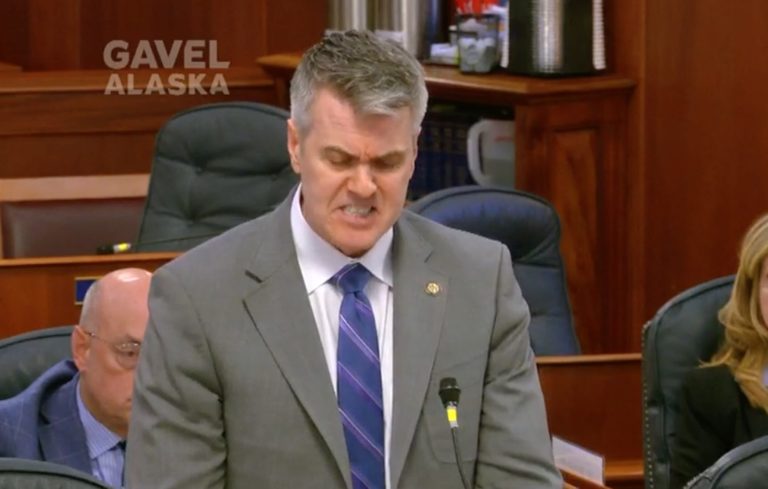
Unfortunately, no one in the House Chambers on Wednesday called a point of order on the maker of the motion to censure Eastman. Freshman Rep. Andrew Gray, who stood at his desk, and nearly yelled and cast aspersions.
Gray should have been censured for linking Eastman to the Nazis, implying that because he posted a photo of himself standing next to a quote by Adolph Hitler at the Holocaust Museum in Washington, D.C., that somehow that means he supports the extermination of people. It’s a willful misunderstanding of Eastman’s social media photo, and it impugns his character.
There was free speech breaking out all over on Wednesday in the House of Representatives. It boiled down to this: “I don’t like what you said.” “You didn’t express something the way I would have expressed it.” “You embarrassed all of us with your comments.”
That’s all in the realm of free speech, and they’ve had their say, all 36 that were present for the vote.
Ironically — and this energy expended in the House is full of irony — Rep. Gray’s words in defense of abused children could be said about the unborn, which was the point that Eastman had been trying, clumsily, to say in committee.
Gray said: “It is incumbent upon all of us to do something. We cannot allow such atrocious, indefensible language to go un-denounced. We must speak out in defense of the dignity of this body but also as a parent, I must defend the value of all those children like mine, whose lives are valuable, whose deaths are not in the best interest of the state.”
There, Gray said it better than Eastman: Lives do matter, and that is the pro-life logic that Eastman was not effective in stating in the Judiciary Committee.
Now that everyone agrees on the value of life, it’s time for the House minority caucus to stop acting like children and get back to the work of the people. If members don’t stop with this Gray histrionics, they’ll be censuring each other all day long, and that is not what we sent them to Juneau for.
If legislators would allow Must Read Alaskato suggest a topic more important than censuring Eastman, we call their attention to the 300 Alaskans in Tuluksak who are still waiting for running water at the school, which hasn’t had water since Feb. 9. It’s time for the Legislature to, as it is permitted, to step up to its role as the borough for the unorganized Bethel Census Area, which has a community that is in dire straits.
Rep. Gray, as we know from his dramatic readings at the Anchorage Assembly, can get his feelings hurt by walking out the door each morning, but there are people in Alaska that need the Legislature to convene as their borough assembly and solve a real life-and-death situation.