Home Blog Page 711

Texas border counties declare disasters as thousands of migrants seek entry

By BETHANY BLANKLEY | THE CENTER SQUARE

 Several South Texas counties issued disaster declarations as the public health authority Title 42 came to close.

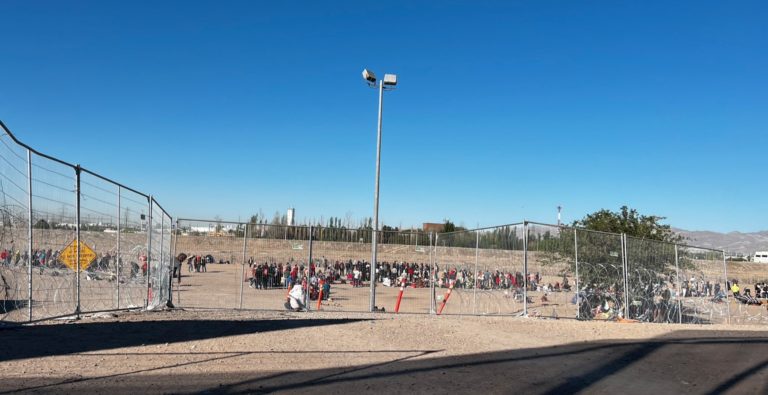
The declarations were made as large groups of people, 15,000 Venezuelans and 15,000 Haitians, arrived in the Rio Grande Valley seeking entry to the U.S. An additional 23,000 are reportedly en route to Del Rio.

In the Rio Grande Valley, Hidalgo County Judge Richard Cortez issued a disaster declaration.

“I received credible information from officials with Customs and Border Protection that large groups of migrants are probing our international border in search of crossing points,” he said. Declaring an emergency is the “first step in securing all available resources.”

It follows a state disaster declaration issued by Gov. Greg Abbott on May 31, 2021, which followed the first disaster declaration filed by Kinney County on April 21, 2021. Roughly 30 counties issued disaster declarations in 2021, most of which are still in effect. Abbott amended the state disaster declaration on April 21, 2023, and also issued subsequent proclamations and executive orders over the border crisis.

Cortez issued the emergency citing a Mexican government estimate that roughly 10,000 people are camped directly across from the border county in Reynosa, Tamaulipas, Mexico, waiting to cross.

“A surge in migrant crossings is a significant public safety and security concern,” he said, “including but not limited to the risk of injury or loss of life and property.”

He also said he “determined that extraordinary measures must be taken to protect all people in and coming through the county.”

Neighboring Cameron County Judge Eddie Trevino also issued a disaster declaration “in response to the imminent threat of widespread or severe damage, injury, or loss of life or property resulting from the Border Security Disaster.”

His declaration cites the Texas declaration stating, “the surge of individuals unlawfully crossing the Texas-Mexico border posed an imminent threat of disaster for a number of Texas counties.”

He did so after the city of Brownsville issued a disaster declaration over a week ago and after 15,000 mostly Venezuelans illegally crossed into the U.S. in one week overwhelming Border Patrol in the last week of April.

Since then, RGV Sector Chief Gloria Chavez reported that agents encountered 8,078 illegal foreign nationals the first weekend in May, including 16 smuggling cases. The last weekend in April, they apprehended 6,371 people, including 10 smuggling cases. And this was before the public health authority Title 42 ended May 11.

By May 9, CBP was holding in custody over 27,000 foreign nationals who’d just illegally entered the RGV in Texas from Mexico, a Border Patrol agent stationed there told The Center Square.

“Of that 27,000, a little over 5,000 are processed waiting for their next phase in the process,” the agent said. “Every sector is near 150% capacity,” the agent said, referring to nine U.S. Customs and Border Protection sectors along the southwest border, five of which are in Texas.

Since then, on May 11, the agent told The Center Square that 15,000 Haitians were expected to breach the Anzalduas Bridge Port of Entry. The Army National Guard, Texas Department of Public Safety, Border Patrol and Office of Field Operations staff were all “staging” and processing had stopped. When asked what staging meant, the agent replied they were preparing for “violence.”

Further west, Del Rio is also bracing for impact. Its police department issued an alert on May 11 stating that apprehensions in one day increased from 800 to 1,400, with 800 in custody. “Unconfirmed intel reports are stating that there are approximately 23,000 migrants possibly heading towards Del Rio, however, they are traveling in groups of 1,000 or less.”

These announcements came after the El Paso mayor declared a state of emergency as mostly single military age men remain homeless in its downtown streets and Texas DPS continues to combat cartel and gang-related crime stemming from the border.

Gov. Greg Abbott deployed the Texas National Guard to the RGV and El Paso, blaming President Joe Biden for creating the crisis.

He said Texas was “being overrun by our own federal government. Texas is being undermined by our own federal government and our efforts to secure our border. It’s only Joe Biden and his open border policies that’s hindered our ability to secure the border.”

“President Biden wants to roll out the welcome mat for illegal immigrants. The elite Texas National Guard soldiers and DPS troopers I deployed will be there to stop them,” Abbott said.

“Texas is doing more than any other state in the United States of America to defend the southern border,” the governor said.

Flash floods are expected in border counties on Saturday as heavy weather moves through the area.
Service High School principal resigns

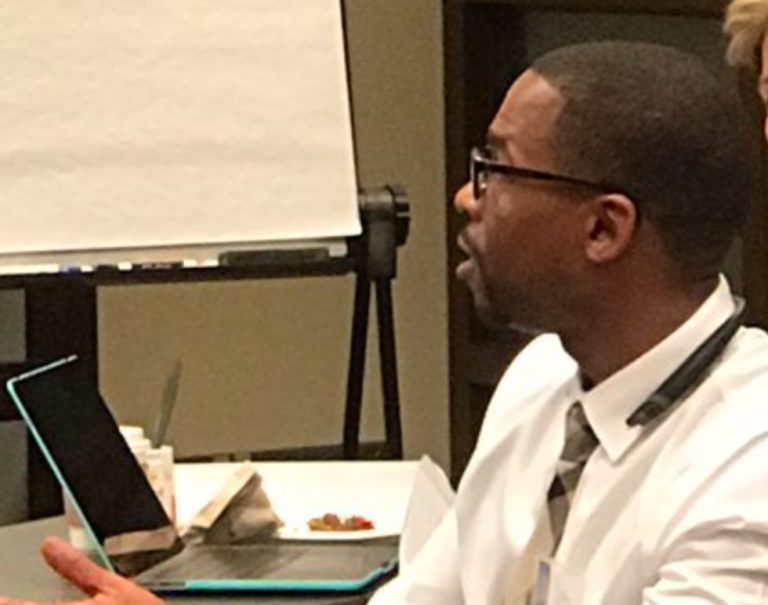
Robert Service High School Principal Allen Wardlaw has resigned from his position, the Anchorage School District reported on Friday.

Wardlaw had been placed on administrative leave last month after a series of salacious text messages allegedly to and from him began circulating among students and staff across the district.

As the drama unfolded, the school district sent a team to meet with faculty and staff at the high school about the sexually crude messages that called into question the principal’s character. Wardlaw was sent home and did not return.

The text messages indicated that a love relationship went south on Wardlaw, and that one or more women were going to exact revenge on him.

Assistant Principal Imtiaz Azzam was named acting principal through the end of the school year.

The school district has only described the incidence as a “community concern,” and is handling it as a personnel matter with the requisite privacy for Wardlaw being observed.

“As a result of Mr. Wardlaw’s resignation, ASD will move forward with hiring a new principal for the 2023-24 school year and would like to invite you to be a part of this process,” Kersten Johnson-Struempler, the district’s senior director of secondary education, wrote in an email to families.

Stories in Must Read Alaska about the incident fill in some of the unsavory details:

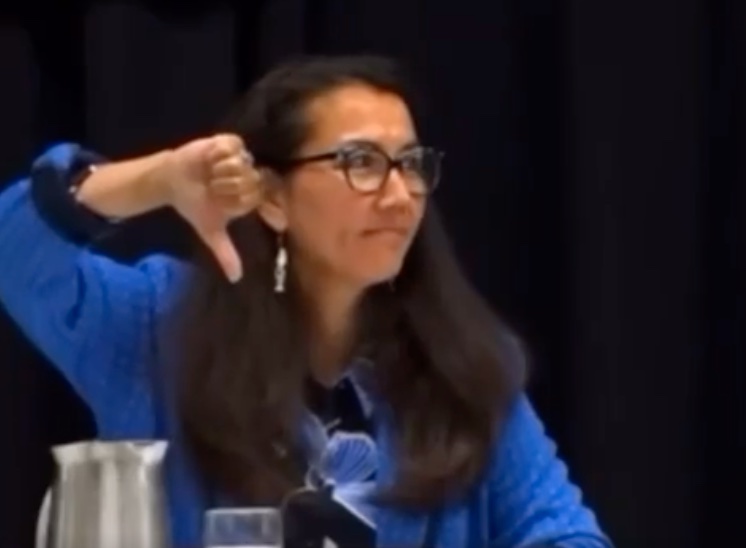
Fraud: Peltola votes against crack down on Nigerian, Chinese, and prison-based Covid scams

Rep. Mary Peltola voted against H.R. 1163, an act designed to help recover fraudulent unemployment claims from highly sophisticated scammers and criminal enterprises. As much as 50% of the $655 billion in Covid unemployment payments that were issued were based on fraudulent claims, federal officials believe.

For example, in 2022, a Nigerian citizen pleaded guilty to Covid-19 unemployment fraud in Washington and 17 other states, with amounts in the hundreds of thousands of dollars.

Abidemi Rufai, who at the time of his arrest was the special assistant to the governor of Nigeria’s Ogan State, used stolen identities to claim hundreds of thousands of dollars in pandemic-related unemployment benefits, according to U.S. Attorney Nick Brown. He was arrested at New York’s JFK airport in May 2021.

In another example, the Department of Justice indicted eight individuals – two who are prisoners – for conspiring to scam $25 million worth of unemployment benefits from California.

It’s unclear how much Covid unemployment fraud occurred in Alaska, and none appears on the map at the federal Pandemic Oversight Office, but California’s share of Covid unemployment insurance fraud is estimated to be between $18.7 billion, according to the the federal oversight agency, and $32.6 billion, according to Republican Congressman Doug LaMalfa of Northern California, who voted for the bill.

Congress created three programs to provide unemployment insurance benefits to individuals who lost their jobs because of the pandemic. The programs expanded eligibility, extended the length of time someone could claim benefits, and added a weekly supplement to existing state UI benefits.

Together, the three programs issued nearly $655 billion in benefits.

But federal and state oversight work in recent months revealed that fraud in pandemic-related UI programs is rampant, with 22 states reporting incidences of fraud.

Fraud was so rampant that even Rep. George Santos of New York was indicted on Wednesday on 13 criminal counts, including fraudulently applying for and receiving unemployment benefits during the Covid pandemic, during a time when he had a $120,000 yearly salary working at an investment company.

Business owners are currently shouldering the burden of this fraud, as they are compelled to pay higher taxes to restore the funds that have been scammed. At present, states lack sufficient motivation to pursue cases of unemployment insurance fraud or recover illicit payments, since they do not retain any of the funds they manage to reclaim.

The Protecting Taxpayers and Victims of Unemployment Fraud Act, which passed with the votes of the Republican majority, permits states to keep 25% of recovered fraudulent Covid funds and 5% of fraudulent regular unemployment funds.

Not a single Democrat in Congress voted for the bill. Peltola stuck with the Democrats.

The Protecting Taxpayers and Victims of Unemployment Fraud Act is intended to remove the liability from business owners who are having to foot the bill and place the responsibility for fixing their own mistakes on state governments that mishandled the federal unemployment money in the first place. 

“Business owners should not be on the hook for money that states allowed to be fraudulently paid out to people who did not deserve it,” Congressman Doug LaMalfa of Northern California said. 

“Billions of dollars in Covid money was lost to fraud, including to Russian, Chinese and Nigerian foreign scammers and even prisoners in prison for life. I support this legislation that will incentivize states to start taking this problem seriously and prosecute this fraud. Business owners have enough trouble trying to make ends meet and meet payroll without being financially penalized for the incompetence of bureaucrats,” said the Republican representative from California’s 1st District, which includes Butte, Colusa, Glenn, Lassen, Modoc, Shasta, Siskiyou, Sutter, Tehama and Yuba Counties.

Downing: Democrats have a zombie problem

By SUZANNE DOWNING

It’s Night of the Living Dead among Democrats in the halls of the nation’s Capitol.

Let’s begin with the footage of Sen. Dianne Feinstein of California being wheeled into the Capitol on Wednesday, photos and videos that were both pitiful and horrifying. Even the Democrat-enabling media was taken aback and started to turn on the Crone from California, telling her that it’s time to go.

That Democrats have put the fate of the nation’s looming debt default on the shoulders of this one incoherent lawmaker is mind-boggling.

Feinstein had been out of service for two and a half months due to a nagging case of shingles. After seeing her so damaged and frail, no reasonable person would advise she is ready to return to the grueling schedule of lawmaking and debt-ceiling busting.

Feinstein is the poster child for elder abuse by Senate Democrats, who also need her for a few crucial votes on some God-awful judicial nominees.

Feinstein is no Sen. Strom Thurmond, who was sharp as a tack and still doing show-off pushups at age 97. Life has come fast at Feinstein since that September day in 2018, when she pinned Sen. Lisa Murkowski, a quarter century her junior, to a wall in the Capitol and bullied her over the Justice Brett Kavanaugh nomination.

Feinstein is also no Congressman Don Young, who was also an old-timer and was being wheeled to the floor of the House during his final year in office. But even at 89,  Young at least had his wits about him.

Unfortunately, he had the same “I’m irreplaceable” ego problem as Feinstein, and when he died on the job on March 18, 2022, he left Alaska in the lurch, and ushered in a Democrat to the Congress, one who votes exactly opposite from how Young would have, had he not keeled over. 

Congressman Young’s liberal legacy should be a warning to lawmakers to heed the wise words of Kenny Rogers’ songwriter Don Schlitz: “Know when to fold ‘em.”

Feinstein turns 90 next month. With her short-term memory loss and an unmerciful attack by the shingles virus, she’s barely hanging onto the power, her elixir of life.

Although she will not run again in 2024, the jury is out as to whether Feinsten can make it to the end of her term or if she will take the Don Young route. We have to ask California: Is this the best that a state of 40 million people can do?

Then there’s Sen. John Fetterman, who is a shadow of his former self. Unlike the cadaver from California, Fetterman lumbers down to the Senate floor in his shorts, tennis shoes, and a black hoodie with the hood pulled up over his misshapen cranium, looking every bit like the grim reaper. It’s unclear why Fetterman is allowed to violate decorum in the Senate and appear in gym attire, but since Democrats are in charge, the Pennsylvania senator somehow gets a few votes on the record. But not many, mind you: Between February and May, the freshman senator missed 67 of 119 roll call votes, over 60%. The average among senators over their lifetimes is 2.3%.

While Fetterman wasn’t gone like Feinstein for two and a half months, he was hospitalized for clinical depression for six weeks and has the behavior of someone heavily sedated with psychotropic drugs. As a result of a near-fatal stroke during his campaign for Senate, he has a difficult time communicating and has profound hearing loss. By any measure, he is a deeply disabled senator, physically, mentally, and emotionally. 

When Fetterman attends committees, his aides put his prepared remarks in 150-point type on an iPad, one or two words per line, so that he can read them. Is this the best that Pennsylvania can do?

Then there’s the Zombie in Chief Joe Biden. At 80, he’s in barely better cognitive shape than Feinstein, and is only slightly more physically fit than Fetterman. One fall on the stairs of Air Force One could put this president in a wheelchair, a leg sling, or worse.

It’s a demanding job being the leader of the free world, and Biden will be 81 this November. Only magical thinking could lead one to believe he will become more capable.

Just who is running the show on the budget catastrophe? A growing number of walking-dead Democrats are, and they’re just about to expand the nation’s debt beyond its $31.4 trillion limit so they can spend even more and turn the debt into its own zombie.

While it’s unkind to beat a dead horse on Feinstein’s fragility, Fetterman’s brain fog, and Biden’s dementia, we know zombies when we see them, and we all know America deserves better. 

Suzanne Downing is publisher of Must Read Alaska.

Banning 18- to 20-year-olds from buying handguns is unconstitutional, judge rules in Virginia

You can fight in a war and die of your country, but you can’t buy a handgun?

A federal judge in Virginia declared unconstitutional laws and regulations prohibiting adults under the age of 21 from purchasing handguns.

U.S. District Court Judge Robert Payne rendered a 71-page decision, says the federal regulation banning handgun sales to 18- to 20-year-olds violates the principles enshrined in the Constitution, since 18- to 20-year-olds can join the military, vote, and serve on federal juries, and there’s no reason a federal law should restrict them from buying a gun.

In his written opinion, Payne said, “If the Court were to exclude 18- to-20-year-olds from the Second Amendment’s protection, it would impose restrictions on the Second Amendment that are not imposed on other constitutional guarantees. Therefore, due to their inconsistency with our nation’s historical context and traditions, the statutes and regulations in question cannot be upheld.”

Payne added, “Because the statutes and regulations in question are not consistent with our Nation’s history and tradition, they, therefore, cannot stand.”

The ruling came in a class action lawsuit was brought by 20-year-old college student John Corey Fraser and other plaintiffs, who in their filing in June of 2022 said the Gun Control Act of 1968 and certain regulations from the Bureau of Alcohol, Tobacco, Firearms and Explosives were unconstitutional because they excluded all adults under 21 from exercising the right to keep and bear arms.

Adults under 21 are allowed by ATF to purchase long guns, which include shotguns and rifles, from federally licensed dealers, but they have been banned from purchasing handguns. 

“This blanket ban violates the fundamental rights of millions of responsible, law-abiding American citizens,” the gun class action stated. 

Fraser, who lives in Virginia, had attempted to purchase a Glock 19x handgun from a licensed dealer in Ashland, Va., but was turned away in 2022, prompting the lawsuit.

Doug Vincent-Lang: Yet another unjustified attack by feds on Alaska

By DOUG VINCENT-LANG

The National Park Service is once again dividing Alaska by unjustifiably undermining the state’s sustainable management of Alaska’s wildlife. In the latest attack, the National Park Service has proposed rule making that prohibits traditional methods and means of hunting throughout national preserves in Alaska.  

The Alaska National Interest Lands Conservation Act passed by Congress in 1980 is the single largest expansion of protected lands in U.S. history. Nearly 40% of Alaska was set aside for conservation and preservation purposes.

During the drafting of ANILCA, many Alaskans attended congressional hearings throughout Alaska as well as traveled to Washington D.C. to voice their concerns for how important it was to have continued access to resources on what would be new conservation system unit lands.

Based on this testimony, Congress included clear provisions protecting Alaskans’ traditional way of life and our ability to use the newly set aside federal public lands, and the resources on those lands, for our cultural, social, and economic needs.

ANILCA’s provisions are clear. They allow Alaskans to continue to access and hunt on the federal preserve lands Congress created in Alaska. Congress specifically designed ANILCA to allow all Alaskans to access our fish and game resources and for the State to manage these resources and the methods and means of hunting. 

Despite this, the National Park Service has repeatedly tried to reinterpret this agreement and law and restrict Alaskans’ access to cherished State resources. This is unacceptable. Alaskans must rally to protect the balance Congress promised—a balance that maintains our resources for use by future generations. 

By taking away our opportunities to hunt and be out on our lands, the National Park Service erodes the terms of our agreement memorialized in ANILCA to ensure this balance. Fish and wildlife are primary food sources for Alaskans and are vital to cultural and traditional heritage. 

In its current rule making, the National Park Service is trying to rewrite ANILCA and dictate not only where, but also how, Alaskans can hunt on park service lands. The National Park Service is claiming they need to ban certain state general hunting regulations that they claim are incongruent with their park values and represent unfair hunting practices. Yet despite this, the very regulations they are proposing to ban under state regulations, they propose to implement through the authority of the Federal Subsistence Board.

We are perplexed by this seemingly incongruent logic.  

To begin, the National Park Service is claiming Alaska has “sport” hunting regulations.  Alaska does not have sport hunting regulations. Alaska has general hunting regulations that provide for subsistence and general hunting. In contrast, the Federal Subsistence Board regulations only allow rural qualified users to participate. 

When the National Park Service replaces state general hunting regulations with federal regulations they limit participation. State regulations provide the opportunity to hunt on park service land for Alaskans who have customary and traditional ties to wildlife, but are displaced to urban areas for health, educational, and socio-economic reasons. Federal regulations do not. But they do allow for a new rural resident who has no customary ties to resources here to hunt. So, the proposed rule must not be to provide for customary and traditional practices. And the rule making must not be because the hunting methods are against park values. If it were, the National Park Service would ban the practices entirely. Yet they have not. They allow these practices by rural residents. 

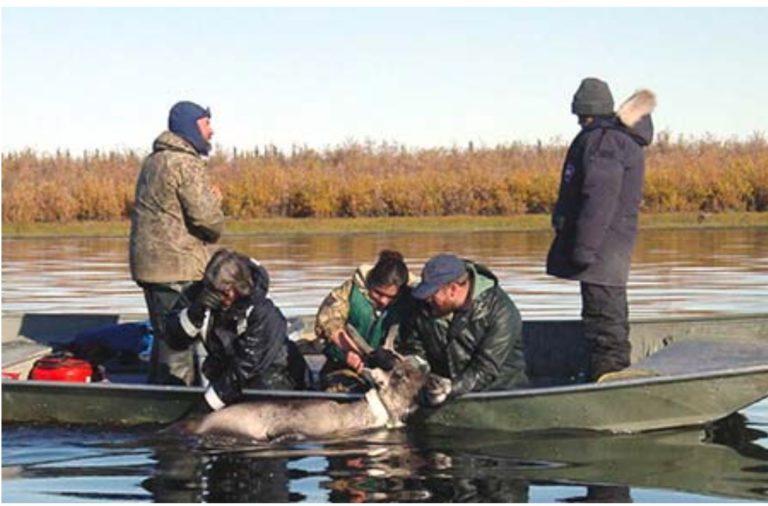
One is left to wonder how it can be within park values to allow the taking of a swimming caribou by a new rural resident who has no tie to this method while barring a person who has a history of traditional and cultural hunting practices but now is displaced to an urban center from hunting. 

The National Park Service also has no conservation concerns for our wildlife driving this rule making. They agree our populations are healthy and appropriately managed throughout Alaska preserves.

In sum, their rulemaking is not providing customary and traditional practices, they are not re-enforcing park values, and there is no conservation concern. It’s simply an example of making hunting rules that are unneeded, to solve problems that don’t exist, by bureaucrats that don’t hunt. It is not what Congress intended.

Congress enacted ANICLA to allow Alaskans to hunt on newly created preserve land.  ANILCA is supposed to allow all Alaskans to access our fish and game resources.  Now the park service seems to be saying that they can rewrite this law and unilaterally determine how, in addition to where, Alaskans can hunt on National Park Service land.  This appears to be a desire to replace state management with federal management and abandon finding ways to fulfill the commitments made to Alaskans in ANILCA.  

Expect Alaska to continue its fight to ensure the bipartisan commitments made to our state at statehood and reconfirmed under ANILCA are maintained and not eroded by unilateral federal actions. 

We, as Alaskans, should be in control of Alaska’s resources, not federal agencies in Washington D.C. who are more interested in forwarding preservation agendas than honoring the rights of Alaskans. Please join in this fight.

Doug Vincent-Lang is the commissioner of the Alaska Department of Fish and Game.

Spotted: Northern Edge exercises have brought a drone to Alaska

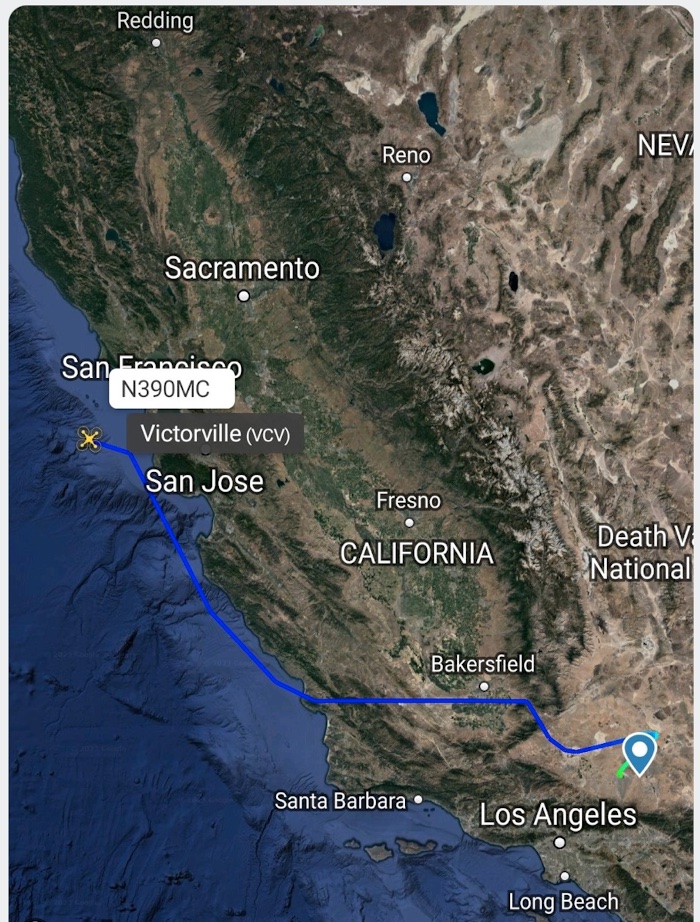
Spotted on radar tracking websites by hobbyists in Alaska this week was a large drone, which was appearing to take part in the Northern Edge military exercises that have been in the skies over Alaska. (The drone in the photo above is of the type that is in Alaska, an MQ-9B Sea Guardian, but the photo is from the skies of California.)

The drone appeared south of Kodiak airspace on Wednesday, along with what appeared to be a Navy jet.

MQ-9B N390MC by General Dynamics came up the California coast from El Mirage Field Airport, after having recently finished working in the Navy’s Group Sail exercise.

Northern Edge 2023, a joint military training exercise, will continue through May 19. Operating locations include Joint Base Elmendorf-Richardson, Eielson Air Force Base, Fairbanks International Airport, and Ted Stevens Anchorage International Airport, among others.

Alaskans have noticed a lot more warbird activity in the skies as a result. The training area involved is mainly the 65,000 square miles of airspace above the Joint Pacific Alaska Range Complex, and another 42,000 square miles in the Gulf of Alaska.

About 10,000 U.S. service members, five ships, and more than 150 aircraft are participating this year. Also taking part are military personnel from the United Kingdom and Australia.

Senate votes to add another day off for State workers: Juneteenth

The Alaska Senate has passed Senate Bill 22, sponsored by Sen. Elvi Gray-Jackson, an Anchorage Democrat. If passed by the House and signed by the governor it would bring the number of official state holidays to 12, by the addition of June 19, also known as Juneteenth.

The recognition marks a day in 1865 when Union soldiers arrived in Galveston, Texas, and proclaimed the Civil War had ended and that all enslaved people were free. The slaves and their ancestors called the day Juneteenth, the emancipation of people who had been sold into slavery and brought to the Americas starting in colonial times.

Then-Rep. Lesil McGuire sponsored a bill in 2001 that recognized the third Saturday of June as Juneteenth Day.

That was not enough for Sen. Gray-Jackson and most of the members of the Senate. They want to shut down the productivity of the State of Alaska by making it a paid holiday.

The current schedule of government shutdown days in Alaska are:

  • New Year’s Day (January 1)
  • Martin Luther King Jr. Day (3rd Monday in January)
  • President’s Day (3rd Monday in February)
  • Seward’s Day (Last Monday in March)
  • Memorial Day (Las Monday in May)
  • Independence Day (July 4)
  • Labor Day (1st Monday in September)
  • Alaska Day (October 18)
  • Veterans Day (November 11)
  • Thanksgiving Day (4th Thursday in November)
  • Christmas Day (December 25)
  • Every Sunday

The fiscal cost of another government holiday are unclear, and the fiscal notes are muddy. But those state workers who must work that day would be paid double the salary, so the entire Department of Corrections, Public Safety, and various divisions of other departments would incur significant costs.

The Assembly in Anchorage has recently added Juneteenth to the list of paid city holidays. President Joe Biden also shut down the federal government on that day, by executive order.

“This is an important process to bring awareness to the significance of Juneteenth and honor the end of slavery within this nation and acknowledge our history,” said Sen. Gray-Jackson. “It is a moment to reflect, celebrate, and become empowered as a free people. I hope that the passage of this bill will ensure that we as a nation and a state do a better job in talking about what’s painful and create a more just future for all the country.”

Voting for the new state holiday were Sens. Click Bishop, Jesse Bjorkman, Matt Claman, Forrest Dunbar, Cathy Giessel, Gray-Jackson, Lyman Hoffman, James Kaufman, Scott Kawasaki, Jesse Kiehl, Kelly Merrick, Donny Olson, Bert Stedman, Gary Stevens, Loki Gale (she/her) Tobin, and Bill Wielechowski.

Voting against the bill were Sens. Mike Shower, Rob Myers, Shelley Hughes, and David Wilson.

The bill is now in Alaska House, where it will probably not make it to the floor for a vote during the final days of this legislative session.

FedEx pilots on informational picket Wednesday say they’re done negotiating, ready to walk

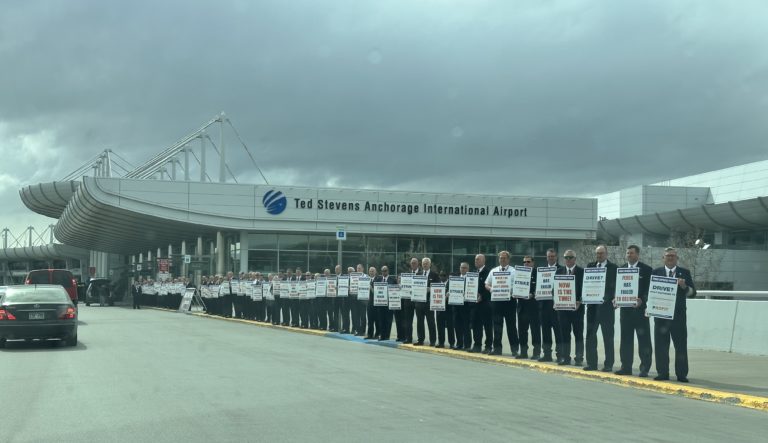
Anchorage is home to more than 500 FedEx pilots. About 80 of them were on the picket line at the Ted Stevens Anchorage International Airport departure drive-through on Wednesday, saying they want a contract now and are done negotiating. Others who didn’t make the picket were in the air or in far-flung airports such as Shanghai or Memphis International Airport, the busiest cargo airport in America.

The Air Line Pilots Association, International represents the pilots, and negotiations have gone on since May of 2021. In April of this year, the association leaders called for a strike authorization vote of the member pilots.

The strike authorization ballot closes on May 17. After that, the association will be authorized to call a strike at any time, which could have an effect on the flow of cargo throughout the country and could cause uncertainty in Alaska’s cities, towns, and villages that rely on air cargo

 Nationwide the company has over 5,000 pilots, which makes Anchorage a significant center for the company workforce.