Home Blog Page 710

Senate passes increase to education formula

The Alaska State Senate last week approved Senate Bill 52, increasing education funding for Alaska’s public schools and correspondence programs by $175 million.

Proponents of the bill argue that the $680 per student addition to the Base Student Allocation calculation is a straightforward and equitable method to boost education funding for students in all public schools and correspondence programs across the state. It’s a reduction from the first version of the bill, which had a $1,000 allocation addition for each student.

While the Alaska Constitution mandates the provision of a public education system, it does not dictate what adequate funding is. Nor has it been proven that pouring more money into the system will automatically lead to improved outcomes. Alaska’s academic outcomes for students in K-12 are at the 49th in the nation, even though spending is new the top. In the 1970s, the state education outcomes were near the top.

In addition to increasing the BSA, Senate Bill 52 includes additional provisions for pupil transportation and residential schools.

Sen. Shelley Hughes tried to amend the bill to give it the strength to direct the money to teaches and classrooms, rather than administration, but was rebuffed time and again by the Democrat-run majority.

“I proposed amendment after amendment today to direct school funds to improving student outcomes by directing the dollars specifically to teachers and classroom instruction, but despite the few brave souls (including both minority and majority members) who stood with me, the amendments failed. Even though proficiency rates in all grades and all subjects hover around only 30% statewide, too many senators turned a blind eye to a golden opportunity. Teachers and families, I want you to know that I fought for you. Although I am heartsick there weren’t the votes to take the bull by the horns for the sake of our most precious resource, our children, the song running through my head since I walked off the floor and out of the chamber has been ‘I get knocked down, but I get up again. You are never gonna keep me down,'” she said.

Senate Bill 52 passed the Alaska State Senate by a vote of 16-3, with Senators Hughes, Robert Myers, and David Wilson voting against it. It will be considered by the Alaska House of Representatives, where it has been referred to the Finance Committee.

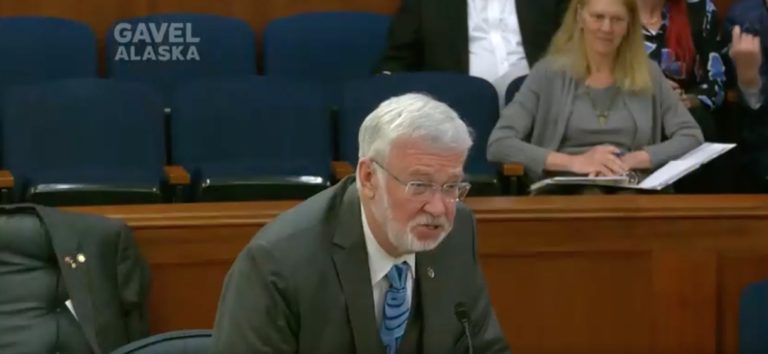
Photo: Sen. Elvi Gray-Jackson argues for Senate Bill 52.

Kreig and Vazquez: Who to vote for in Chugach Electric board elections

By RAY KREIG and LIZ VAZQUEZ

If the takeover of the Chugach Electric Association Board by Outside-funded activists succeeds, get ready to pay much, much more for your power and light. The extreme climate activists want access to the $350 million/year paid by customers’ bills to fund their agenda. 

What to do about it?

For one, pay attention to the Chugach Electric Association elections now underway until May 19.  

In the Anchorage Bowl, you have no choice but to buy your power from Chugach, which is a state-granted monopoly. As a member-owned cooperative, the character of the directors you elect will decide whether Chugach, 1) deceives you with fantasies of “free” power from the sun and wind (heavily subsidized with reduced PFDs and higher taxes) or 2) is competently managed with wisdom and real care for the utility customer-owner’s best interest: Supply electricity at a cost no higher than necessary!

Voting in the Chugach Electric elections is your only way to shop for lower cost power. 

Don’t think that the monthly Chugach Electric bill you must pay is the only expense affected by who is elected to the Chugach board with your vote. You are paying twice or three times what you see on that bill because enormous electric costs are paid by government, your employer and stores. These are passed on to you as higher prices (especially for food), higher taxes, and reduced PFDs, wages, and jobs. Jobs are lost because high electric rates make Anchorage less competitive and force many businesses to shrink, close, or never even get started.

High utility rates hurt low- and fixed-income customers the worst.

There are three open seats. We recommend that you vote for Bettina CHASTAIN, Harold HOLLIS, and Brad AUTHIER.  Vote no on the Round Up Program Bylaw.

Press here to vote electronically!  Deadline to vote is 2 pm Friday May 19.

How high could rates go?

National average electricity costs are now 12.8¢/kwh; Alaska’s statewide average is 21.0¢/kwh, (US EIA, Feb 2023).  A Chugach home using ~740 kwh/month would now be paying about 22¢/kwh.

Rates have exploded in the last few years in many states:

New Hampshire – 16 to 26¢/kwh (63% up)

Maine – 13 to 20¢/kwh (54% up)

Connecticut – 18 to 27¢/kwh (50% up)

Massachusetts – 17 to 25¢/kwh (47% up)

California – 15 to 22¢/kwh (47% up)

Hawaii – 30 to 41¢/kwh (37% up)

Rhode Island – 17 to 23¢/kwh (35% up)

Why Are These Rates Soaring?

In some states, irresponsible green energy mandates are in various stages of implementation, swamping electric utility customers. In others, greens oppose beneficial electric transmission lines as well as new natural gas production and the pipelines necessary for electric generation at reasonable fuel cost.

And this is just what many radical green energy advocates want. They welcome extremely high energy utility rates (electricity and natural gas), which are convenient to make expensive solar and wind projects look less wasteful. It’s part of their bigger agenda of forcing users into lifestyle changes, including more use of bicycles, buses, and electric vehicles.

In Alaska, greens are demanding similar moves to increase energy costs.

The Alaska Center (for the environment) and the Renewable Energy Alaska Project have endorsed and they and allies are heavily funding three candidates for the Chugach Electric board in this election. The candidates the Alaska Center is pushing are in favor of what is called a Renewable Portfolio Standard. 

This Renewable Portfolio Standard is a skillfully designed, back-door, below-the-radar scheme that will escalate electricity costs and be very harmful to Railbelt electric utilities and consumers. It’s been introduced in the Legislature and would force Chugach Electric into an unreasonable 80% renewables generation by 2040, requiring $2 to $3 billion in costly transmission system upgrades to use power from intermittent, renewable power sources. 

Additionally, it provides for confiscatory fines that could well bankrupt Chugach Electric. It also fails to recognize viable alternative carbon reduction measures and other clean energy solutions.

In contrast, consider a state that has reformed its electricity market and mandated competition for most of its urban and suburban areas: Texas statewide average electric cost is only 10.5¢/kwh (US EIA, Feb 2023).

Candidates we support

As former Chugach Electric Board Chairs ourselves we endorse:

These candidates running as the Chugach Stability Team that DO NOT support the RPS above and believe that enforcing these standards on utilities in Alaska is the wrong approach to integrating renewable energy into the current Railbelt grid.

  • Reelect Bettina Chastain – Current Board chair, engineer, executive, business owner.
  • Reelect Harold Hollis – Current Board treasurer, engineer, executive, business owner 
  • Elect to the vacant seat Brad Authier – Engineer, business owner, environmental consultant

Chugach rates started skyrocketing from 50% above national averages in 2012 and 2013 until they plateaued in 2017 at over 100% above national averages. Bettina Chastain was chosen board chair in 2018 and Harold Hollis began his board service the same year. After that, rates didn’t further escalate. Our recommendation is that both these board officers be continued. They have important experience and are clearly qualified. 

They are not politicians or activists and are funding all of their own campaign costs themselves.  They are engineers with technical backgrounds who have successfully owned, grown and managed successful companies here in Alaska. 

Candidates we oppose

The three Alaska Center- and REAP-endorsed candidates have little or no real business experience (a political operative, a climate activist, and the current REAP board chair), nor do they have the technical degrees or backgrounds logically required for any director expected to competently provide governance over your $2 billion electric cooperative.

Outside special interest money is heavily funding these candidates and two members of the Chugach Board (Sam Cason and Mark Wiggin) are working behind the scenes to take over the cooperative with a new pro-RPS majority bloc.

The three AkCenter/REAP candidates have similar agendas and allegiance to these organizations, and they are all ultimately driven to implement an extreme, political, climate activist agenda utilizing the cooperative’s $multimillion ratepayer base to fund their ideology and push through the RPS as quickly as possible.

  • Jim Nordlund – Board chair, Renewable Energy Alaska Project (REAP).  Former IBEW union backed Chugach Electric board member.
  • Susanne Fleek-Green – Mayor Ethan Berkowitz chief of staff, campaign manager; Sen. Mark Begich, campaign manager.
  • Shaina Kilcoyne – Believes traditional energy use and development needs to stop now.  Was Mayor Berkowitz’ energy and sustainability manager; Sen. Mark Begich’s, campaign worker.  

On May 11, Chugach Electric quit its membership in REAP because REAP endorsed board candidates, which violated Alaska Statutes prohibiting use of cooperative funds in board elections. 

Want more information?

See Chugach Consumers Candidate and Situation Analysis.

Conclusion

Chastain, Hollis and Authier will be the best choices for the Chugach membership.

Ray Kreig and Liz Vazquez are both former chairs of the Chugach Electric Association Board of Directors

Train wreck: Senate leaders forcing Legislature into special session

The Alaska Senate has refused to cough up the state operating budget, refused to allow the seating of a conference committee to negotiate the differences in the Senate and House budget, and refused to treat the House as an equal. So let’s not sugarcoat it: There will be a special session.

Adding fuel to that is the Senate budgeters also wedged $40 million into the budget to account for extra state employee leave that may be “cashed out” in the event of a state shutdown, which would occur July 1, if there is no approved budget.

In other words, the Senate is starting to simmer the narrative that the government could shut down.

At this point on the legislative calendar, the Senate will meet on Monday and go through amendments for the operating budget, then return the budget to the House.

By the Uniform Rules, the House cannot even take up that budget until Tuesday — the last day that is allowed of session by the Alaska Constitution. They must adjourn at midnight on Day 121 or go into either a 10-day extended session (requires a three-quarter affirmative vote in both houses) or Special Session, called by the governor.

Juneau legislative observers say the Senate Democrat-dominated majority is managing the timeline to create panic and crisis.

The real negotiations on the budget occurs at a conference committee, which is an open and transparent process. But with no budget to negotiate, that is now a figment of imagination.

As a side effect, the heavy-handed tactics by the Senate leadership with the take-it-or-leave-it budget has simply coalesced the House majority further.

Another dynamic is coming into play for the Legislature: One of the main housing units for legislative staff is the Driftwood Inn has just gotten more expensive. The rates are kept low, about $70 a night, through the last day of session, normally, but the rundown building was purchased by Tlingit Haida Tribes, and as of May 1, the tribe has started charging full tourist season rate to the staffers who live there. As of Monday, the rate will explode to $280 a night. Staffers don’t make enough to afford that.

That has made some staffers so mad they want the Driftwood taken off the preferred legislative housing list, but there’s no where else for them to go; the Marine View building was turned back into tourism season worker housing, and tourism season has all the other worker housing filled to the brim. Thus, expect that several staffers may sleep on the floor somewhere or leaving for home.

The budget’s sticking point, as it has been since 2017, is the size of the Permanent Fund dividend and what pot of money it will be funded from. The Senate would take 75% of the available funds and use it for government, leaving 25% for dividends. This would leave Alaskans with a $1,300 PFD. The House proposes the 50-50 split, for a $2,700 PFD.

By taking from the PFD, the Senate has announced that it balanced the budget, while the House budget would need to dip into the Constitutional Budget Reserve to balance, since it’s about $600 million short.

Accessing the Constitutional Budget reserve takes a three-quarters vote from the House and Senate.

Redistricting board meets Monday to consider the high court’s takeover of redistricting

The Alaska Redistricting Board will meet at 1 pm Monday in the Anchorage Legislative Information Office’s Denali Conference room. The building is on the corner of Minnesota Drive and Benson Blvd.

The board will swear in Bethany Marcum as a returning member and then take up the business of the day: to review the Alaska Supreme Court’s ruling, in which the court gerrymandered some of the political lines in Alaska to favor Democrats.

After the redistricting process was completed in 2022, Democrats sued over the map concerning things like the pairing of military voters at JBER with voters in Eagle River. The justices sided with the Democrats on an area of Anchorage and approved a temporary map, including military voters with the most liberal district in Alaska — downtown Anchorage. By doing so, they diluted the conservative vote.

The justices ruled that the Democrats’ map must be used in 2022, and they did not have time, they said, to explain why.

Their explanation came late last month, and now the redistricting board must decide if it will challenge the Supreme Court authority to seize control of the redistricting process.

There is no real choice for the board, because the justices gave them no choice, indicating that any other district lines would face the same fate at their court.

Live stream will be available at this link.

Public Testimony will be taken in-person, via dial-in teleconference, and by email to: [email protected] .

Teleconference public listen-in and testimony phone numbers:
 – Anchorage: 563-9085
 – Juneau: 586-9085
 – Other: 844-586-9085

Background: On Feb. 16, 2022, the Superior Court ruled for the board on three of the 5 lawsuits, finding that all 40 of the board’s adopted House districts fully complied with the Alaska Constitution. 

One plaintiff, Calista retired their claims. The remaining plaintiffs and the board petitioned the Alaska Supreme Court to review the Superior Court’s findings and rulings.

The Supreme Court found in favor of the board on four of the five challenges and remanded the board to make changes to Senate District K and to return Cantwell to House District 30 with the remainder of the Denali Borough. 

The Board met eight times between April 2 and April 13, and adopted a 2022 Proclamation Plan.

On April 20, 2022, the East Anchorage Plaintiffs filed a motion for the Superior Court to reject the adopted 2022 Anchorage Senate pairings. 

On April 22, 2022, three Girdwood residents challenged the 2022 Proclamation Senate pairings for Anchorage. 

On May 17, 2022, the Superior Court ruled in favor of the Girdwood plantiffs and directed the Board to adopt Anchorage Senate pairings Option #2 as an Interim plan for the 2022 Statewide elections.  The Redistricting Board appealed to the Supreme Court, which affirmed the Superior Court order and directed that the Board await their full decision before taking any further redistricting action.

On April 21, 2023 the Alaska Supreme Court issued its full 144 page decision on all 2022 Redistricting actions, giving its rationale.

Peltola kicks can on debt limit; Begich says it’s time to be honest about spending

On May 1, U.S. Treasury Secretary Janet Yellen notified Congress that the Treasury Department could run out of cash on hand and would have to take even more “extraordinary measures” than simple emergency borrowing.

That comes as soon as June 1 and as late as early August, depending on the amount of payments remitted to the government before June 15 by taxpayers.

With a divided government, normally Americans would expect a deal of some sort between the Republican House and the Democrat-controlled Senate and White House. Polls show that Americans are solidly on the side of Republicans, in wanting to reduce spending and hit the brakes on borrowing. They feel the effects of runaway inflation and understand that federal borrowing is the obvious cause.

Federal spending has increased from $5.1 trillion in 2019 to over $6.3 trillion in 2022. That’s over a 23.5% increase, much of it to fund Green New Deal priorities of the Democrats, who are largely in charge of the direction of the federal government.

The federal budget has also grown from 21% to 25% of gross domestic product in three years, and now stands at over 120% of GDP, greater than even during the Great Depression. Interest payments borne by Americans are set to exceed $1 trillion a year.

The current debt-to-GDP ratio is troubling, ratio of the public debt to the country’s gross domestic product, is troubling. The higher the debt-to-GDP ratio, the less likely the country will pay back the debt, leading to a risk of default, which could lead to one of two outcomes: Dramatically increased inflation or extreme austerity measures.

The government’s debt is now 129% of GDP, as of the end of 2022, according to the Office of Management and Budget in the White House.  

“Debt-to-GDP ratios above 77% can hinder economic growth and (in some cases) place a country at risk of defaulting on its debts, which could wreak havoc on its economy and financial markets,” writes World Economic Review.

The warning bells started in January, when the Treasury Department slammed into the $31.4 trillion debt ceiling set by Congress. Janet Yellen’s Treasury employed emergency borrowing authority to pay for government operations and pay for entitlements.

Former Republican congressional candidate Nick Begich shared his thoughts: “The concept of automatically raising the debt ceiling without debate is nothing more than a convenient escape from fiscal responsibility. It paves the way for unchecked government spending, burdening future generations with the weight of our irresponsibility.”

In a letter signed with other Democrats, Rep. Mary Peltola said that failure to raise the debt limit would prevent the federal government from meeting its legal obligations, including Social Security and Medicare benefits, military salaries, and tax refunds.

That’s dodging the real issue, said Begich.

“We must meet our obligations and we will. Averting a short-term crisis by plunging ourselves further into long-term debt is not a solution. It’s time we stop kicking the can down the road and start addressing the root cause of our financial problems — excessive spending,” he said.

As this debt ceiling showdown continues, voices like Begich’s are calling for fiscal sanity. “We must restore fiscal responsibility to Washington. That begins with a serious, responsible conversation about our national debt, not bypassing the debate once again,” he said.

Did Anchorage’s superintendent break promise to Family Partnership Charter School community?

By DAVID BOYLE

At the April 3 Anchorage School Board meeting, District Superintendent Jharrett Bryantt told the public that the Family Partnership Charter School principal, Jessica Parker, would remain in place.  

He also stated that the dean of students and the business manager would also remain.

He said it is a matter of trust between the district and the FPCS parents.

Here is the exact wording from the Frequently Asked Questions the district provided to Family Partner Charter School parents:

“It is our intent for the Principal, Dean of Students, and Business Manager to remain in their positions. District leadership will support these individuals through the process of transitioning to ASD collective bargaining agreements.”

The district last week sent an email to FPCS parents notifying them that principal Parker will only serve until the end of this school year, which is May 24.

It appears Bryantt has gone back on his word. 

Note that the newly organized “Academic Advisory Council” of the charter school met on May 11, after the decision to replace the current principal had been made by the district.  The district should get the parents’ input on a new principal before the hiring process begins. This suggests that the selection process may be predetermined.

The email to the parents of school also says that the principal position would be posted on May 8.  But that was not true. Here is the post stating the position is advertised beginning May 5, the same date as the parent notification above:

Bureaucrats are incredibly talented at parsing. It appears Superintendent Bryantt’s words were carefully chosen. What parents heard, however, was much different than his intent.  

What other aspects of his promises to the FPCS school parents will be broken or parsed in the future?  

Perhaps it’s time for parents to take their FPCS students to the MatSu School District so they can achieve as they have in the past.  

Trust is a contract. Will we believe Superintendent Bryantt when he says “Trust me” the next time?

DAVID BOYLE is Must Read Alaska’s education writer.

Glen Biegel: Choose your school wisely

Before I discuss schools, let’s cover some “‘”forbidden topics.”

I have a good family culture, one worth defending. I want my kids to be supported in choosing that. Further, I want my kids to remain children for a good while. I don’t want them to be confronted with adult decisions about sexuality, pornography, life-changing friends or situations. In short, I want them to first learn to resist the false promises of a noisy world that will draw them away from the peace, joy, satisfaction, and ultimate purpose that I have in my life.

Now, what can I say about schools?

School and educational success is a direct reflection of how fully teachers support or elevate your family culture and educational values.

The harder your school fights your families values, whether they be educational, discipline or religious, the worse the education will be for your child.

If your children have a consistent message from you, from teachers, from the discipline/respect structure of the school and from their friends, the greater the chance that your children will know what you believe, why, and how important it is to a life well-lived.

I have six graduates from Holy Rosary Academy. I have three children who will soon be in the 4th, 9th and 12th grades. When you talk with my kids, you will recognize a part of me in all of them. They are all different, but healthy, happy, productive, unconfused thinkers and believers.

For my children’s education, you could say I have fought the good fight, I have finished the race, I have kept the faith. I have done my part for my children by first living a vibrant faith, and also sacrificing my time, treasure and talent to their school that has ever been my partner in raising children who know me, who I know, and who, most importantly, know themselves.

Tempus Fugit. Choose your school wisely.

Glen Biegel is a technology security professional, Catholic father of nine, husband to a saint, and politically active conservative.

Four in a row: Winters in Alaska have been on the colder side

So much for being the canary in the global warming mine. If the past four winters in Alaska seemed colder than usual, it’s because, well, they were.

According to the National Oceanic and Atmospheric Administration, the winter of 2023 continued the chill set in 2019, with temperatures in Alaska averaging 11.8 degrees, just .2 degrees above average. The three previous winters were all below the average temperature.

In October, NOAA had predicted warmer-than-average winter for western Alaska. Old Farmer’s Almanac also predicted winter would be “much milder than normal, with the coldest periods in mid- to late November, early December, and late January.” The publication predicted snowfall would be below average. That was wrong. In fact, much of Alaska saw historic snowfall over the winter, and in Anchorage, a new record was set for the snow still remaining on the ground in April. The snow continued into the first week of May, with more than 100 inches falling this past winter.

Although this winter was at about the average temperature, last year’s entire calendar year temperature ended up as only the 17th warmest.

The winter of 2022 stayed -0.7°F below normal, and 2021 was -1.4°F. The last warm winter in Alaska was in 2019, when temperatures were 6.1°F above the norm.

Visit the NOAA National Centers for Environmental Information to explore the data going back to 1977.

One and done: ABC cancels ‘Alaska Daily’

ABC has canceled the television drama series “Alaska Daily” after one season, according to Variety publication. The series, advised by Anchorage Daily News Publisher Ryan Binkley and leftwing ADN writer Kyle Hopkins, starred Hilary Swank as a reporter who left her New York City reporting job after a “fall from grace” and joined the staff of an Anchorage newspaper “to find both personal and professional redemption.”

The series ran one season, with 11 episodes. Filming was done in British Columbia starting last August and concluding in January of 2023.

The series was loosely inspired by the 2019 Anchorage Daily News and ProPublica series of stories, “Lawless: Sexual Violence in Alaska,” which was an anti-Gov. Dunleavy hit job during Dunleavy’s first term in office that was meant to feed the recall efforts by Democrats. It won the newspaper a Pulitzer Prize.

But the series has flopped with the public, whose understanding of journalism is markedly different than it was during the Watergate era of the 1970s, which spawned the thriller, “All the President’s Men” in 1976, which was about the scandal that brought down President Richard Nixon.

According to a Gallup poll conducted last year, 70% of Democrats, 27% of independents, and 14% of Republicans have a great deal or fair amount of trust in the news media. Thus, the make-believe life of an Alaska reporter may not be as interesting to the public as the Hollywood entertainment class believes it to be.