A California company has completed the purchase of KINY AM radio in Juneau, as well as TAKU 105 FM, as part of a purchase of over two dozen radio stations around the west.
Six commercial radio stations in Juneau were previously owned by Frontier Media, whose principals, Richard and Sharon Burns, were Australians who were the first foreigners to own U.S. broadcast licenses.
BTC USA Holdings Management Inc. of Bakersfield, Calif. is the new owner of KINY, KSUP, KXXJ, and KTKU. The $1.3 million deal includes a group of stations in Texarkana, Texas.
The new company is led by KUZZ Bakersfield morning host Cliff Dumas.
“Dumas will own 80 percent of the new company through his Broadcast 2 Podcast Inc. with the Bryan Woodruff-led Local First Media Group holding the other 20 percent. In addition to hosting mornings at KUZZ, Dumas has also hosted mornings at KRST Albuquerque and spent a decade at KSON San Diego. Dumas is a member of the Canadian Country Music Hall of Fame for hosting mornings at KHAM Hamilton and CISS-FM Toronto, was the voice of CMT Canada and the Canadian Country Music Awards, and produced and hosted many Canadian Country music specials,” reported RadioInsight.com, in October.
“I’m thrilled to now be part of the ownership group of 23 radio stations in 5 states,” Dumas wrote on Facebook this week.
A retired engineer who is credited with saving more lives than anyone else in aviation history has died.
For more than 50 years, Bateman led engineers at the company now knows as Honeywell International, creating GPS systems that combine squawks, warnings, and flashing lights to tell pilots if their plane is heading into a mountain or other obstacle.
Don Bateman’s life work brought him to Alaska after the 1971 crash of an Alaska Airlines Boeing 727 jet on a mountain near Juneau.
“He has probably saved more lives than anyone else in modern aviation history,” said William Voss, former chief executive officer of the Flight Safety Foundation, as quoted in the Wall Street Journal, which ran a full news story about his death.
On Sept. 4, 1971, an Alaska Airlines Boeing 727 approaching Juneau International Airport crashed into the Chilkat mountain range, killing all 111 people on board.
Bateman flew up to Alaska after the crash and surveyed the wreckage, which to this day remains Alaska’s worst air disaster.
“It had a big visual and mental impact on me,” he later told the Seattle Times. “That energized us engineers. It was, ‘Hey, we’ve got to do something better.’”
Bateman flew the path of Flight 1866 in a small plane that carried the device he had invented, later called the Ground Proximity Warning System. As they came close to the mountain, the device warning activated, and as the “terrain ahead — pull up!” warning went off, the pilot pulled the plane up and avoided the collision.
Since that system has been implemented, there have been few major commercial airline crashes due to “controlled flight into terrain,” which was the major cause of crashes before the FAA mandated the system in 2001.
In fact, throughout the 1960s and 1970s, one controlled flight into terrain occurred every month. Now, they rarely occur.
Bateman also invented other warnings for wind shear and for planes that are at risk of overshooting a runway on landing or that wander into the wrong runway before takeoff or on landing, the Wall Street Journal reported.
In 2011, President Barack Obama awarded Bateman the National Medal of Technology and Innovation. After retiring in 2016, Bateman died on May 21, 2023 at 91. He had suffered from Parkinson’s disease.
“I would give Don individual credit for having saved more lives than any other individual in the history of commercial aviation,” said Earl Weener, of the U.S. National Transportation Safety Board and former chief engineer for safety at Boeing Company, as reported by Bloomberg in 2016.
“RIP, Don, what a tremendous contributor to aviation safety. I saw him in action first hand when I worked for Boeing. Countless lives saved!” wrote William Royce in response to the news of Bateman’s passing.
“I first heard of Don Bateman, and met him in person, in about 1994. Over the ensuing years, and till my (temporary?) departure from the airline world in April 2010, I have had many occasions to interact with him. Each such encounter had a profound impact on me. I could hardly believe that a man with an international reputation would accommodate me without in any way being patronising. He invariably made me feel that I really mattered to him — that it was worth his while holding discussions with me. And as a bonus, my technical repertoire was always enhanced by each of our encounters,” wrote J.T. Joseph, formerly of Singapore Aviation, in 2016.
According to USA Today, Chinese citizens posing as tourists visiting Alaska may actually be spies who are trying to gain access to U.S. military facilities.
“In one incident, a vehicle with Chinese citizens blew past a security checkpoint at Fort Wainwright in Fairbanks, several soldiers told USA TODAY. The vehicle was eventually stopped, and a search found a drone inside the vehicle. The occupants claimed they were tourists who had gotten lost,” the newspaper reported.
“Many of the encounters have been chalked up to innocent mistakes by foreign visitors intent on viewing the Northern Lights and other attractions in Alaska, officials say. Other attempts to enter U.S. military bases, however, seem to be probes to learn about U.S. military capabilities in Alaska, according to multiple soldiers familiar with the incidents but who were not authorized to speak publicly about them,” the newspaper reported.
Not everyone who appear to be tourists in Alaska, are, in fact tourists, one Army officer told the newspaper. Instead, they are foreign spies.
In January, a Chinese spy balloon entered U.S. Air Defense Zone off of the Aleutian Islands and traveled across Alaska. The Biden Administration allowed the balloon to proceed across the country until it reached the Atlantic Ocean, where it was finally destroyed over water.
“Whether it’s a Chinese spy balloon, Russian Bear Bombers, or this new reporting of suspected Chinese spies in Alaska, this is another wake-up call that we are in a new era of authoritarian aggression led by dictators in China and Russia. It’s also another example of just how important Alaska is for America’s national defense. In my oversight, I am pressing for more details on these alleged security breaches and will continue to work with the Defense Department to ensure our installations in Alaska remain secure,” said Sen. Dan Sullivan in a statement.
In 2020, a rash of suspected Chinese spy incidents took place in Florida. A Chinese woman entered the grounds of Mar-a-Lago through the service entrance, possibly passing as staff, and took photos with her cell phone. She was the second Chinese woman to try that stunt in a year.
Eight days later, a Chinese man walked around the fence of the U.S. Naval Base Air Station Key West, and took pictures of the base buildings.
Nine days after that, two Chinese students were stopped at the Key West base after they were seen taking photos of the base.
Alaska’s bases, which are spread over vast landscapes, are apparently not immune to spying, although the USA Today story is not quoting named sources.
Federal authorities are working to answer those questions, according to the newspaper. FBI counterintelligence agents are investigating whether the spate of incidents might be part of a coordinated espionage effort.
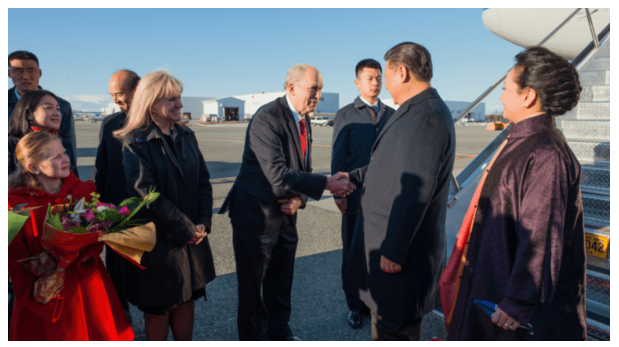
Former Gov. Bill Walker, seen above greeting China President Xi Jinping to Alaska in 2017, used his term in office to try to make a deal with China to finance and help build an Alaska gasline, and he was preparing to seal a deal to sell most of Alaska’s natural gas to China.
The Chinese government, which signed loan agreements with Walker in 2017, would have established Alaska as a “debt trap” province of communist Chinese entities.
China began spying on State of Alaska computers during Walker’s overtures to President Xi Jinping, as part of Walker’s quest to get financing for the Alaska Gasline.
Photo: Gov. Bill Walker welcomes China President Xi Jinping to Alaska in 2017.
The deal aimed at raising the national debt ceiling by trillions of dollars has made progress by advancing through the House Rules Committee.
The bill barely passed by a 7-6 vote, with two Republicans crossing party lines to join Democrats in opposing the bill: Rep. Chip Roy of Texas and Ralph Norman of South Carolina. The two said the bill doesn’t have enough spending cuts.
Conservative Rep. Thomas Massie of Kentucky voted in favor of moving the bill to the House for a full vote Wednesday evening. Massie usually votes with Roy and Norman.
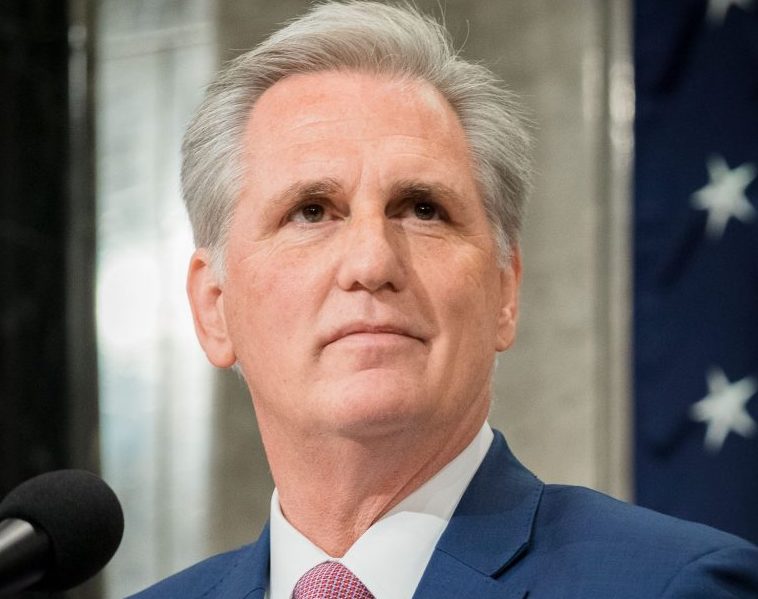
The Democrats have vowed to block a procedural vote on a rule rule governing the debt ceiling increase final vote. McCarthy can lose only five Republicans and still pass the rule if Democrats try to block passage. Republicans need 218 of their members to vote for the rule to advance to the final vote.
“In regards to the rule, it’s very simple: The majority is responsible for passing the rule,” Democrat Rep. Katherine Clark of Massachusetts, told a scrum of reporters. Clark is the Democratic whip.
The bill helps the federal government avoid default by raising the amount of money it can borrow. The debt limit would be increased for two years. It puts limits on discretionary spending that Congress does each year. It also puts sideboards on the president’s ability to spend without congressional approval, and it claws back unspent Covid-19 funds that was appropriated but is unspent. There is also a small amount of welfare reform and some minor loosening of federal permitting requirements that slow the economy down.
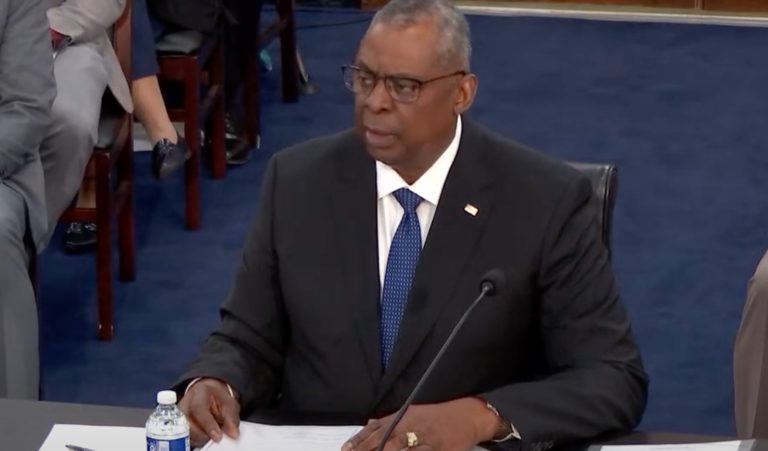
The People’s Republic of China has declined an invitation from Secretary of Defense Lloyd Austin to meet with his counterpart in Singapore while an annual global security conference is under way.
“Overnight, the PRC informed the U.S. that they have declined our early May invitation for Secretary Austin to meet with PRC Minister of National Defense Li Shangfu in Singapore this week,” Pentagon Press Secretary Pat Ryder said in a statement, as reported first by the Wall Street Journal. “The Department believes strongly in the importance of maintaining open lines of military-to-military communication between Washington and Beijing to ensure that competition does not veer into conflict.”
Chinese Embassy Spokesman Liu Pengyu told the Wall Street Journal that the U.S. was “seeking to suppress China through all possible means and continue imposing sanctions on Chinese officials, institutions and companies.”
In 2017, then-Gov. Bill Walker of Alaska had all-but sealed a deal with the government of China and its government-owned banks and financial institutions to help Alaska build a gasline, from which the majority of natural gas from Alaska would be sold to the Chinese.
An environmental group that blames Alaska salmon fishing for the decline of Washington-area orcas won another day in court last week. On Friday, U.S. District Court Judge Richard Jones of Seattle denied the State of Alaska’s request for a stay of Jones’ May 2 order vacating the “incidental take statement” for the Southeast Alaska winter and summer commercial Chinook salmon troll fishery.
The document would give these fisheries coverage for the incidental “take” of species listed under the Endangered Species Act. The judge’s order has the practical effect of closing the directed summer and winter Chinook troll fisheries until a new ITS is in place.
Wild Fish Conservancy sued the National Marine Fisheries Service, alleging violations of the Endangered Species Act and National Environmental Policy Act. The group says that Southeast Alaska troll fisheries are at fault for the decreasing population of Washington and Oregon Chinook salmon and the Southern Resident Killer whales off the coasts of Washington, Oregon, and Canada.
Troll fishing is one of the least intensive forms of commercial salmon harvesting.
The environmental industry plaintiffs make no mention of the major dams that Washington and Oregon have built over the many years that have cut off those states’ own supply of salmon.
The State of Alaska quickly filed an appeal to the Ninth Circuit Court of Appeals and is filing a motion for stay of the judge’s order.
The State is requesting a decision by June 23 so that the fishermen can gear up for the summer season, which starts on July 1.
“Vacating the ITS and effectively closing the fishery spawn disaster for Southeast Alaska’s economy and way of life while providing no meaningful benefit to the endangered Southern Resident killer whales,” said Alaska Fish and Game Commissioner Doug Vincent-Lang.
“Troll fishing for Chinook is critical to Southeast Alaska’s economy, local government, and culture. It is a way of life. And we intend to do everything we can to defend our fisheries.” Vincent-Lang added, “the district court singled out an Alaskan fishery to shoulder the entire burden of conservation, while other fisheries, notably those occurring along the Pacific Northwest coast that have disproportionately higher levels of impact, are left untouched and unrestricted. This is unequitable and unfathomable. If this ruling sticks, we will be looking at having all fisheries treated equally.”
The Polaris Hotel, Fairbanks’ tallest building and biggest eyesore, is coming down at last.
It was built in 1952 with its annex constructed in 1973. Originally designed as an apartment building, it was converted into a hotel but in 2001, 800,000 gallons of water flooded the basement; it was abandoned in 2002. The City of Fairbanks foreclosed on the property over unpaid taxes.
The City of Fairbanks received a Targeted Brownfield Assessment for the main portion of the 11-story building in 2017.
The assessment found asbestos, mold, mercury and PCBs. Because of the polychlorinated biphenyls (PCBs), all material will have to be shipped out of state for disposal.
Fairbanks was awarded a $10 million earmark through the efforts of Sen. Lisa Murkowski by way of the Environmental Protection Agency and was waiting for those funds to arrive so the work could begin.
Demolition started with the annex next to the main structure and will continue to the main structure throughout the coming months.
Mark Sabbatini, who has covered politics for the Juneau Empire on and off for years, is the new managing editor of the Juneau Empire.
He takes over for Ben Hohenstatt, who served as editor for five years and now will work in state government in Juneau as an employee for the State Ombudsman’s office.
Sabbatini first came to the Empire in the 1990s to cover the legislative beat. He ventured to Antarctica and was the publisher of The Antarctic Sun, a newspaper covering science and life in Antarctica, and then went on to arctic Norway, where he spent 13 years editing the alternative weekly called Icepeople in Svalbard. He was forced to leave when his health took a turn for the worse.
Sabattini returned to Juneau in 2022 and started up again at the Empire, where he had become Sunday editor in his prior stint. The Empire has recently become nearly an all-online publication. Print editions of the paper only come out twice a week and are printed in Tacoma, Washington, and delivered by mail to those who still get the newsprint edition.
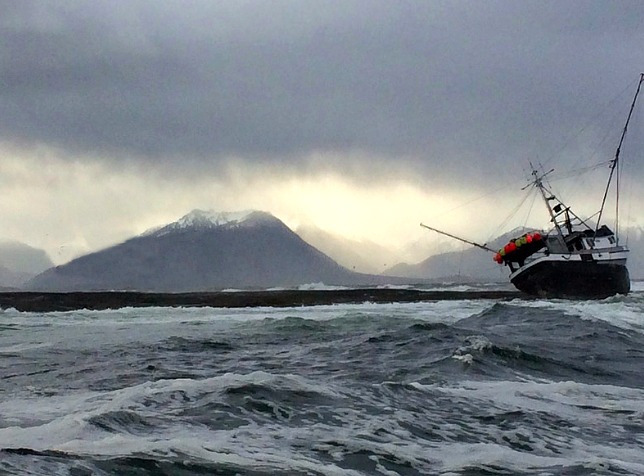
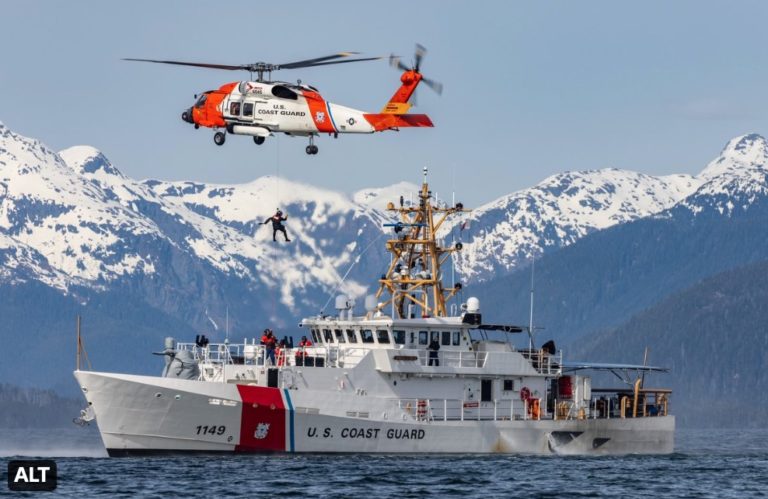
The U.S. Coast Guard continues searching for four missing individuals after a report that a boat from Kingfisher Charters was overdue with five people aboard. The vessel was found partially submerged near Low Island, approximately one mile east of Shoals Point, Kruzof Island.
Last seen underway in the vicinity of Cape Edgecombe, near Sitka Sound, one dead body was found at the wreckage.
Involved in the search are:
· Coast Guard Sector Juneau Command Center
· Coast Guard Air Station Sitka, MH-60 Helicopter aircrew
· Coast Guard Air Station Kodiak, C-130 Hercules aircrew
· Coast Guard Aids to Navigation Team Sitka 38-foot Special Purpose Craft boat crew
· Sentinel-class fast response Coast Guard Cutter Douglas Denman
· Sitka Fire Department
· Several Good Samaritan vessels
“There are currently so many unknowns, we are thankful for the coordination efforts from several municipal agencies including the Sitka Fire Department and Good Samaritan vessels on scene.” said Lt. Trevor Layman, Command Duty Officer. “We’re working quickly to locate the unaccounted-for individuals.”