Saturday, August 15, 2026
Home Blog Page 678

Rick Whitbeck: Here’s another horrible tax conceived in the swamp

By RICK WHITBECK

Despite yearslong pushback from small businesses, manufacturers, and consumers, Congress is once again considering “carbon border adjustment tax” legislation which will unfairly impact the oil and gas industry right here in Alaska.

Record high inflation, a looming debt crisis, and the potential for an economic recession don’t seem to be enough to dissuade eco-centric Congressional members and environmental extremists from attempting to push through this destructive legislation. Even more unfortunate is that several Republicans are helping to draft this legislation and pledging support. 

This legislation has many problems, with the very nexus hinging on the false argument that carbon is a pollutant that must be reduced through whatever means necessary. Regardless of the impetus for considering the legislation, the mechanics of the bill are just plain awful.

It would impose a tax, or tariff, on imported goods including aluminum, paper, steel, petroleum, among others, based on the carbon content of the product. Supportive members in Congress and activist organizations allege this tax would discourage pollution from other countries who do not currently meet U.S. standards, or they would face a penalty.

However, the real result of this tax would strain America’s businesses and increase costs for consumers while providing no benefit to the environment.

David Weisbach, an expert in carbon border tariffs, has said these taxes would “unquestionably” raise prices for U.S. consumers earning less than $400,000 a year.

Despite interest expressed by some Senate Republicans in recent years, proposals pushed by climate activists have thus far been roundly defeated. The ramifications of such a tax would be detrimental for Alaska families and businesses across our state. The cost of producing several important goods would skyrocket while the price of importing goods would simultaneously increase.

Who wins in this scenario? If passed, a carbon border tax would push businesses to pass these rising costs directly on to consumers. All Americans would pay this misguided tax. 

In Alaska, we would see a direct hit on the oil and gas, refining, and mining operations as these industries would lose the ability to invest in new projects as well as maintain current operations without passing on higher costs to customers and consumers.

Crazy ESG policies have put a target on the back of Alaska’s oil and gas industry and already make it incredibly difficult to attract capital to invest in new energy projects here. An additional tax would only add to creating a hostile business environment. The road back to energy independence does not include a carbon border adjustment tax.  

Alaska families are already struggling to keep up with the high cost of groceries and everyday goods and are staring down rising gas prices ahead of the summer travel season. This legislation stands in direct contradiction to the fiscally responsible policies needed at a time when Republicans are the only party willing to make spending cuts and tax less. 

Thoughtful discussions are hopefully underway to tackle the nation’s fiscal situation. Entertaining consideration of a carbon border tax at a time of economic uncertainty should not be on the table for Congress.

Rick Whitbeck is the Alaska State Director for Power The Future, a national nonprofit organization that advocates for American energy jobs and opportunities. Contact him at [email protected] and follow him on Twitter @PTFAlaska.
Downing: Can we boycott them all?

By SUZANNE DOWNING

A three-year-old video of a Chick-fil-A executive discussing race relations surfaced this week, thrusting the fast-food chain into an undesired spotlight alongside Bud Light, Target, J.Crew, and Disney.

In the video, Chick-fil-A CEO Dan Cathy shares thoughts on Christian repentance and the need for an “apologetic heart” concerning black Americans. He suggests that white Americans should “pick up the baton and fight for our black, African-American brothers and sisters.”

Filmed during a particularly tense period, as Black Lives Matter violence and looting swept across America, Cathy knelt to shine the shoes of Black Christian rapper, Lecrae Moore.

This act mirrors the biblical story of Jesus washing his disciples’ feet, a not-unheard-of practice in the Christian race-reconciliation movement. The poignant symbolism of washing the feet of those who may harbor anger and resentment toward your race is powerful.

Yet in 2023, this reconciliatory video encountered a metaphorical guillotine. Public frustration with ever-shifting corporate “woke” ideologies has prompted some conservatives to call for a boycott of Chick-fil-A — a chain they helped elevate to the third-largest restaurant chain in the country, behind only McDonald’s and Starbucks.

Critics contend Chick-fil-A has entered the culture wars by also hiring a vice president of diversity, equity, and inclusion, which some perceive as a departure from merit-based employment and a surrender to the “woke” agenda.

However, Chick-fil-A has been simpering for liberal approval for over a decade. Since its inception, the Chick-fil-A Foundation faced vehement criticism from LGBTQ advocates for donations made to pro-family organizations like Focus on the Family, National Organization for Marriage, and even the Paul Anderson Youth Home. Under pressure, Chick-fil-A caved.

In 2019, ThinkProgress chastised the Chick-fil-A Foundation for donating to two Christian groups supporting traditional marriage: Salvation Army and Fellowship of Christian Athletes. The foundation capitulated and ceased donations.

Over the years, boycotts from those opposed to the company’s Christian leanings, even attempts by elected leaders to block franchise openings, have targeted Chick-fil-A. Yet the brand has grown and now boasts over 2,500 locations. Only Alaska and Vermont lack a Chick-fil-A franchise, with Texas hosting the most locations — 471 stores, comprising 16% of the company.

Ironically, sales would often skyrocket on days when a boycott was called, with customers queued for blocks to buy a breaded chicken sandwich. Like Budweiser, Chick-fil-A had become as American as apple pie, with conservatives expressing their support through their wallets.

Nevertheless, Chick-fil-A is not invincible to consumer discontent and should brace for a protracted battle with Americans who are looking to economize their hard-earned dollars.

Anheuser-Busch is a case in point. Since Bud Light partnered with transgender Dylan Mulvaney, the company’s stock price has plummeted over 18% within a month. It might take years to recover, if at all.

Similarly, Target is investing in security near its Pride Month displays, while consumer resentment appears to be escalating. This week, JPMorgan downgraded Target’s stock to “neutral,” citing growing concerns over the company’s waning fortunes. This marks Target’s longest losing streak since 2000.

Disney is also under fire after hiring a man dressed as a “fairy godmother apprentice” to guide girls into a boutique on its property. Disney’s stock has plummeted.

Chick-fil-A, Bud Light, Target, and Disney are not the only brands provoking Americans’ ire. Kohl’s has come under criticism for marketing infant clothing adorned with “Pride Progress” flags. These companies have become emblems of a cultural trend that at least half of America deems detrimental to the very survival of the nation.

Perhaps June is now the month to spend quality time at home with our families and reconsider funding companies that dismiss our values. After all, we’re increasingly hearing that every time you leave the house, it costs you $100. Save money, spend time with your family. And here’s a practical note: You’re likely to need those savings later this year, considering the precarious economic climate America is in.

Suzanne Downing is publisher of Must Read Alaska.

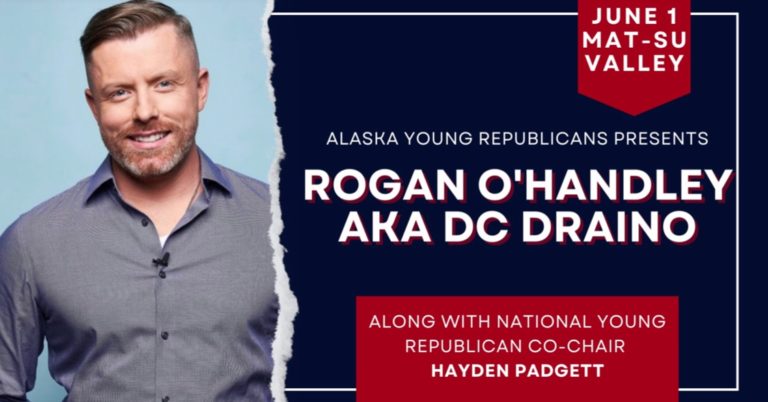
Tickets going fast: DC Draino appears Thursday and Friday in Alaska

Rogan O’Handley, known on social media as DC Draino, will be making appearances in Alaska this week.

O’Handley has millions of social media followers who appreciate hearing from a millennial who is not far-right, but is simply right so far.

A former Hollywood entertainment lawyer who became a conservative commentator, O’Handley battles government corruption and fights for the Constitution and the American Dream, and he does so with clever memes and short, pointed videos.

On Thursday, DC Draino will speak at Settlers Bay Lodge, as part of a spring fundraiser for the Alaska Young Republicans. Also speaking at the event is Hayden Padgett, co-chair of the National Young Republicans. Tickets are $130 for general admission and $199 for the VIP reception, which includes priority seating at the dinner event. The reception is 5:30-6:30 pm, and main dinner doors open at 6:30 pm.

Tickets for the MatSu event are at this link.

On Friday, Draino and Padgett will be at the Egan Center. The VIP meet-and-greet is at 5:30 pm, with general admission doors opening at 6:30 pm. Only 50 VIP tickets will be sold.

Tickets for the Anchorage event are at this link.

Art Chance: Sometimes I hate to be right

By ART CHANCE

In 2018 the US Supreme Court handed down its decision in Janus v. American Federation of State, County, and Municipal Employees, AFL-CIO, hereinafter referred to as Janus or Janus v. AFSCME.

At its essence Janus struck down compulsory union dues for public employees as unconstitutional. Unions went into a fit of apoplexy, which could easily have been expected.   Less expected, unless you were some cynical government type like me, was the sight of Republican elected officials shaking in their shoes over the announcement.

The Unions were ready for Janus. A previous case on the same grounds had resulted in a 4-4 decision due to the death of Supreme Court Justice Antonin Scalia. The unions and the Left saw the handwriting on the wall and began to prepare for public employment in the US to become essentially open shop or “right to work.”

In the “blue” unionized states, the unions had willing accomplices in modifying collective bargaining agreements to impose draconian barriers to employees trying to withdraw from union membership. Union stooge Bill Walker was still Alaska’s governor when Janus was handed down and he and the unions quickly reached agreements to protect union prerogatives and keep as many employees as union chattel as possible. 

I don’t know if they’re still doing it, but for months after Janus was handed down, State human resources people were telling new employees they had to go down to the union hall and sign up to pay dues.

The ”red” states have been more problematic. Over the last couple of decades feckless Republicans have allowed collective bargaining and unionization for police, fire, and teachers in many jurisdictions, even though they have no legal right to bargaining. 

But they do have a right to make political contributions and the feckless Republicans can’t pull their hands back. Just look at how the so-called Republicans in the Alaska Legislature behaved and voted last Session and then go look at who they took money from.

When Janus was handed down most any experienced labor relations practitioner would have known what to do. The people I left behind when I retired would have known what to do. Since it was the union-owned Walker Administration obviously nobody asked them or listened to them. All it would have taken was a letter to each union telling them that the U.S. Supreme Court had rendered their union security clauses unconstitutional and that the State would no longer enforce them. You’d offer a polite invitation to them to come bargain the effects.

Instead, the Walker Administration jumped to their masters’ order and entered bargaining with the unions to secure nice safe contracts to get them past the next election and to keep their mandatory dues schemes intact. The union-Walker junta came apart and Mike Dunleavy became governor. There was a chance to get something right.

I met with Dunleavy’s new attorney general in 2019. He’d been in office a month or so, which is long enough to master the org chart, the directory of state officials, and have some clue what your job is. I’ve worked with and for and supervised a fair number of lawyers and admittedly you wondered who dressed some of them for work, but somehow they’d passed the bar exam. I assure you that a bar ticket is not a certification that the holder has any sense. I left that meeting convinced that that attorney general, now long gone, was an idiot. Nothing since has changed my mind. If you’re a cabinet officer. or even a range 20, you don’t compromise your career and your marriage by playing with the front desk clerk.

I wrote a column here in September of 2019, titled, “Which Way is the Courthouse” or some such. 

My proposition was that the Janus case was a federal question that needed to go to the federal courts, yet the Alaska Department of Law had filed in State court.   

Now I’m just a country boy from Georgia who happens to know a bit about labor relations and I know that nothing in the Alaska Public Employment Relations Act offends the Alaska Constitution, but after Janus, a good bit of it offended the US Constitution.

Last week the Alaska Supreme Court handed down its decision and, funny thing, it reads a lot like my column from a couple of years ago: Compulsory dues are just fine under Alaska law; it’s just that Alaska law violates the U.S. Constitution.

The attorney general had a bunch or Range 24 and 25 assistant AGs working for him, one of which I hired. If one of my Range 18 or 20 entry-level Labor Relations Analysts had brought me the legal analysis that led to that appeal to the State courts, at minimum their career indicator light would have been flashing and it might have been worse. Whomever thought that up for the Department of Law was either an idiot or a crook.

So, now the State has lost in the State courts and it would take a whole new start through the federal courts. The State would be unlikely to win in the Alaska District or in the Ninth Circuit, so a resolution is several years and several million dollars away.

Meanwhile, Gov. Dunleavy and his friends are at peace with the unions, sending our dividends to their friends, and dreaming of carbon credits and the State living off Permanent Fund earnings.   

It isn’t a coincidence that he appointed Alice Rogoff-David Rubenstein’s daughter to the Permanent Fund Board. Maybe Dunleavy can go to the U.S. Senate while his trust fund baby buddies set the table here in Alaska.

Art Chance is a retired Director of Labor Relations for the State of Alaska, formerly of Juneau and now living in Anchorage. He is the author of the book, “Red on Blue, Establishing a Republican Governance,” available at Amazon.

In GOP-controlled House, the debt ceiling bill passes with mostly Democrat votes

The U.S. House voted on Wednesday night to raise the debt ceiling — the amount that the U.S. Treasury can borrow to make ends meet in a government that is living far beyond its means.

The Fiscal Responsibility Act hammered out by President Joe Biden and House Speaker Kevin McCarthy, a Republican, passed the House 314 to 117, with more Democrat votes than Republican vote. Some 149 GOP voted for it, and 71 voted against it, saying it didn’t go far enough to rein in federal spending.

On the Democrat side, Rep. Mary Peltola of Alaska stayed with the 165 Democrats voting for the bill.

The bill suspends the current debt limit of $31.4 trillion until after the Nov. 5, 2024 presidential election, when 435 House seats and 33 of the 100 Senate seats will be on the ballot then.

Rep. Mike Lee, a Republican from Utah, was uncharitable toward the bill, calling it the ” “Biden-McCarthy Debt Expansion Act.”

“To those who thought this was a Republican bill, the numbers don’t lie: 165 Democrats voted for it, and only 149 Republicans joined them. Those voting against it included 71 heroic Republicans and only 46 Democrats,” he said.

The Fiscal Responsibility Act of 2023 claws back $30 billion of unspent Covid-19 funds; completely fund veterans medical care, and ends the pause in the repayment of student loans in August. Non-defense spending is flat for one year and then goes up by 1% in 2025.

At a press conference after the bill’s passage, McCarthy praised it:

“Each week, we have stood up for the American public. Be it a strongest border security, be it a parents’ bill of rights so you can have a say in your kid’s education, be it ending the pandemic or standing up against those who are weak on crime to make our streets safer,” McCarthy said. “Tonight, I hope we proved it to you again that we put the citizens of America first, and we didn’t do it by taking the easy way. We didn’t do it by the ways that people did it in the past by just lifting it. We decided that you had to spend less, and we achieved that goal.”

The measure now goes to the Senate, where Sen. Bernie Sanders is a no, and Sen. Joe Manchin is a yes, because the bill funds a natural gas pipeline in West Virginia.

The conservative group, American Heritage Action, disapproved of the bill.

“As a long-standing policy position, we have consistently called for dollar-for-dollar cuts and reforms commensurate with any debt ceiling increases. This bill does not do that. This bill suspends the debt ceiling until 2025, enabling President Biden and a divided Congress to generate an estimated $4 trillion in new federal debt,” the group wrote.

“This deal does not meet the moment, and it does not address the root problems that have led to nearly $32 trillion in national debt,” Heritage Action said. “As members of Congress continue the fight to rein in Washington’s spending addiction and prevent the country’s fiscal ruin, we remain committed to finding solutions to once and for all bend the spending curve down.”

Dunleavy appoints Tuckerman Babcock to UA Board of Regents

After the Alaska Legislature refused to confirm Bethany Marcum to the University of Alaska Board of Regents, Gov. Mike Dunleavy appointed an Alaskan who is just as conservative: Tuckerman Babcock.

Babcock, the former chairman of the Alaska Republican Party and Dunleavy’s first chief of staff, was named to the Board today, and he will serve until his confirmation hearing next spring.

Babcock served on the Alaska Oil and Gas Conservation Commission and as the executive director of the state redistricting board in 1991. He was assistant manager of the Matanuska Electric Association and worked for the Division of Elections.

Four of his children attended the University of Alaska and his father taught sociology and directed the Mountaineering and Wilderness Survival program at the Anchorage Community College, prior to ACC merging with UAA.

“Tuckerman’s experience serving in numerous statewide government positions and ten years in business management makes him a great fit for the University of Alaska’s Board of Regents,” Dunleavy said. “I am grateful for his continued service and commitment to the State of Alaska. I am confident that Tuckerman’s expert knowledge of public service and leadership will continue to help Alaska for the better.”

Trump slams former press secretary Kayleigh McEnany

Presidential candidate Donald Trump called his former spokeswoman “Milktoast” and slammed her for giving out what he said were wrong polling numbers on FoxNews.

“Kayleigh ‘Milktoast’ McEnany just gave out the wrong poll numbers on FoxNews. I am 34 points up on DeSanctimonious, not 25 up. While 25 is great, it’s not 34. She knew the number was corrected upwards by the group that did the poll,” Trump wrote Tuesday evening on his social media site, Truth Social. “The RINOS & Globalists can have her. FoxNews should only use REAL Stars!!!”

Trump refers to Gov. Ron DeSantis as “DeSanctimonious.” DeSantis is his top challenger for the Republican nomination for president.

McEnany said on the “Jesse Watters Primetime” show that Trump’s lead over DeSantis had fallen from 34 points to 25 points in Iowa.

According to U.S. News, Trump leads the field of possible Republican presidential candidates in Iowa with 62% of voters’ support, compared with DeSantis’ 20%, a more than 42% difference.

However, an Emerson College survey show 49% of Iowa voters support Trump, with 38% supporting Biden in a general election. But if the general election had DeSantis vs. Biden, 45% would vote for DeSantis and 38% would vote for Biden.

She was Trump’s White House press secretary from April of 2020 to January of 2021 and was one of his fiercest defenders.

McEnany then went to Fox News, where she is a frequent guest host on The Ingraham Angle, Jesse Watters Primetime, The Five and Fox & Friends.

Photo credit: Gage Skidmore, Surprise, Arizona

Dunleavy’s former family advisor tells his critics to ‘f*&k off’

Jeremy Cubas, who served as a photographer for Gov. Mike Dunleavy before being promoted to the position of a policy adviser making over $110,000 a year, posted a video on Twitter on Wednesday in response to critics of his controversial views: He wants them to “Do everybody a favor and f*&k off.”

A long story Tuesday in Alaska Public Media chronicles the bizarre views of a man who was in the inner circle of influence with the governor. It shocks the sensibilities to read that he feels women want to be raped, and that rape is part of the marital contract.

“I don’t think it’s possible to rape your wife. I think that’s an impossible act,” he says on his podcast, which can be found at this link.

Cubas is also an adjunct professor at University of Alaska Anchorage, where he has taught philosophy as late as this year.

His expletive-laden on-the-record comments about his firing follow. Be advised: Content is spicy:

Alex Gimarc: High-density living comes to Anchorage?

By ALEX GIMARC

One of my correspondents sent out a blast e-mail last week, warning about AO 2023-66, a change in Anchorage municipal code relating to zoning of residential districts and waiving planning and zoning commission review process. 

The ordinance was first heard May 23. The Muni press release 5/23/23 can be found here. It says that the ordinance will be heard at the next regular Assembly meeting, July 25.  Whether that happens then or earlier is anyone’s guess.

A major rewrite of Anchorage zoning law during the summer while everyone is out fishing raises a red flag. Assemblywoman Meg Zaletel’s fingerprints on it raises that flag much higher, especially after she has left town for the next month or so.  

The problem comes down to trust. Do we trust this Assembly majority to do the right thing, as in take testimony, address concerns, and modify their proposal as necessary? Or do we trust them to simply shove whatever they want down our throats regardless of what we want them to do just like they have done with the homeless problem, Covid lockdowns, and spending over the last several years? 

Sadly, my dime on them doing what they do best, the cram-down technique.

The press release defines the problem as a housing crisis, with land use restrictions contributing to the issue. Solution in this ordinance? Higher density housing city wide.  A page and a half of WHEREAS clauses fall all over themselves touting the joys of increasing residential density.  

OK, problem stated, and Assembly solution proposed. The problem with this is that they completely ignore the deeper problem, opting instead to deal with the symptom (housing crisis). This is sort of like treating swelling around a broken leg as a problem rather than the broken leg.  

But what is causing the housing crisis? At its most basic, the housing crisis is caused by lack of land to build new homes on in the Anchorage Bowl. This has been a known issue for the last 30 years (or more), and to be expected in a chunk of land bounded by a National Forest and Cook Inlet. Happily, there are several hundred square miles of mostly empty land available right across Cook Inlet at Point Mackenzie available for building.  

How to get to that land? The Knik Arm Bridge, the same bridge Sen. Ted Stevens had funding for in 2008. The same bridge Sarah Palin killed in 2008. The same bridge every single Democrat in this town has opposed for the last two decades.  

The two Assembly members offering the high-density residency as a “solution” completely ignore both the underlying problem and the simple solution, opting instead to blow up planning and zoning rules so that it is easier to cram us all together like rabbits in a warren, bringing all the family unfriendly blue inner-city pathologies here to Anchorage.  Quite the solution, that.

No discussion about why the current planning and zoning system no longer works. No discussion about why the planning and zoning commission review is no longer necessary.  No discussion of any other solutions that don’t involve high density housing. No discussion about the local impact of the nationwide crash in commercial real estate that is working its way north.  

High density housing is what they want. And with this majority, this is what they are going to try to get, property rights of homeowners now irrelevant.  

Bad legislation is proposed to solve a symptom rather than the actual problem, which will work out for homeowners just as well as Assembly efforts to solve the ongoing homeless problem for the last decade. 

Like homelessness, it’s going to be difficult to agree on a solution if you can’t even acknowledge what the actual problem is.  

Alex Gimarc lives in Anchorage since retiring from the military in 1997. His interests include science and technology, environment, energy, economics, military affairs, fishing and disabilities policies. His weekly column “Interesting Items” is a summary of news stories with substantive Alaska-themed topics. He was a small business owner and information technology professional.