Wednesday, August 19, 2026
Home Blog Page 646

Hunter Biden plea deal in jeopardy after his team caught scamming court

Update: Hunter Biden has pleaded not guilty to tax charges after deal falls through and judge admonishes Biden legal team.

Hunter Biden’s plea agreement with the Justice Department did not materialize after the judge was reluctant to let Biden off on the felony gun charge, and after she admonished the Biden legal team for trying to bury evidence through a scam on the court.

U.S. District Judge Maryellen Noreika crossed swords with Biden’s attorneys over what appears to be the Biden team misrepresenting themselves to the court clerk in order to convince the clerk to remove an item from the Biden file and make it go away.

Norieka also expressed skepticism about allowing Hunter Biden off on his illegal gun possession while he was on drugs.

Hunter Biden, 53, walked into the court in Delaware ready to enter a plea agreement in that would have seen the gun charge dropped in exchange for pleading guilty for misdemeanor counts of willfully failing to pay federal income taxes.

Meanwhile, House Ways and Means Committee Chairman Jason Smith of Missouri submitted a brief to Noreika, which asked her to reconsider the Biden plea agreement, since a whistleblower has very recently testified under oath that the Department of Justice used political muscle to cut short its investigation into the Biden family legal problems.

“The Defendant appears to have benefited from political interference which calls into question the propriety of the investigation of the U.S. Attorney’s Office,” Smith wrote in a court filing. “It is critical that the Court consider the Whistleblower Materials before determining whether to accept the Plea Agreement.”

After the brief was filed, a member of Biden’s legal firm called the court clerk and misrepresented herself as working on behalf of Smith’s law firm, and tried to have a clerk remove Smith’s brief from the court files, according to the clerk’s account.

The judge then ordered Biden’s legal team to explain themselves by 9 pm Eastern Time on Tuesday, or face sanctions.

The lead lawyer for Hunter Biden responded to the judge with a statement calling it “an unfortunate and unintentional miscommunication.”

Read Rep. Smith’s brief to the court at this link.

Judge Noreika today asked the prosecution if there are any other criminal investigations that are pending relating to Hunter Biden, and the answer they gave was “yes.”

This story is developing and likely to be updated.

This one weird trick could end up costing your entire PFD this year

“Pick.Click.Give.” is Alaska’s unique way of allowing people to donate a portion of their Permanent Fund dividend to charity.

When Alaskans file for their annual share of the state’s oil wealth, they have the option of checking a box that can help them direct some or all of their dividend to any one of dozens of participating nonprofits in the state.

This year, the official Pick.Click.Give. form says Alaskans can give up to $2,800 from their dividends to charity. That’s how much Alaskans have available, the state says. Here is what the form shows at https://pfd.alaska.gov.

The problem is, the 2023 dividend was set at $1,300.

If an unsuspecting Alaskan looks at the Pick.Click.Give form and think he’s getting a $2,800 dividend this fall, and decides to give half to charity, he will end up giving the entire dividend to charity, and will get nothing in his own bank account this year.

Gov. Mike Dunleavy, in his original budget in December, set the PFD for $3,800. The House of Representatives passed a PFD in the amount of $2,700. But the Senate set it the lowest — $1,300. And that ended up being the final amount as the legislature wrapped up business.

Those who may have been led to believe they were getting a $2,800 PFD, and who want to now change their charitable donation amount, have until Aug. 31 to make that adjustment online at pfd.alaska.gov.

Applicants who filed an online application and selected direct deposit will receive their 2023 dividend through direct deposit on Oct. 5, if they have been determined to be eligible.

The Pick.Click.Give. program was launched in 2009 by the State of Alaska in partnership with The Alaska Community Foundation, the Rasmuson Foundation, The Foraker Group, and the State of Alaska Permanent Fund Dividend Division.

Listicle: Gov. Dunleavy is seventh most popular governor in America

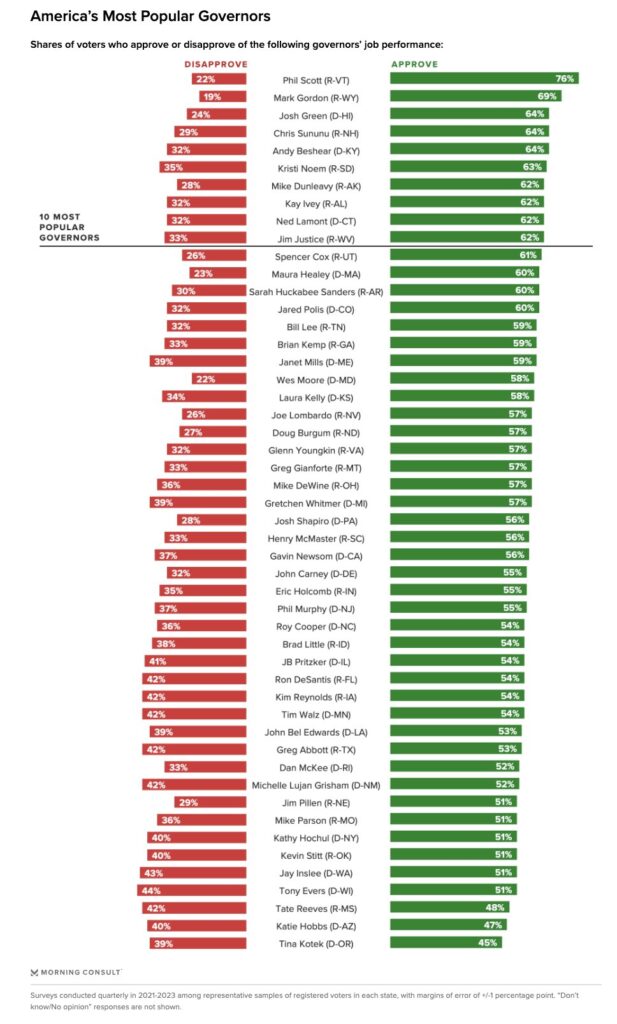
Morning Consult, a polling and data analysis company, issued its annual list showing the popularity of each of the 50 governors in America.

The data shows that Republican Gov. Phil Scott of Vermont is the most popular governor in America, with a 76% approval rating, and that Alaska Gov. Mike Dunleavy is the seventh most poplar, with a 63% approval rating.

Seven of the top 10 most popular governors are Republicans.

At the bottom of the popularity list is Democrat Gov. Tina Kotek of Oregon, with 45%; and Democrat Gov. Katie Hobbs of Arizona, at 47% approval.

Six of the 10 least-popular governors are Democrats.

The top 10 most approved-of governors are: Scott (R-VT): 76% Gordon (R-WY): 69% Green (D-HI): 64% Sununu (R-NH): 64% Beshear (D-KY): 64% Noem (R-SD): 63% Dunleavy (R-AK): 62% Ivey (R-AL): 62% Lamont (D-CT): 62% Justice (R-WV): 62% *April 1-Jun. 30, 2023

Dunleavy is more popular now than he was in 2021, according to the Morning Consult poll, which ranked him 16th most popular that year, even though a partisan group of Democrats had made a valiant effort to recall him from 2019 through 2021, an effort that failed because the group could not get enough signatures.

And he’s far more popular than Gov. Bill Walker was in the Morning Consult poll in 2017. Walker was the fifth least approved of governor in the nation that year. He lost the next year to Dunleavy.

Man who peddled mushrooms and vandalized with Nazi stickers sentenced

Luke Foster, a 28-year-old resident of Anchorage, was sentenced Tuesday to 18 months in prison for perpetrating acts of hate-motivated property damage and a single drug trafficking offense.

The sentencing comes after an investigation into Foster’s actions, which included vandalizing various locations with Nazi-inspired imagery and trafficking a Schedule I controlled substance.

In May 2021, Foster placed swastika stickers that contained the words “WE ARE EVERYWHERE” at eight different locations across Anchorage.

His targets included the Alaska Jewish Museum, the University of Alaska Anchorage campus, and Mad Myrna’s, a bar. The acts led to his conviction on two counts of damaging religious property.

Foster’s vandalism did not end there. In September 2021, he returned to the Alaska Jewish Museum, where he placed another sticker and carved a swastika into the door. The incident resulted in another count of damaging religious property being added to his charges.

While investigating the vandalism, law enforcement authorities stumbled upon an even darker aspect of Foster’s criminal activities. He was found to be using social media to traffic psilocybin mushrooms, a dangerous Schedule I controlled substance under the Controlled Substances Act.

Foster sold the illicit drugs to an undercover agent and boasted about his extensive collection of weapons, intending to use them to protect his illegal drugs from law enforcement, if necessary.

Federal agents acted on this information, executing a search warrant on Foster’s residence. The search yielded a haul of evidence, including psilocybin mushrooms, items associated with drug production, multiple firearms, ammunition, a substantial amount of cash, and a box of swastika stickers. The items led to Foster’s conviction on an additional count of possession of controlled substances with the intent to distribute.

“Mr. Foster’s hateful acts of pro-Nazi vandalism across our city have caused significant harm to multiple communities, and his trafficking of drugs put the people of Alaska in danger. Anti-Semitic crimes and those targeting the LGBTQ+ community have no place here. Our U.S. Attorney’s Office will continue to work with our law enforcement partners to identify, investigate, and prosecute crimes that target our communities to instill fear and distrust,” U.S. Attorney S. Lane Tucker for the District of Alaska said.

The FBI’s Anchorage Field Office led the investigation, with support from the Anchorage Police Department and the Drug Enforcement Administration, showcasing the importance of cooperation among law enforcement agencies to tackle such egregious offenses effectively.

Streets of McCarthy: Much ado about a street fenced off in the middle of town

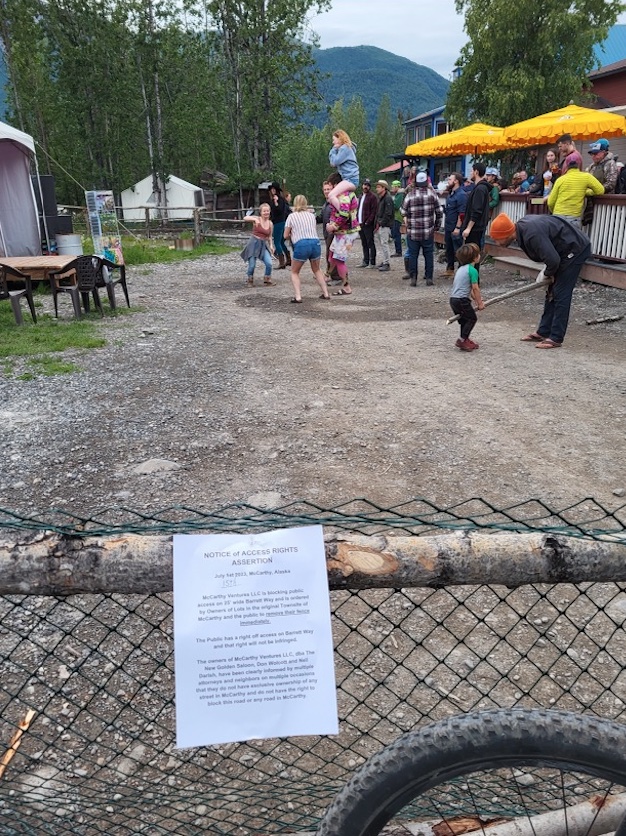
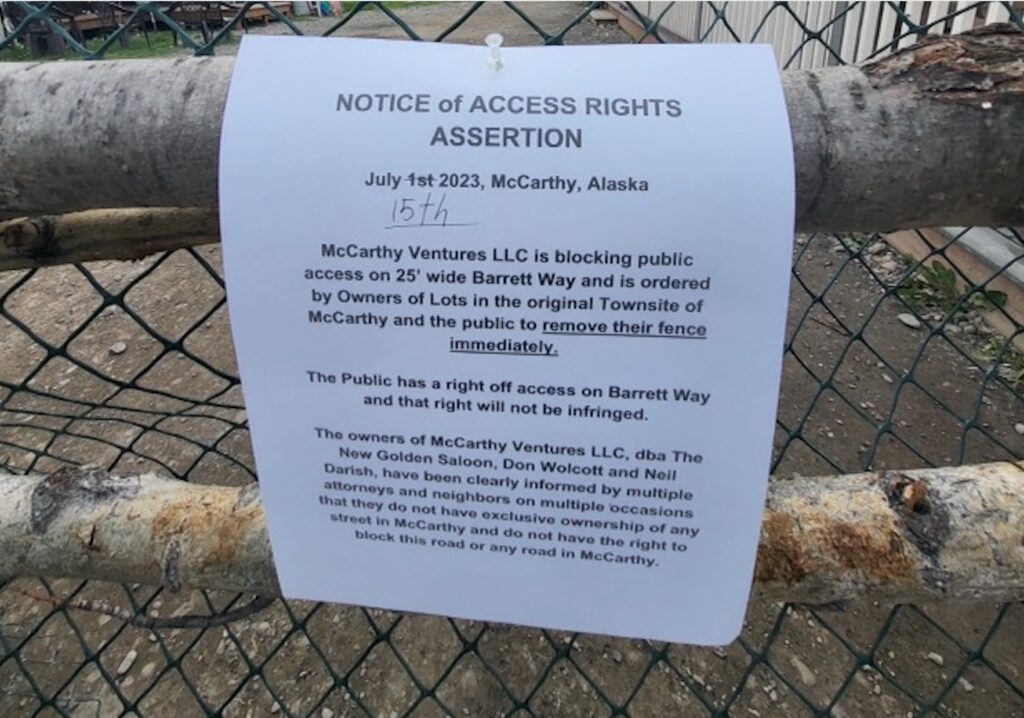
The quaint and historic Alaska town of McCarthy, a summer tourism destination, has been in turmoil over a central street in the town that was blocked by a business owner who thought he had control over the street — Barrett Way.

The sign posted on the fence across the road said that Don Wolcott and Neil Darish, who are principles in McCarthy Ventures LLC, were illegally blocking the street that the people of the town claim is a right-of-way.

The two personalities are members of the group that produced the reality TV series, “Edge of Alaska,” that showcased McCarthy, a colorful town that was built during the Gold Rush. The show premiered in 2014 and ran for four seasons of eight episodes each, ending in 2017.

McCarthy and Kennecott, are historic sites far off the beaten trail in the Copper River and Wrangell St. Elias portion of eastern Interior Alaska. They date back to 1900 and while once filled with miners and mill workers, they now enjoy a short but vibrant summer tourism season. Barrett Way is named after the founder of McCarthy, gold prospector and homesteader John Barrett.

Sources in the town, which has a population of about 110, said that Wolcott and Darish had been notified by the State of Alaska to take down the fence across the street, and the fence eventually came down before tensions rose further.

Darish, who owns the Golden Saloon Bar, has a lot across the street that he has used as an outdoor entertainment venue. He wanted people to be able to legally take their drinks over to the other side of the street, and so he decided to block it off and essentially claim the 25-foot street as part of his property.

Lawyers and state troopers have all been helping untangle the street scuffle. The dispute seems to have been resolved for now, with the chainlink fence removed. It might end up being a good start for an episode of “Edge of Alaska: Who’s Street is This, Anyway?”

Dirty: Assembly walks back ‘density’ as the motive for massive new density zoning planned for Anchorage

Anchorage Assembly members promoting a radical ordinance that will pack single-family neighborhoods across the city with HUD housing and other multi-family dwellings are trying to walk back the motivation for their plan. That original ordinance said which increasing density would improve the quality of life in the city.

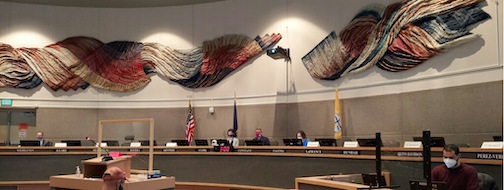
A hearing is set for Tuesday at the regular Assembly meeting that starts at 5 pm in the ground floor meeting room of the Loussac Library.

The draft ordinance mentions “density” as an aspiration 13 times in the first two pages, but a new version that will be considered at Tuesday’s Assembly meeting have substituted the word “density” with “simplifying.” The following is an example of the sneak changes under way:

The proposed changes did not come with the required Assembly Memorandum, which is meant to explain substantive changes to an ordinance or resolution. The proposed changed document is, in essence, incomplete.

The proposed ordinance will incentivize builders to maximize density on any vacant property.

The original AO is at this link.

The stealth-changed document is at this link.

Critics say that the AO 2023-66 has become a sneaky document, trying to fool residents into thinking that simplifying zoning is good government, when in fact the impacts on taxpayers is likely to be profound.

In addition, the Assembly is planning to pass the ordinance and say it is just to start the process and that the details will be ironed out in the future.

In other words, they plan to pass it so the public can then find out what is in it.

The way the ordinance is written, all the community councils are cut out of the process.

The delay in implementation also gives the Assembly the time to change other documents, such as the 2040 land use plan or the 2020 comprehensive plan, to make those legal documents more in line with the density ordinance that the Assembly is now pushing.

The meeting begins at 5 pm at the ground floor meeting room of the Loussac Library. The item is currently listed as 14D on the agenda, but the Assembly could change the order of business.

White Pass Railroad & union come to terms; ratification vote under way

A railroad strike in Alaska has been averted. White Pass & Yukon Route Railroad and the SMART Transportation Division union announced the successful negotiation of a tentative agreement for the more than two dozen railroad’s train and engine workers.

The agreement, which is set to extend through 2027, is undergoing a ratification vote by the unionized operating employees. Once the voting process is complete, the specifics of the agreement will be released publicly.

Mark Taylor, WP&YR Superintendent of Rail Operations, said, “Growing up in train and engine service, I have a deep respect for the craft and have worked hard over my tenure to help further that tradition on the railroad. With this agreement, we can now move forward together, continuing the WP&YR’s 125-year legacy.”

General Chairperson Jason Guiler, who led the labor union’s local negotiating team and represents the unionized operating employees working for WP&YR, commented, “The members I represent will carefully consider the provisions of this agreement. This long process has allowed us to express our concerns and urge the carrier to offer a contract that is fair and addresses workers’ needs.”

SMART-TD Vice President Brent Leonard, who was instrumental in facilitating the negotiations, said, “SMART-TD White Pass members, once again have something to be proud about in their jobs.”

WP&YR Executive Director Tyler Rose noted that the agreement reflects the respect, value, and appreciation both parties hold for the work performed by the employees.

“It has certainly been a challenging process, but we are happy that both parties have been able to come together and get this done in the best interest of our employees. It is a good agreement for both sides, and we believe it shows the respect, value, and appreciation we hold for the work our people do,” Rose said.

Earlier this summer, the workers had authorize a strike if the two sides could not reach an agreement. The railroad, which is one of the main tourist attractions in Skagway, could have ground to a halt near the end of tourist season if the tentative agreement had not ben reached.

Study: More people die from cold than from hot weather, by 20 to 1

According to a study conducted nearly a decade ago, cold weather is 20 times as deadly to humans as hot weather.

The study was published in 2015 in the British scientific journal The Lancet, which analyzed over 74 million deaths in 13 countries between 1985 and 2012.

Of those, 5.4 million deaths were related to cold, and only 311,000 were from heat.

The study also said that most of the heat- or cold-related deaths occurred on moderately hot and moderately cold days. It wasn’t the extreme temperatures that were doing the killing.

Although risk of dying due to extremely cold or hot days is actually higher, they are less frequent, said researcher Antonio Gasparrini of the London School of Hygiene & Tropical Medicine.

The study was launched after the European heatwave of 2003, when governments said about 70,000 premature deaths resulted in countries, particularly in France, and subsequent heat waves in other countries.

The period of extreme heat was at the time thought to be the warmest for up to 500 years, and many European countries experienced their highest temperatures.

The Focus on extreme weather (such as heatwaves) might ignore the incremental risk of moderately unusual temperatures, the journal reported. Both high and low temperatures have been reported to be associated with mortality and morbidity from causes such as cardiovascular disease and respiratory disease.

“Although deaths attributable to cold are substantially more common in most places than are those attributable to heat, they attract far less public attention,” the journal said.

Gasparrini and colleagues used a vast multi-country database to help them analyze attributable risk of ambient temperature for mortality. They collected data for daily mortality, temperature, and other confounding variables from 13 countries, which included more than 74 million deaths recorded in 384 locations across temperate and tropical climates (roughly a third of locations were in the USA).

“Overall, deaths attributable to extreme heat are roughly as frequent as those attributable to moderate heat, while those attributable to extreme cold are negligible compared with those caused by moderate cold,” the researchers observed.

Read the study at The Lancet at this link.

Photo credit: Rob Bussell

Anchorage Assembly public hearing Tuesday on ‘equity’ zoning, creating densely packed neighborhoods

The Anchorage Assembly has a public hearing scheduled for Tuesday, July 25, on an ordinance dismantling the current zoning structure in Anchorage.

The ordinance would create just two zones — housing and not housing. The change has been controversial, in no small part because it states that more tightly packed neighborhoods are better for everyone — and not everyone agrees with that.

Throughout the ordinance, it becomes clear that it’s a “Diversity, Equity, and Inclusion” initiative, and those “DEI” words are sprinkled throughout the “Whereas” clauses at the beginning of the 17-page ordinance.

The ordinance states that “increasing residential density can contribute to a more walkable and bikeable community, reducing dependence on private vehicles and promoting healthier lifestyles; and higher residential density can support the local economy by attracting businesses and services to areas with a larger population base.” 

It continues to state that “allowing more density in residential areas can create diverse and vibrant neighborhoods with a greater mix of housing types, promoting social  interaction and community cohesion; and increased residential density can support public transit systems by providing a larger customer base, making public transportation more economically viable and accessible.”

The ordinance also says that higher density will give people greater access to parks, schools, healthcare facilities, and shopping centers, “as these amenities can be located closer to where people live.”

There’s also the climate change argument in the ordinance, which says “accommodating increased residential density can help reduce the environmental impact associated with suburban sprawl, including carbon emissions from transportation and the loss of natural habitats.”

The ordinance also says “increasing residential density aligns with the goals of creating a more inclusive and equitable city by providing housing options for people of different income levels and lifestyles; and higher residential density can foster a sense of belonging and community pride, as residents have more opportunities to engage with their neighbors and participate in local activities.”

None of the statements are data-driven but appear to be aspirational by the authors of the ordinance and refer to social goals of the Assembly.

Some of the community councils have opposed the change. The Chugiak Eagle River Advisory Board, for instance, has voted unanimously against the resolution.

Assemblyman Kevin Cross and Assemblywoman Meg Zaletel are spearheading the effort to rewrite Title 21, the current zoning ordinance, which, if they succeed, is likely to result in multifamily units being built in single-family residential zones in every part of the city. A tall apartment building may be constructed right next to someone’s house, under this plan.

The full ordinance being considered is at this link.

The item is 14D on the agenda, and may come later in the meeting, or could be moved to a different part of the agenda, if the Assembly votes to change the order of business. Anchorage Assembly meetings start at 5 pm and are held at the ground floor meeting room of the Loussac Library, on the corner of 36th Avenue and Denali Street. Public members are given just two minutes to provide their testimony to the Assembly during meetings.