Sunday, August 16, 2026
Home Blog Page 542

2023’s official homelessness count for Alaska shows 49th state is not as bad as blue states

According to the U.S. Department of Housing and Urban Development’s annual count of homeless individuals, Alaska had 2,614 people experiencing homelessness in January of 2023. That amounts to one-third of one percent of all Alaskans. About 1,700 of the homeless are said to be in Anchorage, many having arrived from villages around Alaska to access homelessness services.

Alaska had the lowest rate of families experiencing homelessness, and one of the lowest rates for unaccompanied youth who were homeless. Only 119 veterans in Alaska were homeless, also a low number compared to the rest of the country.

Most of the homelessness in the country is found in Democrat-run states, such as California, Oregon, and New York.

Other facts from the annual HUD report to Congress on homelessness in America:

  • – More than half of all people experiencing homelessness in the country were in four states: California (28% of all people experiencing homelessness in the U.S, or 181,399 people); New York (16% or 103,200 people); Florida (5% or 30,756 people); and Washington (4% or 28,036 people).
  • – California accounted for 49 percent of all unsheltered people in the country (123,423 people). This is nearly eight times the number of unsheltered people in the state with the next highest number, Florida. In the 2023 point-in-time count, Florida reported 15,482 people or just six percent of the national total of people in unsheltered locations.
  • – States with very high rates of overall experiences of homelessness included New York, Vermont, Oregon, and California, with 52, 51, 48, and 46 people experiencing homelessness for every 10,000 people in the state. In the District of Columbia, a single city, 73 of every 10,000 people were experiencing homelessness.
  • – While Florida and Texas contributed large numbers of people experiencing homelessness to the national count, they continued to have rates of homelessness lower than the national average of 18 people per 10,000 (14 for every 10,000 people in Florida and 9 for every 10,000 people in Texas).
  • – States in the West reported some of the highest percentages of all people experiencing homelessness in who were counted in unsheltered locations. In California, 68 percent of people experiencing homelessness did so outdoors. Other states with more than half of their total population of people experiencing homelessness counted in unsheltered locations were: Oregon (65%), Hawaii (63%), Arizona (54%), Nevada (53%), Arkansas (51%), and Florida (50%).
  • – Two states sheltered at least 95 percent of people experiencing homelessness: Vermont (96%) and New York (95%).
  • – Continuing the upward trend over the past seven years, the total number of people experiencing unsheltered homelessness in 2023 has reached the highest count observed since reporting began in 2007.
  • – The total number of people experiencing sheltered homelessness in 2023 (396,494 people) is the highest observed estimate since 2014 (401,051 people).
  • – Between 2022 and 2023, the total number of people experiencing homelessness increased by 70,642 people (or 12%). The overall increase in the number of people experiencing homelessness between 2022 and 2023 reflects both a sharp increase in the number of people experiencing sheltered homelessness, which increased by 47,864 people (or 14%), and increases in the number of people experiencing unsheltered homelessness, which increased by 22,778 people (or 10%) over the last year.
  • – Nearly 4 of every 10 people experiencing homelessness identified as Black, African American, or African (37% or 243,624 people). A higher percentage of people in shelter identified as Black (45% or 176,325 people) compared to people experiencing homelessness in unsheltered locations (26% or 67,299).
  • – Half of all people experiencing homelessness identified as White (50% or 324,854 people). A higher share of the unsheltered population identified as White (57%) than the sheltered population (45%).

Anchorage Museum institutes race-based admission

Blacks, Samoans, Filipino, and even Choctaw Indians need to pull out their wallets to see the exhibits at the Anchorage Museum.

But Alaska Natives get free admission, because the museum says it is on Eklutna Dena’ina land.

“The Anchorage Museum sits on the traditional lands of the Eklutna Dena’ina. We offer free Admission to Alaska Native visitors,” the website says.

Its mission, it states, is “To be a museum for people, place, planet, and potential, in service of a sustainable and equitable North, with creativity and imagination for what is possible.”

The museum and its race-based fee structure is funded in part by taxpayers of the Municipality. The municipality owns the museum facility and collections. Funding also comes from grants, and a major endowment that includes funding from the Rasmuson Foundation, Alaska’s largest and decidedly liberal philanthropic entity.

In the new equitable world of woke, the race-based fee structure is institutionalizing racism in Alaska, critics say.

For those who are not Alaska Native, the general fee structure is $25 for adults, or $20 for Alaska residents, $18 for senior, military and students, $12 for youth, and under 5 gets in free.

There are other ways to get free admission to the Museum, most notably to have a card that shows you are receiving food assistance through the Supplemental Nutrition Assistance Program. Just whip out that EBT benefits card at the door. Also, your WIC card or Alaska Quest card will get you in the door. Also, first Fridays are free for everyone, regardless of their race, from 6 pm to 9 pm.

NRA’s LaPierre stepping down

Wayne LaPierre, the longtime chief executive officer of the National Rifle Association, has announced his resignation. His announcement came three days before the start of a civil trial against him brought by the attorney general of the state of New York.

“With pride in all that we have accomplished, I am announcing my resignation from the NRA,” LaPierre said in a statement. “I’ve been a card-carrying member of this organization for most of my adult life, and I will never stop supporting the NRA and its fight to defend Second Amendment freedom. My passion for our cause burns as deeply as ever.”

LaPierre, 74, cited health as his reason for retiring. His departure date is Jan. 31.

The late Congressman Don Young served on the board of the NRA. The only other Alaskan on the board is Wayne Anthony Ross.

LaPierre and three other current and former NRA leaders face a lawsuit by Attorney General Letitia James that claims they violated nonprofit laws and misused millions of dollars from the organization to underwrite trips and various luxuries. The civil trial begins Monday in Manhattan and has been scheduled for six weeks.

Former Valley legislative candidate sentenced in fatal road-rage shooting

Gavin Sullivan Christiansen, a 41-year-old resident of Palmer who ran for State Senate in 2020, received a sentence of 25 years to serve for a fatal shooting incident that took place in October 2020.

The sentence was handed down by Superior Court Judge Kari Kristiansen. Christiansen will serve on felony probation after his release.

The charges brought against Christiansen included second-degree murder, misconduct involving weapons in the first degree, and three counts of assault in the third degree. A Palmer jury convicted him of these charges in March, leading to his sentencing this week.

The incident in question occurred on Oct. 11, 2020, when Christiansen contacted 911 to report a hit-and-run incident involving his vehicle near Mile 37 of Wasilla-Fishhook Road in Willow. However, the subsequent investigation revealed a much darker turn of events.

According to the investigation, Christiansen had been outside of his vehicle when his car was struck in the hit-and-run. Rather than simply reporting the incident and awaiting authorities, Christiansen allegedly fired approximately 15 shots at the departing vehicle before deciding to pursue it. The vehicle was being driven by 35-year-old Devin Moorhouse.

The pursuit continued for approximately five miles before Moorhouse lost control of his vehicle and ended up in a ditch, stranding him and his juvenile passenger. During this time, Christiansen made a declaration while on the phone with Matanuska-Susitna dispatch, stating, “I am about to shoot somebody.” He proceeded to fire several shots into Moorhouse’s vehicle, ultimately killing Moorhouse. Fortunately, the juvenile passenger emerged uninjured.

Christiansen claimed that Moorhouse had pointed a firearm at him as he approached the stranded vehicle. However, the subsequent investigation revealed that Moorhouse’s gun was not loaded, casting doubt on the self-defense argument put forth by Christiansen’s defense.

During the court proceedings in March, Palmer Assistant District Attorney Kerry Corliss emphasized that while Alaska does have a “stand your ground” self-defense law, it does not condone pursuing individuals.

Corliss argued that Christiansen had actively pursued Moorhouse for miles after firing at him, making it difficult to justify self-defense in this case. Corliss asserted that Moorhouse had the right to employ self-defense as he had clearly tried to disengage from the conflict by fleeing twice.

Tshibaka cleared: All allegations dismissed by APOC

The ongoing legal harassment of former U.S. Senate candidate Kelly Tshibaka by attorney Scott Kendall and the dark-money group Alaskans for Better Elections went against Kendall and ABE this week.

The Alaska Public Offices Commission ruled in favor of Tshibaka, after Alaskans for Better Elections filed specious claims against her and the group she formed to fight ranked-choice voting, Preserve Democracy, earlier this year.

The staff of the commission had recommended a fine of more than $23,000, because Tshibaka had stated that elections should be “easy to understand and accessible to everyone.” 

Kendall and Alaskans for Better Elections (the group that brought ranked-choice voting to Alaska) said her speech was governed by APOC regulations she had violated.

Tshibaka appealed the staff recommendation to the commission itself, arguing that she has the constitutional right to say that she opposes ranked choice voting and she spoke against the system during events not within the jurisdiction of Alaska Public Offices Commission.

Tshibaka also pointed out that APOC’s attorneys argued in favor of her same position before the Alaska Supreme Court last fall, saying that it only has the right to regulate expenditures that exhort Alaskans to vote for or against ballot measures.

Since the Preserve Democracy website said nothing to Alaskans about how to vote and there is no matter pending on a ballot about ranked-choice voting, Tshibaka argued APOC trying to regulate her speech was a violation of her First Amendment constitutional rights. 

The commissioners agreed with Tshibaka and completely dismissed Kendall and Alaskans for Better Elections’ frivolous allegations. The commission also found no evidence Tshibaka ever operated as a lobbyist, another claim made by Kendall. The commission further determined that Tshibaka and Preserve Democracy ran a non-partisan get-out-the-vote campaign that did not trigger APOC reporting requirements.

“Today is a victory for the Constitution,” Tshibaka said in a statement. “It is the responsibility of the American People to protect Free Speech from being trampled by government. In this case, APOC’s staff were spurred along by Ranked-Choice Voting advocates to trample on the Free Speech protections of the Constitution. But Preserve Democracy and I took a stand for Free Speech by challenging this government overreach. Fortunately, the APOC Commissioners saw through ABE’s disinformation, unconstitutional attacks, and frivolous allegations to discern the truth and protect all of our constitutional rights.”

Tshibaka, a Republican, ran against Sen. Lisa Murkowski in 2022. With the open primary and ranked-choice voting system enacted by voters at the behest of Alaskans for Better Elections, Murkowski was able to avoid and ignore Republican voters in the primary, winning her chance to advance to the general election ballot by depending on loyal Democrats. Kendall, a political operative who is also an activist lawyer, is a longtime supporter of Murkowski.

After the election, Tshibaka launched Preserve Democracy, a platform she uses to educate Americans in Alaska and other states about the realities of ranked-choice voting and how it is being used by Democrats to give their candidates an advantage. More about Preserve Democracy at this link.

David Boyle: Anchorage School District looks to the Legislature to backfill its budget hole

By DAVID BOYLE

The Anchorage School District has issued a proforma budget for its fiscal year 2025 (school year 2024-2025) to get out of its self-inflicted financial mess.

The proforma budget is for planning purposes, makes assumptions, and serves as a starting point for expected revenues and expenses while providing the same level of services.

The school district’s revenue is based primarily on the number of students counted during a three-week period in October. 

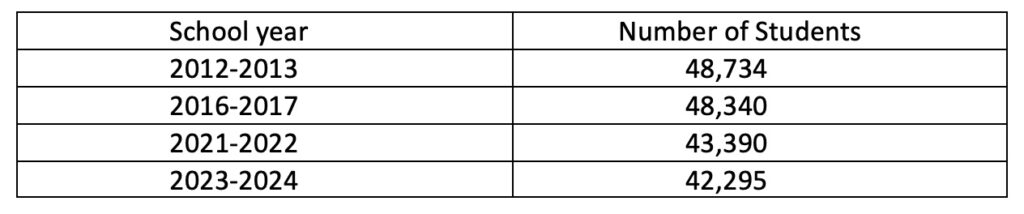
Here is a chart showing the decrease in the number of students in ASD over the past decade:

The trend line is not positive for the school district, with more than a 13% drop in enrollment — and it projects to lose even more students by 2027.

The student count is not yet available on the State’s website even though all districts were required to provide that data to the Department of Education & Early Development by Nov. 10. 

But the preliminary data for the current school year shows the Anchorage School District lost about 1,279 students—582 regular students and 697 correspondence students, year over year.

Of these correspondence students, approximately 600 were from the Family Partnership Charter School. Parents removed their children from that charter school when the district decided to remove its charter and turn it into a correspondence school.

The Anchorage School District also gained an additional 45 intensive needs students—providing an added $77,480 for each of the students to the district for a total of $3,486,600.  

In its proforma budget, the district projects losing an additional 129 students in the next school year, 2024-2025.

Each student has a dollar figure associated with his or her enrollment.  Some dollars are smaller, some are larger.  An intensive needs student has the largest funding — at 13 times the regular student.  A correspondence student is the smallest of all, at 90% of a regular student.

And the actual number of students is multiplied as it goes through something called the Foundation Funding Formula.

Here is a link to how the actual number of 43,978 Anchorage students grows to an astounding 73,124 students:

The school district’s solution to a declining student population is to increase the per student revenue. The district proposes to tell the Legislature to increase the Base Student Allocation by a whopping $1,413 per student.  It further wants the Legislature to increase transportation revenue by $209 per student. 

It seems the district is unable to think about how to live within its budget with fewer students.

That won’t stop the school board from moving ahead on its “we need more money” solution.  

The school board has formalized its effort to get more money in a resolution it will ask the Anchorage Assembly to sign off on.

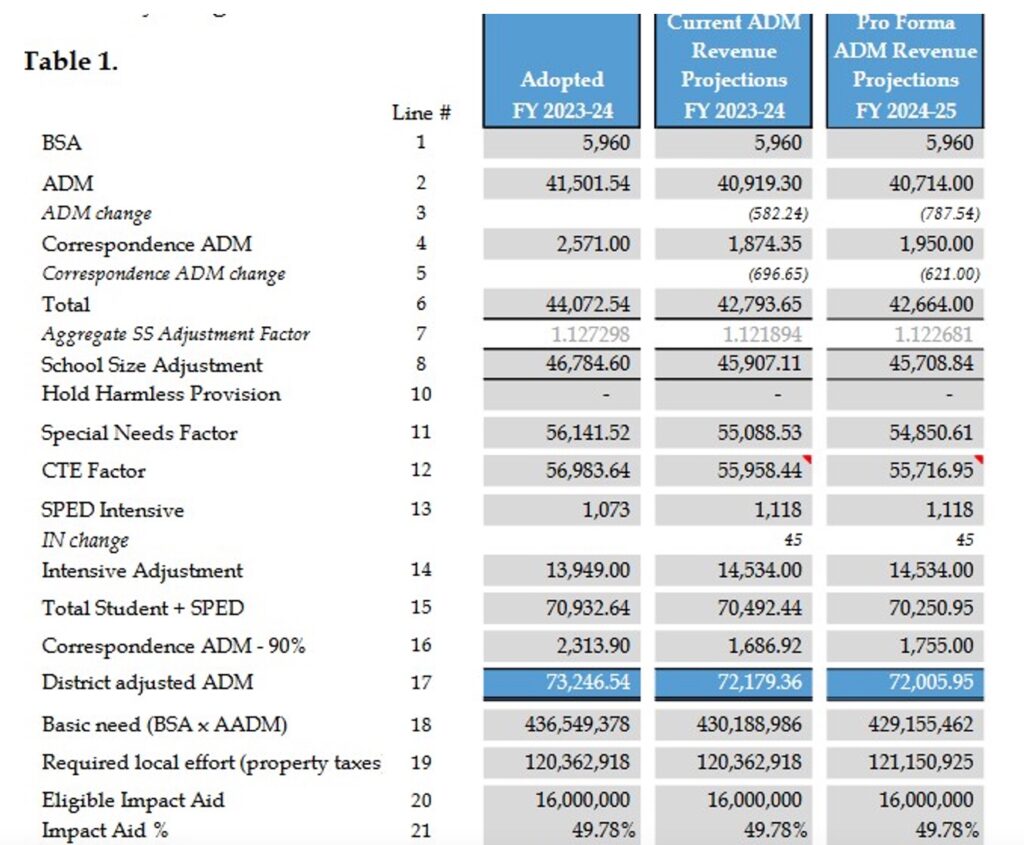
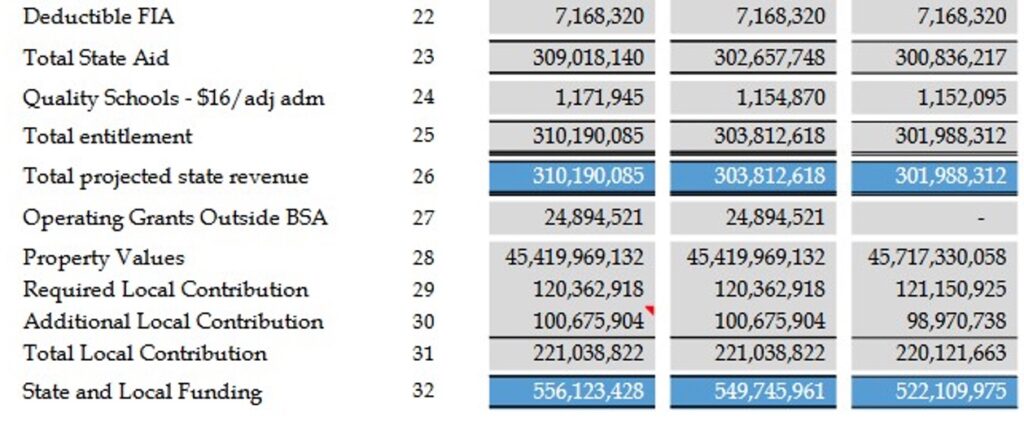
Here is a table provided by the district that shows the current year’s revenue and proforma revenue for fiscal year 2025 (next school year).  It’s a bit complicated but focus on the blue highlighted entries.  The ADM (Line 2) is Average Daily Attendance which is the student count:

Line 23 (second slide) shows a decrease of $8,201,773 in state funding due to the lower enrollment numbers.

The bottom line: The school district gets less state money because it has fewer students.   

There are two major ways to fill a budget hole.  One is to decrease the current expenses and the other is to increase revenue by asking the Legislature for more money for fewer students.

According to the district, the 2024-2025 budget hole is $98 million.

The district stated it could use its vast amount of unreserved funds, the ASD piggy bank for “rainy days.”  If the unreserved funds were reduced to the state required minimum of 5%, the district would free up nearly $71 million to fill the budget hole. That would certainly be a step in the right direction.  

There was the normal pandering by board members talking about school sports activities and decreasing them to save money. This is always a popular tactic to get the parents out in droves to demand more money from the Legislature.  

The district could save at least $30 million by not building a new Inlet View Elementary School.  Already once disapproved by the voters, the school board plans to hit voters up again in the next election to approve the rebuild.   

The school board hopes to persuade voters to vote for this rebuild by tying the rebuild to vital security upgrades at several schools.

It is unfortunate that the board has jeopardized student safety with a wasteful rebuild of Inlet View Elementary School.

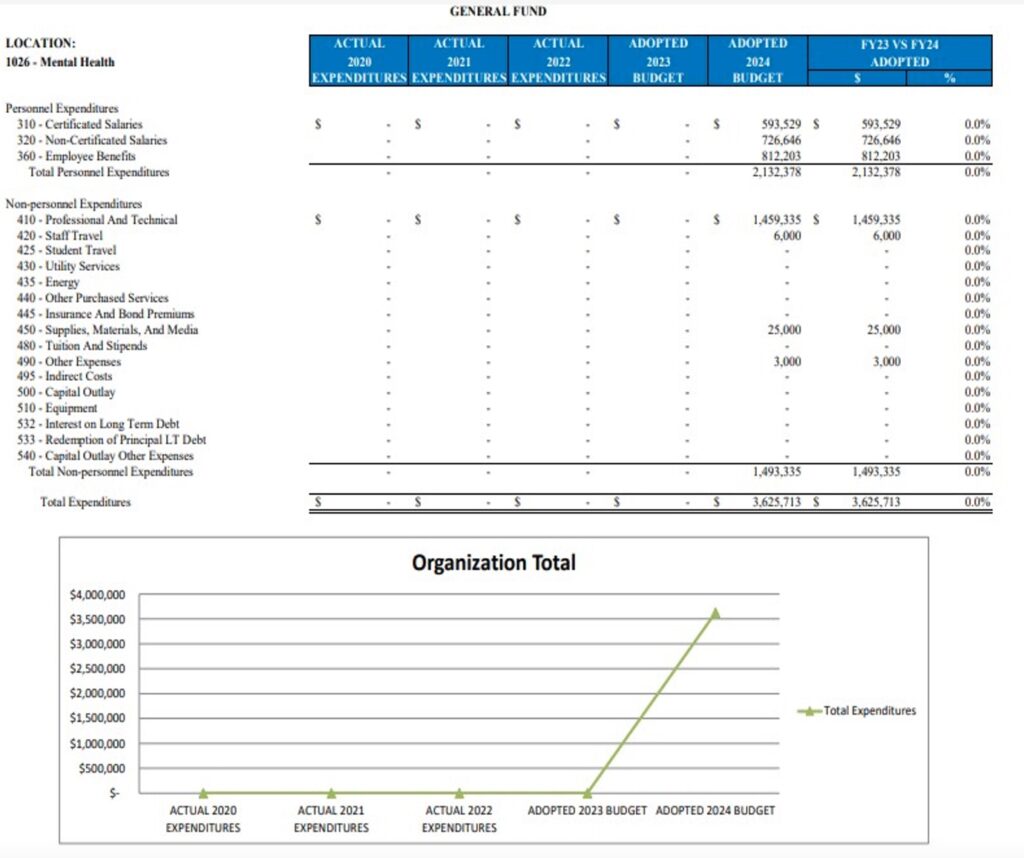
The district could also reduce its expenses by eliminating the Mental Health Office.  The district has 18 Full Time Equivalent positions (personnel) in the new mental health area.

The district caused serious mental health problems for students by its mandated masking, social distancing, and school closures.  So, now the district that caused students’ mental health issues wants to solve the problem it caused.

This is not a function of a K-12 public school system. By deleting this function, the district would save $3,625,335, as shown in this chart from the ASD 2023-2024 budget book, which is no longer available on the district web page:

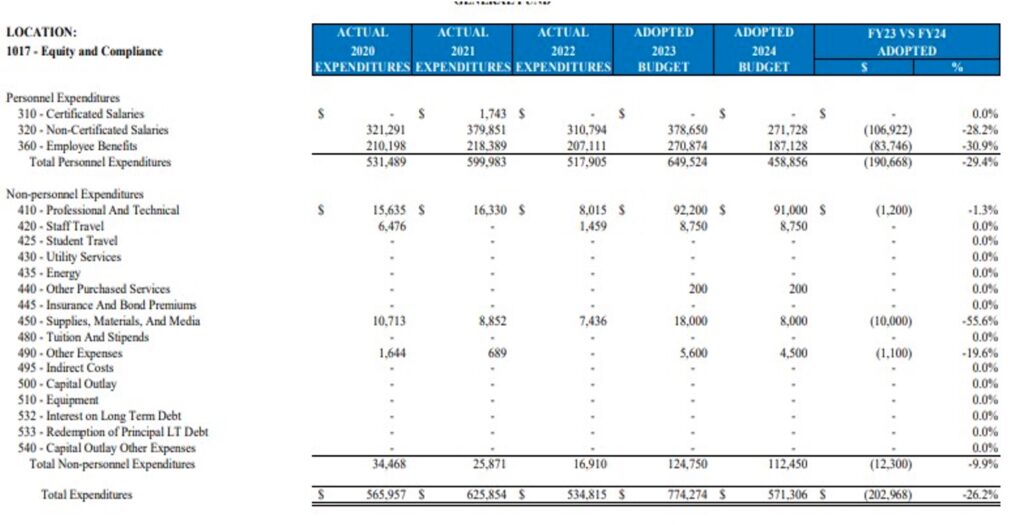
Another function that should be done away with is the Office of Equity and Compliance. Deleting this office would save $571,306 for the district. Here is a chart from the ASD 2023-24 budget book showing the cost of this function:

This is just a quick look at some of the areas where the district can trim down its budget without impacting the classroom.

Surely, there are more seat cushions to look under for unnecessary money to include the consolidation and closing of several elementary schools. 

We elect school board members to lead and make the hard decisions even if they are not popular.

Alaskans are tightening their belts and managing the inflation effects on the basics of energy, housing, and food.  

Thanks to the Legislature, Alaskans have also contributed a majority of their statutory Permanent Fund dividends to fund the State.

It’s past time for board members to lead and ensure all our kids get the best education possible by focusing on the core mission of K-12 education. 

As Thomas Paine said, “Lead, follow, or get out of the way.”

David Boyle is an education writer for Must Read Alaska.

Biden asks high court to allow Border Patrol to cut Texas’ razor wire installed on border by state’s Operation Lone Star

By BETHANY BLANKLEY

The Biden administration appealed to the U.S. Supreme Court to intervene in one of its border lawsuits with Texas, one of several expected to eventually be ruled on by the nation’s highest court.

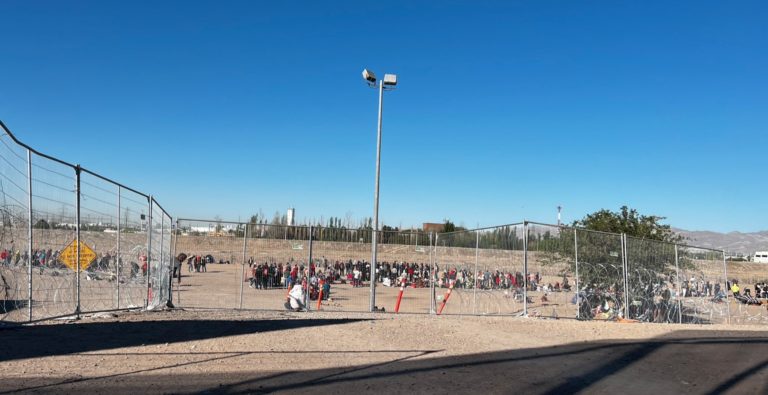
At issue is a lawsuit Texas filed against the Biden administration after Border Patrol agents destroyed concertina wire barriers erected on Texas soil by officials working through Gov. Greg Abbott’s border security mission, Operation Lone Star. As the case progresses before a federal district court, the Fifth Circuit last month handed Texas a win, issuing an administrative stay preventing the federal government from cutting, removing or destroying the wire, with few exceptions.

A separate federal lawsuit challenging Texas’ marine barriers is currently before the Fifth Circuit. In a third lawsuit, an Eagle Pass kayaking company sued over the marine barriers in a broader attempt to end OLS.

Because the federal government has abdicated its responsibility to secure the border and prevent illegal entry, Abbott maintains, he implemented OLS and several border security measures including erecting a range of barriers along the Rio Grande River. In response to some of the OLS efforts, the Biden administration ordered the destruction of the concertina barriers and sued over the marine barriers.

In a case that went through multiple rulings, the Fifth Circuit last month ultimately issued an injunction barring Border Patrol agents from cutting, removing or destroying the concertina barriers, with exceptions, in an area near Eagle Pass, Texas. After the ruling, Abbott said Texas will continue to hold accountable the Biden administration “for attacking Texas’ sovereign authority and their attempts to obstruct our border security efforts.”

On Tuesday, U.S. Solicitor General Elizabeth Prelogar, representing the federal government, asked the justices to intervene. According to court documents, she said the Fifth Circuit ruling has “serious on-the-ground consequences” because it prevents Border Patrol agents from apprehending foreign nationals after they crossed the Rio Grande River to illegally enter Texas between ports of entry. She said the Fifth Circuit’s ruling was “manifestly wrong” because it “prohibits Border Patrol agents from cutting or moving Texas’s wire barriers that physically block agents from accessing the international border and reaching migrants who have already entered U.S. territory.”

There are 29 ports of entry where foreign nationals can attempt to legally enter Texas, Abbott argues, more than any other state in the U.S. Border Patrol agents are also stationed along 1,250 miles of Texas’ shared border with Mexico.

If the Fifth Circuit’s injunction is allowed to stand, Prelogar argued, it would “leave the United States at the mercy of States that could seek to force the federal government to conform the implementation of federal immigration law to varying state-law regimes.”

Abbott maintains that the federal government isn’t enforcing federal immigration laws, necessitating the need for OLS. From April 2021 to December 2023, Texas officers under OLS have apprehended more than 491,100 illegal foreign nationals and made more than 37,800 criminal arrests, with more than 34,300 felony charges. They’ve also seized more than 450 million lethal doses of fentanyl, enough to kill more than everyone in the U.S. and Canada.

“Every individual who is apprehended or arrested and every ounce of drugs seized would have otherwise made their way into communities across Texas and the nation due to President Joe Biden’s open border policies,” Abbot argues. The Texas Legislature has expressed support for Abbott’s efforts, having allocated over $11.5 billion to border security efforts for a four-year period.

On Wednesday, Abbott responded to a video posted by U.S. Rep. Matt Gaetz, R-Florida, showing Border Patrol agents cutting concertina wire. He said, if this video was taken on Jan. 3, “it means that the Biden Admin. is in direct violation of a current court order by the 5th circuit court of appeals prohibiting the border patrol from cutting the razor wire erected by Texas. If true, we will seek contempt of court.”

The high court on Wednesday gave Texas a deadline of Jan. 9 to respond to the administration’s application.

Justice Samuel Alito, the circuit justice for the Fifth Circuit, will first review the case.

Grand juries, a constitutional safeguard against public corruption

By JON FAULKNER

Last April, a Kenai Grand Jury indicted Judge Margaret Murphy on felony perjury charges. Few Alaskan know the status of the indictment, how it came to pass, and how a handful of concerned citizens are trying to educate Alaskans on the purpose and powers vested in grand juries by our Constitution. (See Past coverage at: www.alaskastateofcorruption.com)

David Haeg believes that the powers vested in the people to petition grand juries for the purpose of investigating misconduct by public officials is inviolable, and yet has been systematically dismantled by single vote margins and unconstitutional actions by our Supreme Court.  

His documentation of historic actions by our Supreme Court has drawn the attention of Alaskans and generated protests and sit-ins that have altered the legal landscape. He regards the indictment against Judge Murphy as a siren call:  “I’m hoping Alaskans will rise up in defense of their rights, and not become victims of this massive, ever-increasing consolidation of power in the hands of an elitist, unelected few,” he stated. 

The legal foundation for Judge Murphy’s citizen indictment is Article 1, Section 8, of our Constitution, which states, “The power of grand juries to investigate and make recommendations concerning the public welfare or safety shall never be suspended.”  Other than the right to bear arms, Haeg regards this right of citizens to legally investigate government corruption as the most protective of our democracy and freedoms.

Not a single Constitutional Convention delegate opposed the concept of grand juries. In fact, they unanimously agreed that grand juries secure other essential freedoms, including the power to investigate the government itself, free from the threat of retribution. Delegates opening acknowledged that “The power of grand juries to inquire into the willful misconduct in office of public officers, and to find indictments in connection therewith, shall never be suspended.” (Alaska Constitutional Convention, December 15, 1955.) 

Records of delegate deliberations support Haeg’s view that Grand Juries were conceived and authorized  to investigate public officials: “The grand jury is preserved, for all purposes, particularly for investigation of public officials.” (Alaska Constitutional Convention Commentary on the Preamble and the Declaration of Rights, December 15, 1955). Notably, this authorization stressed a citizen’s right to direct appeal. Delegates stated: “The grand jury can be appealed to directly, which is an invaluable right to the citizen.” (Alaska Constitutional Convention transcript page 1328.) 

Ed Martin, a lifetime Alaskan and activist on this topic, posed this question: “What is unclear about this? The arrogance of our Supreme Court is beyond the pale. How could anyone sensitive to the intent of our framers interpret this as anything but an unconditional right of direct appeal by its citizens? A right, mind you, stripped away from Alaskans by the very branch of government from whom our citizens are seeking justice and protection of our liberties.”   

Haeg’s chronology of events after statehood paints a picture of slow but steady erosion of this Constitutional right. In 1959,  the newly formed Supreme Court distributed its first “Alaska Grand Jury Handbook” and under the title “Importance of the Grand Jury”, the handbook stated, in part: 

“In time of peace no citizen can perform a higher duty than that of Grand Jury service… No body of citizens exercises public functions more vital to the administration of law and order. Thus, the citizens themselves, by this representative body of Grand Jurors, hold in their own hand the control of the maintenance of law and order throughout the state, through prosecution for crime. The importance of this power cannot be overestimated.” (Alaska Grand Jury Handbook, pages 3 and 5).

This same handbook re-affirms the right of citizens to appeal directly to the grand jury:

“A citizen is at liberty to apply to the Grand Jury for permission to appear before it in order to suggest or urge that a certain situation should be investigated by it… Charges of crime may be brought to your attention in several ways: …(4) by private citizens heard by the Grand Jury in formal session, with the Grand Jury’s consent.” The handbook also acknowledges how a grand jury has the “important duty of making investigations on its own initiative…” to “investigate how officials are conducting their public trust.” (Alaska Grand Jury Handbook pages 5, 6, and 7). This language stands in stark contrast to today’s revised, far more convoluted procedural handbook.    

In 1962, Alaska’s Legislature passed AS 12.40.030 and AS 12.40.040complimentary statutes that reinforced a Grand Jury’s duty to investigate and disclose knowledge of certain crimes and present them to the court. They also authorized broad powers to investigate and make recommendations concerning the public welfare or safety. Language exists which limits Grand Jury powers to “…all crimes committed or triable within the jurisdiction of the court…” However, the Constitution delegates broad powers to the judicial branch to implement the administration of justice through the courts, and herein lies the thrust of the issue.   

Haeg notes that between Statehood and 1985, grand jury investigations and recommendations were common and include a range of alleged corruption by judges, district attorneys, and law enforcement officials.  In 1985, a grand jury recommended that Alaska’s legislature impeach Gov. Bill Sheffield for steering a $10,000,000 state lease to a campaign contributor. In reaction to this perceived incursion into their judicial prerogative, a divided Alaska Supreme Court issued Criminal Rule 6.1, which suspended certain grand jury rights to investigate and make recommendations. Two of five justices, Burke and Compton, declared Rule 6.1 to be unconstitutional because it violated the plain wording of Article 1, Section 8 of Alaska’s Constitution, cited above.

Thus, a single vote decided the issue for Alaskans—by a court sitting in judgment about what limits exist to citizen grand juries. 

Once again, in 1991, an important case (O’Leary v. Superior Court) upheld the constitutionality of Rule 6.1 by a single Justice. In their dissent, Justices Burke and Compton wrote: “This procedural rule is not the least bit deferential to the “anti-suspension” clause. Indeed, it mocks it. The Grand Jury, and not the courts, can choose matters on which it reports and recommends, and the manner in which to do so. Its constitutional power shall never be suspended by the overlay of cumbersome procedures which provide for private judicial adjudications and review of whether the report it is to publish adversely reflects on someone, or otherwise violates his or her constitutional rights.” 

Not surprisingly, after 1991 grand jury investigations and recommendations stop according to Haeg and then in 2004 evidence emerges indicating systemic corruption within Alaska’s Legislature and judicial system. In 2006, FBI-led raids of Legislative offices resulted in several criminal prosecutions. That same year, FBI section Chief Colton Seale reportedly told Haeg that he personally fielded many complaints nearly identical to Haeg’s [systemic judicial corruption in Alaska] and in many cases his investigations expanded rapidly and implicated high-level officials. But in each case, a call came from Washington, D.C. telling Seale to pull the plug on his investigations. 

According to Haeg, in 2017 a group of Alaskans became energized by the fact that our Constitution empowers its citizens to investigate government corruption which certain officials may not want to be investigated. That same year, Haeg’s group asserts that the Alaska Supreme Court bypassed established protocols and rewrote the Alaska Grand Jury Handbook yet again. At that time, according to Haeg, they eliminated all references to a citizen’s right of direct appeal to a grand jury, as well as all references to the grand jury’s right to decide, without undue restraint, what to investigate.

This action by the Supreme Court outraged Haeg’s group and in 2018 they assembled a petition of roughly 500 Alaskan signatures asking government officials to deliver their petition to a grand jury, which was refused. According to Haeg, Deputy Attorney General John Skidmore and others directed a total of six different grand juries to cease investigating evidence of judicial corruption even after the Grand Juries initiated actions of their own to investigate. 

By April 2022, organized protests were occurring across Alaska and in June Superior Court Judge Jennifer Wells permanently disbanded a Kenai Grand Jury after it decided, by majority vote, to investigate evidence of judicial corruption and cover up. One day later, activists organize a state-wide courthouse sit-in and on July 4, 2022, filed felony complaints of “Interference with Official Proceedings” (see AS 11.56.510) and “Jury Tampering” (see AS 11.56.590) against Judge Wells.  Protesters organized a citizen’s arrest of Judge Wells and Deputy Attorney General John Skidmore for those same charges, prompting Judge Wells to announce her retirement. 

In July of 2022 a new Kenai grand jury was convened to investigate evidence of judicial corruption, possibly aided by a more sympathetic office under Attorney General, Treg Taylor.  On Aug. 2, 2022 the jurors were advised of their right to independent counsel. Predictably, a showdown ensued. In December 2022, immediately after the grand jury subpoenaed several judges and judicial investigator Marla Greenstein, the Alaska Supreme Court issued Supreme Court Order 1993, a rule change that, according to Haeg, stripped the grand jury of constitutional powers to investigate, make recommendations, and indict government officials such as investigator Greenstein. (See SCO 1993 at alaskastateofcorruption.com).

Haeg’s group regards these actions as self-serving and without constitutional foundation, and argues that Greenstein’s 35-year reign as Alaska’s sole investigator of judicial misconduct is evidence of a too-cozy relationship.   

Tensions increased when, on Dec. 15, 2022, Haeg’s group uncovered an internal Alaska Supreme Court “Memorandum” indicating the Supreme Court bypassed the required oversight of their own 13-member Rules Committee when creating SCO 1993 – ostensibly to avoid interference with their goal to tighten control over grand jury rights. (See SCO 1993 History at alaskastateofcorruption.com) 

Members of the Rules Committee reportedly entered protest of the Court’s action, stating that “…the rule changes were important and serious changes of a constitutional nature and should not be rushed through”). According to Haeg’s timeline, the Rules Committee was denied a hearing.  (See SCO 1993 History at alaskastateofcorruption.com).  

Immediately following this action, citizens gathered petition signatures calling upon Alaska’s Legislature to impeach all five justices for committing unconstitutional acts. Several weeks later, on February 6, 2023, the Alaska Supreme Court rescinded portions of its own order (SCO 1993) which prohibited Grand Juries from indicting, but also retained portions barring citizens from appealing directly to the Grand Jury.  The revisions also retained key provisions granting government officials the power to dictate to the Grand Jury what they can investigate, who they can subpoena in pursuit of that investigation, and what the Jury can actually say in their final recommendations. (See SCO 2000).

In April 2023, the Kenai Grand Jury indicted Judge Margaret Murphy on felony perjury charges and in August Haeg’s group learned that the Kenai Grand Jury proceedings were ongoing but frustrated by procedural efforts to quash certain findings and recommendations. Proceedings are not public, but according to Haeg, Judge Murphy’s prosecution for felony perjury continues on January 8, 2024, at 10 am, room 401 of the Anchorage Nesbett Courthouse.   The oral arguments will also be live-streamed on https://courts.alaska.gov/. (For background, see indictment, case 3HO-23-00295CR on Alaska CourtView, and TV/news stories at alaskastateofcorruption.com)

How did all this get so bad and go on unaddressed for so long? Haeg answers this by offering his followers a glimpse of history (in this case from New York City) which—if ignored, he fears will be repeated here in Alaska. 

New York City’s 1994 Mollen Commission Report

”To cover up their corruption, officers created even more: they falsified official reports and perjured themselves to conceal their misdeeds. In the face of this problem, the Department allowed its systems for fighting corruption virtually to collapse. It had become more concerned about the bad publicity that corruption disclosures generate than the devastating consequences of corruption itself. As a result, its corruption controls minimized, ignored and at times concealed corruption rather than rooting it out. Such an institutional reluctance to uncover corruption is not surprising. No institution wants its reputation tainted – especially an Department that needs the public’s confidence and partnership to be effective. Since no entity outside the Department was responsible for reviewing the Department’s success in policing itself, years of self-protection continued unabated until this Commission commenced its independent inquiries.”

Interested readers can also contact the Alaska Grand Jurors Association at PO Box 123, Soldotna, Alaska 99669

alaskagrandjurorsassociation.org and alaskastateofcorruption.com

A Petition seeking investigation into the Alaska Supreme Court’s actions is at this link.

Jon Faulkner is the president of Alaska Gold Communications Inc., which publishes Must Read Alaska.

Soldotna’s Saturday drag queen story hour for children has been postponed

There won’t be a drag queen story hour at the Soldotna Public Library on Saturday, after all.

The Soldotna Pride group scheduled a number of “Happy New Queer” events to start the new year, including karaoke and adult trivia nights at various venues on the Kenai Peninsula. But the using of public library facilities to promote drag queens to children was postponed because of public outcry against the using of taxpayer facilities to groom children into alternative sexualized lifestyles.

“The Soldotna Pride Council strives to provide safe spaces for all people, including members of the LGBTQIA+ community. Freedom to assemble and express one’s self is guaranteed by the First Amendment, thus, everyone should feel safe, secure and comfortable being their authentic selves and not live in fear of attending a public event in our community. It is with a heavy heart that we have decided to postpone the Jan. 6 story time in the Community Room at the Soldotna Public Library. We believe in the freedom of expression, however, we are aware of the violent rhetoric on social media and elsewhere toward readers and participants who plan to attend story hour, and we are choosing to prioritize the safety of those children and families,” the group wrote on Facebook.

“We would like to thank Chief Meek, the City of Soldotna, the library staff, the volunteer readers and The Queen’s Guard for their support. We apologize to the families who planned to attend and assure you that we will hold inclusive story times in the future. The Happy New Queer trivia and karaoke events will continue as planned on Jan. 6,” the group said.

The group also laundered the graphic advertising the event and removed the name of drag performer “Ivanna Kischakok.”

Some of the group’s supporters on Facebook were dismayed and said they had looked forward to taking their children to the event.

But the drag group reiterated that this is merely a postponement and indicated it would be back on the Kenai at a future time.