Senate Bill 140, a bill that has various funding components for Alaska school districts, is on the calendar for the Alaska House on Monday when the House gavels in at 11 am.
It started out last year as a bill sponsored by Sen. Lyman Hoffman to bring more broadband to rural Alaska districts through a grant program that had matching state and federal monies. It would benefit not only rural villages but Quintillion, the company bringing fiber optic cable connectivity to much of the Arctic, even though Starlink would be vastly cheaper.
Through time, the bill has been added to and debated, and now contains pay incentives for teachers, and an addition to the base student allocation, sometimes called the BSA. The BSA is the permanent funding formula that is calculated on a per-student basis.
Also in the bill is an increase in correspondence school funding and the governor’s plan to pay teacher bonuses that would be between $5,000 to $15,000, something that is outside the BSA.
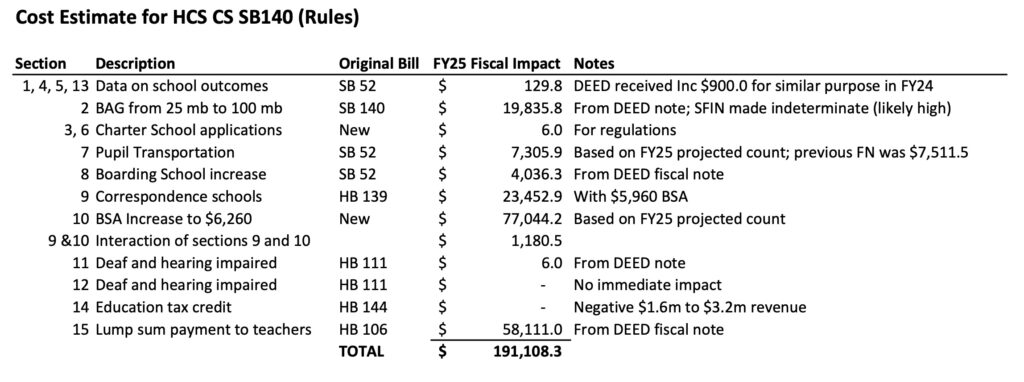
The amount that the BSA would be increased could be $300 per student, or could be over $1,400 per student, but it looks like most in the House will settle in the $600 range. More changes to the bill are expected on the House floor, as several dozen amendments are predicted to be in the works. The total cost of SB 140 could be substantial, as this fiscal summary from January shows (in thousands):
State education officials, teachers’ unions, and Democrat lawmakers are arguing for a $1,413 BSA and they are expected to put up a fight for more money. The bill will have to go back to the Senate if it passes the House, due to the many changes, and the Senate is likely to have its own ideas; these differences are typically sorted out in a conference committee between the two sides to reach a compromise.
The House Select Subcommittee on the Coronavirus Pandemic reopened debate last week over what constitutes “misinformation” regarding the Covid-19 virus and vaccines. The hearings were titled, “Assessing America’s Vaccine Safety Systems, Part 1.”
Chairman Brad Wenstrup, an Ohio Republican, detailed shortcomings in vaccine safety reporting and vaccine injury compensation systems, which have led to confusion about the efficacy of vaccinations. Wenstrup, who is a doctor, noted the dismissive answers from the federal government, and claims from the government that anyone not satisfied with official answers was pedaling “misinformation.”
The complex and convoluted system of overlapping injury reporting systems, such as VAERS — the Vaccine Adverse Effects Reporting System — was not structured to handle the massive influx of injury claims caused by the Covid-19 vaccine, he said. Only 11 injury claims out of the more than 12,000 claims that have been filed in the Countermeasures Injury Compensation Program have been compensated.
Rep. Marjorie Taylor Greene, a Republican member of the committee, said, “I’m not a doctor, but I have a PhD in recognizing bullshit. There have been over 1 million VAERS reports for vaccine injuries and deaths caused by the experimental COVID vaccines. As of Jan 1, 2024, only 11 victims have been compensated.”
She said that it was known early on that children were of almost no risk, and neither were healthy young people. Covid mainly was a danger to obese, elderly and health compromised, she said. And yet even Dr. Peter Marks, the lead witness in the hearing, had been recommending the vaccine for babies as young as six months, something she called “shameful.”
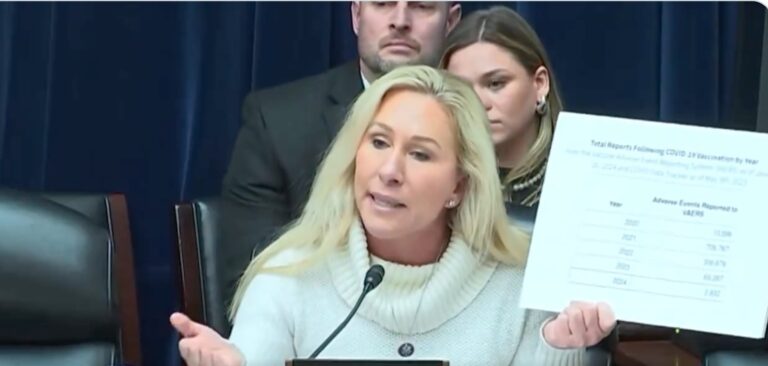
“Some people are trying to belittle these reports, but these reports come from people — people that died, people that got injured,” said Greene. “In 2021, there were 706,767 reports on VAERS for vaccine injuries and deaths. In 2022 it was 206,676 … it was going down because the [vaccine] mandates stopped.”
I’m not a doctor, but I have a PhD in recognizing bullshit.
There have been over 1 million VAERS reports for vaccine injuries and deaths caused by the experimental COVID vaccines.
As of Jan 1, 2024, only 11 victims have been compensated.
Dr. Marks, the director of the Food and Drug Administration’s Center for Biologics Evaluation and Research, tried to defend the federal government’s response.
When asked by the committee if the Food and Drug Administration is able to process the number of VAERS reports that have been submitted on the Covid vaccines, Marks said, “the avalanche of reports was tremendous, and required re-tasking people on the fly. We had to usually staff up and had many meetings working to increase our ability to go through these reports. What the public sees on the VAERS page is a small fraction of the information we sift through.”
Wenstrup noted that “VAERS has been the source of attention and controversy since the beginning of the Covid-19 vaccine rollout. However, concerns about these data are usually met with dismissive replies. They often point to the fact that VAERS is ‘unable to prove causality’ and contains reports of ‘people being hit by a car after vaccination.’ They say that VAERS is being misused by anti-vaccine advocates and that it is ‘misinformation.'”
He said that many legitimate questions have been raised by Americans and the federal government’s answers were contradictory.
“During her testimony before this committee last June, Director [Rochelle] Walensky assured us that CDC had ‘a responsibility to comb through every single [report to VAERS].’ People who have submitted reports to VAERS have told my staff they were never contacted by CDC or FDA officials. A recent British Medical Journal investigation found this too,” Wenstrup said.
Rep. Deborah Ross, a Democrat from North Carolina, disputed the criticisms of VAERS: “In listening to today’s hearing, one might be led to believe that reports submitted to VAERS are the most meaningful measure of adverse health events and should be the sole basis for evaluating whether the Covid vaccines are safe. However, my understanding is that VAERS is just one surveillance program within a multilayered vaccine system that CDC operates, and that submissions to VAERS, which are unverified, can be submitted by anyone, regardless of how likely a vaccine is to have created an adverse event, and can act as early warnings to prompt deeper investigations through these other surveillance programs.”
Recent analysis of the VAERS database on mortality from Covid-19 vaccines shows a spike in adverse effects and deaths, but the government appears to now be dismissing the accuracy of the entire VAERS database.
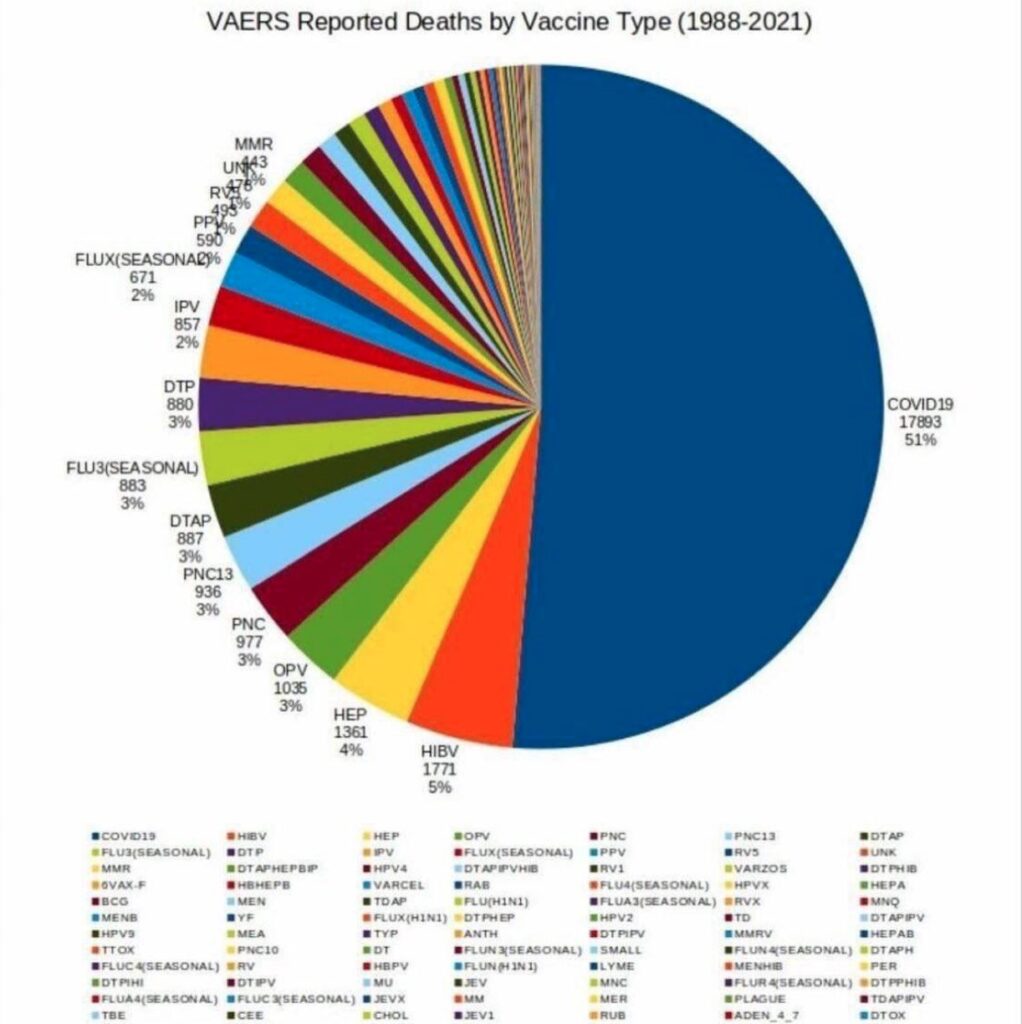
A pie chart showing what is purported to be all reported vaccine deaths in the VAERS database since 1988 has been making its way through social media. Its source and accuracy are unknown, but similar information is found at the nonprofit OpenVAERS.com, which reports on the lack of transparencyat the FDA and CDC regarding adverse effects.
Other takeaways from the hearing:
The Biden Administration mandated the Covid-19 vaccine without a sufficient system in place to compensate individuals injured by the vaccine mandate policy.
HRSA Director at the Division of Injury Compensation Programs George Reed Grimes said, “At the beginning of the Covid-19 pandemic, we had not had a direct appropriation with the CICP. We also had only four staff.”
The FDA accelerated the Covid-19 vaccine approval process to seemingly meet arbitrary mandate timelines set by the Biden Administration.
Executive branch officials from the CDC and FDA agreed in the committee that the federal government can never guarantee a vaccine is 100% safe.
Dr. Marks said, “No pharmaceutical is 100% safe.”
Shortcomings in vaccine injury reporting and vaccine compensation systems, as well as ineffective government messaging during the pandemic, deteriorated public trust in vaccine safety.
“We probably have not done a good enough job of communicating sometimes the actual numbers of deaths versus what’s in VAERS,” Dr. Marks said.
Balanced conversations about the integrity and credibility of vaccines are important for restoring trust in America’s public health system.
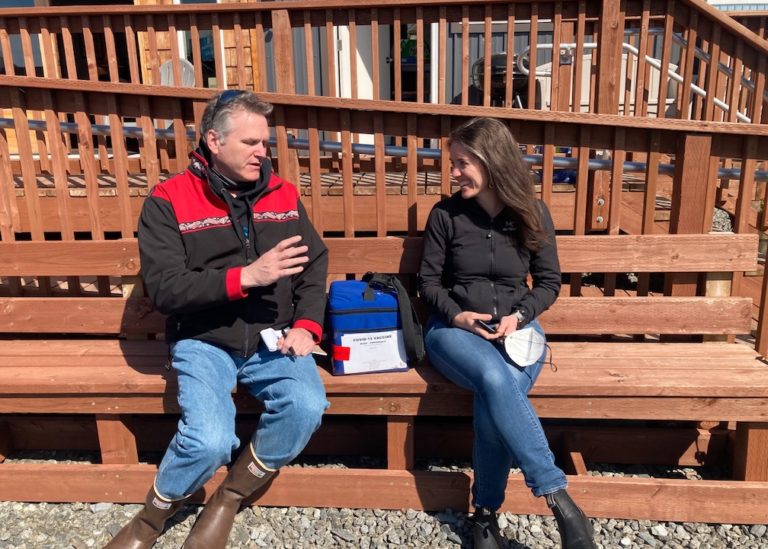
Alaska Gov. Mike Dunleavy met with Yukon Premier Ranj Pillai in Whitehorse, Yukon last week; the two leaders inked an agreement to work on a memorandum of understanding on the Alaska Highway, which is badly gutted with frost heaves throughout its section from Whitehorse to the U.S. border near Tok. The frost heaves between Burwash Landing and the border are so bad they send vehicles with unsuspecting drivers airborne, breaking axles and busting exhaust pipes.
Dunleavy said Alaska is going to help with the cost of the highway repairs and also work to get some U.S. federal money to smooth out the frost heaves, since Americans are the primary users of the highway, as they drive from the Lower 48 to Alaska with either freight for Alaskans or vacation maps.
Dunleavy said talks went well and will continue between the two leaders, including working on a transportation corridor agreement and food security cooperation. It was his first trip to the Yukon.
“The Alaska Highway is the only road link between Alaska and the Lower 48, and the vast majority of traffic on the Canadian portion of the road is American,” Governor Dunleavy said. “By working cooperatively with our neighbors in the Yukon, we can help ensure that people traveling to or from Alaska on the road are able to do more safely with fewer road hazards.”
The MOU outlines an agreement between the Alaska Department of Transportation and Public Facilities and the Yukon Department of Highways and Public Works to repair and improve a section of the Alaska Highway damaged by melting permafrost. The project will be included in Alaska’s 2024-2027 Statewide Transportation Improvement Program, which is currently a point of dispute with the Biden Administration.
Meanwhile, over in Ottawa, Environment Minister Steven Guilbeault said last week that the Canadian federal government will stop investing in new road infrastructure, and instead work on getting people out of their cars and into “active transportation” like bicycles and walking, and into public transportation.
Guilbeault said existing road network in Canada “is perfectly adequate to respond to the needs we have.” The Trudeau government is putting an end to road expansion, he said. Instead, the government will use federal funds on projects to adapt to climate change and fight climate change, Guilbeault said.
“There will be no more envelopes from the federal government to enlarge the road network,” Guilbeault said, as reported by the Montreal Gazette. “We can very well achieve our goals of economic, social and human development without more enlargement of the road network.”
Guilbeault tried to step out of the pothole of his own creation on Wednesday, saying that what he meant to say was no new roads would be built in Canada, but that existing roads would be funded for maintenance.
Yukon is the most western part of Canada and is the smallest Canadian province and the second least populated. At 186,272 square miles and 44,975 people, it is rich in minerals and depends on the Port of Skagway to export its ore. It is the fastest-growing province in Canada.
The Alaska Highway was built mostly by Americans during World War II. It enters the Yukon near Watson Lake, and stretches 550 miles further to the Alaska border at mile 1,903.
Dr. Anne Zink, the state’s chief medical officer in the Dunleavy Administration, announced that she is resigning this year.
She was hired by Dunleavy in July 2019, and six months later the Covid pandemic hit the world, putting her front and center in managing through what was then an unknown, scary, and often deadly virus.
She said on X/Twitter: “Deeply honored to serve as Alaska’s CMO, grateful for the resilience and spirit of Alaskans. I am transitioning out of state service later this year, but my dedication to health, wellness, and #Alaskans remains unwavering—thank you for your trust.”
As I gaze out my window at the tranquil morning blue February sky, I’m struck by the contrast between my modern comforts and the challenges faced by my ancestors in this unforgiving climate. Thanks to advancements in energy production, my family and I enjoy a level of warmth and light that was once unimaginable.
Yet, in my retirement, I’ve grown increasingly concerned about the direction of our energy management. While cost-saving measures should be a priority, it seems that the emphasis is shifting towards sustainability at the expense of affordability and common sense. The Chugach Electric Association, for instance, champions sustainability as a cornerstone of its business ethos.
But what does “sustainability” truly mean for us, the rate payers? It appears that decision-makers, including incumbent board members, are fixated on certain renewable sources like solar and wind while disregarding others like hydro. This narrow focus overlooks the financial realities and practicalities of energy generation.
For us, the average rate payers, this raises critical questions about the reliability and cost-effectiveness of our energy supply. Relying solely on intermittent renewables without adequate storage solutions risks grid instability, particularly during calm or overcast periods.
In engineering decisions, ideology must not trump practicality. While renewable energy is vital for our environment, it must be implemented in a manner that ensures both affordability and reliability for consumers. Ultimately, effective energy management should take precedence over ideological preferences.
For me, understanding the nuances of energy resource quantification is key to controlling costs. Renewable resources can be classified as either intermittent or firm. Intermittent sources, like solar and wind, are weather-dependent and energy-limited, while firm sources can produce power 24/7.
Consider this: The CIRI wind farm on Fire Island costs 9.6 cents per kilowatt hour, while Bradley Lake Hydroelectric only costs 4.6 cents per kilowatt hour. The projections for the Susitna-Watana Hydroelectric Project, with its immense capacity, were similarly cost-effective.
While the Chugach Electric Association’s focus on sustainability is commendable, the reality is that intermittent renewables alone cannot sustain Alaska’s energy needs. Firm resources like hydro must play a central role if we are to secure a reliable and affordable energy future. Let’s ensure that practicality prevails over ideology as we chart our course forward.
Michael Tavoliero is a writer at Must Read Alaska.
Former President Donald Trump was the surprise on Friday, when he dialed into the Fairbanks Lincoln Day Dinner and spoke to the crowd via the cell phone of Gov. Mike Dunleavy, who was in attendance at the Westmark Hotel gala.
The dinner, organized by the Republican Women of Fairbanks, is an annual event. This year’s keynote address was by Drew McKissick, the co-chair of the South Carolina Republican Party and co-chair of the Republican National Committee. McKissick is a nationally sought-after speaker, but nobody expected The Donald to make an appearance — except Dunleavy, who is a vocal supporter of Trump.
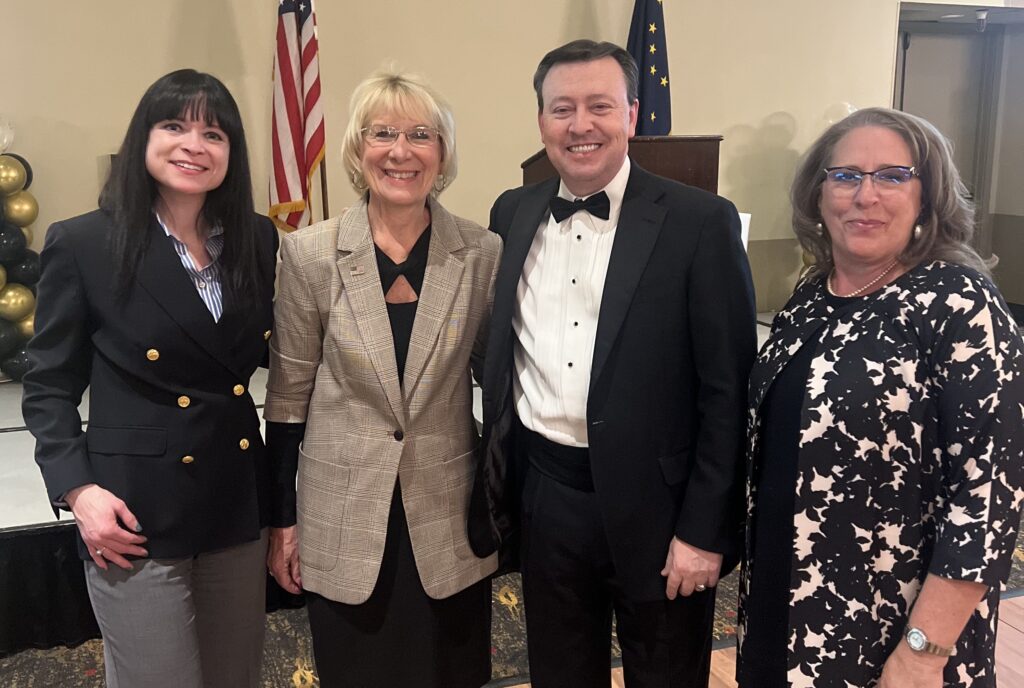
Republican Party candidate for chair Carmela Warfield, National Committeewoman Cynthia Henry, RNC Co-Chair Drew McKissick, and Republican Women of Fairbanks member Cheryl Markwood at the Lincoln Day dinner in Fairbanks.
It was a room filled with Republicans from across the state, including House Speaker Cathy Tilton, Lt. Gov. Nancy Dahlstrom, Anchorage Mayor Dave and First Lady Deb Bronson, Republican activist and candidate for party chair Carmela Warfield, congressional candidate Nick Begich III, Rep. Will Stapp, and Americans for Prosperity Alaska Director Bethany Marcum.
Also, state Sen. Rob Myers, Rep. Frank Tomaszewski, and Fairbanks Mayor Dave Pruhs were there, along with former Sen. John Coghill, former Rep. and current Assembly member Tammie Wilson, Assembly member Barbara Haney, mayoral candidate Aaron Lojewski, and ARP Finance Chairman Jason Warfield. Spotted was ARP vice chair and candidate for Chair Mike Robbins and wife Tatiana.
Senate candidate Leslie Hajdukovich was present and every time her name was mentioned, the room erupted with applause. She is running against Sen. Scott Kawasaki, who is a Democrat.
Sen. Dan Sullivan sent a video message, as he was overseas at the time of the event.
Although Sen. Lisa Murkowski was in state, she did not attend or send a message.
The Alaska Department of Transportation is searching for a new manager for the Ted Stevens Anchorage International Airport.
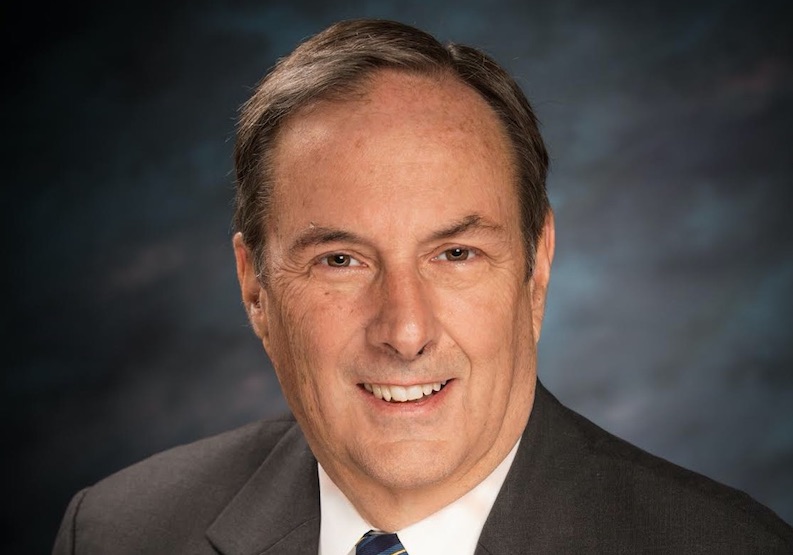
In 2022, former Lt. Gov. Craig Campbell agreed to be the interim manager of the airport after the position opened up upon the departure of the previous airport manager, Jim Szczesniak, in February 2022.
Campbell told a group of aviation professionals earlier this month that he would aim for stepping aside in May.
Campbell spent 35 years in the United States Air Force and Alaska Air National Guard. A certified air traffic controller, he served as chief air traffic controller for Vandenberg Air Force Base and Elmendorf Air Force Base. He retired as a three-star general.
He was the commissioner for the Alaska Department of Military and Veterans Affairs, including the Alaska National Guard, under Gov. Frank Murkowski and Gov. Sarah Palin. He was appointed third in succession and became lieutenant governor when Palin resigned and Sean Parnell stepped into the Governor’s Office in July of 2009. Campbell also served for 10 years on the Anchorage Assembly.
Campbell was the Alaska Aerospace Corporation’s president and chief executive officer from 2012 to 2018. He has been an aviation consultant on numerous Alaska projects throughout his decades in Alaska.
The position was advertised last week at Workplace Alaska. The person selected will be in charge of the second busiest cargo airport in the United States and the fourth busiest in the world. TSAIA is responsible for one out of every 10 jobs in Anchorage, which is the crossroads for many Alaska travelers and cargo jets from across the world.
He has offered to remain part-time to assist in special projects and continue as the interim airport lead until a replacement is selected.
The sponsor of a bill to create a task force to regulate psychedelics in mental health told the Senate Labor and Commerce Committee on Friday the task force will cost nothing. Senate Bill 166’s goal, however, is the same: Prepare Alaska for use of psychedelics in treating some mental illnesses like post traumatic stress disorder.
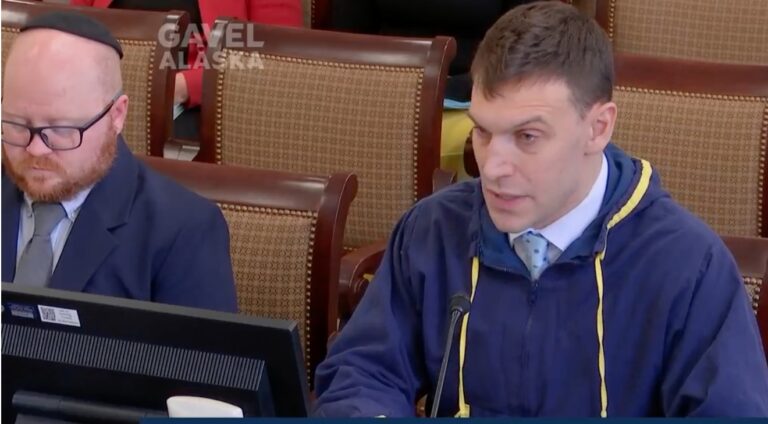
Sen. Forrest Dunbar, who is pushing the use of some psychedelics for mental health treatment, is a member of the committee, and presented the bill to the only two other members who were present on Friday: Sen. Jesse Bjorkman and Sen. Click Bishop. Both Sens. Kelly Merrick and Elvi Gray-Jackson were no-shows.
“Working with the sponsor in the House and the Department, we have change some of the nature of the task force. Now the overriding purpose of the task force is still exactly the same — we are preparing Alaska, hopefully, for what we see as the very likely legalization in the medical context of certain of these substances,” Dunbar said.
The changes that the committee substitute bill now has include dropping the fiscal note (cost of the bill) because instead of being a task force staffed by the Department of Commerce, it would be a legislative task force staffed by those working in the sponsors’ offices. The language also clarifies that the task force is not there to advocate for legalization but to create a regulatory framework in anticipation of federal legalization of some substances.
Also, there is no longer a requirement that one of the members of the task for be an herbalist. Instead, a seat was added for a registered nurse. The task force will get no per diem or travel.
The Task Force will still consist of a “diverse group of experts and stakeholders” tasked with exploring the integration of psychedelic-assisted therapies into Alaska’s healthcare system, according to the bill. It will meet at least four times, submit a report of recommendations to the legislature and the governor by Dec. 31, and terminate at the convening of the 34th Legislature.
“Research shows the effectiveness of psychedelic-assisted therapies in treating PTSD, depression, anxiety, and substance-use disorders, conditions highly prevalent among veterans. What barriers exist in implementing such therapies in Alaska? What regulations are needed for practitioners to ensure safe integration of psychedelic medicine? These are some of the questions the task force will explore,” Dunbar said in his sponsor statement for the bill.
He said the Food and Drug Administration is currently reviewing the drug known as “ecstasy,” also known as MDMA or “Molly” for treatment of post traumatic stress disorder, “with approval expected by the end of this year.”
But, in fact, the FDA has been asked to review MDMA, or midomafetamine (the active ingredient in street drugs like ecstasy and Molly) for post traumatic stress disorder. The request was made by a pharmaceutical company, Lykos, which has been studying the use of the drug in therapy. The FDA is in a 60-day review period, in which it will decide if the drug will be fast-tracked through the approval process.
If approved, it would reschedule MDMA from Schedule I drug. Schedule I drugs have no accepted medical use and are known to have a high potential for abuse.
The FDA recently accepted a new drug application for midomafetamine (“Molly”) capsules to be used in combination with psychological interventions, including psychotherapy for PTSD. The FDA also granted priority review to the new drug application with a target action date of Aug. 11.
The bill moved from Labor and Commerce Committee to the Senate Judiciary Committee, chaired by Sen. Matt Claman, one of Dunbar’s fellow Anchorage Democrats.
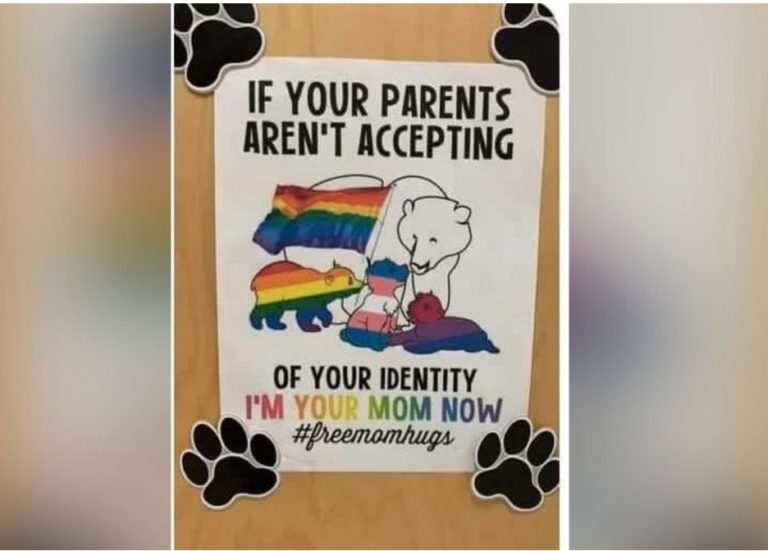
The same legal group that represents Alaska Airlines fight attendants who maintained they were discriminated against due to their Christian beliefs has successfully fought a case for six Muslim families in Minneapolis, who didn’t want their children taught LGBTQ and other sexual materials in school.
The St. Louis Park Public School District in suburban Minneapolis will allow the families to opt their children out of sexually based materials being taught in English classes.
First Liberty has represented the families since last year, along with Renee Carlson, a volunteer attorney at True North Legal.
“Our clients are devout Muslim families who immigrated from war-torn Somalia. Religious freedom and educational opportunities are among the most significant reasons why they came to the United States,” said First Liberty.
“Just like you, and countless families across the country, these parents believe they have an obligation to raise their children consistent with their faith. All they asked for was prior notice and the ability to opt out from books that discuss sexual orientation or gender identity. But the district denied their requests,” the attorneys wrote. They opened the case in December with two letters to school district officials.
“We explained that their denials violated state law and the First Amendment,” the group said.
“Diversity and inclusion must extend to religious families, too,” said First Liberty attorney Kayla Toney. “This is why the First Amendment specifically protects religious exercise.”
Due to the legal challenge, the school district put in place a process by which any family can request opt-outs and alternative learning.
“And it’s not just for elementary school students. The middle school and high school are granting opt-out requests as well,” the group said.
In January, First Liberty Institute filed a motion for summary judgmenton behalf of two flight attendants who sued Alaska Airlines and the Association of Flight Attendants union in 2022 after the airline terminated them because they asked questions in a company forum about the company’s support for the “Equality Act.” The union wouldn’t defend them.
Alaska Airlines VP of Inflight testified that an employee’s use of the term “opposite sex” violates the Airlines’ discrimination policy because that implies that there are only two sexes.
“Alaska Airlines has made it clear that employees who hold traditional Christian beliefs must stay silent if they want to keep their jobs,” said Stephanie Taub, Senior Counsel for First Liberty Institute. “Now, we clearly see that Alaska Airlines’ obsessive focus on DEI created a hostile work environment for anyone who dares disagree with the company about moral issues.”