U.S. Sen. Dan Sullivan released a statement in response to the reported death of imprisoned Russian opposition leader Alexei Navalny, who died in a prison in Siberia.
Navalny was a Russian opposition leader, and activist who organized demonstrations and ran for office to unset Russian President Vladimir Putin and his government
“Alexei Navalny was a very courageous Russian leader, respected by millions of Russians. His murder—and, let’s be clear: he was murdered—underscores the danger of the world in which we’re living and the brutality of the Putin regime,” Sullivan said.
“But it also underscores a huge vulnerability for the dictators of the world—Putin, the ayatollahs in Iran, and Xi Jinping: They fear their own people. Navalny had millions of Russians who looked up to him and wanted him to be an elected leader. As Putin was heading into his elections in the next several weeks, he decided to kill Navalny. The fact that dictators around the world fear their own people is a vulnerability that we have to work harder to exploit in our fight against authoritarian aggression,” Sullivan said.
President Joe Biden said that while he doesn’t know the details of Navalny’s death, “there is no doubt that the death of Navalny was a consequence of something Putin and his thugs did.” It appears the president is using the death of Navalny to gin up support in the House for the funding for the Ukraine defense against Russia and Israel’s defense against Iran and other terrorist-fueling countries.
Alexei Navalny had already survived being poisoned and he had spent months in isolation, when he died in an Arctic Circle maximum-security prison. The 47-year-old Russian was seen on video on Thursday a court appearance in the Russian penal colony. He was smiling and making lighthearted comments.
Sullivan made his remarks from Munich, where he is leading a delegation to the Munich Security Conference.
“One of our greatest strengths relative to our adversaries—China, Russia, Iran, North Korea—is our vast network of allies, which administrations and U.S. Senators have built up over decades,” said Sullivan. “Given the increasingly dangerous world we live in, we need to deepen those alliances and strengthen U.S. credibility. The Munich Security Conference is a good opportunity to do that. The conference is also an opportunity to deliver a message from the American people: We expect our NATO allies to meet their defense spending obligations.”
I always appreciate it when the Left tells us what they think is important. This month’s example comes out of the Democrat, dark money-funded, independent campaign group that calls itself the 907 Initiative.
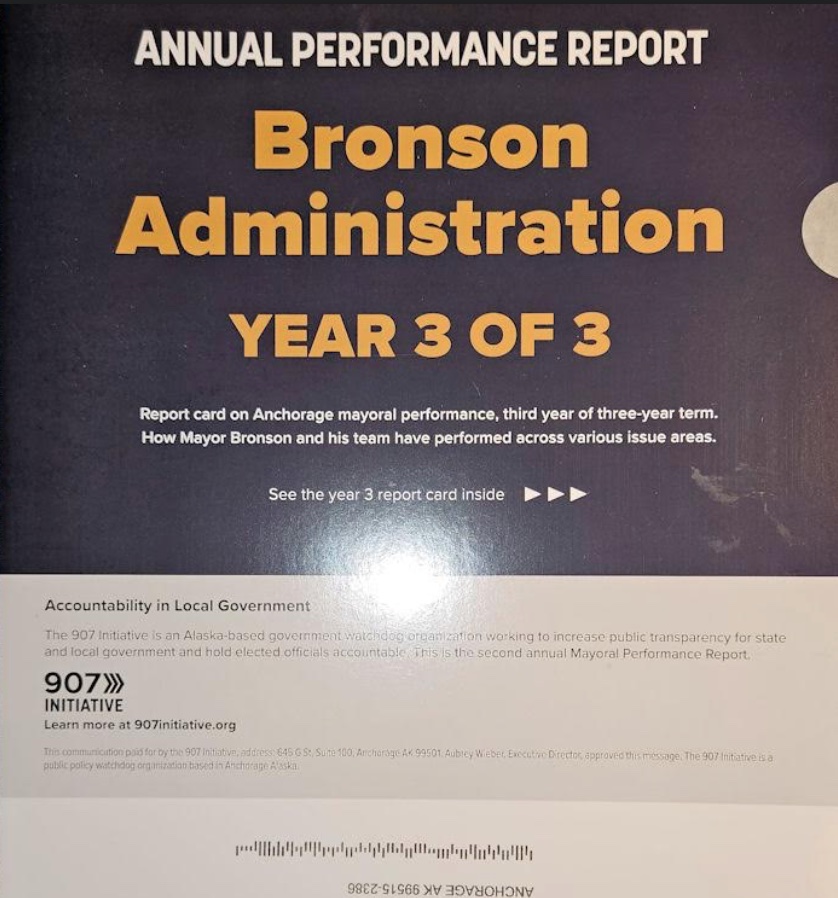
Earlier this month, we received a gorgeous 4-page, color brochure printed on heavy paper entitled the Annual Performance Report Bronson Administration Year 3 of 3. It’s an attack on Mayor Dave.
Not unexpectedly, it was a hatchet job on him, his administration, aimed at battlespace preparation for the mayoral election next month, essentially their local version of Orange Man Bad. It was sent out to whomever the 907 Initiative has on their mail list.
The piece concluded with an easily predictable overall performance grade of F, based on their grades on 8 areas, 2 F’s, two D’s, 3 C’s, and an incomplete. An unweighted combination of those grades in the public schools would be a D+ rather than an F, as C’s outnumber F’s.
But this is a campaign document intended to do just as much damage as possible to Bronson, so their math simply doesn’t matter. Only the conclusion does.
The piece lists 12 sources for information used to construct this thing. 6 of them were Alaska Public Media, 3 of them Alaska Daily News, with Alaska News Source, Alaska Current, and MOA Budget making up the balance of sources. How unbiased those sources are once again depends on your position on the political divide.
If you take a look at the different sections, those areas with a grade of F are the places they think they can win this election on. These are Housing and Homelessness and Ethics & Transparency. Their D grades are slightly less important to the campaign, including Hiring & Management and Roads & Transportation. Note that their incessant carping about slow response to early season record snowfall the last two years is no longer considered to be a prime campaign issue.
It is no surprise that the political left is outraged at Bronson’s refusal to kowtow to the ridiculous demands of the Assembly majority and the Homeless Industrial Complex they’ve managed to construct over the years. Completely ignored is any analysis of bad faith negotiation by that majority, when they toss aside agreements with the mayor like they do with so many homeless Alaskans.
Likewise, it is also no surprise that they are angry that their grifters and rent seekers are being left out of the competitive award of contracts. Perhaps leftist and union entitlement is not a positive in a supposedly competitive environment. As always, ethics is entirely in the eye of the beholder, and when ethics complaints are wielded early and often as political weapons aimed only at those of us on the political right, pardon me if we simply don’t care.
Those of us with memories slightly longer than a week and a half do remember ethics and Gov. Sarah Palin. One of the things Palin ran on was a promise to clean up Alaska politics. Once elected, she was buried under a dump truck full of ethics complaints via anti-Palin leftist lawfare. Perhaps Bronson ought to be congratulated for not giving the Left the rope they most desperately want to use to politically hang him with.
There is some weirdness in their grading. For instance, they give Bronson a C on Schools and Education, something the Mayor has no control over. While both the Assembly and Mayor can veto the ASD budget, neither in my memory has stepped up to the plate to do so. Imagine the heart-rending screams of pain, anguish and highly selective outrage should someone, especially someone on the political right, reject a bloated ASD budget.
In their conclusions, the grifters at the 907 Initiative ding Bronson for failing to implement a response plan to homelessness, their version of simply giving Meg Zaletel and her Homeless Industrial Complex a blank check and rubber stamp on everything they demand.
They then go on to carp about high vacancy rates across the Muni. Some would see this as a good thing, for if you are getting the same job done with fewer people, why is that a problem?
They end with a crack about unethical behavior and problematic advisors. Remind me again about the Assembly’s secret advisor for their anti-detransitioning ordinance a few years ago, notorious luggage thief Sam Brinton.
This is shaping up to be an ugly campaign. Pay attention to what the Left is telling you it is about, as I expect that this has been fully focus grouped and polled so as to maximize union turnout next month.
Alex Gimarc lives in Anchorage since retiring from the military in 1997. His interests include science and technology, environment, energy, economics, military affairs, fishing and disabilities policies. His weekly column “Interesting Items” is a summary of news stories with substantive Alaska-themed topics. He was a small business owner and Information Technology professional.
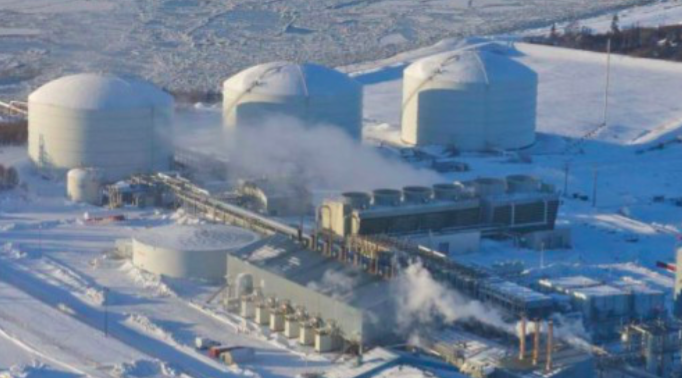
The U.S. House passed legislation on Thursday that would limit President Joe Biden’s ability to stop liquefied natural gas export permits. The bill, H.R. 7176, passed 224-200.
Nine Democrats, including Alaska Rep. Mary Peltola, joined all Republicans in approving “Unlocking our Domestic LNG Potential Act, whose key sponsor is Texas Republican Rep. August Pfluger. The bill would give the Federal Energy Regulatory Commission the exclusive authority to approve LNG projects.
The bill is likely to die in the Senate, which is controlled by Democrats, and where Vice President Kamala Harris can break a tie vote.
Since his first day in office, “President Biden has targeted our domestic energy producers and actively undermined America’s efforts to be energy independent,” House Speaker Mike Johnson said in a statement on Thursday.
The U.S. Chamber of Commerce came out solidly in support of the bill: “In the wake of Russia’s invasion of Ukraine and ongoing weaponization of natural gas for geopolitical influence, U.S. LNG is playing a critical role in providing energy security for allies in both Europe and Asia. With Europe still relying on Russia for nearly 15 percent of its natural gas consumption, and global demand expected to increase for several decades, continued expansion of U.S. export capacity is essential to American interests. H.R. 7176 would enable this expansion while still allowing for appropriate federal reviews of potential new export facilities through the longstanding Federal Energy Regulatory Commission (FERC) process.”
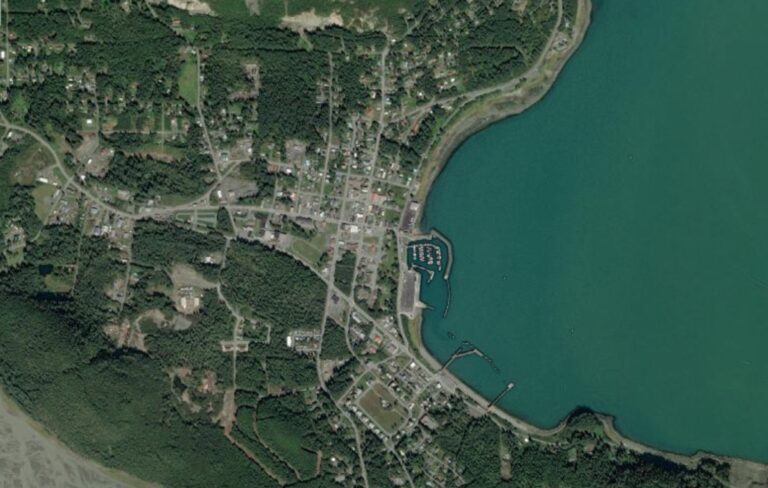
In 2023, Haines residents uncovered actions they perceived as unjust methods for assessing private property. As these actions came to light at a local level, a more widespread problem emerged withinAlaska’s municipal taxation statutes that are supposed to protect individuals’ rights and the public interest from bad actors.
Subsequently, Alaskans become alarmed. Sen. Jesse Kiehl recently announced that he will be introducing a bill to improve Alaska’s property tax assessment procedure. Kiehl stated that “when the government takes money, it needs transparent, fair processes to do it … Many Alaska municipalities already follow all the best practices I’m drafting into a bill. For them nothing will change. But for others, a few additional guardrails are in order.”
The senator’s announcement comes after months of public outcry, a citizen’s petition that resulted in the cancellation of the Haines assessor’s contract, the resignation of the state assessor, and the publication of a white paper on Restoring Public Trustin Alaska’s property tax assessment process.
Excessive property assessments in Alaska have become a source of bipartisan concern. Assessing property at its full and true market value is required by AS 29.45.110. However, Alaska statutes permit broad interpretations and subjectivity that invite unjust outcomes and undermine the guarantee of a fair, just, and equitable tax structure. This means some properties are assessed excessively, causing a detrimental effect on community investment by making homes and commercial property more unaffordable for both owners and tenants.
One outcome appears to be a loss of public trust in Alaska’s property tax assessment process. The Haines assembly voted unanimously to cancel an agreement for services with the community’s property tax assessor, Michael Dahle. Following months of public outcry and a citizens’ petition requesting the contract cancellation, the action quickly gained bipartisan support and signatures from borough residents.
Haines Borough Mayor Tom Morphet issued a formal apology to the public on the topic during last year’s Nov. 14 assembly meeting, noting the protracted time it took government to fully appreciate the problem and reassuring residents that “we are working as fast as we can to fix the property tax assessment system and make it right for both the Haines Borough and property tax payers.”
Charged with implementing the first phase of a new mass appraisal methodology for the borough’s 2023 property tax assessments, Dahle attempted to implement a new “replacement cost” hybrid methodology, which resulted in assessments in excess of full and true market value for some parcels.
According to former Assembly Member Brenda Josephson, when property owners appealed the excessive values, they received threats of increasing assessments if appeals were filed with the Board of Adjustment (BOA).
Citizen petitions to Alaska’s State Assessor’s Office resulted in a BOE retraining that occurred on September 21, 2023. During the retraining, State Assessor Joseph Caissie encouraged the BOE to support the municipality’s methodology. Caissie argued that “uniformity” is what matters, even if the model the assessor uses consistently results in assessments at 150% or even up to 200% of the full and true market. In Caissie’s words, the job of the assembly is not to reduce assessments to market value, but instead “the job of the assembly (is) to set the mill rate lower.”
According to Josephson, Dahle lacked credentials, as he did not have either an assessor’s certification with the Alaska Association of Assessing Officers or possess a license in Alaska as an appraiser. The lack of professional credentials was the basis of the petition to not renew Michael Dahle’s contract.
One resident, Dr. Mark Smith, expressed the need to codify safeguards against unjust actions, stating, “We’re pleased with the outcome, but the culture of inept government that allowed this to occur in the first place still exists. It’s like a tumor has been removed, but it will return unless we get the ‘whole body’ well holistically.”
Juneau appears to have suffered a similar experience under Dahle when he served in CBJ’s Assessor’s Office. Juneau commercial properties in 2021 received assessment increases of 50% across the board, regardless of the area they were in or how COVID-19 shutdowns affected their industry.
There, as in Haines, the problem property owners faced was a mass appraisal methodology with a creative hybrid cost-based approach with some market data that ignored actual market sales conditions. The result is inflated assessment values in excess of their full and true value. Juneau appellants also cited the aggressive tactics of the assessor’s office.
Josephson believes that inherent flaws in Alaska’s property tax assessment process led directly to these problems. Her experience is that the process fails to protect individual rights through a board of equalization process that fails to provide for fair hearings, licensing and/or certification of assessors, and the upholding of assessments in excess of their full and true market value.
In December, Caissie announced his resignation as Alaska’s State Assessor, less than three months after he came under criticism for the training advice provided to the Haines BOE members.
Caisse stated in a farewell letter that he would be leaving in January for a full-time job managing a 501(c)(4) that advances Georgism. Georgism is a controversial policy that bases the land’s value on what the government thinks it should be used for rather than its existing one. Caissie stated that, in his new role with the NGO, he would be “pushing for more jurisdictions to adopt this policy.”
In a white paper titled Restoring Public Trust, Josephson and coauthor Greg Adler call attention to problems with Alaska’s assessment process and highlight instances of the negative effects of the existing approach. Arguing that every resident ultimately pays property tax either directly to the government or through rent and lease payments, Josephson asserts that this is a statewide issue.
She said, “The assessment process should never invite this level of confrontation; instead, statewide policies and statutes must be written to protect citizens from unintended consequences and bad actors.”
Jon Faulkner is president of Alaska Gold Communications Inc., which publishes Must Read Alaska.
After spending several weeks in Unalaska / Dutch Harbor, the cargo vessel Genius Star XI left Sunday for its original destination, San Diego, Calif. The ship has been delayed after a cargo hold carrying lithium batteries caught fire on Dec. 25 and caught fire again on Dec. 28, while transiting the Gulf of Alaska from Asia.
“This was a unique and complicated operation under very challenging conditions,” said Capt. Christopher Culpepper, Federal On-Scene Coordinator. “The broad team of experts that were mobilized worked in a coordinated and professional fashion to accomplish the objectives and get the ship back underway to its intended destination port.”
After the second fire, the ship was directed to Broad Bay, near Dutch Harbor, where it was stabilized. Later, it was allowed to continue to the dock at Unalaska for final inspections and the securing of cargo in preparation for its voyage.
“The vessel’s owner activated its vessel response plan mobilizing incident management and salvage marine firefighting teams. Several experts were engaged from around the world to provide consultation on the risks and specialized operations required to deal with the potentially damaged lithium-ion battery cargo. Organized as a Technical Expert Advisory Group, the experts provided recommendations for operations as more was learned about the condition of the damaged cargo. A salvage firefighting team remained aboard the vessel throughout operations,” the Coast Guard reported.
“This was a particularly challenging operation given the remote location and winter conditions,” said Bernie Nowicki, State On-Scene Coordinator. “I am grateful for the engagement and cooperation of the City of Unalaska and their port officials who assisted us throughout the operations.”
Community air monitoring was conducted during the incident with over 480,000 readings all showing normal atmospheric conditions. A team of specialized expert battery technicians were mobilized to Dutch Harbor to further triage and re-secure the large industrial battery units. Crews completed recharging and installing the onboard CO2 system and the vessel was inspected to meet all safety requirements and regulations, the Coast Guard said.
“I am proud of the team’s accomplishments during this very challenging operation,” said Chris Graff, Incident Commander. “We operated in high winds, rain, and snow, working around dangerous cargo with no accidents or injuries, a true testament to the dedication, hard work, and commitment to safe work practices of all involved.”
The cause of the incident remains under investigation.
Join host John Quick on the Must Read Alaska Show for this new episode with Nick Begich, a determined candidate aiming for Alaska’s sole congressional seat.
Begich shares insights from his experience when he served as the campaign chairman for Congressman Don Young in 2020, highlighting the lessons learned and how they’ve shaped his political vision.
With a critical view of the current Rep. Mary Peltola, Begich outlines why he believes Alaska is in dire need of change.
He discusses his commitment to smaller government, less regulation, and increased oil production as foundational pillars of his campaign platform. This episodeis a deep dive into Begich’s aspirations for Alaska, reflecting on the past and looking forward to a brighter future.
There’s a lot of new material in this podcast interview that Alaskans may not have heard before. Begich talked about how the seat doesn’t belong to any one person, this is Alaskans’ seat, Alaskans’ government. “If you want change, you have to get involved.” And he talked about sending the right team, after Alaskans ended up with an incumbent who is fully signed onto the Biden agenda.
Peltola has voted with Nancy Pelosi 90% of the time. Peltola endorsed Joe Biden for president, he said. And Biden doesn’t want any development in Alaska. “They want to put us in a snow globe,” he said. She ran on a bipartisan message but “when you’re voting with Nancy Pelosi 90% of the time, that’s not bipartisan,” he said.
“We aren’t going to be able to move priorities from Alaska if we don’t have someone that is on the right team down in D.C. Turns out, Democrats don’t want to see more development in Alaska, they don’t want to see more drilling. They don’t want to see more mineral development. They don’t want to see more logging. These are things that have been made clear not just by national Democrats but by Joe Biden himself,” he said.
He also talked about the endorsement he just received by Vivek Ramaswamy, the conservative businessman who ran for president and who continues to shape the pro-business message of America First.
During a Juneau City and Borough Assembly Finance Committee meeting on Feb. 7, opinions about how to handle a sizable deficit in the Juneau School District budget ran the gamut.
The deficit is the result of a catastrophic enrollment loss (1,500 student drop since 1999), accounting errors, and decisions by previous school administrators and past Board of Education leadership. Some Assembly members want to blame the current board, arguing that Juneau School District deficits are a problem primarily of their own making and financial assistance should be mostly in the form of a loan that must be paid back.
Several Assembly members, however, took the view that, while the school district must consider cuts and consolidations, their financial situation is a community issue that cannot be ignored, and the Assembly’s role should be to assist them in resolving it.
Ultimately, the Finance Committee voted to give the district more help than they requested, around $8 million to zero out their current deficit ($4 million as a loan with the balance in cash) and another $1.65 million towards the Fiscal Year 2025 deficit. The $4 million zero-interest loan would be paid back in three equal installments beginning in Fiscal Year 2026.
The Juneau Assembly directed the manager to draft three ordinances to formalize their action in time to have them introduced at the regular Assembly meeting on or before Feb. 26 and public testimony on March 4.
All these actions would be subject to adjustment depending on public testimony and forthcoming updated enrollment projections, possible cuts and consolidations, as well as any increase in the Base Student Allocation, known as the BSA, which determines state funding to the district.
Some in the community will bemoan this action as a “giveaway” or argue details about the amount or structure of the grants and loans. However, there is no viable way of balancing this year’s budget without Assembly assistance.
The Juneau School Board will now turn its attention to changes needed going forward to achieve a balanced budget and how that can be accomplished with minimal negative impact on student educational outcomes. The community should accept the fact that these changes will be extremely difficult for all concerned but there is simply no choice – since by law, the school district must produce a balanced budget. To accomplish this, the city/borough loans must be repaid, and facilities and programs will need to be reduced.
Not to be forgotten are past enrollment projections that forecast the district losing another 1,200 students by 2032. Those numbers should be front and center in both Juneau’s school district and assembly decision-making.
Several mentions were made during the Finance Committee meeting of increasing Juneau’s property tax millage rate to help offset the hit to the municipal budget.
This would be a mistake and, in any case, unnecessary.
Juneau residents are still reeling from recent unprecedented increases in property taxes, both residential and commercial. Increasing property taxes would further exacerbate this situation, hurt the economy, and make Juneau less attractive and less affordable.
For all the handwringing from city leaders about JSD’s “structural deficit,” more attention should be paid to the city’s “structural surplus.”
Under the current CBJ property tax millage regime, the city has continued to over-collect property taxes and accumulate inordinate surpluses despite its best effort to fritter them away on projects that voters have rejected.
Currently, the city has over $140 million in discretionary funding sources available to it:
$31.0 million – general fund balance
$19.0 million – “rainy day fund”
$16.5 million – new city office CIP
$ 5.0 million – New JACC/civic center CIP
$70.0 million – unused bond capacity
Of course, other needs compete for these funds, so the school district shouldn’t get a pass, but any one of those sources are available to assist schools with no immediate requirement to raise taxes.
Furthermore, the city bears a good measure of responsibility for the lack of economic development that has contributed to Juneau’s stagnant population and the outmigration of young people that is directly tied to lower student enrollment in the school district.
Moving forward, Assembly members can do better by avoiding the “blame game,” viewing school funding challenges as a shared responsibility, and asking themselves why economic development efforts have fallen short.
After retiring as the senior vice president in charge of business banking for Key Bank in Alaska, Win Gruening became a regular opinion page columnist for the Juneau Empire. He was born and raised in Juneau and graduated from the U.S. Air Force Academy in 1970. He is involved in various local and statewide organizations.
The Biden Administration rejected Alaska’s plan for road construction for the coming years and sent it back to the Department of Transportation, in what appears to be an attempt to hit at Gov. Mike Dunleavy and Alaska itself during an election year in which Biden already has a slim chance of winning the 49th state.
The Alaska State Transportation Improvement Program (STIP) is the plan for how the state will use federal dollars between 2024 and 2027. The plan is the next generation of the 2020-2023 STIP, a document that is worked on for years and is worth at least $900 million in federal dollars each year. The current STIP ends March 31.
Every state submits a STIP document to the Federal Highway Administration that covers a period of work stretching four years. Alaska has never seen one rejected.
Sources say that that the Federal Highway Administration, under the Biden Administration, has a few midlevel activists who decided to throw a monkey wrench into Alaska’s STIP, forcing the state to redo some of its work. However, while they were empowered to reject projects that Alaska wants, such as roads, bridges, or ferry terminals, the federal agency made a number of mistakes during its rejection, so much so that the Biden Administration is now in panic mode, sending two people north to Alaska to straighten out the mess these activist federal employees made.
The mainstream media has endeavored to make this a “Dunleavy” problem, but Dunleavy’s Department of Transportation is staffed by people with decades of experience in developing the STIP.
But this year, the federal workers got picky. In one place in the STIP document, the State said it planned to build a road across the Susitna River. The federal government objected because the word “bridge” wasn’t included in the scope.
In another instance, the ferry terminal long planned for Cascade Point in Juneau has been approved in previous STIPs, but this time, the federal government didn’t like the project, which would support the most popular ferry route in Alaska, service by the M/V Hubbard. The feds said it is not a “transportation” project.
The feds told the Department of Transportation to redraft portions of the plan, but after the redraft, the agency would not respond to Alaska DOT about whether the plan was acceptable.
Then, the feds told the department to do a “soft submittal” so the feds could review it and look for any corrective measures that would need to be made. DOT complied and did the soft submittal, but got no answer from the Federal Highway Administration.
As the clock was running out on the deadline, DOT finally decided it was time to send in the formal document. That’s when the federal agency started nitpicking.
The Biden Administration objects to anything that has to do with potential development in Alaska, sources said.
The Education Industry has overwhelmed the Alaska Legislature with its opinion on the teacher shortage in Alaska. Is this a true shortage or is it just a means to demand more money from the legislature for K12 education?
During the past few weeks, the Education Industry, which includes the many school districts, the teachers’ unions, the Alaska Association of School Boards, the Alaska Association of School Administrators, the Alaska Association of School Principals, and the Alaska Association of School Business Officials, have pushed their opinion that they need more funding to recruit and retain teachers.
Lisa Parady, CEO of the Alaska Council of School Administrators, said, “We can’t recruit teachers, we are struggling in the worst crisis Alaska has seen in terms of turnover. Fundamentally, that’s very important to high-quality instruction.”
Parady and her fellow administrators from various school districts repeatedly stated the only solution for this “crisis” was more funding.
The live presentation to the joint House/Senate Education Committees is here.
But is this really new? There have been teacher recruiting and retention problems in rural Alaska schools for many decades.
Many young teachers are recruited from Outside Alaska to fill jobs in our rural schools. They come north, yearning for the “Alaska experience.”
Once they are on the job for a while, they become disillusioned with the harsh climate, isolation, lack of entertainment, inadequate housing, and cultural differences.
This rural teacher problem has been very well documented in “It’s more than just dollars: Problematizing salary as the sole mechanism for recruiting and retaining teachers in rural Alaska” by the Center for Alaska Education Policy and Research.This 2016 study was contracted by the Alaska State Department of Administration.
The study’s conclusion is that “salaries alone will not ensure a stable and qualified teacher workforce.” Most importantly, are working conditions.
In urban Alaska teacher recruiting and retention is not such a great problem. The Anchorage School District is representative of the urban school districts.
The ASD student population comprises a very large part of the entire State’s student population. The ASD has 42,431 K-12 students this school year; the entire state has 127,931 K12 students. Thus, the ASD has about 33% of the state’s entire student population.
Let’s look at the Anchorage School District’s teacher manning to determine the scope of the problem.
Parady told the House Education Committee, “We can’t recruit teachers.”
Yet, that does not seem to be a problem in Anchorage.
Here are the data for the number of certificated teachers in both elementary and secondary schools and the number of vacancies:
Category
Budgeted
Filled
Vacant
Elementary Teachers
1108
1096
12
Secondary Teachers
621
612
9
Special Service Teachers
758
670
88
As one can see, there are only 21 vacant elementary and secondary teacher positions in Anchorage — a 1.2% vacancy rate.
Apparently, the district is not having any problems with teacher retention and recruitment.
Maybe that’s because the district just gave the teachers’ union members a 3% pay raise, which Superintendent Jarrett Bryantt described as, “putting forward the largest single-year wage and health benefits increase provided to educators in more than a decade”.
And that raise just may be the reason that the Anchorage School District needs to increase the Base Student Allocation. It needs the extra funding to pay for these raises, for which it doesn’t have the money, and to offset the one-time federal Covid money it used to pay for recurring costs such as salaries.
The Special Service Teachers category above includes the special education teachers. There has historically been a shortage of these qualified teachers nationwide. Alaska isn’t the only place with this shortage.
The teacher retention situation in Anchorage may be mirrored in the other four large urban school districts in Alaska.
To solve the teacher retention/hiring “problem,” the Education Industry wants to put another $1,413 into the base student allocation, increasing state funding of K-12 by a whopping $287.76 million.
This BSA funding, however, would not require any accountability for spending the increased funding in the actual classroom.
The extra funding could be used to pay administrators’ salaries. It could be used to pay the teachers’ union more money for health insurance. It could be used to hire more Diversity, Equity, and Inclusion personnel.
Gov. Mike Dunleavy, on the other hand, wants to target the spending to the classroom so it would have an impact on student outcomes. His House Bill 106 would target teacher retention and hiring by paying teacher bonuses.
These bonuses would consist of 3 tiers: $5,000, $10,000, and $15,000. The total cost would be approximately $60 million.
Should legislators support the more than $287 million given to the school districts to do whatever they want with it?
That $287 million represents 218,750 Permanent Fund dividends (using the 2023 PFD of $1,312).
Or should legislators support the $60 million targeted at teachers actually doing the hard work of educating our students?
This is about accountability for results in the classroom.
Will $287 million increase student reading scores from a mediocre 29.46% reading for all grades statewide?
Will $287 million increase student math scores from a dismal 22.8% for math for all grades statewide?