Friday, June 19, 2026
Home Blog Page 508

Texas governor defies Biden and puts more razor wire up, as former FBI says the invasion is by military-aged men from around the globe

BIDEN THREATENS TO NATIONALIZE THE TEXAS NATIONAL GUARD

A letter signed by several former FBI agents was one of several major developments regarding the southern border this week.

The letter, signed Jan. 17 and made public this week, says that the border is being invaded not by women and children, as portrayed in the media, but by military-aged men from across the globe who may be trained and ready to act on behalf of terrorist organizations.

Over six million illegal aliens have invaded the country under the Biden Administration at the southern border. While Gov. Greg Abbott has ordered more razor wire to be installed, President Joe Biden has now threatened to nationalize the Texas National Guard and order them to remove the razor wire. Biden has the authority to federalize National Guard units, which would take them away from the power of the states.

Texas Gov. Greg Abbott thanks Texas National Guardsmen for doing what they can to protect the Texas border. President Joe Biden has now threatened Abbott by saying he will nationalize the Texas National Guard.

The FBI agents said many of the people coming over the border are young men who are a national threat to security.

“As former senior executives of the Federal Bureau of Investigation with deep experience combatting dangers to the nation, we write to express our concern about a current, specific threat that may be one of the most pernicious ever to menace the United States,” the agents wrote.

“The threat we call out today is new and unfamiliar. In its modern history the U.S. has never suffered an invasion of the homeland and, yet, one is unfolding now. Military aged men from across the globe, many foreign countries or regions not friendly to the United States, are landing in waves on our soil by the thousands — not by splashing ashore from a ship or parachuting from a plane but rather by foot across a border that has been accurately advertised around the world as largely unprotected with ready access granted. It would be difficult to overstate the danger represented by the presence inside our borders of what is comparatively a multi-division army of young single adult males from hostile nations and regions whose background, intent, or allegiance is completely unknown. They include individuals encountered by border oflicials and then possibly released into the country, along with a shockingly high estimate of ‘gotaways’ — meaning those who have entered and evaded apprehension,” the agents wrote to leaders in Congress, including House Speaker Mike Johnson and Senate Majority Leader Chuck Schumer.

“In light of such a daunting, unprecedented penetration by uninvited foreign actors, it is reasonable to assert that the country possesses dramatically diminished national security at this time. The nation’s military and laws and other natural protective barriers that have provided a traditional security in the past have been thoroughly circumvented over the past three years,” the former law enforcement agents wrote.

“In 2021, the demographics of those crossing the porous southern boundary started to shift. Young men from around the world traveling alone and holding questionable motivations dramatically increased in number to become the most common profile of those breaching the nation’s borders. A startling number have been found on the terrorist watchlist or are from countries designated as State Sponsors of Terror distinctly unfriendly to the United States,” they wrote.

The signers of the letter said it is particularly alarming in light of the Hamas terror attack on Israel last Oct. 7.

“Those of us who have fought terrorism know that, historically, successful terror attacks invite mimicry. We know, as well, that terror leaders intentionally cultivate throngs of young men possessing a certain easily-manipulated personality type to carry out atrocities,” they said.

The agents warned that such mimicry could include large numbers of young foreign men attacking gatherings of unarmed citizens at the behest of a foreign terror group.

“We would be remiss not to call out this potentially grave threat in the most direct terms. The warning lights are blinking,” the FBI agents advised Congress.

And yet, this very real concern does not seem to be getting the focus it logically deserves in the halls of power, they said in the letter.

“The Director of the FBI has correctly assessed an elevated threat level since 10/7. But relatively little discussion has followed highlighting unsecured borders as a significant cause of this increasingly dangerous environment. It is a troubling concern that needs illumination, not avoidance,” the letter said.

“Any violation of the nation’s immigration laws increases risks, but the surge in numbers of single, military aged males descending upon American cities and towns is alarming and perilous. Additionally, they are not just from terror linked regions, but from China and Russia as well — hostile adversaries of the U.S. with aspirations to devastate national infrastructure.”

The agents said that the recent surge of illegal military-aged men across the border is not an accident or coincidence.

“These men are potential operators in what appears to be an accelerated and strategic penetration, a soft invasion, designed to gain internal access to a country that cannot be invaded militarily in order to inflict catastrophic damage if and when enemies find it necessary,” they said.

The FBI agents said that this is a threat never seen before.

“The borders need to be secured against these young men and those already here illegally must be identified and removed without delay. This will take the coordinated, cooperative efforts of the FBI, Department of Homeland Security and the rest of the Intelligence Community to achieve,” the signers said.

In addition to Speaker Johnson and Senate Majority Leader Schumer, the letter was addressed to Rep. Mike Turner, chairman of the House Permanent Select Committee on Intelligence; Sen. Mark Warner, chairman of Senate Select Committee on Intelligence; Congressman Mark Green, chairman of the Committee on Homeland Security; and Sen. Gary Peters
chairman, Senate Committee on Homeland Security and Governmental Affairs.

It was signed by Kevin R. Brock, former assistant director, Directorate of Intelligence, FBI; Chris Swocker former assistant director of FBI Criminal Investigative Division; Timothy Healy, former director of the FBI Terrorist Screening Center; Timothy McNally, former assistant director, Los Angeles Division of the FBI, and several other similar former and retired FBI professionals.

Gov. Greg Abbott also signed a letter on Wednesday asserting Texas’ right to protect itself and defying the Biden Administration’s orders to remove razor wire along the border, and accusing President Biden of violating his oath of office. He was supported by 25 Republican governors, who wrote their own letter of support.

Gov. Abbott said he would be adding more razor wire to the border, even as federal agents have been instructed to cut the wire down.

Car dealers push back on Biden EV mandates

8

By LAUREN JESSOP | THE CENTER SQUARE

Concern among the nation’s car dealerships about electric vehicle oversupply spawned a second letter to the Biden administration this week urging him to ‘slam the brakes’ on pending transition mandates.

In November, Mickey Anderson – who owns Baxter Auto Group based in Omaha, Nebraska – spearheaded the effort that drew signatures from nearly 5,000 dealers across the country pushing the president to help them slow the influx of EVs on their lots amid consumer anxiety about making the switch.

With no response in sight, Anderson told The Center Square on Thursday he sent the second letter telling the president he should pause the EV mandate on behalf of their customers until the battery supply chain develops outside of China’s control and the charging infrastructure can support the significant increase in supply.

Dealers also suggests waiting for the American consumer to make the choice to buy an electric vehicle, “confident that they are affordable and won’t strand them because of a lack of charging stations.”

“It is uncontestable” the letter says, “that the combination of fewer tax incentives, a woefully inadequate charging infrastructure, and insufficient consumer demand makes the proposed electric vehicle mandate completely unrealistic.”

Anderson said to The Center Square in an email that dealers are weeks away from a government regulation that will force an extreme shift to battery electric vehicles.

“This will dramatically limit the American consumers’ right to choose a vehicle that meets their needs,” he said.

“Because this mandate is being done by federal bureaucrats at the EPA, and not by Congress, most Americans have no idea what they are about to lose,” he added.

Anderson said since the first letter, the evidence continues to mount that these regulations go too far too soon.

“Every day seems to bring new headlines about auto companies cutting electric vehicle production because of softening demand, rental car companies divesting of EVs, and motorists stranded because they are unable to charge their EVs in the cold,” he said.

“As auto dealers, we welcome a conversation to share what we are hearing from customers regarding battery electric vehicles along with the challenges of the proposed regulations,” he added.

With the finalization of the proposed regulations looming, the letter asks the administration to consider that dwindling tax credits will depress demand in 2024 and beyond as fewer vehicles qualify.

This is because the new rules disqualify vehicles heavily reliant on components and minerals from China, which currently dominate the battery supply chain. 

Range anxiety continues to dissuade consumers from purchasing EVs. Despite the allocation of $7.5 billion two years ago to build public EV charging stations, just three have been opened to date.

Based on government estimates, 2.8 million public chargers will be needed by 2032, but the current count is only 170,000. This implies the need for 800 new chargers per day for the next nine years and is clearly not in the realm of possibility, Anderson said.

Anderson said just 8% of vehicles sold in 2023 were EVs. The proposed regulations would require 60% of vehicles sold in 2030 to be battery electric – and two out of every three by 2032. Electric vehicle sales are not remotely on trend to meet those requirements. Indeed, the day supply of EVs on dealer lots today is nearly twice the supply of conventional vehicles, he said.

Since The Center Square’s recent reporting on the first letter, the number of Pennsylvania dealerships who signed on increased from 85 to 118.

“Mr. President,” the letter ends, “we share your belief in an electric vehicle future. We only ask that you not accelerate into that future before the road is ready.”

Todd Lindley: Alaskans vs. the carbon communists

By TODD LINDLEY

All too often, our elected leaders are democratically elected but then abandon the people either in pursuit of greater power, or–rather than resist the relentless pressure from unelected bureaucrats–they succumb to it. In Alaska, voters fortunately have a choice: we seize the opportunities we have built for ourselves and lead the world, or we bow to foreign powers.

In his book Technocracy: The Hard Road to World Order, Robert Wood describes the hijacking of American’s altruistic concern for the environment by those seeking to destroy America. Stating that the modern anti-carbon movement has “little regard for nature or people”, he exposes the roots of a global agenda to wipe out American success–which is the Trilateral Commission through the United Nations. The United Nations has become, in his words, “… a proxy for this group and the universal driving force to implement its policies.” We know these policies all too well because they are written down for the world to see. The problem is, our leaders are becoming unwitting “apologists” for our wealth-creating economy, and abdicating to foreign influence. 

Governor Dunleavy, for example, is by most accounts a conservative and popular Governor, but what is he doing?  His policies are showcased in the inaugural Alaska Standard Sustainability Report. The UN Sustainable Development Goals (SDGs) are front and center of his policies and lays the foundation for his energy programs in our great state. During his 2023 State of the State, he lamented the “billionaires from Davos” use Alaska as their playground. Yet, after the roll out of the Alaska Sustainability Report in May of 2023, Governor Dunleavy was invited by these same billionaires to visit Berlin, Germany. In front of a crowd of private equity investors he gave the keynote address during the Environmental, Social, and Governance (ESG) Summit describing the Alaska State Constitution as the Alaska Standard. He states “the Alaska Standard was ratified by the people of Alaska in 1959. When Alaska drew up its constitution it became a state long before the recent standard based movements we know by acronyms as ESG, SDG, and DEI came along. In ’59 we put much of what we talk about today in our constitution … we also hear a lot about sustainability and Alaska was ahead of the world when the framers of our constitution took this into account as well!” Simply put, our conservative Republican Governor is advocating for ESG in a foreign country on behalf of an oil producing US state. A political oxymoron if there ever was one!

Make no mistake, there is nothing sustainable about the United Nations SDGs. In a heavy, carbon production and utilization state, there is no such thing as net zero either. Just as we saw with the COVID pandemic, the rules can be changed, the data can be manipulated, and ambiguity in interpretation leaves too much latitude for an ‘expert’ to weigh in with no accountability. Carbon and CO2 are vital elements to the flourishing of life. To claim that reducing carbon for the sake of the climate is a lie and needs to be stopped. 

The Alaska Legislature had their chance to stop the lie in 2023 but let revenue get in the way of critical thinking. With the allure that “some experts claim we could make billions of dollars” the Alaska Legislature removed the speed bumps for Governor Dunleavy to implement the Sustainable Development Goals in Alaska initially via a Carbon Offset Program. This legislation allows an entity to lease state forest land for a period up to 55 years so a company can pollute somewhere else on the planet. Even worse, the Native Corporations were presented as a model example of the millions of dollars they make on Carbon Offsets. They now lease their land for an indeterminate period of time to companies like Meta and Google. What would the Sealaska Shareholders say about the carbon offset revenues?

Fast forward to today and this upcoming legislative session. The Department of Natural Resources will likely make one more attempt at some unfinished business to pass a version of their ‘Storage Bill’ for the purpose of Carbon Sequestration. There will be rehashed discussions on the economic benefit of capturing carbon from the air or from the natural gas production and storing it in the ground. The claim is that companies want to store their carbon here and if they cannot they will take their money elsewhere. It’s funny to listen to these titans of industry make this claim to learn that the only financial incentive a company has to pursue carbon sequestration is the 45Q Federal Tax Credit. Not a business driver to increase oil production but a federal tax credit that is paid on a per ton basis of carbon dioxide injected. 

An important reminder to the citizen, the carbon offset legislation included a provision to advance the application for Class VI well primacy from the EPA, an amendment snuck in at the last minute. Legislators and lobbyists argued that Alaska needs primacy for Class VI wells, which are for geologic storage only by the way, to store CO2. However, if a company wanted to inject CO2 today, they can apply to the EPA on their own for geologic storage. More importantly, they can also take advantage of the primacy Alaska has for Class II wells which are customarily used for enhanced oil recovery. These companies know and as was presented during the last session, the 45Q is due to run out January 1, 2033. Time is of the essence if a company is to pursue carbon sequestration for the gold rush of tax credits. The obvious questions should be, why are we not doing enhanced oil recovery with our CO2 today? Are federal tax credits for sequestration more profitable than producing oil using enhanced oil recovery? 

These are simple questions that have yet to be answered. Alaskans should also know that the legislature didn’t believe it was necessary for any of the revenues to be set aside in the Permanent Fund for the benefit of the people. Senator Jesse Kiehl of Juneau even stated that if “the CO2 is stored in trees, the trees are a replenishable resource… and we don’t put money from replenishable resources in to the Permanent Fund.” 

Now, Alaskans are left with entities, foreign to the state leasing public lands for 55 years, through a third party where the legislature has no regulatory oversight, to store a “worthless” substance in our trees and under our lands, for what? If that is not enough, the discussion of a gas shortage in the Cook Inlet should raise eyebrows. Are the experts that claim we will make billions off of low or no carbon resources the same experts evaluating the reserves in the Cook Inlet? 

Citizens may be thinking that this is all too crazy to be connected in any way but go back to the beginning of this story. Climate change will be the mechanism by which a fundamental transformation of the forms of commerce will take place, namely through ESG. If the United Nations were a proxy to implementing the policies of the Trilateral Commission, is Governor Dunleavy a proxy to implementing David Rubensteins policies on Capitalism in Transition?

Todd M Lindley, PE is an energy and engineering professional in Alaska and VP of Alaska Gold Communications, Inc. Contact him @TMLindley_AK on X (Formerly Twitter). 

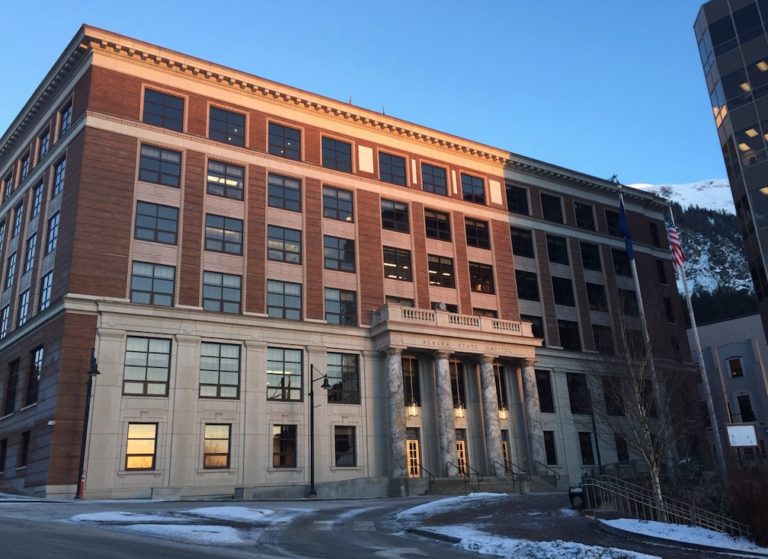
Popcorn: Senate education bill may cause sparks to fly on House floor, as higher base student allocation is on the move with election-year implications

2

Update: This has now been delayed and will not be on the floor on Friday.

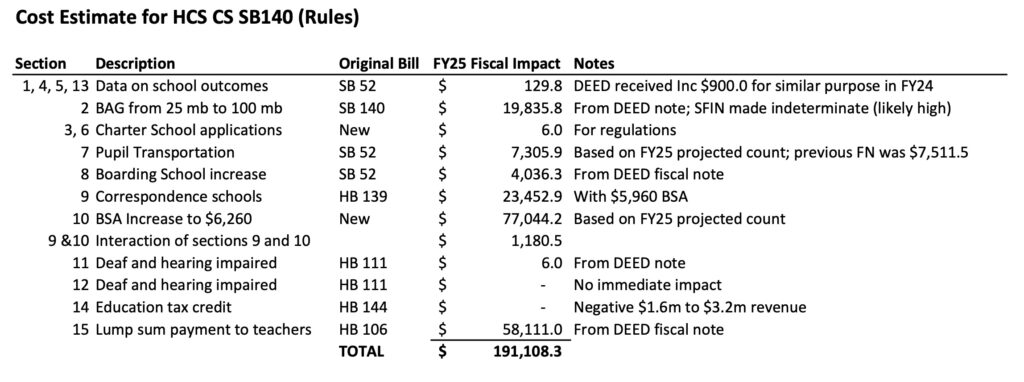
The Alaska House will take up Senate Bill 140 on the Friday floor calendar. What started out with Sen. Lyman Hoffman proposing spending for rural school internet has become a bill that brings up the base funding for education and has other contentious components.

The current base student allocation — the base amount of funding for schools by the State of Alaska — would go up by $300 under the current proposal. But once this bill hits the House floor, Democrats plan to try for $1,000 or more in additional spending, while some Republicans will back a $600 amount that is being crafted in legislative offices.

The House gavels in at 11 am and the proceedings can be watched online at Gavel Alaska.

Unions have swarmed the Capitol this week and are pressuring lawmakers to add more money to districts. How districts spend that money is up to them.

The argument from the education industry is that Alaska school funding is inadequate. Some, like Gov. Mike Dunleavy, want to tie additional spending to accountability. That’s why he worked to get the Alaska Reads Act passed — it was focused on the students, not administrators.

Others, like the National Education Association and other education unions, want the money without strings.

The Alaska Policy Forum says that unfocused education spending does not mean better results. Alaska spends per pupil is $20,191.

Alaska’s current expenditures were the highest nationwide in 2015, according to the NEA. But Alaska ranks 49th in fourth-grade reading, according to the National Assessment of Educational Progress test.

Between 2008 and 2019, Alaska’s education administrators grew their ranks nearly 18%, while the number of teachers fell 5.8%, according to the Alaska Policy Forum.

Alaska has 54 school districts, all with administration costs. Some are as as small as Pelican School District, with 16 students and two teachers. Anchorage, the largest, has 43,000 students and 2,053 classroom teachers, a student-teacher ratio of 17:1. Across the state, Alaska’s K-12 enrollment in public schools has continued to decline. Anchorage schools are losing 2% enrollment every year, but the Anchorage School Board has not had the courage to start closing schools.

Tim Barto: School choice annual event promotes education freedom, parental rights

By TIM BARTO | ALASKA FAMILY COUNCIL

A few years ago, Leigh Sloan was busily homeschooling her three children, but like many homeschool moms she wanted to provide her kiddos more interaction with others their ages, and she wanted them to have more exposure to other adult teachers.

Her solution was to create an alternative educational structure (a micro-school, if you will) that she calls “The Green Room.” 

The Green Room allows other families in similar circumstances to take turns providing instruction to each other’s children in their particular areas of expertise, all while supplying a positive and wholesome learning environment in the basement space they acquired in an Anchorage church.

Leigh and her fellow Green Room compatriots strongly believe that parents are in the best positions to decide their children’s educational paths. This doesn’t necessitate leaving the public schools, but may result in combinations that include some or all of the various schooling options: public, private, charter, trade, and home. 

The Green Room venture piqued Leigh’s interest in and commitment to school choice, and it led to her taking the reins in leading Alaska’s participation in National School Choice Week, with the major event being an annual School Choice convention. This year’s convention (which, to be accurate, was actually termed a “celebration”), took place Monday night at the Alaska Native Heritage Center. 

The National School Choice Week organization provided the bulk of funding for the event, but money also came in from generous donors, such as the local office of Americans For Prosperity. There were also 28 vendors, ranging from private schools to martial arts studios to policy advocacy groups to charter schools. These combined funding sources allowed the approximately 400 guests that showed up on Monday to enter for free. 

Speaking in person to the gathered attendees were Anchorage Mayor Bronson, stalwart Anchorage School Board member Dave Donley, Mat-Su School Board member Jubilee Underwood, Anchor Lutheran School Director Matthew Baxter, public school teacher Sharon Gibbons, parent and school choice advocate Evelyn Dutton, and Todd Smolden from Governor Dunleavy’s office. Appearing via video were Gov. Mike Dunleavy himself, as well as Education Commissioner Deena Bishop, Sen. Shelley Hughes, and Rep. Stanley Wright. 

While Leigh Sloan was the chief organizer of the event, she solicited and received much-needed assistance from Rebecca Koonce, Theo Ransum, and about 15 other volunteers, all of whom share a commitment to school choice. 

Ransum, who served as a roving emcee for the evening, has a story of his own regarding school choice. Several years ago, his two daughters found themselves unhappy at the Anchorage public high school they were attending, so Theo did some research and realized it was perfectly allowable for them to transfer high schools. They were then able to find a school (another public high school, it turned out) that provided learning and social environments more conducive to their educational goals, personal styles, and family values. 

And that type of freedom is what school choice is all about. 

With the trend in public schools being a continual chipping away at parental rights and a simultaneous promotion of leftist ideologies, school choice offers freedom for parents and students. Public schools may work for some – maybe even most – people, but many others would like to tailor their families’ educational programs to suit their children’s learning needs and values.

One of the positive outcomes of the Covid pandemic was the realization that education can be flexible, that families can break the stranglehold that public schools have on education. Staying home with their children and witnessing classroom instruction being administered via videoconferencing, parents were able to see firsthand how public schools were failing them, and the experience provided them the impetus to send their children to private schools, teach them at home, or provide a combination of the better parts of all the learning opportunities discussed above.

School boards, administrators, and teachers’ unions will not easily relinquish control of the education system. They will fight to maintain their power, influence, and funding, even – as we have seen – when confronted with the positive results of charter schools and other non-traditional public school programs. It is necessary to fight for, exercise, and promote school choice. Leigh Sloan and her volunteers and supporters deserve applause for doing so.

Tim Barto is vice president of Alaska Family Council and a regular contributor to Must Read Alaska. He and his wife homeschooled their five (now adult) children.

Dunleavy signs statement of support for Gov. Abbott regarding untenable Texas border crisis

Alaska Gov. Mike Dunleavy and 24 other Republican governors released the following joint statement in support of Texas Gov. Greg Abbott and Texas’ constitutional right to self-defense. 

The statement comes as the Biden Administration continues to attack Texas and refuses to take action or responsibility for the crisis at the Southern border, the governors said. Recently, the Biden Administration ordered Border Patrol agents to cut down the razor wire that Texas law enforcement had installed on the U.S. side of the border at Eagle Pass, where a flood of illegal aliens are crossing every day.

“President Biden and his Administration have left Americans and our country completely vulnerable to unprecedented illegal immigration pouring across the Southern border. Instead of upholding the rule of law and securing the border, the Biden Administration has attacked and sued Texas for stepping up to protect American citizens from historic levels of illegal immigrants, deadly drugs like fentanyl, and terrorists entering our country. 

“We stand in solidarity with our fellow Governor, Greg Abbott, and the State of Texas in utilizing every tool and strategy, including razor wire fences, to secure the border. We do it in part because the Biden Administration is refusing to enforce immigration laws already on the books and is illegally allowing mass parole across America of migrants who entered our country illegally. 

“The authors of the U.S. Constitution made clear that in times like this, states have a right of self-defense, under Article 4, Section 4 and Article 1, Section 10, Clause 3 of the U.S. Constitution. Because the Biden Administration has abdicated its constitutional compact duties to the states, Texas has every legal justification to protect the sovereignty of our states and our nation.”

Congressman Michael Cloud of Texas’ 27th Congressional District, filmed a short video three weeks earlier that shows the razor wire and migrants wading across the river to illegally cross the border:

Signatories of the letter include: Governor Kay Ivey (AL), Governor Mike Dunleavy (AK), Governor Sarah Sanders (AR), Governor Ron DeSantis (FL), Governor Brian Kemp (GA), Governor Brad Little (ID), Governor Eric Holcomb (IN), Governor Kim Reynolds (IA), Governor Jeff Landry (LA), Governor Tate Reeves (MS), Governor Mike Parson (MO), Governor Greg Gianforte (MT), Governor Jim Pillen (NE), Governor Joe Lombardo (NV), Governor Chris Sununu (NH), Governor Doug Burgum (ND), Governor Mike DeWine (OH), Governor Kevin Stitt (OK), Governor Henry McMaster (SC), Governor Kristi Noem (SD), Governor Bill Lee (TN), Governor Spencer Cox (UT), Governor Glenn Youngkin (VA), Governor Jim Justice (WV), and Governor Mark Gordon (WY).

Holland America sets all-time record for bookings

6

Just six months after recording its largest booking day, Holland America Line surpassed that high water mark on Jan. 16, 2024, setting a new single-day sales record.

The Jan. 16 bookings topped the previous record from July 11, 2023, by 18%, making it the biggest sales day in the 150-year history of Holland America Line, the company said.

One third of those record bookings are for Alaska cruises. About 22% of the cruises booked that day were for 2025 or later.

The week of Jan. 16 was during what’s called the industry calls “wave” season, a high-booking period for the cruise industry that happens usually between January and March.

“Stacking records on top of records is a sign of continued strength for our business and an endorsement from our guests that they are truly having the time of their lives exploring the world with us,” said Gus Antorcha, president of Holland America Line. “Our position as the cruise line with the most visits to Alaska’s glaciers and more ways to see wildlife is resonating, and we’re pleased to see so many guests already planning their 2025 vacations.”

The records come amid Holland America Line’s “Time of Your Life” sale, which has a number of attractive perks: Through Feb. 29, 2024, guests who book summer 2024 through spring 2025 cruises with the “Have It All” premium cruise package are getting a free stateroom upgrade, fare discounts, free fares for children, and reduced deposits. Cruisers who book before Jan. 31, 2024, also receive up to $500 per stateroom onboard credit, depending on cruise length. This is in addition to the perks of shore excursions, beverages, specialty dining, and Wi-Fi that are also included with the “Have It All” fare.

Holland America Line has the most Glacier Bay visits in the cruise industry, which portends a very robust season for Southeast Alaska, for those communities that welcome cruise ships.

The cruise lines have just signed an agreement with Juneau to limit ships to five a day this coming season. That could mean more visitors for Hoonah/Icy Straits, and Skagway, but the number of ships in any Southeast port can be limited by dock space and whether there is ample room to anchor. Not every ship has the ability to ferry people to the dock in lighter boats that go from ship to shore and back all day while the cruise ship is in the harbor.

Public employee pension bill leaves Senate Finance, lacks adequate fiscal note, which won’t be ready for a month

Once the go-to-gal for the GOP, Sen. Cathy Giessel of South Anchorage was the darling of the Democrats on Wednesday afternoon.

She was the star of a reception with AFL-CIO Alaska President Joelle Hall, celebrating the movement of Giessel’s bill, SB 88, out of Senate Finance, which means it will get a floor early this session. Unions have flooded the Alaska Capitol this week to make sure it does keep moving.

Giessel is now the AFL-CIO’s water-carrier, at least in the Senate.

Sen. Cathy Giessel, left, is hugged by AFL-CIO President Joelle Hall for managing to get SB 88, defined pension plan for state employees, out of Finance Committee without adequate fiscal notes.

SB 88 is written for state and local public employees: “An Act relating to the Public Employees’ Retirement System of Alaska and the teachers’ retirement system; providing certain employees an opportunity to choose between the defined benefit and defined contribution plans of the Public Employees’ Retirement System of Alaska and the teachers’ retirement system; and providing for an effective date.”

While existing public employees would have the option of choosing between defined benefits (old-style pensions) and 401K contribution plans, anyone new coming into the Alaska State and teachers employment systems will go into the back-from-the-dead defined benefit program.

It would almost certainly put Alaska in the red and hurt its bonding capacity. Alaska is the only state considering going back to pensions, while other states are sunsetting them. The Alaska defined benefits plan was closed to new entrants in 2006, just before it collapsed under its own weight. States that have these public employee pension plans are going bankrupt. 

Sen. Burt Stedman pointed out in the committee hearing that the fiscal notes are inadequate.

“I’m just struggling here trying to figure out, because we’ve got dueling actuaries, and we’ve got these fiscal notes. What do we use for thes fiscal note? We should be able to — we’re dealing with 100,000 people, I think — we should be able to put a hopefully a finer point on it. I don’t know what documents to rely on,” he said.

There was dead silence for several seconds. Stedman was the senator who helped get rid of the old defined benefits program and he is co-chair of the Finance Committee, along with Sen. Click Bishop, who favors reviving defined benefits from its grave.

Olson, who was chairing the meeting, bought up to the witness stand his aide, Ken Alper, who has been trying to get an income tax passed on Alaskans and now is endeavoring to reinstate the costly defined benefit plan that would drive up the state’s retirement costs. He gave a lengthy soliloquy but did not answer the question of why the fiscal note was not ready.

Alper said there is a regular agency fiscal note, but that the fiscal notes attached to the actuary are dated May, 2023 and written for the Senate Labor & Commerce Committee’s version of the bill. He said it will be updated, but not until the Finance Committee votes the bill out of committee.

“Because of the nature of the analysis, it’s expected to take over a month,” he said. The sponsors had all summer to update it, but neglected to do so, evidently.

With 11 sponsors who are in the Senate Democrat-dominated majority, the bill will have passed the Senate and be in the House for consideration before the actuary fiscal note is ready.

The 11 cosponsors on the bill are: 

Democrats: Senators Jesse Kiehl, Scott Kawasaki, Loki Tobin, Bll Wielechowski, Elvi Gray-Jackson, Forrest Dunbar, Matt Claman, Donny Olson

Republicans: Senators Cathy Giessel, Click Bishop, Gary Stevens

Audio is available for the Wednesday Senate Finance Committee deliberation and vote at this link.

Video of the hearing can be found at this link.

Oversight? Assembly Election Office drags feet adding Mayor Bronson to official list of candidates

Two days after Anchorage Mayor Dave Bronson officially filed with the Municipal Clerk’s Office, his name still does not appear on the website for the official list of candidates, a website managed by the Clerk, who runs Anchorage Elections.

Others who filed for the March-April ballot for various seats, however, are listed on the website.

For instance, Jennifer Wingard filed for Girdwood Valley Service Area – Seat A on Jan. 24. She appears on the candidate list. Joseph Connolly filed for Glen Alps Service Area – Seat E on Jan. 23, and his name appears on the list.

Frank Angela filed for School Board – Seat F on Jan. 23. He’s listed. So is Patrice Higgins, who filed for a road service board on Jan. 24, and Kristy Hoffman, who also filed on Jan. 24 for a road service seat.

In fact, none of the other candidates who have filed seem to have been lost in the shuffle at the Municipal Clerk’s Office; Must Read Alaska checks the filings daily and has spotted no other irregularities.

In Anchorage, the City Clerk reports to the Assembly, and the Assembly is headed by Chairman Chris Constant, who is a foe of Bronson. That may be the reason that Municipal Clerk Jamie Heinz is taking the slow lane on Bronson — Constant and several other members of the Democrat-majority Assembly have backed former Assemblywoman Suzanne LaFrance. LaFrance filed for office on Jan. 19 and her name appeared within a few hours on the list the clerk posts for the public on the Election website.

Bronson filed in the middle of the day on Tuesday, Jan. 23. As of Thursday morning, he does not appear as a candidate. Friday is the last day to file for Anchorage offices that will appear on the ballot being mailed to voters on March 13.

As of Jan. 25, the Municipal Clerk has not acknowledged that Mayor Dave Bronson has filed for reelection.

This comes at a time when the Anchorage Assembly has recently passed two ordinances aimed at putting a chill on election observers.

One ordinance, passed in December, makes the creation of a fraudulent public record a Class A misdemeanor. It’s aimed at election workers and volunteers. But there is no mention of not making a public record at all, such as appears to be the case in the Clerk’s Office when it comes to not letting the public know the mayor is a candidate.

The other ordinance, passed by the Assembly this month, sends a chill down the spine of volunteer election observers, who will now be subjected to vast subpoena powers that the Assembly just granted itself with the intent of forcing election observers, who are often present on behalf of a candidate or campaign to ensure fairness, to come before them and undergo an inquisition. 

The two ordinances were designed to suppress oversight of the election process in Anchorage.

The oversight for elections will now primarily be the Assembly, with volunteers expressing fear that they might have to hire lawyers should they be subpoenaed.

And the Assembly chair, who is the direct supervisor for the Election Office, has endorsed Bronson’s leading opponent.

The mayor is on his way to Juneau on Thursday morning making the case to the Legislature for the need for funding for infrastructure like the port, and additional funding for homeless services. Must Read Alaska was unable to reach Bronson for comment.