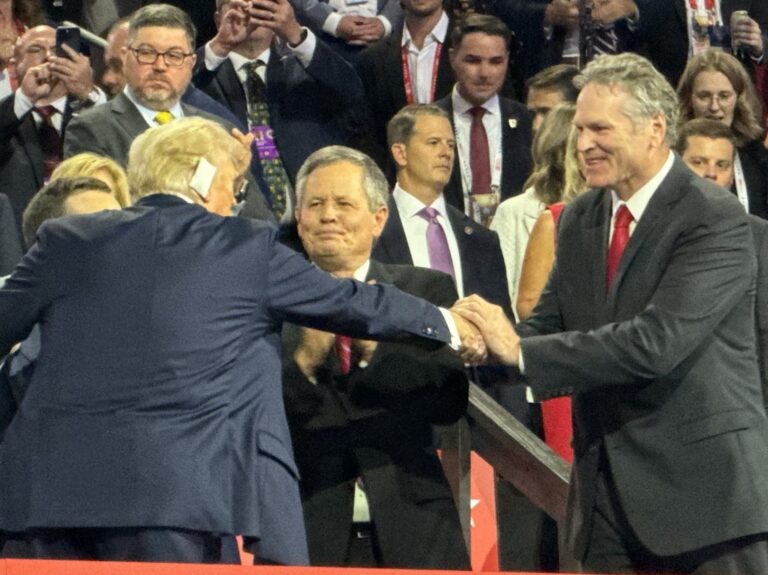
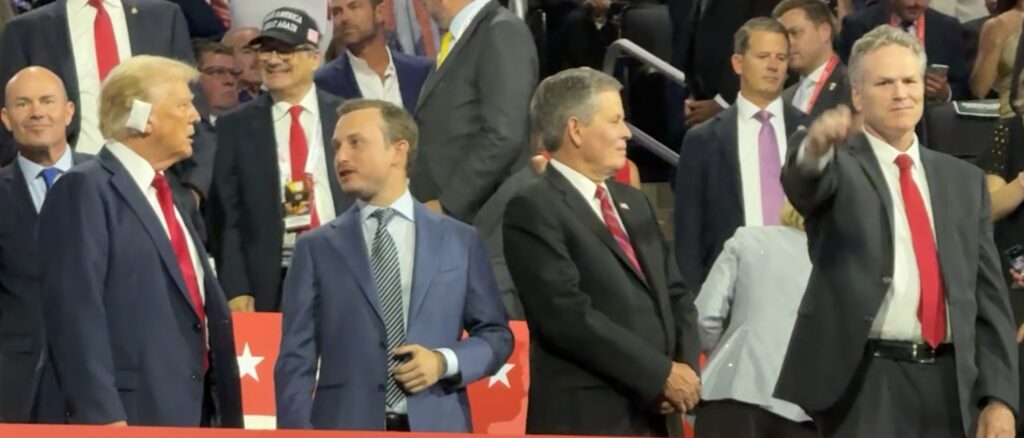
Alaska Gov. Mike Dunleavy was seated three seats from former President Donald Trump on Thursday evening at the Republican National Convention, in the first row of Trump’s designated box.
It’s a signal of the closeness in the relationship between the two political figures — a former and possibly future president and a second-term Republican Alaska governor. Dunleavy has been a strong supporter of Trump through thick and thin and was early to endorse him for president in 2023, after Trump announced his run. Dunleavy has said numerous times that Trump was the best president Alaska has ever had, when it comes to Alaska issues.
There would be dozens of other Republican governors or lawmakers who would jump at the chance to be three seats from the former president on the night when Trump is giving speech in which he will formally accept the nomination of the party.
Carmela Warfield, Alaska Republican Party chairwoman, said she snapped a couple of photos, one of Trump reaching over to shake Dunleavy’s hand. Then, Dunleavy turned and pointed straight at Warfield, who snapped another photo.
Alaska Gov. Mike Dunleavy spots Alaska Republican Party Chairwoman Carmela Warfield on the convention floor, just as she snaps this photo of him in the box assigned to Donald Trump at the Republican National Convention.
“Governor Dunleavy being seated in the President’s Box with President Trump, on the last night of our Republican National Convention, is a sign of great things to come for Alaska. There could not be a greater contrast between the Biden administration – which has levied more sanctions on Alaska than he has on the country of Iran – and what the future holds for Alaska with a united Republican Party under a Trump administration. Together, President Trump and Governor Dunleavy will make America energy dominant again. Let’s get to work!” said Warfield.
Rumors are swirling that Dunleavy will be tapped for a seat in the Trump cabinet, if Trump is elected president in November. Those rumors have been around for months, but are especially being discussed now, and the seating arrangement at the convention has fed further speculation about a possible position as Secretary of the Interior.
Alaska Sen. Dan Sullivan has been a star at the Republican National Convention, appearing at events alongside grassroots Alaskans, dressed in a smart suit, with his wife Julie Fate Sullivan at his side. He has spent more time there than most other Republican senators or congressional representatives.
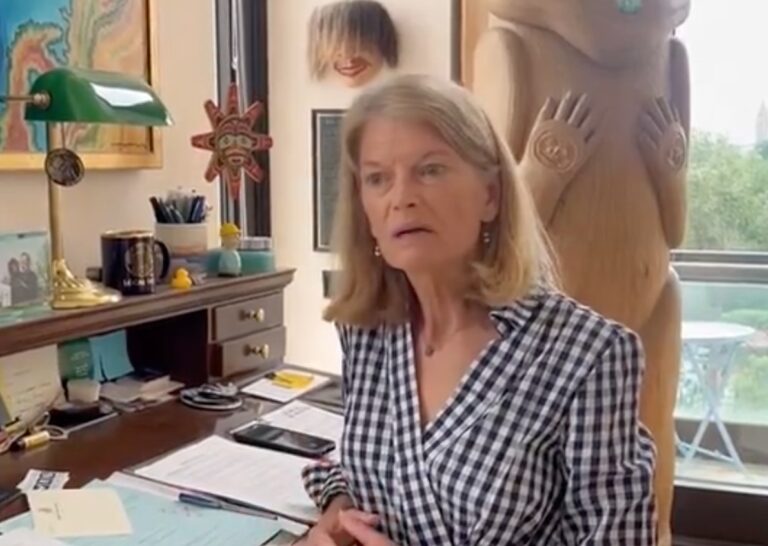
But Alaska Sen. Lisa Murkowski has been seen nowhere, not even in Alaska, according to reports from around the state. She’s done a deep dive into silence. And she has been largely absent from her social media account. That may be because she is a “never-Trumper,” with her well-known hatred of Donald Trump.
Neither senator is allowed to use their official social media accounts for political business, but Murkowski has been quiet for four days since her one social media post that spoke about the assassination attempt against Trump.
Today, her staff simply posted a congratulatory message to Alaska’s two Olympic athletes, Kristen Faulkner of Homer, on the U.S. Cycling Pursuit Team; and Alev Kelter of Eagle River, on the U.S. Rugby team. The message was from the entire congressional delegation.
Murkowski avoided being with the Alaska Republicans who are at the convention, and has said several times she is considering leaving the Republican Party, especially is Trump is elected. For her, Trump is a bridge too far.
She may now be realizing that, with Republicans on the rise and the likelihood that Trump will win in November, she could very well be odd-man-out in a new Republican majority in the Senate.
Murkowski has to pick her path carefully now, because she is in line to become a leading Republican member of the Senate Appropriations Committee, should the Republicans regain majority rule in the Senate.
Murkowski was the only Republican senator facing re-election in 2021 who voted Trump guilty at his impeachment trial. Trump went on to endorse Kelly Tshibaka for Alaska’s Senate seat, but Murkowski’s minions outsmarted him by convincing Alaskans to adopt ranked-choice voting, which ensured her reelection.
“She is neither Republican in form or action. Everything she’s done to this point is about big-government — she just wants to grow government,” observed Michael Tavoliero, a Republican activist from Eagle River. “When you look at her record, she maintained that ‘you put legislation repealing Obamacare in front of it I’ll vote for it,’ but when it was in front of her she was a key vote to keep it in place. She voted for every big-money Biden bill we’ve seen.”
In addition to being on the outs with her own party, Murkowski has had other bad news this week that may contribute to her going into her bunker.
An applicant for U.S. District Court judgeship was outed by the Alaska Landmineas being involved in a sex-texting scandal with former federal District Court Judge Josh Kindred, who has recently and quite suddenly resigned under pressure, after an investigation by the Ninth Circuit Court of Appeals. The Landmine disrobed the seedy scandal that involves lawyers in both the Justice Department of the Biden Administration, and the court system itself.
Although Michelle Nesbett applied, she was not among those who were actually considered, even as she lines up with Murkowski on many liberal issues. Nesbett was the Alaska attorney who led 120 women lawyers from Alaska to Washington, D.C. to meet with Murkowski and ask her to vote down the nomination of Supreme Court Justice Brett Kavanaugh. Murkowski complied and voted against Kavanaugh, who was confirmed, nonetheless.
After receiving applicants for the open position created by the retirement of Judge Timothy Burgess, Sullivan last September set up a panel to help the delegation recommend a judge candidate. The nine-member panel helped him delay the appointment of a liberal to that seat. He and Murkowski don’t appear to agree on candidates for the job of federal judge.
Murkowski was hostile to the nominating council process Sullivan set in place, preferring to defer to the highly political Alaska Bar Association. Murkowski said the Sullivan judicial council process would delay filling a vacant Alaska U.S. District Court seat.
The application period for that judgeship ended in November, and 16 have applied. It’s the president who names the federal judges, but almost always with the advice of the state’s delegation. And that is where things get sticky.
With the rise of Donald Trump as a viable nominee, and the fall of President Joe Biden, who has gone from slightly addled to nearly decrepit, Murkowski is finding herself in a no-man’s land. She had probably hoped to put in a liberal pro-abortion judge to line up with U.S. District Judge Sharon Gleason, who is an appointee of President Barack Obama. But now, with Biden ailing and Trump in a position to win, she may lose this opportunity to make a liberal-dominated district court for Alaska.
Murkowski aligns with Democrats more than Republicans, yet if she becomes an actual registered “independent,” she may get no significant role in the leadership organization in the Senate that seems more and more likely to favor Republicans. And her hatred of Trump makes her less of an asset to Alaska.
U.S. Sen. Dan Sullivan was on a bipartisan call with the heads of the U.S. Secret Service and FBI this week, being briefed on the attempted assassination of former President Donald Trump.
Sullivan was one of four senators on the call who were given the opportunity to ask questions about the state of security around Trump, who survived an assassin’s bullet on Saturday.
The briefing statements from the federal top law officials appear to have been vague and unsatisfactory. One senator asked about the use of drones in their security work. The answer was yes, but drones were not utilized in this instance because Secret Service had augmented their security with snipers.
Sullivan said he was able to get three questions in, and none of the answers were that helpful. The first question was why the manufacturing building outside the event where Trump was speaking had not been secured. The pre-event walk around the grounds by security officials showed them that the building was a real security risk. But the building was still not secured during the event. There were no police stationed on it or around it.
That building Crooks was on was outside the perimeter of the event itself, and so was the responsibility of state and local law enforcement in coordination with the Secret Service, so there was some kind of breakdown in communication, since Crooks was seen by many people. Secret Service is in charge of coordinating the security for such an event.
Officials told senators that up to 63 minutes had passed between the time Secret Service snipers first spotted the Thomas Matthew Crooks on a rooftop and the time shots were fired at Donald Trump, while he spoke at a rally in Butler, Pennsylvania, sources said.
The officials had again spotted Crooks at least by 5:52 pm, and Crooks was able to shoot at Trump at 6:12 pm. Crooks’ bullets hit others behind Trump, killing one man and injuring two others, officials told others.
Sullivan also asked how Crooks got up on the building. Secret Service Director Kimberly Cheatle “literally said, ‘We don’t know yet.'”
In response to the briefing segment about a separate attempt on Trump’s life by Iranian operatives, Sullivan asked for more details on the Iranian threat and asked what the law enforcement arms of the United States plan to do about the threat.
FBI Director Christopher Wray said the Iranian threat was unrelated to Crooks, as far as they know at this time, but that Iran’s lethal targeting of senior American officials has become “very brazen and aggressive.”
Some believe the reported Iranian plot to kill Trump is in retaliation for Trump ordering the drone strike that killed Qasem Soleimani, an Iranian military officer who served in the Islamic Revolutionary Guard Corps until his death on Jan. 3, 2020. Trump had killed the most notorious terrorist on the planet.
Since the shooting on July 13 in Pennsylvania, the Secret Service has come under withering scrutiny for its emphasis on “diversity, equity, inclusion” hires and not hiring for lethality, skill, and judgment. Secret Service Director Cheatle has been subpoenaed by the U.S. House Oversight and Accountability Committee.
Many questions are unanswered, with top federal law enforcement officials not revealing as much information as an average citizen could gather by simply reviewing video footage taken by hundreds of people at the event, all of which is widely available now on social media.
Alaska’s U.S. Sen. Dan Sullivan, who attended the first three days of the Republican National Convention, said the party is unified with a common vision for the future.
In an exclusive interview with Must Read Alaska, Sullivan said the platform for the party is strong on policy helping working Americans, energy dominance, and national security.
Sullivan gave a “big shout out” to Sen. Marsha Blackburn of Tennessee and Rep. Mike Waltz of Florida, who is the first Green Beret to serve in Congress, for coming up with a platform that has the party fully unified.
In it are the words “Drill, Baby, Drill,” something that Sullivan thought Donald Trump probably had a hand in inserting as language.
In his talks with Trump, Sullivan said the presidential nominee brought forward the idea of creating an “iron dome” type missile defense for America, similar to what Israel has. Sullivan said that Alaska would play a large role in such an endeavor.
Sullivan met with several former and possibly future national security figures this week, including former Secretary of State Mike Pompeo, former Director of National Intelligence Richard Grenell, and former Deputy Assistant Secretary of Defense for Strategy and Force Development Elbridge A. Colby.
“We will have a very strong foreign policy, in sharp contrast to the weakness of Biden,” Sullivan said. “Peace through strength.”
Speaking about J.D. Vance as the vice presidential nominee, Sullivan noted with pride that Vance would become the first U.S. Marine in history to become vice president.
Sullivan remembered that he attended events in Ohio in 2022, when Vance was running for Senate, and that Vance attended Sullivan’s retirement party when he left active service in the Marines.
There’s a bond between them as Marines: “We have an ethos: Always faithful, semper fidelis. It applies to Marines but also to the American people we serve. Vance stopped and looked at the camera and said, ‘To all the Marines out there: Semper Fi.’ I loved that!”
Sullivan also appreciated that Vance has a focus on helping the working men and women who built this country.
People now have a choice between the Democrats, who view themselves as the party of working Americans but who are not, Sullivan said. It’s the Republicans who have the real interests of working Americans, as the Democratic Party is now being run by and for coastal elites and left-coast radicals.
For Sullivan, who formed up a group in the Senate called the Labor and Working Americans Caucus, it’s a focus he has had for years, as his home state is one that is very much the heart of working-class families.
“Alaska is ground zero. Think of everything we do, from oil rigs, to ice roads. The Democrats want the state of Alaska shut down,” he said.
Sullivan also touched on the personal life story of J.D. Vance, whose book “Hillbilly Elegy” talks about the terrors of a child growing up around opioid and fentanyl drug use. It’s an issue that is exceedingly important to Sullivan and that he has worked on continuously, as Alaska has serious issues with substance abuse.
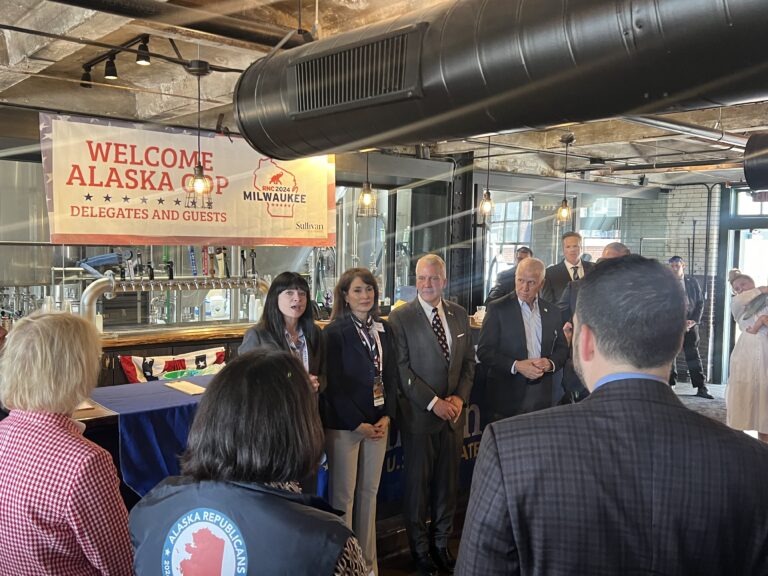
On the fun side of the convention, he hosted a gathering for Alaskans at a local beer brewing company in Milwaukee, and brought in Sen. John Thune of South Dakota and others to speak.
Vice presidential nominee J.D. Vance took the stage as the final speaker in a long day of emotion-filled speeches at the Republican National Convention on Wednesday night. He did not disappoint.
As Donald Trump’s choice for vice president, Vance spoke to his working-class upbringing in a small town, his mother’s addiction, and being raised by that single parent who was dysfunctional. He talked about his grandmother, “Mamaw,” who kept loaded guns all over her house and dropped the “F” bomb regularly. It was a rough growing up, but one that many in America can relate to.
“Now, my Mamaw died shortly before I left for Iraq in 2005, and when we went through things, we found 19 loaded handguns. They were stashed all over her house, under her bed, in her closet, in the silverware drawer. And we wondered what was going on,” he said. “And it occurred to us that towards the end of her life, Mamaw couldn’t get around so well, and so this frail old woman made sure that no matter where she was, she was within arm’s length of whatever she needed to protect her family.”
“That’s who we fight for. That’s American spirit,” Vance said. He continued, turning to his theme of affordability and the crisis that many Americans now face just making ends meet.
“Joe Biden’s inflation crisis, my friends, is really an affordability crisis, and many of the people that I grew up with can’t afford to pay more for groceries, more for gas, more for rent, and that’s exactly what Joe Biden’s economy has given them,” Vance said. He turned his sights on the wolves of Wall Street.
“We’re done, ladies and gentlemen, catering to Wall Street; we’ll commit to the working man,” Vance said. “We’re done importing foreign labor. We’re going to fight for American citizens and their good jobs and their good wages. We’re done buying energy from countries that hate us. We’re going to get it right here from American workers in Pennsylvania and Ohio and across the country.”
“President Trump represents America’s last best hope to restore what, if lost, may never be found again, a country where a working-class boy born far from the halls of power can stand on this stage, as the next Vice President of the United States of America,” Vance said.
“America’s ruling class wrote the checks. Communities like mine paid the price,” Vance said. “For decades, that divide between the few, with their power and comfort in Washington, and the rest of us only widened. From Iraq to Afghanistan. From the financial crisis to the Great Recession. From open borders to stagnating wages, the people who govern this country have failed and failed again.”
The first-term U.S. senator from Ohio was enthusiastically received by the delegates and guests of the Republican National Convention, which has captivated the nation with many speakers who have moved the delegates to tears with their personal stories, in stark contrast to the dysfunction of the Democrats.
Vance, 39, enlisted in the U.S. Marines shortly after 9/11. That touched the heart of many in the convention, including Rep. Jamie Allard of Alaska.
“J.D. Vance gave it to us straight tonight. As a new generation of conservatives rises, J.D. somehow reminds us of the Greatest Generation, one who was willing to lay down his life as a Marine in Iraq. He’s also someone many Americans can relate to, rising above his humble beginnings and imperfect family struggles. Compared to Kamala Harris … well, there just is no comparison,” said Rep. Allard, who is a U.S. Army veteran.
Vance’s working class roots, family dysfunction, and the stepping of his tough-as-nails grandmother to raise him was something that Alaska congressional candidate Nick Begich said shows how all Americans can overcome their tough childhoods.
“J.D. Vance’s story is like so many Americans’ story — aspirations and dreams impacted by a challenging home life,” said Begich, who is at the convention. “Drug abuse, alcoholism, and a broken home threatened to crush a boy with incredible potential, but a tough and loving grandparent stepped in to raise the young man who will become our nation’s next vice president. Vance’s story reminds us that every child has potential, every child deserves good parents, and that preserving the American Dream is not some lofty goal but is vital to the health of our nation.”
John Mowry of Fairbanks, who is at the convention as a delegate, said he was struck by the humility that Vance exhibited.
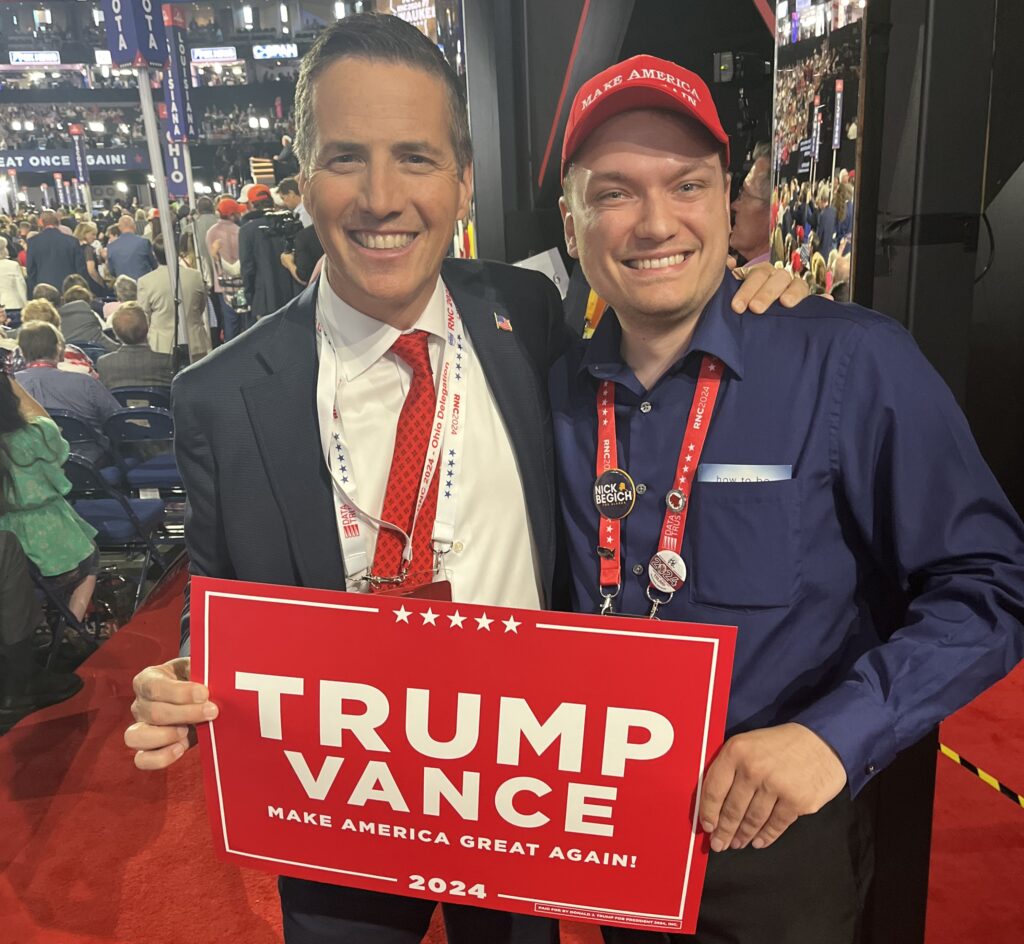
“The thing I really liked about Vance is his solid commitment to Christian conservative values and as vice president to carry on the mantle of the Make America Great Again movement and not the establishment’s agenda,” Mowery said. Mowery is the youngest Alaska delegate at the convention. He is 26 years old and a personal friend of Bernie Moreno, who is running for U.S. Senate in Ohio, and who is endorsed by Trump.
Bernie Moreno, running for U.S. Senate in Ohio, and John Mowery of Fairbanks, Alaska, delegate to the RNC Convention on July 17, 2024.
“We are a unified and electrified Party, and we are mission focused as we move toward November. More young Americans are making their voices heard as members of our Party. JD Vance is an indicator of the powerful youth movement in the Republican Party and the new energy and generation stepping forward to lead – he is the first top ticket candidate in 70 years who is under the age of 40. Vance is relatable and admirable – he comes from humble beginnings, has served our country with honor, and his message is resonating with many. He will be an inspiring Vice President and a shining example for us all,” said Carmela Warfield, chairwoman of the Alaska Republican Party.
Writer Ben Domenech reflected on Vance’s unlikely journey from being a never-Trumper, thinking Trump was a dead end for Republicans, to embracing him as a champion for “America First.”
“If the vice presidency is itself a very boring job in the realm of politics, tasked with worthless drudgery, Vance is far more interesting than the role requires. And his intellectual journey to this point, whatever you think of his views today, is worth understanding to get the measure of a man who seemed more likely to end up in academia than in the White House,” Domenech noted in this thought-provoking column in The Spectator.
Alaska’s Department of Labor and Workforce Development (DOL) released its annual Cost of Living survey this month. Contained in the July issue of Alaska Economic Trends, the report reflects that while inflation has cooled, the cost-of-living in our state remains stubbornly high.
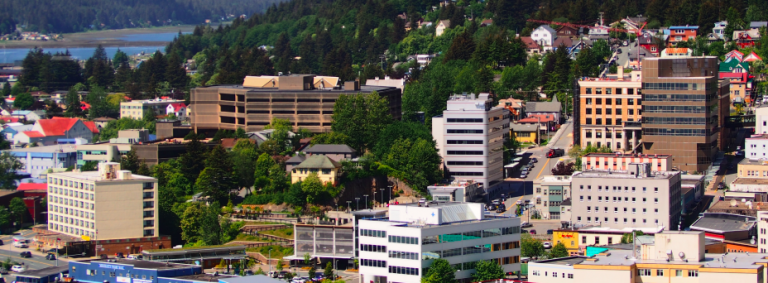
Within the state, Juneau’s economic trends place it at the top of some lists in several categories.
The report breaks down costs into six areas: housing, utilities, groceries, transportation, health care, and miscellaneous goods and services.
Much of the report is based on information from the Council for Community and Economic Research. The Council produces quarterly and annual cost-of-living indexes comparing costs for a fixed standard of living in hundreds of cities, including three cities in Alaska: Anchorage, Fairbanks, and Juneau.
Index values for Alaska ranged from a low of 124 in Anchorage to a high of 128 in Juneau, meaning their costs were 24 and 28 percent higher than the survey average.
Of the 276 participating cities, Anchorage, Fairbanks, and Juneau ranked 24th, 21st, and 18th respectively for overall costs, behind some high-cost metros on both coasts.
Notably, Juneau ranked considerably higher in several of the individual categories, placing 31% higher, 40% higher, and 51% higher than the national average in Housing, Utilities, and Health Care, respectively.
However, since housing is most households’ largest single expense and is a major determinant of the overall cost-of-living, DOL conducted a separate survey for it. In that survey, Juneau topped the list with the highest average single-family home price of $509,285 among all cities in Alaska.
The median monthly residential rental price for a 2-bedroom unit placed Juneau in the middle of the pack at $1,561, with Kodiak the highest at $1,713 and Wrangell the lowest at $1,081.
Census Bureau data on median monthly housing costs (which include mortgage or rent, property taxes, utilities, etc.) for the four years ending 2022 were included for comparison. Juneau was the 4th most expensive city in Alaska behind the Aleutians, Anchorage, and Kodiak. However, this survey doesn’t account for the significant increase in property taxes experienced by Juneau homeowners recently.
Alaska’s geography and remoteness contribute to higher prices in many areas. It becomes almost too easy to justify or rationalize our higher cost-of-living. Yet, our local community governments still have the tools to moderate these higher costs if they choose to use them.
The most obvious way to moderate living costs is to be fiscally responsible and keep taxes low. The Juneau Assembly’s record on this has not been reassuring. While the Assembly approved a token decrease in the property tax millage rate, it does not begin to offset the inordinate increase in property assessments in the last several years.
The Assembly’s predilection for devoting large cash appropriations for projects that voters have rejected is not a sign of fiscal responsibility. Taxes diverted for discretionary projects could otherwise be used for paying down debt or rebating back to taxpayers, thereby lowering property taxes and the overall cost of housing.
Government can grow a community’s tax base organically by fostering economic growth and by reducing over-regulation and bureaucratic obstacles to development.
The current debate over cruise industry impacts in Juneau is a case in point. The cost-of-living won’t be lowered by telling visitors they aren’t welcome to visit the capital city on Saturday, or any day, for that matter, as some cruise critics have proposed.
Nor is blocking responsible development that stimulates our economy and enhances visitor experiences like Juneau’s Huna Totem Dock project. Approval for a needed tidelands lease for the project has languished for months as the Assembly continues to delay a decision.
There is a definite connection between Juneau’s high costs and our Assembly’s reluctance to lower taxes and do more to expand the economy.
Furthermore, Juneau faces some big fiscal challenges in the years ahead. Our school system, our hospital, and our public safety agencies will need considerable financial support to continue providing the level of service that taxpayers expect.
Those needs take priority over some of the wish list items still being funded or discussed by our Assembly.
When will our elected officials connect the dots?
After retiring as the senior vice president in charge of business banking for Key Bank in Alaska, Win Gruening became a regular opinion page columnist for the Juneau Empire. He was born and raised in Juneau and graduated from the U.S. Air Force Academy in 1970. He is involved in various local and statewide organizations.
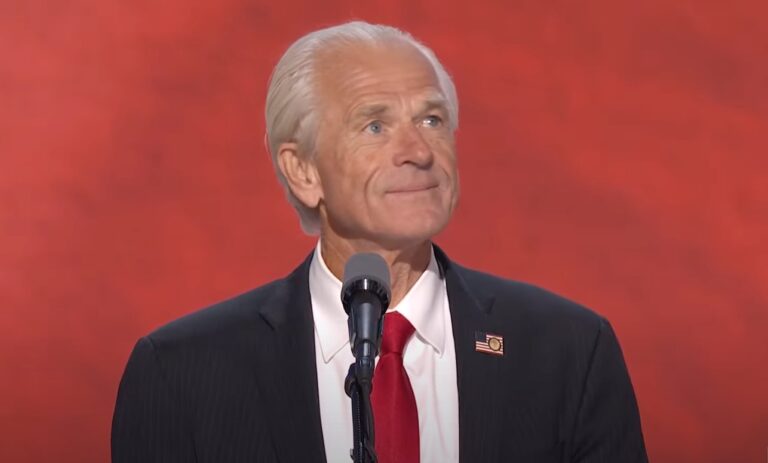
Peter Navarro, economist and former director of the Office of Trade and Manufacturing in the Trump Administration, was released from federal prison, where he had served a four-month sentence for refusing a congressional subpoena.
Just hours after his release from a Miami prison, he was greeted with thunderous applause and cheering at the Republican National Convention in Milwaukee.
Navarro had refused to cooperate with a congressional investigation into the events of Jan. 6, 2021, which Democrats have described as an insurrection.
After a huge ovation that went on for minutes, Navarro addressed the Convention: “It’s a beautiful thing….I think you folks just want to know if you can see my MAGA tattoo that I got there…” The crowd exploded in laughter. “Yes, indeed, this morning I did walk out of a federal prison in Miami. Joe Biden and his Department of Injustice put me there. Tonight I’m here with you in this beautiful city of Milwaukee and I’ve got a very simple message for you:
“If they can come for me, if they can come for Donald Trump, be careful, they will come for you,” he said. “If we don’t control our government, their government will control us. If we don’t control all three branches of our government, the legislative, the executive, and the judiciary, their government will put some of us like me and Steve Bannon in prison.”
He then recounted the events that led up to his imprisonment. “The legislative branch came for me first, your favorite Democrat [former Speaker] Nancy Pelosi created your favorite committee, the sham January 6 committee, which demanded that I violate executive privilege. What did I do? I refused. The J-6 Committee demanded that I betray Donald John Trump to save my own skin and I refused.”
Navarro continued, “Here’s the thing about the Constitution — they demanded that I break the law because they had no respect for it. I refused. And a Democrat majority in the House voted to hold me in contempt. What happened next? The next jackboot to drop was the executive branch, another one of your favorite Democrats — Democrat Attorney General Merrick Garland. Him and Jack Smith indicted and prosecuted me for criminal contempt of Congress. It’s something the Democrat prosecutors refused to do against one of their own, including two guys with blood on their hands — Eric Holder and Alejandro Mayorkas, the great ‘border czar,’ right? They’ve actually gotten people killed.”
Navarro continued to tell his personal experience with the January 6 Committee and the Democrat-controlled House.
Steve Bannon reported to prison on July 1 for defying the J-6 committee; he is serving a four-month sentence.
As an engineer, when I start a project, I confirm that the information I have to work with is correct, and that my objective is understandable and clear.
If in the course of my evaluation of that new project anything appears to not line up with my understanding of the project. I do deeper evaluation to determine what is right and make adjustments to the basis of the design to ensure a proper outcome.
I have been involved with projects that are based on combating climate change that results from greenhouse gas emissions. I have been evaluating the claims of heating, especially here in Alaska. When I became aware of the claims that Alaska is warming two to four times the rate of the rest of the planet, I began checking to see if this claim is true.
In my investigation of temperatures of the air, water, and soil around Alaska, I use actual data that is Alaska data; I do not consider computer models, upper atmosphere physics, or other esoteric sources.
After I looked at the claims that Alaska was warming two to four times faster than the rest of the planet, I kept looking at other data, such as sea surface temperatures, sea ice extent, soil temperature profiles, and the growing seasons around Alaska.
So far, I am sticking with my finding that Alaska is not warming at a rate much faster than the rest of the planet, and the claim that it is warming faster is based on data analysis that skews the outcome because of the lack of extreme low temperatures for a few years in Alaska.
It is true that Alaska has warmed a bit from the cooling of the Little Ice Age, and that warming does not seem to be continuously advancing at any significant rate. The sea surface temperatures at coastal communities of Alaska are at or below normal values. Some locations have had above normal temperature over the past few years. A friend reported to me last week that the temperature is Bristol Bay is back down to normal, 54.3o. Southeast Alaska has slightly above normal surface temperatures at this time.
There are reports in Alaska newspapers of ancient trees revealed from beneath the glaciers as they recede. A range of ages are revealed by carbon dating that is 1,000 to 2,500 years or more. From this I know that it has been warmer in Alaska than it is now, and that warm could not have been the result of greenhouse gas in the atmosphere. I encourage everyone to observe your surroundings, pay close attention to the weather, with intent to make up your own mind about global warming and climate change.
The hot weather occurs in the summer time when high pressure areas occur over a location. Likewise, cold weather occurs when high pressure occurs in the winter time, at high latitudes (like Alaska). So whatever has happened seems to have altered the path and pattern of the jet stream so that the high and low pressure areas are not as predictable as they used to be. Have you noticed that it was warm this spring and summer when the sky was clear, and have you noticed that when the clouds moved in it has been cooler and rainy?
If CO2 is not the evil that the world’s population has be convinced it is, we need to quickly and urgently spread the word and educate the people that science has been abused and misrepresented and we need to not blame fossil (hydrocarbon) fuels for the changes we have experienced. We need to quickly and urgently affect a change in energy policy in Alaska and in the U.S. and get back to market-driven energy markets, get back to cheap energy, get back to reliable energy, and get back to sensible energy and practices in Alaska.
For communities without fossil fuels or hydroelectric power plants, the wind and solar, or other renewable energy sources should still be pursued to provide power to those communities. Meanwhile, we in Alaska, can spent the years or decades in front of us to come up with whatever energy source that will best replace the natural gas or coal that has served us well for so long.
I will continue to study the temperature data for Alaska as well as precipitation, sea level, sea ice, and other factors that might be affected by climate variations. But now is the time to start our action to change direction on energy and resource development policies. Our citizens are better off with the fossil fuel-driven economy. They are better off from a health perspective and they are better off with opportunities with the fossil fuel-driven economy. Without the fossil fuel economy, Alaska would have no economy at all, or at best a small economy. If Alaska is to make a change, we need time to develop whatever we will change to.
If you understand science at all, you will know that the rightness or wrongness of understanding of a process is not provided by consensus of involved scientists. Truth is arrived at by scientific studies which are in direct opposition to many of the other studies to demonstrate best what seems to be, as opposed what doesn’t work.
Keep reading. Keep studying. Keep thinking. Keep discussing. You’ll reach a point of enlightenment.
Robert Seitz is a professional electrical engineer and lifelong Alaskan.
Hours after President Joe Biden told BET News that he would consider dropping out for a medical condition, the White House claims that Biden has tested positive for Covid and is being forced to cancel his speech at the UnidosUS annual conference in Las Vegas.
Biden said in an interview released on Wednesday that he would reconsider staying in the race if a doctor told him he had a medical condition. Ed Gordon of BET News had asked Biden if there was anything that would make him re-evaluate his decision.
“If I had some medical condition that emerged, if somebody, if doctors came to me and said, you got this problem and that problem,” Biden responded.
Biden is current on all of his Covid shots and boosters. This is his second bout with Covid in four years. He has said repeatedly that his doctors say he has no serious condition. His White House physician, Dr. Kevin O’Connor, wrote in February that Biden is “a healthy, active, robust, 81-year-old male who remains fit to successfully execute the duties of the presidency.”
A statement from White House Press Secretary Karine Jean-Pierre said Biden has moderate symptoms, including a runny nose, dry cough, and weakness.
“Earlier today following his first event in Las Vegas, President Biden tested positive for COVID-19. He is vaccinated and boosted and he is experiencing mild symptoms,” Jean-Pierre wrote in a statement.
“He will be returning to Delaware where he will self-isolate and will continue to carry out all of his duties fully during that time. The White House will provide regular updates on the President’s status as he continues to carry out the full duties of the office while in isolation,” Jean-Pierre said.
“The President presented this afternoon with upper respiratory symptoms, to include rhinorhea [sic] (runny nose) and non-productive cough, with general mailaise. [sic] He felt okay for his first event of the day, but given that he was not feeling better, point of care testing for COVID-19 was conducted, and the results were positive for the COVID-19 virus. Given this, the President will be self-isolating in accordance with CDC guidance for symptomatic individuals. PCR confirmation testing will be pending. His symptoms remain mild, his respiratory rate is normal at 16, his temperature is normal at 97.8 and his pulse oximetry is normal at 97%. The President has received his first dose of Paxlovid. He will be self-isolating at his home in Rehoboth,” his doctor said.
Biden’s embarrassing performance in the June 27 debate with Donald Trump last month has created a groundswell of calls for him to step aside, as he appears to be suffering from advanced dementia. Today, Rep. Adam Schiff, a Biden loyalist, called for him to withdraw from the race. Schiff is the highest-profile Democrat to make the case that Biden cannot win.
During his speech to the NAACP on Tuesday, Biden lost his train of thought and rambled incoherently.
This is from Biden’s speech to the NAACP yesterday.
He loses track of what he’s saying constantly. Asking people to ignore what’s right in front of them is absurd. pic.twitter.com/b2IVsFStIe