Sunday, May 3, 2026
Home Blog Page 182

Compare and contrast: Gov. Walker signed pact with communist China, while Gov. Dunleavy deals with free Taiwan for natural gas sales

It has been seven years since Alaska Gov. Bill Walker and entities owned by the communist Chinese government signed a preliminary agreement granting extraordinary control over the planned Alaska LNG project to Chinese firms, including Sinopec, the Bank of China, and the China Investment Corporation, all owned by the communist government.

Under the agreement, Sinopec, a state-owned oil and gas company, would serve as the primary buyer, committing to purchase up to 75% of Alaska’s natural gas from the AKLNG project. The company would also be responsible for the engineering and construction of the gasline.

The Bank of China, also government-owned, would act as the primary lender, putting Alaska in financial dependency on China.

Additionally, the China Investment Corporation would take an equity stake in the project, giving China a direct ownership interest in Alaska’s natural gas infrastructure. This was all part of China’s international effort to buy up and control infrastructure. It is called the “Belt and Road Initiative.”

A widely circulated photo of Gov. Walker shaking hands with Chinese President Xi Jinping highlights the relationship Walker cultivated with China. This courtship began in April 2017, when President Xi made a stopover in Anchorage. Walker and then-AGDC head Keith Meyer later traveled to China to further negotiate details.

Gov. Bill Walker signs a deal with China in November, 2017, to build the Alaska LNG Project.

After Mike Dunleavy was elected governor in 2018 — his victory due in part to public opposition to Walker’s deals with China — he promptly canceled the agreement.

On July 19, 2019, Joe Dubler, interim president of the Alaska Gasline Development Corporation after Keith Meyer’s departure, testified before the Alaska House Resources Committee that the joint development agreement had effectively collapsed. The Dunleavy administration had informed the Chinese via teleconference that Alaska would instead pursue partnerships with North Slope producers and other potential buyers.

Then, in 2022, Sinopec was delisted from the New York Stock Exchange.

Six years into his administration, Dunleavy embarked on a trade mission to Asia to secure non-communist buyers for Alaska’s gas, notably avoiding China. He returned with at least one letter of intent from Taiwan’s President Lai Ching-te, expressing Taiwan’s interest in purchasing six million tons of LNG per year from Alaska and even investing in the project.

While the agreement with Taiwan is still non-binding, the Alaska Gasline Development Corporation has meanwhile secured a primary private-sector developer, Glenfarne Group, to lead the project. Similar to the Trans-Alaska Pipeline System, which is privately owned by Alyeska Pipeline Service Company, the gasline project is moving toward a private-sector ownership model, as it was before Walker took office in 2014 and started giving Alaska’s infrastructure to the communists.

When Gov. Walker made his deal with China, he had just one year left in his only term.

Now, Gov. Dunleavy has less than two years to finalize agreements with key stakeholders, including builders, buyers, and financiers, to ensure the gasline delivers energy to Alaska’s Railbelt region and international buyers in Taiwan, South Korea, Thailand, Japan, and beyond. He is spending a good deal of his time on this project to finalize it before he leaves office.

The project reached a new milestone on March 27, when AGDC signed binding, definitive agreements with Glenfarne Group, which will assume a 75% ownership stake, with AGDC retaining 25%. Glenfarne is expected to make its final investment decision in the fourth quarter of 2025 after securing additional investors.

The Alaska Industrial Development and Export Authority approved a $50 million line of credit in December for front-end engineering and design work, which Glenfarne estimates will cost around $150 million. Additionally, federal loan guarantees of $30 billion may enhance the project’s financial viability.

President Donald Trump has voiced strong support for the project, issuing an executive order on January 20, the day he was sworn into office, prioritizing the Alaska LNG initiative.

DOGE prevails in court: USAID is shuttered

Foreign assistance can be done without USAID, said Secretary of State Marco Rubio in a post on X.

“Foreign assistance done right can advance our national interests, protect our borders, and strengthen our partnerships with key allies. Unfortunately, USAID strayed from its original mission long ago. As a result, the gains were too few and the costs were too high. Thanks to President Trump, this misguided and fiscally irresponsible era is now over,” Rubio wrote, as the State Department takes over many of the programs previously run by the US Agency of International Development.

“We are reorienting our foreign assistance programs to align directly with what is best for the United States and our citizens. We are continuing essential lifesaving programs and making strategic investments that strengthen our partners and our own country,” Rubio said.

This means USAID is closed and the legal challenges have failed. A federal appeals court overturned a lower court’s ruling that had claimed certain Department of Government Efficiency actions at USAID were unconstitutional. The appeals court allows DOGE to continue digging into waste, fraud, and abuse at the agency.

DOGE pulled back the veil on USAID’s excessive ideological leaning, including millions to fund diversity-equity-inclusion programs around the world. The blatant abuse of taxpayer dollars has led President Donald Trump to make the decision to close USAID and incorporate some of its programs into the State Department.

DOGE-Alaska: Liz Cheney speaking engagement is part of the very liberal UAA lineup this year

Alaskans can line up to hear former Rep. Liz Cheney on May 1 at the Atwood Concert Hall in Anchorage.

She, who vice-chaired the United States House Select Committee on the January 6 Attack, is being brought from Wyoming to Anchorage by the University of Alaska Anchorage as part of the College of Arts and Sciences Community Lecture Series.

Her 90-minute lecture is titled “Defending Democracy: A Conversation with Liz Cheney.”

The event has resulted in much debate, due in part to Cheney being a particularly polarizing political figure, intensely anti-Trump, and because she is being paid $151,000, as reported by The Alaska Landmine.

Cheney, who was a Republican representative for Wyoming and was a House GOP leader, was ousted in the Republican primary in 2022 after serving in Congress for just four years. She lost by a landslide.

Now, according to her booking agent, she makes between $75,000 and $150,000 for a single speaking engagement.

The university is paying the top end of Cheney’s range, but says the cost of the entire lecture series is recovered by ticket sales and sponsorships. Tickets are going for between $58 and $166.50, and it appears half of the approximately 2,000 seats are still available. If tickets average $75 apiece, the university will need a sell-out crowd to barely break even.

The venue at the Anchorage Performing Arts Center itself is not cheap and may cost the university as much as $10,000 for the evening. Plus, the university is paying for Cheney’s first-class travel and luxury accommodations. All that could push the cost of her visit up to $165,000. There are sponsorships, but those haven’t been made public yet.

Cheney, the daughter of former Vice President Dick Cheney, chaired the House Republican Conference, the third-highest position in the House Republican leadership, from 2019 to 2021, and served as the Vice Chair of the Select Committee to Investigate the January 6th Attack on the United States Capitol.

Cheney publicly blamed Trump for inciting what she called an insurrection on Jan. 6, 2021, and said that he “summoned this mob, assembled the mob, and lit the flame of this attack.”

Her father Dick Cheney called Trump the greatest threat to American democracy in 2020. Again in 2024, he said, “In our nation’s 248-year history, there has never been an individual who is a greater threat to our republic than Donald Trump.” Both Dick Cheney and his daughter Liz Cheney endorsed Kamala Harris for president, and Liz campaigned with Harris.

Her harsh criticism of Trump puts her at odds with much of her party, which largely sought to avoid directly confronting the former president. She is more in line with Rep. Lisa Murkowski than with most Alaska Republicans or conservatives.

Cheney is expected to speak about the need to not be aligned with a party. Indeed, she is not aligned with Republicans and in November 2021, the Wyoming Republican Party voted to no longer recognize her as a member of the GOP. It was a symbolic move by the state party, similar to the censure Alaska Republicans voted overwhelming for in censuring Murkowski on March 13, 2021, and does not affect Cheney’s official voter registration status.

During the second impeachment of Trump, which charged him with “incitement of insurrection,” Cheney was one of only 10 House Republicans who voted in favor of impeachment on Jan. 13, 2021. So did Murkowski, when the Senate voted on whether to convict Trump after the House impeachment process.

Cheney’s vote broke her away from most of the party; 197 House Republicans, including then-Congressman Don Young, voted against the article of impeachment. Congressman Young said publicly that Jan. 6 was not an insurrection.

Cheney served previously at the State Department as the Principal Deputy Assistant Secretary of State for Near Eastern Affairs, and worked in USAID.

In 2022, Cheney and Ukrainian President Volodymyr Zelensky received the John F. Kennedy Presidential Library’s prestigious Profile in Courage Award, with a commendation for her “consistent and courageous voice in defense of democracy.”

Her memoir, Oath and Honor, is her side of the story concerning her stance against Trump, in which she presents herself as a defender of democracy, something Democrats tend to believe about her, while Republicans say is a case of someone who appears too egocentric to be self-aware.

Her appearance is a risk for the university, both financially and in reputation management. But it fits with the liberal track the university is on.

The dean of the UAA College of Arts and Sciences is Jennifer McNulty, a registered Democrat. She books Democrats and leftists in general for the speaker series.

Speakers from the fall segment of the lecture series included NPR host Melissa Block and Seth Kantner, an author who lives in Kotzebue and who is a registered Democrat.

Another speaker was Patrick Flynn Sullivan, an ecologist and researcher with the university who signed the recall petition in 2019 to try to remove Gov. Mike Dunleavy, right after he became governor.

A speaker in the series from earlier this year was Mr. Whitekeys, an Alaska political and musical performer whose real name is Douglas Haggar. On stage he generally lampoons Republicans. He also signed the recall petition in 2019 to remove Gov. Dunleavy.

Gov. Dunleavy has the veto pen for the entire university system, and in 2025, there may be a need to trim the sails of a university that believes Liz Cheney brings any value at all to the Alaska intellectual ecosystem.

Official kick off for repeal of ranked-choice voting has started with signature gathering

The second effort to repeal ranked-choice voting began its next big phase on Saturday, with the signature-gathering effort launched at the Governor’s Prayer Breakfast in Anchorage. Petition books have been distributed across the state by the group REPEAL NOW, which is headed up by Bernadette Wilson, Bethany Marcum, and Judy Eledge.

The first effort to repeal ranked-choice voting was vastly outspent by opponents with Outside dark money, yet came within a few hundred signatures from repealing the novel voting method put in place — again, with dark money supporters — in 2020.

REPEAL NOW’s campaign focuses on educating voters about the complexities inherent the RCV system, which is confusing and ends up with many more spoiled and uncounted ballots than regular voting. This time, the REPEAL NOW group is doing a straight repeal of the 2020 law that voters passed through initiative.

The signature-gathering process is formidable. To succeed, REPEAL NOW must collect signatures from at least 10% of the number of voters who participated in the last general election, distributed across three-fourths of Alaska’s House districts. This equates to approximately 35,000 valid signatures statewide. 

The next big event where signatures will be gathered will be the Mat-Su Outdoorsman Show, Arpril 11-13 in Wasilla. But other signature books will be circulating in communities from Ketchikan to Utqiagvik.

Once collected, these signatures will be submitted to the Division of Elections for verification. If validated, the repeal measure will appear on the 2026 ballot, allowing Alaskans to vote on whether to retain or discard the RCV system.

To learn more about REPEAL NOW, head to this link.

Questions and correspondence can be directed to [email protected]

The group is now planning to raise funds to educate the public about the choice between the current system of voting in Alaska, which Democrats and Sen. Lisa Murkowski support, and the regular method of voting that American voters have used since voting began in 1788’s with the election of George Washington as the nation’s first president.

Alaska GOP chairwoman asks House and Senate leaders why they aren’t acting to build on Trump’s executive orders unleashing Alaska

Carmela Warfield, chairwoman of the Alaska Republican Party, has issued a forceful call to action in a letter addressed to Senate President Gary Stevens and House Speaker Bryce Edgmon.

In the letter, Warfield expresses urgency and frustration over the lack of legislative movement following President Donald Trump’s executive order titled, “Unleashing Alaska’s Extraordinary Resource Potential.”

Signed more than two months ago, the executive order rescinded over 70 prior sanctions on Alaska’s resource industries and aimed to accelerate responsible development.

Despite this, no tangible progress has been made in the Alaska Legislature to capitalize on the opportunities the order provides, Warfield says in her letter.

“Why hasn’t anything changed in Alaska?” Warfield asks the two leaders of the Democrat-led House and Senate. “Why aren’t hearings on the Executive Order for Alaska, on permitting, and to find ways to unleash Alaska’s extraordinary resource potential being called by committee chairs in the State Senate and State House?”

Warfield emphasizes the necessity of working alongside Gov. Mike Dunleavy to advance projects such as Alaska’s long-debated natural gas pipeline.

She also criticizes the Legislature for focusing on bills she deems less impactful, such as those addressing climate change commissions and bans on disposable food service items, instead of prioritizing economic growth and resource development.

Earlier this month, a bill was filed that would mandate the Governor’s Mansion be rented out like a VRBO rental, whenever the governor is not using it or if the Legislature is not in Juneau.

“We are at a crossroads,” Warfield states, invoking former President Ronald Reagan. “We have an outstanding opportunity before us… Now is the time to choose the path of economic prosperity, quality education, and freedom for Alaskans.”

The letter reflects the growing divide between pro-economy Alaskans wanting rapid resource development and the environmental litigation industry and its adherents, who want to make Alaska more of a national park.

Warfield calls for eliminating new taxes and regulations that she believes are hindering economic progress. She argues that a thriving private sector, fueled by responsible resource development, will provide the necessary revenue to fund education and infrastructure without overburdening Alaskan taxpayers.

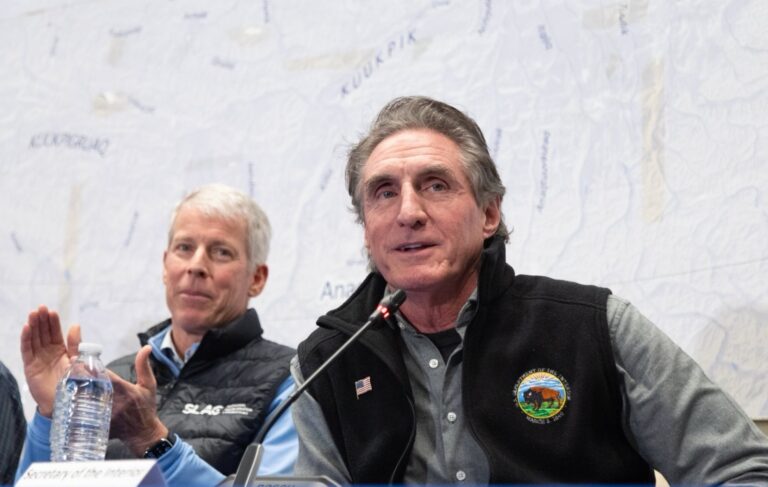
Her letter comes as Interior Secretary Doug Burgum recently announced federal steps to expand exploration and development opportunities in Alaska. Yet, Warfield expresses disappointment that state leaders have not taken more proactive steps to collaborate with industry partners and maximize these opportunities.

The letter also highlights concerns over Alaska’s struggling education system. Warfield insists that legislative efforts should be focused on improving outcomes rather than approving spending without a clear path to funding.

“Our students are among the very last in the nation for educational outcomes,” Warfield writes. “We must find ways to responsibly pay for the education our children desperately need.”

Of course, the letter will not be considered by either Stevens or Edgmon, both of whom do not align with Republican values. Nevertheless, Warfield’s letter reminds Alaskans that state leaders must decide whether to act on Alaska’s behalf, or bend to the no-development Democrats who now control the Legislature.

Supreme Court case next week could recast Medicaid funding for Alaska Planned Parenthood

The US Supreme Court is set to hear a case on April 2 that could transform how states like Alaska distribute taxpayer dollar funds to Planned Parenthood, the nation’s and Alaska’s largest abortion provider.

The case, Medina v. Planned Parenthood South Atlantic, originates in South Carolina, where in 2018 state officials attempted to exclude Planned Parenthood from the state’s Medicaid program. The decision was challenged by pro-abortionists.

Now, the Supreme Court ruling, which would not likely come until late summer, could have national implications, including in Alaska, where past efforts to defund the organization have faced legal hurdles.

In 2019, Alaska Gov. Mike Dunleavy attempted to veto $334,000 in state Medicaid funding for Planned Parenthood, citing taxpayer opposition to subsidizing abortion services. However, the Alaska Supreme Court overruled his decision, reaffirming that state Medicaid funds must cover abortions under the court’s interpretation of the Alaska Constitution’s privacy protections. If South Carolina prevails at the US Supreme Court, it could set a precedent empowering states like Alaska to take similar action.

South Carolina’s argument is that states should have the authority to determine which healthcare providers receive Medicaid funding, particularly when it comes to organizations that perform abortions. Alliance Defending Freedom, representing the state, contends Medicaid payments for Planned Parenthood’s general overhead indirectly free up other funds for abortion services.

Planned Parenthood asserts that excluding it from Medicaid violates the program’s free-choice-of-provider provision, which allows patients to select their own healthcare providers. The organization points to its broader range of services, including cancer screenings, contraception, and pregnancy counseling, as essential resources for low-income Medicaid recipients.

However, data shows that Planned Parenthood’s focus has shifted in recent years, with a decline in cancer screenings and an increase in transgender-related services. In 2022, the organization reported performing 392,715 abortions nationwide—a 5% increase from the previous year. Cancer screening have dropped. In the past decade, total cancer screening and prevention services at Planned Parenthood dropped by approximately 71%, including a 72% decline in breast exams and a 74% decline in Pap tests from 2010 to the 2021-2022 service year. The big growth area for Planned Parenthood is transgenderism.

The Supreme Court case comes as Planned Parenthood faces financial difficulties. The organization’s Greater New York affiliate recently closed five clinics in a year due to budget constraints, and Planned Parenthood of Northern New England has projected an $8.6 million deficit over three years.

In Alaska, Planned Parenthood of the Great Northwest has already scaled back by one third. The closure of the Juneau clinic in November 2024 left only two locations in the state — one in Anchorage and another in Fairbanks. Like other affiliates, Alaska’s clinics rely heavily on Medicaid reimbursements and federal Title X funding.

Adding to the financial strain, the Trump Administration recently announced a $20 million freeze on Title X grants as part of a broader $120 million review of Planned Parenthood’s DEI policies.

While abortion remains legal in Alaska due to state court rulings, many Christians and libertarian-leaning Alaskans oppose using taxpayer dollars for abortion services. If the Supreme Court sides with South Carolina, it could provide Alaska’s leaders with new legal leverage to restrict Medicaid funds from flowing to Planned Parenthood.

Planned Parenthood, however, remains a financially powerful entity and spends much of its money on political lobbying and advocacy. It received nearly $700 million in taxpayer funds in 2022-23, mostly through Medicaid. Despite its financial dependency on US taxpayers, the national organization still holds $2.5 billion in assets and pays its CEO more than $680,000 annually.

Kevin McCabe: Civic economy, free market, and why the sky isn’t falling

By REP. KEVIN MCCABE

Last Friday, Rep. Ky Holland stood up on the House floor to sound the alarm about the so-called “civic economy.” He warned that cutting federal jobs — like President Trump has promised — will cripple communities, tank the free market, and send us all into economic free fall.

Let’s look at that a bit. Alaskans don’t fall for scare tactics without evidence, and history tells us that a leaner government doesn’t kill the economy; in fact, it strengthens it.

First, let’s start with a definition. What is a “civic economy”? It’s not some new DC buzzword, it is not an economic term, and it is not one that economists or scholars use.

Generally speaking, it’s just people getting things done together — whether it’s a Kenai Peninsula co-op selling local beef or Big Lake neighbors pitching in to build a boat ramp. It’s regular folks, not bureaucrats, improving their communities without government handholding.

The free market? That’s the bigger animal in the discussion. It is not, as Holland suggested, subservient to a civic economy. The free market is supply, demand, competition, and the freedom to turn hard work into success. The civic economy is actually an ancillary part of that, not the thing keeping it alive.

The big fear of many people right now is that cutting federal jobs — maybe as many as 200,000 if Trump sticks to his past plans – will gut local projects and send the free market into a tailspin. The Democrats, liberals, and big-government independents claim federal workers and grants are the glue holding communities together.

Sorry, folks, history proves that’s nonsense. Let’s look at the cuts of a famous Democrat president in the 1990s.

Under President Bill Clinton, the government slashed over 377,000 federal civilian jobs — some estimates put it as high as 426,000. That’s 17-20% of the federal workforce. Most of those cuts came through buyouts, early retirements, or voluntary exits. In fact, only about 20,000 federal employees were forced out.

Did the economy crash? Hardly. The private sector actually boomed, adding 22.7 million jobs. Unemployment hit a 30-year low, GDP grew 35%, and we had four straight years of budget surpluses—the only ones since 1969. The national debt? It shrank from 47.8% of GDP in 1993 to 31.4% by 2001. Instead of collapsing, the free market thrived. America thrived!

Fast forward to today. The federal workforce is still sitting at 2.1 million civilians—a tiny fraction of the 155 million workers in America. A 10% cut (about 200,000 jobs) barely moves the needle in a $27 trillion economy. To put it in perspective, 20 million jobs were lost in a single month in 2020, and the economy still bounced back. I know it hurts some of our friends and family, and I understand the angst in a government town like Juneau or even a government state like Alaska, but if a real crisis like that didn’t destroy the free market, some federal job cuts won’t either.

And the civic economy isn’t dependent on federal paychecks. In 2023, US nonprofits pulled in $2.6 trillion, and only a third of that came from government funding—mostly at the state and local level, not DC. The rest came from private donations, local businesses, and good old-fashioned hard work. Co-ops and community projects don’t need a bureaucrat in Virginia to survive; they run on members, markets, and local initiative.

Clinton’s job cuts came alongside tax hikes on the wealthy and spending reductions in defense and welfare. The result? The economy grew, revenues climbed, and businesses thrived. The civic economy didn’t collapse—people adapted, just like they always do and America boomed.

I have heard some argue, “But what about federal grants? Won’t cutting them kill local projects?” Not likely. After 2008, when the feds tightened spending, private crowdfunding exploded. By 2012, crowdfunding had hit $1.6 billion—funding everything from community centers to small businesses. Less government doesn’t mean people give up; it means they step up. That’s freedom, not failure.

And let’s not forget that a smaller federal government actually strengthens the civic economy. Fewer regulations mean it’s easier to start a co-op, pool local funds, and launch new businesses. Less interference from Washington means communities lean on each other, not bureaucrats. That’s the Alaskan way. Less government equals more liberty. Why do progressives have such a hard time with that concept?

Rep. Holland and others can wring their hands and worry all they want; publishing lists of jobs lost, and offices affected, but the facts are clear – the civic economy isn’t held together by federal jobs, and the free market isn’t fragile. Trump’s reductions in force might shuffle some desks in Washington, or even in Alaska, but they won’t sink Main Street or Wall Street. If anything, they’ll open up more opportunity for innovation, local control, and private-sector growth. Clinton’s cuts trimmed government waste, fueled economic expansion, and even reduced the national debt. There’s no reason to believe history won’t repeat itself.

Change can make people nervous — I get that. But this country wasn’t built on government paychecks. It was built on self-reliance, hard work, and the drive to make things happen without Washington’s permission. That’s the Alaskan way, and it’s the American way too.

Rep. Kevin McCabe serves in the Alaska Legislature for Big Lake, District 30.

Tim Walz floats idea of forming ‘shadow government’ to counter Trump

Tim Walz, the former Democratic running mate with presidential candidate Kamala Harris, told a crowd on Friday that it’s time to form a “shadow government,” and hold alternate press conferences.

“We see one of the first things they do is try and restrict the vote,” the Minnesota governor said. “This is one of the things, though, that this is going to take power industry to — I don’t know what the answer is on this, but I’m kind of — I’ve been saying this: I think we need a shadow government, so when all these things come up every single day, we’ve got an alternate press conference telling the truth about what things are happening, tell them what’s going on.”

In other words, this is not the first time Walz has said there needs to be a shadow government. It’s something, he says, “I’ve been saying.”

Walz was speaking in Eau Claire, Wisconsin at a town hall meeting, where he doubled down on unpopular Democrat policies.

“We let them define the issue on DEI. And we let them define what woke is. We got ourselves in this mess because we weren’t bold enough to stand up and say ‘You’re d*** right, we’re proud of these policies. We’re gonna put them in, and we’re gonna execute them,’” he said. He went on to suggest that all Democrats need is a coordinated messaging strategy that can reach the masses.

Rent out the Governor’s Mansion like an Airbnb? What could go possibly wrong?

In an era when leftists vandalize historic statues, national monuments, and even Tesla cars, a recent House Bill by State Representative Will Stapp to rent out the Alaska Governor’s Mansion during periods of non-use has opened up a debate, particularly regarding the security risks such a measure could introduce.

House Bill 139 aims to generate revenue by allowing short-term rentals of the historic residence when the governor is not present and the Legislature is not in session.

The primary concern centers on the security of the governor and his family. The Governor’s Mansion is not merely a residence but a secured facility designed to protect the state’s highest executive and his or her loved ones and guests.

Introducing short-term tenants into this environment could compromise security. Even with thorough background checks, the transient nature of short-term rentals increases the risk of unauthorized individuals gaining intimate knowledge of the property’s layout and security measures, and poses a significant risk to the governor.

Multiple types of misuse could occur, including:

  1. Surveillance and intelligence gathering: Individuals with malicious intent could use a stay to gather sensitive information about the mansion’s security systems, potentially planning future breaches or attacks.​ A bug placed in the mansion might go undetected after the building is swept for bugs after the renter leaves.
  2. Unauthorized access, theft, vandalism: Renters might attempt to access restricted areas within the mansion, leading to potential theft or damage of state property.​ There are numerous works of art in the public areas of the mansion that have enormous value.
  3. Illicit substances, poisons, hallucinogens, or bedbugs: Persons with intent to harm could leave behind substances such as cocaine, methamphetamine, fentanyl, or even poisons like anthrax or cyanide. Someone could smear LSD on flatware or silverware. A bad actor could bring in cockroaches, fleas, ticks, or even rodents, and leave them behind.

The possibility of renters engaging in inappropriate behavior or conducting illegal activities could tarnish the reputation of a sitting governor and the state itself. A person might rent the mansion for a “wedding,” when in fact the person intends to film a porn video or use the occasion to deface or desecrate the property.

Beyond security concerns, the mansion holds historical significance, having served as the governor’s residence since its construction in 1912. Frequent turnover of occupants increases wear and tear, potentially compromising the preservation of this landmark.​ The state would have to budget for a complete sweep of the property, inside and out, to cover every possible mischief that someone could cook up.

While the intent behind Rep. Stapp’s bill is to monetize an underutilized asset, the bill may get amended by others as it goes through the committee process. It’s been assigned to House State Affairs and to the House Finance Committee.

Should it ever pass the House and Senate, it may draw a veto from the governor.