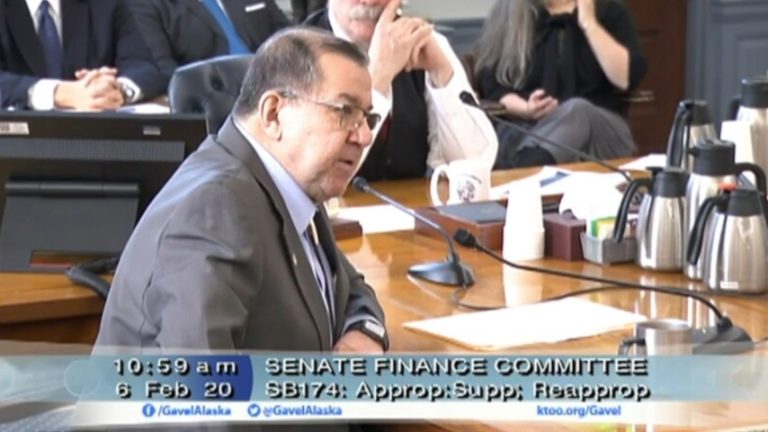
Sen. Lyman Hoffman had a few choice words for Commissioner of Administration Kelly Tshibaka during a Senate Finance Committee meeting this week. He verbally raked Tshibaka over the coals for not asking for a supplemental budget item to help rural Alaskans get their REAL IDs.
Take a look:
Tshibaka responded that while the federal requirement has been known about for 15 years, there are many partners, including the Division of Motor Vehicles, which can help people become ID compliant. Drivers’ licenses, she said, are just one form of REAL ID; people may use passports, military id or tribal id to get into secure areas in airports after October, when the rules finally take effect.
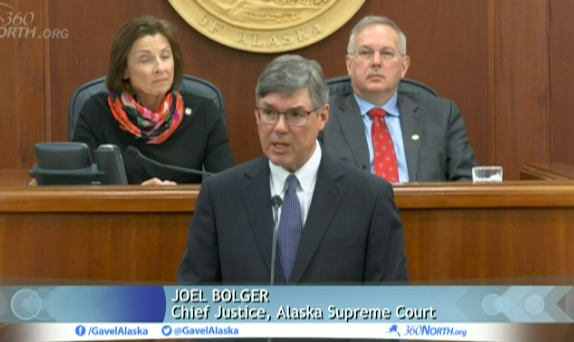
Supreme Court Chief Justice Joel Bolger has refused to recuse himself from the Recall Dunleavy case, scheduled for March 25, even though he is a material witness to the first of the recall “charges” made by the Recall Dunleavy Committee, and even though he has publicly weighed in with his criticism of the governor on another one of the recall “charges.”
That first charge relates to the appointment of a judge to the Palmer District Court in 2019. The Alaska Judicial Council, which is led by Bolger, had forwarded just two candidates’ names to Gov. Mike Dunleavy, and the governor wanted to know why so few names had been forwarded — were that few candidates actually qualified?
The two met on March 26, 2019, in a private meeting in which Bolger and Dunleavy discussed the judicial appointment process, during which time Dunleavy was able to express his concerns about too few candidates being sent to him for his consideration.
“I believe the governor’s office does not understand the constitutional requirements for these nominations,” Bolger said, before his meeting with the governor. “So I’m going to spend some time outlining the requirements of the constitution and the bylaws and procedures the council has adopted to follow the constitution.”
The meeting was lengthy and detailed.
A few days after that meeting with Bolger, Dunleavy appointed someone to the position from the “list of two,” fulfilling the vacancy as prescribed by the Alaska constitution, but a few days past when the Alaska statute says the appointment should be made.
During this time, the retiring judge in Palmer was still on the bench, and would not be leaving for several weeks. There was no vacancy yet.
The delay in the appointment is the first charge on the recall petition, which Bolger and the other Supreme Court judges says must be printed and distributed for signatures. Recall Dunleavy Committee says the governor broke the law by missing the statutory deadline.
There’s no putting the toothpaste back in the tube on this conflict — Bolger was at the center of the discussion about the judicial council’s decision that Dunleavy was questioning.
Bolger has yet another conflict with one of the recall “charges.”
At the Alaska Federation of Natives convention last year, he asked the assembly present to help him:
“It’s absolutely essential that judges maintain independence to make decisions based on the law and facts and not on political or personal considerations,” Bolger said in October 2019.
“We are facing a great deal of political pressure. Some people want to make the judicial selection system more political. Others would like to impose political consequences for the content of judicial decisions.
“So I respectfully ask this convention to join me in resisting political influence in our courts.” – Justice Joel Bolger to Alaska Federation of Natives, referring to Dunleavy
The message had been sent by Bolger. There was no question Bolger was referring to the governor in his remarks to AFN.
The governor had cut the Supreme Court’s administrative budget, and stated that he did so because the Supreme Court insisted the state pay for optional abortions with Medicaid funds. The governor was going to shift those funds from the courts over to the Medicaid accounts to pay for the mandate.
This makes Bolger deeply conflicted on the third recall “charge.”
Today, the Stand Tall With Mike group, which was defending the governor in court, withdrew from the case at the Supreme Court, in part because it appears the judges have already made up their minds, and because Bolger refused to recuse himself. The state attorneys will have to continue on without the independent legal team.
It’s important to note that no formal request was made to ask Bolger to recuse himself. Normally, lawyers who are getting ready to appear before a judge do not make such a request because if the judge thinks he or she should recuse himself, he or she does so “sua sponte,” which means you do something without having to be asked.
But if a lawyer goes so far as to ask a judge to recuse himself, the lawyer can be guaranteed to have a rough time in front of what is then going to be an annoyed judge. Lawyers do not poke that hornet’s nest except in very rare cases.
Chief Justice Bolger has undeniable direct involvement with Recall Charge No. 1, and he has made political statements about Recall Charge No. 3. But voters have little recourse — Bolger himself will not be up for retention for six more years.
Gov. Mike Dunleavy has chosen Glenn “Mike” Prax to the vacant House District 3 seat in the Alaska House of Representatives.
“Mike Prax has demonstrated for many decades that he has the experience, knowledge and leadership abilities to make an effective legislator for the North Pole area,” Dunleavy said. “He also understands and reflects the values of its residents, so I am proud to appoint him to the House District 3 seat.”
The Republicans in the Alaska House must confirm the appointment by a simple majority vote. If approved, Prax will be the third legislator appointed by Governor Dunleavy.
Prax was a longtime volunteer on the Dunleavy campaign in the Fairbanks area and a well-known grassroots Republican. He will need to run this year for the seat if he wants to to retain it, and word from Fairbanks is that there will be a Republican primary in August.
WON’T LET COMMISSIONER SPEAK DURING HEARING ABOUT HER BUDGET
In a Senate Finance subcommittee meeting this week, Sen. Donny Olson put Public Safety Commissioner Amanda Price in her place. Women are to be seen, not heard, evidently in his committee. Not once, but repeatedly he would not allow Price, who is the department leader, to answer questions about her budget or needs of her department, but continued to refer the questions to her subordinate, Col. Barlow, while telling her to shut up.
Price is the first woman to lead the Alaska Department of Public Safety in state and territorial history, and this isn’t the first time a male lawmaker has shush’d her since she was sworn in back in 2019.
Take a look at how Olson treats Price in this hearing:
Today, Stand Tall with Mike has decided that pursuing the case against the recall of the governor in the Alaska Supreme Court is hopeless, and has instructed its attorneys to withdraw its appeal. The arguments are scheduled for March 25, when those on each side of the recall fight are scheduled to make their case to the Supreme Court.
The actions made by the Supreme Court last week, ordering petition booklets to be issued before the case is even heard by the court, indicate that further participation in the legal process would not be a productive use of its resources, Stand Tall With Mike wrote in a press release.
In other words, it’s a waste of money to send lawyers in when the outcome has been predetermined by the court, over the objection of the Superior Court judge, who said that starting early on signatures would sow confusion and cause irreparable harm.
“To counteract this harm, Stand Tall With Mike believes the public is better served, and its resources are better used by turning its full attention to educating the public why the recall of the governor is unjustified, a waste of public resources, an affront to the 145,000 Alaskans who voted for this Governor, and a distraction from the critical issues facing Alaskans,” the group said.
Also on Friday, the court held a scheduling conference setting oral arguments for March 25, telling the lawyers the court will issue its ruling rapidly, perhaps even the day of the argument, the group said.
“This blistering pace is simply unnecessary. At issue are constitutional questions of first impression that deserve careful consideration. In combination with lifting the stay, when there was no harm in allowing the legal process to conclude next month, it is clear the Court is determined to let the recall effort go forward before it has even reviewed the parties’ legal briefings,” STWM said.
“Also on Friday’s call, the court indicated that Chief Justice Joel Bolger would not recuse himself. Chief Justice Bolger is a material witness in the case, and directly participated in the events that gave rise to one of the recall charges. Since then he has made public statements criticizing vetoes made by the Governor.”
The Stand Tall group said they fully expect the Supreme Court to move ahead with a recall election and that voters, rather than unelected judges, will need to stand up to protect the integrity of elections.
It appears the State of Alaska will continue its case, in which it is defending the Division of Elections’ decision to not issue booklets because the grounds for recall are invalid.
Stand Tall With Mike has been a legal defense group, but will now transform into an independent expenditure group to become a campaign organization.
Jim Crawford, who filed to challenge Sen. Natasha von Imhof in the Republican primary for Senate Seat L, will officially withdraw his candidacy due to not having lived in the South Anchorage district long enough.
State election law requires a person to have lived in the district for one year before filing for office.
Crawford, born and raised in Anchorage, had lived in midtown, where during the last Senate race in 2018 he ran against now-Sen. Elvi Gray Jackson, a Democrat, for Senate Seat I.
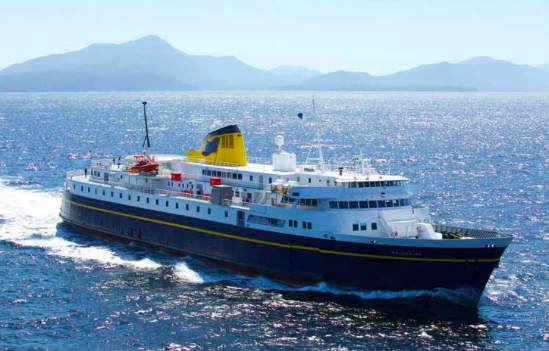
A rumor floated on Twitter late Sunday had Southeast Alaska social media users spun up. The person who posted it reported that the Malaspina, an Alaska State ferry, had been improperly put in cold storage, the pipes had bursts, and the boat was flooded. Not only that, he wrote, the artwork on the ship was “looted” because there was no watchman on duty.
In fact, a minor pipe froze and burst, which cause a minor amount of water in four staterooms, according to the Alaska Marine Highway. There was no lasting damage and the water was cleaned up promptly.
The ferry, moored in Ward Cove near Ketchikan, has not been looted. The art was removed by Department of Transportation for safe keeping and is being stored off the ship. Kitchen items were also not looted, as reported, but some were removed by staff for use on other vessels.
All of this happened a couple of weeks ago but idle ferry workers are pushing rumors out on social media platforms through “useful idiots who are taking the bait,” according to a source inside AMHS.
The Malaspina was scheduled for an overhaul this winter, after it was discovered that it needed extensive steel replacement, at the cost of more than $16 million, plus another $24 million to refurbish the vessel. The funds have not been available for all that is needed for the 56-year-old boat, which still has the original engines in it.
Right now the Malaspina is sitting in warm storage, hooked up to shore power, under the care of a private contractor, while awaiting decisions from lawmakers about whether the state can afford the $40 million needed to repair the vessel, one of the original ships in the fleet of the Alaska Marine Highway System.
Last week, the Alaska Marine Highway System issued a request for information to determine interest from marine charter companies about the services they can provide to communities along the Marine Highway System’s route. Specifically, AMHS is trying to establish interim passenger and freight service for the northern Panhandle, now that the ferries have been unexpectedly sidelined.
AMHS anticipates that the updated Spring/Summer service will include special runs to accommodate the Cordova fishery.
The Matanuska is anticipated to return to service on March 2. The Tazlina is scheduled to return to service on March 5. Schedules are available at http://dot.alaska.gov/amhs/.
MEDIA GOES AFTER DUNLEAVY TEAM, IGNORES AGENCY THAT WAS SUPPOSED TO GROW THE ECONOMY
The Anchorage Economic Development Corp. produces a luncheon twice a year, in which the organization presents an economic look-back and forecast for the region, a report produced under contract by the McDowell Group, with the AEDC logo slapped on it.
Beyond that, the AEDC is not much more than an announcer at events and pronouncer of things. Its president since 2007, Bill Popp, is much like Punxsutawney Phil, who comes out once or twice a year to say whether the recession will end early or late.
While the mainstream media and bloggers have focused on their narrative over a brand-new economic development team headed by Gov. Mike Dunleavy, none has taken a critical look at the 33-year-old economic development agency that does lunch and puts out Facebook posts.
Last summer, Popp pronounced that Anchorage was in for a long recession due to massive state budget cuts. He railed against Dunleavy. The recession would last another three years, Popp said. He forecasted a net loss of 700 jobs in 2019 year in Anchorage and a thousand in 2020.
It was a reversal from his previous utterance, when months earlier he pronounced the economic recession effectively over in January of 2019. That was before he saw the governor’s budget, which made deep cuts in programs.
For Popp, the sky was falling. And the only way forward was to reverse the budget cuts.
This year, his January report shows Anchorage lost 300 jobs in 2019. And he forecasts 100 more jobs will be added in 2020.
A visit to the agency’s website shows that the group has fallen into disrepair from its own neglect. The website, which is the portal for people from outside the state who want to learn more about Anchorage economic opportunities, is rife with broken links and canned paragraphs that pump how well Anchorage has weathered the terrible national economy.
It wasn’t always like this. When founded in 1987 during the big recession in Alaska, it quickly helped bring cargo flights through Anchorage and helped clear the way for the Alyeska Resort. That was under the leadership of the late Scott Hawkins.
But it has been years since AEDC produced anything but glossy reports.
Has AEDC become a metaphor for the Anchorage economic scene — a nonprofit that skims funds from businesses and government to survive, and yet has no real deliverables other than contracting for reports and putting up Facebook posts to compliment others for their work?
Similar to the Downtown Community Development Authority, run by Andrew Halcro on behalf of Mayor Ethan Berkowitz, AEDC appears to have set the bar low for itself, lacking targets and milestones that one would expect to see in a pro-business enterprise.
And yet, the AEDC budget shows that Popp earns $168,000 a year, that overall payroll is about $700,000, and that the agency’s budget comes from government grants, membership, and an “other” category, which is a kickback from utilities paid for by Anchorage rate-payers. The budget for AEDC is $1.68 million.
GOVERNOR’S TEAM HAS A DIFFERENT APPROACH
Pivot to the newly launched Alaska Development Team, a creation by Gov. Mike Dunleavy, reportable to Dunleavy, and headed up by a young businessman whom he trusts named Clark Penney.
The Democrats and their media have had a field day in recent weeks implying it’s improper for the governor to contract with a trusted ally. And yet, in eight short months, the Penney-coordinated team has been working on breaking down barriers to business and actually has some promising new industries in the works:
They’re working on expanding mariculture across coastal Alaska from Kodiak to Ketchikan through a combination of working with coastal communities and lifting regulatory barriers at DNR for things like oyster farms and kelp farms.
The team was at the center of a timber deal in the Mat-Su that opened up 11,000 acres of beetle-damaged timber for the next decade. The timber is on state land, and the team was able to bring in the State Forester and move that timber sale along before fire season gets here.
They’ve been working to develop rare earth minerals from Nome to Bokan Mountain in Southeast. Through their efforts and with help from Texas, they had mining added to eligible projects for the Fixing America Surface Transportation Act.
Alaskans can look to the Alaska Development Team for upcoming improvements at the Anchorage International Airport that will lead to more cargo. The cold storage cargo enterprise at the airport is finalizing its lease agreements, and may break ground this summer. It will bring 200-300 direct jobs year-round. The Alaska Development Team had an important role in convening those conversations.
Business development is a long game. It can’t perform magic overnight and a lot of business is done around a small table in the “small conference room” of a company.
But at least it looks like the State of Alaska has the right team in place to bring some big deals over the goal line — deals that appear to involve diverse businesses that are not oil and gas.
Consumers of mainstream media are reading a lot about how Clark Penney has an $8,000-per-month contract to be that business development leader for Dunleavy. The media and left-wing bloggers like to do the math — over four years that would be $384,000 plus expenses for Penney. That’s more than the average reporter makes, and it seems like a lot to some.
Democrat lawmakers have said they want to see that contract put out to the lowest bidder and that’s a narrative the mainstream media has been quick to report.
The ADT group’s website is not yet launched, but its members are out in the field and on the phone, trying to stir up the economy in Alaska. Time will tell if it’s a good value for Alaska, but at least the new group is accomplishing more than published reports and doing lunch.
Juneau’s Wearable Art exhibition has seen better days — at least more creative days, and more liberated days.
Just two years ago, more than 30 entrants typically took part in the pageant, which is a fundraiser for the operations of the Juneau Arts and Humanities Council.
Beth Bolanger’s “Dragon” took third place in 2018, but was pulled from the final line-up after a complaint was lodged.
But then came the “woke police.”
In 2018, one creative entry from Haines caught the ire of progressives, who said it was cultural appropriation. The garment and model were withdrawn from the competition and publicly humiliated. JAHC then set forth stringent rules to ensure that no one ever commits the sin of cultural appropriation again.
Creativity, meet political correctness.
The result of JAHC’s plunge into an era of artistic prohibition? Only 18 people even entered this, the 20th anniversary of the arts event. That’s a 40 percent drop in the usual number entries.
2018-2019 became the era of an ensuing Mao-like “criticism-self-criticism” exercise by the arts council, which now states its mission as not promoting the arts, but destroying racial inequality.
“The JAHC recognizes that our society is challenged to overcome a complex web of inequities – racism, sexism, homophobia, classism, and ableism among them. All of these forms of discrimination are powerful drivers of unequal individual and group outcomes. However, it is our belief that ALAANA [African, Latino, Asian, and Native American] individuals whose identities intersect with those of other “minority” social statuses often experience compounded mistreatment that is amplified by the interaction of race. We support the work being undertaken to dismantle the array of social and economic injustices; however, The JAHC has determined that we must focus our efforts to heighten our effectiveness. We move forward from our assessment that racism is one of the most pressing issues of our time, and that meaningful progress on advancing racial equity will have significant positive impact on challenging other discrimination-based injustices. Therefore, our current priority is working against racism by working toward racial equity in arts philanthropy.”
So states part of the long political creed that prospective artists read before they take part in the wearable arts competition.
“The JAHC Board of Directors and Staff have enacted an equity and inclusion policy to guide JAHC programming, events and actions. During the development of this policy there have been many courageous conversations about racial inequity, cultural appropriation and unintentional exclusion and stereotyping. And, we are confident and hopeful these rewarding and courageous conversations will continue. Please review the equity and inclusion policy on the next page, and keep it in mind as you design and create your project.”
The theme for this year’s pageant was “Joie de Vivre,” joy of living. The artists, however, held back because in this era of political correctness, being subject to shame by your arts peers is a bit of a kill joy.
(Editor’s note: the wearable art shown at the top of this story is from the 2019 competition, the first-place winner “Wishes & Prayers in Turbulent Times” by Rhonda Jenkins Gardinier).