Tuesday, April 21, 2026
Home Blog Page 1182

A doctor’s open letter

26

By JOHN MORRIS, MD

Do no harm, the foundation of modern medicine since Hippocrates, the creed that taught physicians treatments better than shamans, witch doctors, and quacks. It is an approach to healing that focuses on objective scientific results rather than anecdote or emotion, antibiotics instead of blood letting, and X-rays above incantations.

This year has seen our Anchorage leaders from the Assembly to the mayors, called upon to make decisions about our health, an unfair tasking, given that most of these well-meaning individuals lack medical training or experience.

Worse still, they have been asked to treat not just one person at a time, but entire communities, basing their decisions largely on the advice of others. Without the years of training that go into making a modern physician, or the experience of practice, do no harm is not the basis of their logic and, because of that, emotions, anecdote, and perhaps politics have all too often guided decisions.

A city is a living thing, its citizens and their businesses its cells and organs. When we ask a part of our community, for example our restaurants, to stop functioning, we hurt all of us, but the people who work in those businesses most of all.

There must be both a compelling, logical reason to take such a step but also a great compassion for that part of our city once such a decision is made. It is our community’s responsibility to help those we hurt in the name of our greater good. This is morally right but even more it is the contract between our government and our people. Anchorage leaders must care, and be shown to care for every one of their citizens.

It is a very hard thing for physicians to learn, and they have years of formal training and experience to accomplish it, that sometimes the right thing to do is nothing at all. Let us hope that our leaders can rise above this, be extraordinary, treat our community as a whole, and open our businesses. Failing that, help them with every means at our disposal.

We are in this together — if our restaurants, businesses, and neighbors must hurt to help the rest of us then we, and our leaders, must help them. Better still, we could simply decide that now is the time to reopen and recover.

The author is an Anchorage medical doctor.

A really bad idea

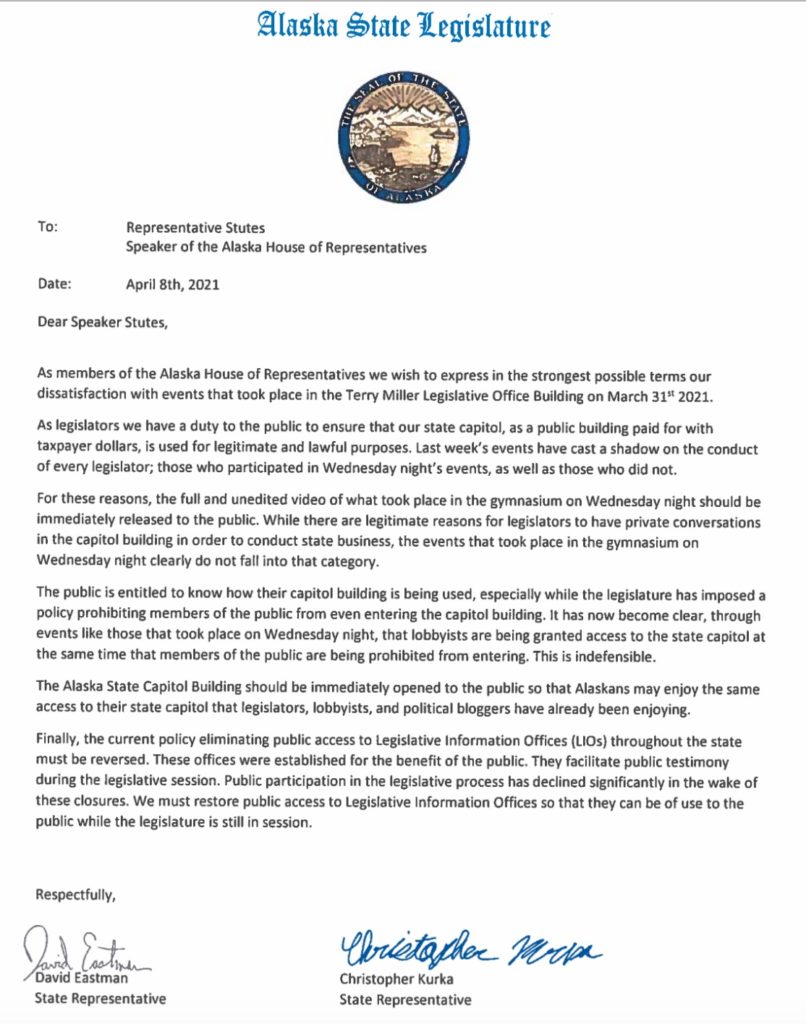
We note with more than a little interest that the Legislature, in its vast wisdom, has decided to bar the news media from the state House and Senate chambers during the upcoming legislative session.

The public, just for good measure, is to be barred, too, under a set of stringent, new anti-COVID-19 rules adopted by the joint House-Senate Legislative Council.

When we first read of it, we thought for certain it was joke. It has been our experience that nothing good – nothing – comes of barring the news media, or the general public for that matter, from public meetings, turning them into playgrounds for really, really bad ideas and no accountability.

Saying such a ban is necessary is indefensible. From where we sit, a few reporters wearing masks and following the same health rules as lawmakers certainly would add little, if any, more COVID risk than a chamber of 20 or 40 yakking legislators and their attendant aides and hangers-on. 

Too often, in our experience, outside influences are used as excuses to shield lawmakers from the prying, pesky eyes of the news media, but a free nation requires a free press. A free press requires, as a minimum, open access to public meetings.

It is understandable, with the issues facing the upcoming Legislature – the budget deficit, the Permanent Fund dividend, taxes – that some lawmakers would be tickled pink if the press took a hike while the political sausage is being made. But pretending it is because of COVID-19 just will not fly.

What they apparently want are the keys to the clown car, with nobody watching.

A very bad idea.

Read more at www.anchoragedailyplanet.com

2021 prediction: The panic party is over

Vaccines are now rolling out to every corner in every state, a remarkable feat of science, ingenuity, and gritty supply chain management.

The panic-purveyors, and the pandemic they have fretted over, are taking one last spin around the dance floor, but this pandemic party is all-but over.

Within the week, hospitals across the country will discover that all the beds that were occupied this fall and winter are suddenly freed up, because fall and winter are the months when shoulder and knee replacements are done, and other elective surgeries are booked. It’s harvest season for hospitals and surgeons, as people try to squeeze all their medical costs into the present year, and avoid scheduling costly procedures for January, if they can help it.

Those beds were never overwhelmed by COVID patients; it was just a matter of competition with the seasonal crush of patients. The crush is over.

At the same time, at least 60 million Americans are already, in practical terms, immune to the COVID-19 coronavirus. Their bodies have played host to the virus with varying degrees of complications, but for now, the survivors of the virus are getting back to a normal life.

There are tens of millions of them, and probably even more undiagnosed who caught a whiff of the virus but never experienced so much as a sniffle.

Health experts from Dr. Anthony Fauci to Dr. Anne Zink are telling these folks they have to wear masks anyway, but this group of Americans aren’t really buying it. They’re done.

Another 2 million Americans have already received the COVID-19 vaccine, and they are building immunity to the virus, a process that will take up to five weeks.

In the two weeks since the rollout of the Pfizer vaccine, most of our front-line medical workers are well on their way to immunity.

Assume, for a moment, another 1 million will be infected and another 20 million will be vaccinated by mid-January. Now we’re up to roughly 83 million, or nearly 25 percent of the population of the United States, essentially immune.

Vaccines for about 30 percent of the population will be available by the end of February but the first milestone is the one to watch: In the first week of January, there will be more people vaccinated in the U.S. than will have been reported as positive for the virus in the past year.

Many of those people in the next segment of vaccinations will be elderly and medically compromised or disabled — the ones who would have the roughest time with the virus and could end up in the hospital. By March, these vulnerable Americans will have received the vaccine and be well on their way to freedom.

Eighty percent of the panic during the past year has been coming from about 20 percent of the population. I predict that in 2021, the 20 percent group will be the early adopters for the vaccine. Once they get their second dose, the noise will stop, along with a greatly reduced incentive to continue the panic amongst their peers.

And that will leave public health officials with a rapidly shrinking audience. Public health officials, who command the stage now, will find that people have moved on to birthday parties, funerals, weddings, and school.

What this column is about is human nature, and the way societies work. It’s the self-interest hardwired into all of us that drives this human behavior, especially among Americans. Thus, in a matter of weeks, the media won’t be able to scare people into getting the vaccine; they’ll either get it or they will shrug and take their chances.

Once the year-long fight-or-flight syndrome fades, the public will not only accept “getting back to normal,” they’ll insist on it. They want their adrenal glands back.

By then, the damage to the economy will be profound and irreversible for many. And by economy, we always mean the private sector — the government is not part of GDP, except for government spending. It does not produce wealth, but skims it from the nongovernmental public. That is a topic for another day.

There are too many pieces to the puzzle of 2021 to know with certainty how soon this calming-down will unfold, but the big conversation right now needs to shift to how to repair the damage to communities caused by the panicked politicians and their well-meaning public health advisers.

The true policy professionals will soon understand that there is just not enough evidence to keep our cities locked down any longer.

Rules of the road set for legislators, staff heading to Juneau for 32nd Legislature

30

As legislators and their staff make plans to head to Juneau in January, they are going to be paying attention to strict rules about their movement and attire. If they break the rules, legislators may face consequences, including being excluded from being able to perform their constitutional duty.

Legislative Council, which handles legislative business when the Legislature is not in session, has been devising sets of rules and how they will be enforced, including who will enforce them.

First, those traveling to Juneau to work in the Capitol Building will need to have a COVID-19 test shortly before they board the plane for Juneau. They’ll need to arrive early in the capital city and quarantine themselves for two weeks before the session starts, and get another COVID-19 test 12 days into their stay. If they leave Juneau to go home for a break, they’ll have to repeat that protocol.

Tests will be available for legislators and staff in the Anchorage and Fairbanks airports. Others traveling through other airports will need to make arrangements to get a COVID-19 test within a day or so of their departure. In Juneau, there will be a contractor doing testing in the airport and at the Capitol. That contractor is Beacon, an occupational safety and health services provider

When entering the Capitol building, legislators, their immediate families, and staff members will have their temperatures read by a Beacon employee. They will be required to answer a health screening survey, which will likely ask them if they have been exposed to anyone who was contagious with COVID-19 during recent days or if they are experiencing any symptoms.

Everyone in the Capitol will be required to wear face masks when in the hallways or outside of their offices. This will be enforced by Legislative Security.

On the floors of the House and Senate Chambers, members will be required to wear a double-ply masks, and will be removed from the chambers by the Sergeant of Arms if they do not. They will need to ask permission to approach the dais, and may not congregate at the dais. Floor staff will not be refilling their water glasses.

Frequent breaks will be taken for hydrostatic sanitation, and members will be behind plexiglas panels, to reduce the transmission of aerosols that may have the virus.

Specifically, the rules state:

  1. Any member who refuses the temperature reading or refuses to answer health screening questions will be denied entrance to the Capitol.
  2. Any member who refuses to wear face covering will be escorted by the Beacon contractor to her individual office where she shall remain.
  3. Any member who refuses to undergo testing shall be reported to presiding officer and Rules chair and the Legislative Affairs Agency executive director for appropriate action, if any.
  4. Anyone who screens positive for symptom shall be escorted to an onsite testing location for further screening and testing.
  5. Any member testing positive cannot be in Capitol until their quarantine is over as determined by the contractor.
  6. Any member who has close contact with known positive must self quarantine, as determined by the contractor.
  7. The intent of Legislative Council is that a member will be excused from the “call of the House” if they are quarantined
  8. In absence of a presiding officer on the first day, the rules will be enforced by the Sergeant of Arms or Legislative Security.

Members may be able to vote from their offices if they don’t wish to comply with the mask mandate, but there would need to be a rule change to allow that to occur. That change can’t be voted on until the new 32nd Legislature convenes, so any member refusing to wear a mask in the chamber would not be able to vote on the incoming presiding officer.

The one vote against the new policy was Rep. DeLena Johnson of Palmer, who said she was concerned about disenfranchising an entire district from having its member able to represent them.

But Sen. Tom Begich said that even now members can be removed for not following decorum. Men, for instance, are not allowed on the floor of either body without wearing a necktie.

“These rules only apply until we have a new president and speaker. It is pretty extraordinary, but we know the fears that many of our employees have,” said Sen. Gary Stevens, who is co-chair of the Legislative Council. “The questioned health conditions they have that they may not even be aware of, and some may not even work for us if they don’t feel safe.”

One aspect of the rules was amended. That one would have required legislators to remain seated while speaking. Sen. Bert Stedman and Sen. Natasha Von Imhof said that it was unnecessary, considering all the other barriers in place. That rule was removed on a close vote.

Members of the public, including the press, will not be allowed in the Senate or House chambers, something that Sen. Gary Stevens said has made members of the press unhappy.

Although one Legislature cannot bind the next one, neither the House nor Senate has organized with leaders, and it’s likely that the 32nd Legislature may begin and continue for several days without leadership in place. These rules are to govern that interim period, Stevens said, but they also may provide the next Legislature with guidance on how to provide a safe work environment not only for Legislators but for the employees of the building.

Sen. Cathy Giessel and Rep. Bryce Edgmon have sent a letter to the committee that is making the decision on who should receive the next round of vaccines. They have requested that legislators and staff be prioritized because they have a constitutional duty to pass a budget.

Legislators and staff will need to arrive in Juneau on or before Jan. 4 in order to complete their quarantine and testing and be ready for the session to start on Jan. 19.

How to reduce sickness, death: Public comments on who gets vaccine next

92

Critical infrastructure workers, such as power, gas, and waste water workers; pilots; school workers; domestic violence shelter staff; court system staff; senior citizens; those working in domestic abuse shelters.

Representatives from the commercial fishing industry and those who work on processors were especially noticeable in the public comment period today, as were those from the education system.

They were among the groups that had someone call to give a one-minute plea to State health officials to include their workers or demographic in the next round of COVID-19 vaccinations.

The State’s public comment period today on Zoom was in front of the panel making the decision; it is comprised of health care professionals, ethicists, and other health professionals, led by Dr. Anne Zink, the state chief medical officer.

Also requesting to be in line were representatives of zoo, sea life workers, veterinary workers, and search and rescue volunteer groups, such as Juneau Mountain Rescue.

Elizabeth Medicine Crow of First Alaskans Institute requested that Native culture bearers, elders, and language teachers be at the top of the vaccination list even if they are young, because they are so important and the culture is in jeopardy, with some languages near extinction.

Cynthia Christiansen said that rather than younger people, the next group should be the group most vulnerable — the aged — and that Alaskans were being pitted against each other to get in line for the vaccine.

Ollie Christieansen agreed, saying elderly and the ill should be a priority, not young people who can better fight the disease.

Monte Hawver of the Brother Francis Shelter in Kodiak said his staff needs to be innoculated so the shelter doesn’t need to shut down, leaving people in the cold. A representative from the court system reminded the panel that the 39 courts with 775 staff members around the state cannot work from home and cannot take court files home, and that justice must go on.

The committee will be weighing its decision based on guidance from the CDC, along with how to maximize the benefits and minimize the harms of vaccination, prevent illness and death, as well as achieve equal outcomes for all Alaskans.

The state is currently in the 1a phase, with frontline health care and first responders being vaccinated.

Phase 1b guidance from the state will be released on Dec. 30. The state does not yet have numbers from the federal government for what it will be receiving in January for that allocation, but expects regular shipments throughout 2021, in addition to allocations going directly to Veterans Affairs and Department of Defense, as well as separate Tribal allocations.

Phase 1c is the next round after 1b, and public comments on that phase will be taken on Jan. 11.

Paper thin: Muni spends $50K on paper-trail website to explain how it’s burning through CARES Act funds

The Anchorage Assembly budgeted $50,000 of CARES Act funds for a website to explain where the $156 million in CARES Act money went, but the website is not entirely helpful, although it is translated into several languages, such as Vietnamese, Mandarin, Tagalog, and Samoan.

In its own words, the $50,000 was for the Assembly to educate the community and create awareness on the use of Coronavirus Relief Funds. In reality, the Assembly created a low-grade website with superficial information. But $50,000 was a rounding error for the $156 million grant.

You can explore it at this link and give the Anchorage Assembly feedback at links therein:

Anchorage Assembly CARES Act website

The website shows that the municipality has spent $104 million of the $156 million it received in federal CARES Act funding. It must expend all of its funds before the end of the year.

Semi-complete details of expenditures of CARES Act funds

The information made public on the website is not exactly a fulsome explanation. Researchers must go to different places in the Municipality of Anchorage’s website to find out more. Even then, it’s unclear where the money is actually going. That level of transparency is missing.

For instance, the website says there is $14 million set aside for hospitality and restaurants, but only $4.2 million has been granted. It also says $3.49 million was still available earlier this month. A Dec. 13 deadline may have wiped out that amount, but it still doesn’t account for the entire $14 million that the Muni says it set aside.

Tier A businesses — bars — that were required to close down earlier this year, and again in December, were eligible to receive up to $30,000.

Tier B businesses, such as restaurants and breweries, were only eligible for up to $15,000, according to the Muni website.

Small businesses that were not restaurants, bars, or hotels, received $4.9 million, with $1.56 million remaining in the appropriation bucket. 529 grants were awarded.

To learn which small businesses received grants this summer, you’ll have to go to the Acting Mayor of Anchorage’s press release archive in a different location on the Muni website, where the first list was posted in October.

Vaccine rollout public comment meeting Monday

18

The State of Alaska Department of Health and Social Services will hold a public comment meeting on the plans for the the next phase of the vaccine rollout, on Monday, Dec. 28 from 4-5 pm.

Link to the meeting through the State of Alaska website. This meeting will be held via Zoom Webinar, Facebook Live via the DHSS Facebook page, and by telephone. 

More information about the 1b rollout plan at this State of Alaska link.

Jim Crawford: Begin the PFD debate

23

By JIM CRAWFORD

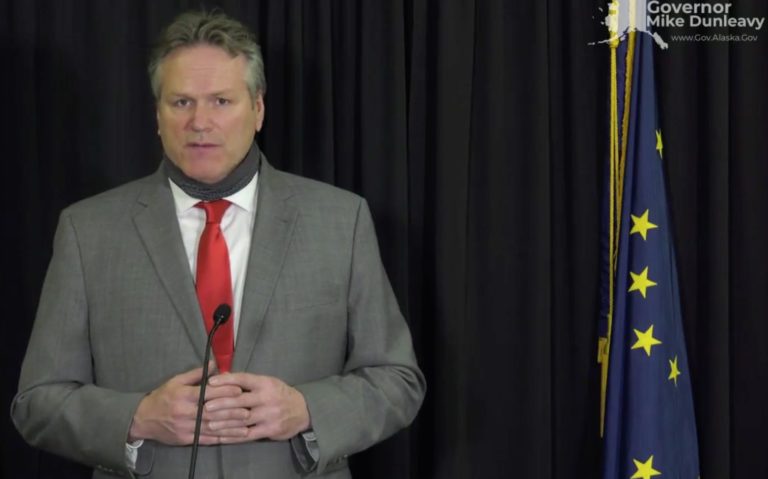
Gov. Mike Dunleavy is right: “We need the full dividend to stabilize the Alaska economy.” 

When Gov. Jay Hammond appointed the Investment Advisory Committee, he assigned us an interesting task.  “Figure out how to use the billions that we will accumulate in the Alaska Permanent Fund to bring stability to Alaska’s budget.”  

We did just that.

When the volume and price of oil goes down, investment income generally goes up.  If we are down $1 billion or so in the oil patch, we gain a billion or so in investments.  In the Seventies, we called it the Saudi model since they were the richest kingdom around. There is a competitive difference between their cost of pipelines to get Saudi oil and gas to market and ours.  Saudi’s cost is measured in dollars per mile while Alaska’s hard costs are measured in millions of dollars per mile and 800 of those miles.   

But there are competitive offsets. We have natural high-pressure wells which enhance production. Other states are fracking the heck out of the wells at double or triple our cost.  No one seems to talk about it much but there are great economies in the Super basin of Alaska oil and gas. Alaska producers, forced by high costs, are now experts at innovative cost reduction. Our break-even is comparable to other large fields. There are distinct advantages to being in the oil and gas business in Alaska.  

Compare economies of the world. Think of the differences.  Alaskans sought balance to prosper with a huge asset base in a harsh environment and a small but hardy population. We recognized those differences in planning for the Permanent Fund. Oil and gas would not always be stable and would have ups and downs in price and volumes. But taken as a whole, the oil and gas business has brought great wealth to Alaska and to Alaskans.  And will continue for centuries.

Gov. Hammond wanted to protect the economy and the land by providing a dividend. A dividend is a reward for not tearing up the tundra or wasting the earnings of the Fund. We designed a dividend which only paid on income, the safest way to guarantee a future for the Fund. We looked at the waste of capital in Alberta, Calgary and decided that not every Alaskan project should be funded.  

We overshot solutions in some cases with disastrous results.  Our discouragement of Alaska projects resulted in just the opposite of what our economy always needs, investment capital. Not only did risk-based projects go without funding but state agencies measured their success in how much they could grow their balance sheets rather than completing their assignment of helping Alaskans.  

That must change.  Two examples leap to mind; education which provides the worst result for our children at the highest cost per pupil and our housing finance agency which charges 100% more in interest rates to landlords than homeowners.  The obvious results are deteriorating housing stock and higher rents. An agency like Alaska Housing should not be an investor of its $1.61 billion when it earns under 1% annually.  Transferring investment management to the Permanent Fund makes sense.  

Alaska’s fiscal fix is to increase production and manage our wealth wisely. We must grow both the oil and gas sector and gain a better financial rate of return on investments. Our governor understands that the people of Alaska are the ones that must control the wealth if we are to stabilize and grow our economy.  

If we follow the Governor’s careful and conservative plan, expand the economy through the dividend programs and expand our economic base, we will bring back broad-based job growth to Alaska. With a dividend at $5,100 per Alaskan, our economic engine restarts.  

I am pleased to see the focus of the Administration on long-term growth.  What the full dividend provides is investment income for Alaskan families.  Legislators, if you want to build small business, then pay the dividend.  If you want to expand our fisheries, then pay the dividend.  If you want to expand tourism in Alaska, pay the dividend. Put Alaskans to work.

The dividend is not another government handout.  Alaskans wisely chose to invest 25% of our oil and gas royalties in the Alaska Permanent Fund and directed the Legislature to invest it for us, safely, securely and to gain a market rate of earnings.  The Alaska Permanent Fund is a huge success and will grow if we control our government spending and manage our other assets for maximum yield.  Compliments to the governor for keeping his eye on the ball.  

I want Governor Dunleavy to grow the Permanent Fund to $100 billion and its earnings to $8 billion. What would you like for the Fund?  

Alaskans are well served by a governor who wants us to vote on the future structure of the dividend.  Let that great debate begin.  And thank you, Governor.  You done good. 

Jim Crawford is a third-generation Alaskan entrepreneur who resides in Anchorage with his bride of 37 years, Terri.  The Alaska Institute for Growth is a local think tank which studies and reports on and may sponsor projects of sustained economic growth for the Alaskan economy.   Mr. Crawford known as the Permanent Fund Defender was a member of the Investment Advisory Committee, appointed by Governor Hammond to plan and execute the Alaska Permanent Fund Corporation.

Alaska oil price heads higher

23

Alaska North Slope crude oil hit an eight-day streak where prices were over $50 per barrel this month.

On Thursday, the price for ANS was $51.74 a steady trend up from $38.06 it was priced at on Nov. 1, 2020.

Since Dec. 10, the price for ANS has only dipped slightly below $50 once.

The year will end with about 472,200 barrels a day coming from the North Slope, which should grow over the next decade.  Production hit a low spot in May and June, when it went as low as 393,000 barrels, in response to a global economic slowdown.

Last December, prices for ANS ranged from $63.73 to $68.91 a barrel.

About 60 percent of Alaska’s revenue comes from oil and gas taxes, with production at 43.60%, oil and gas property tax, 11.17%, and oil and gas corporate income tax, 5.35% of overall revenues received by the state.

As for oil companies, it has been a year when their company values have been hit hard and have put the dow in down.

ExxonMobil is down 42 percent year to date, starting the year at over $70 per share and now selling at $41.60. This year, Exxon was kicked out of the Dow Jones Industrial Average index, where it has been since 1928. (So was Pfizer and Raytheon Technologies, as tech companies like Salesforce, Amgen Inc., and Honeywell International were added.)

ConocoPhillips started the year higher than $66 per share and is now trading at $39.49.

Schlumberger, the oilfield service provider, lost nearly half of its market valuation this year, with shared won 47 percent.