Wednesday, June 3, 2026
Home Blog Page 1158

Dan Fagan: Former DPS Commish says Dunleavy fired her after she demoted politically connected trooper

By DAN FAGAN

Former Department of Public Safety Commissioner Amanda Price took a direct shot at Mike Dunleavy on Facebook this week describing the governor as a member of the “good ole boys club.” 

Price believes Dunleavy fired her back in February after she demoted a former union boss and political ally of the governor’s. 

This past week, Dunleavy reversed Price’s demotion of Trooper Doug Massie from colonel to sergeant. He’s a colonel again.

Massie, who was president of the Public Safety Employees Union during the time Dunleavy was running for governor, played a big role in securing the union’s endorsement of “Big Mike.”

It was a huge get, considering Dunleavy ran as a government cutting candidate. Public employee unions aren’t typically too keen on candidates promising to cut government. 

Here’s what Price posted on her Facebook page on Thursday:
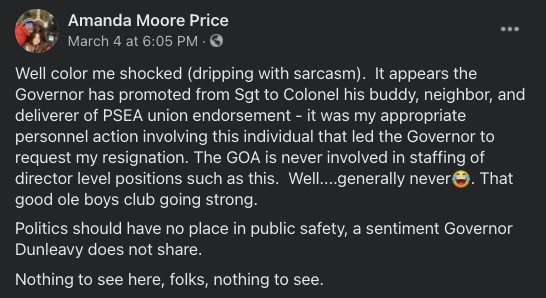
Price says in 2019 she spoke with Dunleavy about her concerns with Massie and what she describes as his inability to perform his duties as director of the Troopers’ Wildlife Division. She says she even considered removing him. 

“During the conversation I asked the governor if I could take appropriate and necessary personnel action with Massie or if he expected me to keep Massie as colonel regardless of performance issues,” says Price. “At that time, he told me that Col. Massie was my staff, and I should handle it as I see fit.”  

Price says she demoted Massie and quickly heard from Dunleavy. 

“A few hours after I took the action to demote Massie, the governor called me very upset,” says Price. “He was more escalated than I’ve ever heard him in the three plus years that I’ve known him, even though the action should not have been a surprise to him as I had spoken to both he and the Chief of Staff Ben Stevens a number of times about my concerns. He was very upset and ultimately hung up on me.” 

Price says Dunleavy called her a few days later and apologized, telling her he needs to think about this and that he would get back to her. 

Price says that was the last time she ever heard from Dunleavy. To this day she says he won’t take her calls. 

Three days later Stevens called Price to his office telling her she must resign or be fired. The only reason Stevens gave for the firing was the governor wanted to take the department in a different direction. 

Price believes she was fired because she demoted Massie. 

Price says because of his political connection to the governor, Massie now becomes untouchable for the incoming commissioner.  He or she cannot take action against the colonel if they want to keep their job. 

Price says it’s clear to her when Dunleavy promised during the campaign to make public safety a priority, what he really meant was he’d make the Public Safety Employee Union’s endorsement a priority.

Dan Fagan hosts the number one morning drive radio show in Alaska on Newsradio 650, KENI. He splits his time between Anchorage and New Orleans.


Trump says explicitly that he’ll campaign against Murkowski in 2022

In Politico on Saturday, former President Donald Trump made it clear that he will get involved in the 2022 Senate race in Alaska, where incumbent Sen. Lisa Murkowski is expected to defend her seat.

“I will not be endorsing, under any circumstances, the failed candidate from the great State of Alaska, Lisa Murkowski. She represents her state badly and her country even worse. I do not know where other people will be next year, but I know where I will be — in Alaska campaigning against a disloyal and very bad Senator,” Trump wrote to Politico. “Her vote to advance radical left democrat Deb Haaland for Secretary of the Interior is yet another example of Murkowski not standing up for Alaska.”

This is the second time he has said he will be in Alaska next year, campaigning against Murkowski.

Murkowski has been Alaska’s senator since appointed to the seat by her father, former Gov. Frank Murkowski, in 2002.

Some political observers, among them Must Read Alaska columnist and radio show host Dan Fagan, are wondering aloud if Alaska’s Commissioner of Administration Kelly Tshibaka is preparing for a run for Senate.

Trump coming to Alaska to back a candidate other than Murkowski could make Alaska’s Senate race the one to watch nationwide. After all, in November’s General Election, 189,951 Alaskans voted for Trump, with 153,778 voting for Biden.

According to Politico, Trump’s political team commissioned polling about Murkowski, which was conducted Jan. 30-Feb 1, just before Murkowski voted to convict Trump during the impeachment trial. That poll found Murkowski with a 43 percent favorable rating among Alaska voters, while Trump had a 52 percent approval rating, nearly identical to the percentage of Alaska voters who voted for him in November.

The survey by McLaughlin and Associates was paid for by Save America, Trump’s political action committee. McLaughlin was key to Trump’s 2016 and 2020 campaigns.

Politico wrote that Trump’s statement and the poll from his leadership PAC “represents a new escalation in his battle against Murkowski. It also stands in stark contrast to his support for other Republican senators up for reelection in 2022. In recent days, Trump has given his endorsements to several incumbents in generally safe seats, including Sens. Mike Crapo (Idaho), Tim Scott (S.C.), Todd Young (Ind.) and John Kennedy (La.).”

Due to Ballot Measure 2, it will be harder than ever for a challenger to unseat Murkowski, who will not have to face a semi-closed party primary this cycle. Her name will be on a jungle primary ballot with all others who choose to run for Senate, giving her a distinct advantage with name recognition, power of the purse, and her ability to convince Democrats to vote for her.
That’s an advantage she did not have in 2010, when Joe Miller beat her in the Alaska Republican Party’s semi-closed primary, which has been outlawed by Ballot Measure 2.

In 2016, Bob Lochner, Paul Kendall, and Thomas Lamb challenged her in the primary, which she won with 71 percent of the vote.

By the numbers: Anchorage drifts bluer, while Mat-Su and Kenai trend redder

In the March 3 purge of the voter rolls by the Division of Elections, Alaska has ended up with 585,525 voters.

Year over year, 13,609 more voters are registered in Alaska than at this time in 2020, defying the population trends that are showing seven years of outmigration from the state. In 2015, for example, the state hit a high of over 740,600 residents, but after the March 6, 2015 voter roll purge, there were just 500,882 voters.

The March voter roll purge is part of the annual maintenance by the state list to remove those who haven’t voted in several years, nor responded to queries from the Division of Elections, presumably because they moved away or died. The process of cleaning up the voter rolls is required by the National Voter Registration Act.

Some areas of the state are getting more Democrat registrants, while others are growing redder with Republicans.

Republicans gained in Anchorage district 19, where Rep. Geran Tarr has served for several years. Although they added 100 voters there, the district is still solidly Democrat.

Democrats lost 173 voters in District 24, and Republicans added about 93 voters. That’s Rep. Tom McKay’s constituency. He won over former Rep. Chuck Kopp in an Anchorage district that continues to get more conservative, with 4,007 Republicans and 2,054 Democrats.

Republicans also outpaced Democrat registration in Anchorage District 28, year over year, where Rep. James Kaufman beat former Rep. Jennifer Johnston in November. Democrats shedded 155 voters, and Republicans picked up 121. There are 4,840 Republicans in District 28 to 2,390 Democrats.

Across the rest of Anchorage, Democrats outpaced Republicans in registrations over the past year in many of the districts. Even in red districts, Democrats made slight gains.

State data from the Department of Labor shows that Anchorage has lost 3,517 residents, year over year, although not all of those would be registered voters.

Anchorage may have lost residents, but it gained 4,871 voters since last March’s voter roll purge (we are counting Districts 13-28 only, as 12 is halfway in the Mat-Su). There are 230,116 voters registered in Anchorage out of the population of 288,970.

This would mean 80 percent of the entire population of Anchorage is registered to vote. And the data indicates there are close to 58,854 children 17 and younger living in Districts 13-28.

In Southeast Alaska, Democrats outpaced Republican registrations in Juneau, but Republicans outpaced Democrats in Sitka and Ketchikan, even though Sitka is still a blue town.

Juneau Districts 33 and 34 grew a lot more blue since last year, picking up an additional 520 Democrats and losing 89 Republicans. The Department of Labor estimates Juneau’s population at 31,773.

In Fairbanks North Star Borough, Republicans outperformed Democrat registrations in four of six districts, but overall the increase in the Interior was about split.

But in the Mat-Su and Kenai, Republicanism got stronger. Mat-Su Republican registrations outperformed Democrat registrations by a four-to-one margin and on Kenai, the ratio was three to one, Republican over Democrat.

There was little change in rural Alaska.

Statewide, Republicans gained 5,213 voters year over year, to the 4,446 Democrat registrations added to the state voter file in the same time period. This represents a greater percentage gain for Democrats, who have 79,136 registered voters, compared to Republicans, with their 138,749 registered voters.

The winner statewide for registrations is in the undeclared category; that grew from 248,772 voters last March to 252,440 voters last week. Those voters are largely being added through automatic registration that occurs when people apply for their Permanent Fund dividend.

Anchorage mayor stops by Fairbanks Native clinic for her second vaccine

19

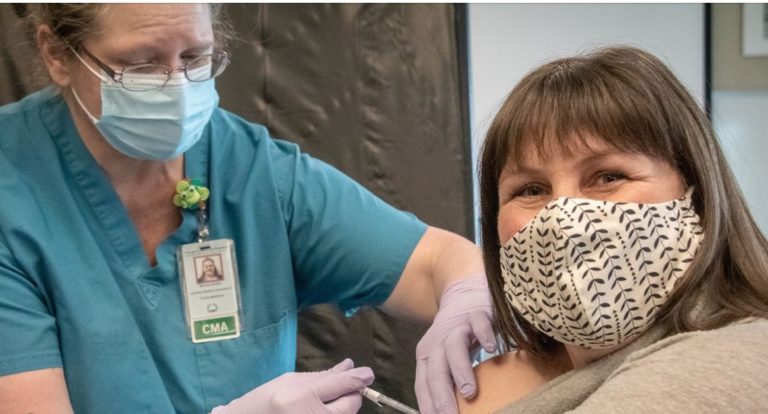
Anchorage Mayor Austin Quinn-Davidson traveled to Fairbanks this week, where she received her Covid-19 vaccination from the Chief Andrew Isaac Health Center.

“I am so thankful I had the opportunity to receive the vaccine through my wife’s employer, Tanana Chiefs Conference. Alaska is leading the country in vaccinations because of the incredible work and generosity of our Tribal partners. I want to encourage everyone to get the vaccine once it is available to you – for the benefit of all of us as individuals, our businesses, and our communities.”

Quinn-Davidson was able to jump the line for a vaccine because her wife, Stephanie Quinn-Davidson, works for the Tanana Chiefs Conference as director of the Yukon River Inter-Tribal Fish Commission. Quinn-Davidson is not a member of the tribe and she caught the Covid virus in December, so may still have natural immunity. This was her second vaccination.

Quinn-Davidson wrote: “Deeply thankful for this moment. I offer my heartfelt gratitude to all our Tribal partners for their dedication to the health and well-being of our state. I encourage everyone to get their COVID-19 vaccine as soon as the opportunity arises. Our community has been through a lot these past twelve months, but as Alaskans, we’re resilient and we look out for each other. As with mask-wearing and distancing, getting your vaccine is one way to show how much you care for your community.”

Major Obamacare expansion in Covid relief package

34

In addition to unemployment benefits and economic stimulus measures, the $1.9 trillion Covid-19 relief bill being voted on in the Senate this weekend has a massive expansion of the Affordable Care Act.

Although it is a one-time relief package, the bill increases subsidies for health insurance premiums, and that portion of the bill is not likely to be temporary, as it is an expansion of the ACA.

The bill lifts the income limits on the subsidization of premiums, which will be now 400 percent of the federal poverty line.

Those in households that are at 150 percent of the federal poverty line will now qualify for Medicaid. Under the existing law, Medicaid expansion is for those at under 138 percent of the poverty line who don’t have insurance through their employers, as they are not likely to be able to afford private health insurance.

A single person with an income of $60,000 income could see subsidies more than double for their health insurance.

Insurance premiums are set to skyrocket in 2023, something this amendment of the bill is anticipating and trying to mitigate with the expansion of the subsidies and tax rebates for those with private insurance.

The bill also has incentives for those states that have not expanded Obamacare. Although 37 states adopted the expanded ACA, including Alaska, the relief package being voted on has more attractive matching payments to try to coax the remaining states to sign up. This comes at an anticipated cost to future taxpayers of $16 billion over 10 years.

The little-publicized measure is the first major expansion of Obamacare since it passed in 2010. The Senate is voting on the Covid-19 relief package this weekend. It will likely pass and be signed by President Biden next week.

The Congressional Budget Office estimates this aspect of the relief package will cost $44 billion over the next decade.

The current national debt stands at greater than $28 trillion, more than $224,000 per taxpayer in America.

Forrest Dunbar is running for mayor against Must Read Alaska and Save Anchorage?

A fundraising letter to residents in the Geneva Woods neighborhood makes it sound like Democrat candidate Forrest Dunbar thinks his opponent in the mayor’s race is actually Must Read Alaska.

Dunbar asks his recipients to pitch in $50, $100, or $200 to support his vision for Alaska, which is “bold, proactive, and fact-based leadership.”

“Our far-right opponents have embraced conspiratorial, anti-science rhetoric that would have us ignore COVID rather than face it head on. They support the toxic partisanship of Save Anchorage and Must Read Alaska,” he continues. And worse, his “far-right opponents” hold events where people do not wear masks, which “threaten our hard-won progress toward re-starting our economy.”

Dunbar goes on to say that his campaign has outraised every other candidate by tens of thousands of dollars, “And we’re the only campaign to earn the endorsement and support of the Alaska Center and more than a dozen labor unions, including the AFL-CIO and the Anchorage Education Association.”

Residents of Geneva Woods have been united against the policies promoted by Dunbar, including the purchase of the nearby Golden Lion Hotel for use as a homeless and drug-and-alcohol center.

Dunbar is arguably the farthest left of over a dozen mayoral candidates appearing on the ballot that will be sent to voters in the municipality on March 15. The conservatives with the most visible and financial support who are running for office include Mike Robbins, Dave Bronson, and Bill Evans. The election ends April 6.

Must Read Alaska is a publication and that “keeps the mainstream media on their toes” by telling the other side of the story than the one the liberal media chooses to report. The publication’s Facebook page reached 1.2 million Facebook users last month, and the website averages 20,000 visitors a day. Newsletters published by Must Read Alaska reach 13,000 email addresses in Alaska eight times a week.

Save Anchorage is a Facebook group dedicated to better government in Anchorage, which formed about the time that the Anchorage Assembly decided to buy four properties for its homeless industrial complex plan. It has nearly 9,000 members.

The two organizations are not connected, although one can read the media’s portrayal of them as associated at the Anchorage Press.

Sen. Tom Begich introduces state income tax bill — SB 100

83

Sen. Tom Begich of Anchorage has introduced SB 100, a 5 percent state income tax. The tax would be based on the federal tax rate.

“… the road Alaska is on has finally arrived at the edge of the fiscal cliff. Alaskans realize we need a balanced fiscal plan — a plan that relies on a balance of revenue sources and other solutions, not just on one or two major sources like oil and the Permanent Fund. We need a plan where we all play a part – where Alaskans and those who make their profit or their living here invest directly in the services we all use. That commitment will, in turn, increase taxpayer scrutiny of the budgets we produce,” he said.

The bill was referred to the State Affairs Committee and Finance Committee. State Affairs is chaired by Sen. Mike Shower, and Finance is co-chaired by Sens. Bert Stedman and Click Bishop. All three are Republicans.

At this point the bill has no cosponsors.

Follow the bill and related documents at this link.

Video: Fields apologizes, Rasmussen chokes back tears, Ortiz stuffs envelopes

22

Rep. Zack Fields has apologized to Rep. Sarah Rasmussen for sexist comments he made about her body on the House Floor on her birthday. He now has apologized to all of Alaska.

That was the main event in the Alaska House of Representatives on Friday, although there were side bits.

Rasmussen choked back tears as she talked about how difficult it is to raise children to be respectful and how important respect is, citing Gov. Sean Parnell’s Choose Respect campaign.

Rasmussen said it is important that everyone can feel safe in their lives, their communities, and their workplaces.

Both Fields and Rasmussen had just returned from a week of quarantine after they were exposed to Covid-19 in the Capitol.

Behind Rasmussen, Rep. Dan Ortiz of Ketchikan wrote letters and stuffed envelopes, evidently bored by the drama taking place in the House today. It was unclear if the retired schoolteacher was even listening to Rasmussen’s remarks.

On Wednesday, House Speaker Louise Stutes tried to move the Sense of the House criticism of Fields to a committee, where it could be killed. As of late Thursday, Fields was still trying to remove any reference to him in the Sense of the House, through amending the resolution.

Republican Minority Leader Cathy Tilton did not grandstand on the House floor, but stood strong in saying the matter needed to be voted on. By so doing, she drew a contrast between the behavior of the Republican minority and the Democrat majority. Some in the House Chambers may have understood the contrast, although many are new.

In May of 2017, Rep. Ivy Spohnholz called for the Sense of the House against statements made outside the building to the media by Republican Rep. David Eastman. Her words then were, “When one member of this body brings the dignity of this institution into question, it’s incumbent upon all of us to act to defend it.” 

Ivy Spohnholz’ Sense of the House speech condemning Rep. Eastman

This year, Spohnholz was quiet when her fellow Democrat made a crass statement about Rasmussen’s body on the House floor.

In the end, the “Sense of the House” was accepted unamended and unanimously today, an act meant to criticize the jokey comments Fields had made about Rasmussen 10 days earlier.

And with that, the House adjourned for the day.

Is this the year for independent travel in Southeast Alaska?

By WIN GRUENING

In my last column, I wrote about the prospects for any kind of a tourism recovery this year in Alaska.  

The visitor industry, especially in Southeast Alaska,  is very dependent on large cruise ships. However, between yet-to-be finalized pandemic protocols and Canada’s cruise ban, it is becoming increasingly unlikely that the season will happen.

While our Congressional delegation and governor are trying to salvage the cruise season, a separate discussion of how we might boost independent tourism is ongoing – and vital.

On the cruise front, Rep. Young has introduced legislation, the Alaska Tourism Recovery Act, a temporary workaround that would make roundtrip voyages between Alaska and Washington a “foreign voyage” under U.S. regulations. This would make moot the requirement for a Canadian port call under the Passenger Vessel Services Act (PVSA).

Unfortunately, the PVSA isn’t the only hurdle that cruise lines face before returning to Alaska. 

Interim CDC guidance mandates that cruise companies run several “simulated” cruises with each ship along with a complex list of protocols, procedures, and other requirements before being cleared for operation.  Can cruise companies get ships ready, crews onboard and trained, obtain unanimity of agreement on protocols among affected Alaska port communities, then run several mock cruises in time to begin an economically feasible season?

It’s highly doubtful.  Cruise lines have already begun cancelling ship sailings for the 2021 season.

Travel Juneau, the Capital City’s travel and convention bureau, is formulating a plan to increase sales and independent travel in Southeast Alaska.  A few key components being considered are:

  • bolstering sales to in-state traffic and locals
  • developing targeted campaigns in the lower 48 through video & social media 
  • marketing Juneau as a “safe” community 

While the CDC has resisted loosening restrictions for cruise travel, other forms of travel are feasible. Governor Dunleavy has pointed out that Alaska should be the safest destination of choice for travelers this year. From the first traveler-testing program in the United States, to leading our country in testing and vaccines, the pandemic response from Alaskans has been rated the best in the U.S.

This should make Alaska more attractive to visitors looking to travel after a year of lockdowns.  Furthermore, most travel companies and airlines now have flexible and more generous booking and cancellation policies, and prices are historically low.  More readily available vaccines combined with pent-up travel demand should result in increased vacation planning and bookings.

Communities and businesses in SE Alaska might consider ways to take advantage of this.

First, each community should review their pandemic protocols and testing requirements. In Juneau, for instance, strict testing and quarantine rules are still in place for unvaccinated visitors (although this is scheduled to sunset on May 1). No one is going to schedule a vacation to Alaska if required to practice strict social distance (essentially quarantine) for 5 days after getting here. Since trip planning is happening now, communities should reassess these restrictions when warranted.

Second, businesses might explore ways to provide services and products that cater to smaller groups of people.  This may involve downsizing their operation further and finding efficiencies that allow them to operate with groups of say,  5-10 customers. This will be difficult for business models that depend on large volumes of cruise passengers such as whale watching boats and bus tours.

While these actions are short-term in nature and will not offset the revenue losses caused by a shortened or cancelled cruise season, they may help some businesses survive until 2022, when we can anticipate some recovery.

In the long term, Juneau residents and our neighboring communities would be wise to encourage continued growth and diversity in our visitor industry.  An ill-conceived local ballot initiative scheduled to be filed this month to limit cruise ship tourism in Juneau  does just the opposite.

It’s ironic that many people that criticize the cruise industry also fight a project that would have an exponentially beneficial impact on independent tourism – the construction of a road linking Juneau to Haines, Skagway, and the Continental U.S.

If we genuinely want to increase the number of independent visitors to our community, recognizing the economic benefits of a  road should be part of our vision and planning.

Win Gruening retired as the senior vice president in charge of business banking for Key Bank in 2012. He was born and raised in Juneau and graduated from the U.S. Air Force Academy in 1970. He is active in community affairs and in various local and statewide organizations.