Wednesday, June 3, 2026
Home Blog Page 1120

Dark money trail: Backing Dunbar for mayor, Sixteen Thirty Fund in hot water over major foreign donor pouring millions into races

A complaint filed by the Americans for Public Trust says that a Swiss billionaire has funneled millions of dollars into campaigns of Democrats through the Sixteen Thirty Fund.

That fund then funneled $35,000 into “Building a Stronger Anchorage,” a group solely dedicated to the election of Forrest Dunbar for mayor of Anchorage.

The complaint with the Federal Election Commission doesn’t reach as far down as the municipal level, but says that $200 million flowed from Hansjoerg Wyss’ nonprofit organizations — the Wyss Foundation and the Berger Action Fund –with the intent of pushing the money to campaigns for specific progressive candidates and causes. The group helped unseat Republicans in 2020, including Sen. Martha McSally in Arizona.

The complaint filed Friday notes that “the law prohibits foreign nationals from making contributions to political committees whether directly or indirectly.”

Earlier this month, the New York Times reported that Wyss had become one of the more influential donors to nonprofits that funneled money to the Sixteen Thirty Fund.

“Newly obtained tax filings show that two of Mr. Wyss’s organizations, a foundation and a nonprofit fund, donated $208 million from 2016 through early last year to three other nonprofit funds that doled out money to a wide array of groups that backed progressive causes and helped Democrats in their efforts to win the White House and control of Congress last year,” the Times wrote.

“Mr. Wyss’s representatives say his organizations’ money is not being spent on political campaigning. But documents and interviews show that the entities have come to play a prominent role in financing the political infrastructure that supports Democrats and their issues,” according to the Times.

Wyss also donated tens of millions of dollars over the past five years to groups opposing former President Donald Trump, and to support Democrats.

Americans for Public Trust filed the complaint with the Federal Elections Commission on Saturday.

“Hansjörg Wyss is a Swiss-born billionaire residing in the U.S. who contributes much of his wealth to various causes. Foreign nationals are prohibited from directly and indirectly making contributions to influence U.S. elections,” APT wrote. “However, Mr. Wyss, through a complicated scheme of non-profit foundations, has been able to make sizable contributions to establish and fund the Hub Project. The group then oversees spending in federal elections; yet, the group is not registered with the FEC.  The complaint requests that the FEC look into whether these contributions made by Mr. Wyss are indirect campaign contributions from a foreign national, running afoul of federal law. Given the significant campaign spending, the American public is entitled to a thorough investigation of this issue.”

Building a Stronger Anchorage, which is run by the liberal Ship Creek Group in Anchorage, used the Sixteen Thirty Fund money to conduct ballot harvesting through paid personnel in Anchorage for the mayoral election of Forrest Dunbar. The donation from Sixteen Thirty Fund was made in late February, records show. The Ship Creek Group also had a major contract to run the Dunbar campaign. Ship Creek Group also has a close business relationship with Lottsfeldt Strategies, run by Jim Lottsfeldt of Portland, which does campaign work in Alaska.

In a pitch for funds to increase its reach this spring, the group said it was laying the foundation for bigger political prizes, specifically the U.S. Senate race in Alaska:

“In the same way that Stacey Abrams’ organization, Fair Fight, laid the groundwork that enabled us to help Warnock and Ossoff over the finish line in 2020, organizations like Building a Stronger Anchorage are laying the groundwork for future U.S. Senate wins in Alaska,” the group admitted.

“Winning Anchorage’s mayoral race will pave the way for a purple future for Alaska, including in national elections such as the U.S. Senate, much the way that the progressive strength of metro-Atlanta has muscled Georgia into the purple column,” the group wrote.

“Forrest Dunbar is the progressive Democratic challenger. He’s in the Alaska Army National Guard and, since 2016, a member of the Anchorage Assembly. He is running on a platform of rebuilding Anchorage and its economy after COVID. His opponent, Dave Bronson, is new to politics and has gained popularity among a crowd vehemently opposed to the pandemic restrictions and with ties to the January 6 Capitol riots. Bronson is proposing dangerous rollbacks of policies around public health, economic growth, and housing and homelessness,” the group’s Chair Allie Banwell wrote. Banwell is managing partner of Ship Creek Group.

Banwell’s group also has ties to the Empurpling Project, “the new national startup supporting work to turn Alaska and other small-population red states into purple and blue states.”

Empurpling is a project of the George Soros Open Society Foundations through Bill Vandenberg, who directs U.S. Programs’ Special Initiatives and Partnerships Unit for Open Society.

Ballot Measure 2 forces Dunbar to admit Sixteen Thirty Fund ties

Dunbar’s dark money – what could go wrong?

The dark money connection between Dunbar and the Sixteen Thirty Group came to light after Must Read Alaska researched campaign spending. Because of Ballot Measure 2, that dark money trail became more discoverable. Ironically, the primary backer of Ballot Measure 2, Scott Kendall, was also a major supporter of the Forrest Dunbar for mayor campaign.

Mask-be-gone: Walmart, Costco drop mask requirements for shoppers

Both Walmart and Costco were among several major companies that announced on Friday they no longer have a mask mandate in their stores for shoppers who are vaccinated against the Covid-19 virus. The new policy applies in jurisdictions where local or state governments do not have a mask requirement.

There is no requirement that a shopper must show proof of vaccination.

The Kirkland, Wa.-based Costco “will allow members and guests who are fully vaccinated to enter Costco without a face mask or face shield,” in those areas, the company said on its website Friday. “Costco continues to recommend that all members and guests, especially those who are at higher risk, wear a mask or shield.”

The corporate letter from Walmart stated, “vaccinated customers and members are welcome to shop without a mask,” while unvaccinated shoppers are asked to keep masks on.

Walgreens is keeping its mask policy until the company further reviews it. Kroger, which owns Fred Meyer, is reviewing its company mask policy, and Home Depot still required masks as of Friday.

A Must Read Alaska venture into restaurants in Anchorage on Friday evening revealed that many had quickly abandoned the masks as soon as the Anchorage Assembly lifted the emergency order that required them. A few servers still wore masks, but most did not.

There’s no word on when the FAA or airlines will release passengers from the mask mandates, although the CDC says that those who are not vaccinated don’t need to wear masks indoors or outdoors. Alaska Airlines has banned 509 passengers for not following the mask mandate, while Delta has banned over 1,200.

Homer couple sets up website to tell their story of shocking FBI raid on their home

Marilyn and Paul Hueper, whose Homer, Alaska home was raided by 12 FBI and other law enforcement agents on April 28 in search of a laptop belonging to Rep. Nancy Pelosi, have set up a website to tell their story.

WethePeopleSTAND.org covers the top points of what happened when the FBI crashed through their front door and held them at gunpoint.

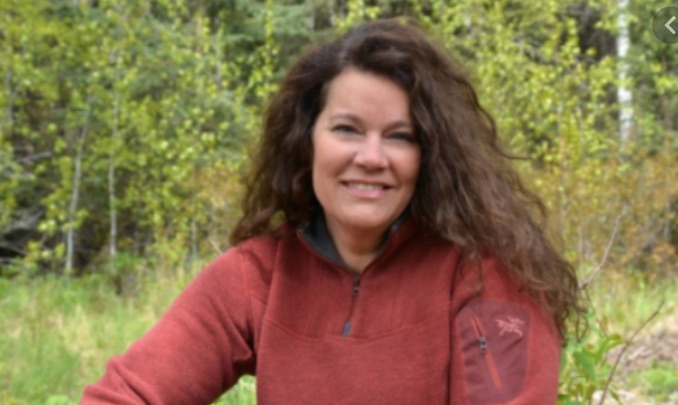
The Pelosi laptop apparently disappeared during the Jan. 6 surge into the U.S. Capitol by protesters of the certification of the presidential election. The FBI and Capitol Police evidently think Marilyn took the laptop, but she says it is a case of mistaken identity. (She is pictured above on the left, and the person the FBI is searching for is on the right.)

“Our home was unlawfully raided and we were held captive at gunpoint by the FBI on April 28, 2021.  Ignorance of our Rights and the Law caused us to resign ourselves to their terrorism in our own home!” Marilyn wrote on the website.

“Unfortunately, this was not an isolated incident. Weaponized aggression by government agencies is growing!  Because of this, I have committed myself to learning about my Rights, and how to exercise my Power, even in intense situations. And to Empower as many others as are willing,” she wrote.

She wants others to learn from her experience, and if this happens to them, to not make the same mistakes she made. In her view now, she should not have talked to the FBI at all. Instead, when they questioned her, she was very forthright and good-natured about the raid. They left with her computers and cell phone that day.

The couple has their cell phones back, but do not have her computer back. They also have back the pocket copy of the U.S. Constitution that the FBI took during the raid.

“WARNING!  Do not do what we did!  We made tons of ‘mistakes’ in dealing with the FBI that day.  Listen to our story, but know that no matter how innocent or well meaning you may be, sharing ANY information with the FBI or other enforcement agency is always a very very VERY dangerous idea,” Hueper wrote.

“We will be informing you what we ‘should’ have done that day as we learn more ourselves, in hopes that we and you will become more fully informed and empowered.  But for now, give a listen and know that so far, we appear to have survived our own trusting ignorance… by the grace of God!”

Hueper has appeared on national news and talk shows, such as Laura Ingraham, Grant Stinchfield (NewsMax), Glenn Beck (The Blaze) and others, all of which she has linked to her new website. More details are linked in stories they’ve posted from various media, including Must Read Alaska and Epoch Times, the Dan Fagan Show, Birdeye View with Bob Bird, and Top of the World with Chris Story.

“This is a learn as we go space.  We are still very much in the midst of the situation with the FBI and will be posting as we get solid understanding and direction… to empower all of us!”

FBI breaks into Homer couple’s home, looking for Nancy Pelosi laptop

Clem Tillion: Open letter to the 32nd Alaska Legislature on the Permanent Fund dividend

Distinguished Members of the 32nd Alaska Legislature:

Before writing this missive, l gave considerable thought to whether or not I have anything relevant to add to your deliberations.

After all, I am 95 and the contemporary political scene is much changed since I served in the Alaska Legislature.

On reflection and as I have been paying close attention to what is transpiring or perhaps not happening down in Juneau, I do have some general guidance that may assist in addressing some of the difficult challenges facing Alaska.

The demands of the present that command much of your attention are, in some regards, in conflict with the need for protecting our collective future.

As a teenager serving in the United States Navy on Tulagi and Guadalcanal, I learned first-hand in a sometimes-brutal manner how the present can overwhelm the future. We didn’t think very much about the future in those tough days, given that someone you might share rations with at breakfast might not make it past lunch.

Providing for the future in the face of immediate demands is arguably the hardest task any elected official faces. When Hugh Malone, Oral Freeman, Jay Hammond and other political leaders were maneuvering to save a fraction of the oil wealth owned by the people by establishing the Alaska Permanent Fund, the idea of saving a small portion of our collective wealth from a nonrenewable resource was bitterly contested. So was the idea that the people should obtain a share of the earnings from their savings account in the form of a Permanent Fund dividend.

Similarly, the concept of amending our Constitution to provide for limited entry in our splendid fisheries to protect the long-term viability of this rich renewable resource was slugged out in a not very genteel fashion. Still, who among us disputes the value of saving via our Permanent Fund, how the Permanent Fund dividend has lifted many citizens out of poverty and broadened the economy or the merits of protecting Alaska’s fisheries?

Which brings me to the point I believe is critical: Alaska’s financial future and whether our people will thrive instead of merely surviving is dependent on the Alaska Legislature acting to protect the Alaska Permanent Fund, including putting a halt to spending money from the existing Earnings Reserve Account.

You also need to act promptly to settle, once and for all, the annual brawl over how to appropriate funds from the Permanent Fund earnings in order to pay the dividend. It is obvious to anyone paying the slightest bit of attention the past six or so years that we are spending more than is available for government.

Borrowing funds from savings accounts like the statutory budget reserve account and the constitutional budget reserve account cannot continue. In a fiscal sense, we have been living on borrowed time and the end of the line is drawing near.

Next up in terms of spending, if we cannot control ourselves, is the race through the Earnings Reserve Account, a matter that will prove disastrous in a matter of a few years if we walk down that trail. At this point, if you are still reading this correspondence, you wouldn’t be wrong if you conclude I am nattering on and telling you something that you already know.

So, what is to be done? Creating the Alaska Permanent Fund is probably the single best accomplishment completed by our state government since statehood. It can be argued (and has been), that we should have saved more and spent less. Perhaps so. Those of us who were there at the time did the best we could and the legacy we left is what you have to work with but at least we left you with options, some of them pretty good. To be sure, we made some mistakes.

Until the Alaska Supreme Court decided otherwise, I believed with all my heart that the constitutional amendment we advanced and the people ratified setting up the Permanent Fund implicitly allowed for the dedication of a dividend from the earnings of the fund. We left the dividend formula up to the legislature based on the desire to give future legislatures some flexibility.

But nobody expected the judiciary to rule that the dividend was just another appropriation to be battled over by factions in our society. Back in the day, we really believed the Legislature would protect the Permanent Fund by protecting the dividend from being carved up and devoured by special interests and the lobbyists.

At this point, there is a loose move to change the Permanent Fund from what is essentially a trust fund into an endowment according to the Percentage of Market Value structure. This would be a fundamental shift in how the Permanent Fund is structured and nobody in the Alaska Legislature should be under the impression that adopting the POMV structure is a simple accounting move without potential to destroy the Permanent Fund.

Let me be blunt: I do not like the POMV concept. I have two reasons for not liking a shift to the POMV methodology. First, if the percentage drawn from the value of the Permanent Fund is established at or fractionally above 4%; the fund will be overdrawn at some point and enter into a downward spending spiral that will destroy the fund. If you don’t believe me, simply take counsel from the consultants to the Permanent Fund Corporation who indicated this year that drawing 5% from the fund is unsustainable.

The analysis by the consultants to the Permanent Fund Corporation conducted prudent stress tests illustrate the likelihood of systemic failure by adopting an overly generous percentage value. Secondly, the problem of how to split the POMV yield is critical.

Are you prepared to provide all eligible Alaskans with an equal share of the percentage value derived from their savings contained in the Permanent Fund in the form of a dividend?

A large majority of Alaska citizens like the Permanent Fund dividend. They use the dividend, often in creative and prudent Ways, to live and support their families and children. How many of you really believe you can cut or eliminate the dividend and not get cross-threaded with the citizens?

At this point in my life, I know I will stand with the people and oppose any move to convert the Permanent Fund from a trust account to an endowment that uses an overly generous percentage or that fails to make a fair share allocation to the citizens in the form of a dividend. If you insist on advancing the POMV concept, it seems to me that putting a 4% POMV with a 50/50 split of the percentage in order to provide for a dividend and fund government services (or whatever the legislature elects to do with the funds), is probably acceptable.

If you instead decide to throw caution to the wind by adopting an overly large percentage and then chisel off most of the funds to pay for our large state government the prospect of electoral insurrection and rejection at the polls is likely.

l’ll wind up my thoughts here by asking you to read an article that Louis Latham wrote as a young journalist fifty years ago.” Alaska was on the cusp ofexploding with oil revenue. The present in Alaska was dodgy when he wrote the article but the future looked promising, a situation that one might say has been reversed today, at least in some regards.

One of the great points made by Latham in this article is that saving a few bucks today for the future was the smart play. He didn’t characterize the present as working against future considerations the way I might have but by reading about what was transpiring in Juneau 50 years ago, you might tease out some solutions to the brutal problems you are confronted with in the moment.

I have never believed history is a circle. History in my view is a series of spirals that sometimes overlap, occasionally cross but mostly loops around in a way that gives guidance if not answers to contemporary problems. The task of political leaders in a democracy is to keep the loops and spirals on an upward trajectory.

That’s all I can ask of you – keep the future of Alaska heading up. I do not have any hard answers for any of you as you conduct the lawmaking powers for our people but I have do have a few observations that I think square with some of the observations made by Louis Latham 50 years ago about this wonderful place all of us are privileged to call home.

The yoke and burden of the present, hard as it may be, should never deflect acting in the best interest of those who will walk behind us. If you cannot summon the will and votes to address how the earnings of the Permanent Fund will be allocated that includes a fair dividend that is constitutionally guaranteed for the owners of the fund, then at least stop spending the funds in the Earning Reserve Account managed by the Alaska Permanent Fund Corporation.

We have blown through the bulk of our enormous savings accounts set aside for genuine catastrophes. For too long, we have avoided making the hard choices required to build a right-sized and sustainable budget. For years we spent too much of our communal nonrenewable mineral resources. Instead of doubling down on spending disconnected from fiscal reality, it is time to act to preserve the best idea Alaska has adopted — the Permanent Fund — and protect the fund in perpetuity by embedding a sensible Permanent Fund Dividend in the Alaska Constitution.

Do that and the other problems, demons and heartaches confronting you in the political sphere will resolve and disappear like a plate of King Crab legs at a legislative reception.

With my regards and sincerest hope that you act in the interest of our citizens, l am,

Clem Tillion lives in Halibut Cove and is one of Alaska’s resident eldest living former legislators and lifelong Republican. He is a long-time commercial fisherman, a nine-term Alaska State legislator, and is a charter member and past chairman of the North Pacific Fisheries Management Council.

Jamie Allard: Long live the Class of 2021. Long live freedom

By JAMIE ALLARD

“Freedom is never more than one generation away from extinction. We didn’t pass it to our children in the bloodstream. It must be fought for, protected, and handed on for them to do the same, or one day we will spend our sunset years telling our children and our children’s children what it was once like in the United States where men were free.” – President Ronald Reagan

Just as the trees stretch their leaves into the sky this month, Alaska’s high school graduating Class of 2021 are tossing their mortarboards skyward.

Along with those mortarboards, face masks are flying through the air as well – into the bonfire.

The Class of 2021 is moving on from all that, and well they should.

No red-blooded American parent ever thought they’d see our young people hidden behind a cloth mask for the best years of their lives, nor did we wish for them to be home-bound, ordered to shelter in place by the government for indefinite periods of time. 

That’s not what we dreamed for them as newborns, and it’s sure not what we want for them on their journeys through adulthood. We cannot accept that an ever-present government threat of house arrest is the new norm for this generation as they take on the responsibilities of running their own lives, and ultimately our nation.

As Americans, we expect more for our graduates, and we, the adults in the room, must protect that precious foundation of freedom that allows them to dream, achieve, and live their destinies. 

To regain the sense of American promise, we must recommit to our responsibilities because our liberties, as explained so eloquently by Ronald Reagan, are just a generation away from being taken from us.

Therefore, I can think of no better gift for this graduating class than a copy of the U.S. Constitution, with our precious rights delineated in the Bill of Rights. Forget the car, computer, or diamond necklace. Those are tangible but temporary; liberty is intangible, and wholly irreplaceable.

It would be my hope to see a copy of the Constitution in the hands of every single senior this year, whether they walk across the stage or get their GED in the mail and head to their first real job.

The Bill of Rights guarantees their liberties as individuals: Rights like freedom of speech, religion, due process, and rule of law. It reserves all powers not delegated to the federal government to the people or the states. Why wouldn’t we want to issue each graduate a copy of this sacred document?

Indeed, we should wear it on our shirts, print it on our business cards, and talk about it at least as much as we gossip about the Kardashians. Let’s print that Bill of Rights on the back of every diploma, to remind graduates of what they have as citizens: Rights endowed by the Creator, as described in that other great document, the Declaration of Independence. 

We should motivate our new graduates to take to heart the Bill of Rights, and dare I say we should hope they would be obsessed with them.

These rights have had a severe trampling this past year and our graduating class might have absorbed the notion that the taking of their God-given liberties is normal and part of our compact with government. It is not.

I would not want to overstate the difficulties of the past year, of course. Perspective is important. Those who have endured wars, Holocausts, Biblical plagues, and desperate poverty saw horrors that make this past year’s “policy pandemic” look tame. We’ve seen an erosion of our rights, not a wholesale decimation. I believe there’s a path back to restore the balance, but it will take all of us, graduates included, to take that path.

I hope today’s graduating class and their parents take away this lesson as they look back and look ahead: Governments are organisms that like to grow and gather power unto themselves. From the White House to the local City Hall, bureaucracies and those who run them want to gain more control over our lives, not less. 

For America to continue as the land of promise and opportunity, we cannot allow government at any level to overstep its bounds. We, the people, must stand in the gap to protect the next generation — including this Class of 2021 — so they, too, may have the opportunity to live long and fruitful lives. 

Let this be our promise to the graduating class of 2021: We know we didn’t meet our own expectations for fighting for your freedom this past year. But we will do better. We will keep fighting for your future. Our Constitution will be our sword and shield. We do this for you, and we expect you will do this for the next generation.

Jamie Allard is the Anchorage Assemblywoman representing Chugiak / Eagle River.

Win Gruening: How the Juneau cruise ballot initiative process went so wrong

By WIN GRUENING

Most people probably didn’t notice the correction to a Juneau Empire opinion piece by cruise initiative sponsor Sue Schrader that was published on the weekend of April 24.  

Schrader urged passage of three initiatives seeking to block large cruise vessels and slash the number of cruise passengers visiting Juneau.  

She declared that Disney Cruises had stated they could easily accommodate the proposed changes in the initiatives. That turned out to be false and the Empire published a correction within days. 

The same op-ed proclaimed that the city’s Visitor Industry Task Force “recommended many expensive infrastructure projects that benefit the cruise ship industry, but that Juneau will pay for.”  The author failed to mention that these projects would also benefit residents and be paid for with passenger fees collected from the cruise lines for that purpose.

Kim Metcalfe, another initiative sponsor, authored an Empire My Turn complaining about “problems caused by 22,000-visitor days” in 2019. A study conducted by Juneau Economic Development Council charting projected 2022 cruise passenger volumes throughout the day reveals that this number is grossly misleading. In fact, ship scheduling has limited the number of onshore passengers during the week to between 5,000 and 15,000 per day.  Only Monday, Tuesday, and Wednesday are projected to exceed 10,000 passengers at any one time with the remaining days averaging around 7,500 passengers during peak hours.

Hyping the cruise visitor numbers is part of the anti-cruise strategy. The Facebook page of the group backing the initiatives contends that without limits, along with an additional dock, Juneau “could top three million (visitors) with just one ship at each dock each day for a 150-day season.”

Are these examples of “opinions” or are the authors presenting them as “facts”?

Corrections to opinion pieces are rare.  After all, in America we believe in free speech and when we see misstatements of facts – whether by design or ignorance – we often roll our eyes and try to correct the record with an opposing opinion piece.  However, that doesn’t carry the weight or credibility of an editor’s official correction.

The referenced initiatives would prevent cruise ships (except those with fewer than 250 passengers) from docking in Juneau on Saturdays and, on other days, limit their hours in port to between 7 a.m. and 7 p.m.  In addition, all cruise ships over 100,000 gross tons would be totally banned beginning in 2026. 

As discussed in my previous column, based on an analysis of the 2022 cruise schedule, these initiatives would effectively reduce passenger numbers by about one million visitors, to the level experienced almost 30 years ago, and shrink passenger spending in Juneau businesses by $162 million per year.  This would jeopardize tens of millions of dollars in municipal tax revenue and decimate Juneau’s economy and city budgets.

Yet, initiative supporters claim these are just “modest” proposals seeking to “balance” the industry, an industry they assert contributes little and leaves Juneau “the crumbs”. 

How can these allegations be supported when the facts indicate otherwise?

Therein lies the problem with the ballot initiative process, a process easily  abused with unrealistic ideas masquerading as reasonable reforms.  The campaign to pass an initiative then provides a platform for activists to promote every misconception, distortion, and fallacy possible. 

All three of these initiatives were apparently drafted without much, if any, research on how they would impact Juneau’s economy.  The drafters chose to bypass the elected Assembly and their Visitor Industry Task Force as well as the community process (Tourism Best Management Practices) that has been in place since 1997 addressing visitor industry impacts.

The campaign rhetoric is just beginning.  As petition signature-seekers continue to ratchet up the emotional arguments, will they continue to ignore facts?

There is nothing inherently wrong with suggesting ways to mitigate visitor impacts.  But ballot initiatives are not the best vehicle for dealing with complicated issues that require facts and deliberation to achieve well-thought-out policy.

Apparently, petition sponsors didn’t care enough to explore the consequences of these initiatives.  Their extreme proposals are evidence of that.

But Juneau voters should care enough not to sign on to this ill-conceived effort. 

After retiring as the senior vice president in charge of business banking for Key Bank in Alaska, Win Gruening began writing op-eds for local and statewide media. He was born and raised in Juneau and graduated from the U.S. Air Force Academy in 1970. He is involved in various local and statewide organizations and currently serves on the board of the Alaska Policy Forum.

Ann Brown takes over as AK-GOP chair

Glenn Clary announced his resignation from the Alaska Republican Party earlier this year, and on May 15, 2021 he became immediate past chairman, as Ann Brown stepped up to lead the party. At this point, there is no vice chair of the Alaska Republican Party, as that person has to be chosen by the State Central Committee, which meets July 10 in Fairbanks.

Although he has no official role, Clary will retain a voting membership. The former immediate past chairman, Tuckerman Babcock, no longer has a vote on the State Central Committee.

Clary and his wife Debbie are moving to Lynchburg, Virginia, where Clary will work as the Vice President of Strategic Partnerships for Liberty University. He will run a group called “Standing for Freedom Center,” where he will build coalitions with pastors, churches, universities, conservative organizations, lawmakers at the state and federal level, and voters to influence political issues.

Hot mic: Assemblyman Chris Constant says ‘I just didn’t want to give Jamie the power’ in mask mandate removal maneuver

The Anchorage Assembly on Friday buckled to pressure, but in the end, they showed their political hand.

Dr. Fauci, the White House, Congress, the Department of Defense, and even the Alaska Legislature had revoked mask mandates. Had the Assembly not acted to do the same, it would have had a revolt on its hands.

“It’s time to end the mask mandate, it’s time to end it now,” said Assemblyman Kameron Perez-Verdia, who has voted in favor of the mask mandate for months.

Originally, Acting Mayor Austin Quinn-Davidson had kept in place the mandate, which former Mayor Ethan Berkowitz had put in place last June. She said the mandate would stay until 70 percent of the population was vaccinated against Covid-19. While many are vaccinated, it’s only about 50 percent of the population in Anchorage at this point.

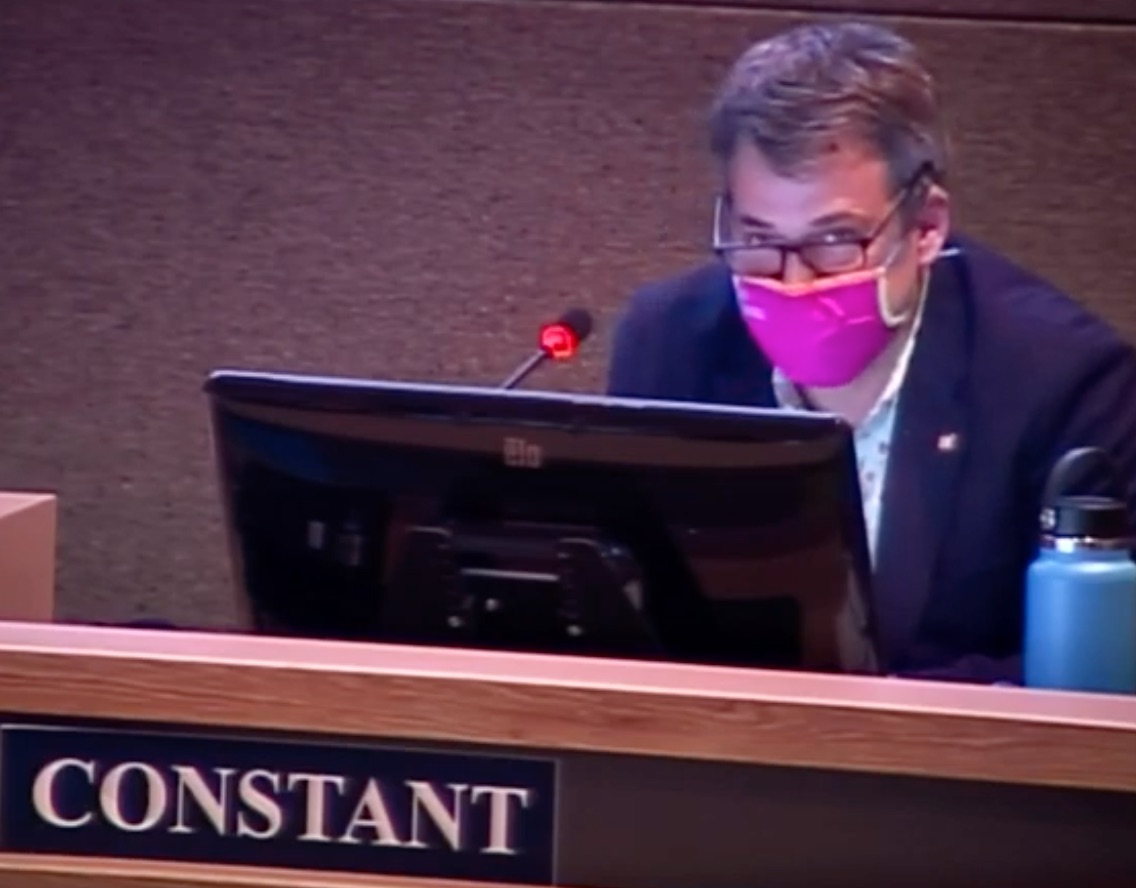
But after Friday’s special meeting, Assemblyman Chris Constant quickly moved that the Assembly remove the mandate.

Constant was preempting Eagle River Assemblywoman Jamie Allard, who already had an amendment on the table to do just that. Allard has fought the mask mandate for many months, as the lone champion for opening Anchorage’s economy.

Constant, who has been busy working on the Forrest Dunbar for Mayor campaign, made the procedural move to ensure Allard could not take credit for it.

Constant was caught on a hot mic saying, “I just didn’t want to give Jamie the power.”

“I thought this wasn’t about political posturing, I thought this was about doing what’s right for our community,” Allard said later.

Assembly members and the public must still wear a mask in Assembly chambers until Tuesday, when that order is expected to be lifted.

Louis Imbriani, a citizen activist who attends many meetings of the Assembly, taped Constant in his “hot-mic moment,” and then played it back to the Assembly at the end of the meeting, expressing outrage that the liberal assemblyman had politicized the mask mandate.

Breaking: Bronson extends lead to 1,116 votes over Dunbar

Dave Bronson grew a sizable lead over Forrest Dunbar in the latest vote count released by the Anchorage Election Office. Some 6,052 votes were counted today, and Bronson now has a 1,116-vote lead.

87,165 have been counted so far. An estimated 4,900 ballots are still out in the runoff election for Anchorage mayor:

  • Bronson has 44,076 votes.
  • Dunbar has 42,960 votes.

The difference between the vote counts is 1.28 percent, far beyond the half-percent difference that would prompt a recount.

In addition, Dunbar would have to take three-to-one out of the remaining uncounted ballots to overcome the Bronson lead.

The municipal election workers do not plan to count ballots over the weekend, Must Read Alaska has learned.