In a jump from Monday, Tuesday’s statewide Covid testing positivity count was 1,200. That is still a 1 percent decrease from last week, but a significant day-over-day increase from 464 diagnosed on Monday.
Hospitalizations also bumped up, with 204 Alaskans now in a hospital with Covid, up from 186 on Monday. There are 277 non-ICU beds available in the state and 21 ICU beds, a drop from 26 on Monday.
26 people with Covid are on ventilators in Alaska, and the percentage of currently hospitalized Covid patients makes up nearly 20 out of every 100 patients.
62 new Covid hospitalizations have occurred in Alaska since Oct. 1. Some 23 of those were of Anchorage residents. There have also been 28 deaths in Alaska attributed to Covid since Oct. 1.
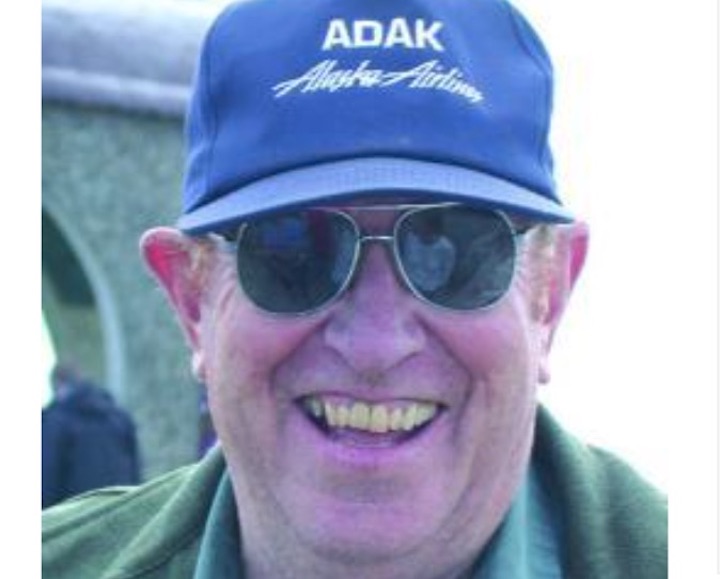
Sen. Clem Tillion, who was one of the oldest former legislators in Alaska, has died. He was a long-time commercial fisherman, a nine-term Alaska state legislator, serving in both the House and the Senate, and he served as Senate president.
Born in Brooklyn, N.Y. in 1925, he was a resident of Halibut Cove near Homer, he served on state boards, commissions, including as chair of the North Pacific Fisheries Management Council. He was 33rd degree Scottish Rite Mason, the highest rank.
As a legislator, he was considered one of the founders of the Alaska Permanent Fund; in recent years he was a founder and board member of the Permanent Fund Defenders group, a group of people trying to restore the statutory formula for the Permanent Fund dividend.
His wife, Diana Rutzebeck Tillion, an artist who used octopus ink in her paintings, died of cancer at the couple’s home in Halibut Cove in 2010.
Tillion served in the U.S. Navy from 1940 to 1945 before coming to Alaska. He got into fishing by working as a deckhand.
He helped shape the borough boundaries for the entire state. He specifically shaped the Kenai Peninsula Borough to include the Cook Inlet oil finds, and he carved in Halibut Cove to be part of the Kenai Peninsula Borough.
In later years he ran a commercial boat shuttling people from Halibut Cove to the Homer Spit. He was 96 when he died, but as late as last year he was still running the boat. He also was a lobbyist during his 90s for fishing interests in the Aleutian Chain.
Tillion was a colorful character who was not shy to share his opinions on politics. Anyone in politics in Alaska, from a city council person to a governor, would gladly take his call and consider it an honor and privilege to listen to Tillion. In May, he penned a letter to the Alaska Legislature about the Permanent Fund and his position on the dividend:
Oct. 13, 2020, former Mayor Ethan Berkowitz resigned, after nearly five and half years serving as mayor of Alaska’s largest city. He has barely been seen or heard from since.
The day before, he had admitted to engaging in a salacious relationship with then-news anchor Maria Athens, who posted a photo on Facebook that looked like the bare-naked backside of Berkowitz.
She also accused him of posting nude selfies on a website for older men interested in dating underage girls.
“It is with profound sadness and humility that I resign as mayor of the municipality of Anchorage,” Berkowitz said in a statement that night. He didn’t actually read the statement himself; it was read into the Anchorage Assembly record by his Chief of Staff Jason Bockenstedt. “My resignation results from unacceptable personal conduct that has compromised my ability to perform my duties with the focus and trust that is required.”
The Assembly chambers were filled that night with residents protesting the mayor’s dire restrictions that were killing businesses and ruining people’s lives. The crowd sprang to their feet, clapped and cheered at the news of his departure.
Berkowitz would remain mayor for another week and a half, while a transition took place to make Assemblywoman Austin Quinn-Davidson the acting mayor, a role she held onto for eight months, after the Assembly refused to hold a special election for mayor.
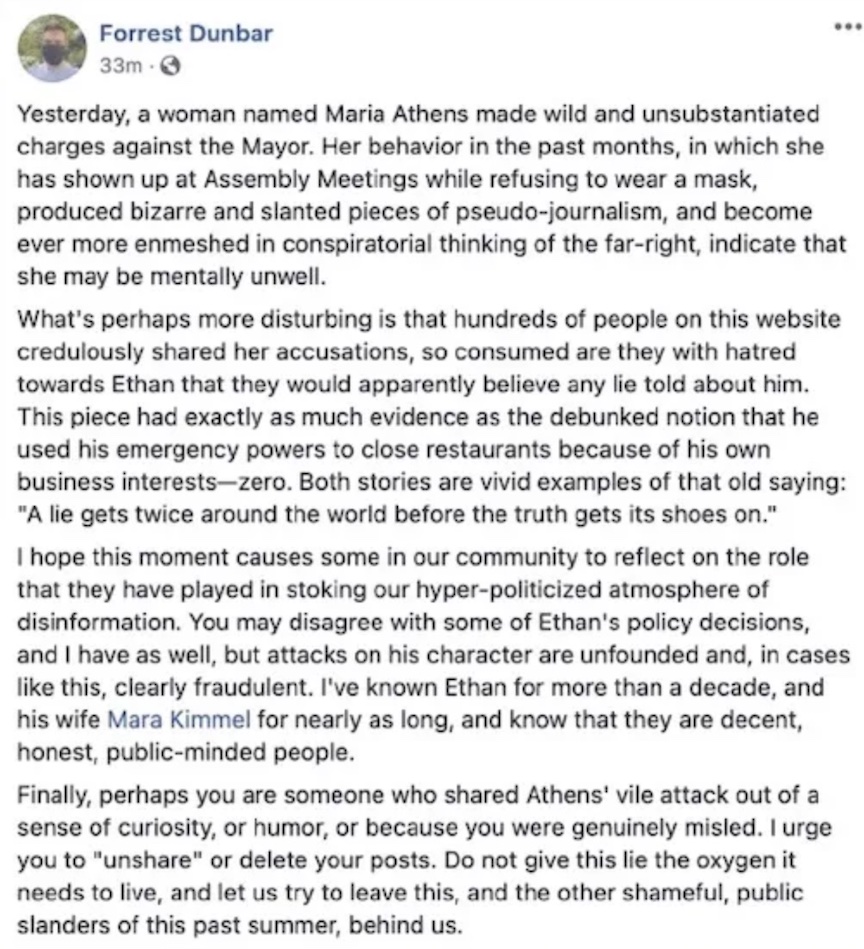
Soon, the disgraced mayor used the power and privilege of his office to attack Athens. Anchorage Assemblyman Forrest Dunbar joined him in attacking the woman:
While Dunbar attacked Athens and Must Read Alaska, and strongly encouraged people to delete any of their shared social media posts about the incident, the mainstream media stayed quiet for days, unwilling to touch the story about a man who many journalists considered an ally and a friend.
“Do not give this lie oxygen it needs to live, and let us try to leave this, and other shameful, public slanders of this past summer, behind us,” Dunbar wrote.
The media complied. More than 50 hours after the story first broke of the sexting relationship, the mainstream media still had not written a word about the matter. Instead, the Anchorage Daily News ran a story about the mayor’s proposed budget.
Also defending the mayor was Eric Croft, another political ally of the mayor who had already announced his candidacy to take over after Berkowitz was scheduled to be term-limited out in June, 2021.
The response from the Left — not believing a woman in this “believe all women” era — and the silence from Alaska’s largest newspaper, became the hot the topic of discussion in many conservatives circles in Anchorage.
The reporter who blew apart Berkowitz’ political aspirations for governor — or for finishing his term as mayor — ended up leaving the state and has disappeared from public life.
By Oct. 21, the Left-stream media, the Anchorage Press, had written a feature blaming the mayor’s demise on Must Read Alaska and Save Anchorage, titled, “Save Anchorage, Must Read Alaska and the plot to overthrow the mayor.”
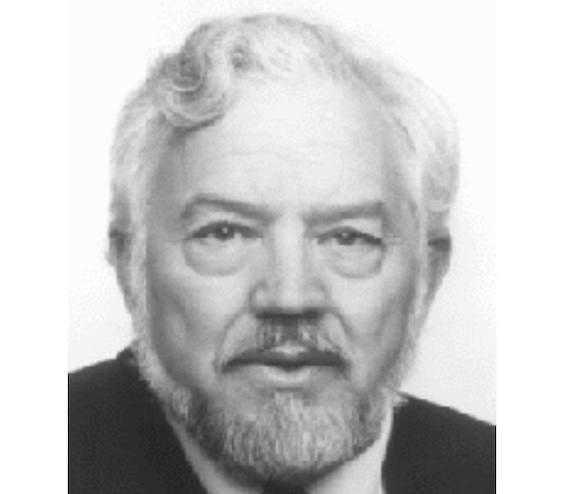
Former Rep. Bill Hudson has passed. He died on Monday.
Hudson was a member of the Republican Party who served as a House representative for Juneau from 1987 to 2002. He also lived in Dot Lake, Ketchikan, Cordova, and Soldotna during his long life.
Born in Yuma, Arizona in 1932, he attended high school in Wallace, Idaho, and attended Columbia University and the Julliard School of Music. He attended officer candidate school and served in the U.S. Navy, and for 21 years in the U.S. Coast Guard, rising to the rank of Commander with 8 decorations.
He and his wife Lucy were the parents of nine children. His wife, who was a special assistant to Senator Frank Murkowski and Rep. Don Young, passed away in 2018 in Idaho.
Hudson was a real estate professional and business consultant in Juneau. In addition to his six terms in the State House, he was the director of the Alaska Seafood Marketing Institute, served as the commissioner of the Department of Administration, and as director of the Alaska Marine Highway System.
Hudson served on the board of directors for REACH and the Salvation Army.
Mayor Dave Bronson has vetoed the ordinance hastily passed by the Anchorage Assembly on Tuesday that orders all within Anchorage to wear masks when indoors in public places.
The Assembly immediately scheduled a special meeting for 5 pm on Thursday to override the veto. The meeting is to take place at the Loussac Library in the Assembly chambers for consideration of overriding EO the veto of 2021-3, the compulsory mask ordinance.
“I have reviewed the emergency ordinance and heard the Assembly’s justifications for and against the same. The Assembly introduced and passed this emergency ordinance [EO 2021-3], on the same night, effectively shutting down public testimony on the issue of mask mandates. They blatantly ignored the people’s right to petition their government. The Assembly openly displayed their scorn for the public process, which is fundamental to self-government and self-governance,” the mayor wrote.
Bronson went on to describe the trickery involved on Tuesday.
“The Assembly’s decision to impose a mask mandate, after assuring the public here would be continued public testimony, and under the cover of darkness is, at its core, ignoring the fundamental right of citizens to participate in a meaningful way on matters of community interest and importance,” he said.
The Assembly ignored data that demonstrates a significant decrease of Covid-19 cases in Anchorage and misrepresented to the public their ability to weigh in on the issue that affects every citizen in Anchorage,’ he said.
He was referring to the lie that the Assembly Chair Suzanne LaFrance told the public on Monday and Tuesday, that they would be able to continue testifying on the mask ordinance on Wednesday. Instead, the Assembly majority wrote a new ordinance, duplicating Anchorage Ordinance 2021-91, but made it an emergency ordinance and moved it without a hearing.
“Alaska’s constitution expressly provides the right of the people to privacy, a right that shall not be infringed. Our right to privacy is expressed, and its protections are broader in scope than those implied under the federal system,” Bronson wrote.
“The reasons Alaskans wrote the right to privacy into our constitution, and ratified the same by overwhelming vote, is our home’s longstanding tradition of respecting privacy and individuality. At the core concept of Alaska’s liberty is the notion of personal immunity from government control and the right to be let alone,” he said.
Bronson said the Assembly was stoking widespread fear to frighten the public into submission.
The Assembly has 36 hours to override the veto, which would take a vote of nine of the members.
Garvin Federenko, the CEO of Alaska Native Tribal Health Consortium, has suddenly resigned.
Federenko had been with the consortium since 1998, when he helped transition the organization from federal to Tribal management. Most recently, Federenko served as ANTHC’s senior director of Administration and Finance, which included oversight of Tribal Support Services to regional partners.
Valerie Davidson took over as president of ANTHC after former president Andy Teuber went missing in an apparent helicopter crash in March. He was never found and was declared dead. Davison had been filling in since Teuber’s disappearance, when she was named permanently to the position in mid-June.
The resignation is evidently effective, as his profile has been wiped from the consortium’s website. “Effective immediately, Valerie Nurr’araaluk Davison will serve as Acting CEO until the position is filled,” the group stated.
ANTHC is the non-profit health organization that provides health services to 158,000 Alaska Natives and American Indians in Alaska. Because Federenko is white, his job has always been on the line. Davidson said in a note earlier this month that the organization is not covered by the Civil Rights Act of 1964.
My book, “Red on Blue,” sells for $9.99 at Amazon. Those ten bucks would have saved the State of Alaska a lot of money and the Dunleavy Administration a lot of embarrassment because there is a chapter titled “Taking Out the Trash” about removing the flotsam and jetsam of prior administrations when you take office as a Republican.
In that chapter I admonish that you need a good lawyer for taking out the trash. I go on to say; “Many states that have had long time Democrat dominance have lots and lots of jobs that look like political appointees but are not. There is a line of U.S. Supreme Court law, interestingly mostly out of Chicago, that says that if the employee is not in a policy making position, they do not serve at the pleasure no matter what your state law may say. Make sure your reach does not exceed your grasp because the lawsuits can be expensive and embarrassing …”
I hate to have been so right, well, not really, I could have used the ten bucks if they’d bought my book.
As I get the story, the Office of the Governor asked the Department of Administration for a list of all “at will” State employees.
In my time, the reply to that request would have been, “Please define what you mean by ‘at will.’ ”
If the question had come to me as director of Labor Relations or to Dianne Corso as director of Personnel in the early 2000s, both of us would have answered simply, “the State has no ‘at will’ employees.” The senior governmental affairs lawyers in the Department of Law would have had the same answer.
I have fond memories of lots of spirited conversations at the labor relations conference table with Corso, Assistant Attorney General Kathleen Strasbaugh, and whatever labor relations and personnel staff who might be around. We debated the contours and limits of “satisfaction contracts,” non-retention versus dismissal of probationary employees, and especially about the Alaska Supreme Court-imposed “covenant of good faith and fair dealing” that they found to exist in anything that in the mind of someone in a black robe constituted an employment contract.
Needless to say, there was no love in the State’s management for the Supreme Court’s idea that they reserved judgment over whether our actions were fair and in good faith.
Time has not changed my belief that the whole notion is merely an arrogation of power by the Judiciary, allowing somebody in a robe to substitute their judgment for that of any manager.
Funny how most things done by Democrats were fair and in good faith, and most things done by Republicans weren’t, at least at the trial court level, though in those days the State did pretty well at the Supreme Court level. Despite our tensions with the State courts, we did everything we could to stay away from the federal courts.
The problem there was not so much the Alaska District Court, but the fact that anything the District Court did had to go to San Francisco and through the Ninth Soviet, excuse me, Circuit Court of Appeals, and nothing having to do with Alaska ever fared well there.
The essence of Judge Sedgwick’s decision is that the two plaintiffs were not policy makers and, thus, were not “at will.” This is illustrative of a problem I struggled with throughout my time in government; all too many elected and appointed officials believe that “Exempt” means exempt from all labor laws and regulations, thus the notion of “at will” employment.
Those of you who follow me know that I have real problems with the State’s use of “exempt” appointments, and especially “temporary exempt” appointments, which I believe to mostly be blatantly illegal.
The Alaska Constitution almost uniquely requires a “merit system” of employment for State employees. However, once they had to contemplate actually staffing and running a government, it quickly became apparent that the rigid rules of federal-style merit system employment made it almost impossible to hire and pay some types of employees. At the inception of the State Personnel Act in 1961, the Legislature created two classes of employees who were somewhat or entirely exempted from the “merit system of employment” articulated in the State Personnel Act.
The Legislature created the “partially exempt” service of State employees, composed primarily of true political appointees such as directors and special assistants to commissioners and the like. Later the assistant attorneys general were added to the partially exempt service, ostensibly to give governors and attorneys general more freedom in choosing their subordinates.
The Legislature also created the “exempt” service, a group of employees who were not subject to competitive selection and did not have to be paid from the State Pay Plan established in statute and later in labor agreements. The statutory purpose of the exempt service is to have employees who cannot be recruited by the State’s normal recruitment processes or paid from the State’s established pay plan and to assure that elected officials, the Legislature, and the Judiciary are not subject to the Executive Branch’s rules.
Other than elected officials and other branches of government, the primary driver for the fully exempt service was the vessel employees of the Marine Highway System. At that time, the Marine employees were the State’s only unionized employees and they had the sweetest of sweetheart deals; they weren’t about to have to deal with bureaucrats in Juneau about who got hired, how they got paid, and who got promoted and such, so they got themselves exempted from that stinking personnel act.
An early issue with exempt appointments were certain professions, among which was the chief psychiatrist at the Alaska Psychiatric Institute; you simply couldn’t buy a psychiatrist for what the State Pay Plan offered, so they were exempted and the salary was negotiated, sometimes with a bit of controversy.
As the oil industry developed in Alaska, various petroleum-related professions were added so that the State could compete with the oil industry for professional talent.
If you peruse AS 39.25.110 it is hard to escape the conclusion that it is mostly a compilation of people with friends in high places. Few of them are in positions that have even the slightest indicia of policy-making authority. I might have been willing to take a shot at showing the chief psychiatrist at API had some policy-making authority, but I wouldn’t have been willing to bet my career on it.
So, before this becomes the book they should have bought, you can boil it down to some fundamental issues:
First, Dunleavy and his courtiers didn’t know enough about State government to either ask the right question or understand that they got a bad answer.
Second, they didn’t see the “loyalty oath” ploy coming. The rule is, “any reason, no reason, but not an illegal reason,” and the best rule is no reason; you just don’t fit into our plans is all you need to say, then you can offer them all the opportunity to re-apply. They could have read that in a book too.
Third, there is either a serious erosion of competence in the Department of Administration or there was some malicious obedience. To be charitable, maybe Admin gave the Dunleavy Administration advice they didn’t want to hear.
And finally, if you’re a Republican administration pursuing a controversial agenda against a powerful Democrat interest, you simply cannot use the Alaska Department of Law for either advice or representation. In short, the judge’s decision was entirely predictable, if you just knew enough to predict stuff.
Art Chance is a retired Director of Labor Relations for the State of Alaska, formerly of Juneau and now living in Anchorage. He is the author of the book, “Red on Blue, Establishing a Republican Governance,” available at Amazon.
As an Anchorage conservative activist lay dying in Providence Alaska Medical Center, Assemblyman Chris Constant waxed on about how sad he was that someone who opposed Constant and his heavy-handed approach to government was in such grave condition.
Appearing by telephone, Eagle River Assemblywoman Jamie Allard was incensed. She was Topel’s medical power of attorney, and she was on the other line, while attending the Tuesday Assembly meeting, telling Topel’s family the sobering news: He had only minutes left in his life.
Chris Constant, Anchorage Assembly
Constant told the public that Topel was on a ventilator. That was not true. Topel had advance directives to not be placed on one. He also ordered no extraordinary efforts be made to revive him, should he die in the hospital. He fought to live until the end, Allard said.
Allard called for a point of order during Constant’s soliloquy. Constant refused, breaking Robert’s Rules of Order. He said that this was his time.
“When this process started with hundreds of people in this room, I realized that some of the people who came to testify were not going to survive,” Constant said in his remarks about Topel. Then he told the details of Topel, without referring to him by name, but all who knew Topel understood to whom Constant was referring.
“We’ve heard a very sad story of an individual who was here two Wednesdays ago, providing participation in the group, who’s now on a ventilator and may or may not make it,” Constant said. “And this is not somebody who spent the last year supporting my position on matters but has been somebody who spoke consistently against the issues that I support and believe in. But I don’t believe any less of him and my heart breaks when I think about the fact that someone was in this room two weeks ago, and he’s probably going to die from this virus.”
“Chair, I have a point of order,” Assemblywoman Allard said.
“No, not yet, this is my time,” Constant replied and continued.
Allard, who had been contacted by Topel’s doctor, was trying to reach Topel’s family to try to get them to the hospital. She asked for the point of order so she could reach the family.
“It’s absolutely insane that you would wish somebody dead,” Allard interrupted him, and said Topel was not on a ventilator. “You have no idea what you’re talking about. You’re a disgrace as a public official.”
“You are out of order,” Constant replied.
“And you are a liar,” Allard retorted.
Constant completed his remarks, called for the vote, and nine of the Assembly members voted in favor of the mask ordinance that went into effect immediately in Anchorage on Oct. 12. The mayor has 36 hours to veto it, and the Assembly intends to override the veto on Thursday at a special meeting.
Topel had been admitted to Providence hospital several days ago, where he was refused the experimental use of Ivermectin, a drug that is used around the world to reduce symptoms of Covid, and a drug originally developed to treat diseases of the tropics.
He had described publicly in testimony in recent weeks that he had age, heart issues, and other health conditions working against him, but he valued freedom and personal choice and opposed the overreach of government.
Topel had attended Anchorage Assembly meetings for years, testifying frequently. He was a volunteer on the Dave Bronson for Mayor campaign.
“He was a good soul,” Allard said this morning. She added that bill died about 1 am Wednesday.
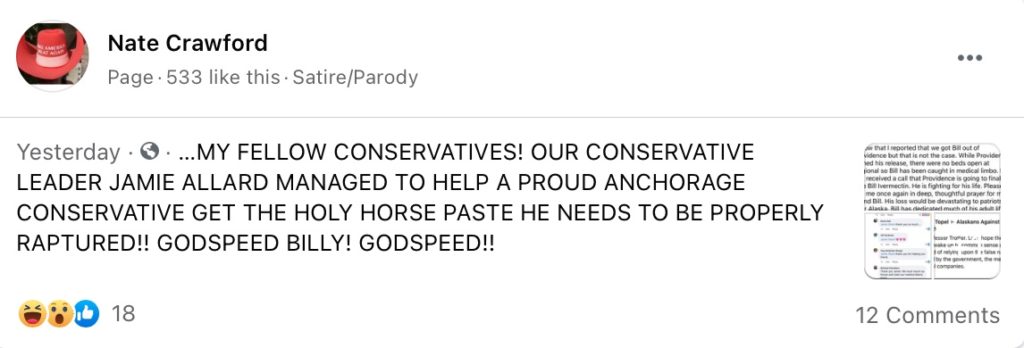
The left-wing Facebook parody-of-conservatives account that goes by fake-name Nate Crawford commented,
Another leftist on Facebook also celebrated the man’s death:
During the waning minutes of the Anchorage Assembly meeting on Tuesday night, the leftist governing majority pulled a fast one on the public.
In spite of overwhelming testimony against forcing residents to wear masks indoors, in a preplanned move that may have broken open meetings laws and city code, the Assembly majority passed an unpopular mask ordinance by making it an emergency order item on the agenda, requiring no public hearing.
Earlier in the meeting, Chairwoman Suzanne LaFrance, who had turned the gavel over to Assembly Vice Chair Chris Constant since she was not present in the room, assured the public there would be more public hearings on the ordinance, but they would be postponed to Wednesday and even Thursday if needed.
It was a ruse organized by the nine leftist members, but predicted by Must Read Alaska.
“That could be a ploy. With a supermajority, LaFrance could call a halt to the hearing tomorrow and bring the matter to a vote, hoping that she can succeed in doing so without many members of the public present. The chambers has been filled with protesting public for over a week on this item. The emergency order has been requested by Kameron Perez-Verdia, and there appear to be enough votes to pass the ordinance,” Must Read Alaska’s story forecasted on Monday.
Mayor Dave Bronson took to social media to say he will veto the ordinance. He has 36 hours to do so. A supermajority of the Assembly — 8 — can override the mayor.
“Under the cloak of darkness and while misleading the public that they would be allowed to testify on the mask mandate before a vote, at 10:35pm the /anchorage Assembly snuck in an Emergency Mask Mandate that didn’t take public testimony. They have broken the pubic trust, and this Emergency Order Mask Mandate will be vetoed,” he wrote.
Bronson was not physically at the meeting, nor was City Manager Amy Demboski or any of the other members of the Bronson team normally there. All were quarantining due to exposure to Covid-19.
The Assembly likely intends to override his veto at the meeting Constant said would take place on Thursday.
Only three members of the Assembly were physically present, as the rest were phoning in due to Covid-19 exposure. That calls into question the legality of the ordinance, because the Municipal Charter says six members must be present.
Last year, the Assembly changed municipal code to allow members to attend telephonically in the case of an emergency. There is no declared emergency by the mayor or the governor, but President Biden has the country under a national emergency effective through February, 2022.
Assemblywoman Jamie Allard, calling in from home due to Covid exposure, fought the ordinance but was not able to stop it. She said that many people will simply not comply in acts of civil disobedience.
“I will not comply,” she said.
The ordinance has changed since first introduced. Amendments to it mean that there are now no specific fines, but that the city may do what it needs to do to enforce compliance. Originally the fines were up to $300 for a first violation and considered a complaint against a non-masked person to be equivalent to a public health hazard complaint.
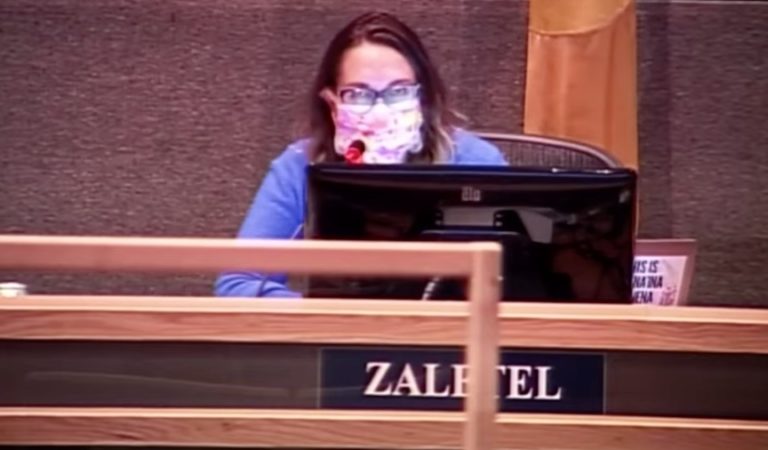
It also doesn’t contain the Assemblywoman Meg Zaletel provision to turn neighbors into enemies by having them rat out each other for disobeying the law.
The Zaletel provision was criticized by dozens of testifiers in the days leading up to the passage of the ordinance.
The mask ordinance is in effect for 60 days but is also is tied to hospital capacity and the “crisis standards of care” that many hospitals say they are operating under.
The ordinance exempts the executive branch of Anchorage government, a separation of powers issue.
Constant spoke at length about a member of the public who was in the hospital with Covid and who was probably going to die. He was referring to Bill Topel, a longtime conservative activist in Anchorage, whose power of medical attorney was Assemblywoman Jamie Allard.
Allard reacted harshly to Constant speaking about Topel and mischaracterizing his situation, using a man’s grave condition as a political stunt.
Topel had given directives to not be put on a ventilator, but Constant said into the record that he was on a ventilator. While Constant was saying how sad he was that an opponent of the mask mandate was dying, Allard was not only attending the meeting telephonically, but was informing Topel’s family that Toppel was taking his last breath and would soon be gone. Allard called Constant’s remarks “disgraceful.”
The deed was already done long before the meeting took place. There were few members of the public left in the Assembly chamber when the final vote went down. Constant had security remove the few people who yelled in opposition and by the end of the meeting, hardly anyone but security guards were left. He adjourned the meeting as soon as the vote was finished.
The Assembly had prior to the meeting re-erected the Plexiglas barricade that he keeps the public behind, which is part of its Covid mitigation plan. Last week, the Bronson Administration had removed the barricade, infuriating the Assembly but drawing cheers from the public present.