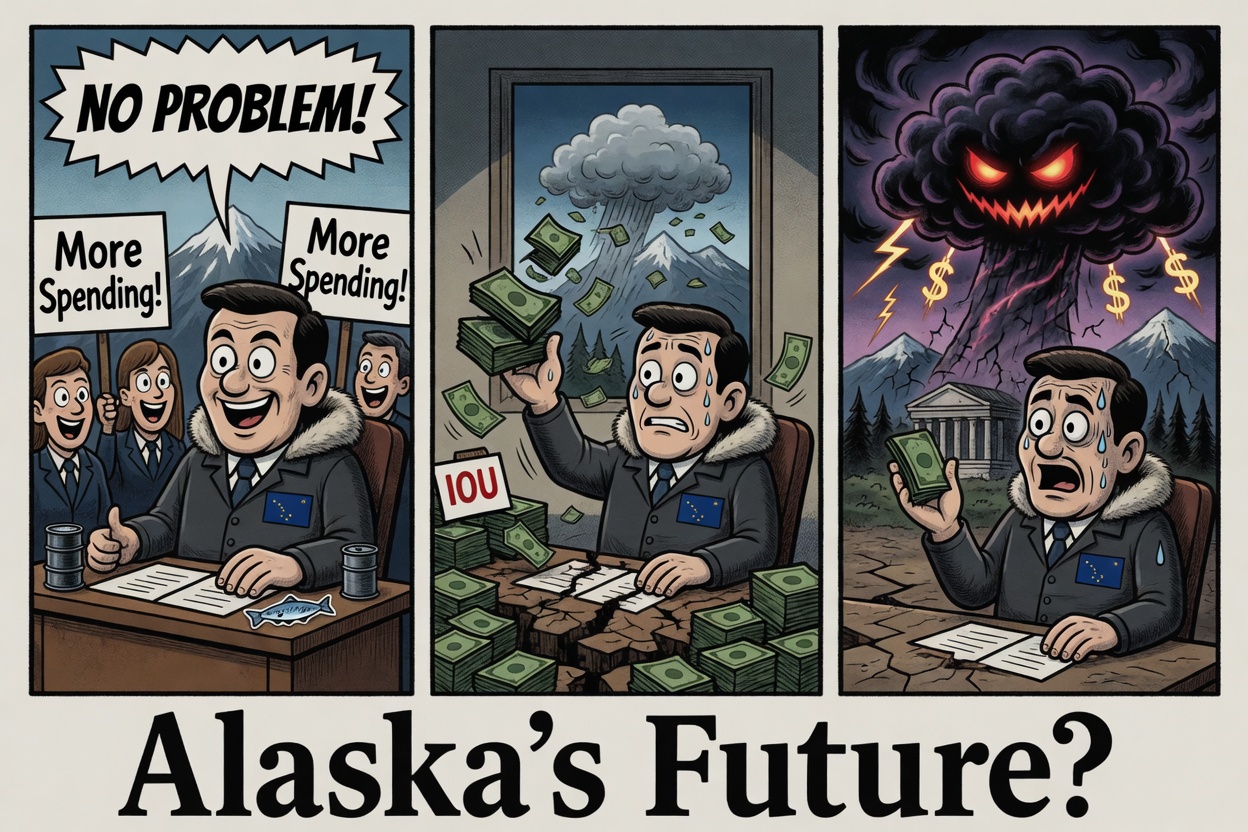
On Tuesday, April 28, the Alaska State Senate passed House Bill 78, which reestablishes a defined benefit retirement plan for public employees. Proponents of the bill emphasize its impact on workforce retention, claiming the bill could potentially save the State millions by reducing turnover, lowering re-training costs, and encouraging higher quality of services. Opponents to the bill consider the plan too similar to the State’s failed Legacy Plan which continues to cost the State billions of dollars despite being discontinued decades ago.
According to a press release from the Senate Majority, HB 78 is “a fiscally responsible path to recruit and retain public employees by providing a modest pension plan with structural safeguards, including adjustable contributions and shared risk provisions that ensure the plan remains fully funded without creating unfunded liability for the state.”
Currently, a high turnover rate, leading to constant recruiting and training public employees has cost the State an estimated $640 million since 2006, when the State ended its previous defined benefits plan.
HB 78 will allow current and new employees to opt into the new defined benefit plan or remain in their existing defined contribution plan. The defined benefits plan features a tiered pension calculation, a five-year vesting period, health reimbursement accounts, Post-Retirement Pension Adjustments to protect against inflation, and disability and death benefits.
According to Senator Jesse Kiehl (D-Juneau): “For years, Alaska tried to make a broken system work. Year after year we’ve seen public servants leave because we couldn’t offer them a secure retirement and reasonable pay. This bill makes government more efficient and effective by giving public employees the stability to build careers here and set deep roots in Alaska.”
Senator Bill Wielechowski (D-Anchorage) also praised the bill, stating: “Thousands of Alaskans commit their careers to public service to keep our neighborhoods safe, our youngest generation educated, our communities healthy, and our roads plowed. Those employees deserve to retire with dignity. This is not just a fix to the state’s employee vacancy issues; it’s a solution for Alaskans so they can keep their roots in the communities they love and grow their families for generations. This is a promise that we owe to every single dedicated public servant.”
HB 78 passed the Senate with a vote of 12-8. All but two Senators in the Senate Majority voted Yea. All six members of the Senate Republican Caucus voted Nay. Senators Stedman (R-Sitka) and Olson (D-Golovin) joined the Republican Caucus in voting Nay.
According to a press release from the Senate Republican Caucus, the defined benefits plan “is anticipated to cost Alaskans billions of dollars.”
“The Senate Republican Caucus has the deepest respect for our public employees. However, we cannot support a policy with unknowable future costs, obscure fiscal notes, and a legacy of failure,” stated the Caucus in a press release.
The Senate Republican Caucus expresses concern over the “little evidence that public pensions will reduce employee turnover and improve the state workforce,” the lack of a reliable cost analysis, and the fact that Alaskans will be constitutionally bound to “foot the bill.” If the State fails to cover the cost with current revenue, Alaskans will see higher taxes or further reductions to their PFDs.
On Wednesday, April 29, the Alaska House of Representatives passed HB 78 in a narrow vote of 21-19. It is now headed to the Governor’s office.
The House Republican Caucus also expresses “deep concern” regarding the defined benefits plan, warning that the bill causes a “seismic shift toward fiscal instability.”
According to House Minority Leader DeLena Johnson (R-Palmer): “Alaska is already struggling under a $7 billion deficit in its retirement systems, despite a massive $3 billion infusion in 2014. While other states struggle under the weight of their own defined benefit plans, Alaska had previously found a more stable path. This plan costs $40 million a year. Where is the state going to find the money to cover these new costs?”
Rep. Will Stapp (R-Fairbanks) warned of the bill’s binding liability: “Because of Article 7 of the Alaska Constitution, which prohibits the diminishment of benefits, the bill creates a forever liability that future legislatures cannot adjust, even in the event of a revenue collapse. The state’s previous defined benefit plan saw its liabilities balloon from $15 billion to over $25 billion after it was closed.
“Today, we took action that will bind not only this Legislature, but future legislatures, for the next half of the century,” continued Rep. Stapp. “We don’t know the impacts of the risks that we’re taking. We learned that lesson 20 years ago, and we can’t afford to relearn it.”
Final draft of HB 78 sent to Governor: