Monday, May 4, 2026
Home Blog Page 1027

Buyer’s remorse: Polls say Trump would win if election was today

86

Most voters would choose former President Donald Trump if he runs in 2024, if he was pitted against either President Joe Biden or Vice President Kamala Harris, according to the most recent Rasmussen Report poll of over 1,000 Americans on Sept. 20-21.

The Rasmussen national telephone and online survey found that 48 percent of likely U.S. voters think it would be a good idea for Trump to run for president again in 2024, and 44 percent say it would be a bad idea.

The survey this week shows Trump would beat either Biden or Harris in a hypothetical race. 20 percent of Democrats say they would vote for Trump over Biden or Harris in 2024.

A Gallup Poll this week had 30 percent of Americans approving of the direction of the country, with 69 per cent disapproving.

“Eight months after President Joe Biden’s inauguration, his job approval rating has fallen six percentage points to 43%, the lowest of his presidency. For the first time, a majority, 53%, now disapproves of Biden’s performance,” Gallup reported.

“These findings are from a Sept. 1-17 Gallup poll that was conducted after the U.S. military evacuated more than 120,000 people from Afghanistan. The United States’ exit from the nation’s longest war was marred by the Taliban’s quick takeover of most of the country and a suicide bombing at the airport in Kabul, which killed 13 U.S. service members. Over the same period, COVID-19 infection rates, nationally, were surging, leading to hospital overflows in some regions.”

In a Harvard CAPS-Harris Poll , 51 percent of 1,578 registered U.S. voters considered Trump to be the better leader, while 49 percent prefer Biden, according to the online survey conducted Sept. 15-16.

Since Trump lost the popular vote in November, 2020, getting a 51 percent approval in a liberal-biased poll is a stunning gain for the former president. Biden won the popular vote 51-47.

In the Harvard poll, 49 percent say they view Biden unfavorably, while 47 percent see Trump unfavorably.

Vice President Kamala Harris did poorly in the poll. Fifty-five percent of participants also say that Mike Pence is a better leader than Harris, and 63 percent think Mike Pompeo was a better Secretary of State than current Sec. Antony Blinken.

Biden has been president for 247 days.

Class action: United Airlines sued in Texas court

11

Six United Airlines employees this week filed a federal lawsuit in Texas that claims the airlines is discriminating against employees who ask for a religious or medical exemptions from the company’s Covid-19 vaccine mandate.

The class action lawsuit asked for a temporary restraining order or a preliminary injunction.

“United’s actions have left Plaintiffs with the impossible choice of either taking the COVID-19 vaccine, at the expense of their religious beliefs and their health, or losing their livelihoods. In doing so, United has violated Title VII and the ADA by failing to engage in the interactive process and provide reasonable accommodations, and also by retaliating against employees who engaged in protected activity,” the lawsuit contends.

Two of the plaintiffs are captains who were denied his request for a religious exemption. At least one of them also wanted a medical exemption but the online system for claiming an exemption only allowed for one or the other. The same with a jet mechanic, who wanted to declare both exemptions.

“Because United stated that it was no longer accepting requests through its online accommodation request system on August 31, 2021, which was the only formal mechanism United offered its employees to submit an accommodation request, Mr. Castillo made the unilateral decision to request these accommodations through his supervisor. A United Human Resources representative has now informed Mr. Castillo through his supervisor that the religious accommodation request is untimely, but that Mr. Castillo may submit his medical request. Mr. Castillo’s religious accommodation request has thus been administratively denied,” the lawsuit says.

A station operations representative with United requested a religious accommodation from United’s vaccine mandate, to which United responded by offering only an indefinite period of unpaid leave as a “reasonable accommodation.”

According to United’s rules, employees must receive their first dose of vaccine by Sept. 27 or face termination.

The lawsuit also notes that United no longer requires deep cleaning of its aircraft after each flight, as it did at the beginning of the pandemic, instead burdening employees with having to submit to a medical procedure — a shot — in order to try to ensure a safe environment.

United flies to and from Anchorage and places like Chicago, Denver, San Antonio, Houston, Los Angeles, Pittsburgh, Cleveland, and many other major airline hubs.

The lawsuit can be seen at this link.

Muni manager addresses Assembly espionage by shutting down backchannel requests from rogue members

34

After Assemblyman Forrest Dunbar was caught trying to get to draft budget documents from the various Anchorage municipal department heads, circumventing the Municipal Manager, the hammer has come down.

Manager Amy Demboski wrote a memo to all employees in the city today, telling them they are not to respond to any requests from the Assembly. All requests must go through her office.

Read: Dunbar caught trying to get to draft budget documents through backchannels

Read: Smoking gun: Assembly and City Clerk spying on mayor’s computer files

“It continues to be apparent that the Legislative Branch and some of their employees refuse to respect separation of powers between the Executive and Legislative branches,” Demboski wrote.

She said the Assembly has been utilizing backchannels to gain information, and that they have been impinging on the workload of employees of the city, which is distracting from the missions of many department.

“These willful and intentional efforts to bypass Executive Branch leadership must now be addressed more directly,” Demboski said. She described a process that will “ensure the separation of powers” and ensure the Administration is responsive to the Assembly:

Effective immediately, all communications from the Administration and the Assembly, Assembly Aides, Assembly staff, the Municipal Clerk, Clerk’s office staff, or Assembly Attorney will rest solely with the Municipal Manager, or her designee, should she direct it.

Information requests initiated by an Assembly member, an Assembly aide, or the Assembly attorney, whether orally or in writing, must be forwarded to the Municipal Manager for response.

All Assembly committee reports, requests for attendance at meetings, and request for information must be reviewed by the manager for “operational availability, resource prioritization, and department mission alignment.”

Demboski noted that Assembly members requesting advice and legal opinions from the Municipal attorney should contact the attorney’s office directly and those requests are not covered by her stated guidelines.

Must Read Alaska received a copy of the memo from a city employee:

Smoking gun: Docs show Municipal Clerk spying, passing mayor’s confidential information to Assembly leadership

41

In a series of communications accessed through a public records request with the Municipality, it appears that Anchorage Assembly Vice Chair Chris Constant has been directing the Municipal Clerk to spy on the computer files of the Anchorage Mayor’s Office and report to him what the mayor has planned.

The evidence is seen in a text exchange from Constant to Municipal Manager Amy Demboski. In it, Constant says that the way that the confirmation hearings were submitted to the “Onbase” scheduling system made it difficult for Assembly leadership, and they wanted the names broken up for the agenda.

It’s clear in the text exchange that Demboski had not submitted the names yet for the final agenda. They were still in her workflow files.

But Constant said he got the information, which was a still a deliberative document, from Municipal Clerk Barbara Jones.

Jones works for the Assembly, not for the Mayor’s Office, and also runs Anchorage elections. During the recent election, she and the Bronson for Mayor campaign clashed over access and transparency in how she was running her operations in her Ship Creek offices, where the ballots were being counted.

Constant, on the other hand, has a close relationship with the clerk, and brought her a bouquet of flowers during the ballot counting process, while he was working as a top deputy for Forrest Dunbar for mayor.

Here’s the text exchange that’s the smoking gun that Constant was directing Jones to access confidential documents:

At this point in the exchange between Demboski and Constant, it becomes clear that he had gone back to Jones for more information about where the document was. It was in the HR director’s files, Constant told Demboski in his follow-up comment:

With Jones looking over the shoulder of the Mayor’s Office workflow and work products, the Assembly, which is run by a hardcore liberal majority, has an advantage, knows the direction Mayor Bronson is going to take on any issue that might come before the Assembly. How long she has been passing confidential information to the Assembly is the subject of an ongoing Must Read Alaska inquiry.

The text exchange raises some serious separation of powers issues, and will pose a challenge to the trust between the branches of government.

Another document on the same topic, also accessed through the public records request, explained the problem, as Demboski notified the Municipal Attorney about the breach of confidentiality that is occurring is and whether it should be addressed:

Patrick [Bergt], 
Last night Assembly Member Constant raised a concern to me that our forth coming nominees were submitted on one AM. I was perplexed because no such AM has made it to me for approval to the Assembly agenda. Further text query to Chris indicated the Municipal Clerk told him that the document was in OnBase queued with HR. 
This raises a significant concern to me that a separate branch of government is reviewing internal executive branch work products that are confidential and deliberative until such time they have been approved by me. 
Please see below screenshots. 

Read Must Read Alaska’s earlier story on Assemblyman Forrest Dunbar attempting to obtain the deliberative documents belonging to the Executive Branch by going directly to department heads and asking them for draft budget documents:

Kelly Tshibaka scores Durling, Hyde, leading business owners, as campaign co-chairs

16

Kevin Durling and Ron Hyde, two longtime Alaska business entrepreneurs, joined the Kelly Tshibaka for Senate campaign as co-chairs, the campaign announced today.

Anchorage resident Kevin Durling is a 44-year resident of Alaska and owner of two businesses supporting diverse aspects of Alaska’s economy. His life in Alaska began in the field of resource development as a subsurface survey manager and service representative in Prudhoe Bay.

Durling joined Petroleum Equipment Services, Inc. and became president, concentrating on facilitating services and technology with Alaska’s oil and gas sector.

PESI created Alaska Services and Technology, LLC in Kenai to offer an environmentally safe method of cleaning and recycling thread-protectors. He purchased a welding and fabrication facility in North Pole and he is looking forward to expanding the capabilities of Universal Welding and Fabrication Alaska, LLC.

Kenai Peninsula’s Ron Hyde has over 35 years of experience in managing logistics throughout Alaska and the Pacific Rim. In 2002, Ron founded PRL Logistics, Inc. PRL specializes in “the last tactical mile” providing comprehensive support for extremely complicated, remote projects with limited infrastructure.

His background in logistics includes extensive knowledge in remote and urban transportation planning, procuring, risk management, insurance and managing the following: marine operations, air support, overland transportation, turnkey remote camp design, construction, operation and maintenance, radio and satellite communication, remote medical evacuation and safety and management of waste material transportation and disposal operations.

Hyde led his team to support all concepts of remote sustainment, workforce logistics and training, and material logistics on major projects in oil and gas, mining, U.S. defense projects, and government programs.

Tshibaka is running as a Republican, endorsed by former President Donald Trump and the Alaska Republican Party, against incumbent Lisa Murkowski.

Alexander Dolitsky: The case of the ‘delicious salad,’ and the keys to cross-cultural communication

3

By ALEXANDER DOLITSKY

Cross–cultural communication requires a knowledge of how culturally different people groups communicate with each other.

Studying other languages helps us understand what people and societies have in common, and it has profound implications in developing a critical awareness of social relationships. Indeed, understanding these relationships and the way other cultures function is the groundwork of successful business, foreign affairs and interpersonal relationships.

Elements of language are culturally relevant and should be considered. There are, however, several challenges that come with language socialization. 

Sometimes people can over-generalize or label cultures with stereotypical and subjective characterizations. For instance, one may stereotype by saying that Americans eat hamburgers and French fries in the McDonald’s restaurant daily, and Russians eat borshch (cabbage soup) for breakfast and drink vodka before bedtime. Both stereotypes are far from the truth. 

With increasing international trade and travels, it is unavoidable that different cultures will meet, conflict, cooperate and also blend together. People from different cultures often find it difficult to communicate, not only due to language barriers but also because of different culture–styles, customs and traditions. These differences contribute to some of the biggest challenges of effective cross–cultural communication. 

Cultures provide people with ways of thinking, seeing, hearing, behaving, understanding and interpreting the world. Thus, the same words or gestures can mean very different things to people from different cultures—even when they speak the same language (e.g., Canada, Australia, New Zeeland, England, South Africa and United States). When languages are different, however, and translation is needed just to communicate, the potential for misunderstandings significantly increases.

From the mid–1980s to early–2000s, I was an unofficial Russian translator in Alaska for the U.S. and State of Alaska governments, as well as for various public institutions and private individuals. The most challenging aspect of translation  was relaying specific terminology, such as that used by the U.S. Cost Guard, medical professionals, political protocols and verbiage and, especially, jokes and humorous expressions. Often, I had to provide cultural and historic backgrounds before translating a joke. 

Ones, a member of the Russian delegation, in an informal setting over dinner, told a joke to his Alaskan counterparts:

“Archaeologists found an ancient sarcophagus in Egypt with human–made artifacts and skeletal remains. Experts around the world thoroughly investigated this finding in an attempt to identify the person buried in the sarcophagus, but had no success. So, they invited a KGB agent (Soviet Committee for State Security) Major Ivan Ivanov to investigate this matter. Major Ivanov spent nearly three hours in solitude with the skeleton and, finally, with a confidence in his voice, reported to the archaeologists that the remains and skeleton belong to the Egyptian Pharaoh Ramses the Second. Archaeologists were impressed by this quick revelation and asked Ivanov,  “How certain you are in this remarkable conclusion?” Then Ivanov replied with a great pride, ‘After three hours of the bulldozer interrogation, the skeleton itself revealed to me his identity!’”

The Russian jokester was a large, broad-shouldered man—his voice deep and curt. No one among the Alaskan delegation laughed after hearing the joke. They sat still at the table, holding crystal shots of vodka, and just stared with alarm at the joke-teller.

Needless to say, I had to provide the Alaskans with some background about the notorious brutality of the Soviet KGB. Unfortunately, in the process of explaining the joke, the humor disappeared.

In teaching Russian language at the University of Alaska Southeast for 16 years, my very first message to students was to emphasize that a language must always be understood and learned in a cultural context. As an example, I shared with them a personal and rather humorous story of my early arrival to the United States in Philadelphia during the winter of 1978.

In the early years of my immigration, I watched a lot of TV in order to learn English, American traditions and lifestyles. Many advertisements described food items and dishes, including various salads, using the word “delicious.”

It was a new experience for me because there were no TV ads for commercial products in the former Soviet Union due to a lack of commercial competition. The government controlled standardized prices for commercial products throughout the entire country. 

So, I understood the word “delicious” as a name of the salad (a noun) rather than a quality of the salad (an adjective). In fact, food dishes have a particular name in Russia—Chicken Kiev, Salad Stolichniy (salad capital), Borshch (cabbage soup), Beef Stroganoff (meat stew), Blini (Russian pancakes), etc.

Later that year, my uncle from Canada, accompanied by his wife and daughter, visited me in Philadelphia. As a welcome greeting to America, they invited me to a fancy restaurant in downtown. When the waiter asked for my order, I requested a steak, shot of vodka and “delicious” salad—hoping my order would match the “delicious” salad that I had seen on TV. The puzzled waiter leaned slightly and whispered to me, “Sir, all our food is delicious.” Then, I clarified to the waiter, “I want a delicious salad.” The confused waiter served me a cabbage with mustard.

So, that evening in the fancy restaurant, I enjoyed a delicious steak and stuffed myself with a cut-in-half cabbage with mustard. This was a prime lesson in cross-cultural miscommunication.

Indeed, the demographics and cultural complexity of our nation changes rapidly. It is only a matter of time before ethnic minorities in our country will take a lead in shaping the cultural and ethnic landscape of our nation and, eventually, become a significant ethnic majority in our country. These demographic and cultural changes are inevitable and unavoidable. However, our society should learn how to make inclusive and, yet conservative cross–cultural adjustments without undermining the fundamental core of American Judeo–Christian religious and moral values.

It is imperative to be inclusive and tolerant rather than exclusive and narrow minded in order to secure cultural, religious and moral Judeo–Christian continuity of our great nation—the United States of America.

Alexander B. Dolitsky was born and raised in Kiev in the former Soviet Union. He received an M.A. in history from Kiev Pedagogical Institute, Ukraine, in 1976; an M.A. in anthropology and archaeology from Brown University in 1983; and was enroled in the Ph.D. program in Anthropology at Bryn Mawr College from 1983 to 1985, where he was also a lecturer in the Russian Center. In the U.S.S.R., he was a social studies teacher for three years, and an archaeologist for five years for the Ukranian Academy of Sciences. In 1978, he settled in the United States. Dolitsky visited Alaska for the first time in 1981, while conducting field research for graduate school at Brown. He lived first in Sitka in 1985 and then settled in Juneau in 1986. From 1985 to 1987, he was a U.S. Forest Service archaeologist and social scientist. He was an Adjunct Assistant Professor of Russian Studies at the University of Alaska Southeast from 1985 to 1999; Social Studies Instructor at the Alyeska Central School, Alaska Department of Education from 1988 to 2006; and has been the Director of the Alaska-Siberia Research Center (see www.aksrc.homestead.com) from 1990 to present. He has conducted about 30 field studies in various areas of the former Soviet Union (including Siberia), Central Asia, South America, Eastern Europe and the United States (including Alaska). Dolitsky has been a lecturer on the World Discoverer, Spirit of Oceanus, andClipper Odyssey vessels in the Arctic and sub-Arctic regions. He was the Project Manager for the WWII Alaska-Siberia Lend Lease Memorial, which was erected in Fairbanks in 2006. He has published extensively in the fields of anthropology, history, archaeology, and ethnography. His more recent publications include Fairy Tales and Myths of the Bering Strait Chukchi, Ancient Tales of Kamchatka; Tales and Legends of the Yupik Eskimos of Siberia; Old Russia in Modern America: Russian Old Believers in Alaska; Allies in Wartime: The Alaska-Siberia Airway During WWII; Spirit of the Siberian Tiger: Folktales of the Russian Far East; Living Wisdom of the Far North: Tales and Legends from Chukotka and Alaska; Pipeline to Russia; The Alaska-Siberia Air Route in WWII; and Old Russia in Modern America: Living Traditions of the Russian Old Believers; Ancient Tales of Chukotka, and Ancient Tales of Kamchatka.

Read: Neo-Marxism and utopian Socialism in America

Read: Old believers preserving faith in the New World

Read: Duke Ellington and the effects of Cold War in Soviet Union on intellectual curiosity

Read: United we stand, divided we fall with race, ethnicity in America

Read: For American schools to succeed, they need this ingredient

Read: Nationalism in America, Alaska, around the world

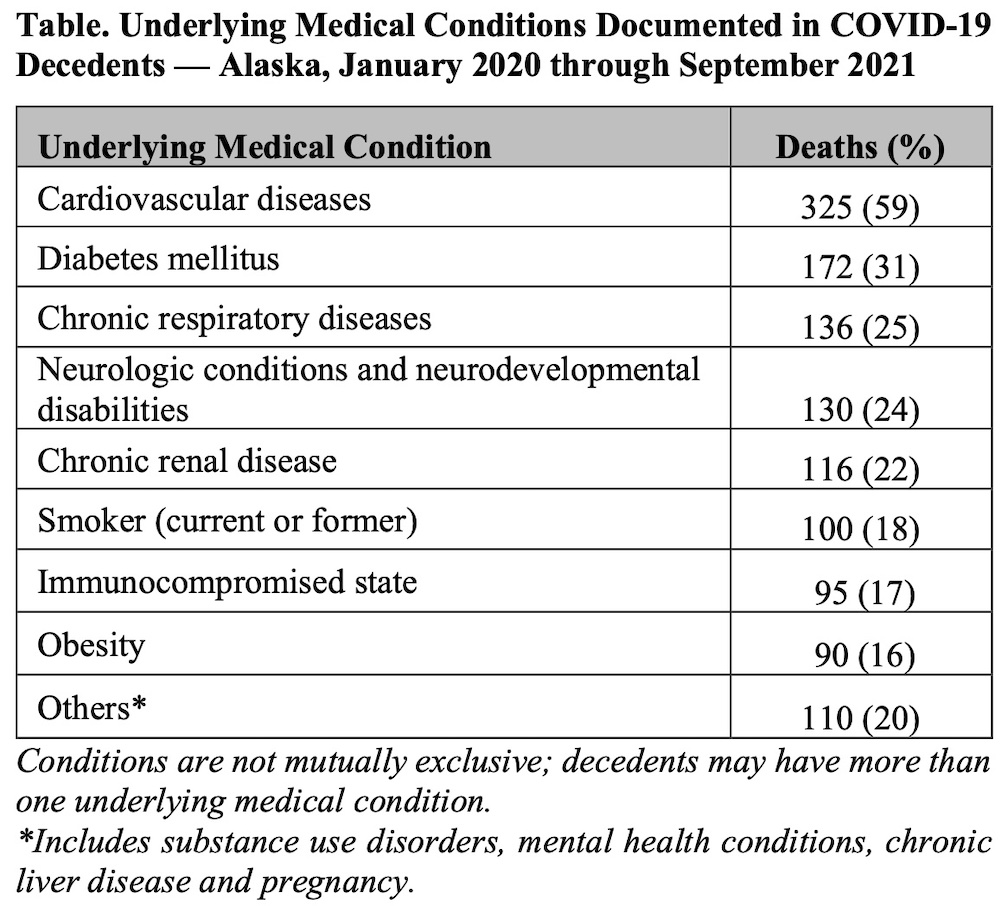
Breaking: 44 more Covid deaths reported in Alaska, but some are backlog cases

115

Forty-four more deaths were reported on the Alaska Department of Health and Social Services ECHO meeting today and on the state data dashboard. The new case count for the day shows 1,740 more cases of Covid.

The process of reporting deaths can take some time, so many of these cases are backlog deaths that are just now being logged in after going through the extensive maze of agency verification. The state now says that 514 deaths in Alaska can be attributed to Covid.

In today’s report, there are three nonresident and 41 Alaska resident deaths; again, from a mix of timeframe.

“Cases continue to climb in Alaska, and are nine times higher than the national level,” said Dr. Anne Zink, chief medical officer for the State of Alaska. “Alaska’s case rate is the highest in the nation.”

“This is the highest incidence in cases we have ever experienced,” Zink said. “We need to add layers of protection. Vaccination is key.” Anyone 12 and above who has not received a covid vaccine should get one right away, she said. People are eight times less likely to be hospitalized with Covid if they have been vaccinated.

This story is being updated.

Backlog describes cases that are not posted the next day. As the State has been trying to increase staff, the workload has not been updated. Most of the new 1,740 new cases were from the past week, but others date back further.

The DHSS says the cyberattack on the department’s website from earlier this year may have contributed to the delay in reporting, but staffing is also a contributing problem.

Jab or job II: Pharmacist with auto-immune disease says her medical exemption was overridden by Anchorage hospital

20

This is the second in a series of stories from Alaska medical professionals who are losing their jobs because they will not take the Covid-19 vaccine. They asked that their names be kept anonymous. This is the testimony of “Janice,” a pharmacist in Anchorage.

Janice has worked as a pharmacist in Anchorage for four years, but has worked in pharmacy since she got a job as a pharmacy technician when she was 17. Her mother always told her to study for a career in health care, because she would always have a job.

But her job is ending next month at an Anchorage hospital because she is not going to take the Covid-19 vaccine. Janice has an auto-immune disorder and provided what she said is a legitimate letter from her doctor saying that the vaccine could make her condition flare up. But the hospital refused to honor the exemption, and so this pharmacist and young mother will be fired.

Janice is the primary income provider for her family, and she’s concerned about making ends meet, although she believes she can pick up part-time or substitute work around the city. It troubles her that she still has significant student loans to repay for her advanced pharmacy degree.

Will she move out of state? No, she said that she and her husband talked about it, but decided that Alaska is their home.

Will she sue? She said she thinks there is a basis for a lawsuit. “Certainly, if I worked at Lowe’s (home improvement store) there would definitely be a lawsuit,” she said.

Can she work remotely? She has asked to do so and said she been denied the accommodation.

Auto-immune diseases are tricky; they are hard to diagnose and difficult to treat. The CDC says that people with an auto-immune disease, such as MS, “should be aware that no data are currently available on the safety of COVID-19 vaccines for people with autoimmune conditions.”

On the other hand, those with auto-immune disease can also have very serious reactions to the virus itself, the CDC says.

It is a decision that is typically made between patient and doctor, not patient and employer. But for some medical professionals this year, the decision is now being made by their human resources department.

There is a silver lining for Janice. She has wanted to spend more time with her children, and although financially this is a major hit for her and her family, she is grateful that she is going to be able to be a more effective parent.

Have you lost your job because you won’t take the Covid-19 vaccine? Are you a medical professional? Send your information to [email protected]. You will be kept anonymous.

Compensation, benefits commission meets to review pay for legislators, governor

19

State Officers Compensation Commission will hold a meeting on Sept. 29, 2021, at 9 a.m. at the Atwood Building, 550 W. 7th Ave., Suite 1960, Anchorage, to review preliminary findings and recommendations on the rate and form of compensation, benefits, and allowances for legislators, the governor, the lieutenant governor, and each principal executive department head of Alaska state government. The commission will take public testimony.

The meeting is open to the public. Persons wishing to participate by telephone may do so by calling 1-800-315-6338, Access code 46544031.