Saturday, June 13, 2026
Home Blog Page 1006

Oklahoma National Guard first state to defy Pentagon on vaccine mandate

A statement by the Brigadier General of the Oklahoma National Guard makes it clear that it’s not OK for the federal government to force the Covid-19 vaccine on the men and women of the Sooner State’s National Guard.

In a statement posted on the Oklahoma National Guard website, Brig. Gen. Thomas H. Mancino, the adjutant general for Oklahoma, said:

“This policy is not anti-vaccine. I and the Governor are both vaccinated. I encourage all our Oklahoma Guard Members to get vaccinated if they choose to do so. We want to educate and inform our Soldiers and Airmen so that they can make an informed decision regarding the DoD Vaccine Mandate,” Mancino said in the statement.

“Under Title 32, Congress established a dual framework for the National Guard. The states receive federal funding in return for being made available to the federal government when called to active duty by the President.

“Under Title 32, the Oklahoma National Guard is a state-controlled and federally-funded entity and takes orders from the Governor and his designated chain of command. When mobilized by the President, under Title 10, the Oklahoma National Guard takes all orders from the President and his designated chain of command.

“Failing to follow the Governor’s lawful orders while on Title 32 would be both illegal, unethical, and against our sworn oaths. Nothing in this order prevents anyone from taking the vaccine. Also, nothing in his order eliminates the Federal Requirement. The Governor is hoping for Federal Relief from Secretary of Defense Lloyd Austin and in the interim has granted state relief from this requirement,” he wrote.

Until a Guardsman is activated under Title 10, Mancino said they follow the lawful commands of the governor of the State of Oklahoma, who has not mandated the COVID-19 vaccine for Oklahoma Guard Members. Once activated to title 10 status, Guardsmen are subject to all Title 10 laws and mandates until returning to Title 32 status.

“If you [Oklahoma Guard Members] are not mobilized on Title 10 orders, the only entity that can give you a ‘lawful’ order – that is an order backed by the authority of law – is the Governor and his designated State chain of command.  That ‘law’ is Title 32 U.S. code,” Mancino said. “This is easily seen by the fact that the UCMJ does not apply to you in Title 32 status. Instead, you are governed by the Oklahoma Code of Military Justice (OCMJ).”

Brig. Gen. Mancino provided clarity to Gov. Kevin Stitt’s order that soldiers and airmen in the Oklahoma National Guard are relieved from this requirement until mobilized in accordance with the Constitution, the Law, and sworn oath, the statement said.

“The Governor’s request is with Secretary Austin for decision, and the National Guard Bureau has indicated it will conduct a legal review of our position,” Mancino said. “The proper venue for the resolution of these issues is the Governor’s office, Congress, and the Federal Executive branch. Not the court of public opinion in the press or on social media,”

The order came one day after the governor replaced the adjutant general, after Maj. Gen. Michael Thompson, who had served as adjutant general since November 2017, said he would enforce the order from the Pentagon.

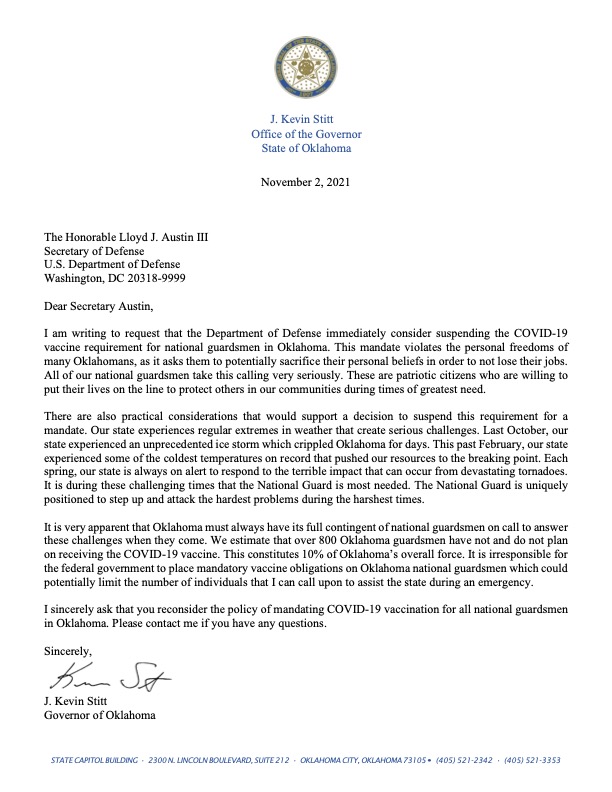
On Nov. 2, Gov. Stitt had written to Department of Defense Sec. Lloyd J. Austin III, asking him to suspend the vaccine requirement for Oklahoma National Guard personnel. He said the mandate violates the personal freedoms of many Oklahomans, as it “asks them to potentially sacrifice their personal beliefs in order to not lose their jobs. All of our national guardsmen take this calling very seriously. These are patriotic citizens who are willing to put their lives on the line to protect others in our communities during times of greatest need.”

The Pentagon said that it would have a response, and said that a vaccinated force is a ready force. Sec. of Defense Austin could respond by activating the force, and thereby bringing them under his command and forcing the vaccine. But there would likely be a heavy political cost to doing so.


Anchorage schools remove ‘Gender Queer’ graphic memoir from school shelves

Anchorage School District has removed a book titled “Gender Queer” from school library shelves after complaints from parents.

According to a parent, Superintendent Deena Bishop wrote “This particular book was ordered in a batch purchase of a library association ‘award winners’ package.”

According to the Amazon review, author “Maia Kobabe, who uses e/em/eir pronouns, thought that a comic of reading statistics would be the last autobiographical comic e would ever write. At the time, it was the only thing e felt comfortable with strangers knowing about em. Now, Gender Queer is here. Maia’s intensely cathartic autobiography charts eir journey of self-identity, which includes the mortification and confusion of adolescent crushes, grappling with how to come out to family and society, bonding with friends over erotic gay fanfiction, and facing the trauma and fundamental violation of pap smears.”

The book has since been moved to the public library, according to a note from Superintendent Deena Bishop.

“As I shared with you in my reply, I have asked for a review of this book. Yesterday, a final report of this review and a meeting with all librarians took place. I will share the update to you now. I am recommending this book not be in circulation in our libraries. We had found one copy and will remove it from circulation,” she wrote.

“It will be available to the general public via the Muni’s local public libraries; however, students will not have access via the shared resources process for an electronic or hardback copy. Thank you for your feedback on this book. It is an adult novel, and while many adult authors such as Stephen King and Jody Picoult, are appropriate for our teen readers, our assessment is that this one is not appropriate for our school libraries,” she wrote to a parent.

It’s unclear how many children had access to the book that was chosen for them by librarians, presumably with librarians with masters degree in library science.

One of the pages in the ‘Gender Queer’ memoir.

This is the same book that a parent started reading aloud to a school board in California in October, making national news. Orange County School Board Chair Teresa Jacobs directed police officers to remove parent Jacob Engels when he began reading it into the microphone during the public testimony portion of the meeting. He had found the graphic novel in the local high school library, and discovered detailed written and graphic depictions of sex acts, some of which may be considered pornographic.

Engels was removed when he got to the part about “a new strap-on harness,” which “fit my favorite dildo perfectly. School Board Chair Jacobs said “the language he just read is inappropriate for this forum. This is the first time I’ve heard of this and the board has heard of this. We will look into it, and I do hope the book is removed. OK? And if not, we’ll be back here having this conversation again, but I can guarantee you, I did not know that book was in the library.” The Orange Times and Observer wrote that the book was indeed removed from the school library shelves.

Watch Jacob Engel reading the book and being removed from the school board meeting at this link. Or here:

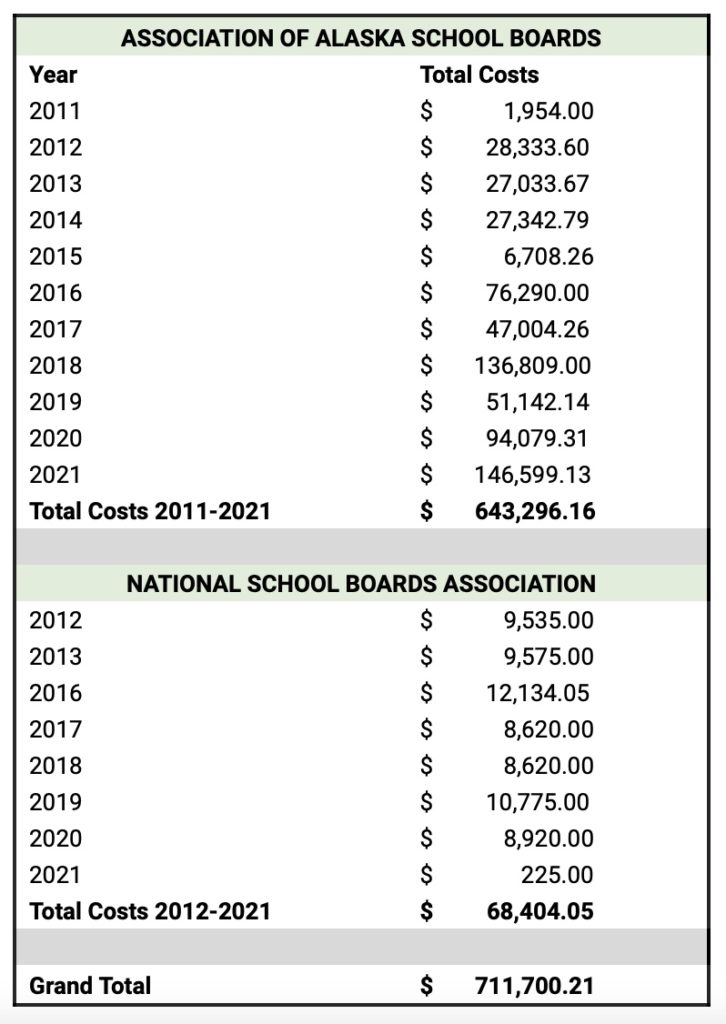
Waste and abuse report: Anchorage School District spent $711,000 in dues to two school board associations since 2011

BUT WAIT, THERE’S MORE…

Anchorage School District is a dues-paying member of the Association of Alaska School Boards. It should get a gold-plated certificate, considering how much it pays for its membership.

The school district also pays dues to the National School Board Association, which recently was caught collaborating with the White House to start treating parents as terrorists and have protesting parents investigated by the FBI.

The cost of belonging to these two organizations has been growing over the past decade in a state where the average annual education spend per pupil is nearly $18,000, more than 46 percent higher than the national average of about $12,200.

The dues Anchorage pays to the Association of Alaska School Boards has been exploding: It went from $1,954 in 2011 to $146,599 in 2021, a growth of more than 7,400 percent.

Payments to the National School Board Association have seesawed, according to the chart below, which has information obtained through a public records request. In the chart, it appears the small 2021 payment of $225 is simply because the payment has not yet been sent, received, or recorded.

The average cost of dues to these two school board associations is over $71,000 per year over the past 10 years, even as the number of students has dropped from about 50,000 to just under 43,000.

In fact, over the past five years, when student numbers have fallen fast, the Anchorage School District has paid the Association of Alaska School Boards an average of more than $95,000 per year.

In 2017, the AASB collected $547,541 as dues from public sources, and the AASB also received $598,107 in government grants that same year, according to the Alaska Policy Forum, which conducted a survey of these costs.

In terms of being represented on the association, Anchorage in a minority position compared to the other districts that are members. Anchorage School District may be the biggest, but has just five voting positions in the Association, which has 51 member districts in Alaska.

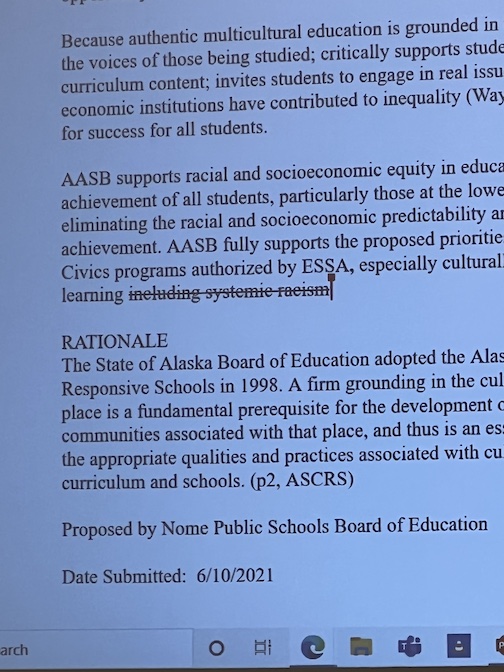
AASB is not without controversy. Last week, the AASB met in Anchorage to discuss incorporating the concept of “systemic racism” into its overall goals and objectives for the organization. And it booted out a citizen who was trying to film the proceedings, which inform school board policies across the state.

The Anchorage School District also belongs to the Council of Great City Schools, which is targeted toward the largest school districts in the country, and which pushes a radical leftist agenda, including Critical Race Theory, the theory that whites are inherently racist.

The dues Anchorage taxpayers pay for membership in CGCS are more than $40,000. See their dues sheet at this link.

But wait, there’s more: The Anchorage School District belongs to a group called the Coalition for Alaska Education Equity, for which there is a fee of more than $27,000 a year. In 2016, the group collected $160,571 in dues.

According to the Alaska Policy Forum, CEE collected $145,000 in membership dues, and an additional $171,982 in government grants. It’s main purpose is to sue the State of Alaska to get more money for rural school districts.

“Under the CEAAC banner, the organization focused on the perception of school inadequacies in rural Alaska by filing lawsuits asserting inequitable state funding, with two lawsuits being settled in CEAAC’s favor after years of legal wrangling,” the Alaska Policy Forum wrote.

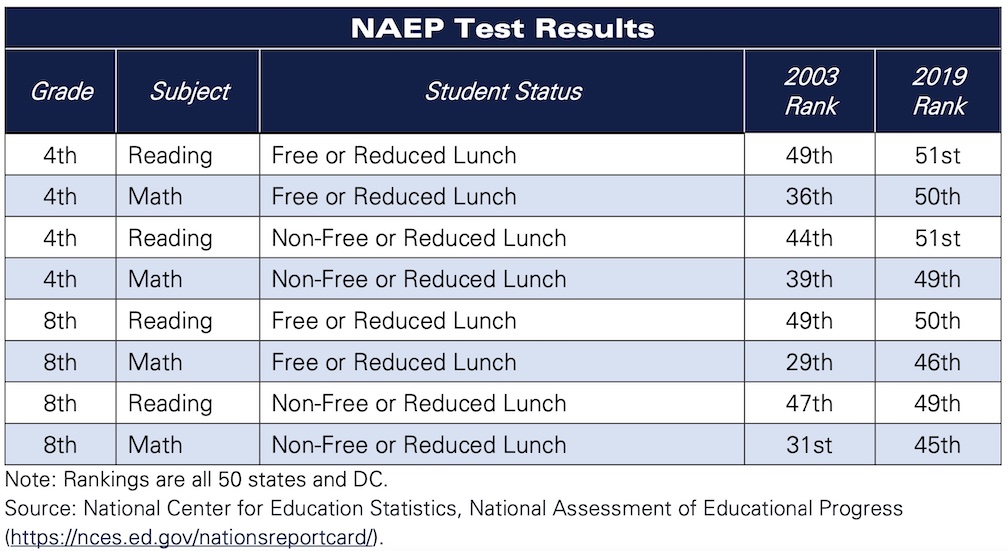
“Despite a significant funding advantage over other states, Alaska has continued to produce very disappointing results in national standardized testing. Scores from the National Assessment of Educational Progress (NAEP) between 2003 and 2019 showed that Alaska’s combined math and reading standings sank more than any other state—ranking 49th or lower in six of eight categories by 2019,” APF wrote.

School Board member Dave Donley has in the past attempted to have the district end its membership in the Coalition for Education Equity because the Anchorage School Board is paying far too much for the value received. But it has since been added back to the budget.

Although the Coalition for Alaska Education Equity is a fringe group, the National School Board Association is a heavyweight and most Americans might see it as mainstream. And yet, after its recent missteps in trying to characterize parents as terrorists, nine state school board associations have pulled out of that national advocacy group.

According to Fox News, newly released internal emails reveal that the National School Boards Association actually coordinated with the White House and the Department of Justice before sending President Biden the “notorious letter that compared concerned parents to domestic terrorists. Emails provided to Fox News show that NSBA had coordinated with the White House for weeks beforehand,” Fox wrote.

“Viola Garcia, the NSBA president whom the Department of Education later named to a federal board, sent a memo to NSBA members on Oct. 11 (but dated Oct. 12), providing a timeline of the NSBA’s interaction with the White House ahead of the letter to Biden, which the NSBA sent on Sept. 29,” the story continues.

“Five days later, on Oct. 4, the DOJ issued a memo directing law enforcement to investigate threats to school boards. On Oct. 22, the NSBA issued an apology for the letter,” the News group wrote.

Board member Donley has asked the Anchorage School Board to censure the National School Board Association for its actions to cause the FBI to investigate protesting parents. His resolution was referred to the Governance Committee and it has not been seen since by the left-dominated Anchorage School Board.

Win Gruening: Juneau’s vote-by-mail belly-flops, so what happens next?

By WIN GRUENING

With every passing day, the justification for Juneau switching to universal vote-by-mail becomes murkier, more problematic, and less convincing.

Over half of the 652 ballots that were received, but not counted, were those of 357 voters that were thrown out because the post office failed to postmark their ballot envelopes.

Last week, those voters received form letters from the city clerk notifying them they were among the disenfranchised. Most, no doubt, were livid.

As detailed in my two previous columns, problems associated with Juneau’s recent VBM election have made voting more confusing and unreliable, resulting in almost 8 percent of ballots being invalidated for various reasons. VBM did not increase turn-out, as barely 30 percent of registered voters participated, 28 percent less than voted last year and below voter turn-out in past elections where in-person voting was used. 

Finally, the demonstrated lack of security of the Alaska voter database (it was hacked last year) coupled with the vulnerability of haphazard mass mailings of unsolicited ballots, has undermined people’s confidence in elections.

Voters are likely to trust vote-by-mail even less next year.

There also seems to be confusion about the actual costs of the new system.

Mayor Beth Weldon noted in a radio interview after the election that vote-by-mail elections are more expensive, $400,000 more per year than in-person elections. This is significantly more than previously reported when the Assembly studied the issue last spring. This is in addition to the estimated $700,000 for equipment and building renovations required for vote counting. 

Later, Mayor Weldon clarified her comments by providing a city staff memo that reflected a significantly lower annual operating cost. Nevertheless, the cost will exceed four times that of a conventional precinct election.

Despite Juneau’s low turn-out, during a post-election KINY interview, City Manager Rorie Watt stated the Assembly is “convinced that vote by mail is a good, long-term decision.” Mayor Beth Weldon offered this explanation for the disappointing voter turn-out: “…we didn’t have a big bond package. We didn’t have a big controversial thing. We didn’t have a vastly contested race.”  

Maybe so, but isn’t this a tacit admission that issues and candidates drive turn-out, not whether voters feel VBM is more convenient?

If that’s the case, why is the Assembly spending over one million of our tax dollars this coming year to get this misguided effort off the ground?

Some unfairly blame the Alaska Division of Elections for not keeping the database of registered voters current, thereby allowing ballots to be mailed to invalid addresses and to the names of voters who have died or moved to other states. 

But, under state law, every eligible person over the age of 18 applying for a Permanent Fund Dividend is automatically registered – whether they intend to vote or not. In addition, the Division of Elections’ annual voter list maintenance process must comply with state law (AS 15.07.130) and the requirements of the National Voter Registration Act. Voters are not required to update their registrations (and rarely do) and they cannot be removed from the voter list for simply not voting.

Annually, the Division of Elections notifies registered voters who may no longer be eligible but, by law, these voters cannot be removed or declared inactive unless they haven’t contacted DOE nor voted in any local or state election for at least four calendar years.

The 2020 census data reveals that 75.4 percent of Alaskans are 18 years or older. This results in a potential voter population of 552,976 – almost 42,000 voters fewer than are currently registered.

Barring a seismic shift in state and federal law and voters who voluntarily update their status, excessive numbers of ineligible voters will remain on active voter rolls. 

Unfortunately, city taxpayers will continue to bear the needless cost of printing and mailing ballots that will never be used. (Over 18,000 ballots were not returned in 2021 –  around 70 percent of the ballots that were mailed to voters.)

Despite evidence to the contrary, Juneau’s city leaders continue to insist that vote-by-mail was a wise expenditure. With increasing pressure on municipal finances, an uncertain economy and struggling businesses, it’s hard to understand why this initiative, with no measurable benefit, hasn’t been responsibly re-evaluated.

One can only wonder what other questionable spending is in the works. The City and Borough of Juneau is now concluding an unofficial survey of citizens about a brand-new city hall. Presumably, the results, including the comments, will be shared with the public. Following the disappointment of vote-by-mail, will a new city hall be the next “best” thing?

After retiring as the senior vice president in charge of business banking for Key Bank in Alaska, Win Gruening began writing op-eds for local and statewide media. He was born and raised in Juneau and graduated from the U.S. Air Force Academy in 1970. He is involved in various local and statewide organizations and currently serves on the board of the Alaska Policy Forum.

Dave Donley: Proposed six-year plan for Anchorage includes building 3 new schools

By DAVE DONLEY

State law requires Alaska school districts to have a six-year capital plan; that includes major maintenance projects such as new roofs, large remodeling projects and new schools.

The Anchorage School District administration reports a maintenance backlog of about $800 million. For years before the 2018 earthquake, the Anchorage School Board had a formal policy to maximize the coverage of new bond funds, by prioritizing needed remodeling and roof replacements, rather than building new replacement schools.  

School board members were told that policy needed to be repealed to do the needed earthquake repairs, and the board did so. 

It appears that wasn’t all that was really intended by that policy repeal.

A newly proposed Six Year Capital Plan proposes bonding to tear down three existing elementary schools and replace them with three new schools at a total cost of close to $100 million. The three schools are Inlet View, Wonder Park, and Tudor Elementary. The first of these is Inlet View and the School Board is deciding, at the November 16 meeting, if it is on the 2022 School Bond. 

Inlet View Elementary School

This comes at a time when over the past five years the ASD student population has dropped from about 50,000 to this year’s projected 42,800.    

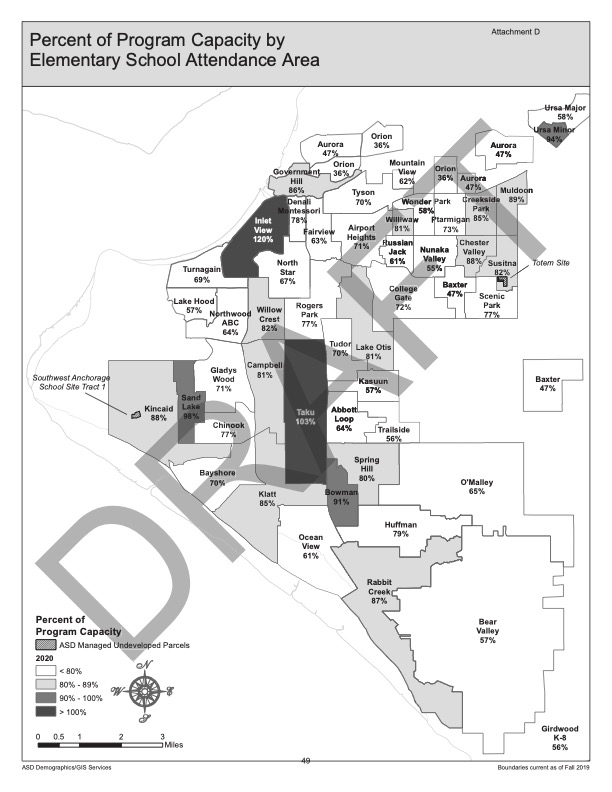
Wonder Park is currently about 58 percent occupied and Tudor is at 70 percent occupancy. In 2020, Inlet View Elementary’s design costs was combined with the earthquake repair projects bond by a 4-3 Board vote. In the 1980-90s the District had proposed to close Inlet View. 

Inlet View absolutely needs at least a major remodel costing about $15-20 million but possibly more. The new school has a total price tag of over $30 million and seems to be growing.

I strongly support a major remodel project at Inlet View to address existing needs.  These needs include a new sprinkler system, a multipurpose room, relocation of the office to help secure the entrance, some increased capacity, and many other overdue upgrades.  

The school administration points out if every student in the area went to Inlet View, increased capacity would be needed even without out-of-area students. They argue that if universal pre-K education was implemented (at a cost of tens of millions just in the Anchorage area) the extra classroom space will be needed.

Prior to several years ago, district guidelines indicated Inlet View was essentially at capacity, but not overcrowded.  Then the guidelines were changed and pre-pandemic it measured at 120 per cent capacity.  But that is not the full story.  

About 70 of the about 240 students at Inlet View come from outside that school’s boundary area. The administration has allowed this despite it creating what is now measured as overcrowding at Inlet View.  

I do not support students currently at Inlet View having to go to other schools, but the district should stop allowing new outside area students to go there. Without these additional students Inlet View is not over capacity.

There are five schools that border on Inlet View’s boundaries with lower occupancy: Turnagain 69%, Willow Crest 82%, North Star 67%, Denali 78%, and Government Hill 86%.  

Also, before just recently Central (less than a mile from Inlet View) was only 70% occupied. Obviously, some very basic phased-in (to not impact current students) boundary adjustments would eliminate over-crowding at Inlet View.

It is important to note that the experts explain that sprinkler systems in schools are not a student safety requirement; they are to reduce potential property damage.  All occupied schools are safe, even without sprinkler systems, or they would not have students in them.  

Turnagain Elementary is of similar age as Inlet View and was very successfully remodeled just a few years ago. A similar major remodel at Inlet View is estimated to cost about $15-20 million. Major remodels are projected to last about 20-30 years while new schools can last 50 years.  

The experts say it is more cost effective to tear down Inlet View and build a new school.  Probably true; but spending twice as much for a larger school than needed has immediate lost opportunity costs unless unlimited funds are available. Remember all these school building costs are now 100 percent on the Anchorage taxpayer as the State no longer reimburses new school construction debt.  Many other schools in Anchorage badly need remodels, new roofs, and security upgrades. Those projects will be delayed to pay for a new Inlet View school.

Inlet View is a great school, and its parents are a great example of how parents can be effective advocates for their students. Although the Inlet View Community Council, and it seems most of the neighborhood residents, support the total new school plan, some do not. Quite a few have told the School Board they believe the 2020 bond language’s use of the word “site” meant any new school would be located where the current school is now and not the south end of the current school property as ASD is proposing.  

Among other concerns they also question the new school being two stories and the soil conditions at the new proposed southern site.  Concern has also been raised by the District’s Capital Improvement Advisory Committee who declined to adopt a recommendation citing earthquake risk reports: “The reports depict the Inlet View location within the Bootlegger Cove Special Landslide Areas, and thus at risk in a large seismic event.”

The other proposed new schools at Wonder Park, and Tudor are currently significantly under capacity (58% and 70%) and are mostly surrounded by schools currently under 80 percent capacity (and even as low as 57%).  Clearly in addition to saving close to $50 million in property tax debt with remodels instead of new schools; other reasonable cost saving options are available, but they may be painful.

A word about school roofs: Even the best commercial roofs only last up to 30 years. The district has over 90 schools and buildings. That means, no matter how well maintained, in any given two-year cycle about six roofs will need replaced; they are costly.  The district aggressively maintains existing roofs and is using new technology to make roofs last longer for less cost. But still, every school bond will need a certain number of roof projects on it.

A word about elementary school security; while violent threats to middle and high schools can come from inside, almost all threats to elementary students and staff originate outside the school. Many of our elementary schools where not designed to meet an external threat. The administrative offices are not located where they can control the front doors. The district has been bonding to remodel elementary schools all over town to relocate offices, increase door security, and upgrade video monitoring. Up to $30 million is needed to complete this effort and $16 million was proposed to be on the 2022 bond to continue these projects. I strongly support prioritizing these projects to protect our most vulnerable students.

Finally, the complex matter of bonded debt retirement; when it comes to debt retirement an old dollar does not equal a new dollar.  For years now the district has been retiring more debt than it is adding with new bonds. But the real value of this decrease to Anchorage taxpayers is being greatly reduced by the loss of State bond reimbursement funding.  The district is retiring bonds that had up to 50 percent state subsidy with new bonds that are 100 percent paid for by Anchorage taxpayers.  Accordingly, the cost of even the reduced total debt is going up every year as more of the State reimbursed bonds are paid off.  

Now the question Anchorage taxpayers face is: Do we want to build three new elementary schools?

This communication is from Dave Donley as an individual and not on behalf of any elected, appointed, or military position he may hold including the Anchorage School District and School Board.

Alaska reporters got scooped: Murkowski announced her reelection campaign to East Coast media first

Alaska Sen. Lisa Murkowski, who represents 730,000 people in the furthest west state, announced her reelection campaign first to the East Coast media, while Alaskans were fast asleep early Friday morning.

The Washington Post had the scoop. One hour before Murkowski announced her campaign — at 6:58 am East Coast time and 2:58 am Alaska time — the Post had its story up. Politico had the story up at about the same time. It wasn’t until 8 am East Coast time that the official announcement went live on Twitter.

Later on Friday, Murkowski officially filed at the Division of Elections in Anchorage and then held a press conference to a select group of journalists.

Although Must Read Alaska was not on the invitation list for the press conference, KTUU reported Murkowski said that in an age when politics is polarizing, “I think a voice of … moderation, one that is looking to serve all Alaskans … not putting party interests over politics or performance, but just doing the best job I possibly can for the state.”

The Republican senator’s announcement was not a surprise. Must Read Alaska had broken the story earlier in the week that a Super PAC had been filed to support Murkowski’s 2022 run, and she has been raising a lot of money. It was unofficial, however, until Friday.

Murkowski has been in the Senate for four full terms, after finishing her father former Sen. Frank Murkowski’s term, when he became governor of Alaska.

Breaking: Biden vaccine mandate halted by appeals court in major blow to president

The 5th Circuit Court of Appeals in New Orleans today put a temporary injunction on the Joe Biden vaccine mandate for businesses with more than 100 employees.

The ruling came Friday afternoon, and said that the mandate “grossly exceeds OSHA’s statutory authority.”

Gov. Mike Dunleavy heralded the opinion as a victory for freedom.

“For a federal court of appeals to stop a government action from proceeding tells Americans all they need to know about the ramifications of President Biden’s aggressiveness toward citizens,” Dunleavy said. 

“Make no mistake, this issue will go to the U.S. Supreme Court. In the meantime, Alaskans can know there is some constraint against rampant overreach into their work and lives.” – Gov. Mike Dunleavy

Earlier this fall, President Joe Biden announced that the vaccine mandate would be enacted through the Department of Labor’s Occupational Safety and Health Administration, the federal regulator for workplace conditions.

The proposed mandate was published in the Federal Register last week, prompting the court challenge. On Friday, the court put a temporary stay on the Biden mandate.

The 5th Circuit’s decision halting the mandate applies nationwide. OSHA is now barred from taking additional steps until the federal courts issue a new order. 

Earlier this week, the White House advised businesses who would be impacted by the mandate should proceed as though the White House would win in court.

Read the 5th Circuit decision here.

Rep. Ken McCarty and Sharon Jackson file for new Eagle River Senate seat

6

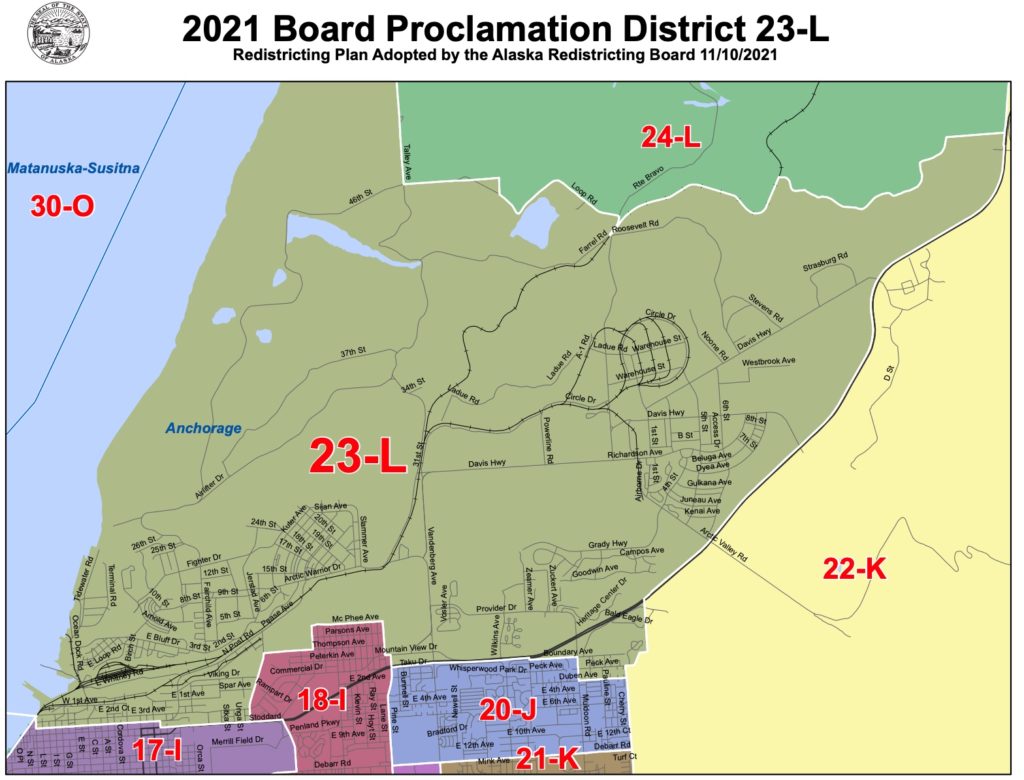
Three’s a crowd? Rep. Ken McCarty and Sharon Jackson have filed letters of intent to run for Senate Seat L, a seat that has opened up after the recent redistricting exercise.

Two days ago, Eagle River Rep. Kelly Merrick filed to run for the seat. All three are Republicans, but District 22 Republicans censured Merrick for joining with the Democrats earlier this year to form a caucus in which she was able to be appointed co-chair of the Finance Committee.

Must Read Alaska has learned that Corrections Commissioner and former Republican Rep. Nancy Dahlstrom is weighing whether she will run.

McCarty beat Jackson for Eagle River House seat 23 (formerly 13) in 2020. Both are Republicans,

In a ranked choice voting scenario, an unlimited number of candidates can get on the primary ballot, but no more than four will be on the General Election ballot.

If no one has 50 percent of the vote on the General election, the number four candidate is removed and their second choice votes go somewhere. If there is still no more than 50 percent plus one win, the third place candidate goes away, and their votes go to one of the top two.

Joe Gerace confirmed for Health Department

Joe Gerace has been confirmed as Anchorage Health Department director, after an Anchorage Assembly 2-hour executive session that lasted from 10:30 am to 1 pm on Friday, which focused on an anonymous allegation from a person who used to work with Gerace. The allegation was made at the last minute on Tuesday, prior to when he was originally scheduled to be up for confirmation.

Today’s vote was 7-3. Assembly members Austin Quinn-Davidson, Suzanne LaFrance, and Felix Rivera voted against Gerace. Member Meg Zaletel recused herself because of her new job as the director of the Anchorage Coalition to End Homelessness.