Sunday, June 14, 2026
Home Blog Page 1002

Sen. Sullivan talks infrastructure, energy, and China threat on Must Read Alaska Facebook livestream

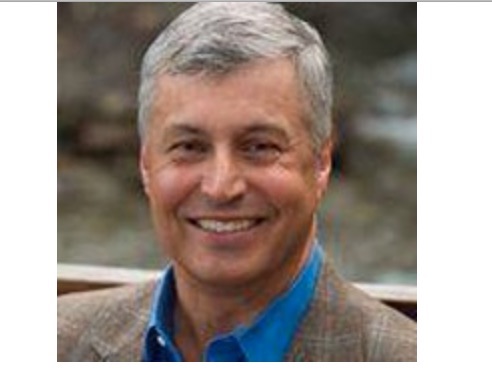
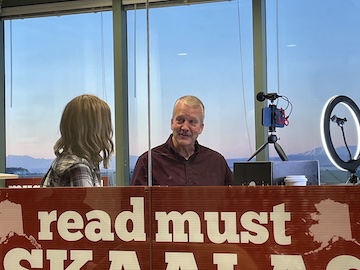
Sen. Dan Sullivan stopped by the Must Read Alaska office in Spenard to talk to Alaskans about the recent passage of the massive infrastructure bill, and the good it will do for Alaska over the next few years. Some of the high points from the interview are:

Perfect? No: Sullivan said the bill wasn’t perfect, but that it is going to put a lot of people to work in Alaska over the next five years on projects that are critical to moving the state forward. It is not the big social engineering bill that is called the Build Back Better Act, which was split off from the infrastructure bill so that the road, bridge, and broadband upgrades won’t be held up by what he termed as a socialist agenda that is in the BBBA.

Roads: The bill has $3.5 billion over five years for Alaska, a 34 percent increase over the previous highway bill. Much of the regular highway bill funding is incorporated into this legislation. Alaska will also receive part of the $110 billion over five years in supplemental funding for roads and bridges. The funds go to the state government, which decides which projects get worked on, and in what order.

Bridges: Alaska will get part of $40 billion over five years that is set aside for bridges; Alaska has 141 bridges that are structurally deficient.

Broadband: Sullivan emphasized the importance of broadband for giving parents and children choice in their education, making charter and homeschool education more available to those in rural areas. He also pointed to the $1.5 billion in flexible funding over five years, with Alaska having achieved priority for getting broadband to remote communities, before that money flows to cities like Chicago. Broadband is a key economic driver, he said, for a young state like Alaska.

Water and wastewater: The bill has $40 million to $60 million by 2026 for for safe drinking water, plus Sullivan was able to get $3.5 billion over five years for Indian Health Service sanitation facilities to help build out running water and flush toilets in rural Alaska.

Energy: The bill provides a loan guarantee up to $18 billion for the Alaska LNG project.

Streamlining Permits: The bill sets deadlines for completion of environmental reviews.

Ports and Harbors: The bill has $2.25 billion over five years for ports, including $250 million over five years for the construction of remote and subsistence harbor projects.

Sullivan, after the interview, dispelled some of the myths about the bill. It does not include Critical Race Theory, it doesn’t include gender identity politics, and it is different from the $3.5 trillion Built Back Better bill the Democrats are now trying to shove through Congress (the BBBA has passed the House).

Sullivan also talked about the increasing problem with the communist Chinese and their intent to invade and take over Taiwan. A Marine Reserve colonel, he said he is keeping a close eye on the developments and is concerned the Biden Administration will give over Taiwan to the Chinese.

Watch Sullivan talk about the bill at this link.

Words and wardrobe: Haaland removes ‘squaw’ from federal land, and Murkowski critiques NY Times about fashion reporting

Women in power asserted themselves this week on issues of words and wardrobe.

Secretary of the Interior Deb Haaland on Friday ordered a ban of the word “squaw,” which is an Algonquin word that simply means “woman,” from all federal lands.

Haaland, as an agent of the federal government, declared “squaw” to be a derogatory term that was inappropriate to use to name geological features. There are more than 650 place names that use the word, such as Squaw Mountain, Squaw Valley, and Squaw Creek. She appointed a task force to find replacement names.

“Racist terms have no place in our vernacular or on our federal lands. Our nation’s lands and waters should be places to celebrate the outdoors and our shared cultural heritage — not to perpetuate the legacies of oppression,” Haaland said in a news release.

“The term has historically been used as an offensive ethnic, racial, and sexist slur, particularly for Indigenous women,” the news release said.

The newly created Derogatory Geographic Names Task Force will include representatives from federal land management agencies, as well as diversity, equity, and inclusion experts from the federal agency. The order requires that the task force engage in Tribal consultation and consider public feedback on all proposed name changes.

Secretarial Order 3405 creates a Federal Advisory Committee to broadly solicit, review, and recommend changes to other derogatory geographic and federal land unit names. The Advisory Committee on Reconciliation in Place Names will include representation from Indian tribes, tribal and Native Hawaiian organizations, civil rights, anthropology, and history experts, and members of the general public. It will establish a process to solicit and assist with proposals to the secretary to change derogatory names, and will include engagement with tribes, state and local governments, and the public.

Some states have passed legislation prohibiting the use of the word “squaw” in place names, including Montana, Oregon, Maine, and Minnesota. Squaw Valley Ski Resort officially changed its name to Tahoe Palisades in September.

Meanwhile, Alaska Sen. Lisa Murkowski and two other women senators had a letter published in the New York Times on Nov. 20, in which they criticized the newspaper for focusing too much on the wardrobe of Sen. Kyrsten Sinema, a Democrat from Arizona who has some of the more flashy, form-fitting, and colorful attire in Congress. The letter was also signed by Jeanne Shaheen, a Democrat senator from New Hampshire and Susan Collins, a Republican from Maine.

Vanessa Friedman, a writer for the New York Times, wrote a defense in 2017 about why writing about the wardrobe of powerful people is of interest. In her column, she wrote:

“Every garment — a tie, a dress, a pair of socks or shoes — is a communication device of varying power and clarity, and we choose how to use those tools to sway those looking at us. After all, since long before Queen Elizabeth I whitened her face and exaggerated her ruff to transform herself into a living myth, leaders have been using clothes to influence opinion. For all of us, what we choose to wear in the morning telegraphs a message about who we are; and for those in the public eye, this effect is simply multiplied a hundredfold (or more).

“Is it sillier to acknowledge the strategy behind appearance, or to pretend such influences don’t exist? It may be embarrassing to recognize that what someone wears can affect your judgment, but it does: leather leggings and sneakers can make a member of the establishment seem accessibly cool; a red tie taps into memories of Morning in America; rolled-up shirt sleeves indicate hard work. At the very least, wardrobe choices can subconsciously make you relate to public figures in a more personal way, which could then tempt you to give them the benefit of the doubt when it comes to motivations and policy making — or they may alienate you entirely.

“Barack and Michelle Obama were masters of the sartorial statement, and a wave of politicians who have come since, including Justin Trudeau and Emmanuel Macron and their wives, have learned from the Obamas’ example: strategically abandoning their ties on occasion; daring to wear “Star Wars” socks; promoting homegrown designers. Donald Trump, with his hair and his tan and his devotion to the overlong tie and boxy suit, uses his style to weave a different story. But, in the current White House, it is Melania whose clothes may be the most telling. Not because she is a woman, but because since the election she has rarely spoken, retreating to her penthouse in New York and emerging last week on the global stage in a series of strict, battle-ready outfits.

“It’s not that what she wears matters more than world peace or freedom of the press or trade policy or any piece of legislation — of course not. And The Times covers those issues with dedication. But one kind of analysis does not obviate the other, and can, in fact, elucidate it. We scour her wardrobe for clues as to who she is as a person and how she sees her role; where her values lie and how she will represent the country on the world stage. Where her husband’s (perhaps unstated) priorities lie. The vehicles may be superficial. But they are also broadly accessible, and that makes them powerful. And power is a subject I don’t think any of us would dismiss.

Michael Tavoliero: The crime and tragedy of passive grooming and indoctrination

By MICHAEL TAVOLIERO

“In the course of human events there have always been those who deny or reject human freedom, but Americans will never falter in defending the fundamental truths of human liberty proclaimed on July 4, 1776. We will — we must— always hold these truths.”  The President’s Advisory 1776 Commission, January 2021

These truths are especially meaningful when it comes to the protection, nurturing, and instruction of our children as we prepare them to take our place in what will hopefully be a better future and a better lifestyle than our own. That said, over the last decade I have become increasingly skeptical of this outcome.

I’m not an attorney, yet I can’t help but ask questions. 

Are the Anchorage School District (ASD) board members, its superintendent, the unnamed library association, and those staff accountable for the procurement and placement of the book, “Gender Queer”?  

What other books, which by intentional design move to sexually groom and indoctrinate Anchorage’s children for future exploitation, are on the shelves at Anchorage public schools? 

Are those people criminally culpable in their breach of custody and subsequent unlawful exploitation of the 43,500 plus students in the Anchorage School District?

What’s really the difference between an adult sexual predator and an adult in the school district knowingly placing visual and aural material within the reach of minors? 

Both are intended to groom and indoctrinate children for future sexual exploitation, and once sufficiently groomed, to prey on them.  This has happened in the past with ASD and other Anchorage schools. 

Is this an attempt to make it legal, or at least culturally acceptable?  

Alaska Statutes 11.41.436 and 11.41.455 describe the circumstances that define the felony of unlawful exploitation of a minor: 

AS 11.41.436:

(a) An offender commits the crime of sexual abuse of a minor in the second degree if…

(4) being 16 years of age or older, the offender aids, induces, causes, or encourages a person who is under 16 years of age to engage in conduct described in AS 11.41.455 (a)(2) – (6);

*and* the offender occupies a position of authority in relation to the victim.

Alaska Statute 11.41.455 graphically describes the kinds of sexual activities the minor may be induced into performing by the exploitative adult who is grooming them.  As we know, the process of grooming a child for future exploitation begins slowly, the perpetrator often starting by showing the child pornographic materials. 

How is this different from the adults within the school district providing our children with easily accessible pornographic materials?  

These people are effectively babysitting our children.  

How would you feel if you found out that the babysitter you left your children with one the evening had been showing them pornographic and sexually explicit materials while you were out to dinner?

Of course, this begs the question, are there other sexually explicit and pornographic books and materials now being shipped to the Anchorage School District libraries and classrooms?  

Who is ordering these?  

Why would an adult, someone who is in a position of authority in the eyes of the children, want to subject young people to these materials?  

The AS 11.41.370 further provides that a parent, legal guardian, or person having custody or control of a child under 18 years of age commits the crime of unlawful exploitation of a minor if, in the state, the person permits the child to engage in conduct described in this section knowing that the conduct is intended to be used in producing the material that visually or aurally depicts the conduct.

You be the judge.

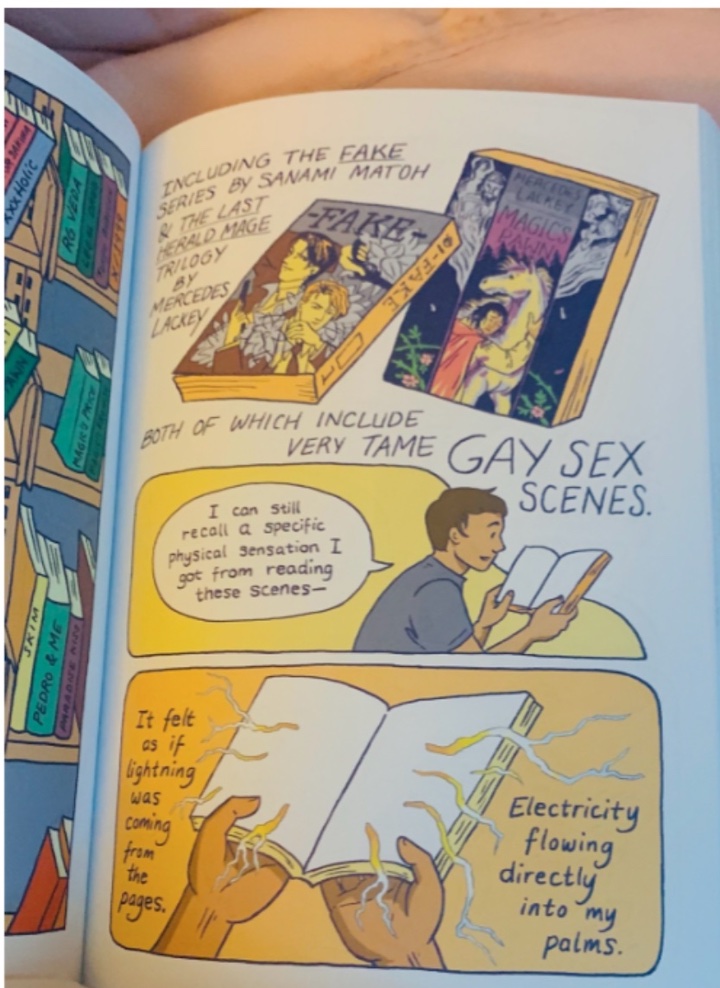
Suzanne Downing, editor of Must Read Alaska, showed pages from the book in her Nov. 13, 2021 article, “Anchorage Schools Remove ‘Gender Queer’ Graphic Memoir From School Shelves”.

I bought the book from Amazon and reviewed it. While it could be termed as a “coming of age” memoir, I cannot agree that this book should be placed in front of minors as reading material in the schools.

In my opinion, the comic book format is a clandestine way of spreading sexual content to underage children.

Superintendent Deena Bishop responded to the article with what can be best described as an apathetic and dismissive memo posted on the ASD website.  

The book was in a “batch” of “award-winning” books, she said.

What is striking is her total lack of curiosity as to what in her procurement system resulted in this purchase. 

Why is she not outraged and angry?  

Why is she not demanding answers?  

Why is she not requiring her staff to thoroughly vet and review all “batches” of books coming into the school system for appropriate subject content?

Per Superintendent Bishop’s Nov. 15, 2021, memo to the public, the ASD Teaching and Learning Department is the department that reviewed and removed of the book.  She details casually the circumstances surrounding the book’s journey to the ASD.

From the ASD website, the Teaching and Learning Department is the authority in curriculum. Per website, it is responsible for “the alignment of curriculum across academic services to support equitable, high quality instruction within a multi-tiered system of supports.”

Who are the members of ASD Teaching and Learning Department? 

Was this department ultimately responsible for the purchase of this book as part of a library association’s “award winning” package of books?

Were there others involved?

Where are the records identifying the purchase of this book and others with the complete list of books from “a library association’s award winning” package of books”?

Into which school library (or libraries) was this book installed?

Who in the ASD library system distributed this book to its final destination?

Was there a review of this book before it was put into circulation?

What is the name of the library association and what is the length and depth of its relationship to ASD?  

And perhaps what is most discouraging and disappointing, where are the responses of the Anchorage clergy and churches? 

Dear leaders and acolytes who lead Anchorage’s religious communities, are you aware of what happened?  

Are you curious in finding out the truth? 

Where is the moral outrage to this crime perpetrated on the entirety of the children attending the ASD schools?

I grew up in the ‘50’s and ‘60’s, when Catcher in the Rye, Catch 22, The Painted Bird, and other novels were continually subjected to bans.  I do not support censorship. Hey, I went to Woodstock.

And yes, I accuse any adult who intentionally places these materials in the hands of our children, our most precious asset, of committing an egregious and unforgivable crime.  These people will get away with this and more if we don’t apply the law and statutes to them now.

When public funds are used for the grooming and indoctrination of children for sexual exploitation, beyond the scope of what true education must be in Alaska, I just can’t buy it.

Can you?  

Michael Tavoliero is a realtor in Eagle River, is active in the Alaska Republican Party and chairs Eaglexit.

Scott Atlas: How panic spread in the early days of Covid-19

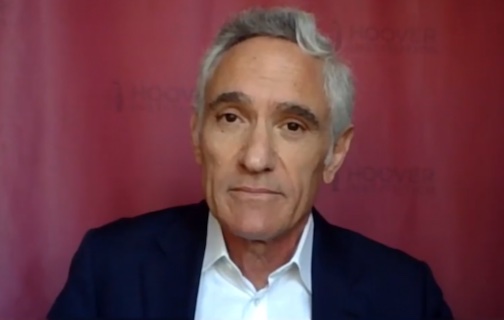
SCOTT W. ATLAS, MD

Adapted from A Plague Upon Our House by Scott Atlas, MD, due out from Bombardier Books on Dec 7.

It was February 2020, and news accounts had been describing increasingly alarming information about a deadly new virus emanating from Wuhan, China.

Apart from my general concern about the spread of the infection, I was confused about some of the basic numbers being aired. The overall message coming from the World Health Organization (WHO) seemed to have obvious flaws.

The extremely high risk estimates seemed very misleading. Even worst—the reported fatality rates were based only on patients who were sick enough to seek medical care rather than on the undoubtedly much larger population of infected individuals.

I was stunned that this basic methodological flaw was being overlooked by almost everyone, while the resulting fatality rate of 3.4 percent was highlighted throughout the media. Every legitimate medical scientist should have called that out. Their silence was puzzling.

Scott Atlas, MD

In the United States and throughout the world, a naive discussion about statistical models ensued. To an extraordinary and unprecedented extent, these epidemiological models were featured front and center in news coverage, with no perspective on the models’ usefulness. Reminiscent of other legendary frenzies in history, like the tulip bulb mania or the tech stock bubble, hypothetical extreme-risk scenarios went seemingly unchallenged and were given absolute credence.

At the same time, common sense and well-established principles of medicine were being ignored. Every second-year medical student knew that the elderly were almost certainly the most vulnerable group of people, since they were virtually always at highest risk of death and serious consequences from respiratory infections. Yet this was not stressed.

To the contrary, the implication of reports and the public faces of official expertise implied that everyone was equally in danger. Even the initial evidence showed that elderly, frail people with preexisting comorbidities—conditions that weakened their natural immunological defenses—were the ones at highest risk of death. This was a feature shared by other respiratory viruses, including seasonal influenza.

The one unusual feature of this virus was the fact that children had an extraordinarily low risk. Yet this positive and reassuring news was never emphasized. Instead, with total disregard of the evidence of selective risk consistent with other respiratory viruses, public health officials recommended draconian isolation of everyone.

The architects of the American lockdown strategy were Dr. Anthony Fauci and Dr. Deborah Birx. With Dr. Robert Redfield, the director of the CDC, they were the most influential medical members of the White House Coronavirus Task Force.

The task force quickly expanded to include a new chairman, Vice President Mike Pence. The White House also announced that Birx would be the task force’s coordinator. She had worked in the State Department as the U.S. AIDS coordinator under the Obama and Trump administrations—hence she was often addressed by the honorific “ambassador.” The task force ultimately included representation from numerous federal agencies concerned with health, science, national emergencies and logistics, the economy and many other relevant concerns.

The task force dealt with a number of issues at its origin. Since the country had not been well prepared for a pandemic, one of the primary tasks was to develop adequate testing—a key public health measure in early infectious disease outbreaks. The second main set of tasks centered around the production and logistics of supportive medical equipment, including ventilators, personal protective supplies for hospitals and extra beds and personnel to accommodate sick patients anticipated to overwhelm the system.

Dr. Birx, Dr. Redfield and Dr. Fauci—often called “the nation’s top expert in infectious disease”—dominated all discussions about the health and medical aspects of the emerging pandemic. One thing was very clear: all three were cut from the same cloth.

First, they were all bureaucrats, with a background in various government agencies. Second, they shared a long history in HIV/AIDS as a public health crisis. That was problematic, because HIV couldn’t be more different from SARS2 in its biology, its amenability to testing and contact tracing, its spread and the implications of those facts for its control. Indeed, the three of them spent many years focusing on the development of a vaccine, rather than treatment, for HIV/AIDS—a vaccine that still does not exist.

It’s also worth noting Dr. Fauci’s history in regard to AIDS. He created headlines for his alarmist speculations in his 1983 JAMA editorial that AIDS could be transmitted by “routine close contact, as within a family household.” It had already been known that transmission happened via fluids through blood or sexual contact.

Less than two months later, on June 26 in The Baltimore Sun, Fauci publicly contradicted his own explosive claim: “It is absolutely preposterous to suggest that AIDS can be contracted through normal social contact like being in the same room with someone or sitting on a bus with them. The poor gays have received a very raw deal on this.” That seemed like quite a flip-flop, with no new evidence or explanation given—more reminiscent of a politician than a reliable scientist.

Most others on the task force were juggling several concerns or had no medical background. This was one more responsibility added to their portfolios, so they deferred to those deemed medical experts. Drs. Birx and Fauci commandeered federal policy under President Trump and publicly advocated for a total societal shutdown. Instead of focusing on protecting the most vulnerable, their illogical and extraordinarily blunt response—despite its predictable, wide-ranging harms—was instituted as though it were simple common sense.

Over those first several weeks, fear had taken hold of the public. Media commentators and even policy experts, many of whom had no expertise on health care, were filling the airwaves and opinion pages with naive and incorrect predictions. This misinformation was going unchecked, and was indeed repeatedly endorsed and sensationalized. Some whom I had previously considered among my smartest colleagues and friends expressed great confusion and a striking absence of logic in analyzing what was happening.

I asked myself time and again, “Where are the critical thinkers?”

After more than 15 years a health policy researcher and decades in medical science and data analysis, I had never seen such flawed thinking. I was bewildered at the lack of logic, the absence of common sense and the reliance on fundamentally flawed science. – Scott Atlas, MD

Suddenly, computer modelers and people without any perspective about clinical illnesses were dominating the airwaves. Along with millions of other Americans, I began witnessing unprecedented responses from those in power and nonscientific recommendations by public health spokespeople: societal lockdowns including business and school closures, stay-at-home restrictions on individual movements, and arbitrary decrees by local, state, and federal governments.

These recommendations were not just based on panic; they were responsible for generating even more panic. Covid rapidly became the most important health policy crisis in a century.

Scott W. Atlas, M.D. is the Robert Wesson Senior Fellow in health care policy at the Hoover Institution. This column first appeared in Newsweek and is used with permission.

Today Don Young became the 6th overall longest-serving Congressman in history

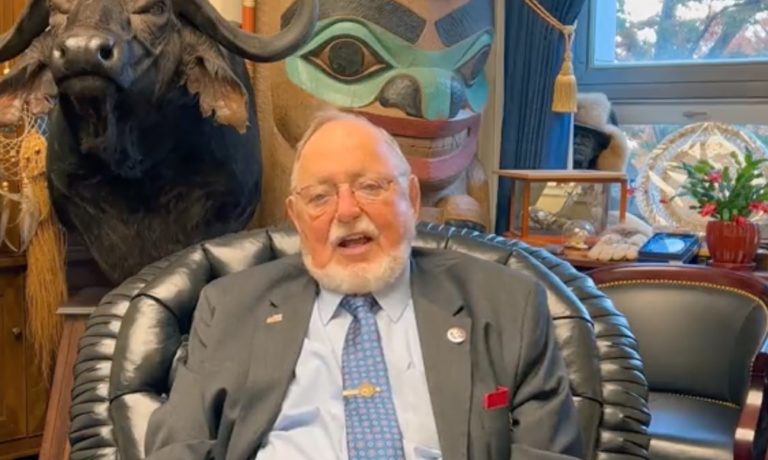
On Friday, Alaska Congressman Don Young surpassed former Speaker Sam Rayburn’s tenure and became the 6th overall longest serving congressman in the history of the U.S. House of Representatives.

Young has served since March of 1973, and is in his 25th term.

He already was the Republican Party’s longest-serving member of the House in history, and is currently Dean of the House, the first Republican Dean in over eight decades.

“It’s truly the honor of a lifetime to represent Alaskans. I love this institution dearly, and I’m grateful to have served with nearly 2,200 friends on both sides of the aisle in the House,” Young said in a video posted by his staff.

“His tenure in the United States Congress. 48 years, 256 days.That’s me. That puts me in the sixth position of every congressman who has ever served for longevity. When I get reelected this time, I’ll go to number four,” he said in the video, taped in his colorful DC office, surrounded by his Alaska memorabilia. “I thank you for that, Alaskans. Don Young thanks you. I’ve done the job for you because you’ve asked me to do it, and we’re going to do it again. I’m proud of that. It’s gonna be good times. God bless.”

Rayburn, of Texas, was a Democrats who served as the 43rd Speaker and was also speaker three times. He still is the record-holder for having the longest tenure as Speaker, 17 years total. He served from 1913 until 1961, and an office building — the Rayburn Building — at the Capitol is named in his honor.

Watch the Don Young video at this link:

Kelly Tshibaka: Voters sent a message this month about government overreach, but Alaskans already get it

By KELLY TSHIBAKA  

Earlier this month, voters across the country delivered a strong message that they are tired of government overreach and want a change in direction. In Virginia, New Jersey, Seattle, Minneapolis, and Buffalo, people showed support for parental involvement in schools and opposition to pandemic-related mandates. They also supported increased law enforcement and spoke clearly against government intrusion. 

It’s good that the rest of the nation is finally catching on. In Alaska, we’ve been fed up with encroachment of government for a long time. 

President Joe Biden’s vaccine mandate is blatantly unconstitutional. Already halted by the 5th Circuit Court of Appeals, which called it “fatally flawed” and “staggeringly overbroad,” it threatens the jobs of workers if they decline to be vaccinated.  Biden bulldozed over millions of Americans’ rights and medical autonomy by compelling individual behavior under the guise of a workplace regulation. What’s more, his mandate made no allowance for people who already recovered from COVID-19 and have natural immunity, People should make their own decisions about medical treatment, and independent Alaskans don’t take kindly to having politicians push their way into the provider-patient relationship.  

Alaska had by far the highest violent crime rate of any state in 2020, and still there are leftists who want to defund and dismantle police departments. Incredibly, Biden installed Vanita Gupta in a top job at the Department of Justice, despite her Senate testimony a year earlier urging lawmakers to adhere to the Defund the Police movement. In Alaska, we know that people in our most vulnerable communities need public safety protection. 

Another great risk to the livelihoods of Alaskans are Biden’s radical environmental policies, which attack our resource industries. On his first day in office, Biden halted the oil and gas leasing approved under President Donald Trump. Biden then worsened the blow by suspending leases that had already been sold, with the Secretary of the Interior, Deb Haaland, leading the charge. And even though he had promised he would defend the massive Willow energy project and its billions of dollars in investment and thousands of jobs, Biden allowed U.S. District Court Judge Sharon Gleason to block it without filing an appeal. 

Biden reversed another Trump policy when he returned to the “roadless rule” for the Tongass National Forest. This blocks our ability to attract tourists and produce timber, both of which mean jobs for Alaskans. It was Agriculture Secretary Tom Vilsack delivering the blow that time. 

And finally, the same federal judge as in the Willow case, Judge Gleason, stopped the King Cove Road, which would link Alaskans living in the Aleutians with life-saving emergency medical facilities. 

The people listed above have taken direct aim at Alaska’s sovereignty, safety, and prosperity. And all of them have something in common: They all bear the seal of approval from Sen. Lisa Murkowski. 

Murkowski paved the way for Biden’s presidency through her outspoken and unrelenting opposition to President Trump, even though Trump won Alaska twice by double digits and enacted policies that were great for us. 

Murkowski cast the deciding vote on the Senate floor to confirm Gupta to the Justice Department. 

Murkowski cast the deciding vote in committee to move Haaland’s nomination for Interior Secretary to the floor of the Senate, despite expressing “very real misgivings” knowing it would hurt Alaskans.  

Murkowski voted to confirm Judge Gleason, calling her a “superb judge” despite knowing her record of supporting environmentally radical positions from the bench, putting her in position to block the Willow project and the King Cove Road. 

Murkowski voted to confirm Vilsack as Agriculture Secretary, allowing him to block access to our own forest. 

And when she had a chance to cast votes that would actually help Alaska with liberty-minded judges, she voted against confirming Supreme Court Justice Brett Kavanaugh and voted to filibuster Justice Amy Coney Barrett. 

We heard what voters said across the nation earlier this month–it’s what Alaskans have been saying for a while. Government is supposed to work for us, not against us.  

The government’s role in our life is supposed to be like the two referees in a hockey game. They regulate the game, call the fouls, and make sure the plays are fair. But right now, we have 200 referees on the ice with sticks in their hands, messing with our puck!  

Next November, I will be asking Alaskans to send me to the U.S. Senate because we deserve a leader who will listen to the people, and who will help clear the rink so we can get back to playing the game! 

Kelly Tshibaka is the candidate for U.S. Senate in Alaska endorsed by the Alaska Republican Party and President Donald Trump. 

Oops, she did it again: Public official threatens lawsuit against MRAK

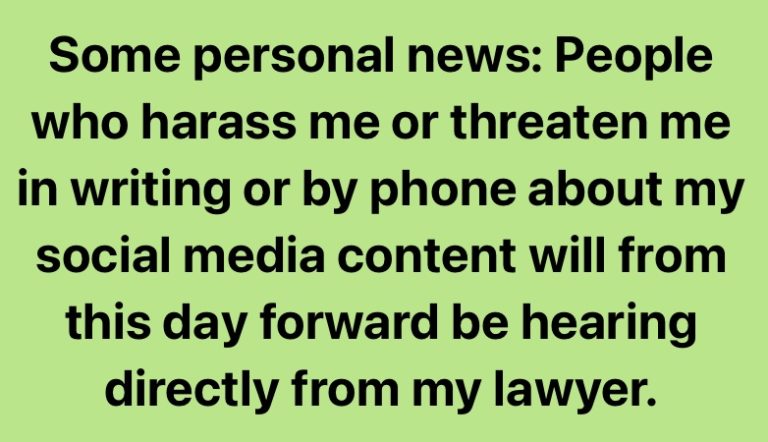
[Redacted] City Attorney Libby Bakalar, who demands Must Read Alaska not name the city for which she is counsel, has written a letter threatening Suzanne Downing, publisher of the Must Read Alaska news site.

Through her attorney, Juneau trial lawyer Mark Choate, Bakalar demands Downing must not write about her anymore, or else there will be lawsuit.

In October, she had posted a social media message (seen above) saying anyone harassing her would be hearing from her lawyer. Now, even writing about her social media political work is enough to trip that trigger.

Bakalar is suing Gov. Mike Dunleavy because she was let go after the Walker Administration was shown the door by voters in 2018. She was an attorney with the Department of Law and says she was wrongfully fired by Dunleavy. She doesn’t want Downing writing about that, either.

“Your ongoing mining and re-publication of Ms. Bakalar’s personal social media in tandem with repeated references to her position as the City Attorney of Bethel is clearly intended to provoke requests and actions to end that employment. You engaged in similar critiques of her while she was an Assistant Attorney General and continued those after her wrongful termination by the Dunleavy Administration. Your resumption of these efforts constitutes ‘tortious interference’ with an employment contract, for which you and your business may face significant liability
and damages,” says the letter from Choate.

Bakalar is evidently upset about a republication of her social media artwork in which she depicts male genitalia on a logo used by the governor for a podcast that features his commissioners talking about their departments. The social media post makes it appear as though she or someone drew the male genitalia on the logo as a joke:

“When considering claims of tortious interference with a contract, the Alaska Supreme Court recognizes a clear distinction between persons who interfere with the contracts of competitors and those who interfere with contracts in which they have a direct interest themselves. Even when there is a direct financial interest involved, “the essential question in determining if interference is justified is whether the person’s conduct is motivated by a desire to protect his economic interest, or whether it is motivated by spite, malice, or some other improper objective.” Burton v. Fountainhead Development, Inc., 393 P.3d 387 (Alaska 2017). My client is a hobby blogger and litigant against the Dunleavy administration, for which you are a widely-known and vocal supporter. You utilize your blog to attack what you perceive as its foes and write frequently about the “Deep State”. You have attacked Ms. Bakalar in your blog for years. You have no business relationship with or financial interest in my client, her hobby blog, or her job. Your continued harassment of Ms. Bakalar and the goading of your supporters to harass and threaten her—both at work and at home—is rooted exclusively in political disagreement, malice, and spite,” according to Bakalar/Choate.

Bakalar has been a political actor for many years on and off social media, commenting on any manner of issues and political figures in Alaska as well as former President Donald Trump. She and other liberal women traveled to Washington, D.C. to implore Sen. Lisa Murkowski to vote against the Supreme Court nomination of Brett Kavanaugh, and Must Read Alaska has written about such exploits and others by the Juneau woman, who is a social media sensation, with over 9,000 followers on Twitter and who writes op-eds for the Anchorage Daily News. Her blog is titled One Hot Mess Alaska.

She has alleged in her lawsuit against Dunleavy that her free speech rights were being infringed by his Administration.

The entire letter threatening legal action follows:

South Carolina governor calls for investigation of porn in school libraries — same porn found in Anchorage schools

21

South Carolina Gov. Henry McMaster requested this week that S.C. Superintendent of Education Molly Spearman immediately begin a comprehensive investigation into the presence of obscene and pornographic materials in public schools.

McMaster sent the request in a letter to Superintendent Spearman after he received examples of what many see as pornographic materials found in schools from concerned parents in Fort Mill. 

The material he is concerned about is the same porn that was removed from Anchorage School shelves by Superintendent of Schools Superintendent Deena Bishop, who found the book “Gender Queer: A Memoir” to be inappropriate for school libraries.

“By way of example, it is my understanding that concerned parents were recently required to petition the Fort Mill School District to remove a book from a school’s physical or digital library, titled Gender Queer: A Memoir, by Maia Kobabe,” Governor McMaster wrote. “If school personnel had performed even a cursory review in this particular instance, it would have revealed that the book contains sexually explicit and pornographic depictions, which easily meet or exceed the statutory definition of obscenity.  Thus, I am concerned that further examination may identify additional instances in which inappropriate materials have been introduced into our State’s public schools.”

McMaster also said, “For sexually explicit materials of this nature to have ever been introduced or allowed in South Carolina’s schools, it is obvious that there is or was either a lack of, or a complete breakdown in, any existing oversight processes or the absence of appropriate screening standards.  Therefore, I respectfully request that the Department of Education promptly investigate this matter, on a statewide basis, and identify whether any systemic policy or procedural deficiencies exist at the state or local levels, or both.”

He called on the Department of Education or the State Board of Education to promulgate statewide standards and directives to prevent pornography from entering the state’s public schools and to identify any materials that may already be in school libraries.

Noting that the dissemination of the obscene materials likely violates state law, the governor referred the matter to Chief of the State Law Enforcement Division, Mark Keel, writing: “I trust you agree that pornography and obscenity have no place in our State’s public schools, much less in their libraries. Aside from being deeply disturbing and manifestly inappropriate, it is likely illegal under South Carolina law. Accordingly, by copy of this letter, I am simultaneously notifying the South Carolina Law Enforcement Division of this matter for further evaluation.”

In Anchorage, the superintendent said the book was sent to the district in a bulk order of books, without the district specifically requesting it. Around the nation, other school districts have also found the book among their stacks, leading parents to lobby to have the book removed.

To date, there has not been a robust defense of it by LGBTQ activists, but a superintendent in Illinois has ruled the book should remain, saying “the book ‘Gender Queer’ meets the critieria for inclusion in our library.”

Caution: The following story from Nov. 13 Must Read Alaska has graphic depictions from the book, not appropriate for everyone:

Suzanne Downing: In Rittenhouse verdict, the real justice is now Kyle’s case against the media, politicians, celebrities, and the president himself

By SUZANNE DOWNING / MUST READ AMERICA

For those who followed the Kyle Rittenhouse trial closely, there is no doubt in their minds that the young man who shot rioters in Kenosha, Wisc. was not guilty of murder. 

Most of America, however, did not watch the proceedings, or not closely, at least. They got their information spoon-fed to them by the mainstream media. They expected a conviction.

Mature Americans can agree that a 17-year-old should not have run to the fight, as riots tore across America during the 2020 election year –- riots fomented by anti-Trump forces like Black Lives Matter and Antifa cells. Rittenhouse had the courage of youth, but not the wisdom of years to know how badly things could go for him during that “fiery but peaceful” riot.

But, as many of the actual trial watchers have observed, the prosecution had no legitimate case. So they lied, withheld evidence, and even doctored video provided to the defense. 

In the end, the jury was able to see through it all.

Rittenhouse now deserves his own justice. President Joe Biden, then a candidate, called him a “white supremacist” in 2020. Celebrity journalists and politicians on Twitter condemned the young man before the trial.

Congresswoman Ayanna Pressley’s message in 2020 was by parroted by thousands of Twitter trolls and other racist partisans who are on the record with their premature verdict.

She wrote: “A 17 year old white supremacist domestic terrorist drove across state lines, armed with an AR 15. He shot and killed 2 people who had assembled to affirm the value, dignity, and worth of Black lives,” she wrote on July 26, 2020. There are hundreds of declarations just like hers from the famous and the famous-for-being-famous.

As jury deliberations had dragged into a third day, some observers thought a guilty plea was all but inevitable. There appeared to be no “slam dunk” in the making. 

Rittenhouse’s defense attorney, considered one of the best criminal defense lawyers in Wisconsin, told media he had never had a jury take longer than 18 hours. The jury had deliberated for nearly 24 hours, and then Friday morning the verdict came: Not guilty on all counts.

For this writer, that appears to be the correct set of verdicts. There is plenty of reasonable doubt that recommends acquittal; Rittenhouse was under attack by grown men, one with a gun, and he fired in self defense.

To review, Rittenhouse, who was a 17-year-old youth from a nearby suburb, volunteered to be on foot patrol in downtown Kenosha in August of 2020. It’s where his family lives and race riots were burning it down. Rittenhouse had on him an AR-15-style rifle. He was trained on the weapon and he kept it properly pointed down, as evidenced in all the video available, until he had to save his own life when, he was attacked. His actions were clearly self defense, but in that moment, he killed two men and woundied another. The charges were reckless homicide and attempted homicide. Other charges relating to possession the weapon were already dropped.

Rittenhouse’s case became fodder for the leftist media, which declared him guilty early on, painted him in the worst possible light, called him a white supremacist, and colluded to misinform and shape public opinion against the youth.

The media saw Rittenhouse as the easiest of targets, fitting their narrative of a Trump supporter.

The lawsuits and settlements could certainly help restore some order to Rittenhouse’s interrupted life. Patriotic Americans would willingly contribute hundreds of thousands of dollars to help the young man win justice against those who prematurely condemned him as a criminal.

A parallel to this case of media malpractice is the story of Nick Sandmann, a high school student who was defamed by The Washington Post and CNN, and many other news outlets.

“The parallels between me and Kyle Rittenhouse are impossible not to draw,” Sandmann wrote this week. “Kyle was 17-years-old when he became a household name after that terrible tragedy in Kenosha. I was 16-years-old when I was catapulted into the national conversation by video of an encounter with a Native American activist on the steps of the Lincoln Memorial.”

Sandmann eventually settled his $250 million lawsuit agains the Post and CNN. But the damage to his reputation, as the damage to Rittenhouse’s reputation, has been done by the pig sty that American journalism has become.

Lawsuit or no lawsuit, there will be no real reckoning for the media. As with its corrupt colluding with the Hillary Clinton Campaign in 2016 to take down Donald Trump with the Steele Dossier, the wholesale slaughter of a boy in Wisconsin is merely collateral damage for news outlets that are organ grinders for the Democratic Party.

But at the very least, Rittenhouse deserves his justice against who railroaded him in the court of law and in the court of public opinion.

Suzanne Downing is publisher of Must Read Alaska and Must Read America.