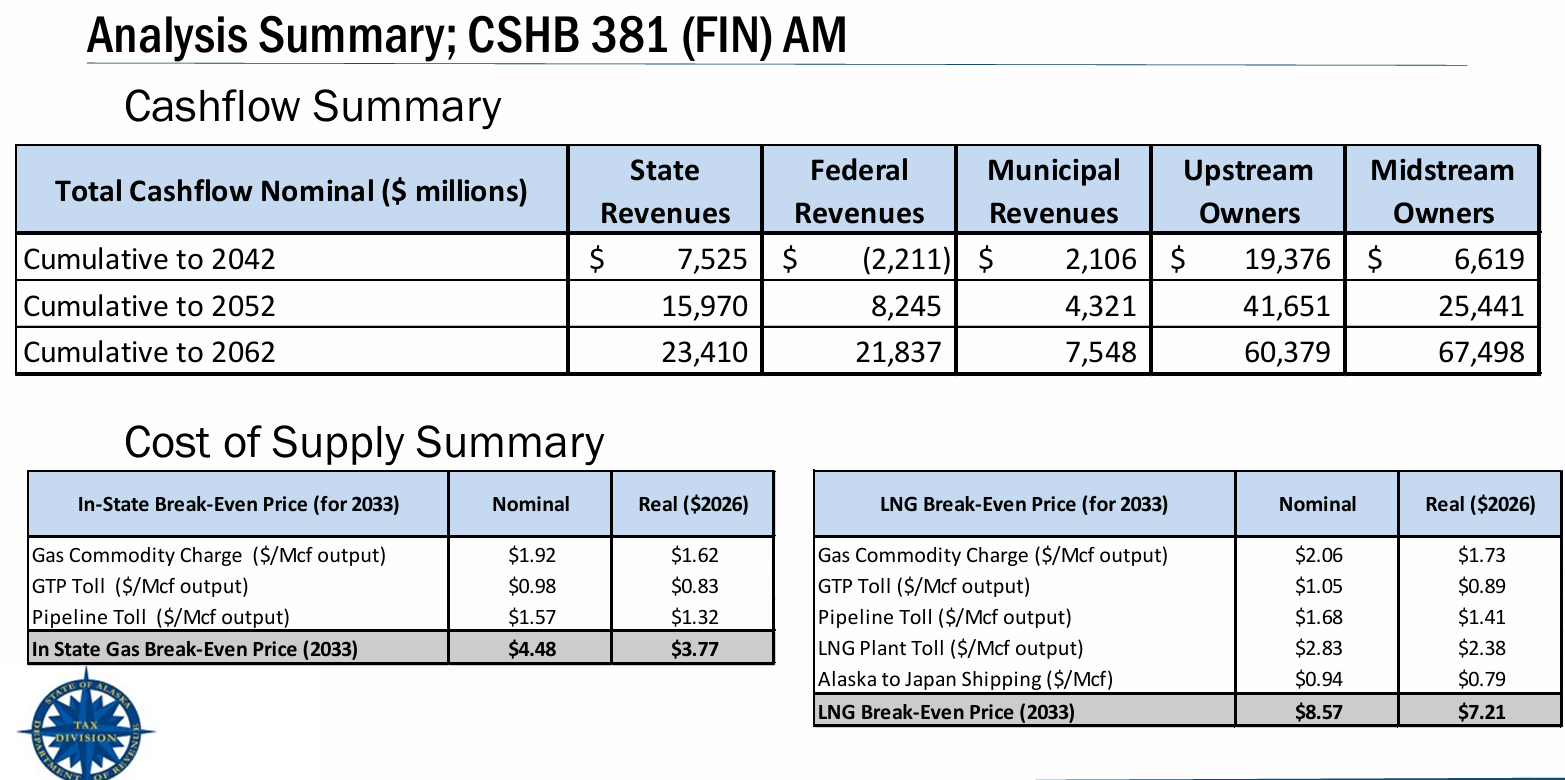
My previous analysis of HB 381 published on Thursday, June 11, 2026, was based on HB 381 version T which was the most current available version of the bill on the Alaska Legislature’s website (akleg.gov). The revenue calculations in my analysis were based on the Department of Revenue’s presentation on HB 381 version T, which was also the most current available analysis from DOR when HB 381 passed the House on Friday, June 12. However, an updated analysis and bill text was uploaded to akleg.gov sometime after the House passed HB 381.
So, let’s take a look. The recalculation reveals a substantial change from HB 381 version T, especially in regards to municipal revenues under the bill.
Here is the math put simply:
| State Revenues | Revenue Increase: Current Tax Structure –> HB 381 | Percent Change |
| 2042 | -2.6 billion | 25.7% decrease |
| 2052 | -4.7 billion | 22.6% decrease |
| 2062 | -6.3 billion | 21.2% decrease |
| Municipal Revenues | ||
| 2042 | -4.2 billion | 66.7% decrease |
| 2052 | -7.6 billion | 63.9% decrease |
| 2062 | -9.8 billion | 56.6% decrease |
See full DOR analysis on HB 381 as passed by the House: https://www.akleg.gov/basis/get_documents.asp?session=34&docid=16612

For comparison, here is the math from my analysis on HB 381 version T, published June 11:
| State Revenues | Revenue Increase: Current Tax Structure –> HB 381 | Percent Change |
| 2042 | -2.3 billion | 22.8% decrease |
| 2052 | -4.2 billion | 20.2% decrease |
| 2062 | -4.6 billion | 15.5% decrease |
| Municipal Revenues | ||
| 2042 | 0.5 billion | 7.9% increase |
| 2052 | 1.6 billion | 13.5% increase |
| 2062 | 2.1 billion | 12.1% increase |
State revenues under HB 381 as passed by the House are further reduced compared to HB 381 version T. Additionally, rather than the modest increases in municipal revenues under HB 381 version T, the House passed a bill that slashes municipal revenues by two-thirds in 2042 and by over half in 2062.
Because the Legislature failed to provide the most up-to-date bill text and DOR analysis before the House floor vote, the claim by Senators Wielechowski and Kawasaki that HB 381 provides a 90% tax break for the project producers seemed incorrect. However, in light of the documents made available sometime after the House floor vote on Friday afternoon and before Tuesday morning, Wielechowski and Kawasaki’s claim is somewhat true, although simplified.
The facts: HB 381 as passed by the House allows a combined State and municipal revenue reduction of 92.4% in 2042, 89.3% in 2052, and 77.8% in 2062. Municipal revenues take a much steeper reduction than State revenues with municipal revenue reductions being approximately twice that of the State’s revenue reduction.
HB 381 version T (the most current version made available to the public during the House floor vote) would have decreased State revenues, but moderately increased municipal revenues. However, the version actually passed by the House paints a different picture: up to a two-thirds revenue reduction for municipalities.
Proponents of the tax cut argue that reducing tax burdens on the project producers will benefit the average Alaskan by reducing the price of gas. The argument follows lines of basic free market economics: the less it costs to produce, the less it will cost to consume. The converse is true as well: higher cost for the producer, higher cost for the consumer. DOR’s conclusion corroborates this principle, stating the bill as passed by the House “would materially decrease the cost of gas and make the project more attractive to investors, compared to current law.”
On the other hand, opponents of the bill argue that HB 381 fails to capture a revenue source for the State and local governments that are feeling the effects of tight budgets. While opponents of the tax cuts argue the necessity of increased government revenue, proponents of HB 381’s tax cuts criticize the government’s overspending habits and emphasize the direct benefit of lower energy costs for Alaskan households.