

This article was originally published in “Seward’s Folly,” the author’s personal Substack, on June 15, 2025.
By Greg Sarber
The June 1st filing deadline has passed, meaning the field for the governor’s election is set. The candidates and voters might be tempted to look ahead to the November general election, but the importance of the August primary should not be overlooked. Thanks to Alaska’s jungle primary system, although 18 candidates are currently running, it is only the four candidates getting the most votes in the primary who will move on to the general election. Because of the large number of candidates running, those lucky four candidates will be determined by a very small percentage of the total vote count. Meaning that there could be some unexpected results, and some of the more well-known candidates may not appear on the general election ballot.
One idea of who will end up in the final four can be gleaned from recent polling. Two polls have been published recently: one by Ditman and another by Alaska Survey Research. While polling is notoriously inaccurate here in Alaska, and voters might find fault with the results, it gives us an idea of who the pollsters think is favored at this time. That information is summarized in Table 1.

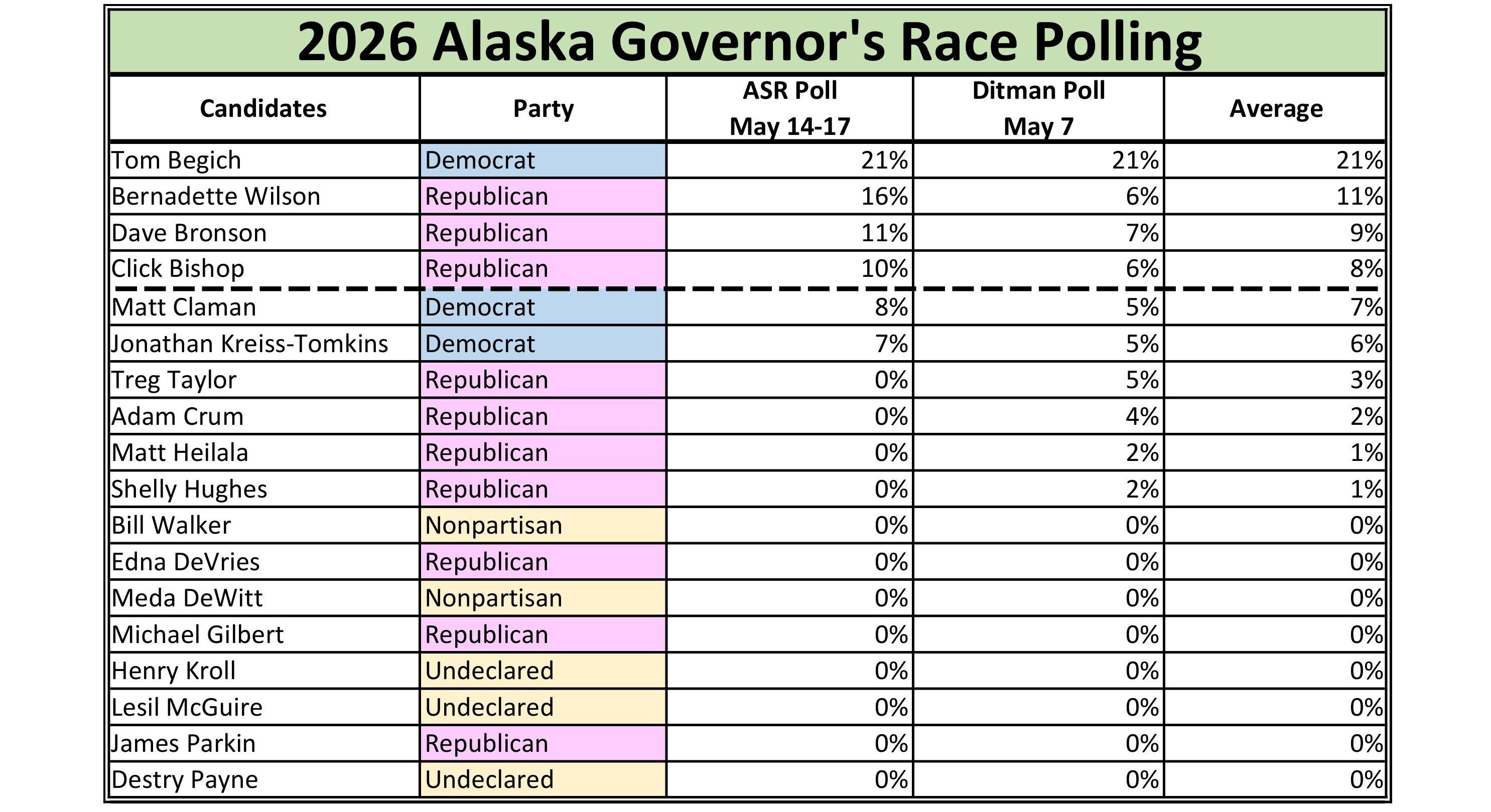
This table shows the candidates ranked based on the average of the results of the two polls. Based on that data, one Democrat and three Republicans will make it to the general election ballot in November. Surprisingly, some of the more well-known candidates will not make it past the primary based on current polling, including former Attorney General Treg Taylor and former Governor Bill Walker.
Of course, all of this could change, but if the polling reflects the primary election results, it sets up an election where the Democrat has the opportunity to emulate Mary Peltola’s strategy in 2022 and try to remain above the fray while the Republicans attack each other right up to election day. In 2022, despite getting fewer votes than the combined Republican candidates in the first round, Peltola won her seat in Congress in an RCV runoff. Here are the strategies that each of the candidates might choose to pursue if they make it through the primary.
Tom Begich’s strategy for winning as the lone Democrat is to emulate Mary Peltola in 2022, act like the nice guy, and hope the Republicans so alienate the voters that the voters all put Begich as their second choice on the ballot, allowing him to win the RCV runoff. This worked once for Mary Peltola and is really the only way Begich can win because he is unlikely to resonate with the voters. His 6 years as an Alaska Senator were undistinguished. He is a candidate with few political accomplishments and has done nothing of note in the private sector. His only asset is his last name, which he was born with. Begich has to hope that people vote for his likability and confuse him with his well-liked conservative nephew, US Congressman Nick Begich III, who is on the opposite end of the political spectrum from his liberal uncle Tom.
Bernadette Wilson is a telegenic businesswoman from Anchorage who has no previous experience in elected office. However, she has been active on the political sidelines, supporting initiatives to repeal RCV, and is running as a political outsider. Her best chance to win is to tap into the anti-incumbent sentiment, which has resulted in primary election losses for RINO senators like John Cornyn in Texas and Bill Cassidy in Louisiana. If Wilson can paint Bronson and Bishop as RINOs and appeal to the MAGA voters, she could do very well in this race despite her lack of previous experience in political office.
Dave Bronson is the former mayor of Anchorage and has the most executive experience of this group. He would need to highlight that fact while at the same time downplaying that his time as mayor was marked by an adversarial relationship with the Anchorage assembly. The assembly was able to thwart many of his efforts to bring conservative reform to Anchorage. Bronson will need to convince the voters that he has learned from his time as mayor and will do a better job down in Juneau.
Click Bishop has significant political experience, serving 12 years in the Alaska Senate, and is the former head of the Alaska Department of Labor and Workforce Development. Unfortunately, many of his political accomplishments will not resonate with today’s voters. Bishop is famous for reaching across the aisle and working with Democrats. That might be an asset in Alaska’s clubby political environment in Juneau, but it will be a liability with voters in an anti-RINO political season. Also, Bishop is from the interior and is not well known in Anchorage or on the Kenai Peninsula. He will have a tough time winning the general election if he is pitted against fellow Fairbanks resident Tom Begich.
This evaluation is all predicated on two polls, and a lot can happen to influence voters between now and the August 18th primary. One of those is an event being held this Thursday at the Loussac Library in Anchorage. The Anchorage Republican Women’s Club is hosting a gubernatorial debate, which will allow voters to see the Republican candidates compared side by side. How the candidates present themselves in this debate might change the current polling results and determine which Republican candidates make it through the primary election.
While the names of the three Republicans who will win the primary might be changed by the debates, the danger still remains for the Republicans if they end up running multiple candidates against one Democrat in the general election. They should not underestimate the diabolical nature of Ranked Choice Voting.
No matter which Republicans catch the eye of the voters, this year’s primary election is only 65 days away. The Republican primary winners will be determined by a very small percentage of votes. One or two votes either way could make a huge difference. Like no other election in recent memory, your vote really matters this year, so please be sure to make time to vote in the primary election on August 18. May the most conservative candidate win.



